
Law Firm Lateral Hiring: The 2026 Playbook
September 11, 2026 · 14 min read · Five Star Placements

Table of contents
In 2025, U.S. law firms reported 3,535 lateral lawyer hires across 305 comparable offices and firms, while total lateral hiring rose 16.4% from the prior year, according to NALP's 2026 lateral hiring release. That figure reframes law firm lateral hiring. It isn't a prestige contest among the largest firms. It's a cyclical growth tool, and the firms that control the economics, screening, offer design, and integration process usually capture more value from each move.
The market is also uneven. Associates represented 58.2% of lateral hiring, partners 22.3%, and other lateral lawyers, including counsel and staff attorneys, 19.5%, in the same NALP data. The median firm or office made 4.0 lateral hires, compared with an average of 11.6, a gap showing that a relatively small group of firms is hiring much more aggressively than the typical office.
Table of Contents
- The Current State of Legal Talent Acquisition
- Designing a Targeted Lateral Search Strategy
- Screening for Competency and Culture Fit
- Structuring Offers and Driving Integration
- Mitigating Risk and Managing Recruiter ROI
- Metrics to Shorten Time-to-Fill and Improve Retention
The Current State of Legal Talent Acquisition
Lateral hiring fell 35% in 2023, following an 11.5% decline in 2022, before the market reported a 13.9% increase in 2024. Those swings show why firms need a hiring plan that can withstand market cycles rather than react to them.
The 2023 decline was based on 4,444 lateral lawyers reported across 479 offices and firms. NALP's later figures reached 4,295 lateral lawyers in 2024, with lateral associate hiring up almost 25% and partner lateral hiring up about 2%. The figures are reported in NALP's research summary of the lateral market.
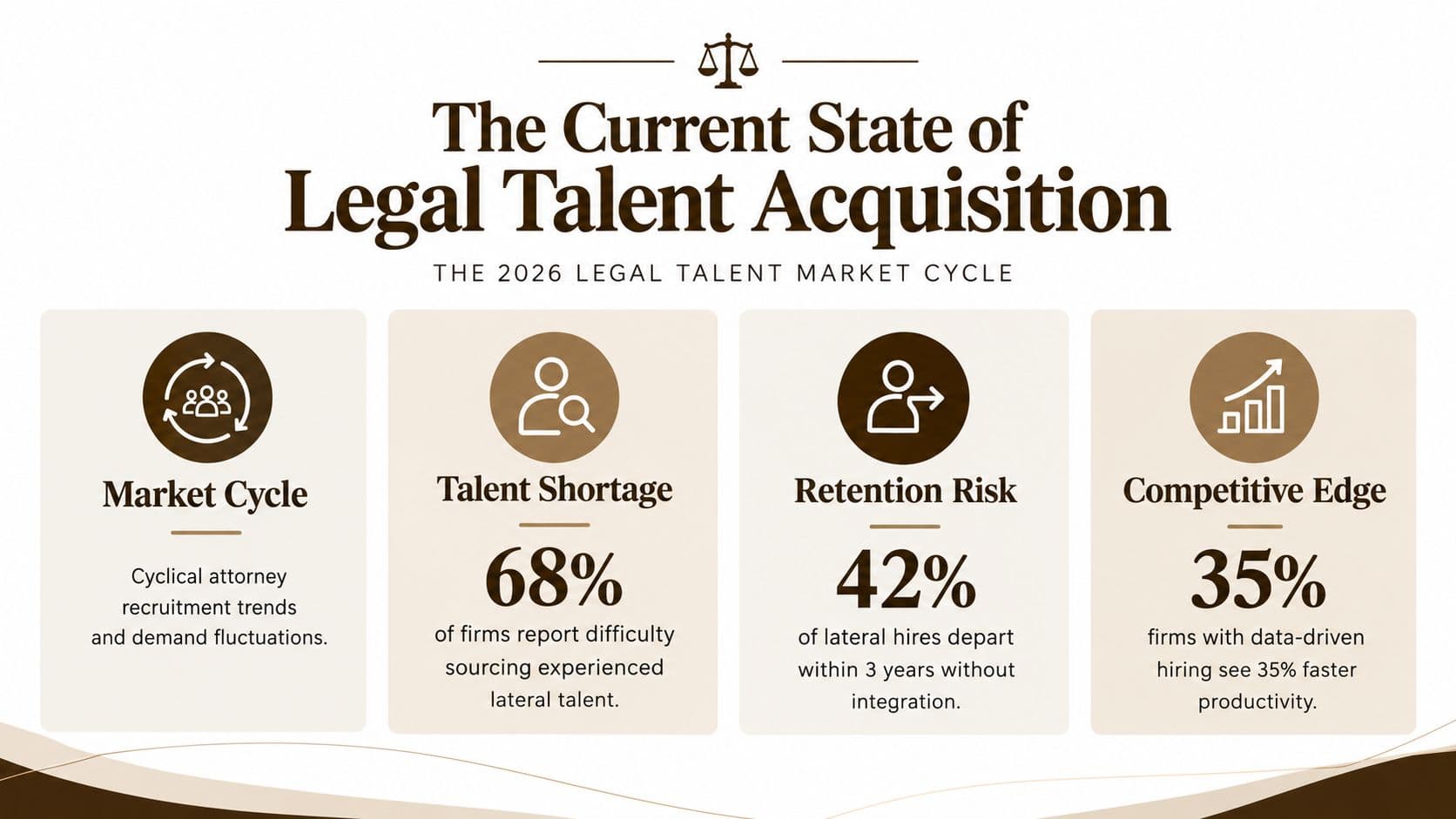
The market is cyclical, but hiring needs are specific
A downturn can tempt firms to freeze recruiting. That may reduce near-term expense, but it can also leave a practice short-staffed when demand returns, forcing the firm to compete for talent at higher cost. A rebound creates the opposite risk. Partners may approve searches quickly, before defining the revenue, coverage, or succession problem the hire must solve.
The right response is selective. Identify practice gaps that remain valuable across market conditions, then define the candidate profile, decision authority, and expected contribution before competitors begin bidding. This approach also limits a hidden cost of lateral hiring, partner time spent on interviews, references, compensation discussions, and integration for candidates who were never tied to a clear business need.
Practical rule: Treat a lateral search as a business investment with a defined purpose, not as a response to whoever happens to become available.
Firm size changes both the opportunity and the economics. NALP's 2025 survey found lateral-hiring growth of 44% at firms with 250 or fewer lawyers, compared with 20% at mid-size firms and 11% at the largest firms, as reported in FindLaw's discussion of lateral recruiting trends. Smaller firms may use a lateral to establish a practice, add a recognizable specialist, or protect a local client base. They may also offer faster decisions and broader responsibility. Larger firms can provide wider platforms and pursue geographic expansion or high-profile partners, but their approval and integration processes often take longer.
The partner market is concentrated. Recent Am Law 200 reporting identified 3,009 partner moves in 2025, a five-year high and roughly 10% year-over-year growth. Litigation represented about 26% of moves, while New York and Washington were among the busiest markets, according to the same FindLaw analysis. Firms in those markets should expect competing approaches and set a process that moves quickly without skipping conflicts, financial review, client portability analysis, or a concrete integration plan. Those omissions are common causes of expensive lateral turnover.
Designing a Targeted Lateral Search Strategy
Lateral hiring becomes expensive when the firm defines the person before defining the business need. Start with a written brief that states the problem to solve, the work the lawyer will handle, available support, and evidence required before an offer.
Separate the practice need from the candidate fantasy. “We want a strong corporate partner” gives a recruiter no usable market. A precise brief might identify a transactional capability, client segment, geographic priority, or succession concern. For an associate, specify the matters, supervision, technical skills, and advancement path. For a partner, distinguish portable relationships and current matters from referral sources or reputation that may not produce work at the receiving firm.
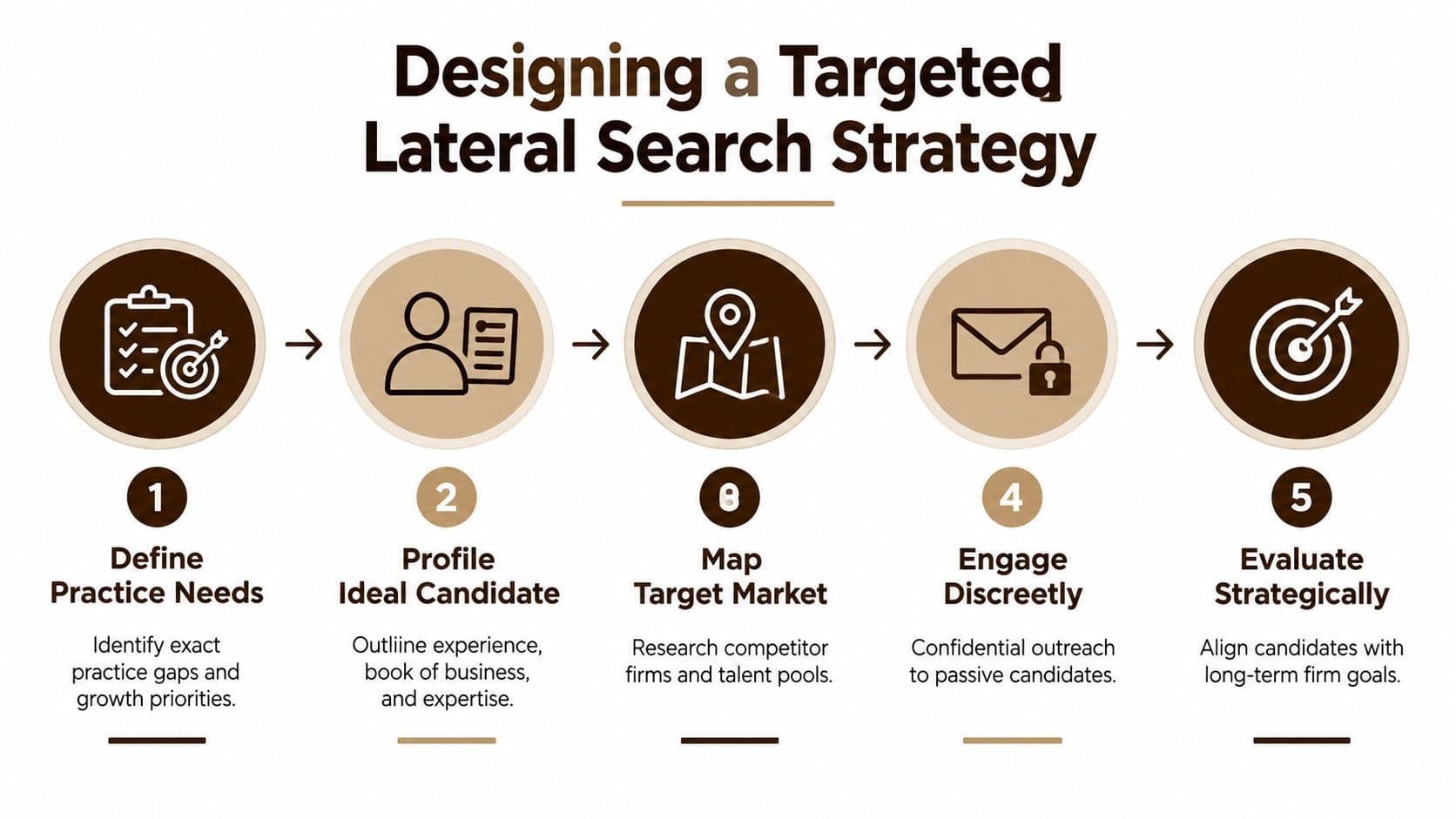
Define the candidate before you map the market
A useful profile covers more than years of experience:
- Practice evidence: Identify representative matters, actual responsibility, court or deal exposure, and client contact.
- Business-development reality: Separate personal relationships from firm-owned accounts. Distinguish introductions from work that can reasonably move.
- Operating fit: Set expectations for billing systems, staffing, collaboration, office requirements, and administrative responsibility.
- Motivation: Determine whether the lawyer seeks platform, autonomy, compensation, geography, leadership, or a different type of work.
Consider a mid-size firm hiring a partner described internally as “portable.” The brief should require a matter-by-matter review, identify which clients are personal contacts, and state what support the firm can provide. That exercise may reduce the apparent candidate pool, but it also prevents a costly hire based on assumed revenue.
NALP's data, cited earlier, shows that lateral hiring growth differs by firm size. The search brief should reflect those economics. A smaller firm may need immediate billable capacity and broad responsibility. A larger firm may prioritize platform fit, client conflicts, or integration into an established group. The same title does not describe the same business case.
Internal networks help, but they are narrow. Partners often know candidates from similar professional circles, while referrals may omit compensation expectations, portability limits, performance concerns, or reasons for leaving. Internal sourcing also consumes partner time when a group needs capacity quickly.
Specialized legal recruiters can reach passive candidates and conduct discreet outreach before a search becomes visible. The trade-off is operational: the firm must provide a precise brief and give fast feedback. A recruiter cannot repair an undefined role or an indecisive committee.
For firms comparing engagement models, a retained search explanation clarifies how exclusivity, research, and payment structure differ from contingency work. Whatever model the firm chooses, set a communication cadence, document feedback, and define how the team will handle conflicts, confidentiality, and competing offers.
Build a short approval path
Before outreach, assign responsibility for approving the role, screening candidates, conducting substantive interviews, and making the final recommendation. A search slows when partners ask unrelated questions or add requirements after the first candidate appears.
Set a response standard as well. Qualified lawyers assess the firm through the speed and precision of its process. Fast decisions do not require lower standards. They require resolving predictable questions before candidates enter the pipeline.
Screening for Competency and Culture Fit
A résumé can confirm credentials, but it can't prove that a lawyer can manage the work your firm needs. It may show a recognizable firm, a compelling title, or a detailed practice description while leaving unanswered who handled the matter, how the lawyer communicates with clients, and how the lawyer behaves when a team is under pressure.
The most reliable screening process compares claims with evidence. Ask candidates to describe a matter in which they personally made a material legal or strategic contribution. Follow up on judgment, delegation, client communication, outcome, and lessons learned. Vague answers aren't automatically disqualifying, but they should trigger deeper verification.
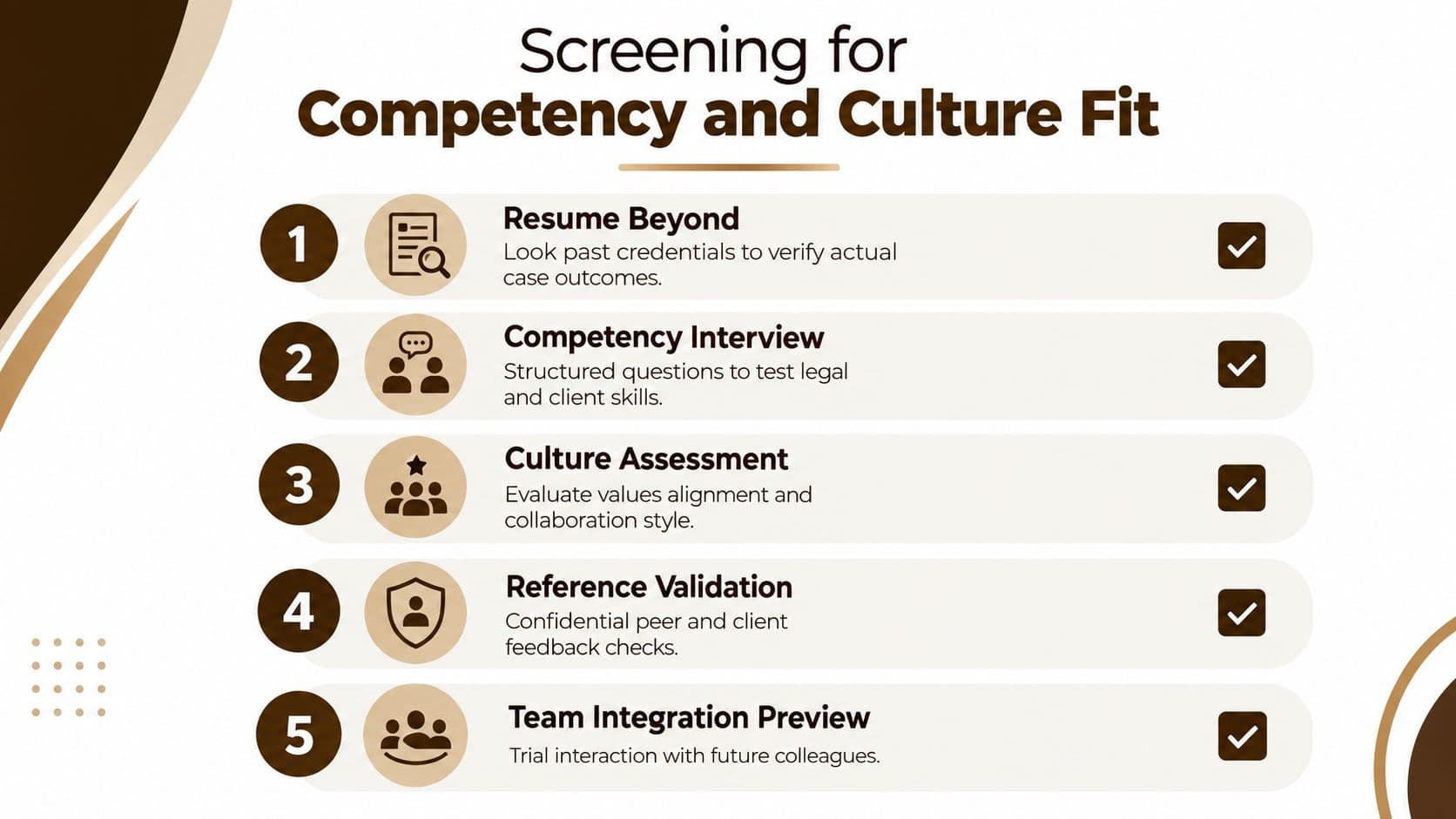
Use structured comparisons, not partner instinct
Unstructured interviews favor candidates who interview well with a particular partner. They also make it difficult to compare candidates fairly because each person receives a different evaluation. A structured interview gives every finalist a consistent set of questions tied to the role.
| Screening area | Weak evidence | Stronger evidence |
|---|---|---|
| Legal competency | General practice labels | Specific matters, responsibilities, and work product |
| Client management | Claims of strong relationships | Examples of advice, retention, escalation, and communication |
| Collaboration | “Team player” language | Concrete examples of staffing, delegation, and disagreement |
| Business development | Broad book-of-business claims | Relationship ownership, matter history, and realistic transfer conditions |
| Adaptability | Positive self-description | A detailed account of changing practice, systems, or priorities |
For partners, ask how the candidate develops work, shares credit, and collaborates with lawyers outside the immediate practice. A partner who depends on a personal support structure may struggle if the receiving firm staffs matters differently. An associate may have excellent technical training but need a clearer path to client exposure than the firm currently provides.
Culture fit shouldn't mean similarity of personality. It should mean compatibility with the firm's actual operating expectations. Compare how the candidate makes decisions, handles feedback, manages conflict, and communicates when a deadline is threatened. A highly autonomous lawyer may thrive in a lean office and struggle in a committee-driven environment. The reverse can also be true.
Validate the story before the offer
References should test specific claims rather than invite general praise. Ask former colleagues about work quality, reliability, responsiveness, client judgment, and the candidate's role on matters. For partner candidates, validate relationship depth carefully and distinguish a client who values the individual from one who is committed to moving work.
Internal interviewers may also need preparation. A structured employment screening process can help firms align interview questions, verification steps, and decision criteria. External interview coaching can be useful when a candidate needs to present complex experience clearly, but coaching shouldn't replace independent evaluation.
A candidate can be legally excellent and still be wrong for the platform, staffing model, or leadership expectations your firm actually operates.
Structuring Offers and Driving Integration
Lateral hiring fails most often after the signature, when the firm delivers less than the offer discussion implied. A partner may hear that staffing, client introductions, and leadership access are ready. After joining, the lawyer finds no staffing plan, no coordinated introductions, and no owner for the first matters. That gap creates avoidable turnover and can erase the expected value of the hire.

Compensation should match verified value and realistic portability. Review an associate's level, experience, work allocation, advancement path, and connection between pay and performance. For a partner, document guaranteed compensation separately from discretionary components, along with assumptions about originations, collections, staffing, and client movement. A smaller firm may offer greater responsibility and faster access to clients, while a larger platform may provide broader infrastructure but impose more approval steps. The offer should make those trade-offs explicit.
The firm also needs to specify what it will provide. A portable book requires conflicts review, engagement letters, pricing discussions, conflicts waivers, technology access, and coordinated client communications. Assigning owners for these tasks before the start date prevents the new lawyer from carrying the transition alone. Firms reviewing senior candidates can also use this guide to hiring a law firm partner to test leadership, business development, and platform fit before final approval.
A practical first 90 days
The first three months need named owners, written commitments, and scheduled checkpoints.
- Before arrival: Complete conflicts and systems preparation, identify relevant matters, confirm workspace and support, and arrange introductions to practice leaders and client teams.
- First month: Meet the practice group, finance team, recruiting contact, and administrative partners. Review staffing options and assign immediate work that matches demonstrated capabilities.
- Second month: Check workflow, client communication, billing and document-system access, and internal referrals. Correct bottlenecks before they become proof that the firm was unprepared.
- Third month: Review matter activity, relationship development, team collaboration, and unresolved expectations. Separate goals that remain realistic from those requiring added support.
An integration mentor should have enough seniority to remove obstacles, not merely offer informal encouragement. That person should meet the lateral consistently, report concerns to the hiring leader, and explain informal decision-making channels. Without that access, a new lawyer can misread slow approvals or limited staffing as a judgment about performance.
Use matter-management and financial systems to monitor work allocation, time entry, collections, and staffing. Dashboards cannot explain every relationship issue, but impressions alone are unreliable. A busy partner may be working on matters unrelated to the strategic reason for the hire, while an associate may be waiting for assignments that were promised during negotiations.
Negotiate the offer and integration plan together. If the firm expects a partner to build a practice, identify internal sponsors, collaborating client teams, early business-development support, and responsibility for follow-through. A law firm lateral hiring strategy that ends with a signed agreement has completed only the visible portion of the work.
Mitigating Risk and Managing Recruiter ROI
A vacant role carries an opportunity cost, but a poor lateral hire can create broader damage. The firm may lose partner time, disrupt client coverage, unsettle existing teams, and spend months correcting a decision that looked attractive during a rushed search.
Risk management begins with a clear hiring thesis. The committee should be able to answer what the hire adds, why the firm needs it now, what evidence supports the candidate's fit, and what conditions could prevent the expected value from appearing. If the answers depend on unverified portability or assumptions about culture, the firm should pause before negotiating.
External recruiting can reduce pressure on internal teams, especially when partners are responsible for sourcing, interviewing, client work, and final approval at the same time. The benefit isn't just more résumés. It's access to candidates who may not respond to public advertisements and a process that filters for practice readiness, motivation, and organizational compatibility.
Compare fee risk with vacancy risk
A contingency model can align recruiter compensation with a completed hire and avoid upfront search spending. That structure doesn't eliminate recruiting risk, and firms still need to review the guarantee period, replacement terms, candidate ownership, conflicts handling, confidentiality obligations, and payment timing.
A useful recruiter scorecard includes:
- Search clarity: Did the recruiter restate the role accurately and challenge unrealistic requirements?
- Candidate quality: Did introductions match the agreed practice, seniority, motivation, and location criteria?
- Process discipline: Did the recruiter provide timely updates and surface concerns rather than merely forwarding résumés?
- Outcome quality: Did the hire remain aligned with the role after joining, and did the recruiter support communication through placement?
- Total effort: How much partner and HR time did the search consume before and after outside support?
Five Star Placements is one contingency-based option for law firms seeking permanent placement across attorney, partner, legal support, and legal operations roles. Its stated model includes payment upon successful hire, customized screening for experience, skills, and culture fit, and confidential lateral recruiting support.
The correct model depends on the search. A firm with a deep internal network and a highly visible role may handle sourcing internally. A confidential partner search, a specialized practice build, or a multi-office hiring push may justify external support because the firm needs reach and speed without lowering evaluation standards.
Metrics to Shorten Time-to-Fill and Improve Retention
Hiring partners should measure the process from approved requisition through post-start integration. “Time-to-hire” alone hides the bottleneck. A firm may source quickly but lose candidates during committee review, or make offers promptly but fail to prepare the new lawyer's workflow.
Track each stage separately. Record the time from approval to first qualified slate, first interview to decision, decision to offer, and offer to acceptance. Review withdrawals by reason, including compensation, delay, role ambiguity, counteroffers, and concerns about platform or culture.
Quality measures should follow the hire. Review whether the lawyer received the promised work, whether matters were staffed appropriately, whether client relationships developed as expected, and whether the practice group considers the hire a productive addition. For associates, assess work quality, utilization, supervision, training, and collaboration. For partners, examine matter flow, collections, referral activity, team participation, and the feasibility of portability assumptions.
| Metric | Definition | Target Outcome |
|---|---|---|
| Qualified slate speed | Time from approved search to first candidates who meet the written brief | A consistently fast, relevant slate |
| Interview conversion | Share of screened candidates advanced to substantive interviews | Strong alignment between sourcing and requirements |
| Decision cycle time | Time between final interview and approved decision | Fewer losses caused by internal delay |
| Offer acceptance | Accepted offers compared with offers extended | Offers that reflect market expectations and role reality |
| First-quarter integration | Completion of systems, introductions, staffing, and mentor checkpoints | A prepared lateral with immediate operational support |
| Quality of hire | Performance against role-specific legal, client, and collaboration criteria | Evidence that the hire solved the original business need |
| Retention review | Continued fit, productivity, and engagement at defined checkpoints | Early intervention before dissatisfaction becomes departure |
Use a simple quarterly review with the managing partner, recruiting leader, finance representative, and practice-group chair. Compare searches by practice, office, seniority, and sourcing channel. The point isn't to create administrative work. It's to identify whether the firm loses candidates because it lacks reach, clarity, approval speed, competitive offers, or integration capacity.
Start with one open role. Write the business case, define the evidence required, assign decision owners, and schedule the first 90-day review before outreach begins. That discipline will shorten time-to-fill more reliably than adding another unstructured résumé review.
Five Star Placements provides contingency-based permanent placement for law firms, including confidential lateral attorney and partner searches, customized screening, and support across legal practice and operations roles. Visit Five Star Placements to discuss a targeted search built around your firm's hiring needs, approval process, and integration requirements.
Need help filling a legal role?
Five Star Placements partners with law firms and legal departments nationwide.
Schedule a Call