
Risk Based Pricing Model in Legal Recruiting
September 6, 2026 · 15 min read · Five Star Placements

Table of contents
A managing partner is staring at a six-figure placement invoice the day before a lateral attorney's start date. The position has been open for 119 days, clients are waiting, and the firm has already absorbed the lost billable capacity. The invoice creates a second question: should the firm pay a retained search firm 30% upfront for a candidate who may or may not work out, or should the recruiter share more of the delivery risk?
That tension explains why a risk based pricing model has become useful in legal recruiting. In consumer lending, a lender prices credit according to the borrower's expected risk rather than charging every borrower the same rate. The Federal Deposit Insurance Corporation followed a similar path in banking, moving from a flat assessment approach to risk-based assessments after banking crises and later broadening the assessment base to create a more granular framework. The FDIC's history of risk-based assessments shows the underlying logic clearly: the party assuming greater risk should account for that exposure in the price.
Legal recruiting applies the idea differently. The recruiter carries more of the search cost, and the law firm or legal department pays only when a placement succeeds. The sections below explain how the fee works, where the model strains, what guarantee language matters, and how to compare contingency proposals without reducing the decision to the lowest percentage.
Table of Contents
- The Hiring Moment Every Managing Partner Faces
- What a Risk Based Pricing Model Means in Legal Recruiting
- How Payment-on-Success Contingency Actually Works
- Benefits and Drawbacks for Law Firms and Legal Departments
- Example Pricing Scenarios Across Practice Areas
- Implementation Considerations Before You Sign
- Client-Facing Messaging That Earns Trust
- Why Risk-Based Pricing Reshapes Legal Hiring
The Hiring Moment Every Managing Partner Faces
The invoice feels expensive because it arrives at the end of a long operational problem. A vacancy has affected matter staffing, client responsiveness, associate supervision, and partner workload. Yet the fee is still paid before the firm knows whether the new attorney will integrate, perform, and remain in the role.
Retained search changes that cash-flow pattern. The client usually pays in stages tied to the engagement, research, or candidate presentation process. The recruiting firm receives compensation for its work even if the search ends without a hire. That structure can make sense for confidential partner searches, highly specialized mandates, or assignments requiring extensive market mapping, but it places more financial exposure on the buyer.
A contingency search reverses the immediate incentive. The recruiter invests in sourcing and evaluation before receiving the placement fee. The client generally pays only after a candidate accepts and starts, subject to the language in the agreement. The recruiter's return depends on reaching a successful placement, not opening a file or delivering resumes.
The risk transfer in practical terms
Three parties feel the change:
- The law firm or legal department preserves cash until a hire begins, but it must evaluate whether the fee percentage and guarantee terms justify the external expense.
- The recruiter funds outreach, screening, coordination, and candidate management before payment, while also carrying the possibility of a replacement obligation.
- The candidate enters a process where confidentiality, role accuracy, compensation expectations, and cultural fit directly affect whether the placement survives.
That arrangement resembles regulated risk-based pricing in consumer credit, but it isn't identical. In lending, a risk-based price can trigger disclosure duties when a consumer receives materially less favorable terms based on a consumer report. The Consumer Financial Protection Bureau's regulation on risk-based pricing notices illustrates an important operational principle for recruiting too: pricing and decision logic need clear, reproducible terms.
Practical rule: Don't ask only what the fee is. Ask which party pays when the placement fails early, and how the agreement defines that failure.
This guide treats contingency recruiting as a commercial allocation of risk, not a promise that every search will be quick or every candidate will stay. The useful comparison is between fee timing, sourcing responsibility, replacement protection, confidentiality, and the recruiter's actual reach into the relevant legal market.
What a Risk Based Pricing Model Means in Legal Recruiting
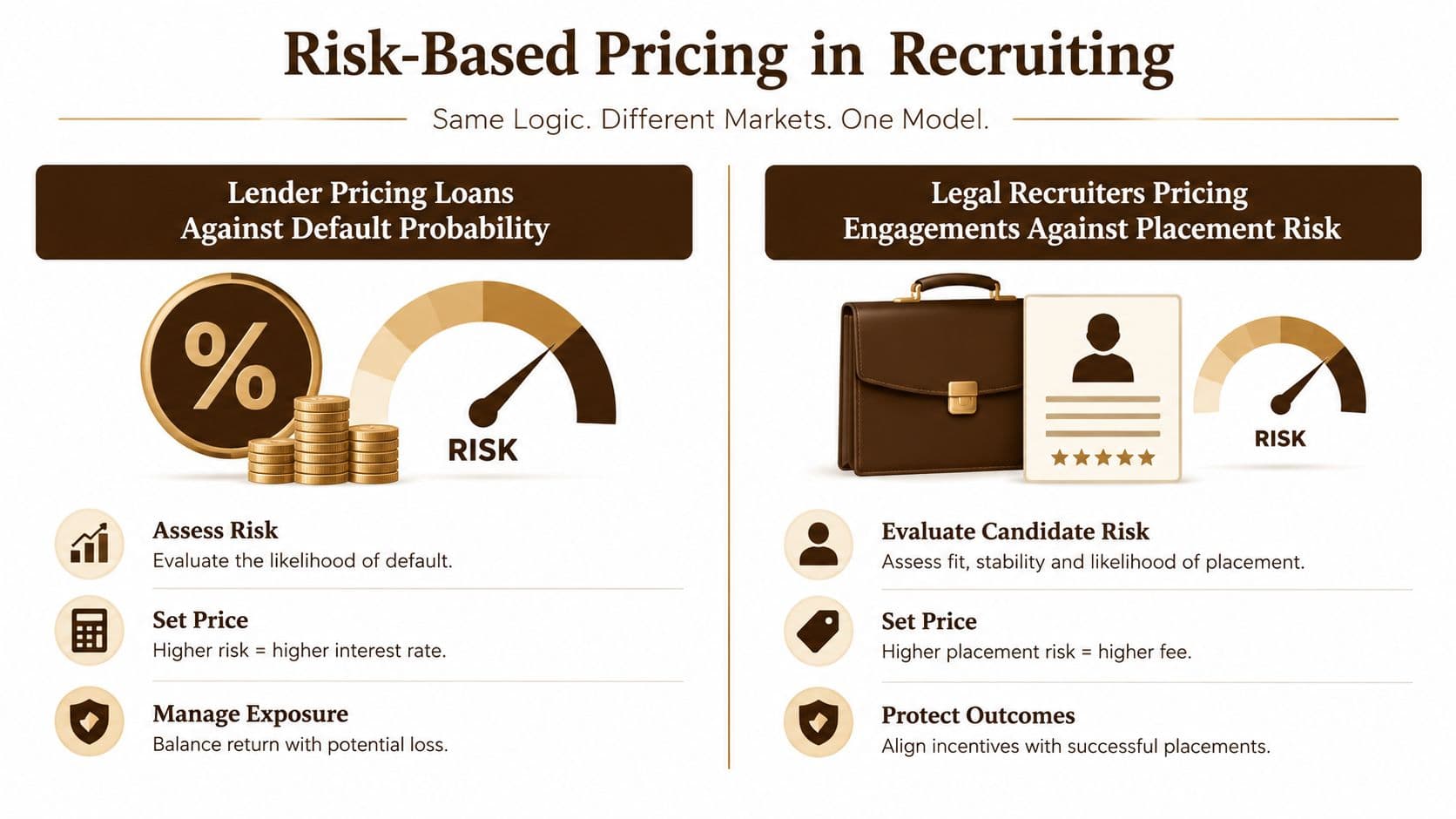
A risk based pricing model in legal recruiting links the recruiter's compensation to the probability and economics of a successful placement. A lender may price a loan according to expected default risk, funding cost, and required return. A legal recruiter prices an engagement according to the difficulty of finding, persuading, vetting, and retaining the right attorney, partner, legal-operations leader, or in-house counsel.
The core mechanic is straightforward. Under a contingency agreement, the client pays a percentage of the candidate's compensation after the candidate accepts the offer and starts. In legal recruiting, fees are commonly negotiated within a range of 18% to 30% of first-year compensation, but the exact fee, fee base, payment date, and guarantee belong in the written agreement rather than in a marketing summary.
Three models buyers should distinguish
Retained search normally involves an upfront or staged fee. The recruiter commits resources regardless of the eventual outcome, and the client pays for the search process as it advances.
Contingency search makes payment conditional on hiring. The recruiter absorbs more of the initial cost and earns the fee only when the placement occurs. A typical arrangement also includes a replacement or refund provision if the candidate leaves during a stated guarantee period.
Hybrid search combines features of both. A client might pay an initial project fee for a confidential market map, then pay a success fee if an introduced candidate joins. Another agreement may use a smaller engagement fee with a reduced contingency percentage.
The contingency recruiting model explained by Five Star Placements is useful as a plain-language reference, but buyers still need to negotiate the details for their own search.
The analogy to consumer credit has limits. A lender can model probability of default, while a recruiter must judge candidate motivation, practice fit, compensation alignment, conflicts, timing, and the client's interview process. A risk based fee therefore shouldn't be treated as a scientific score that predicts the outcome precisely. It's a contract design that decides who carries the downside before the outcome is known.
How Payment-on-Success Contingency Actually Works
The process begins with an intake call, but the commercial risk begins when the recruiter agrees to work without an upfront search fee. The parties should document the role, compensation assumptions, interview authority, candidate ownership rules, fee percentage, payment trigger, guarantee, and replacement remedy before sourcing starts.
The lifecycle usually follows this sequence:
- Intake and agreement. The recruiter clarifies the practice area, seniority, reporting line, location, work arrangement, compensation, conflicts, and decision-makers. The client confirms the fee base and when payment becomes due.
- Sourcing and vetting. The recruiter searches its network and market, approaches potential candidates, checks motivation, and tests the candidate's experience against the role rather than forwarding every plausible resume.
- Interview management. The client evaluates selected candidates. The recruiter coordinates feedback, resolves misunderstandings, and keeps compensation and timing aligned.
- Offer negotiation. The recruiter helps both sides identify issues involving title, base compensation, bonus, equity, partnership track, workload, or start date.
- Start date. The success fee becomes payable according to the agreement, usually after the candidate begins employment rather than when the offer is merely accepted.
- Guarantee period. If the candidate leaves under the covered circumstances, the recruiter may owe a replacement search, a refund, or a prorated credit.
Where the economics sit
During a typical four-to-six week search, the recruiter may pay for staff time, outreach, screening, scheduling, reference work, and candidate communications without receiving client cash. The client's direct recruiting outflow can remain at zero until the start date, while the recruiter's cost continues throughout the search.
The guarantee creates another layer of exposure. If the hire leaves during a 60-to-90 day guarantee period, the recruiter may need to repeat the search without a new fee. That obligation can be valuable to the client, but only if the agreement defines replacement scope, candidate quality, timing, and whether the remedy is exclusive.
For a practical discussion of how disclosure and fee expectations should be communicated, review risk-based pricing disclosure in recruiting.
The process works when both sides perform their part. The recruiter needs access to decision-makers and timely feedback. The client needs a credible job description, realistic compensation, and an interview process that doesn't lose qualified candidates through avoidable delay.
Watch this contingency recruiting lifecycle overview for a visual explanation of the stages from intake through payment.
Benefits and Drawbacks for Law Firms and Legal Departments
The strongest benefit is timing. A law firm or corporate legal department doesn't fund the search before seeing whether the candidate starts. That matters when a vacancy is already creating pressure on partners, managers, or internal recruiting staff.
The second benefit is incentive alignment. The recruiter earns nothing if the process stops before a hire, so the recruiter has a direct reason to source viable candidates, manage objections, and keep the process moving. The guarantee can extend that alignment beyond the start date, although its value depends on the remedy written into the contract.
The buyer's side of the trade
| Buyer benefit | Buyer drawback |
|---|---|
| No upfront search spend: Cash remains available until a placement occurs. | Higher headline fee: A contingency percentage may exceed the apparent percentage in a retained or project-based arrangement. |
| External sourcing capacity: Internal HR can focus on broader pipeline work while the recruiter handles targeted outreach. | Replacement conditions: A departure may trigger a replacement process with limits, exclusions, or deadlines. |
| Outcome-linked payment: The fee is connected to a candidate who starts. | Stakeholder friction: Partners or finance leaders may resist paying a percentage of compensation to an outside firm. |
| Access to passive talent: A specialist recruiter may reach attorneys who aren't responding to public postings. | Process dependence: Slow feedback or unclear authority can weaken the contingency search. |
Corporate legal departments face an additional approval challenge. Finance may compare a recruiting fee with internal hiring costs, while the general counsel may care more about reducing vacancy risk and protecting confidential information. Neither view is sufficient on its own. The decision should compare the fee against the cost of delay, the scarcity of the profile, and the consequences of a poor fit.
The recruiter's side
The recruiter's advantage is the possibility of earning a meaningful fee from a successful placement. The burden is that failed searches consume capacity without payment, and early departures can create unpaid replacement work. A recruiter that accepts every assignment at a low percentage may lack the resources to support difficult searches properly.
Conflicts also require attention. A recruiter may represent candidates in a narrow practice area or work with multiple firms seeking similar talent. The agreement should address candidate confidentiality, conflicts, off-limits relationships, and whether the recruiter can present the same person to another client.
A lower percentage isn't automatically cheaper if the recruiter can't reach the candidates the role requires.
Example Pricing Scenarios Across Practice Areas
Worked examples make the fee mechanics easier to evaluate. The following scenarios use the fee assumptions supplied for comparison, not as universal market rules. Each agreement should state whether the percentage applies to base salary alone or to a broader compensation definition.
| Placement | Base Salary | Fee % | Total Fee | Guarantee |
|---|---|---|---|---|
| Mid-level litigation associate | $185,000 | 22% | Approximately $40,700 | 90 days |
| Senior in-house counsel | $275,000 | 25% | Approximately $68,750 | Six months, tied to equity vesting |
| Legal operations leader | $210,000 | 28% | Approximately $58,800 | 120-day replacement window, with reduced fee terms if the candidate exits within year one |
A mid-level litigation associate in a secondary market illustrates a relatively conventional contingency engagement. The compensation is substantial, but the candidate pool may be broader than for a specialized executive or legal-operations role. A 22% fee on $185,000 produces approximately $40,700, with the 90-day guarantee providing a defined early-retention safeguard.
The in-house counsel scenario carries different risk. A senior lawyer joining a publicly traded company may evaluate title, reporting structure, equity, public-company experience, and long-term advancement alongside base salary. The 25% fee on $275,000 produces approximately $68,750, while a six-month guarantee tied to equity vesting recognizes that the compensation package may not be fully understood through base salary alone.
The legal-operations placement shows how scarcity can affect the negotiated percentage and remedy. A leader responsible for systems, finance, recruiting, or firm administration can influence the performance of an entire legal organization. A 28% fee on $210,000 produces approximately $58,800, with a 120-day replacement window and reduced-fee treatment if the candidate exits within the first year.
What changes from one scenario to the next
- Practice scarcity: Hard-to-reach candidates may justify a higher fee if the recruiter is committing more sourcing effort and specialized access.
- Seniority: Senior hires often require more stakeholder management, confidentiality, and compensation negotiation.
- Compensation mix: Equity, bonuses, signing payments, and partnership economics can materially change the fee base.
- Guarantee design: Longer coverage can protect the buyer, but the contract should define exclusions and the exact replacement remedy.
For a broader explanation of how placement percentages and fee bases are commonly structured, see legal recruiting fees explained.
Implementation Considerations Before You Sign
A contingency agreement deserves the same care as any other commercial contract. The headline percentage tells you only part of the cost. The fee base, payment trigger, guarantee remedy, candidate ownership rules, and termination language may matter more than a small difference in the quoted rate.
Start with the fee base
Ask whether the percentage applies to base salary only, guaranteed compensation, signing payments, annual bonuses, commissions, equity, or total first-year compensation. A percentage applied to total compensation can produce a very different invoice from the same percentage applied only to salary.
Then confirm timing. Payment should be tied to the candidate's actual start date if that is the agreed commercial trigger, not to offer acceptance. Also ask whether the recruiter may invoice if the candidate starts and leaves before the first payroll cycle.
Use a written pressure test
- Guarantee definition: Identify the coverage period, good-standing requirements, exclusions, notice deadlines, and whether the remedy is replacement, refund, credit, or a combination.
- Candidate ownership: Clarify how long the recruiter can claim a fee for a candidate introduced during the engagement and what happens after termination.
- Exclusivity: Determine whether the recruiter has exclusive rights to the role, whether the client can use other firms, and how duplicate submissions are handled.
- Confidentiality: Address partner-level searches, sensitive company information, candidate consent, and internal distribution of resumes.
- Expenses: Confirm whether outreach, travel, assessments, background checks, or other costs are included or separately capped.
- Track record: Evaluate experience in the specific practice area, market, seniority level, and role type, not just total placement volume.
A risk based pricing model only works when the recruiter can reach plausible candidates. If the firm lacks a relevant pipeline, payment-on-success may reduce upfront cost but won't solve the underlying access problem.
Client-Facing Messaging That Earns Trust
The lowest contingency percentage rarely makes the strongest proposal. Buyers want to know what happens when a candidate declines, the interview process stalls, confidential information spreads, or a new hire leaves before becoming productive.
A credible recruiting proposal should state the commercial terms plainly. It should identify the fee base, the payment trigger, the guarantee length, the replacement remedy, and the boundaries around candidate ownership. Vague language such as “we stand behind our placements” doesn't tell a managing partner what protection exists when the hire exits.
What a useful proposal says
A recruiter can write:
Fee: The agreed percentage applies to the compensation base defined in the search agreement, and the invoice becomes due when the candidate starts.
That sentence should be followed by the actual guarantee period and remedy. If coverage lasts 90 days, say 90 days. If the recruiter offers a replacement rather than a refund, state that directly. If the remedy is prorated, explain the calculation and the conditions.
The proposal should also address confidentiality. A partner candidate may not want the current firm to learn about a move, and an in-house lawyer may be handling sensitive matters. The client needs to understand who can see candidate information, how the recruiter handles consent, and what happens to sourced-candidate data after the engagement ends.
Pair price with retained risk
Every fee quote should answer one practical question: What financial risk does the recruiting firm absorb if the placement fails early? That answer may include unpaid sourcing work, a replacement search, a credit, or a refund, depending on the contract.
A comparable placement by practice area is more useful than a general statement about experience. A firm seeking a construction litigator should hear about relevant construction litigation recruiting work, while a corporate legal department hiring a compliance leader should evaluate experience with comparable compliance mandates.
Trust grows when the recruiter explains both sides of the deal. A contingency structure isn't risk-free recruiting. It changes who funds the search first and how the parties respond when the hire doesn't last.
Why Risk-Based Pricing Reshapes Legal Hiring
A risk based pricing model is best understood as a risk-allocation instrument, not merely a fee schedule. In lending, the price reflects the expected risk and cost of deploying capital. In legal recruiting, the fee and guarantee distribute the cost of finding, closing, and retaining talent between the recruiter and the hiring organization.
That allocation changes behavior. The client has less upfront cash exposure, but it must provide timely feedback, realistic compensation, and access to decision-makers. The recruiter has a chance to earn a success fee, but it funds the search before payment and may face replacement liability. Both parties benefit when the process rewards a durable fit rather than a fast offer that breaks down after the start date.
The lending analogy also highlights a limitation. A price signal can fail when other product features obscure the underlying risk. Research on U.S. credit card markets found that annual percentage rates per unit of risk could decrease for some higher-risk consumers, particularly subprime borrowers, and concluded that rewards, issuer brand, and network affiliation could blur the pricing signal. The study of risk-based pricing in U.S. credit card markets is a useful warning for recruiting: a fee percentage alone doesn't prove that the recruiter has separated easy searches from difficult ones effectively.
The criteria that should replace headline-fee shopping
Evaluate search partners on:
- Relevant candidate access: Can the recruiter reach attorneys or legal professionals who fit the practice, seniority, location, and compensation requirements?
- Guarantee strength: Is the protection clear, usable, and connected to a meaningful replacement or refund remedy?
- Replacement velocity: Can the recruiter restart the search quickly if the placement fails?
- Confidentiality controls: Does the process protect sensitive candidate and client information?
- Process discipline: Will the recruiter manage feedback, negotiation, and expectations rather than just forward resumes?
Before signing, request a side-by-side contingency proposal, confirm the guarantee period in writing, and ask the recruiter to name two recent placements still retained after one year. That exercise tests whether the conversation is about durable hiring outcomes or only about reducing the initial invoice.
Five Star Placements offers contingency-based permanent placement for attorneys, partners, in-house counsel, legal support professionals, and legal operations leaders, with payment tied to a successful hire and no upfront cost on standard engagements. Visit Five Star Placements to request a proposal that spells out the fee base, guarantee, replacement terms, and search scope.
Need help filling a legal role?
Five Star Placements partners with law firms and legal departments nationwide.
Schedule a Call