
What Is Contingency Recruiting: A Law Firm Guide
August 19, 2026 · 14 min read · Five Star Placements

Table of contents
Contingency recruiting is a pay-on-success permanent placement model where the recruiter is paid only when a candidate is hired, with typical legal-industry fees of 15% to 25% of first-year base salary. There's no upfront fee, but the recruiter carries the cost when the search fails.
You've got an open associate seat, matters are piling up, and the partners want someone practice-ready without approving a large search commitment. Three recruiters offer to “take a shot” at the role. All three promise speed. Within days, the same candidate may appear in multiple inboxes, while each recruiter decides how much time the vacancy deserves.
That's the core issue with contingency recruiting. The model protects the firm's cash flow, but it can create duplicated outreach, fragmented communication, and shallow candidate screening. It works well when the candidate market is accessible and the role is clearly defined. It performs poorly when the search depends on confidentiality, deep practice-area knowledge, or careful persuasion of a senior lateral.
This guide focuses on law firm and legal department hiring, including associates, counsel, partners, legal support professionals, and legal operations leaders. It covers the process, fee mechanics, competing search models, operational safeguards, and the situations where contingency is the wrong tool. It won't cover recruiter career advice, non-legal industries, or interim executive search.
Table of Contents
- What Contingency Recruiting Actually Means
- How a Contingency Search Moves From Job Order to Start Date
- The Fee Structure and Who Really Pays for Failure
- Contingency vs Retained vs Hybrid Search Models
- When Contingency Recruiting Is the Wrong Tool for Legal Hiring
- Running a Contingency Search Without Getting Burned
- Two Real Legal Hiring Scenarios Side by Side
- FAQs and a Direct Recommendation for Hiring Partners
What Contingency Recruiting Actually Means
Contingency recruiting is a permanent placement arrangement in which a recruiter or agency earns a fee only after its candidate is hired, usually subject to a replacement guarantee. The firm doesn't pay for sourcing activity, interviews, or an unsuccessful search. Payment follows the result.
For legal hiring, the commonly reported contingency fee range is 15% to 25% of the new hire's first-year base salary, with 20% often used as a working midpoint in permanent-placement searches, as summarized by recruitment agency commission guidance. A $100,000 hire therefore produces a fee of roughly $15,000 to $25,000, depending on the agency and the role. The firm pays only after the candidate starts, while the recruiter funds the sourcing and screening effort beforehand.
The practical distinction from retained search
Contingency searches are generally non-exclusive. A law firm can ask several recruiters to work the same vacancy, and each recruiter competes to submit a candidate who gets hired. There's typically no retainer at launch, and the agency absorbs the financial risk of failed searches.
Retained search works differently. The recruiter receives an upfront commitment and usually receives exclusive responsibility for the assignment. That structure gives the recruiter a stronger reason to map the market, manage discreet outreach, and stay involved when the first obvious candidates aren't available.
Industry summaries describe contingency recruiting as a mainstream, no-hire-no-fee method used most often for mid-level and specialist roles with an accessible candidate pool. Higher-end executive work more often shifts to retained search, as outlined in this overview of contingency recruiting.
For a managing partner, the decision is simple at first: contingency gives you external coverage without spending capital before a placement. The harder question is whether several recruiters competing for the same legal vacancy will produce better results than one recruiter given the mandate, access, and time to conduct a disciplined search.
How a Contingency Search Moves From Job Order to Start Date
A contingency search moves quickly when the firm gives the recruiter a precise brief and responds decisively. Consider a firm hiring a litigation associate for an insurance coverage practice.
The six operating phases
-
Intake and job order. The recruiter starts with a partner or hiring manager, not just a copied job description. The conversation should establish practice-area depth, years of experience, billable expectations, compensation, location flexibility, portable client relationships, and timing. If the role requires immediate deposition experience or specific insurer-side work, that belongs in the brief.
-
Sourcing and outreach. The recruiter searches an existing network, maps relevant litigation groups, conducts direct outreach, and may post the role selectively. In a contingency model, the recruiter has an incentive to identify viable candidates quickly because every hour spent on an uncertain vacancy competes with work on other open searches.
-
Candidate vetting. A serious legal recruiter screens more than credentials. The recruiter checks the candidate's actual matters, portability of work, reason for moving, compensation expectations, conflicts considerations, geographic constraints, and willingness to interview. A résumé that lists insurance coverage isn't enough if the attorney has never handled the work the partner needs.
-
Submission and interview coordination. The recruiter submits the candidate with context, then coordinates interviews, feedback, and follow-up. Because several recruiters may be working the same role, speed matters, but a fast submission is useful only if the candidate fits the firm's standards.
-
Offer and start date. Once the firm selects a candidate, the recruiter helps manage compensation discussions, resignation timing, references, and onboarding logistics. The fee is generally invoiced when the candidate starts, rather than when the candidate merely accepts an offer.
-
Guarantee period. The agreement should state what happens if the hire leaves shortly after joining. A replacement guarantee is commonly used, and the parties need to define whether the remedy is a replacement search, a credit, or another contractual solution.
Realistic timing
Associate and counsel searches can often move in four to eight weeks, while partner-track and lateral partner searches usually take longer because the parties must address clients, conflicts, compensation, and business-generation expectations. Those timelines are practical planning ranges for legal searches, not guarantees.
Practical rule: A contingency recruiter can move fast, but the firm must supply fast feedback. Delayed decisions turn a supposedly urgent vacancy into a low-priority assignment.
The Fee Structure and Who Really Pays for Failure
The economic appeal is immediate. If a firm hires an attorney at a $250,000 first-year base salary and agrees to a 20% contingency fee, the placement fee is $50,000, payable after the candidate starts. Those figures follow the fee structure described in the verified recruiting benchmark, where contingency fees commonly sit between 15% and 25% and 20% serves as a midpoint, as explained in this legal recruiting fee guide.
The firm's cash exposure before the start date is effectively limited to its own interview and decision-making time. If the recruiter spends weeks sourcing, screens numerous attorneys, and produces no hire, the firm owes no placement fee. That's valuable when the vacancy is uncertain or the hiring budget is under pressure.
The recruiter carries the failed-search cost
The recruiter, however, pays for the failed search. That cost includes sourcing time, outreach, screening calls, candidate relationship management, interview coordination, and the opportunity cost of not working on another assignment. If another firm hires the candidate first, the recruiter may receive nothing despite doing substantial work.
That risk allocation explains the model's behavior. A recruiter working on contingency may prioritize roles with a visible candidate pool and a credible chance of closing. The agency has to balance depth against the possibility that the firm, another recruiter, or an internal referral will win the placement.
The tradeoff becomes more serious for confidential partner moves. A failed retained engagement still costs the firm money, but it also buys dedicated effort and controlled outreach. Contingency avoids that upfront cost, yet multiple agencies may approach the same partner, increasing the chance of a confidentiality breach or a damaged candidate relationship.
Hybrid arrangements
A hybrid structure can combine a smaller upfront commitment with a reduced success fee. It may suit a firm that wants the recruiter to prioritize a difficult role without paying the full cost of a retained search. Contract-to-hire arrangements can also include a conversion fee, so the firm should define the trigger, timing, and calculation before any candidate begins work.
The right question isn't whether contingency is cheap. It's whether the firm is transferring enough search risk to the recruiter while preserving the quality and discretion the vacancy demands.
Contingency vs Retained vs Hybrid Search Models
Managing partners usually weigh three models, and each one makes a different promise about attention, cash flow, and control.
| Search model | Fee timing | Exclusivity | Recruiter effort | Best legal fit |
|---|---|---|---|---|
| Contingency | Payment only after a hire starts | Usually non-exclusive | Fast sourcing and competitive submissions | Clearly defined associate and counsel roles |
| Retained | Upfront installments regardless of outcome | Typically exclusive | Dedicated market mapping and candidate development | Senior partners, practice leaders, confidential replacements |
| Hybrid | Smaller upfront commitment plus success fee | Can be negotiated | Prioritized search with shared financial risk | Difficult roles that need focus without a full retainer |
Contingency wins on speed and optionality
Use contingency when the firm needs a qualified attorney quickly, the role has clear requirements, and the candidate pool is broad enough that several sourcing channels can find relevant people. The firm preserves cash and can obtain coverage from more than one recruiter.
That flexibility has a cost. Recruiters may submit similar candidates, compete to be first, and spend less time developing a candidate who needs education about the firm. Industry commentary reports that contingency recruiters may manage 15 to 20 open positions simultaneously, while an average mid-market vacancy may be worked by 4.2 agencies at the same time, creating competition and duplicated submissions, according to industry analysis of contingency recruiting.
Retained wins on discretion and depth
Retained search is the better choice when the firm needs discreet access to sitting partners, a mapped candidate market, or a recruiter who can manage a complicated political and compensation process. The upfront commitment pays for dedicated attention, not merely a résumé.
Industry comparisons commonly place retained search fees in a higher band than contingency work, with payment divided into installments. The firm pays whether or not a placement occurs, so retained search is a poor fit for an ordinary, well-defined mid-level vacancy. It's the right fit when a failed or exposed search would cost more than the retainer.
For a practical decision framework, see when a law firm should use a recruiter. My recommendation is blunt: choose contingency for liquid talent pools and short deadlines, retained for confidentiality and scarcity, and hybrid when the role needs priority without full retained economics.
When Contingency Recruiting Is the Wrong Tool for Legal Hiring
Contingency recruiting is structurally weak when the firm needs controlled access rather than broad coverage. A senior partner search illustrates the problem. The recruiter must approach a sitting partner without exposing the client, the firm's strategy, or the reason the vacancy exists. If several agencies race to contact the same person, discretion becomes harder to manage.
Senior and confidential searches
A practice chair, equity partner, or lateral group leader needs more than an introduction. The recruiter must understand the candidate's clients, conflicts, compensation history, internal relationships, and reasons for considering a move. Contingency economics can encourage quick outreach before that context is developed.
A replacement search after a sensitive departure carries the same risk. Broad sourcing may alert competitors, unsettle existing attorneys, or signal weakness to clients. The fee savings from avoiding a retainer won't repair a confidentiality problem.
Narrow practice-area roles
Some legal vacancies require genuine submarket knowledge. Patent prosecution may depend on a specific technical background. Fund formation may require experience with a particular client base. FDA regulatory work may demand a precise mix of agency, product, and commercial exposure.
A recruiter can't reliably evaluate those distinctions from a résumé alone. If the agency doesn't understand the practice, it may produce candidates who look adjacent but fail under partner review. The firm then spends interview time rejecting profiles that should never have been submitted.
Lateral teams and coordinated moves
A lateral group move involving three or more attorneys requires coordinated negotiation, references, conflicts analysis, client portability review, and culture diligence. Parallel recruiters can fragment the process. One recruiter may speak with the partner, another with an associate, and neither may have authority to manage the group's shared expectations.
The failure modes are predictable: candidate leaks, competing recruiters undercutting compensation, inconsistent messaging, and offers that collapse because the group's requirements were never aligned. Retained or hybrid search costs more upfront, but it gives one recruiter responsibility for the full transaction.
Running a Contingency Search Without Getting Burned
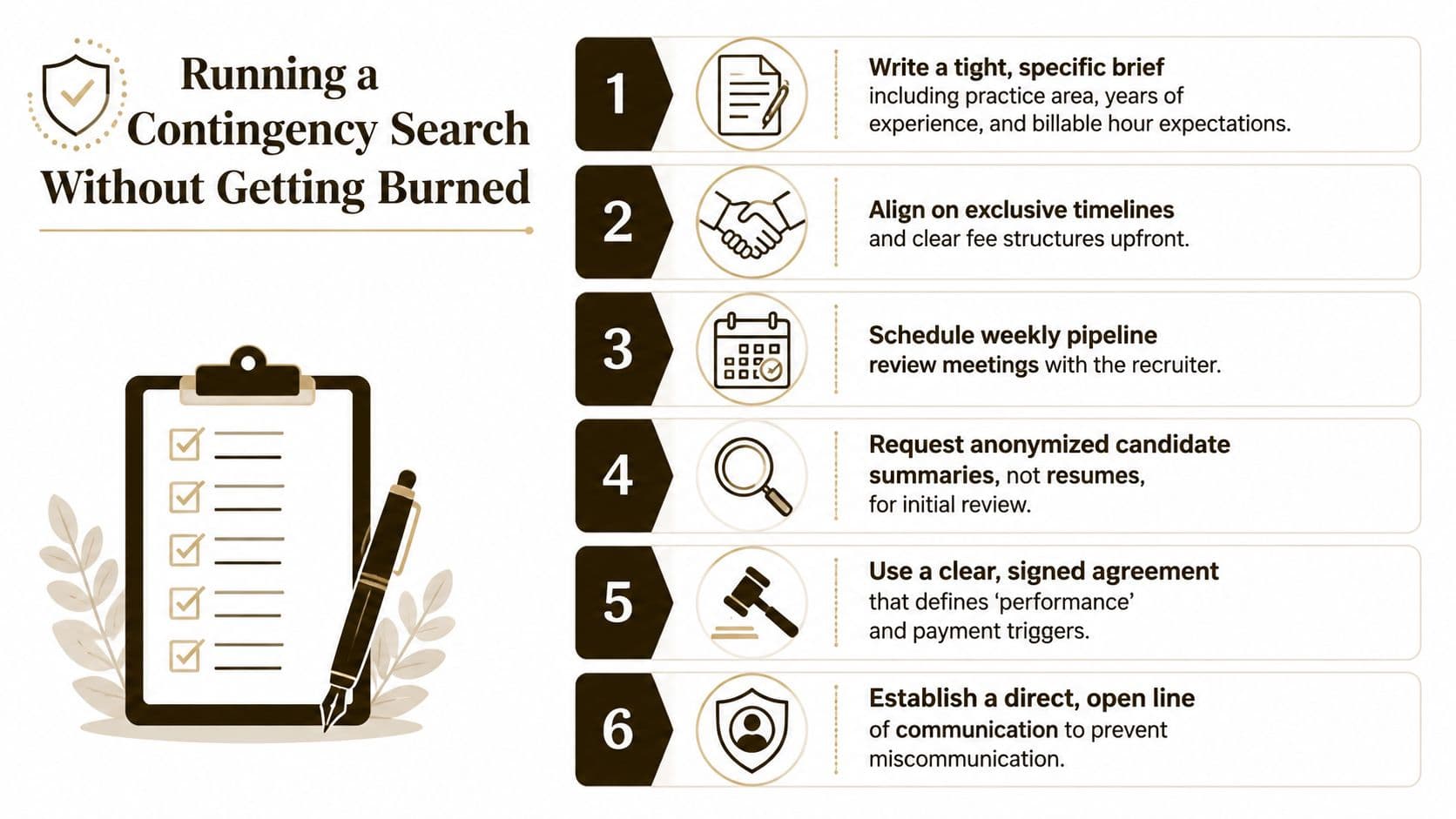
The firm controls much of the outcome through search governance. Start with a written brief that identifies the practice area, experience level, billable expectations, compensation range, location flexibility, interview process, and disqualifiers. “Strong litigation background” isn't a brief. “Fourth-year insurance coverage associate with insurer-side matters and immediate deposition experience” is closer.
Operational controls that matter
- Limit recruiter coverage: Give the same brief to no more than three to four recruiters. More coverage usually creates more duplicate outreach, not better judgment.
- Define ownership: Decide how candidate ownership works before submissions begin. The agreement should address duplicate candidates, prior contacts, and the period during which a recruiter can claim a fee.
- Demand named pipeline reporting: Require weekly updates listing sourced candidates by name and firm, where confidentiality permits. Reject vague reports that describe activity without showing market progress.
- Control initial contact: For sensitive roles, require recruiter approval of outreach language. Use a blind role description or route the first contact through the firm when appropriate.
- Confirm the guarantee: Put the replacement period and remedy in writing. A commonly used legal recruiting guarantee is 90 days, but the agreement controls the actual protection.
- Pay at the right trigger: Tie the invoice to the candidate's start date, not merely offer acceptance. That preserves leverage through resignation, references, and final negotiations.
You can compare agencies on specialization, screening quality, communication, and agreement terms using a structured legal recruiting firm comparison. Treat each contingency recruiter as a vendor competing for the assignment, not as an exclusive strategic partner unless the contract says otherwise.
Protect the candidate experience: The same attorney shouldn't receive multiple poorly coordinated pitches about one firm. Candidate fatigue becomes a firm reputation problem quickly.
Two Real Legal Hiring Scenarios Side by Side
A mid-sized commercial litigation firm in Chicago needed a fourth-year associate for its insurance coverage practice. The firm gave the role to three contingency recruiters, each working from the same general requirements. One recruiter identified a suitable candidate within 11 days, the associate started in seven weeks, and the firm paid a 20% fee on a $215,000 base salary.
The search worked because the role was specific without being inaccessible. The firm needed a mid-level litigator, the practice description was recognizable to the market, and the recruiters could compete on speed. The firm didn't need one recruiter to cultivate a sitting practice leader or coordinate a multi-attorney move.
A different result emerged at a 40-attorney IP boutique in Boston seeking a lateral patent partner with a $1.8 million portable book and a PhD in electrical engineering. Four contingency recruiters worked the search. None produced a qualified candidate within 90 days, so the firm converted to retained search. The engagement closed four months later with a $95,000 fee.
The second role combined seniority, technical specificity, portable business, and likely confidentiality concerns. Those requirements sharply narrowed the pool. A recruiter had to identify not only patent partners with the right degree, but partners whose books, conflicts, compensation expectations, and strategic goals aligned with the boutique.
| Search | Why contingency fit or failed | Result |
|---|---|---|
| Chicago insurance coverage associate | Accessible mid-level market and clear practice need | Fast placement through competitive coverage |
| Boston patent partner | Scarce technical profile and senior business-generation requirement | Switch to retained search after contingency failed |
The lesson isn't that contingency always works for associates or never works for partners. The lesson is that search structure should follow candidate scarcity, confidentiality, and coordination complexity.
FAQs and a Direct Recommendation for Hiring Partners
Do contingency recruiters offer replacement guarantees?
Often, yes. Agreements commonly provide a replacement period in the 60-to-90-day range, applied as a credit or replacement search, but the exact remedy varies. Confirm when the period begins, what happens if the candidate is terminated, and whether the guarantee applies to resignation, performance, or both.
Are contingency searches exclusive?
Pure contingency searches are rarely exclusive. Retained searches typically are. If the firm wants one recruiter to control outreach, negotiate exclusivity expressly rather than assuming the recruiter has it.
How are fees calculated?
The fee is generally calculated as a percentage of the candidate's first-year base salary. The agreement should also address bonuses, guarantees, signing payments, split-fee arrangements, candidate ownership, and the payment trigger. Never rely on an informal understanding after interviews begin.
How is confidentiality handled with multiple recruiters?
It's harder to protect. Limit recruiter access, approve outreach language, use blind descriptions, and maintain a central submission log. If the search involves a partner, practice chair, replacement, or lateral team, use retained or hybrid search instead.
My decision rule is straightforward: use contingency for non-confidential associate and counsel searches below a $250,000 base salary when speed matters, and use retained search for partner-level, niche-practice, or politically sensitive vacancies. Hybrid is the middle ground when the role is difficult enough to require priority but doesn't justify a fully retained structure.
Five Star Placements provides contingency-based permanent placement for attorneys, partners, in-house counsel, legal support staff, and legal operations leaders, with screening aligned to practice needs and organizational culture. If you're opening a legal vacancy, visit Five Star Placements to discuss the role, candidate profile, and search structure before you put multiple recruiters into the market.
Need help filling a legal role?
Five Star Placements partners with law firms and legal departments nationwide.
Schedule a Call