
How to Choose Associate Attorney Recruiting Firms
August 8, 2026 · 12 min read · Five Star Placements

Table of contents
You're probably dealing with the same problem I see in every serious associate search. The practice group says it needs help, HR wants a clean process, the partners want résumés fast, and the first recruiter who sounds polished starts getting traction. That's exactly how firms end up paying for activity instead of outcomes.
Associate attorney recruiting firms are only useful when they can reach the right lawyers, for the right seat, without wasting partner time. A recruiter who can't define the role, source passive candidates, and pressure-test fit is just forwarding paper. In this market, that's noise, not search.
Table of Contents
- Define the Seat Before You Call a Recruiter
- Why the Lateral Shift Changes Which Recruiters Matter
- Comparing Fee Models and Risk Structures
- The Due-Diligence Funnel Behind Every Good Shortlist
- Measuring Reach Into the Passive Market
- Interview Questions and Red Flags That Actually Filter
- Onboarding, Retention, and Holding the Recruiter Accountable
Define the Seat Before You Call a Recruiter
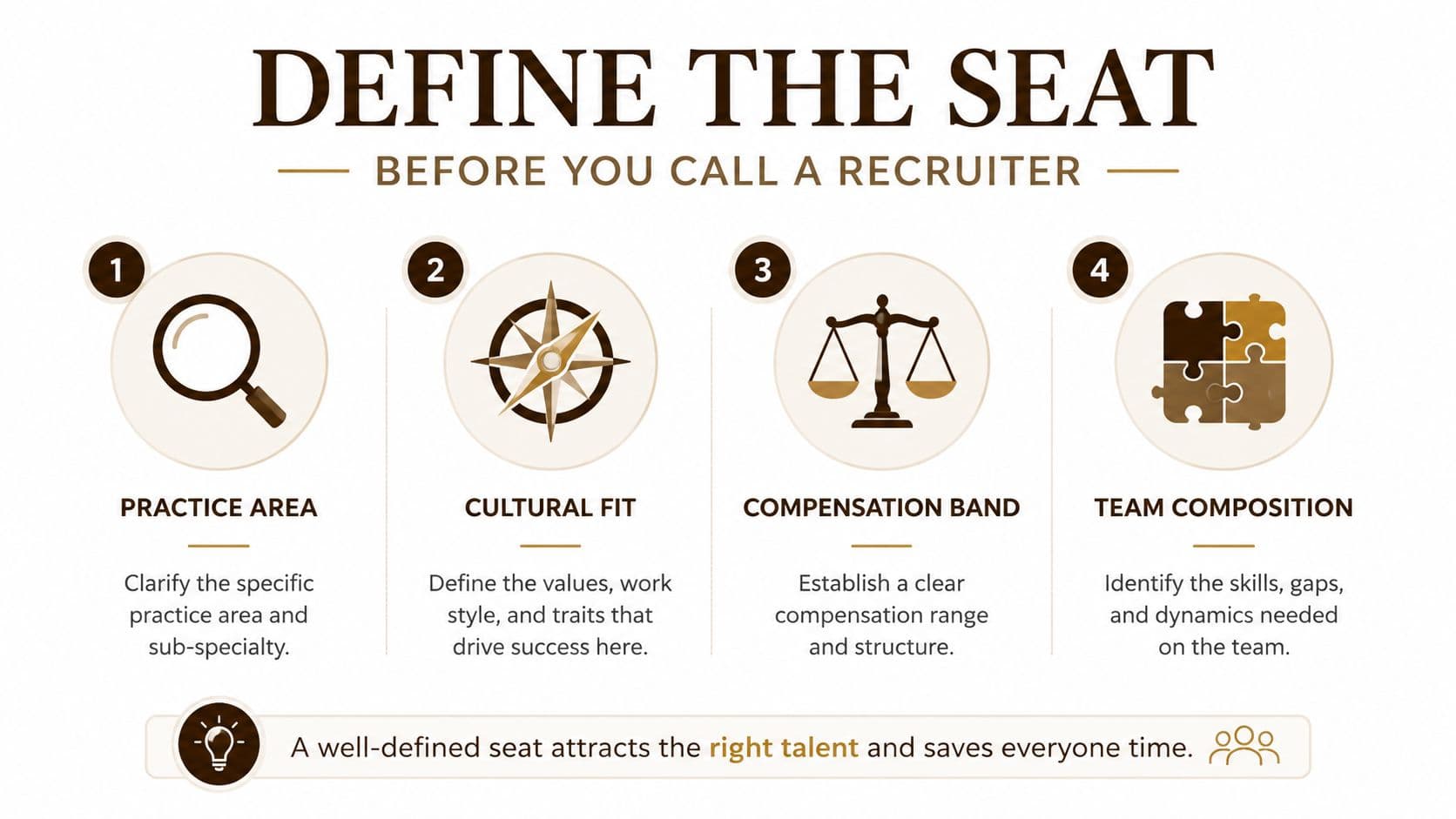
The first mistake firms make is calling recruiter after recruiter before they've done their own intake work. If the seat isn't defined, the search becomes a moving target, and every recruiter will help you by sending a different version of the wrong candidate. That's how you end up reviewing résumés that look impressive and solve nothing.
Start with the matter pipeline, not the résumé wish list
Tie the need to a live practice reality. Is this a backfill after a departure, or a net-new seat built around incoming work? Are you trying to cover one matter type, or several adjacent ones? If the work is corporate M&A, don't ask for “general corporate” and expect the recruiter to read your mind.
The class year decision matters just as much. A mid-level associate can often absorb active demand with less supervision, while a junior hire may look cheaper on paper but cost more in partner oversight. Align the role with what the team needs to get done.
Don't let scope drift kill the shortlist
I've seen broad scoping wreck searches at the shortlist stage. One firm told the recruiter it wanted “someone who can do litigation and help on employment and maybe some counseling work.” That sounded flexible, but it described three different seats, so every candidate looked partially right and fully wrong.
I've also seen the opposite failure. A firm defined the seat so narrowly that only one obscure profile qualified, then complained that no one fit. A recruiter can source intelligently only when the firm gives a usable boundary, not a fantasy profile.
Practical rule: write the intake like a one-page brief, not a pitch meeting. Include practice area, matter mix, class year, backfill or net-new, location, compensation band, reporting line, and the one thing the candidate must be able to do on day one.
A clean intake gives the recruiter a real mandate. It also gives your hiring committee something to compare against when the first shortlist arrives.
Why the Lateral Shift Changes Which Recruiters Matter
The market has moved away from a graduate-heavy model, and the hiring data makes that impossible to ignore. Reuters reported that in 2025 U.S. law firms hired 24,441 associates, a 5% decline from 2024, but only 38% of those hires were recent law-school graduates, down from 46% in each of the prior two years, while lateral associates made up 49% of associate recruitment in 2025, up from 43% in 2024 (Reuters). That is not a small adjustment. It changes who matters as a recruiting partner.
Campus recruiters and lateral recruiters do different work
A recruiter who shines in OCI-style pipelines isn't automatically the right person for an associate search in a competitive market. Campus recruiting is built around volume, timing, and structured evaluation of early-career candidates. Lateral search is built around discretion, persuasion, and access to lawyers who are already employed and often not actively applying.
That distinction matters because the value of the search partner is tied to the seat. If you're hiring a first-year associate, you want process discipline and broad candidate reach. If you're hiring a fifth-year or sixth-year associate, you need someone who can open doors to lawyers who are comfortable where they are.
Off-market access is the real differentiator
The firm that wins mid-level and senior associate searches usually doesn't win because it has prettier marketing. It wins because it can speak to lawyers who aren't reacting to postings. That's the heart of associate attorney recruiting firms now, especially in practice groups where immediate productivity matters more than a long training runway.
A recruiter with only inbound traffic will overstate market interest and underdeliver quality. A recruiter with mature lateral reach can show you candidates who were never going to answer a job board posting in the first place.
The question isn't whether a recruiter knows lawyers. The question is whether that recruiter knows the right lawyers for your opening, in your geography, at the class year you need.
Comparing Fee Models and Risk Structures
Recruiter compensation shapes behavior. If you don't understand the fee model, you won't understand what kind of search behavior you're buying. Associate searches are usually the wrong place to pay for a long, bespoke retained process unless the role is unusually sensitive or unusually hard to fill.
Contingency is usually the cleanest fit for associate work
Contingency economics commonly run at 20 to 25% of first-year compensation for legal search, according to the hiring guidance in the brief (Five Star Placements blog). That structure keeps the recruiter focused on actual placements, not on warming you up with endless status calls. It also keeps the firm from paying upfront for a search that may never get past intake.
Retained search can make sense for partner-level or highly specialized leadership work, where confidentiality and process control matter more. Hybrid structures sit in the middle, but they can blur accountability if the deliverables aren't tightly defined. For most associate-level searches, pure contingency aligns incentives more cleanly.
Use the model that matches the risk
| Model | Typical Fee | Best Fit | Timeline Expectation |
|---|---|---|---|
| Contingency | 20 to 25% of first-year compensation (source) | Standard associate searches, backfills, competitive lateral seats | Often fast when intake is clear |
| Retained | Not fixed in the brief | Sensitive, senior, or strategically important searches | Usually slower and more controlled |
| Hybrid | Varies by engagement | Searches where the firm wants some upfront commitment and some performance linkage | Depends on structure |
If a recruiter can't explain what the fee buys, keep walking. You're not just buying introductions. You're buying sorting, screening, and judgment.
The fee should reward the recruiter for advancing a real hire, not for occupying your inbox.
The Due-Diligence Funnel Behind Every Good Shortlist
A polished shortlist is the end product of a disciplined funnel, not a pile of attractive résumés. The firms that do this well move from role definition to market mapping to actual validation before a hiring committee ever sees a name. That's why some searches feel surgical while others feel like a resume dump.
The five gates that matter
A strong associate search usually runs through five checks: define the seat, map the active and passive market by practice and geography, verify that each lawyer can run the relevant matters or deals, run a preliminary conflicts read, and pressure-test motivation before the shortlist is presented. That sequence matters because it filters out candidates who look fine on paper but won't survive real firm scrutiny.
Here's the part firms ignore. One recruiting guide notes that interviews rates above 80% come from diligence, not volume, and that roughly 80% of legal roles are never publicly posted (BCGSearch). I don't need another stack of random résumés. I need a recruiter who can prove the shortlist is built on actual fit.
What to ask before you approve a shortlist
- How did you map the market? I want to hear practice area, geography, and class-year targeting, not just “we reached out broadly.”
- What did you verify about the candidate's work? Ask whether the lawyer has handled the matters you need, not just touched adjacent ones.
- Did you run a conflicts read early? Waiting until the end wastes everyone's time.
- Why is this person looking now? If the motivation is vague, the hire is fragile.
- What did you exclude? Good recruiters know why a candidate didn't make the cut.
If you want a practical benchmark for how this process should feel, the associate search guidance at Five Star Placements is a useful example of a screening-heavy workflow. The point isn't more names. The point is a better shortlist that saves partner time.
Measuring Reach Into the Passive Market
Most firms say they want more candidates. That's the wrong metric. What they want is access to the lawyers who would be good fits but aren't responding to job postings, because that's where the market lives for many associate searches. Major recruiters explicitly emphasize that they place associates who never answer a posting, and that tells you where the value sits.
Passive reach beats public visibility
A recruiter's real edge is not how many résumés arrive. It's how many employed lawyers they can persuade to talk. That matters most for mid-level and senior associates, because those lawyers are harder to dislodge and more likely to be passive.
You should test this before signing the engagement. Ask how many candidates were sourced directly versus inbound, what practice groups they came from, and how many were reachable without a public posting. If the first two weeks of activity produce only generic applicants, you don't have market access. You have a mailbox.
Use depth-of-reach questions, not volume questions
- Who are you already speaking with in this practice area? You want named market segments, not a promise to “work the network.”
- How many of your candidates came from direct outreach? If the answer keeps circling back to job boards, that's a warning sign.
- What did the recruiter say to employed candidates? Strong recruiters know how to reposition opportunity without sounding desperate.
- Which firms are you targeting? Recruiters with real reach can name the competitor set.
For a broader look at how legal recruiting is presented to the market, the firm overview at Five Star Placements shows how a recruiter can describe practice coverage, but your real test is still the candidate list. A big pipeline is useless if the lawyers in it never would've replied to a posting.
Interview Questions and Red Flags That Actually Filter
Once the shortlist lands, partners still have to do their job. A recruiter can identify a plausible candidate, but your interview process decides whether the firm avoids a bad hire. The three questions that matter are simple: can the candidate do the work, do they fit the practice, and will they stay long enough to justify the ramp-up.
Ask about real work, not résumé theater
Start with the matters. Ask the candidate to walk through the exact work they've handled, what they owned, and where they needed supervision. If they describe everything in vague prestige language, they probably haven't had enough ownership for your seat.
Then ask about billable demand alignment. If your practice is busy in a narrow niche, the candidate needs to show they've lived in something close to that rhythm. If they say they can “pick it up quickly” but can't explain comparable matters, keep the skepticism high.
Direct question: “What parts of this work would you be able to run independently in your first month?”
Red flags that should slow the process down
- Unexplained short tenures. Frequent moves without clear reasons usually mean the candidate is carrying a pattern, not a one-off event.
- Vague practice descriptions. If the lawyer can't name the deal type, litigation stage, or client profile, the fit is probably thinner than advertised.
- Compensation expectations far outside the band. Don't drag a search forward if the economics don't match.
- Overly polished motivation. If every departure sounds perfect, the story probably isn't.
- Weak answers on portability. If the candidate can't explain why a firm should invest in them, the committee will hesitate.
Use the same rubric on every recruiter-presented candidate. Consistency matters more than charisma, and it's the fastest way to tell whether the search partner is sending real prospects or just warm paper. If the recruiter is doing the front-end work correctly, your interviews should feel like validation, not discovery.
Onboarding, Retention, and Holding the Recruiter Accountable
A placement is not the finish line. Too many firms celebrate the signed offer and then forget that the true test starts on day one. If the associate leaves early, the search wasn't successful, no matter how pretty the offer acceptance looked.
Tie recruiter performance to the first year
The 20% overall associate attrition rate in 2024 reported by the NALP Foundation, up from 18% in 2023 but below the 26% peak in 2021, is a useful reminder that turnover is still part of the market reality (NALP Foundation)). The same update said associates were leaving earlier than the traditional five-year window, within four years of hire, and that boomerang rehires were 11% of associate hires in 2024 versus 7% in 2023. That tells you the placement game isn't just about getting to offer. It's about keeping the person in seat.
Run 30-, 60-, and 90-day check-ins with every placed associate. Ask whether the work matches the pitch, whether the team is giving real assignments, and whether the compensation or workload conversation changed after start date. If the recruiter promised support, the recruiter should hear about issues early, not after the guarantee period expires.
Hold the search to a simple dashboard
- Offer accepted and started: the basics, not the finish line.
- Stayed through the guarantee period: the minimum accountability test.
- Stayed through 12 months: the true measure of search quality.
- Was the intake accurate: if the hire failed because the seat was misdefined, that's a firm problem too.
For a broader view of how the firm thinks about placements and screening, the about page at Five Star Placements is relevant because it frames the operating model around customized search and contingency placement. Use that kind of model as a benchmark, then judge every recruiter by retention, not just responsiveness.
If you want a recruiter who can reach passive associates, screen for practice fit, and stay accountable after the hire starts, talk to Five Star Placements. They handle customized legal recruiting and screening across associate-level searches, and they can help you separate real search support from resume forwarding.
Need help filling a legal role?
Five Star Placements partners with law firms and legal departments nationwide.
Schedule a Call