
What Is Retained Search and How Legal Teams Use It
August 20, 2026 · 15 min read · Five Star Placements

Table of contents
Retained search is an exclusive, staged-fee engagement in which one firm owns a legal search from market mapping through offer close. In 2025, retained search accounted for 62.88% of global executive search revenue, representing an estimated USD 36.55 billion in market value, so it remains the dominant structure for senior hiring.
Your firm has just lost its head of litigation. The managing partner wants a successor in eight weeks, the practice group is anxious, and the obvious candidates are already busy at competing firms. Three agencies promise to “send a few names,” but none has asked how the role affects client relationships, partner politics, origination credit, or the firm's appetite for lateral risk.
That's the point at which retained search deserves a serious look. The client chooses one search firm, pays through agreed stages, and gives that firm responsibility for the assignment end to end. Contingency search works differently. Multiple recruiters may compete for the same legal hire, and the client pays only when a placement happens. The recruiter carries more financial risk, while the client keeps more flexibility.
The core difference isn't billing mechanics. It's commitment structure. Retained search buys dedicated attention, controlled messaging, deeper research, and a process designed for candidates who won't respond to a generic job pitch. A risk-based contingency model can still deliver much of that rigor, but the recruiter must earn the client's trust through behavior rather than an upfront contract.
Table of Contents
- The Short Answer a Managing Partner Needs
- Retained vs Contingency Search in Legal Hiring
- How Retained Search Fees Are Structured
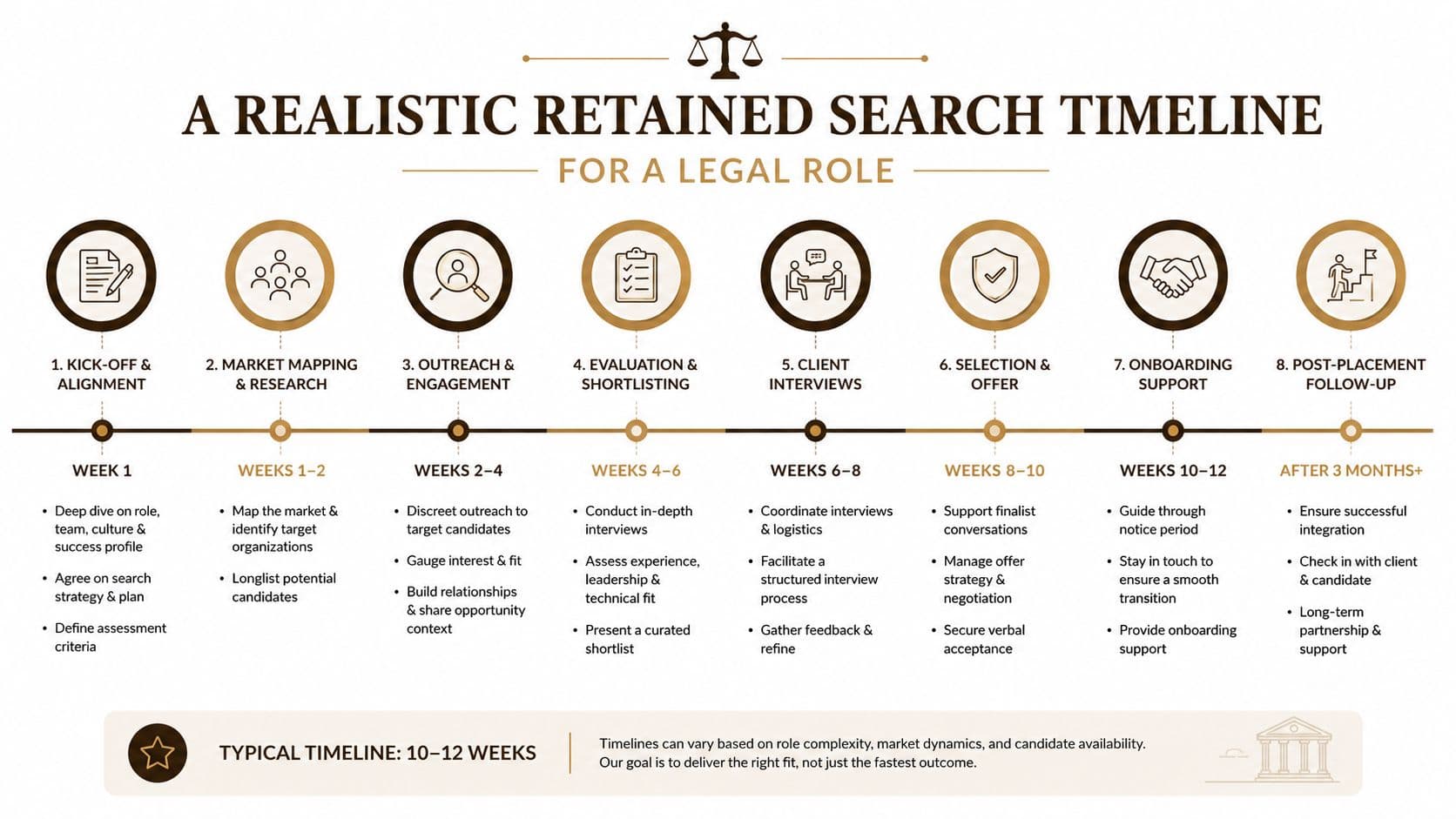
- A Realistic Retained Search Timeline for a Legal Role
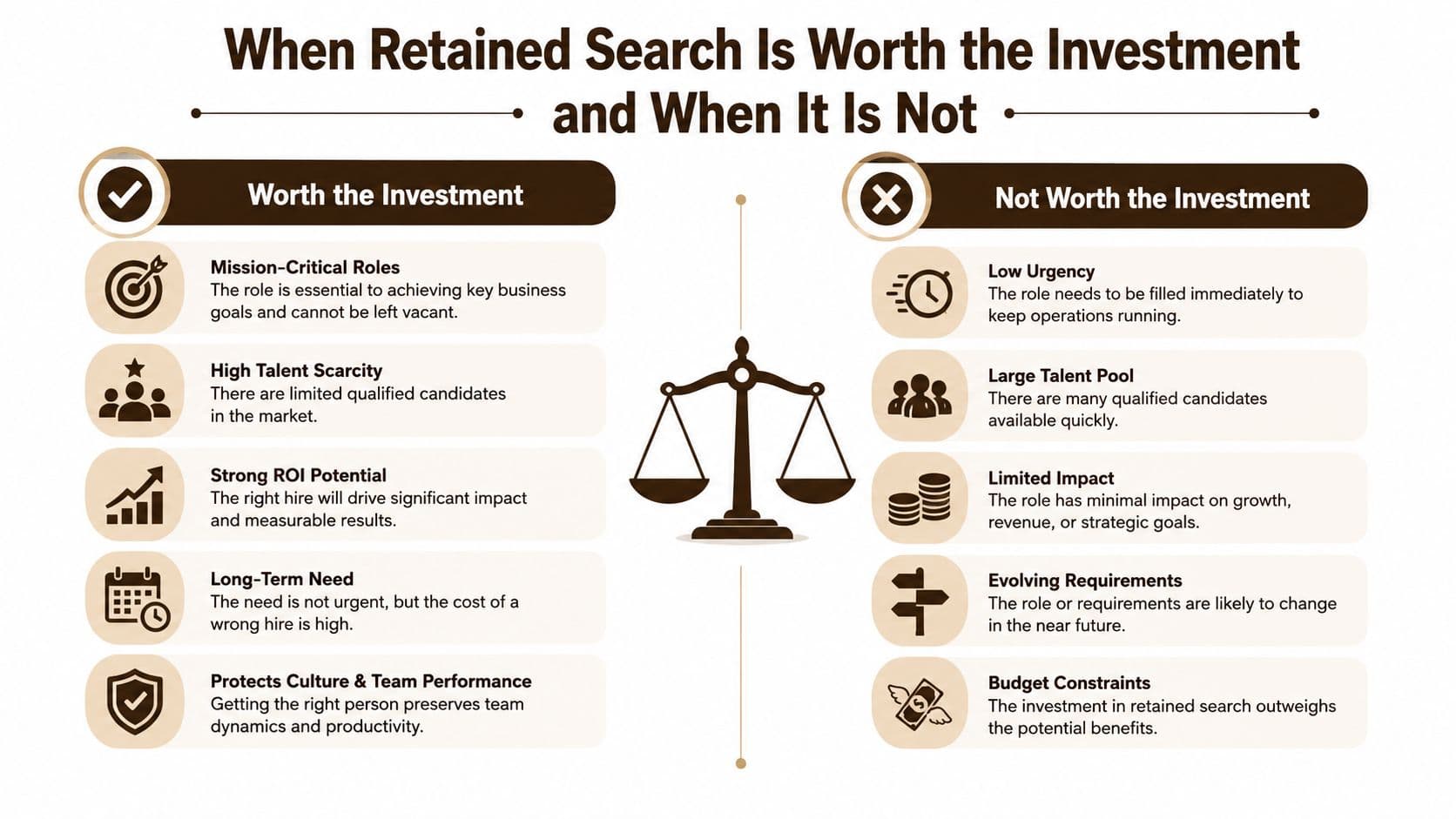
- When Retained Search Is Worth the Investment and When It Is Not
- Getting Retained-Style Rigor on a Risk-Based Contingency Model
- What to Do Next with Your Legal Hiring Decision
The Short Answer a Managing Partner Needs
You have lost a head of litigation, and the partnership wants a successor within eight weeks. The strongest candidates are busy at competing firms, while the three agencies offering “a few names” have not asked about client relationships, origination credit, partner politics, or the firm's tolerance for lateral risk.
That scenario shows what retained search is designed to handle. It is an exclusive recruiting engagement in which one firm leads a difficult, confidential, or strategically important hire. The client pays an upfront amount and milestone payments rather than a single fee only after a placement. In return, the recruiter owns research, outreach, assessment, shortlist development, interview coordination, and offer support through close.
The core difference lies in commitment structure, not billing mechanics. Retained search gives the recruiter a defined mandate to control the process, protect confidentiality, maintain consistent messaging, and spend time on candidates who will not respond to a generic job pitch.
That structure matters when the candidate market is narrow. A Managing Partner, General Counsel, practice group leader, or complex partner lateral rarely emerges from a job posting. The recruiter must identify people who are not actively looking, approach them discreetly, explain the opportunity credibly, and test whether the move works for both sides.
Contingency search serves a different buying need. The client can engage several recruiters, and each firm competes to produce the hire. That model can fit a mid-level associate, legal assistant, paralegal, or another role with an accessible candidate pool. It also suits firms that want external sourcing without paying before a placement.
Practical rule: Use retained search when the assignment needs one accountable owner. Use contingency when speed, flexibility, and payment on outcome matter more than exclusive control.
The broader executive search market was estimated at USD 63.99 billion in 2026 and is projected to reach USD 103.54 billion by 2031, with an approximately 10.11% CAGR over that period, according to Mordor Intelligence's executive search market outlook.
A contingency firm can still provide retained-style rigor for a legal hire, including disciplined research, controlled outreach, and clear ownership. The difference is that the recruiter earns that commitment through execution rather than an upfront contract.
Retained vs Contingency Search in Legal Hiring
The central difference is commitment. Retained search gives one recruiter responsibility for the assignment from market research through acceptance. Contingency search pays for the successful hire, often while several recruiters compete for the same role.
| Dimension | Retained Search | Contingency Search |
|---|---|---|
| Exclusivity | One firm leads the assignment and controls the search plan. This suits a confidential Managing Partner succession or General Counsel replacement. | Several firms may work the same role. This fits a visible associate or support hire with a broad candidate pool. |
| Fee timing | Payment is staged, usually before research and outreach begin. | Payment follows a successful hire, so the client avoids an upfront fee. |
| Research depth | The recruiter can map peer firms, identify passive partners, and examine a discreet candidate market. | The recruiter typically prioritizes candidates who can be reached and moved quickly. |
| Recruiter attention | The engagement creates clear ownership, dedicated work, and regular reporting. | The recruiter balances the role against other assignments and may prioritize searches with a realistic path to placement. |
| Confidentiality | One controlled channel reduces inconsistent messaging during a sensitive lateral or leadership change. | Multiple outreach channels make confidentiality harder to manage. |
| Candidate experience | A senior candidate may take the opportunity more seriously when one specialist understands its context and represents it consistently. | Candidates may receive competing messages from several agencies or view the role as a broad market transaction. |
| Guarantee | Agreements often include a replacement guarantee, commonly around 90 days, as described in National Recruiting Authority's retained search overview. | Guarantee terms vary and should be reviewed before a candidate is accepted. |
For a publicly traded company hiring a General Counsel, retained search can protect confidentiality and force alignment among the board, chief executive, and legal leadership. For a mid-level associate opening in an active practice area, contingency is usually more proportionate. The firm may need several qualified conversations quickly, rather than a lengthy competitor map.
Retained-style work also means structured competency interviews. The recruiter tests judgment, client management, leadership behavior, portable business, and the reasons behind a lateral move. That assessment gives the hiring committee information a résumé cannot provide.
A contingency recruiter can perform the same work, but the fee model does not automatically create the time or incentive to do it. Buyers should judge the operating process, not the label. A retainer does not purchase quality if the firm supplies weak candidates without market evidence. A contingency firm may be the better commercial choice if it provides disciplined screening, controlled outreach, and one accountable point of contact.
The distinction is therefore practical, not cosmetic. Choose retained search when the role is confidential, the candidate pool is narrow, or internal stakeholders need one party to manage the process. Choose contingency when the market is accessible, several firms can source credible candidates, and payment on outcome matters more than exclusive control.
A contingency firm can still deliver retained-style rigor for a legal hire. Require a defined search plan, target-market research, agreed reporting, documented candidate evaluation, and clear ownership of communication. That arrangement preserves execution discipline without treating an upfront retainer as the only route to serious work. For a deeper explanation of the success-based model, see Five Star Placements' guide to contingency recruiting.
How Retained Search Fees Are Structured
Retained fees usually follow the work plan. The client pays an initial retainer, a second payment at the shortlist or midpoint, and a final payment when the candidate joins. The agreement changes with seniority, geography, specialization, and the amount of competitor mapping required.
In the UK market, retained executive search commonly costs 25% to 35% of first-year total compensation, with minimum fees often cited at £30,000 to £40,000, according to the Clockwork Recruiting 2024 Executive Search Benchmark Report. These figures are reference points, not a fixed legal recruiting tariff. A partner search involving book-of-business analysis may require a different structure from a senior associate or in-house counsel assignment.
What each payment funds
The first payment funds the search foundation. The recruiter sharpens the brief, writes the position specification, interviews stakeholders, maps target firms or companies, and begins discreet outreach. Without agreement on what success means, the recruiter cannot build a credible slate.
The middle payment funds evaluation. Recruiters screen candidates, test competencies, examine motivations, assess cultural alignment, and prepare written presentations. That work separates an impressive résumé from someone who can lead the practice, manage clients, or operate within the organization's decision structure.
The final payment covers closing. It includes interview coordination, compensation discussions, counteroffer management, notice-period planning, and support through the start date. Some agreements include a replacement guarantee, giving the search firm a reason to qualify candidates carefully before presenting a finalist.
Ask whether the arrangement is fully retained, hybrid, or success-triggered. A hybrid model can use retained-style research and exclusivity while tying later payments to defined outcomes. The agreement should also identify who owns the assignment, what each stage delivers, how a changed brief affects the work, and how the firm handles candidate withdrawal.
Before signing, compare the proposed structure with this explanation of legal recruiting fees. Negotiate accountability, not only price. A lower fee with unclear ownership can cost more than a clear agreement that prevents wasted interviews and poor-fit introductions. Five Star Placements' success-based model can also support retained-style discipline without requiring the buyer to fund every stage upfront.
A Realistic Retained Search Timeline for a Legal Role
A senior legal hire rarely succeeds through database searches and forwarded résumés alone. The process should create decision-ready evidence at each stage, especially when the role affects clients, leadership, or firm strategy.
Consider a retained Managing Partner or General Counsel search. The timeline below shows the level of work buyers should expect, whether they pay fully retained or choose a contingency firm that commits to the same discipline.
Weeks one and two
The first week establishes the assignment. The recruiter interviews decision-makers, builds a position scorecard, clarifies the leadership mandate, and maps peer firms or relevant companies. The firm must settle reporting lines, authority, compensation, client expectations, succession politics, and the reason the role is open. If those points remain vague, sourcing starts before the market can be assessed properly.
During the second week, the recruiter builds a longlist and begins confidential outreach. Passive candidates need a credible explanation of the opportunity, its context, and the client's appeal. The recruiter also answers discreet inquiries from candidates who will not authorize résumé submission until they understand the situation.
Weeks three through six
Weeks three and four focus on assessment. The recruiter conducts screening calls, scores competencies, examines cultural alignment and motivation, and begins reference triangulation where appropriate. Concerns should surface before a candidate reaches the hiring committee.
Weeks five and six produce written candidate presentations and first-round interviews. A serious presentation goes beyond the résumé. It explains the candidate's practice, leadership style, reasons for moving, compensation expectations, potential conflicts, and likely concerns about the client.
Firms comparing providers should review this overview of legal executive search firms and ask how each recruiter controls the assignment. The label matters less than clear ownership, disciplined market work, and evidence behind every recommendation.
Weeks seven and eight, with room for slippage
The final stage includes finalist interviews, compensation negotiation, partner-vote preparation where relevant, counteroffer management, and closing the offer. For a senior legal role, internal decision-making can take as long as external sourcing.
Clockwork Recruiting's 2024 benchmark materials report a global average of 117 days from search kickoff to placement. The same report also records 123 days to signed offer and a 71% overall placement rate across tracked searches. Those figures describe benchmark performance, not a promise for any individual legal search.
An eight-week target can work when the brief is settled, interviewers respond quickly, and candidates remain available. Counteroffers, partner politics, notice periods, compensation disagreements, and slow feedback can extend the process. The buyer should demand momentum and visible work, not an artificial deadline.
When Retained Search Is Worth the Investment and When It Is Not
Retained search earns its fee when the vacancy creates a business problem that ordinary sourcing won't solve. It becomes expensive theater when the firm hasn't decided what it wants, won't make time for interviews, or is using an executive-search label to avoid basic hiring discipline.
Assignments that justify commitment
A Managing Partner succession search is a strong retained case because the candidate must evaluate more than title and compensation. The recruiter may need to understand internal factions, client continuity, leadership expectations, and the firm's willingness to support the successor.
A public-company General Counsel search also benefits from one controlled process. Board members, the chief executive, and the legal department need aligned messaging, consistent assessment, and confidentiality while the market is approached.
Practice group leader hires and complex partner laterals belong in the same category. A recruiter may need to map competitors, evaluate portable business, understand conflicts, assess team portability, and determine whether the candidate's stated book will translate to the hiring firm. That work takes judgment and repeated conversations.
A retained fee is defensible when the cost of a wrong appointment includes lost clients, damaged confidence, disrupted teams, and another search.
Assignments that don't need it
A mid-level associate search with a broad, active talent pool usually doesn't require a fully retained structure. Neither does a legal support role the firm fills regularly through its own network. If the hiring manager already has qualified candidates and can run interviews promptly, paying for extensive market mapping adds little.
The buyer should also walk away from any model when the basic conditions are broken:
- Vague position specification: The recruiter can't evaluate fit against an undefined mandate.
- Hidden compensation: Candidates will disengage when the financial framework appears late.
- Undisclosed internal politics: A recruiter can't represent the opportunity accurately without knowing who really decides.
- Pressure to skip references: Speed doesn't justify removing a critical risk check.
- Punitive withdrawal terms: The client shouldn't bear unreasonable exposure when a candidate withdraws or the recruiter fails to qualify the person properly.
The strongest retained firms welcome hard questions about deliverables, replacement terms, reporting, and candidate ownership. If the recruiter sells exclusivity but won't explain how exclusivity changes the work, the buyer is purchasing a promise rather than a process.
Getting Retained-Style Rigor on a Risk-Based Contingency Model
Retained search isn't the only way to run a serious legal search. A contingency firm can deliver retained-style rigor if it behaves like an accountable search partner instead of a résumé distributor.
The first requirement is single-search ownership. One recruiter should own communication, candidate tracking, feedback, and process pace. The second is a structured intake. The recruiter should leave the kickoff meeting with a scorecard covering technical experience, client profile, leadership behavior, business expectations, compensation, location, and deal-breakers.
The work should then follow a repeatable sequence:
- Calibrated sourcing: Build a target profile before contacting candidates.
- Competency interviews: Test the work the person will perform, not just the titles on the résumé.
- Written summaries: Explain strengths, concerns, motivations, culture fit, and compensation expectations.
- Reference depth: Complete appropriate reference calls before the finalist presentation, where the candidate and client agree.
- Active closing: Manage interview scheduling, objections, counteroffers, and communication through acceptance.
That process gives a legal buyer much of the substance associated with retained search while preserving a risk-based fee structure. The recruiter is paid only on a successful hire, so the client avoids upfront cost and the recruiter must make its candidate selection count.
The tradeoff is real. Contingency works best when the role has a reachable candidate pool, the client can share enough information for credible outreach, and confidentiality is important but not absolute. It's less suitable when the firm needs a hidden succession search, a tightly controlled board-level process, or a market map that must remain private until the client is ready.
Five Star Placements operates as a contingency-based legal recruiting firm, making permanent placements across attorney, partner, in-house counsel, legal support, and legal operations roles. Its stated process includes customized screening for experience, skills, and culture fit, with payment only upon successful hire and no upfront costs.
The practical signal is straightforward: retained-style rigor is a behavior pattern, not a contract structure. Ask the recruiter to demonstrate ownership, screening depth, written evaluation, communication cadence, and reference discipline. Don't assume an upfront invoice creates those behaviors.
What to Do Next with Your Legal Hiring Decision
Choose the model by testing the assignment, not by copying what another firm used. Answer these five questions before you speak with recruiters:
- How visible is the role? A confidential replacement or sensitive succession points toward one controlled search owner.
- How senior is it? Managing Partners, practice leaders, General Counsel candidates, and complex partner laterals require more judgment than routine hiring.
- How narrow is the market? A niche practice, unusual jurisdiction, or specialized industry background may require direct market mapping.
- How much internal bandwidth exists? If the hiring committee can't review candidates and deliver feedback quickly, no recruiter can rescue the process.
- What does the vacancy cost? Consider lost client coverage, delayed matters, team strain, and leadership distraction, not just the agency fee.
My recommendation is direct. Default to risk-based contingency for most legal hires. Escalate to retained or a hybrid structure when at least two of those questions produce a clear warning that the role is confidential, senior, unusually narrow, internally under-resourced, or costly to leave open.
AI is changing the mechanics of search, but it hasn't replaced the judgment that closes a legal hire. Automated sourcing can accelerate target-list development, competency scoring can organize assessment evidence, and calendar orchestration can reduce administrative delay. A 2026 whitepaper cited AI-assisted workflows reducing average C-suite timelines from about 14 weeks in 2025 to 9 weeks by Q1 2026, as reported in recent executive-search trend coverage. Treat that as a directional signal about process efficiency, not a guarantee for your search.
Before signing, pressure-test the recruiter on three points:
- Candidate ownership: Who speaks to each candidate, and who manages the relationship?
- Replacement protection: What happens if the hire leaves during the agreed guarantee period?
- Reference depth: When are references completed, and what evidence reaches the hiring committee?
The right search partner will answer without defensiveness. The right model will match the role's risk, not the recruiter's preferred fee.

Five Star Placements provides contingency-based permanent placement for attorneys, partners, in-house counsel, legal support staff, and legal operations leaders, with screening aligned to practice needs and organizational culture. If you're deciding between retained discipline and a risk-based legal search, visit Five Star Placements to discuss the role, candidate market, and fee structure that fit your hiring decision.
Need help filling a legal role?
Five Star Placements partners with law firms and legal departments nationwide.
Schedule a Call