
Strategic Recruitment Solutions for Law Firms in 2026
August 25, 2026 · 15 min read · Five Star Placements
Table of Contents
On Monday morning, a practice-group leader admits that an associate vacancy has been open for six months. The team is covering the caseload, but deadlines are tighter, senior lawyers are doing work below their level, and clients are beginning to ask who will handle the next matter. Nobody calls it a recruitment failure. They call it a temporary gap, then absorb the cost.
That pattern appears across litigation, transactional practices, in-house legal departments, and support teams. The United Kingdom's recruitment industry contributed £40.6 billion to the economy in 2024, equal to 1.6% of UK Gross Value Added, and supported around 872,000 temporary or contract workers on assignment on a typical day, according to the UK Recruitment Industry Status Report. Recruitment is labor-market infrastructure, not an administrative afterthought.
Legal hiring needs a sharper approach. A partner search, a midlevel litigation associate search, and a high-volume paralegal search don't belong in the same workflow. The recruiting model you choose is part of the strategy, because it determines how the market is mapped, how candidates are assessed, how quickly decisions move, and how much confidentiality the process protects.
Table of Contents
- The Hiring Problem Most Law Firms Do Not Name Out Loud
- What Strategic Recruitment Solutions Actually Mean
- The Core Models That Power Strategic Legal Recruiting
- Screening Beyond the Resume for Legal Roles
- Matching the Right Approach to the Right Legal Seat
- A 90-Day Strategic Hiring Plan You Can Run This Quarter
- Where Speed, Selectivity, and Candidate Experience Compete
- A Decision Framework for Your Next Legal Hire
The Hiring Problem Most Law Firms Do Not Name Out Loud
An open legal seat consumes more than salary budget. It creates unbilled supervision, delays matter staffing, increases pressure on existing lawyers, and can weaken a practice group's ability to accept new work. A departing associate may leave a manageable workload behind, but the remaining team still has to absorb deadlines, client calls, document review, and court preparation while the firm searches.
The managing partner often sees the problem only after it has spread. The practice leader reports lower morale. A senior associate says the team can't sustain another quarter. A client asks whether the firm has enough capacity for a new instruction. At that point, the vacancy has become a business risk rather than an isolated human-resources task.
UK market data reinforces why firms shouldn't treat hiring conditions as a simple boom-or-bust cycle. Permanent placement activity was estimated at 536,400 placements in 2024, down from 806,400 in 2023, a 33.5% decline, while the sector still produced £40.6 billion in GVA. The same data records 31,225 recruitment enterprises in 2024 and 31,345 in 2025, even as recruitment employment fell from 243,118 in 2023 to 236,470 in 2024, as reported in the UK recruitment market data analysis.
Treat the vacancy as a capital allocation decision
Before contacting a recruiter, answer four questions:
- What does the seat protect or create? Identify client revenue, matter delivery, partner succession, regulatory coverage, or operational continuity.
- How scarce is the candidate? A general commercial associate and a partner with a portable book of business require different market access.
- What would a wrong hire disrupt? Consider client relationships, team dynamics, confidentiality, and the cost of restarting the search.
- How much process can the market tolerate? Senior candidates may accept a discreet, deliberate process, while a backfill may require immediate outreach and tightly scheduled interviews.
Firms that fill every opening by default usually end up with a default process. They send the same job description to several contingency recruiters, compare resumes, and hope one candidate survives partner review. Firms that recruit strategically choose between contingency, retained, scalable sourcing, and assessment-led models before the search begins.
Practical rule: Decide how the role should be recruited before deciding where to advertise it.
What Strategic Recruitment Solutions Actually Mean
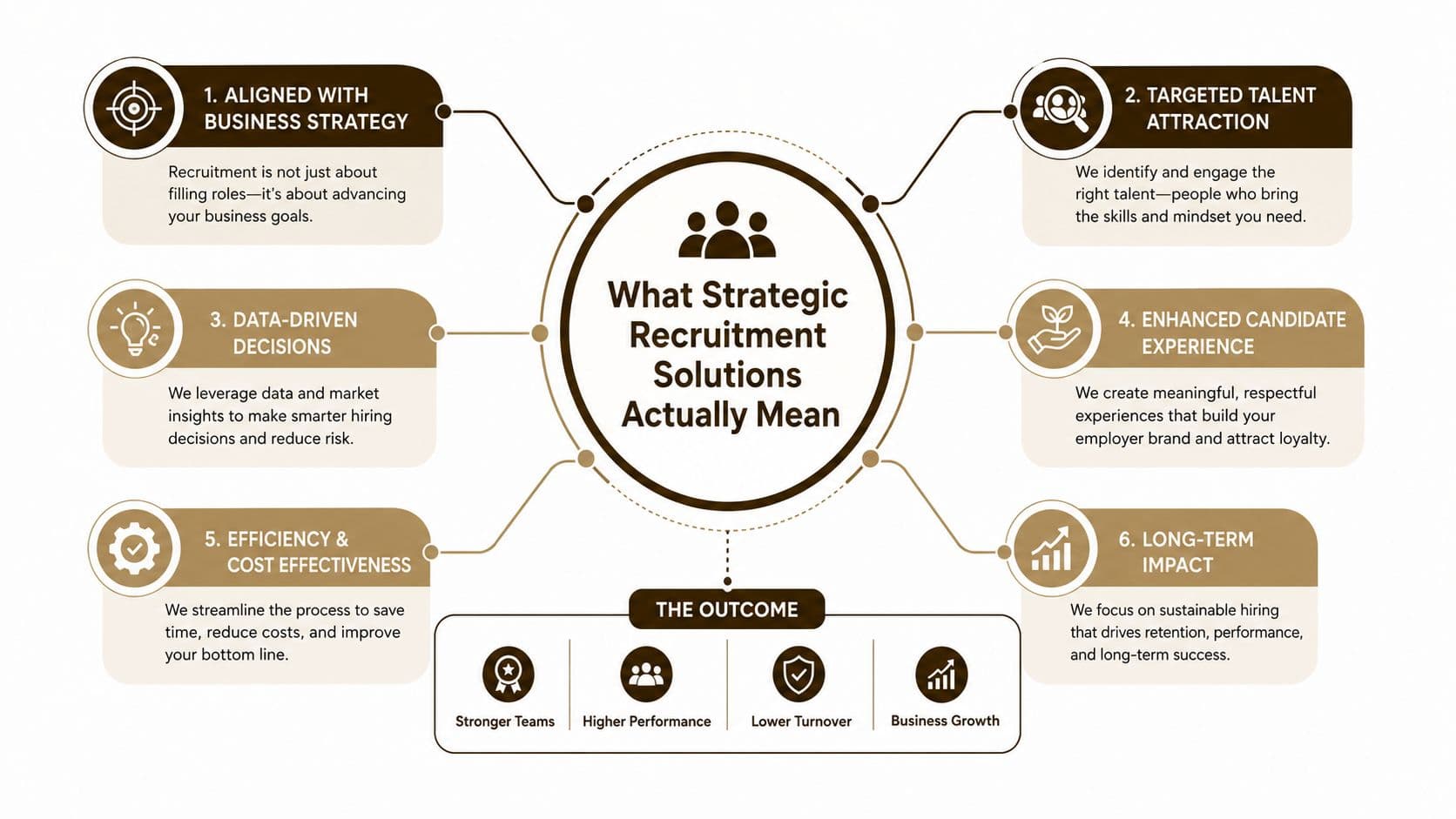
Strategic recruitment solutions are a deliberate system for matching the hiring model, sourcing depth, screening rigor, and candidate experience to a specific legal seat. The system isn't a recruiter submitting resumes. It defines what evidence the firm needs, who owns each decision, and how the process will protect both hiring standards and candidate trust.
A litigator doesn't use the same preparation for every matter. A summary judgment motion, a deposition, and a trial each require a different level of investigation and preparation because the forum, stakes, and risks differ. Legal recruiting works the same way. A partner succession hire needs market mapping and discretion. A paralegal expansion needs reach, workflow control, and reliable skills verification.
The weak model is familiar. A firm writes a broad job description, gives it to several recruiters, receives overlapping candidates, and lets the busiest partner decide which resumes look interesting. That approach creates activity without a hiring thesis.
Three layers create a real strategy
First, choose the search model. Contingency search, retained search, scalable sourcing, and assessment-led screening each solve a different problem. The firm should choose based on scarcity, urgency, confidentiality, and the consequences of a wrong appointment.
Second, calibrate assessment depth. A senior lawyer may need evaluation of client development, leadership, conflicts, compensation expectations, and integration risk. A legal assistant may need a focused test of document management, scheduling, communication, and workload control.
Third, design the candidate experience. Candidates judge a firm through response times, interview preparation, consistency among decision-makers, and the quality of offer communication. The process should reflect the firm's actual culture rather than advertise values the partners don't practice.
Practice-area nuance makes this layered method essential. Litigation partners may need courtroom credibility and team-building ability. Corporate counsel may need commercial judgment and stakeholder management. A technically excellent paralegal may still struggle if the team expects rapid prioritization across several attorneys.
The Core Models That Power Strategic Legal Recruiting
The four core models differ in where they create value. Contingency search emphasizes speed and access to an identifiable candidate pool. Retained search pays for exclusivity, research, confidentiality, and sustained ownership of a difficult assignment. Scalable sourcing supports repeatable volume. Assessment-led screening improves decision quality regardless of the sourcing model attached to it.
| Model | Fee Structure | Typical Timeline | Candidate Pool | Best-Fit Legal Seat |
|---|---|---|---|---|
| Contingency search | Payment on successful hire | Shorter, when qualified candidates are visible | Broad and identifiable | Experienced associates, paralegals, legal support |
| Retained search | Agreed engagement with dedicated search ownership | Deliberate and research-led | Smaller, passive, and carefully mapped | Partners, senior counsel, practice leaders |
| Scalable sourcing | Project or volume-based arrangement | Repeatable and capacity-driven | Larger pipelines | Junior associates, contract attorneys, operations teams |
| Assessment-led screening | Added evaluation layer within another model | Depends on role and assessment design | Any pool, with stronger qualification signals | Selective legal roles across seniority levels |
Contingency search
Contingency works when several credible candidates are available and the firm needs movement without giving one recruiter exclusive control. It fits experienced associates, paralegals, legal assistants, and similar roles where the hiring team can define practical requirements and compare candidates quickly.
The risk is fragmentation. Multiple recruiters may chase the same visible candidates, submit thin profiles, or prioritize volume over fit. The firm must provide a precise scorecard and respond quickly, or the model loses its speed advantage.
Retained search
Retained search suits a partner, senior counsel, or practice leader. These hires often involve confidential outreach, lateral relationships, portable business, conflicts, compensation structure, and internal politics. A recruiter working exclusively can map the market instead of waiting for applicants.
Firms evaluating this option should understand what retained search involves before selecting an engagement structure. Retained work isn't justified by seniority alone. It earns its place when the role is scarce, strategically important, or sensitive enough that a public search would damage the firm's position.
Scalable sourcing and assessment-led screening
Scalable sourcing makes sense when the firm needs a dependable flow of candidates across repeatable roles. Technology can support outreach, rediscovery, scheduling, and pipeline organization, but it shouldn't replace legal judgment.
Assessment-led screening adds the missing quality control. Structured interviews, work samples, and calibrated scoring help the firm compare candidates on job outcomes rather than familiarity, confidence, or school name.
Screening Beyond the Resume for Legal Roles
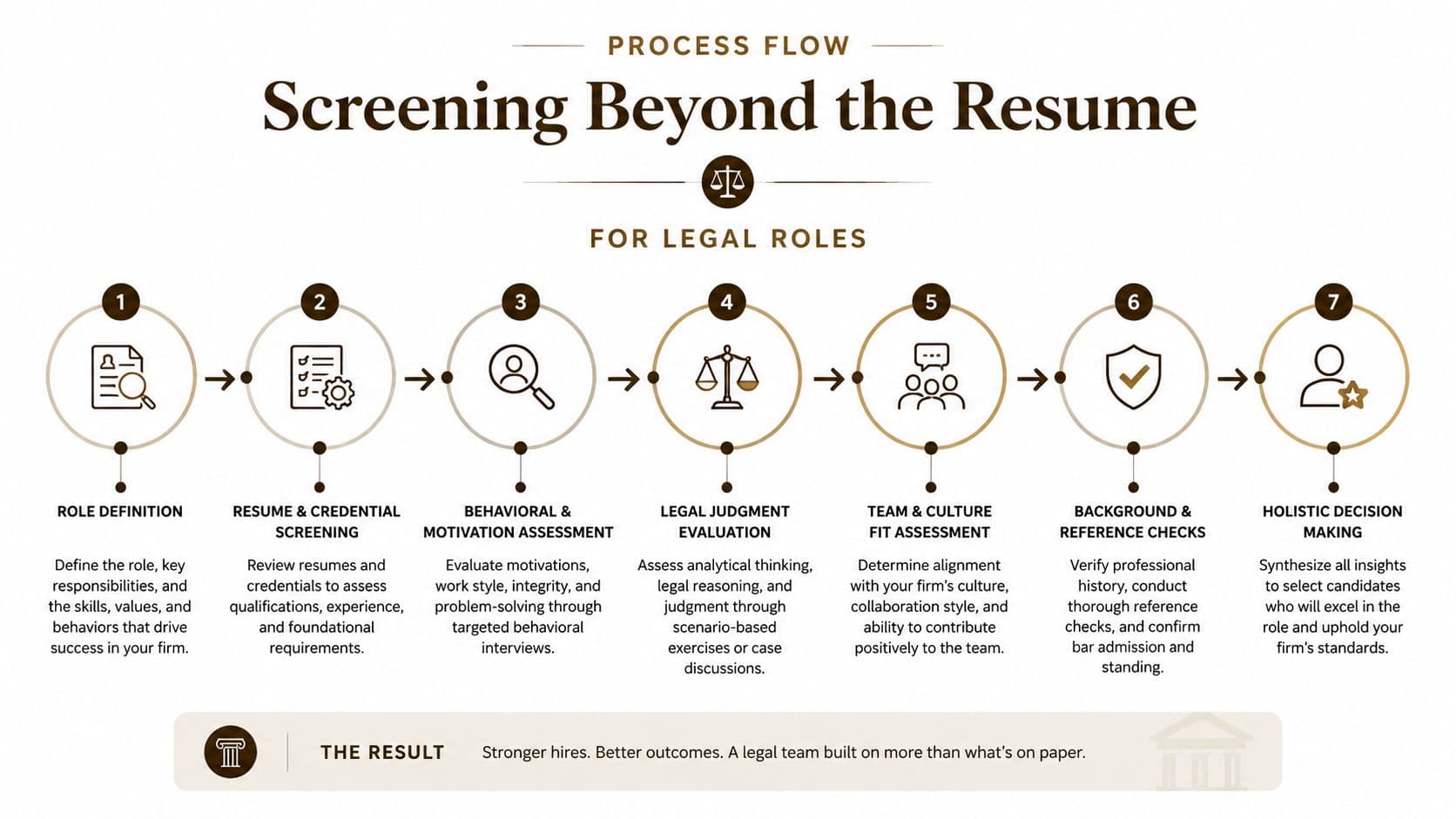
A resume tells you where someone has worked. It doesn't tell you how that lawyer handles an unreasonable client, a changing case theory, a difficult partner, or a deadline that collides with another deadline. Legal hiring needs evidence of behavior and capability, not just evidence of credentials.
Start with a structured interview built around practice-specific situations. Ask a litigator to explain how they would reassess a case after damaging discovery. Ask corporate counsel how they would respond when a commercial team wants to sign before legal has resolved a material risk. Ask a paralegal how they would prioritize competing attorney requests during a filing-heavy week.
Use three screening layers
Behavioral interviews test judgment, communication, ownership, and resilience. Use the same core questions for every candidate, then add role-specific prompts. Interviewers should score the answer against defined behaviors instead of recording whether they “liked” the person.
Competency checks expose the gap between claimed ability and usable ability. A drafting exercise can test an associate's structure and precision. A negotiation simulation can reveal whether counsel protects the client's position while preserving the relationship. A support-role exercise can test docket awareness, document control, or matter coordination.
Culture-fit evaluation should examine working preferences, not personal similarity. Test how candidates collaborate, receive feedback, handle hierarchy, communicate with clients, and operate within the firm's expectations. Culture fit shouldn't become a vague reason to reject someone who has a different background or style.
Structured screening also needs measurement. An evidence-based benchmark is to complete initial screening within 5 business days and maintain inter-rater reliability above 0.80 on final screening scores. High-performing programs also use predictive validity of 0.7 or higher against 90-day performance reviews, according to candidate evaluation benchmarks for effective screening. Those benchmarks are useful only when the scorecard measures outcomes relevant to the role.
The resume earns the interview. The work sample and structured evidence should earn the offer.
School prestige can be a useful data point, but it shouldn't outrank writing quality, client judgment, technical competence, or the ability to perform in the firm's actual environment. For guidance on the verification stage, firms can review attorney background checks, then keep verification separate from the broader assessment conversation.
Matching the Right Approach to the Right Legal Seat
The correct model depends on role criticality, candidate scarcity, and the cost of delay. Seniority matters, but it isn't the deciding factor by itself. A junior lawyer with rare regulatory experience may require more focused sourcing than a senior lawyer in a well-supplied market.
For partner and senior counsel hires, use retained search when the role affects client revenue, succession, or the firm's market position. Confidentiality and lateral integration deserve dedicated attention. A partner who brings strong technical credentials but can't collaborate across the practice group can create more damage than an unfilled seat.
Midlevel associates and specialized in-house counsel usually fit targeted contingency or a hybrid approach. The talent pool may be visible, but the screening still needs practice-specific questions, writing review, and a clear explanation of workload, reporting lines, and decision authority. A recruiter should not send a commercial counsel candidate to an organization without clarifying whether the role is primarily contracts, product advice, disputes, or compliance.
Paralegal, legal operations, and compliance searches often benefit from scalable sourcing. Volume, availability, systems experience, and verification matter more than relationship-led business development. The firm still needs a defined skills screen, especially when candidates will support several attorneys or manage sensitive records.
Apply clear if-then rules
- If the hire affects client revenue or succession, use retained search when the market is confidential or the firm needs a mapped passive-candidate pool.
- If the role is backfillable and qualified candidates are visible, use contingency search with a strict submission scorecard.
- If the firm needs repeated hiring across support or operations roles, use scalable sourcing with standardized screening and scheduling.
- If the role is highly selective, add assessment-led screening regardless of the sourcing model.
A practical time-to-fill benchmark places the median at 39 calendar days for nonexecutive roles and 45 days for executive roles, with other benchmarks showing roughly 44 to 45 days across roles, according to time-to-fill benchmarks and hiring risk. These figures aren't promises. They are warning signals that help firms identify when an open seat is drifting.
| Legal Role | Recommended Model | Screening Depth | Typical Timeline |
|---|---|---|---|
| Partner or practice leader | Retained search | Market map, business case, conflicts, leadership, integration | Deliberate and confidential |
| Senior counsel | Retained or hybrid search | Technical, commercial, stakeholder, and leadership assessment | Structured and selective |
| Midlevel associate | Targeted contingency | Practice scenario, writing, teamwork, and workload review | Focused and responsive |
| Junior associate | Scalable sourcing with structured screening | Fundamentals, writing, judgment, and learning capacity | Repeatable and efficient |
| In-house counsel | Hybrid or targeted contingency | Commercial judgment, stakeholder management, and technical fit | Dependent on specialization |
| Paralegal | Scalable sourcing | Systems, accuracy, prioritization, and communication | Fast and standardized |
A 90-Day Strategic Hiring Plan You Can Run This Quarter
A 90-day plan works when the firm treats hiring as an operating project with owners, deadlines, and decision rules. The calendar isn't a reason to make a poor hire. It creates enough structure to stop the search from disappearing into partner schedules.
Days 1 to 30 define the assignment
The hiring partner, recruiter, and relevant stakeholders should agree on a role scorecard. Separate must-haves from preferences, identify the matters or workflows the hire will own, and define what successful performance will look like after joining.
Use this phase to choose the model. A partner search shouldn't default to contingency because the firm wants to avoid an engagement conversation. A repeatable paralegal requirement shouldn't become a bespoke executive search.
Set weekly checkpoints for:
- Role clarity: Confirm practice scope, reporting line, compensation framework, and decision authority.
- Candidate quality: Agree on the minimum evidence required before a profile reaches the hiring committee.
- Process ownership: Name who schedules, who interviews, who consolidates feedback, and who communicates with candidates.
Days 31 to 60 create and test the pipeline
Launch targeted outreach, referrals, database searches, and any appropriate advertising. Run structured recruiter screens before partner interviews. Keep a written reason for advancing or rejecting each candidate, especially where several practice areas or offices participate.
Track time-to-shortlist, candidate quality scores, interview-stage conversion, and response delays. The objective isn't to maximize submissions. It's to identify whether the firm is reaching the right market and making decisions quickly enough to preserve candidate interest.
Days 61 to 90 close and integrate
Present finalists with a clear comparison against the scorecard. Resolve compensation and title questions before the offer whenever possible, then give the candidate a direct explanation of the role, workload, leadership expectations, and first milestones.
Once the candidate accepts, create 30-day, 60-day, and 90-day onboarding outcomes with the hiring partner. For a lateral lawyer, that may include client introductions, matter transition, and internal relationship mapping. For a paralegal, it may include systems access, attorney preferences, and workload priorities.
Candidate experience deserves dashboard attention. Benchmark data records an average candidate NPS of 12, application completion of 42%, and response time of 96 hours, while top-quartile organizations reached 89% completion and 24-hour response times, according to the candidate experience benchmark. The same research surveyed more than 66,000 candidates across 110 companies, showing that communication and process friction can be measured.
Use the video below as a discussion prompt for partners and hiring managers, not as a substitute for a role-specific process.
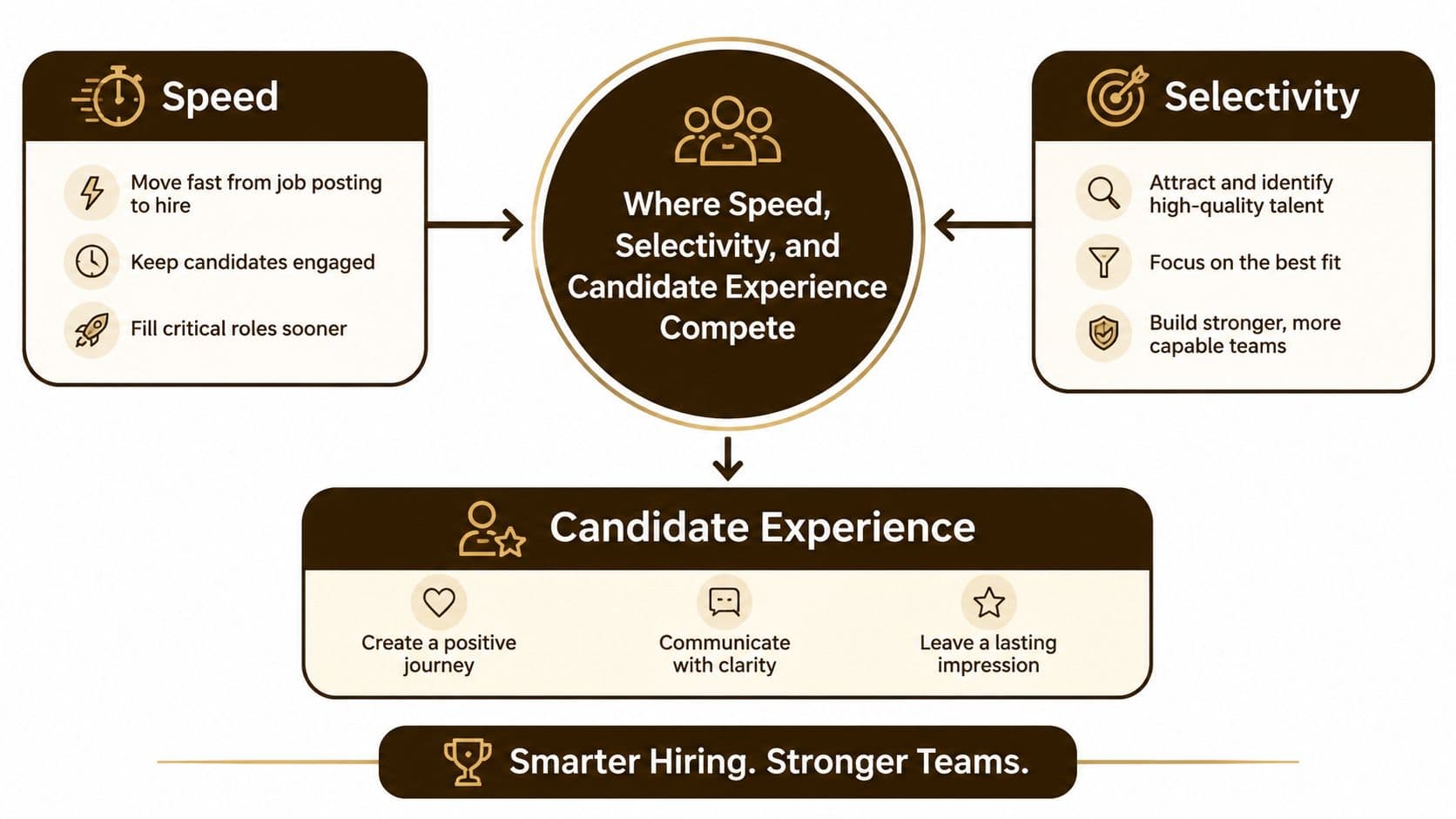
Where Speed, Selectivity, and Candidate Experience Compete
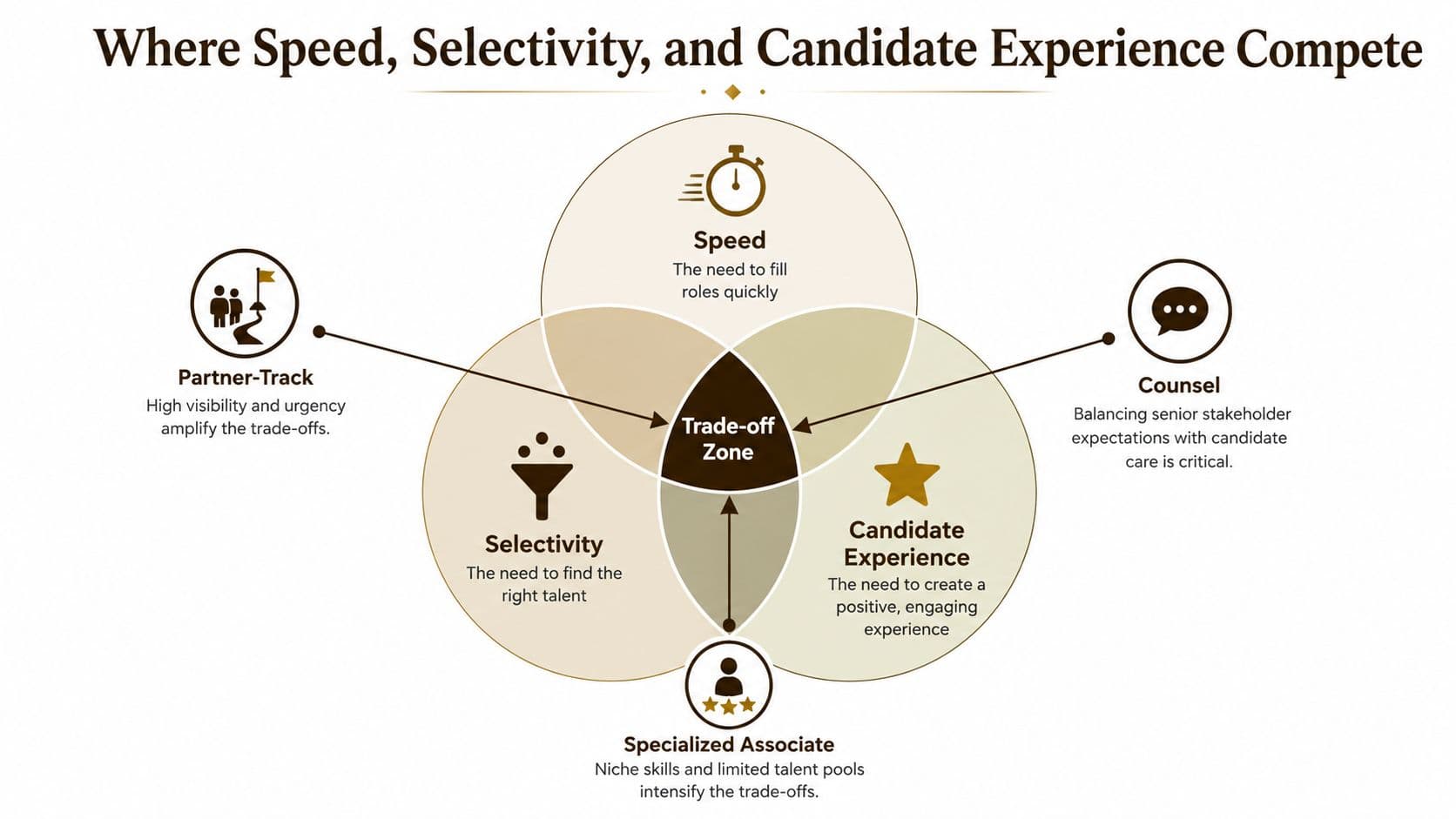
Faster isn't automatically better. Speed matters when a firm is replacing an associate during an active matter, filling a support role before a workload spike, or responding to a candidate who is already in several processes. It becomes harmful when partners compress a senior search so aggressively that they never test the candidate's judgment, relationships, or ability to work within the firm.
Partner-track, counsel, and specialized associate searches need a meaningful assessment window. A rushed process may produce an available lawyer rather than the right lawyer. A deliberate process can preserve confidentiality, surface references, examine practice fit, and give both sides enough information to make an informed decision.
The trade-off has three dimensions:
- Speed: How quickly the firm can move from intake to accepted offer.
- Selectivity: How much evidence the firm gathers before choosing.
- Candidate experience: Whether candidates receive clarity, respect, and timely communication.
A ten-day partner process may look efficient on a dashboard but still fail if it attracts weak fit or leaves serious candidates unconvinced. A longer process can work when every stage has a purpose, decision-makers stay available, and the candidate knows what happens next.
The legal market is also segmented by practice area and transaction type. Legal-market data reported that lawyer movement rose about 15% in 2025, law-firm combinations increased 8.6% year over year, and 2,261 lawyers changed firms through mergers, with movement concentrated in Litigation, Corporate, Banking, Real Estate, and Bankruptcy, according to the 2025 legal market review. That pattern argues against one universal hiring playbook.
For practical process changes, firms can use this guidance on how to hire lawyers faster, while still protecting the assessment depth the role demands.
A Decision Framework for Your Next Legal Hire
Use four filters before posting the requisition:
- Criticality: Does the role protect revenue, client relationships, succession, compliance, or daily capacity?
- Scarcity: Can the firm identify several qualified candidates, or must it approach passive and niche talent?
- Timeline: Is this a genuine urgent backfill, or has poor internal coordination created the urgency?
- Evidence: What screening will distinguish technical competence from actual performance in the role?
Then select the model and screening stack together. A partner may need retained search, market mapping, conflicts review, business-development analysis, and leadership interviews. A midlevel associate may need targeted contingency sourcing, a writing exercise, and a practice-specific behavioral interview. A paralegal may need scalable sourcing, systems verification, and a prioritization exercise.
| Legal Role | Recommended Model | Screening Depth | Target Timeline |
|---|---|---|---|
| Partner | Retained search | Market mapping, portable business, conflicts, leadership, integration | Deliberate |
| Senior counsel | Retained or hybrid search | Technical, commercial, stakeholder, and culture assessment | Selective |
| Midlevel associate | Targeted contingency | Writing, practice scenarios, judgment, collaboration | Focused |
| Junior associate | Scalable sourcing | Fundamentals, drafting, learning capacity, teamwork | Efficient |
| In-house counsel | Hybrid search | Commercial judgment, technical scope, stakeholder management | Role-dependent |
| Paralegal | Scalable sourcing | Systems, accuracy, prioritization, communication | Fast and structured |
This week, audit every open requisition. Classify each role by scarcity and business impact, write the scorecard, and choose the recruiting model before anyone publishes the job description. If the firm can't explain why a model fits the seat, it isn't ready to recruit for it.
Five Star Placements provides contingency-based permanent placement for attorneys, partners, in-house counsel, paralegals, legal support professionals, and legal operations leaders, with screening aligned to practice needs and organizational culture. To discuss a role-specific search rather than a generic hiring workflow, visit Five Star Placements.
Need help filling a legal role?
Five Star Placements partners with law firms and legal departments nationwide.
Schedule a Call