
Attorney Background Checks: A 2026 Compliance Playbook
August 18, 2026 · 13 min read · Five Star Placements
Table of contents
A lateral associate is ready to join. The references are strong, the résumé is polished, and the hiring partner wants an answer before another firm makes an offer. Then a disciplinary issue from the candidate's earlier practice surfaces through a bar record, after the firm has already assigned client work. The problem isn't only the missed fact. It's the absence of a screening process capable of finding it before the decision.
Attorney background checks require more than ordering a generic criminal report and checking a box in an applicant-tracking system. A defensible program connects the candidate's identity, license, discipline history, criminal record, credentials, financial exposure, sanctions status, and professional history to the actual risks of the role. The checks should run in parallel after consent, with a documented review process for anything that needs context.
Table of Contents
- Why Attorney Background Checks Are a Different Animal
- The Seven Checks That Actually Matter for Attorneys
- FCRA Compliance and the Credit Check Question
- Vendor Selection and RFP Questions That Actually Filter
- Red Flags, Escalation, and Candidate Conversations
- Post-Hire Monitoring Without Crossing the Line
- Sample Policy, Checklist, and What to Do This Week
Why Attorney Background Checks Are a Different Animal
Licensing creates a second layer of scrutiny
In the United States, every state and territory requires a character-and-fitness review before an attorney can be licensed, and many jurisdictions use the National Conference of Bar Examiners to investigate applicants. That makes lawyer screening structurally different from ordinary employment screening. A firm isn't just deciding whether a candidate seems trustworthy. It's hiring someone whose professional fitness has already been examined through a licensing system.
The employer's job is still separate. Bar admission doesn't eliminate the need to confirm current status, review public discipline, verify the jurisdictions in which the lawyer may practice, or identify changes since admission. The ABA's National Lawyer Regulatory Data Bank provides a national repository of public lawyer disciplinary actions, which reinforces the profession's long-standing focus on regulatory due diligence.
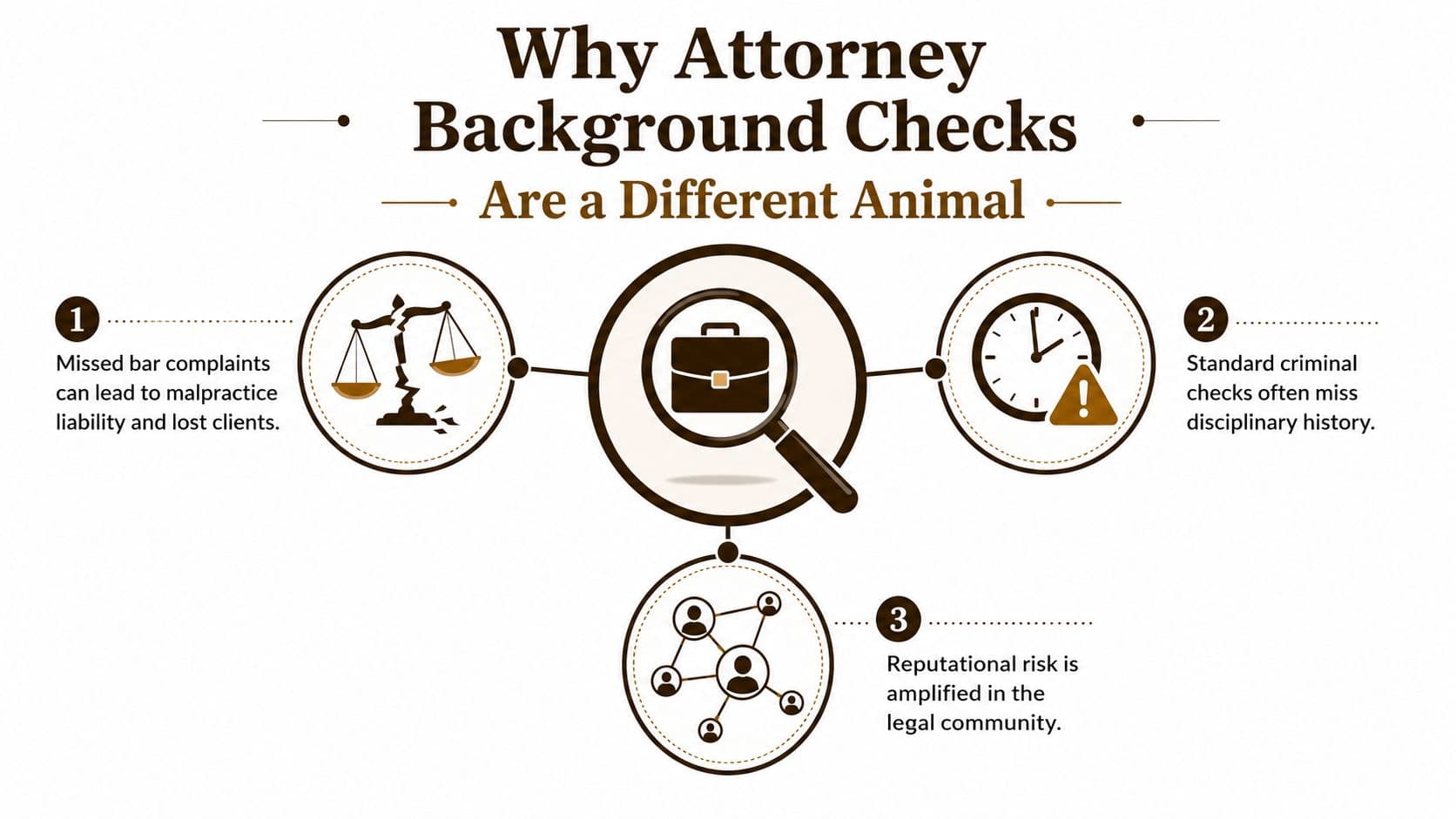
A generic report can miss the issue that matters most. A criminal search may return no relevant result while a bar authority records a reprimand, suspension, or unresolved complaint. The Minnesota court system has specifically warned that ordinary case-search tools shouldn't be used for background checks because they don't provide fingerprint-based identity verification. That warning captures the central operational point: the source and method must match the risk.
Client trust raises the cost of a miss
Attorneys handle privileged information, client money, settlement proceeds, litigation strategy, and regulatory decisions. A missed discrepancy can affect malpractice exposure, fiduciary obligations, conflicts management, and the firm's standing with clients and courts.
Practical rule: Treat the license as an active risk signal, not as proof that every relevant fact has already been checked.
The best process doesn't assume that every adverse item disqualifies a candidate. It confirms the record, gives the candidate a meaningful opportunity to explain it, and applies the same standard to similarly situated applicants. That balance protects the firm without turning screening into unstructured suspicion.
The Seven Checks That Actually Matter for Attorneys
The seven checks below should begin once the firm has the required disclosure and authorization. Running them sequentially creates avoidable delays. Identity, employment, education, licensing, sanctions, and references can often proceed together, while the reviewer tracks dependencies and unresolved discrepancies.
| Check Type | Purpose | Lookback | Primary Source |
|---|---|---|---|
| Bar status and discipline | Confirm active license, jurisdictions, restrictions, and public discipline | Current status and available disciplinary history | State bar authorities and regulatory databases |
| Criminal history | Identify convictions and legally reportable records relevant to the role | Seven to ten years is a common practitioner benchmark | Appropriate state, federal, and county sources |
| Employment verification | Confirm dates, titles, employers, and separation details | Five to seven years is a common practitioner benchmark | Former employers and candidate-provided records |
| Education verification | Validate law school attendance, degree, and graduation details | Credential history | Law school registrar or authorized verification service |
| Credit history | Assess permitted financial-risk indicators for specific roles | Seven years is a common practitioner benchmark | Consumer reporting agency, where legally allowed |
| Sanctions and watchlists | Identify restrictions affecting client, government, or regulated work | Current and historical matches as applicable | Government and regulatory lists |
| Malpractice or litigation history | Surface professional disputes, public claims, and relevant litigation | Role- and jurisdiction-specific | Court records, insurer information, and candidate disclosure |
Start with bar status and discipline
A bar check catches inactive status, public discipline, suspension, disbarment, practice restrictions, and sometimes pending regulatory information. It won't replace a full criminal search, employment review, or direct conversation about candor. Review every jurisdiction where the candidate has practiced, not just the location of the new job.
Verify the professional story
Employment and education checks are simple in concept but valuable in practice. They can expose unexplained gaps, inflated titles, inaccurate dates, or a degree that doesn't match the résumé. They won't explain why a candidate left, whether performance was strong, or whether a partner's portable business is real. References and structured interviews handle those questions better.
Use financial and litigation checks selectively
Credit history belongs in a role-based analysis, not an automatic attorney package. A lawyer with control over client funds or financial approvals may present a different risk profile from a first-year associate. Malpractice and litigation searches also need interpretation. A case may reflect ordinary professional activity rather than misconduct, and a database search can miss matters filed under different names or jurisdictions.
Criminal history and sanctions screening should be interpreted with identity precision. A name match isn't a confirmed match, and a report that lacks dates, disposition, or identifiers shouldn't drive an immediate rejection.
FCRA Compliance and the Credit Check Question
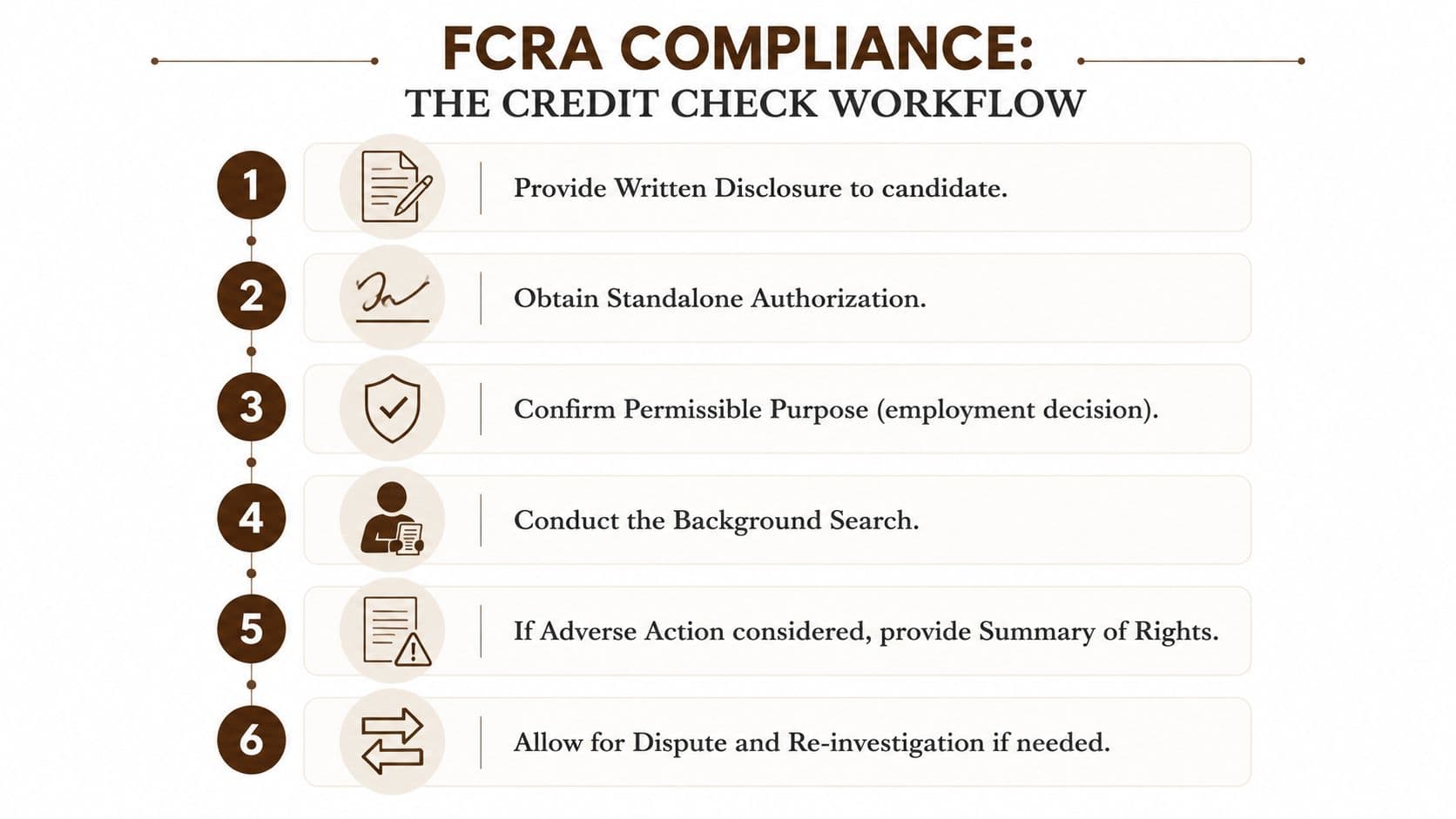
The Fair Credit Reporting Act workflow starts before the vendor searches anything. The employer needs a clear written disclosure that a consumer report may be obtained for employment purposes, a standalone authorization from the candidate, and a permissible purpose tied to the employment decision. The disclosure and authorization shouldn't be buried inside unrelated hiring paperwork.
If the employer may take adverse action based partly or wholly on the report, the process must include the required pre-adverse action materials, including a copy of the report and the Consumer Financial Protection Bureau's summary of rights under the FCRA. The candidate must have a meaningful opportunity to dispute inaccurate information before the employer makes the final decision. A final adverse action notice follows if the employer proceeds.
Credit checks need a role-specific rationale
The question most hiring teams skip is whether a credit check is lawful and necessary for this particular attorney role. The answer is increasingly state-dependent. Illinois Senate Bill 3072 limits employer use of credit history in hiring to a narrow set of roles, while federal EEOC guidance requires employers to avoid discriminatory use of background information and to follow applicable notice and authorization requirements.
A defensible decision tree looks like this:
- Does the role involve fiduciary duties, access to client funds, financial controls, or sensitive regulatory responsibility? If no, don't default to a credit check.
- Does the applicable jurisdiction permit the intended use? If state or local law restricts credit-history use, stop and obtain jurisdiction-specific advice.
- Can the employer identify a job-related reason? “We check every lawyer” is weaker than a documented explanation tied to the role.
- Will the same rule apply consistently? Apply the standard across comparable candidates and document exceptions.
- Can the reviewer distinguish financial hardship from dishonesty or misuse? Credit information is context, not a character verdict.
A firm treasurer, billing partner, or in-house counsel with approval authority over financial controls may justify closer review. A first-year associate or litigation counsel with no financial-control responsibility typically presents a weaker rationale. For specialized hiring process support, compliance leadership recruiting can help organizations define role controls before a search begins.
Vendor Selection and RFP Questions That Actually Filter
The right screening model depends on the firm's volume, risk tolerance, and internal expertise. In-house screening offers control and may work for a boutique with knowledgeable administrators, but it can produce inconsistent searches across jurisdictions and leave FCRA procedures dependent on one person's memory. A consumer-focused vendor may provide speed and a broad interface, yet it may not understand bar records, court-specific searches, or the difference between a license status problem and an ordinary name variation.
A legal-vertical specialist usually costs more in management attention, but it can provide better role mapping, escalation, and source selection. The U.S. Department of Justice's attorney suitability process illustrates the layered model worth testing. Its process combines completed security forms, fingerprint and credit checks, a full FBI field investigation, and separate tax and bar checks for attorney applicants, as described in the DOJ suitability and background investigation guidance.
Questions for the shortlist
Put these questions directly into the RFP:
- Source coverage: Which state bars, federal courts, county courts, sanctions lists, and credential sources can you search?
- Identity controls: How do you distinguish a candidate from someone with a similar name?
- Dispute handling: What happens when a candidate challenges a result?
- Accuracy metrics: How do you track inaccurate matches, corrected reports, and unresolved disputes?
- FCRA workflow: Which disclosures, authorizations, pre-adverse notices, and final notices does the platform support?
- Jurisdiction rules: How does the system identify state and local restrictions on criminal or credit information?
- Adverse action: Can the vendor document each step and preserve an audit trail?
- Parallel processing: Can bar, criminal, employment, education, sanctions, and reference checks run at the same time?
- Turnaround visibility: Does the hiring team see what's complete, pending, or blocked?
- Data retention: How long is information retained, who can access it, and how is it deleted?
- ATS integration: Can results and status updates connect with the firm's applicant-tracking system?
- Pricing: Is the price per check transparent, including searches, adjudication, disputes, and reinvestigations?
Match the model to the operation
A boutique firm may need a tightly documented package with a reliable specialist rather than a complex enterprise platform. A mid-size firm typically benefits from standardized workflows, centralized adjudication, and parallel execution across offices. An AmLaw-scale operation needs permissions, jurisdiction logic, auditability, integration, and a governance owner who can review policy changes.
The operating mistake to avoid is waiting until the preferred candidate accepts an offer before starting. Obtain consent at the appropriate stage, launch the authorized checks together, and reserve human review for findings that require judgment.
Red Flags, Escalation, and Candidate Conversations
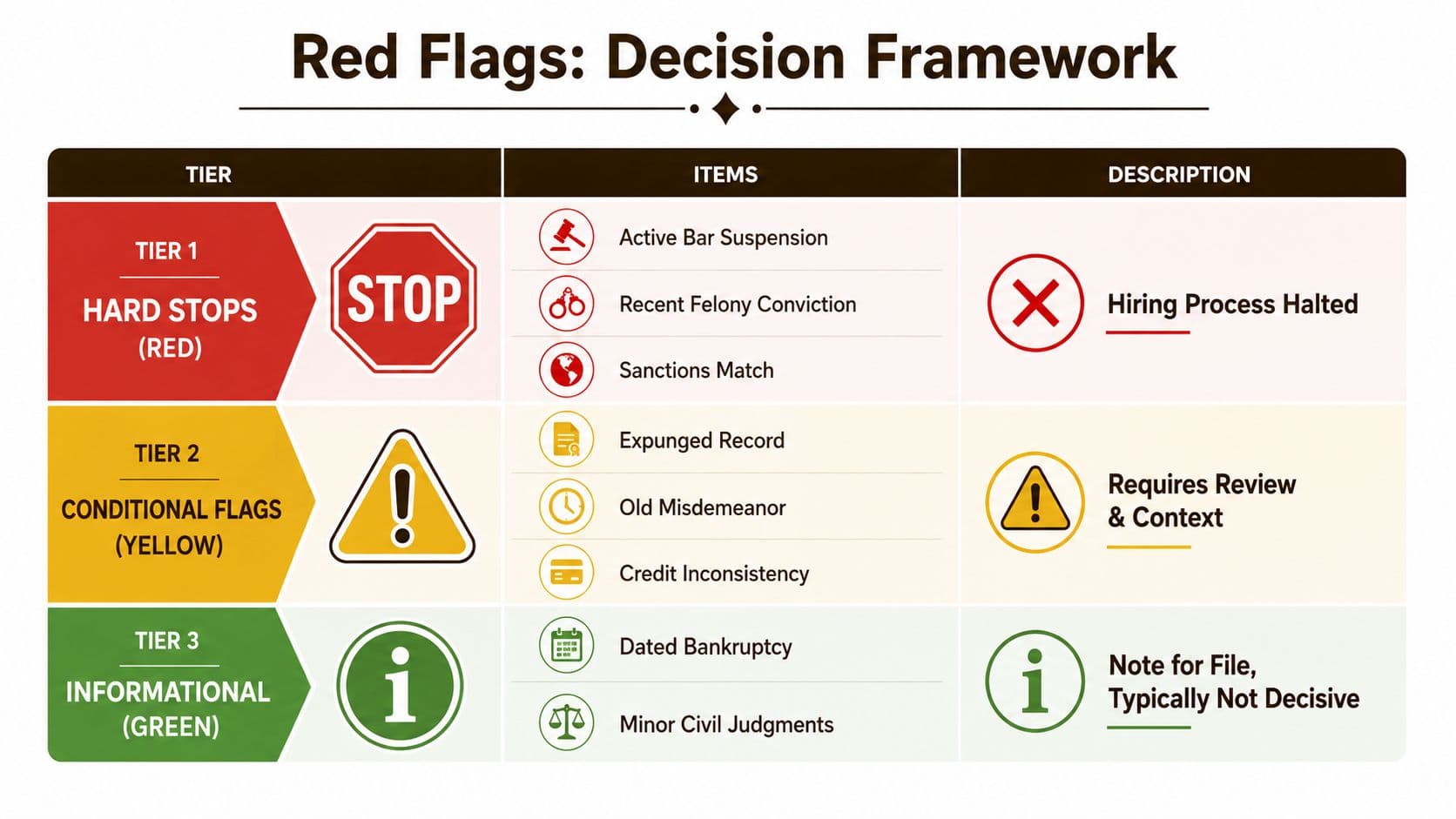
A report doesn't make the hiring decision. The reviewer does, and the reviewer needs a consistent path from finding to action. A useful matrix separates immediate barriers from issues that require context and items that should be recorded.
| Tier | Examples | Response |
|---|---|---|
| Hard stop | Active bar suspension, recent felony conviction, sanctions match | Pause the process, verify the result, escalate to designated legal or compliance authority |
| Conditional flag | Expunged record, old misdemeanor, credit inconsistency, disciplinary history older than five years | Confirm accuracy, invite explanation, assess relevance and proportionality |
| Informational item | Dated bankruptcy, minor civil judgment, ordinary lateral movement | Document the item and determine whether it affects the role |
An active suspension or confirmed sanctions match should halt progression while the firm verifies the identity and source. A disciplinary event that is older, resolved, and fully disclosed may warrant a very different response from a recent omission. The distinction is not leniency. It's risk analysis.
Ask for facts, not confessions
Candidate conversations should be neutral and specific:
- “The report lists a record associated with this name and date. Can you help us confirm whether it belongs to you?”
- “Our review shows a difference between the employment dates on your résumé and the employer's response. What explains the difference?”
- “The bar record reflects a public disciplinary event. Please describe the outcome and any current restrictions.”
Don't demand a broad explanation before showing the candidate the disputed information. Don't treat an arrest, civil matter, or credit entry as proof of wrongdoing. For questions about structured interviewer conversations, this interviewer question guide provides a useful companion framework.
Document the reasoning
The file should show the source, date reviewed, identity analysis, candidate response, role relevance, decision-maker, and final outcome. It should also show why the firm treated comparable findings consistently. That record supports fair treatment, helps the firm follow EEOC expectations, and gives the hiring committee a defensible explanation if the decision is later challenged.
A red flag is a prompt for disciplined review. It isn't a substitute for disciplined review.
Post-Hire Monitoring Without Crossing the Line
A one-time check can confirm a candidate's status on the day of hiring. It can't tell the firm whether a license later becomes inactive, a new sanctions restriction appears, or a regulatory issue changes the employee's suitability. Post-hire monitoring makes sense for certain high-trust roles, but only when the firm defines the purpose before collecting more information.
Three populations usually deserve different treatment:
- Partner-level fiduciary roles: Partners who control client funds, settlement proceeds, trust accounts, or major financial approvals may justify more frequent license and regulatory review.
- Regulated in-house counsel: Counsel working in heavily regulated businesses may need monitoring for license status, sanctions exposure, and role-specific regulatory restrictions.
- Staff attorneys and support populations: These employees may need a lighter annual review, supplemented by event-driven checks when a legitimate trigger occurs.
A 2025 industry report on background-screening trends describes increased attention to workforce monitoring, rescreening, AI-assisted screening, and data integration. Those tools can reduce administrative work, but automation doesn't decide whether a record belongs to the employee or whether an event is job-related.
Monitor the professional risk
Appropriate monitoring may include bar status changes, new sanctions-list matches, and defined court or regulatory filings that relate directly to the employee's responsibilities. The firm should state which sources it uses, who reviews alerts, how disputes work, and what happens before any employment action.
Avoid turning monitoring into lifestyle surveillance. Routine credit drift, social-media activity, and vague “reputation” signals invite privacy concerns, inconsistent treatment, and irrelevant decision-making. A monitoring policy should collect the least information needed for a defined risk.
A practical cadence is quarterly for partner-level fiduciary roles, annual for most attorneys, and event-driven when a legitimate criminal or regulatory trigger arises. Each cadence should be reviewed against applicable law, employee notice requirements, collective policies, and the actual duties of the role.
Sample Policy, Checklist, and What to Do This Week
A usable policy can fit on one page if it answers five questions:
- Scope: Which attorney and legal-support roles require screening?
- Checks: Which of the seven checks apply to each role tier?
- Authorization: What disclosure, consent, and FCRA workflow must be complete before searching?
- Review: Who adjudicates discrepancies, and who approves a hiring stop?
- Retention: Where are reports stored, who can access them, and when are they deleted?
Keep a separate pre-offer checklist with consent at the top, followed by bar status, criminal history, employment, education, permitted credit review, sanctions, and malpractice or litigation history. Add fields for source, date, result, dispute status, reviewer, and decision. A standardized form prevents the hiring partner from relying on memory or treating one candidate differently from another.
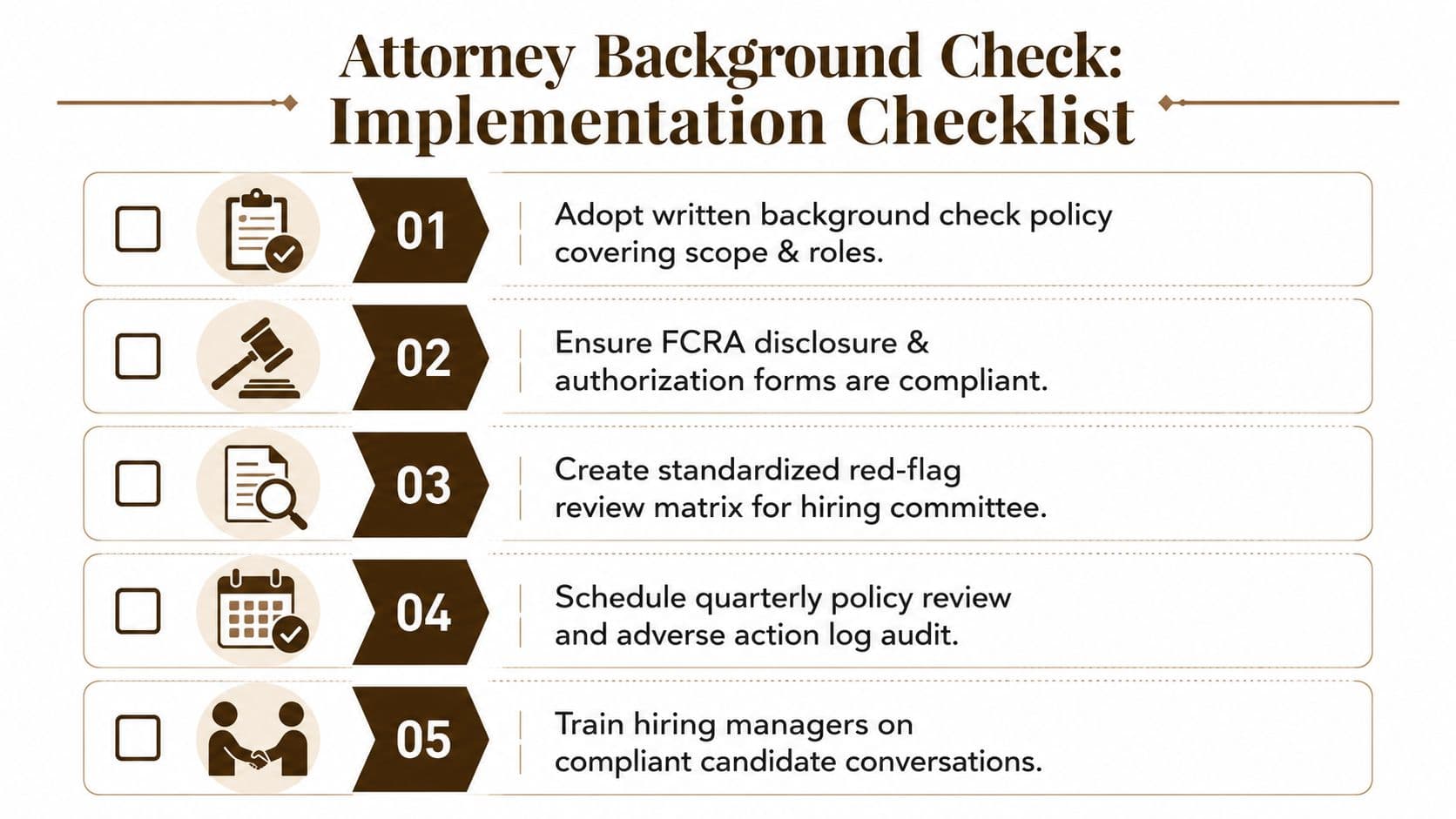
A practical rollout
This week, define role tiers and identify when financial exposure or regulatory sensitivity changes the screening package. Then shortlist a vendor, review its dispute and adverse-action process, and draft compliant disclosure and authorization forms. Pilot the workflow on one requisition, record every delay and discrepancy, and revise before expanding.
For broader hiring architecture, legal talent acquisition strategies can help connect screening with sourcing, interview design, and offer timing. The immediate objective is simple: launch every authorized check in parallel, escalate findings consistently, and preserve a clear record of why the firm proceeded or stopped.
Five Star Placements provides permanent placement for attorneys, partners, in-house counsel, legal support professionals, and legal operations leaders, with screening designed to meet practice needs and organizational culture. If your next search requires a faster, more disciplined process for evaluating legal talent, visit Five Star Placements to discuss your hiring needs.
Need help filling a legal role?
Five Star Placements partners with law firms and legal departments nationwide.
Schedule a Call