
Legal Talent Acquisition Strategies: Your 2026 Guide
June 30, 2026 · 18 min read · Five Star Placements

Table of contents
A critical legal role sits open longer than anyone expected. Partners are covering client work they shouldn't be touching. Senior associates are stretched thin. Your legal operations lead is triaging around a missing hire instead of improving the function. Every week the vacancy stays open, the team absorbs the cost in missed responsiveness, slower execution, and rising frustration.
Most firms react to that pressure by pushing harder on the obvious levers. They rewrite the job post, ask for more resumes, schedule more interviews, and hope volume fixes the problem. It rarely does. Legal hiring breaks down earlier than that. The underlying issue is usually poor role definition, weak candidate calibration, too many process steps, or a mismatch between what the firm says it wants and what the team will support once the person starts.
The firms that hire well don't treat acquisition and retention as separate projects. They build retention into the search itself. They define success before they source. They screen for how someone will work inside the practice, not just whether the resume looks familiar. They move decisively when they find the right person. They onboard in a way that validates the promises made during recruiting.
That is what strong legal talent acquisition strategies look like in practice. They reduce avoidable turnover by improving fit before the offer ever goes out. If you want a hiring partner's view of how that work is typically approached, the Five Star Placements team overview gives useful context on the permanent placement side of the market.
Table of Contents
- Introduction The High Cost of an Empty Desk
- Building Your Strategic Foundation Before the Search
- Sourcing Top Legal Talent Beyond the Job Board
- Screening for Practice Fit and Cultural Alignment
- Closing the Deal and Optimizing Your Time-to-Fill
- Onboarding for Retention and Measuring What Matters
Introduction The High Cost of an Empty Desk
An empty desk in a law firm or legal department doesn't stay empty in practice. Other people fill it with their time. A partner reviews work that should have been handled lower down. A paralegal picks up overflow from two matters at once. A department head delays an internal initiative because hiring has become the full-time side job nobody budgeted for.
The visible cost is delay. The less visible cost is distortion. Teams start designing around the vacancy. They lower expectations, redistribute work poorly, and accept avoidable strain as normal. That is how one open role turns into attrition risk for the people you were trying to protect.
Retention starts before the first interview. If the role is vague, the search will be noisy. If the interview process is inconsistent, the shortlist will be unreliable. If the offer is built around urgency instead of fit, the new hire may arrive misaligned from day one. Good legal talent acquisition strategies work because they connect all of those decisions.
A hiring process tells candidates what working at your firm will feel like. Slow, confused, and repetitive processes don't just lose people. They attract the wrong ones.
The practical question isn't whether you need to hire. You already know that. The question is whether your current process helps you make a durable hire or just a fast one that you'll revisit later.
Building Your Strategic Foundation Before the Search
A managing partner wants an offer out in three weeks because the workload is already spilling uphill. The instinct is to post the role, collect resumes, and let interviews sort it out. That usually creates a slower search and a shorter tenure. If the role is poorly defined at the start, the firm spends the rest of the process correcting for it.
The strongest hiring plans answer one question early. What does this person need to accomplish in the first year to make the hire worth repeating?
Start with success, not the job description
A job description is an administrative document. It lists duties, credentials, and reporting lines. It rarely explains why one candidate will last and another will leave after nine months.
A better starting point is a structured success profile. That means defining the work product, judgment calls, communication style, and pressure points attached to the role before sourcing begins. It also means asking where prior hires or internal transfers struggled. In legal hiring, that exercise improves both selection and retention because it forces the team to separate true performance requirements from habits and preferences.
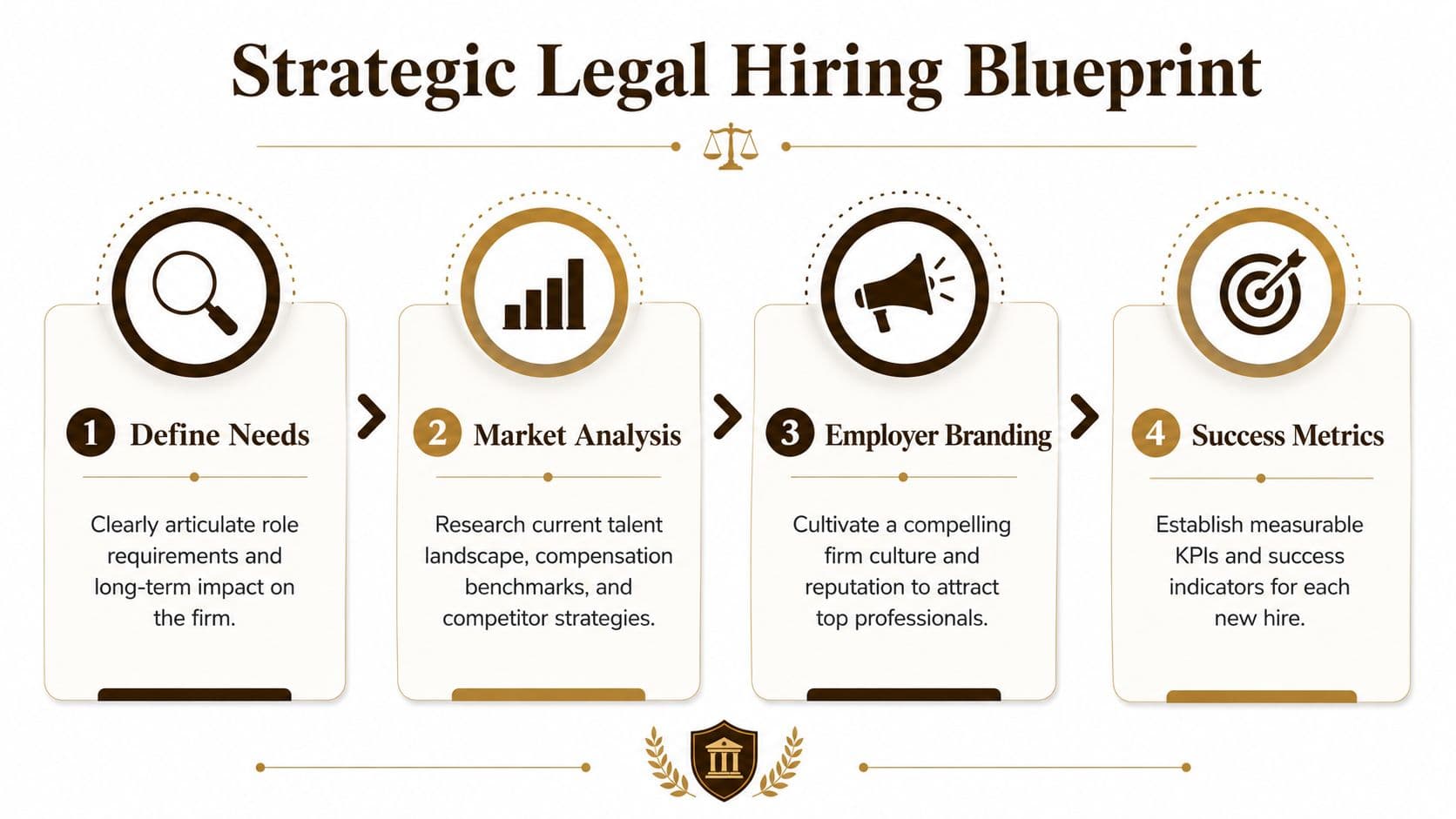
For a litigation associate, success may depend less on pedigree than on drafting discipline, calm judgment under deadline, and clear partner updates when a matter turns. For an in-house commercial counsel role, the retention risk often sits elsewhere. A lawyer may have strong technical skills but struggle with cross-functional influence, business pace, or a client group that expects practical answers before perfect ones.
That distinction matters. Firms and legal departments lose good people by hiring to the wrong scorecard, then trying to coach around a mismatch that was visible from the start.
Use the intake meeting to build a hiring brief the interview team can use:
| Hiring input | Weak version | Useful version |
|---|---|---|
| Role scope | Lists responsibilities | Defines decisions the hire will own |
| Candidate criteria | Years of experience and credentials | Competencies tied to success in your environment |
| Team fit | "Works well with others" | Specific collaboration style and communication expectations |
| Retention lens | Starts at onboarding | Starts before sourcing |
A retention-oriented search also requires honesty about the seat itself. If the role has heavy partner contact, uneven workflow, limited remote flexibility, or a narrow promotion path, define that now. Hiding friction points may increase early candidate volume, but it raises fallout later, either before acceptance or after start date. Good hiring teams surface the hard parts early and screen for people who can do well in that reality.
Build the market story before you recruit
Once the role is clear, the firm needs a consistent market story. Candidates are assessing more than compensation. They are reading for stability, expectations, leadership alignment, and whether this move improves their next three years, not just their next title.
That story starts well before the first recruiter call.
Review the public signals candidates will see. Check whether your LinkedIn company page reflects current leadership, practice strengths, and attorney experience. Check whether online reviews reveal recurring complaints about training, communication, or workload. Candidates do not expect perfection. They do expect consistency between what they read, what recruiters say, and what interviewers repeat.
Internal alignment matters just as much. If the practice group leader describes the role as strategic, HR frames it as coverage hiring, and a partner suggests the person will clean up work no one else wants, strong candidates will spot the contradiction quickly. So will the ones most likely to leave if they join under the wrong impression.
Set decision criteria before interviews begin. Decide which matters more for this role: immediate subject-matter depth, client management, portable relationships, process discipline, or team leadership potential. Trade-offs are normal. Vagueness is expensive.
Practical rule: If the hiring team cannot explain in one sentence why this role exists now, candidates will not trust the process.
This is also the point to decide how much of the search should stay in-house. Some firms keep intake, employer messaging, and interviews internal but ask an external partner to handle market mapping or screening. Others need full-cycle support because the hiring manager is billing full time and cannot run a disciplined search at the same time. One option in that mix is Five Star Placements, which provides permanent placement for attorneys, legal support staff, in-house counsel, and legal operations roles nationwide.
The right foundation reduces more than search friction. It shortens time-to-fill because the team knows what to screen for, and it improves retention because the candidate accepts a role they fully understand.
Sourcing Top Legal Talent Beyond the Job Board
A partner loses a fifth-year associate with two active matters, a key client expects continuity, and the team posts the role by lunch. Three weeks later, the applicants are mostly off-target, the strongest prospects have not entered the process, and the remaining team is covering the gap at the expense of billable work and morale. That is the pattern firms need to avoid.
Posting a role still has value. It gives active candidates a way in and supports baseline visibility. It rarely carries a search for a specialized associate, a discreet replacement, or an in-house legal hire where the best options are fully employed and cautious about changing seats. If retention matters, sourcing has to start with who is likely to stay and perform in your environment, not just who clicked apply first.
Why postings underperform for critical hires
The applicant pool is not the talent market. It is one slice of it.
Legal hiring teams often overread inbound volume. A stack of resumes can create false confidence, especially when the role has urgency behind it. In practice, the strongest long-term hires often come from channels where there is context around the candidate: who has worked with them, why they might move, what type of team they do well in, and what usually causes them to leave. That context helps firms avoid a common retention mistake, filling a seat quickly with someone who can do the work but has no reason to stay once the market shifts.

A stronger sourcing mix usually includes several channels working at once:
- Referral pipelines built before the opening exists, so trusted contacts can point you to lawyers and legal staff with a known work style and reputation.
- Professional network outreach through bar associations, specialty sections, alumni groups, and legal operations communities where people build standing over time.
- Past finalist re-engagement with candidates who were credible on a prior search but lost out on timing, practice need, or internal preference.
- Targeted recruiter outreach to passive candidates whose experience and likely tenure fit the role better than the public applicant pool.
Silver-medalist candidates deserve more attention than they usually get. If someone reached the final round six months ago, understood the work, and was treated well during the process, that person is already warmer than a new market contact. Re-engaging them often cuts time-to-fill and improves retention because both sides have a clearer picture of the role than they did at first pass.
For firms that want a practical read on how legal employers approach sourcing, market mapping, and candidate engagement, the legal recruiting insights on the Five Star Placements blog offer useful examples.
Narrow sourcing creates expensive hiring mistakes. Broad, targeted sourcing gives you options before urgency forces a compromise.
Retention should shape outreach from the first conversation. A candidate who needs a fully remote setup, more training, clearer origination credit, or a different path to partnership is not a bad candidate. They may be a bad fit for your role. Good sourcing identifies that early, before the team invests weeks in a search that ends in a short stay or a declined offer.
Use interim talent as a conversion pipeline
One underused channel in legal hiring is interim-to-permanent conversion.
Firms and legal departments often treat interim support as a stopgap. Sometimes it is. Sometimes it is the safest way to test fit in a real operating environment without forcing a permanent decision too early. This works especially well when demand is immediate but the long-term shape of the role is still taking form, such as a legal department adding contract management support or a firm assessing whether a practice group needs another permanent midlevel associate.
The retention benefit is straightforward. You get live evidence. Can the lawyer step into active matters quickly? Do they communicate in a way your partners, clients, or business stakeholders trust? Does the work itself justify a permanent hire once the initial backlog clears? Those are better questions than guessing fit from interviews alone.
A sound interim conversion process looks at three things:
- Short-term contribution. Can this person reduce pressure on the team without heavy supervision?
- Working fit under real conditions. Do they collaborate well, respond to feedback, and handle the pace as described during outreach?
- Long-term case for permanence. Does the business need support beyond the immediate gap, and does the candidate want the role as it operates?
This model is not right for every search. It adds a layer of planning, and some high-end candidates will only consider direct permanent moves. But when certainty is low and workload pressure is high, interim conversion can protect service levels while giving both sides a better basis for a long-term decision.
Here is a short explainer on sourcing and candidate engagement that fits this stage of the process:
Screening for Practice Fit and Cultural Alignment
Resume quality matters. Resume prestige is often overrated. A polished background can get someone into the process, but it doesn't tell you how they make decisions, handle clients, absorb feedback, or work under the norms of your practice.
Structured interviews beat pedigree-first screening
A common legal hiring mistake is overusing degree requirements and pedigree screens as a proxy for competence. The Stivers analysis of talent acquisition challenges points out that overlooking degree requirements can screen out qualified candidates, and it identifies skills-based hiring as one of the most impactful strategic shifts, especially as 70% of U.S. employers face skill gaps.

That doesn't mean lowering standards. It means testing the standards that matter.
Structured video interviews are one of the simplest upgrades. They force consistency. Every finalist gets the same core questions, the same scoring criteria, and the same opportunity to show how they think. That matters in legal hiring because unstructured interviews drift fast. One partner spends the whole conversation on writing samples. Another explores personality. A third evaluates "presence" without defining it. Then everyone compares impressions that were formed from completely different evidence.
A stronger interview design uses behavior-based questions such as:
- Tell me about a matter where the facts changed late and your recommendation had to change with them.
- Describe a time you had to push back on a partner, internal client, or stakeholder without damaging the relationship.
- Walk me through how you organize work when several deadlines hit at once.
- Give me an example of feedback you received that changed your approach going forward.
What to test before the final round
By the final round, you should know more than whether the candidate is likable. You should know whether the person can operate inside your specific environment.
Use a simple scorecard with room for narrative comments. Test for a mix of technical and organizational fit.
- Technical execution. Can the person explain their judgment process clearly, not just the result?
- Work style fit. Do they prefer autonomy, frequent feedback, or highly collaborative drafting cycles?
- Client or stakeholder presence. Can they translate legal complexity without sounding evasive or defensive?
- Retention indicators. Are they joining for the actual shape of the role, or for an imagined version of it?
If a candidate would succeed only after you change how your team manages, communicates, and assigns work, you're not evaluating fit. You're negotiating fantasy.
This is also where AI can help, but only in the right lanes. Use it for repetitive, high-volume tasks like resume review support, scheduling, and workflow handling. Keep human judgment in the final hiring decision. Engagement, motivation, and relational fit don't show up reliably in automation alone.
Closing the Deal and Optimizing Your Time-to-Fill
A candidate finishes the final interview on Friday, signals strong interest, and then hears nothing until the following Thursday. By then, another firm has already moved to offer. That loss usually has little to do with qualifications. It comes from delay, mixed signals, or unclear ownership inside the hiring team.
Time-to-fill problems often show up late, but they start much earlier. Firms add extra interviews to reduce risk, wait on compensation approvals that should have been settled before the search opened, or let feedback sit because no one owns the deadline. In a law firm or legal department, candidates read that delay as a preview of how decisions get made after they join.
A short workflow review usually reveals the same pressure points:
| Friction point | What it causes | Better fix |
|---|---|---|
| Too many interviewers | Delays and conflicting feedback | Limit decision-makers |
| Unclear approval chain | Offer bottlenecks | Pre-approve compensation range and title |
| Repetitive assessments | Candidate fatigue | Assign each stage a distinct purpose |
| Long silent gaps | Drop-off and ghosting | Set response deadlines after every round |
The practical target is simple. Remove any step that does not improve the decision. If a partner wants one more conversation, that interview should answer a specific question, not repeat the same discussion in a different office.
Speed matters, but speed alone does not improve hiring. The right goal is a fast, credible process that helps the candidate make an informed decision and helps you hire someone likely to stay. That means closing the deal with the same retention lens used in sourcing and screening.
The offer stage is where many firms create future turnover. They sell autonomy, but the role is tightly managed. They suggest a clear partnership path, but no one defines the timetable or business-development expectations. They imply flexible work arrangements, then introduce informal restrictions after acceptance. Candidates rarely forget that gap.
A stronger close does four things well:
- Assign one person to own the verbal offer and candidate communication.
- Resolve compensation, title, reporting line, and work arrangement details before the final round ends.
- Put specifics around growth, support, and expectations so the candidate can judge fit accurately.
- Stay in contact through conflicts checks, notice period, and start-date logistics.
That last point gets overlooked. Strong candidates are still deciding after they say yes. Counteroffers, partner outreach from competing firms, and second thoughts about workload or culture often surface during the notice period. Regular contact helps. So does reinforcing the actual shape of the role instead of reselling it.
In practice, the best closes are precise. A litigation associate should know who reviews drafts, how often they will be in court, and what success looks like in the first six months. An in-house counsel candidate should know whether the business wants a pure legal technician or a cross-functional operator who can handle product, compliance, and commercial stakeholders. Specificity reduces renegotiation after start and lowers the odds of an early exit.
If your team needs help tightening offer-stage execution or reducing preventable delays, use the legal search contact page to discuss the search.
Onboarding for Retention and Measuring What Matters
A candidate accepts your offer on Friday. By the second month, they are already wondering whether they made a mistake. That usually starts earlier than firms admit. The handoff was sloppy, expectations changed after the start date, or no one translated the promises made during recruiting into the actual first 90 days.
Retention starts before day one.
The firms and legal departments that keep good hires treat onboarding as part of talent acquisition, not an HR formality after the search closes. What was learned during sourcing, interviews, and offer discussions should shape how the person is introduced to the role. If an associate joined because they wanted stronger mentoring, assign that support immediately. If an in-house counsel hire was sold on cross-functional exposure, put them in the right meetings early instead of burying them in contract backlog.
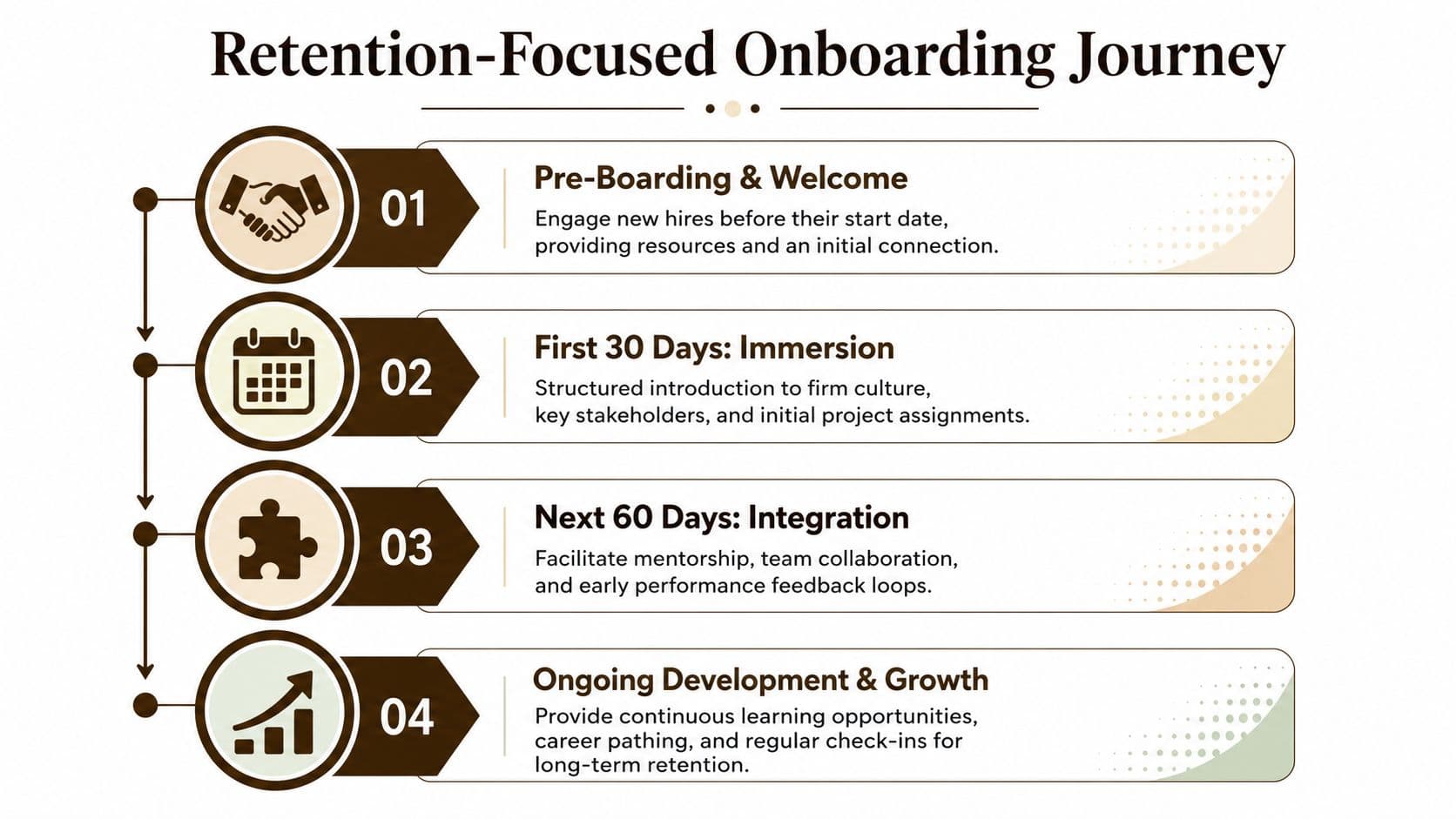
During the onboarding process, many hiring teams lose the retention gains they created during the search. They hire for long-term fit, then onboard for short-term coverage. That mismatch shows up fast in law firms with uneven partner management and in corporate legal departments where the new lawyer inherits stakeholder pressure without clear priorities.
A practical onboarding plan usually includes four parts:
- Pre-boarding with equipment, conflicts clearance follow-up, calendar access, and one clear point of contact
- Role immersion in the first month focused on how work gets assigned, reviewed, and escalated
- Structured integration through mentor access, early matter involvement, and regular feedback from the hiring manager
- Development checkpoints that connect performance expectations to advancement, not just immediate workload
Remote and distributed teams need even more structure. A new hire who does not know who can answer routine questions will often look disengaged before they have had a fair chance to contribute. Regular manager check-ins and deliberate mentorship are not culture extras. They reduce avoidable frustration and shorten the time it takes a lawyer or legal operations hire to become productive.
The strongest onboarding plans also carry forward the trade-offs discussed during hiring. If the role came with heavy billable expectations in exchange for better training, say that again in week one. If the in-house position offered broader business exposure but slower title progression, reinforce that reality early. Retention improves when the job stays consistent with what was sold.
Track quality of hire after the start date
A filled requisition is not the outcome. A productive hire who stays is the outcome.
That means measuring more than speed. Time-to-fill still matters because long vacancies strain partners, delay matters, and increase pressure to compromise on fit. But retention-focused hiring teams also review what happens after the start date. They look at early attrition, performance at defined checkpoints, and whether the original reasons for hiring the person were validated on the job.
The core measurements worth tracking include:
- Time-to-fill to spot process delays that hurt candidate quality or create coverage problems
- Offer acceptance rate to see whether compensation, scope, or decision speed are weakening close rates
- Cost-per-hire to compare search channels and internal process efficiency
- Retention through the first year and beyond to test whether fit was real or overstated
- Performance at 6, 12, and 18 months to confirm whether screening criteria predicted success
Those metrics are more useful when they are tied to role type. A litigation associate, a contracts manager, and a deputy general counsel should not be evaluated with the same retention logic. Some roles turn over because compensation is off market. Others fail because reporting lines are unclear, partner expectations conflict, or the hire was strong technically but weak in the operating environment. If you do not separate those causes, your recruiting process will keep solving the wrong problem.
This matters with nontraditional legal hires in particular. Legal operations leaders, privacy professionals, and hybrid commercial counsel often succeed because they can manage ambiguity, influence stakeholders, and build process. Conventional credentials matter, but they are not the whole picture. Firms that hire for long-term retention screen for those working traits early, then support them after the start date with clear authority, practical goals, and access to decision-makers.
The best teams review hiring outcomes quarterly. They ask simple questions. Which hires are still here? Which ones are performing? Which searches produced early regret, and why? That discipline improves the next search because retention is treated as a front-end hiring standard, not a problem to diagnose after someone resigns.
If your firm needs help hiring attorneys, legal support staff, in-house counsel, or legal operations leaders with a stronger focus on long-term fit, Five Star Placements provides permanent placement support built around customized search and screening for law firms and corporate legal departments.
Need help filling a legal role?
Five Star Placements partners with law firms and legal departments nationwide.
Schedule a Call