
What Does an Intake Specialist Do at a Law Firm
September 19, 2026 · 17 min read · Five Star Placements

Table of contents
Your phone is ringing. Marketing did its job. A prospective client is ready to talk. And your firm either captures that matter or wastes the lead before a lawyer ever gets involved.
That's the answer behind the question, what does an intake specialist do at a law firm. This person doesn't just answer calls. They protect revenue, filter risk, clean up data, and decide whether a live inquiry turns into a scheduled consultation or disappears to the next firm.
If your front desk is taking messages, your attorneys are screening random calls between hearings, or your CRM is full of half-complete leads, you don't have an intake process. You have lead leakage.
Table of Contents
- Why Intake Specialists Decide Whether Cases Become Clients
- How Law Firms Define the Intake Specialist Role
- A Day in the Life of a Law Firm Intake Specialist
- Risk Control and Data Governance Duties Most Pages Miss
- KPIs That Measure Intake Specialist Performance
- Sample Job Description for a Law Firm Intake Specialist
- How to Evaluate and Hire the Right Intake Candidate
- Hiring Checklist and Next Steps for Managing Partners
Why Intake Specialists Decide Whether Cases Become Clients
A serious lead comes in at 8:14 a.m. By 8:20, that caller has either booked with your firm, been cleanly disqualified, or hired the firm that answered faster and documented the matter better.
That outcome is usually decided before any lawyer speaks.
An intake specialist controls the first conversion point in your case pipeline. Indeed defines the role as the first contact for prospective clients who handles screening, intake details, scheduling, and case-management entry, according to Indeed's legal intake specialist overview. In practice, that job carries three consequences managing partners should care about immediately: revenue capture, risk control, and data quality.
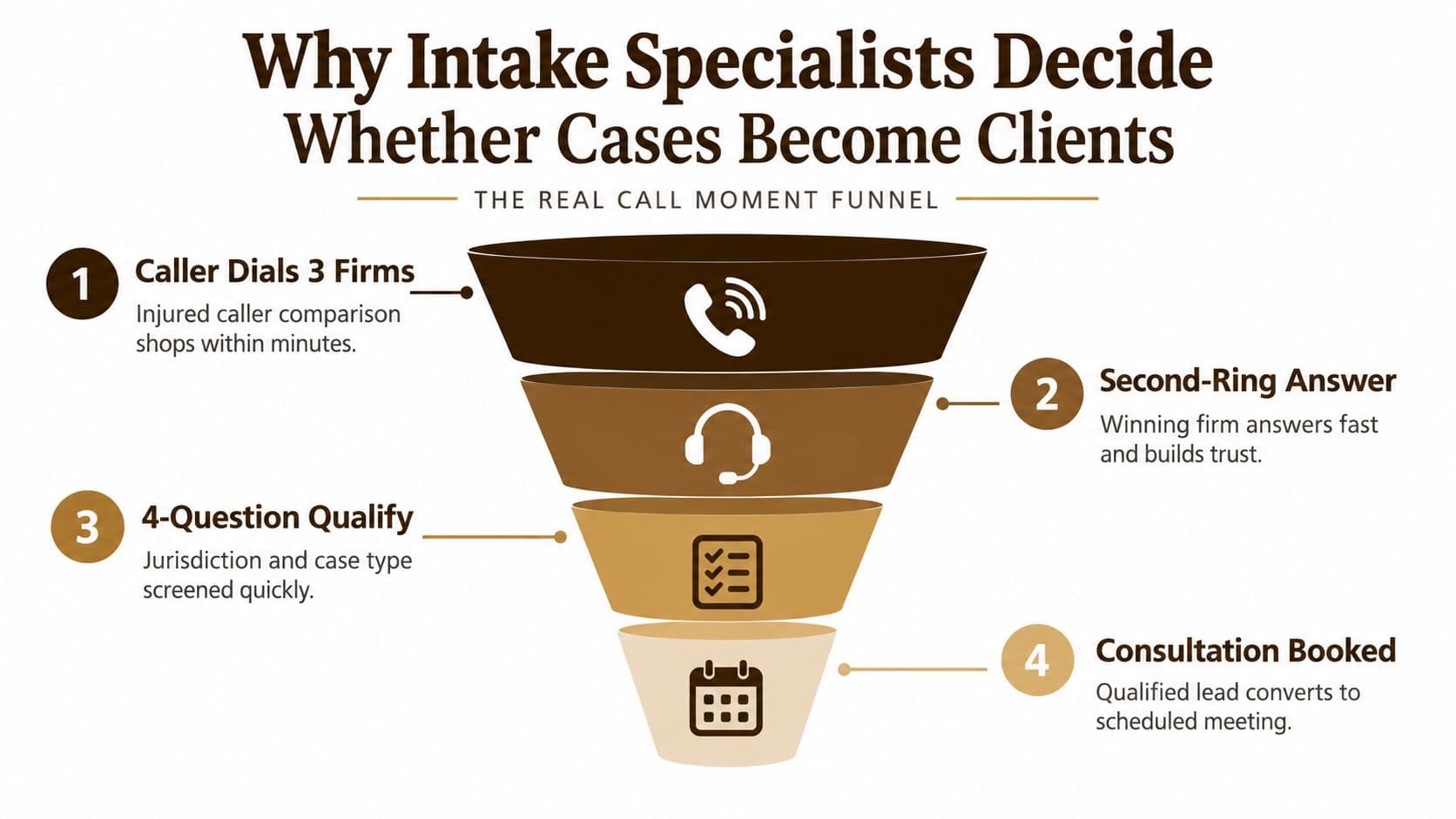
Missed first contact costs money
If a qualified prospect cannot reach a competent human, your marketing spend just bought traffic for a competitor. Speed matters, but quality of response matters just as much. The person handling intake has to capture enough facts to protect attorney time, route the matter correctly, and keep the lead from going cold.
Analysts cited in Pareto's legal client intake statistics summarize how often firms fail at basic call handling. That should not be read as a call-center problem. It is an operations problem that hits signed retainers.
Intake decides whether the firm gets a real opportunity
Firms lose cases at intake in predictable ways. Calls go to voicemail. Staff collect partial facts. No one records source, urgency, or adverse parties. The lawyer gets a vague message hours later and walks into the consult blind, if the consult gets scheduled at all.
A strong intake specialist prevents that breakdown. The role turns an interruption into a usable opportunity record, with enough structure for the firm to act fast and enough discipline to avoid avoidable mistakes.
Practical rule: Hire intake for judgment, pace, and documentation accuracy. If the person on your main line cannot identify fit, urgency, and the next step during the first interaction, you are losing revenue and increasing intake risk.
This is the hiring mistake firms keep making. They staff intake for courtesy instead of conversion, compliance, and clean data. Courtesy matters. It just does not save a weak pipeline.
How Law Firms Define the Intake Specialist Role
A managing partner who treats intake as front-desk coverage usually discovers the mistake in the monthly numbers. Marketing spend rises. Consultation calendars look half-full. Signed matters lag anyway. The missing piece is usually role definition.
An intake specialist is the firm's first revenue filter, first conflict checkpoint, and first owner of lead data quality. This person does not just answer inquiries. They turn inquiries into usable records, apply the firm's acceptance rules, document what matters, and move qualified prospects to the next step without wasting lawyer time.
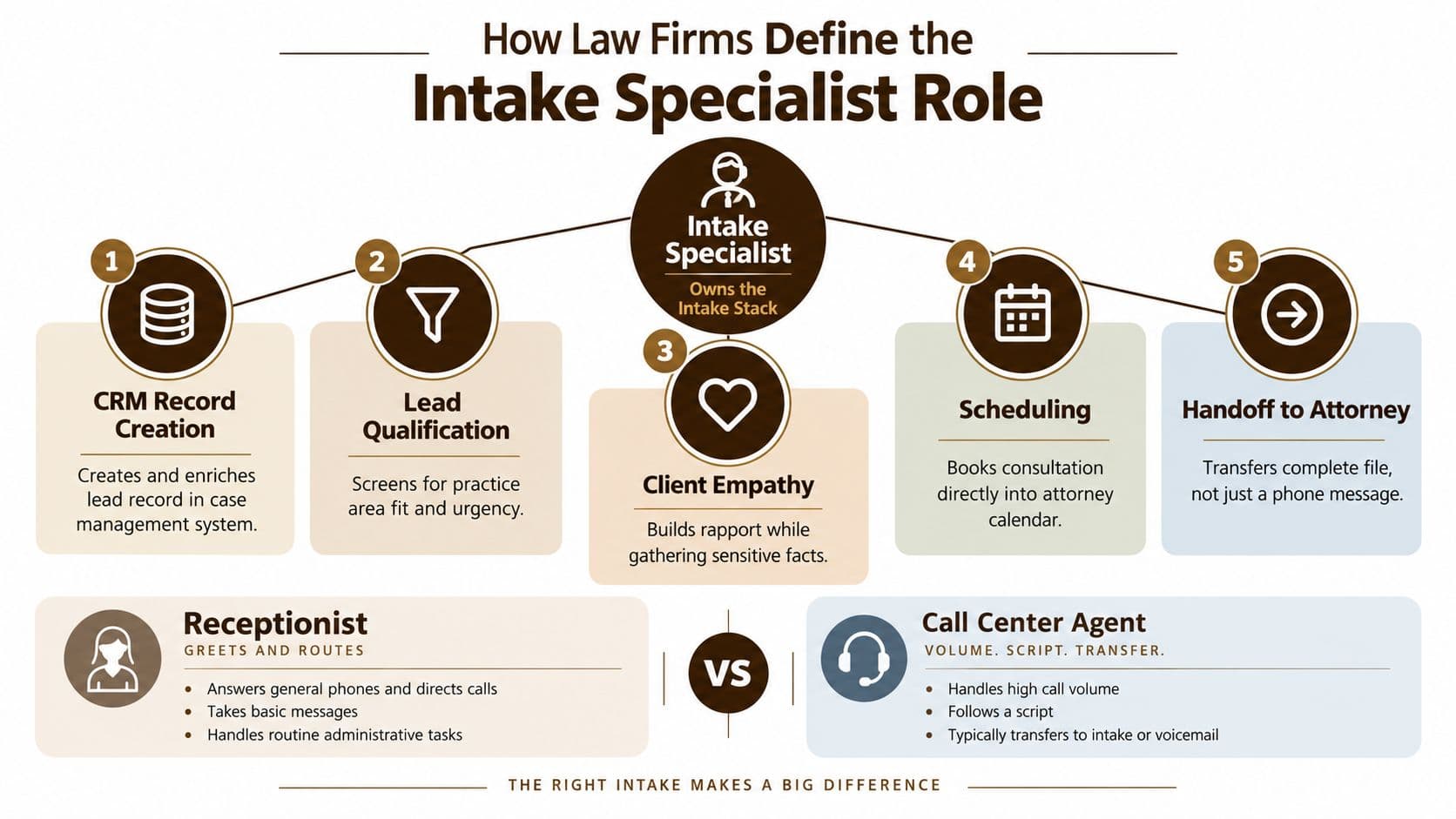
What the role actually owns
Well-run firms define intake as an operations role with clear decision rights. The intake specialist usually owns:
- Inbound lead handling: Calls, web forms, chat follow-up, email inquiries, and missed-call recovery.
- Qualification: Screening for practice-area fit, jurisdiction, urgency, case economics, and threshold facts that determine whether the matter should reach an attorney.
- Data capture: Creating complete, structured records in Clio Grow, Lawmatics, MyCase, HubSpot, or the firm's case-management stack.
- Scheduling: Booking qualified consultations based on attorney rules, capacity, and matter priority.
- Handoff quality: Giving attorneys a documented intake file with facts, source, notes, and next-step status.
That last point matters more than firms admit. A vague message wastes attorney time. A clean intake record protects it.
Why firms now define intake as a business function
Firms that staff intake as general admin support get admin results. Firms that define it as pipeline management get better conversion, cleaner reporting, and fewer avoidable errors.
Analysts cited earlier at Pareto describe how often firms mishandle first contact through missed calls, weak follow-up, and inconsistent response. The lesson is simple. Intake performance changes revenue outcomes. It also changes hiring risk. If your definition of the role ignores judgment, documentation discipline, and system use, you will hire a pleasant bottleneck instead of a producer.
The strongest job definitions tie each duty to a business result:
- Fast response protects paid demand.
- Accurate qualification protects attorney time.
- Clean data protects reporting and follow-up.
- Basic conflict spotting protects the firm.
- Complete handoff notes improve consult quality and close rates.
What separates the role from reception
Reception measures courtesy and call routing. Intake measures conversion, judgment, documentation accuracy, and next-step control.
The job is to screen, document, route, and preserve the opportunity without creating preventable risk.
That distinction should show up in the posting, training plan, and scorecard. If your job ad reads like office support, you will attract office support candidates. If you want someone who can protect revenue and keep your intake data usable, define the role that way from the start.
A Day in the Life of a Law Firm Intake Specialist
Here's what a competent intake workflow looks like in real life.
A new caller reaches the firm after a car accident. The intake specialist answers, opens a fresh CRM record, and tags the lead source before the basic facts get lost. They start with the essentials: who was involved, where it happened, when it happened, what injuries are being claimed, and whether the matter falls within the firm's practice lane.
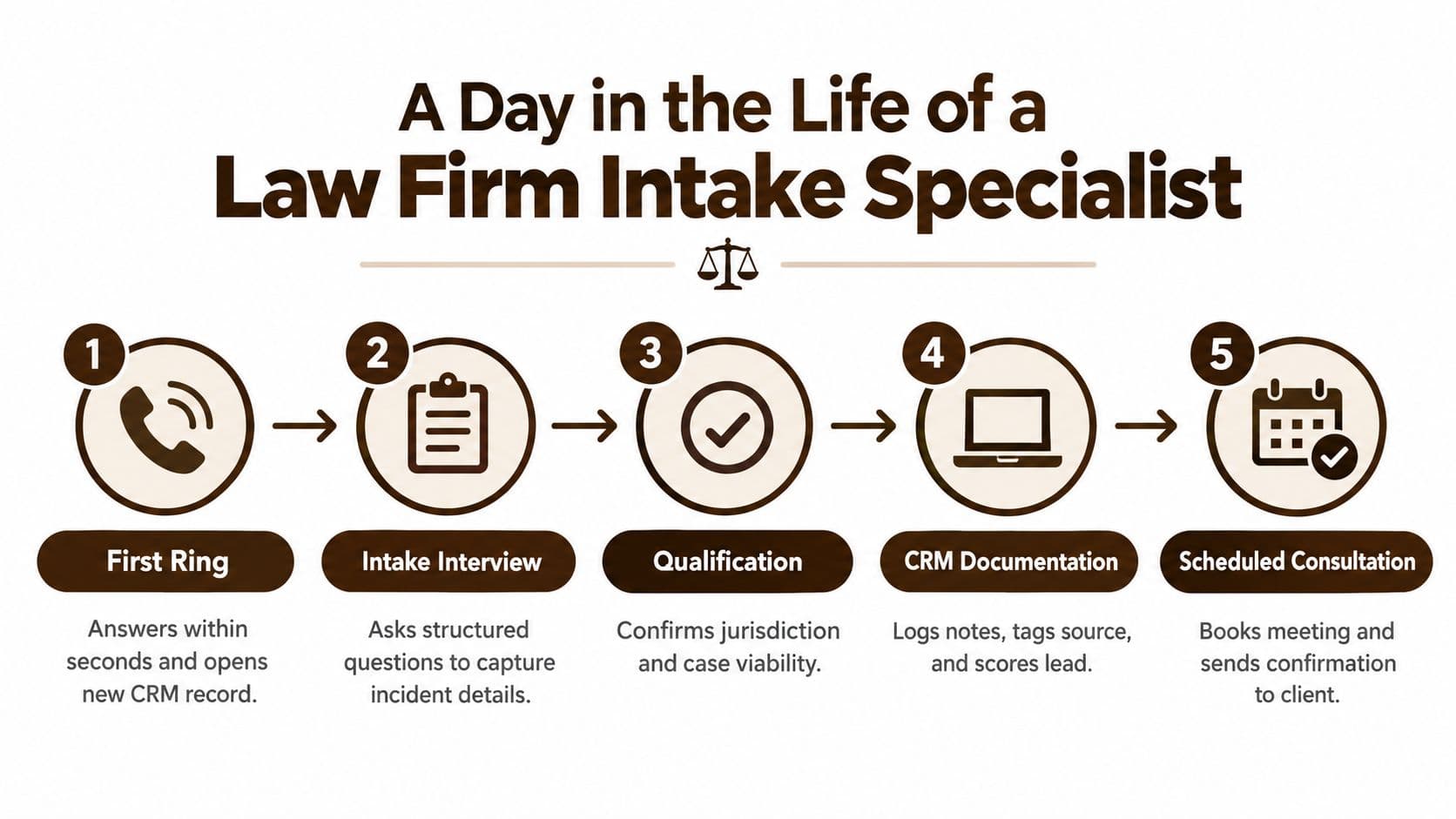
The live intake interview
This part isn't casual conversation. It's structured extraction.
The intake specialist interviews the prospect by phone or email, gathers timeline, liability, injury, jurisdiction, and documentation details, and applies firm-specific acceptance criteria before routing to an attorney or scheduling a consultation, as described by Legal Soft's explanation of the legal intake specialist role.
That process saves lawyers from wasting time on low-fit inquiries and preserves viable matters for fast escalation.
What gets captured in the system
On a strong intake call, narrative gets converted into fields your firm can use later. The intake specialist records names, opposing parties, incident date, county or state, adverse carrier if relevant, urgency level, and status notes that tell the next user what has happened already.
That matters because intake is also a data-capture and decision-support function inside the case-management stack, not just a warm transfer point. Every interaction needs to be logged cleanly enough that someone else can pick up the file without starting over.
Here's the flow in practical terms:
- Answer and identify the caller, matter type, and urgency.
- Screen for fit using the firm's actual acceptance criteria.
- Capture structured facts in the CRM, not just freeform notes.
- Check gating issues before attorney time gets committed.
- Book the right next step with the right lawyer on the right calendar.
To see the workflow visually, this short walkthrough is useful:
The handoff is where weak firms break down
Most intake failures happen at the handoff. The specialist gathered facts, but nobody owns next action. Or the lawyer receives a calendar invite with no context. Or the caller gets booked before obvious screening issues are caught.
A good intake specialist prevents all three. They don't just schedule. They package.
Risk Control and Data Governance Duties Most Pages Miss
Most explanations of intake stop at “answers calls and schedules consultations.” That's incomplete to the point of being dangerous.
Intake is also your firm's first compliance checkpoint. The person in this seat sits at the intersection of client acquisition, conflicts exposure, matter setup quality, and downstream billing integrity. If they capture bad data or skip the right checks, the damage follows the file.
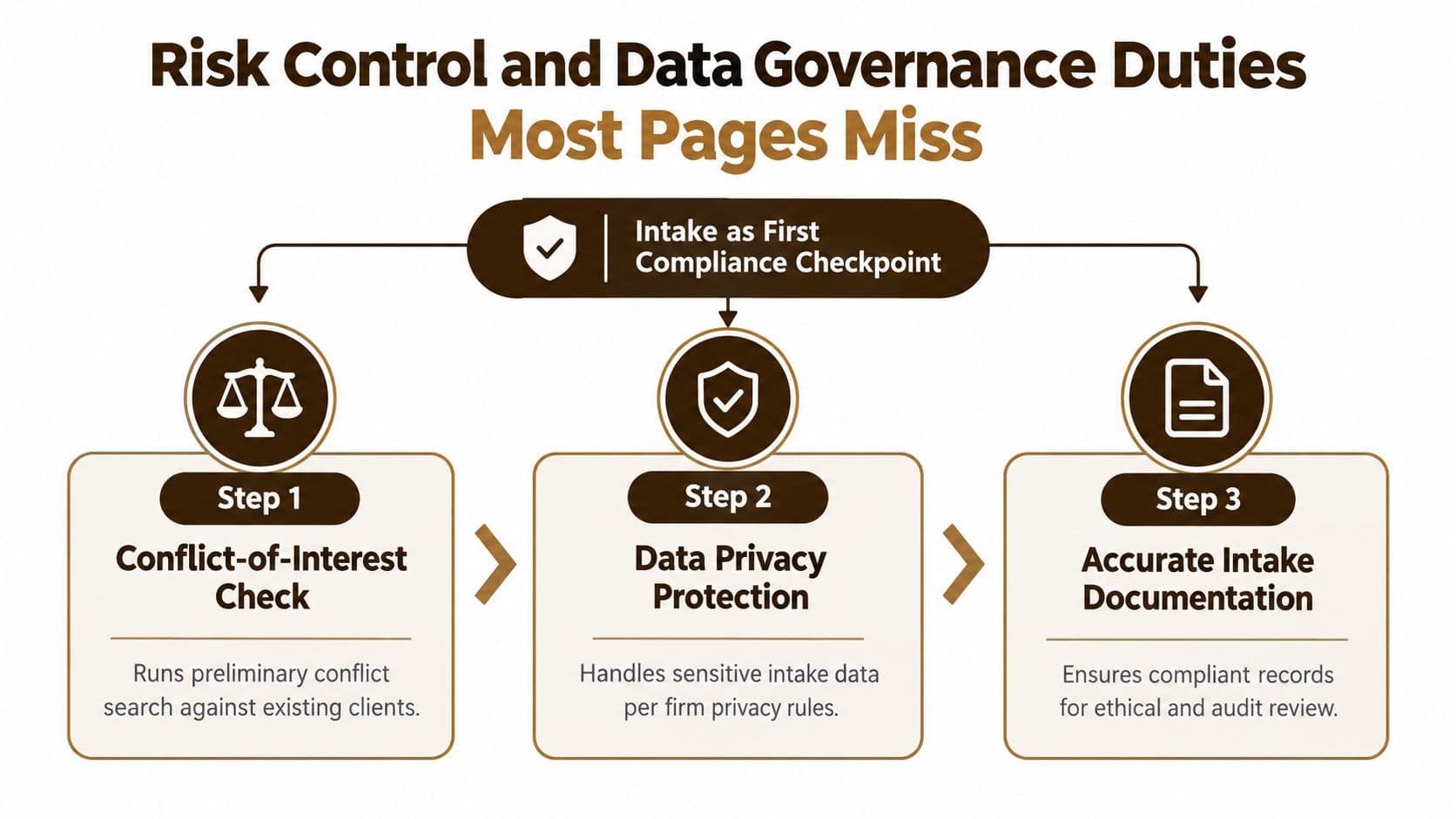
Conflict screening comes first
Public job descriptions increasingly emphasize conflict checks before a matter is opened. That shift reflects reality. Intake isn't just gathering names. It's comparing them against existing relationships, current files, and adverse parties before the firm moves deeper into the conversation.
A business intake posting highlighted by the Gordon Rees Scully Mansukhani role description underscores this risk-control angle, including conflict checks, validated matter data, audit trails, and compliance review.
If your intake hire doesn't understand why exact party names matter, you're not hiring a gatekeeper. You're hiring future cleanup work.
Audit trails and clean matter data
Every disclosure, follow-up, incomplete item, and scheduling event should leave a timestamped trail. That protects the firm when questions come up later about who said what, when a lead responded, or whether consent and next steps were properly documented.
The data itself also has to be usable. Mis-keyed names, wrong county, missing incident date, vague opposing-party information, or inconsistent naming conventions can poison the file before an attorney ever sees it.
Intake owns the data contract between marketing, case management, and risk. If that contract is sloppy, every downstream team pays for it.
What hiring managers should test for
You should evaluate this role for accuracy, not just phone presence. Ask whether the candidate has handled conflict searches, whether they understand why intake fields need standardization, and how they document incomplete records without losing accountability.
Three capabilities matter more than most firms realize:
- Conflict awareness: They need to know when a name mismatch can create a real issue later.
- Documentation discipline: They should log every touchpoint in a way another staff member can audit.
- Field validation: They must understand why matter data needs to be complete before the file is pushed forward.
This is why generic “friendly receptionist” hiring language backfires.
KPIs That Measure Intake Specialist Performance
If you can't score intake, you can't manage it. And if you can't manage it, you'll keep blaming marketing for a conversion problem that starts at the first human contact.
The most useful intake KPIs measure speed, persistence, conversion, and record quality. One intake playbook notes that in consumer-law settings, answering inbound calls and web leads within minutes improves conversion, and it describes 10 to 20 contact attempts per lead as a common follow-up range. The same source also cites 8% to 15% as a typical inbound-call-to-retainer conversion range for solo and small firms, according to HQ Intake's overview of the legal intake specialist role.
What should be on the scorecard
Don't dump a dozen vanity metrics on this role. Use a tight scorecard that tracks whether the specialist is moving qualified people forward and documenting the process cleanly.
| Intake Specialist KPI Scorecard | Formula | Target | Review Cadence |
|---|---|---|---|
| Lead-to-consultation rate | Qualified leads booked for consultation ÷ total qualified leads | Improve steadily over baseline | Weekly |
| Consultation-to-retainer conversion | Signed retainers ÷ completed consultations | Benchmark against firm baseline and practice area | Weekly and monthly |
| Speed to answer | Time from inbound call to human answer | As fast as operationally possible | Daily and weekly |
| Speed to lead | Time from web inquiry to first outreach | Within minutes whenever coverage allows | Daily and weekly |
| Follow-up persistence | Total documented follow-up attempts per unconverted lead | Consistent with firm workflow, often multiple attempts | Weekly |
| Show rate | Attended consultations ÷ scheduled consultations | Improve steadily over baseline | Weekly |
| Data completeness score | Complete required intake fields ÷ total required fields | Near-complete records before attorney handoff | Weekly |
| Lead source attribution accuracy | Correct source tags ÷ total new records audited | High accuracy | Monthly |
How to use the metrics
A KPI is only useful if it changes behavior. Review speed daily. Review conversion and quality weekly. Review broader patterns monthly.
If you need a broader framework for support-staff expectations, use a documented set of support staff performance standards and then tailor them to intake-specific work. Generic admin reviews don't work here because this role sits between sales, operations, and compliance.
Track the ratio between effort and movement. A specialist who logs every call but doesn't advance matters isn't performing. A specialist who books meetings with incomplete records is creating a different problem.
What to watch in the first 90 days
In the first 90 days, look for three signals. First, response activity is consistent. Second, records are clean enough that attorneys stop complaining about handoffs. Third, follow-up discipline is visible in the CRM instead of living in someone's memory.
That's how you know the function is becoming operational, not personal.
Sample Job Description for a Law Firm Intake Specialist
Most intake job ads are weak because they undersell the role. They sound like front desk coverage with better manners. That attracts the wrong people.
Use language that reflects the actual function. You are hiring someone to qualify leads, maintain CRM integrity, support conflict-aware intake, and move viable matters to the right attorney without friction.
Copy-ready job description
Job Title: Law Firm Intake Specialist
Role Summary
We are hiring an intake specialist to serve as the first point of contact for prospective clients and to manage the front-end screening process for new matters. This role is responsible for converting qualified inquiries into scheduled consultations, maintaining accurate intake records, and supporting risk-aware matter setup through conflict screening and clean data entry.
Core Responsibilities
Lead qualification and scheduling
- Answer inbound calls, emails, and online inquiries from prospective clients
- Conduct structured intake interviews using firm-approved scripts and qualification criteria
- Identify practice-area fit, jurisdiction, urgency, and other gating issues
- Schedule consultations for qualified leads with the appropriate attorney or team
- Follow up on incomplete or unsigned matters until the lead is resolved, disqualified, or advanced
CRM and case-management hygiene
- Create and maintain accurate lead records in systems such as Clio Grow, Lawmatics, MyCase, HubSpot, or equivalent platforms
- Record lead source, contact history, matter notes, and required intake fields
- Update dashboards, task queues, and status tags so the pipeline remains usable across teams
- Prepare clear attorney handoff summaries before consultations
Risk and compliance support
- Run preliminary conflict checks using firm procedures
- Validate names, dates, parties, and matter details before opening or routing the file
- Maintain clear documentation of outreach attempts, disclosures, and status updates
- Protect confidentiality and follow firm privacy and data-handling protocols
Required Qualifications
- Prior experience in legal intake, law firm client services, or a high-volume screening role
- Strong verbal communication, active listening, and call control
- Experience with CRM or case-management software
- High attention to detail in data entry and documentation
- Ability to manage distressed or time-sensitive callers professionally
Preferred Qualifications
- Experience with structured intake scripts
- Bilingual capability
- Familiarity with conflict screening workflows
- Exposure to personal injury, family law, immigration, or other consumer-facing practices
Reporting Line
This role typically reports to the director of operations, intake manager, office administrator, or marketing leadership, depending on firm structure.
If you're benchmarking current market language for this role, reviewing active guidance on intake specialist jobs can help tighten the posting before it goes live.
What to remove from weak postings
Cut vague filler like “must wear many hats” or “assist where needed.” Replace it with actual ownership. Strong candidates want clarity, and weak candidates hide inside ambiguity.
How to Evaluate and Hire the Right Intake Candidate
Resume polish doesn't predict intake performance. Structured screening does.
I'd score candidates across four dimensions: legal-industry exposure, structured call screening, CRM fluency, and composure under pressure. You don't need someone who sounds impressive. You need someone who can control a live interaction, capture facts accurately, and move the file forward without missing risk signals.
Use a scored interview, not a casual conversation
Role-play beats small talk. Give candidates realistic prompts and score what they do, not how confident they sound doing it.
| Intake Specialist Interview Scorecard | Weight | Scored Task | Red Flag |
|---|---|---|---|
| Legal-industry exposure | High | Explain how they would screen a new matter for fit before attorney review | Can't explain jurisdiction, urgency, or basic conflicts logic |
| Structured call screening | High | Run a mock intake call with a distressed prospective client | Talks generally, misses key facts, doesn't control the conversation |
| CRM and case-management fluency | High | Describe how they document lead source, notes, and next action in prior systems | Gives vague answers about software use or resists documentation |
| Composure under pressure | Medium | Handle a hostile or impatient caller in a live scenario | Gets flustered, argumentative, or abandons structure |
| Follow-up discipline | Medium | Explain how they manage incomplete leads and repeat outreach | No clear process for tasking, callbacks, or status tracking |
| Risk awareness | Medium | Respond to a conflict-of-interest probe or sensitive disclosure | Doesn't know when to pause and escalate |
The interview scenarios that matter
Use scenarios that reveal judgment:
- Hostile PI caller: Can the candidate keep control, gather facts, and preserve trust?
- Statute panic: Do they recognize urgency and move fast without improvising legal advice?
- Conflict probe: Do they know when names, relationships, and adverse parties need careful handling?
For a sharper read on candidate communication, use a practical communication skills assessment instead of relying on interview charm.
A candidate who refuses to log calls in detail is telling you how they'll fail in the job.
Red flags that justify a no-hire
Three red flags predict operational pain fast. First, the candidate talks about “helping out with phones” but can't explain a screening process. Second, they mention prior software but can't describe how they used it. Third, they don't understand why urgency and jurisdiction matter at intake.
If you need outside help building a candidate slate for this role, Five Star Placements provides permanent placement for legal support positions, including intake hires, with screening tied to role fit and law-firm process requirements.
Hiring Checklist and Next Steps for Managing Partners
If your firm is missing calls, slow-walking web leads, or handing attorneys sloppy intake notes, hire for intake now. Don't wait until “operations gets around to it.” The leak is already costing you.
Pick the right staffing model
The right model depends on lead flow and practice mix.
- Small firms with lighter intake volume: Compare a part-time or remote specialist against outsourced recruiting help if you don't want to build the search internally.
- Mid-size firms with steady consumer-facing work: A full-time hire paired with CRM automation is usually the cleanest answer.
- Higher-volume firms: Build a dedicated intake team with quality-control review and clear escalation rules.
Set first-60-day operating priorities
In the first two months, wire in the metrics that tell you whether the hire is changing outcomes:
- Lead-to-consultation movement: Are qualified inquiries getting booked?
- Speed to lead: Is the team responding in minutes when coverage allows?
- Conflict-check cycle time: Are records being cleared and routed without bottlenecks?
Run a pre-launch checklist before day one
Don't hire the person and then improvise the job.
Make sure you have:
- System access: Phone, VoIP, dialer, CRM, calendar, templates
- Permissions: Role-based access inside intake and case-management tools
- Decision rules: Written qualification criteria, escalation triggers, and conflict procedures
- Baseline reporting: Current conversion and response benchmarks so performance can be measured against something real
The firms that get this right don't just answer more calls. They create a cleaner front end for the entire business.
If your firm needs an intake specialist who can do more than answer phones, Five Star Placements can help you hire for the role the way it functions inside a law firm: conversion, documentation, and risk-aware screening. They recruit legal support talent for permanent placement and can help you tighten the job spec, evaluate candidates, and fill the seat faster. Visit Five Star Placements to see how they support legal hiring across intake, operations, and attorney roles.
Need help filling a legal role?
Five Star Placements partners with law firms and legal departments nationwide.
Schedule a Call