
Contingency Example in Legal Recruiting: How It Works
October 22, 2026 · 14 min read · Five Star Placements
Table of contents
A litigation associate has resigned, a trial calendar is already full, and the managing partner needs coverage before the vacancy starts pulling work away from the rest of the team. Two recruiters call in the same week. One offers a contingency arrangement: no fee unless the firm hires a candidate the recruiter introduced. The other recommends a retained search, with payment due before a hire is made.
The obvious question is which recruiter can deliver. The more important one is what the agreement makes the firm responsible for if a candidate is hired, leaves, or was already in its network. A “no hire, no fee” headline doesn't settle those details.
A contingency placement can shift some sourcing risk to the recruiter, but it doesn't erase the cost of a prolonged vacancy or protect a client from poorly drafted terms. The decision comes down to three things: how the model works, what the fee covers, and whether the agreement puts unexpected risk back on the firm.
Table of Contents
- A Managing Partner's Dilemma
- What a Contingency Placement Really Means
- Contingency as a Risk Transfer Mechanism
- Contingency Versus Retained, Internal, and Contract
- A Contingency Placement Fee Structure Walked Through
- Contract Clauses Most Contingency Examples Ignore
- Pros and Cons for Clients and Candidates
A Managing Partner's Dilemma
The managing partner has a real business problem, not an abstract recruiting question. A litigation associate has left, client matters still need attention, and the remaining attorneys are dividing the work. One recruiter says the firm can review candidates without paying upfront. Another says the vacancy merits a retained search with a more dedicated process.
Neither proposal is automatically safer. The contingency recruiter may bear the cost of sourcing and only earn a fee if the firm hires a candidate they introduced. But the firm may still owe a fee under a clause that treats an accepted offer as the trigger, or that gives the recruiter ownership of a candidate for a period after submission. The retained recruiter asks for payment earlier, but the agreement may define the work, responsibilities, and search scope more clearly. Read the terms, not just the sales pitch.
A useful starting point is the vacancy itself. If the associate's work is recurring, the practice group has a clear picture of the skills required, and the firm can interview promptly, contingency may fit. If the role is a senior partner hire requiring confidential outreach, or the brief is still evolving, a retained model may better match the search. If the work is temporary or tied to a defined matter, neither permanent-placement model may be the right answer.
The practical question: Which arrangement gives the firm the right candidate, with clear obligations if the search succeeds or the hire doesn't last?
The firm should compare the recruiter's candidate access and screening process, but it also needs to test the agreement. What event triggers the fee? How does the firm establish that a candidate was already known? What happens if another recruiter submits the same person? Does a replacement guarantee provide a replacement search, a refund, or neither?
Those answers matter as much as the shortlist. A contingency agreement can make a search easier to start, but the contract determines whether the firm is protected when the search gets complicated.
What a Contingency Placement Really Means
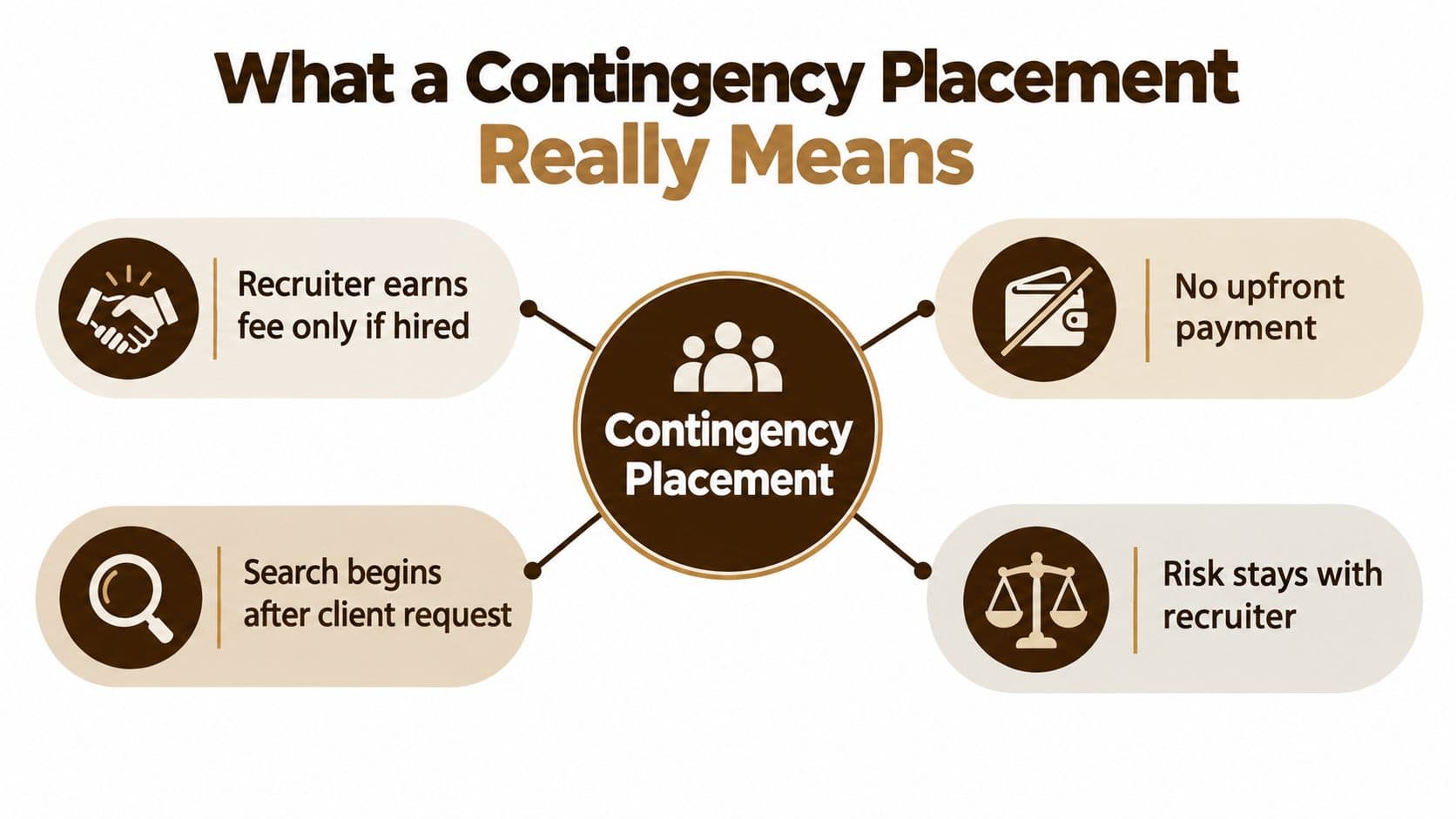
In plain English, contingency recruiting means the recruiter earns a fee only if the client hires a candidate the recruiter submitted under the agreement. The firm doesn't pay a retainer to begin the search. The recruiter invests effort in sourcing and evaluating candidates, with payment dependent on a successful placement.
For example, a law firm wants a trusts-and-estates attorney with experience advising clients on complex matters. The recruiter searches for candidates, checks their relevant experience, and introduces people who meet the firm's requirements. If the firm hires one of those candidates, the agreement determines the fee and the payment terms. If it hires no one introduced by that recruiter, the usual contingency model doesn't produce a placement fee.
The recruiting meaning, not the legal-fee meaning
In legal recruiting, a contingency placement is typically a permanent hire at a law firm or corporate legal department. The placement may be an attorney, paralegal, legal operations leader, or another legal professional. The fee is commonly calculated as a percentage of first-year base salary, but the agreement must state exactly what compensation counts and when the fee becomes due.
That use of contingency is different from a plaintiff attorney's contingency fee. In that arrangement, the attorney's payment depends on the outcome of a legal matter. In recruiting, the contingent event is the employer's hire of a recruiter-introduced candidate. The recruiter isn't representing a party in litigation or collecting a share of a legal recovery.
A working definition you can give a colleague is: the client pays a recruiting fee if it hires a candidate covered by the agreement, and the contract defines which hires count. That final phrase matters. Candidate ownership, prior knowledge, duplicate submissions, and the fee trigger can all affect whether the client owes a fee.
A recruiter's responsibilities can also extend beyond forwarding resumes. For a practical overview of the work involved, see this explanation of what a legal recruiter does. The firm should still ask how the recruiter will screen for practice readiness and fit, rather than assuming that a contingency fee automatically buys a particular level of service.
Contingency as a Risk Transfer Mechanism
A contingency arrangement isn't free recruiting. It shifts some search risk to the recruiter. The recruiter invests time and effort in outreach and screening, and the client pays a placement fee only if a covered hire occurs. The firm's larger remaining exposure may be the vacancy itself: work delayed, redistributed, or not taken on while the position remains open.
That exposure can be made concrete. SHRM reports a median time-to-fill of 39 calendar days for nonexecutive roles in its recruiting benchmark. Consider a litigation associate role where the firm estimates that each vacant day represents $2,000 in collected revenue or matter-delivery value. If a hiring process reduces the vacancy from 39 days to 20, the firm preserves roughly $38,000 in gross opportunity value: 19 fewer vacancy days multiplied by the estimated daily value.
That is an illustration, not a promise that a recruiter will fill the role on a particular schedule or that every day's value can be collected. It does show why a firm should weigh a placement fee against the cost of leaving the role unfilled. Speed has financial consequences when the work is waiting.
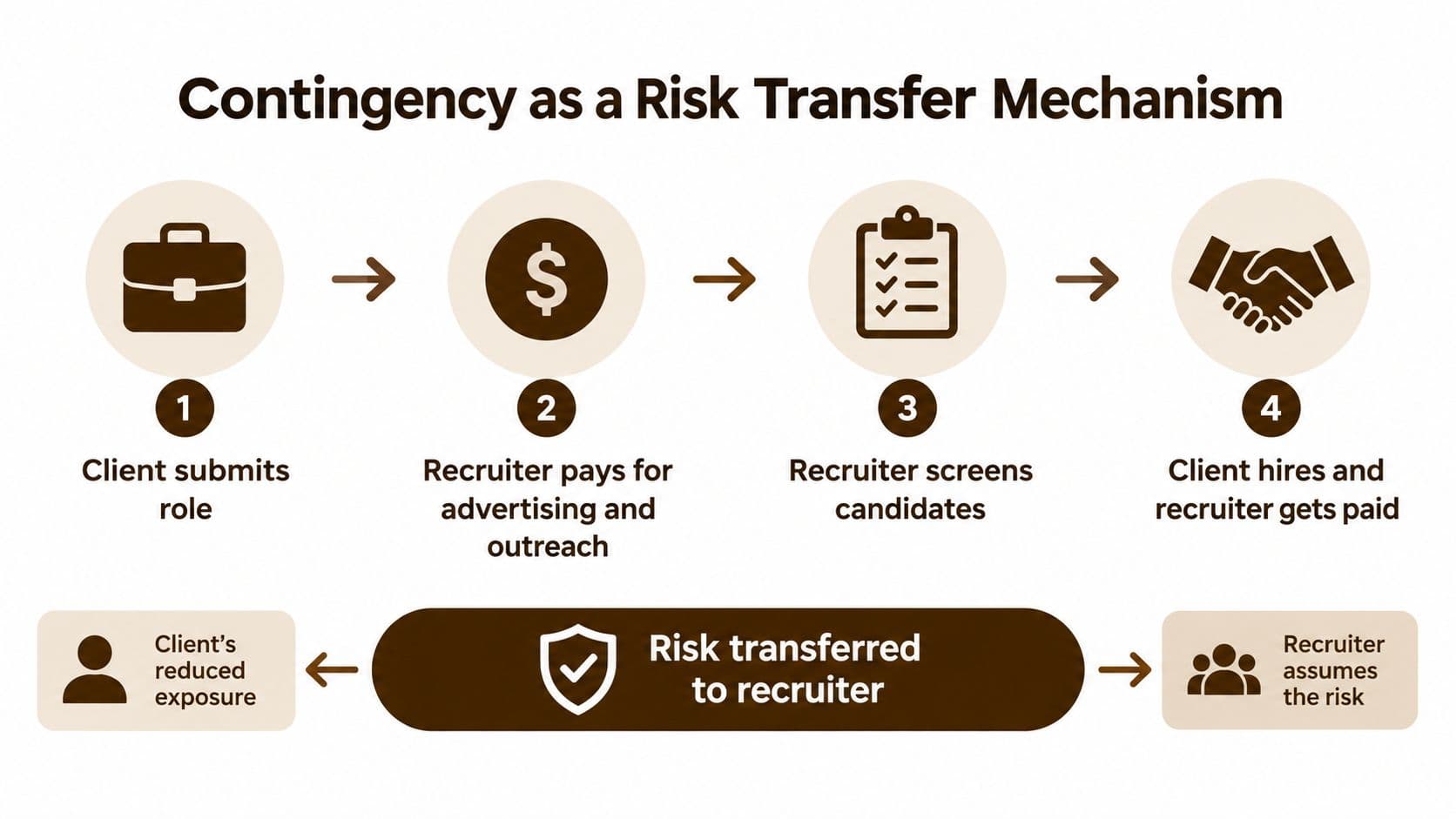
Measure the hiring process, not just the invoice
The firm should track the search from authorization to start date. Record when the role opens, when qualified candidates arrive, when interviews take place, when an offer is accepted, and when the hire starts. Afterward, track retention and whether the hire restored the work or capacity the practice group needed.
A contingency fee is easier to assess when the client compares it with both vacancy exposure and the risk of a failed match. A fast offer to a poor-fit candidate can create more cost than a deliberate search with structured evaluation. Set the role requirements before reviewing resumes, then decide whether the recruiter is meeting them.
The recruiter takes on sourcing expense, but the client still has responsibilities. Hiring partners need to agree on a decision-maker, provide timely feedback, and make interview availability a priority. If the firm lets qualified candidates wait while the process stalls, the fee structure can't solve the vacancy problem.
The video below provides another view of the recruiting process and how the parties' responsibilities connect.
Contingency Versus Retained, Internal, and Contract
The right model depends on the vacancy, not on a blanket preference for “no upfront cost.” A firm should first decide whether it needs a permanent employee, what level of search support the role requires, and how quickly the hiring team can act.
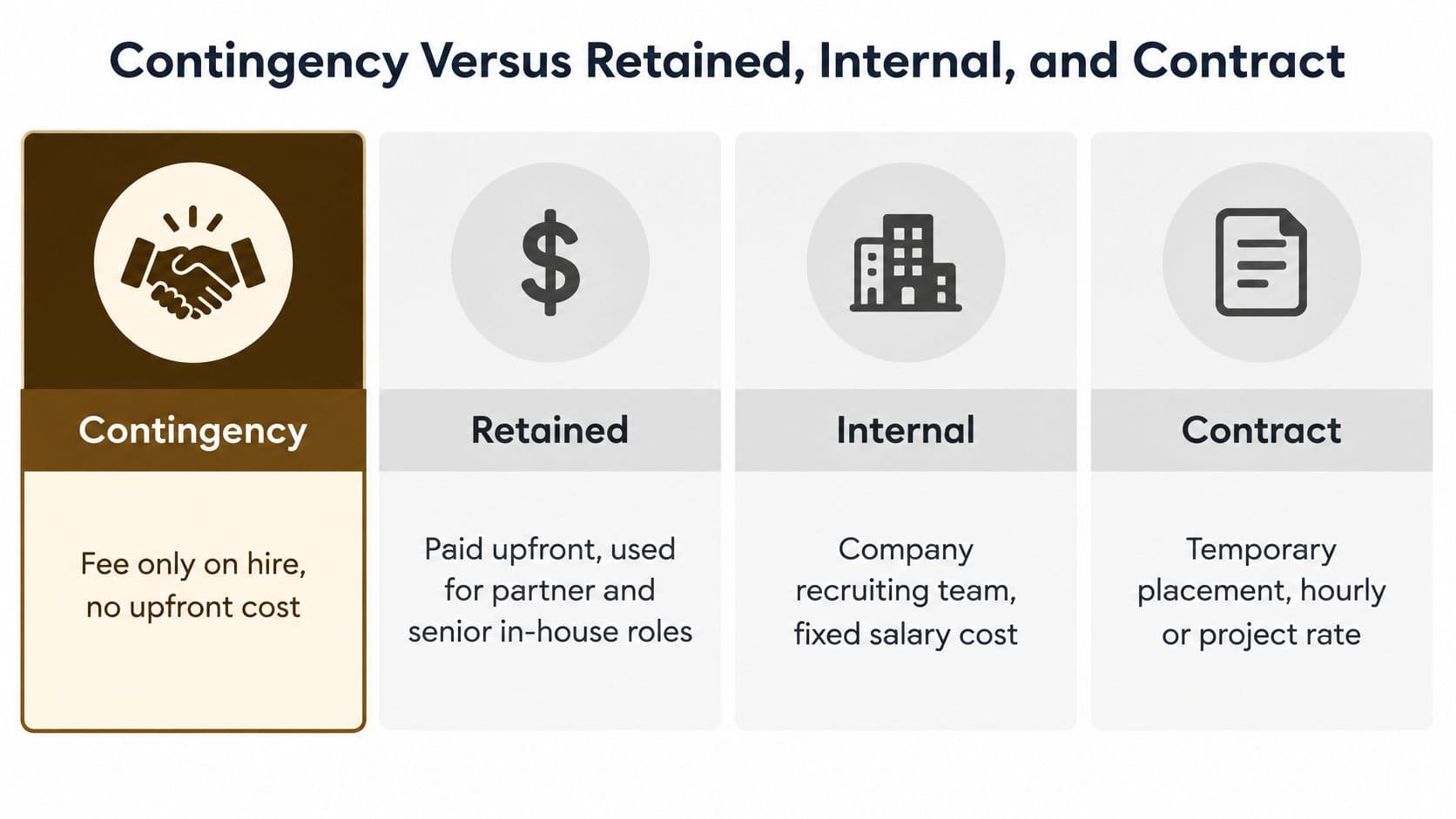
Match the model to the vacancy
| Hiring model | Best fit | Main trade-off |
|---|---|---|
| Contingency | A permanent role with clear requirements and a hiring team ready to interview | No placement fee unless a covered candidate is hired, but the firm must clarify ownership and fee terms |
| Retained search | A partner, senior in-house counsel, or specialist role requiring a defined search commitment | The firm pays for the search before a placement is made |
| Internal sourcing | A firm with time, internal recruiting capacity, and an existing candidate pipeline | The firm avoids an external placement fee but commits its own staff time |
| Contract legal support | Time-bounded work or a temporary skills gap | The firm gets temporary capacity, not a permanent hire |
Choose contingency when the role is mid-level or support-focused, the hiring team can describe the requirements, and the firm wants external sourcing without a retainer. This model is less attractive if the firm can't agree on who owns the candidate, or if hiring managers won't review submissions promptly.
Choose retained search when the role is senior, confidential, or difficult to define through a simple job description. A retained arrangement can make sense when the search requires dedicated attention and proactive outreach to a narrow pool. Before signing, review the scope and payment milestones. This guide to what retained search means can help frame the comparison.
Use internal sourcing when the firm has a credible pipeline and can give the search consistent attention. An internal recruiter may understand the culture and decision-makers well, but that doesn't automatically translate into access to candidates outside the firm's network.
Use contract support when the workload has a defined endpoint or the firm hasn't established that it needs a permanent employee. Don't hire permanently just because a matter is urgent. Compare the expected duration of the work, specialization, onboarding demands, and likelihood that the workload will continue. The fastest staffing answer isn't always a permanent placement.
A Contingency Placement Fee Structure Walked Through
Consider a firm hiring a trusts-and-estates associate at a $165,000 base salary. Treat that salary as an example for examining the contract, not as a market benchmark. The agreement should tell the firm how to turn the salary into a fee, what event creates the obligation, and what remedy applies if the placement doesn't work out.
Industry guidance describes contingency fees as commonly 15% to 25% of first-year base salary, with guarantees commonly 60 to 90 days. It also emphasizes that terms vary by agreement, so those ranges aren't a substitute for reading the contract. See the discussion of contingency recruiter fees and terms.
Read the calculation from the salary definition outward
For this example, the fee calculation starts with the agreed base salary and the percentage stated in the contract. The firm should not assume that “first-year compensation” means base salary alone. Ask whether guaranteed bonus, signing bonus, equity, draws, or other compensation is included. If the agreement uses “compensation” without defining it, ask for a precise written definition.
| Role type | Typical base salary | Fee range (% of base) | Trigger event | Guarantee window |
|---|---|---|---|---|
| Trusts-and-estates associate | Agreed salary for the role | Commonly 15% to 25% | As defined in the agreement | Commonly 60 to 90 days |
| Paralegal | Agreed salary for the role | Confirm in the agreement | As defined in the agreement | Confirm in the agreement |
| Senior in-house counsel | Agreed salary for the role | Confirm in the agreement | As defined in the agreement | Confirm in the agreement |
The trigger may be offer acceptance, the employee's start date, or another defined event. Don't rely on what a recruiter says is “standard.” If the fee is triggered on acceptance, establish what happens if the candidate withdraws before starting. If the trigger is the start date, clarify whether the invoice is due then or on a later schedule.
Payment timing is a separate clause. The contract should say when the recruiter invoices and when the client must pay. Likewise, a guarantee should identify what qualifies for coverage if the hire leaves or the firm terminates the employee. A promise to replace a candidate isn't the same as a refund, and the agreement should state which remedy applies.
A paralegal search and a senior in-house counsel search shouldn't be treated as interchangeable because both are permanent placements. The salary basis, search difficulty, trigger, and guarantee terms must be confirmed for each role. For a broader breakdown of legal recruiting fees, focus on the actual written terms rather than a headline percentage.
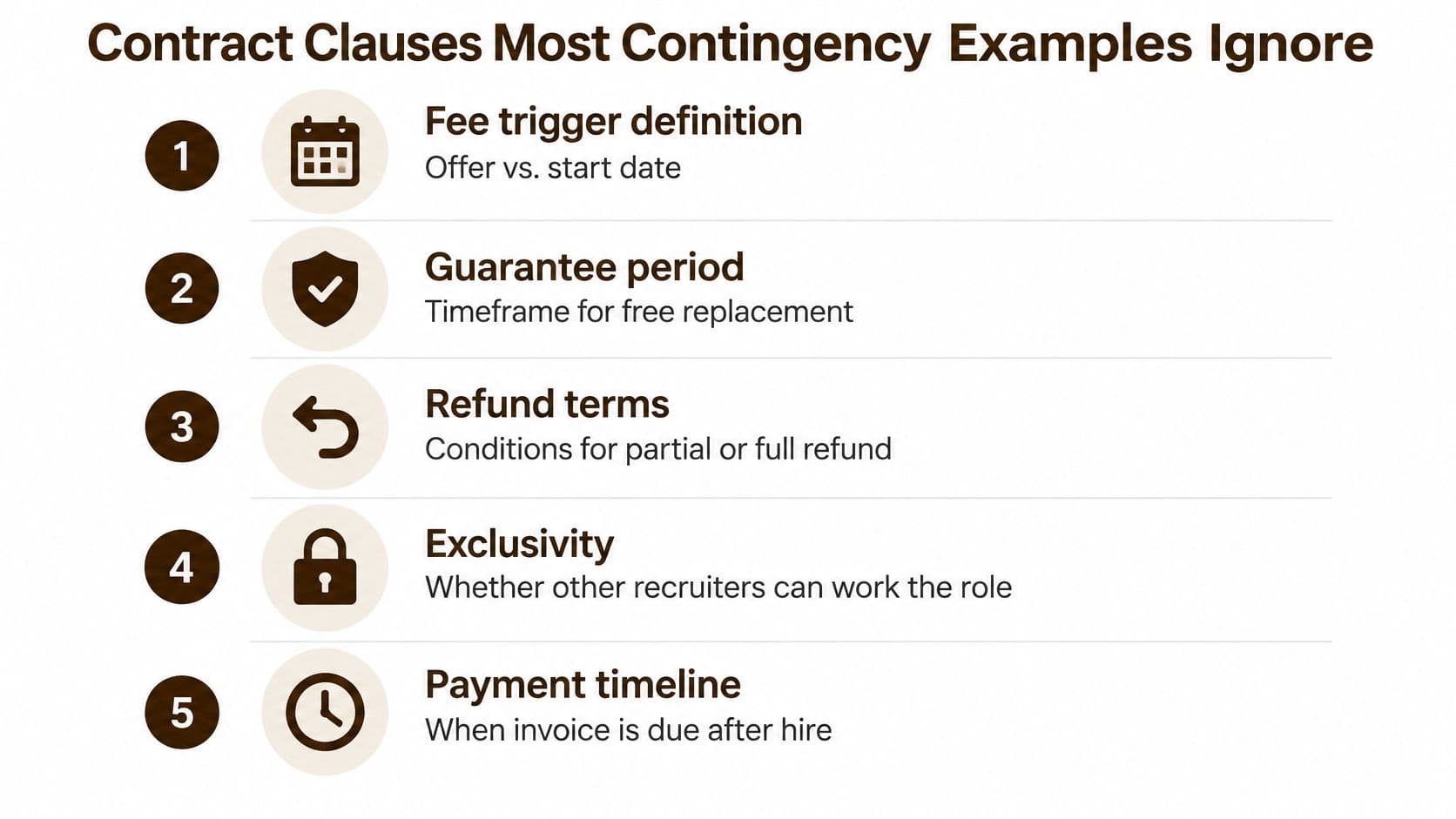
Contract Clauses Most Contingency Examples Ignore
“No hire, no fee” describes the broad commercial arrangement. It doesn't answer every question about what counts as a hire, which candidate the recruiter owns, or what the client gets if the placement fails. Review these provisions before authorizing the search.
Define ownership and the fee trigger
- Fee trigger: Identify whether the fee is due at offer acceptance, at the candidate's start date, or when the client hires the candidate during a post-introduction period. Ask whether the clause also covers a different position or a later hire.
- Candidate ownership: Set a clear process for recording submissions and disputing a claim. If the candidate was already known to the firm, the agreement should say how quickly the firm must raise that fact and what evidence is enough.
- Duplicate submissions: Decide what happens if two agencies submit the same candidate. Require a prompt notification process, and don't leave the answer to whichever recruiter sends a resume last.
- Candidate withdrawal and counteroffers: Clarify whether a fee remains payable if a candidate accepts and then withdraws before starting. Address what happens when the current employer makes a counteroffer and the candidate stays.
- Internal transfers: State whether the fee applies if the candidate is hired by a different office, practice group, affiliate, or role than the one originally discussed.
Make the guarantee meaningful
The agreement should define what departure qualifies for a replacement search or refund. It should also explain any exclusions, such as a role change, compensation change, or termination for reasons unrelated to the candidate's performance. Confirm whether the recruiter provides a replacement, a partial refund, or another remedy, and whether the guarantee period restarts if a replacement is hired.
Ask for the consequence, not just the label. A “replacement guarantee” is useful only if the contract says what the recruiter must do, what the client must do, and what happens if no replacement is found.
Finally, check how the agreement defines first-year compensation. If it includes guaranteed bonus, signing bonus, equity, or draws, the fee could be calculated on more than base salary. A firm that agreed to a percentage of base pay shouldn't discover after hiring that the contract uses a wider definition.
A clear agreement doesn't need to anticipate every business dispute. It does need to remove avoidable ambiguity about payment, ownership, duplicate submissions, and remedies. If the recruiter won't explain those terms plainly, don't sign on the strength of a low-friction sales pitch.
Pros and Cons for Clients and Candidates
Contingency recruiting aligns payment with a hire, but both clients and candidates should understand who pays, who controls the process, and what happens when more than one recruiter is involved.
For clients, the main advantages are no upfront placement fee, an outside recruiter absorbing sourcing effort, and potential access to candidates who aren't actively applying. A recruiter paid upon a successful hire also has a direct incentive to move qualified candidates through the process. Those benefits depend on clear expectations and a hiring team that responds to submissions.
The downsides are practical. Multiple agencies can create duplicate submissions and disputes over candidate ownership. A hard-to-fill role may attract less focused effort if the recruiter sees a better chance of earning a fee elsewhere. The firm may also owe a fee for someone it already knew if the prior-knowledge clause is vague or the client misses a notice deadline.
Candidates don't pay the employer's recruiting fee, and a recruiter may introduce opportunities that aren't publicly advertised. Interview coaching can also help a candidate prepare for the client's process. But the recruiter is paid by the employer, not by the candidate. Candidates should understand where their information will go and should avoid authorizing multiple recruiters to submit them to the same firm without coordination.
Use structure, not instinct, to assess fit
For specialized legal roles, a resume alone won't show whether a candidate can handle the work. A meta-analysis of 31 interview-validity studies reported an average observed validity of 0.27 and estimated true validity of 0.38, with interview structure the only examined characteristic that moderated validity (meta-analysis of interview-validity studies). Set consistent, job-related questions and rating criteria before interviews so the firm can compare candidates on evidence rather than recruiter intuition or prestige signals.
Client checklist
- Read the fee terms: Confirm the trigger, salary definition, payment timing, and guarantee remedy.
- Protect candidate ownership: Record prior contacts and set a process for duplicate submissions.
- Set selection criteria: Agree on practice experience, skills, and interview responsibilities before reviewing candidates.
- Make time to hire: Assign decision-makers and give the search timely feedback.
Candidate checklist
- Confirm consent: Know which employer and role the recruiter plans to submit you for.
- Ask about representation: Understand that the employer pays the fee and ask how the recruiter works with the hiring organization.
- Prevent duplicate submissions: Tell recruiters if another agency has already introduced you to the same employer.
- Prepare your evidence: Be ready to explain relevant matters, skills, and the kind of role you want next.
A good contingency relationship should make expectations clearer for everyone. If you're hiring, ask for the agreement before a recruiter submits candidates, not after a preferred candidate is ready to accept.
Five Star Placements provides contingency-based permanent placement for law firms and corporate legal departments, with customized screening for attorneys and legal professionals. If you're assessing a vacancy or reviewing a contingency agreement, visit Five Star Placements to discuss a search aligned with your hiring needs.
Need help filling a legal role?
Five Star Placements partners with law firms and legal departments nationwide.
Schedule a Call