
What Does a Legal Recruiter Do for Law Firms
September 16, 2026 · 13 min read · Five Star Placements

Table of contents
A partner needs another litigator before a major matter reaches its busiest phase. A general counsel needs someone who can take ownership of contracts, compliance, or a growing legal operations function. Internal HR has posted the role, but the applicants don't quite match the practice, the strongest prospects aren't applying, and every additional week leaves existing lawyers carrying the gap.
That's the point at which many hiring leaders ask, what does a legal recruiter do beyond forwarding résumés? The answer is broader than sourcing. A legal recruiter helps define the search, interpret the talent market, identify active and passive candidates, test skills and motivation, manage interviews, reduce hiring risk, and guide the parties through an offer.
For a law firm or corporate legal department, the recruiter should function like an extension of the hiring team. The recruiter doesn't replace the partner, general counsel, or HR leader who owns the decision. Instead, the recruiter prepares the decision by turning a loosely defined vacancy into a disciplined search with clear evidence behind each introduction.
That distinction matters when you're deciding whether an outside firm is worth engaging. A useful overview of the business case appears in the benefits of using a legal recruiting agency, but the practical question remains: what should the recruiter do once the search begins?
Table of Contents
- Understanding the Core Role of a Legal Recruiter
- How Legal Recruiters Run a Full Cycle Search
- Beyond the Resume How Recruiters Assess Fit and Readiness
- Lateral Partner and In House Searches Where Recruiters Add Most Value
- Evaluating a Search Partner Model Economics and Collaboration
- Deciding When to Engage a Legal Recruiter and What to Expect Next
Understanding the Core Role of a Legal Recruiter
A legal recruiter is a market intermediary between employers with selective requirements and legal professionals whose experience may be difficult to identify through ordinary applications. Think of the recruiter as a combination of talent scout, practice-area translator, and hiring advisor. A job board displays an opening. A recruiter investigates who could succeed in it, including people who aren't actively looking.
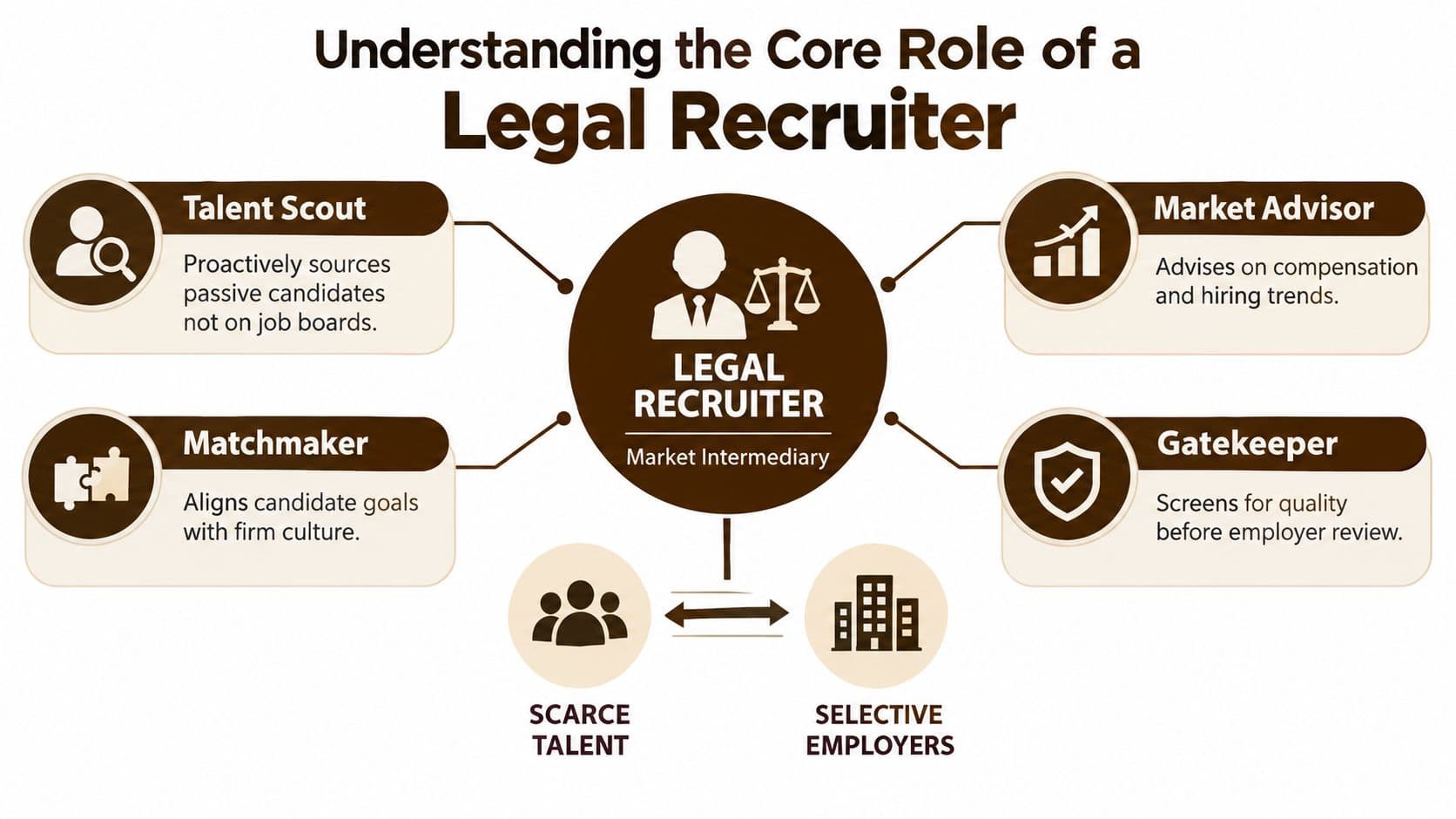
The work usually has four connected parts:
- Talent scouting: The recruiter searches professional networks, prior relationships, market databases, referrals, and direct outreach to find candidates who may not appear in an application queue.
- Market advising: The recruiter explains how the role is positioned, what type of experience is available, and how compensation expectations or location may affect response.
- Candidate matching: The recruiter compares a person's practice history, career goals, work preferences, and communication style with the firm or department's actual environment.
- Quality control: Before a hiring leader invests interview time, the recruiter checks whether the candidate meets the agreed requirements and is interested in the move.
Legal hiring covers more than associate recruitment. A specialized recruiter may work on permanent placements for attorneys, partners, paralegals, legal assistants, in-house counsel, and legal operations leaders. The employer might be a single-office firm, a multi-office practice, or a corporate legal department with needs across litigation, corporate work, real estate, healthcare, compliance, contracts, or operations.
The supply conditions explain why proactive outreach matters. In 2025, the legal market recorded 159,600 job postings overall, including 45,300 lawyer postings at law firms, more than 68,200 paralegal and legal operations postings, and 24,300 paralegal postings specifically, as reported through Pernini Legal's labor-market data. Lawyers had a 1.0% unemployment rate in Q1 2026, while paralegals and legal assistants had a 3.6% rate, both below the 4.3% national unemployment rate in May 2026, according to the same source.
Practical rule: A recruiter shouldn't measure success by the number of résumés delivered. The relevant question is whether the recruiter can produce a small group of qualified, interested people the hiring team couldn't efficiently reach and evaluate alone.
A contingency-based permanent recruiter is also different from a temporary staffing provider. The assignment is generally tied to a full-time hire, with the recruiter paid when a successful placement occurs. That model makes the recruiter's value dependent on a completed match, not merely on sending names.
How Legal Recruiters Run a Full Cycle Search
A thorough search begins before anyone contacts a candidate. The recruiter meets with the hiring partner, HR leader, or general counsel to clarify the work, reporting relationship, required credentials, decision criteria, compensation parameters, timing, and reasons someone would want the role. “We need a strong associate” isn't enough. The recruiter needs to know whether the associate will take depositions, manage discovery, support a partner, or develop a portable practice.
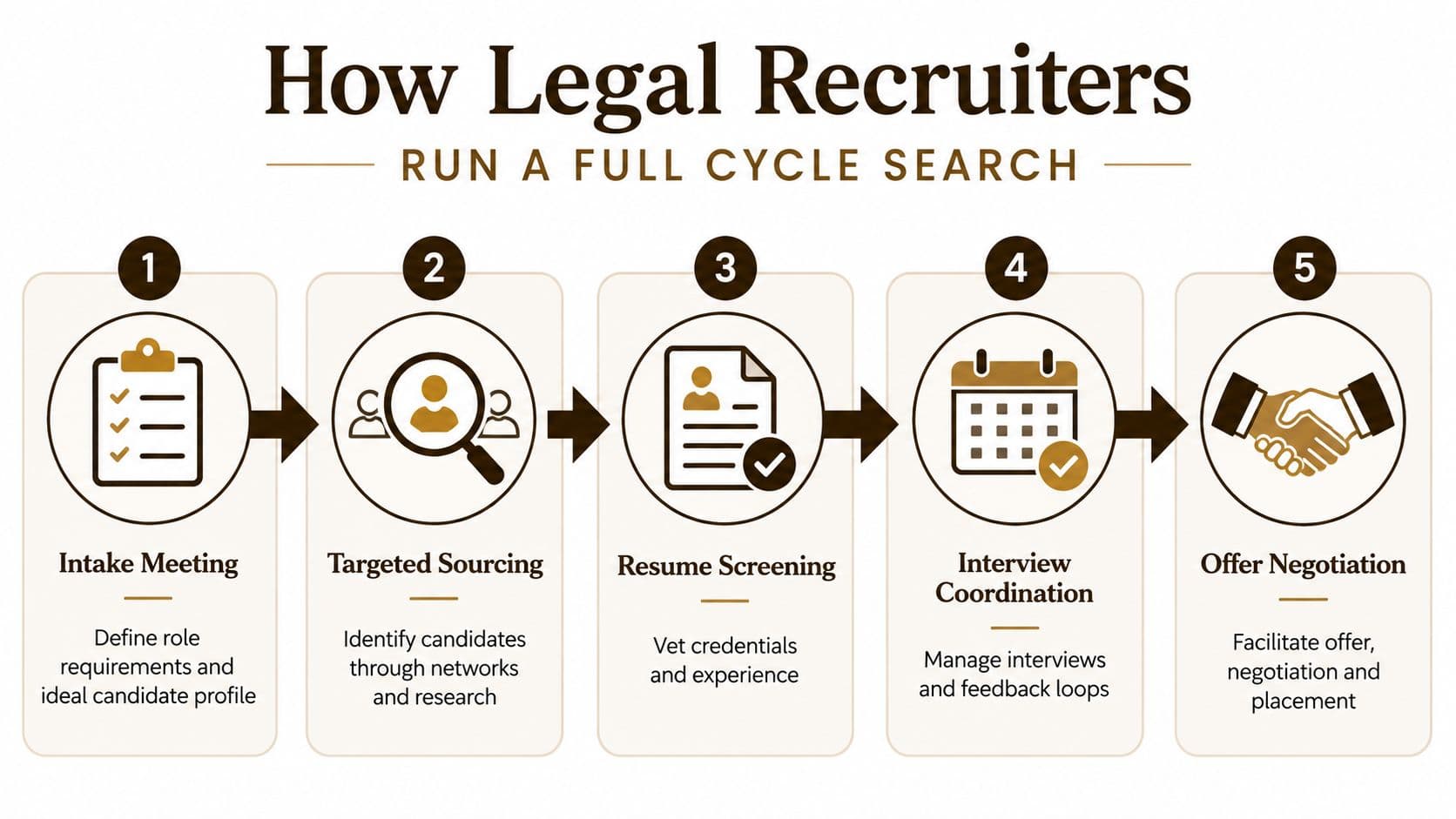
The five operating stages
-
Intake becomes a search brief. The recruiter converts the conversation into an agreed candidate profile. That brief separates essential requirements from preferences, identifies likely target employers, and gives the hiring team a consistent basis for evaluating introductions.
-
Sourcing becomes targeted outreach. The recruiter researches the market and contacts both active applicants and passive prospects. A passive candidate may not be browsing job postings, but could consider a move if the practice, leadership, flexibility, or long-term path fits.
-
Screening tests more than keywords. The recruiter reviews the résumé, then speaks with the candidate about substantive work, responsibility level, reasons for moving, availability, compensation expectations, and interest in the particular employer. This conversation prevents a résumé that looks suitable on paper from becoming an unsuitable submission.
-
Coordination keeps the process moving. The recruiter schedules interviews, prepares candidates for the client's process, records feedback in the applicant-tracking system, follows up with decision-makers, and resolves misunderstandings before they become withdrawal points.
-
Offer management protects the close. The recruiter helps both sides understand the offer, surfaces concerns, supports negotiation, and confirms that the candidate is prepared to accept and transition. Offer acceptance isn't the end of the work. Clear communication through resignation and onboarding helps prevent avoidable breakdowns.
Current legal recruiting role descriptions connect the position to active and passive candidate outreach, résumé screening, interview coordination, applicant tracking, and offer closure, as reflected in this legal recruiting job description. The recruiter also reports market feedback. If qualified candidates decline because the role requires an unrealistic background or an uncompetitive arrangement, the hiring team learns that early.
A retained search is a distinct model, usually involving a more exclusive advisory engagement and a deeper market-mapping process. For a practical comparison, review what retained search means.
The handoffs are where much of the operational value appears. Practice leaders spend less time sorting unqualified applications, HR receives clearer feedback, and candidates have one person responsible for keeping the process understandable.
Beyond the Resume How Recruiters Assess Fit and Readiness
A résumé can confirm where someone worked and what matters they handled. It can't, by itself, explain why the person is leaving, how they behave under pressure, whether they want the role, or whether the firm's working style will suit them. Strong legal recruiting therefore treats the résumé as an entry point, not a verdict.
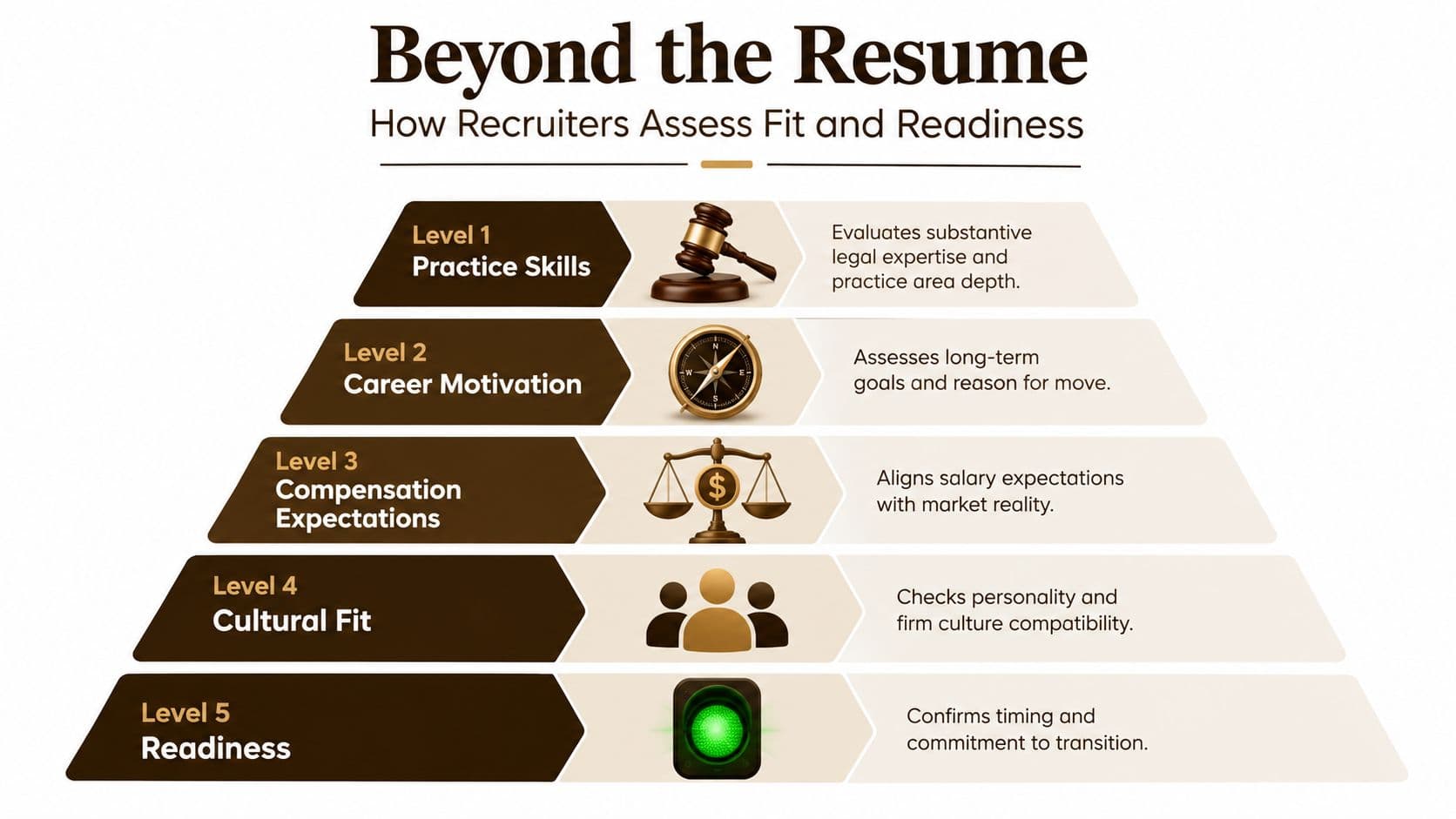
Five evaluation lenses
- Practice skills: The recruiter verifies the depth and recency of substantive experience. A candidate who lists commercial litigation may have handled hearings, discovery, and client strategy, or may have supported a narrow portion of the work. Those differences affect the match.
- Career motivation: The recruiter asks why the person is considering a move now and what kind of role they want next. Someone seeking partnership progression needs a different opportunity from someone prioritizing predictable hours or a transition in-house.
- Compensation expectations: The recruiter tests whether the candidate's expectations fit the employer's framework and the relevant market. Early clarity protects both parties from spending time on a search that can't close.
- Cultural alignment: Culture isn't a vague personality test. It includes how partners delegate, how teams give feedback, how lawyers collaborate, how leaders make decisions, and how the organization handles autonomy and accountability.
- Readiness: A qualified candidate may still be unable or unwilling to move within the employer's timeframe. The recruiter confirms availability, commitment, conflicts that could affect the hire, and practical transition considerations.
The best screening conversation is structured but not mechanical. A recruiter might ask a litigator to describe the matters they personally owned, ask an in-house candidate how they prioritize competing business requests, or ask a paralegal what kind of workflow allows them to perform consistently. Follow-up questions expose the difference between familiarity with a task and meaningful responsibility for it.
Candidate preparation also matters. A recruiter can explain the client's interview format, help the candidate present relevant experience clearly, and identify questions the candidate should ask before accepting. That isn't coaching someone to perform a false version of themselves. It helps both sides reach the same decision with better information.
A good submission should answer three questions: Can this person do the work, do they want this particular work, and can they succeed with these people?
Hiring leaders should ask search partners how they define practice fit, how they test motivation, what information appears in a candidate summary, and how they handle concerns. If the answer is only “we review the résumé,” the process is closer to forwarding applications than managing a professional search.
Lateral Partner and In House Searches Where Recruiters Add Most Value
Standard associate hiring and senior lateral hiring don't carry the same search risk. An associate may be evaluated primarily on substantive ability, development potential, and team fit. A partner or senior in-house leader may bring client relationships, revenue expectations, conflicts, leadership obligations, regulatory exposure, and a business plan that affects multiple stakeholders.
Lateral hiring is a central part of the market, not a minor variation. NALP reported that total lateral hiring volume increased 16.4% in 2025 across 305 law offices and firms that reported both years, as described in the legal talent movement report. That activity makes timing, discretion, and relationship depth particularly important.
The diligence is different
For a lateral partner or counsel search, the recruiter may help coordinate:
- Background review: Confirming professional history and identifying issues that require clarification before the process advances.
- Conflict analysis: Helping the firm identify, investigate, and resolve conflicts that could prevent the candidate from joining or serving important clients.
- Business-plan review: Understanding the partner's portable work, target clients, practice economics, and realistic growth assumptions rather than relying on a title alone.
- Committee communication: Keeping recruiting committees, practice leaders, candidates, HR, and outside search firms aligned as the decision develops.
- Onboarding support: Maintaining momentum after acceptance while the firm works through notices, client transitions, conflicts, and integration.
In-house searches create a different version of the same problem. A general counsel may need legal judgment plus executive presence. A compliance leader may need regulatory knowledge and the ability to influence business teams. A legal operations leader may need process design, technology judgment, budgeting experience, and credibility with lawyers who don't report to them.
| Hiring Scenario | Key Recruiter Contribution | Why It Matters |
|---|---|---|
| Lateral associate | Tests practice experience, motivation, and workload fit | The hiring team sees relevant candidates instead of relying on broad applications |
| Partner or counsel | Coordinates diligence, conflicts, business-plan review, and stakeholder communication | A credential match can still fail if portability, compliance, or strategic fit is weak |
| General counsel | Assesses legal judgment, leadership, business partnership, and organizational fit | The role may influence enterprise risk, strategy, and executive decisions |
| Compliance or legal operations leader | Evaluates specialized capability and cross-functional working style | Technical knowledge alone won't establish adoption across the organization |
The recruiter's value rises with the consequences of a wrong answer. In a fast-moving lateral market, a candidate may be speaking with several firms, while a partner may require discreet handling of client and compensation information. An experienced recruiter gives the hiring team a controlled process without pretending that every candidate can be reduced to a résumé.
Evaluating a Search Partner Model Economics and Collaboration
Hiring leaders should evaluate a recruiting partner as they would evaluate outside counsel. The central questions are scope, incentives, judgment, communication, and accountability. A large database matters less if the recruiter can't understand the practice or explain why a candidate belongs in front of the hiring committee.
Start with the commercial model
A contingency-based permanent placement arrangement generally ties payment to a successful hire, with no upfront cost to begin the search. That structure can reduce initial hiring risk, but it also requires clear expectations about candidate ownership, communication, exclusivity, replacement terms, and what the recruiter will do before a placement occurs.
Exclusivity changes the working relationship. A dedicated search may support deeper market mapping and tighter coordination. A non-exclusive search may give the employer access to multiple firms, but can create duplicate outreach, inconsistent messaging, and less certainty about who owns the process. Neither approach is automatically right. The choice should follow the role's urgency, confidentiality, difficulty, and stakeholder complexity.
Test collaboration before signing
Ask a prospective partner to describe the first intake meeting, the screening questions, the candidate summary, the feedback cadence, and the escalation process when the search stalls. You should also know whether the recruiter will provide interview preparation, help interpret candidate concerns, and stay involved through acceptance and onboarding.
Five Star Placements provides contingency-based permanent placement for attorneys, partners, in-house counsel, legal support professionals, and legal operations leaders across the United States. Its stated model includes customized screening for experience, skills, and culture fit, along with candidate interview coaching and communication designed to operate as an extension of the client team.
A practical comparison can look like this:
| Evaluation Factor | Strong Search Partner | Warning Sign |
|---|---|---|
| Screening rigor | Explains how practice skills, motivation, and fit are tested | Relies mainly on résumé keywords |
| Market reach | Uses active and passive outreach suited to the role | Waits for applicants to appear |
| Communication | Provides prompt updates, feedback, and sourcing obstacles | Sends names without context |
| Economics | Clearly explains payment triggers and responsibilities | Leaves fees or ownership terms ambiguous |
| Follow-through | Supports interviews, negotiation, and transition | Disappears after the introduction |
The right model isn't the one with the most activity. It's the one that gives the hiring team better decisions while preserving speed, confidentiality, and control.
Deciding When to Engage a Legal Recruiter and What to Expect Next
External recruiting makes sense when the internal team has already tried the obvious channels and still can't reach practice-ready candidates. Other signals include a vacancy that is disrupting matter coverage, limited capacity for confidential outreach, repeated withdrawals, or hires that look qualified but don't fit the way the team works.
The decision shouldn't be based only on whether the role is senior. A difficult paralegal search, specialized associate opening, or legal operations position can justify outside help when the internal opportunity cost is high. The recruiter should bring access and evaluation discipline that the hiring team can't easily create while managing client work.
A good engagement starts with a candid intake. Prepare the reporting structure, essential responsibilities, preferred background, compensation parameters, location and flexibility expectations, interview participants, decision authority, and reasons a strong candidate would choose the role. Also identify what has failed so far. That information lets the recruiter refine the search instead of repeating the same outreach.
Use this guide to when a law firm should use a recruiter as a practical prompt, then judge potential partners by what happens after the kickoff. You should receive a clear search brief, qualified introductions with context, regular updates, organized interview coordination, honest market feedback, and support through negotiation and transition.
The profession is also changing. AI is helping streamline résumé screening, database searches, and candidate assessments, while legal leaders are planning for blended staffing needs. Recent research reported that 58% of legal leaders planned to add permanent employees and 51% expected to bring in more contract talent, according to Robert Half's legal hiring research. Technology may filter information faster, but recruiters still need to interpret judgment, motivation, risk, and fit.
Five Star Placements provides contingency-based permanent placement and customized screening for attorneys, partners, in-house counsel, legal support staff, and legal operations leaders. Visit Five Star Placements to discuss a focused search that treats recruiting as a full-cycle, risk-managed extension of your hiring team.
Need help filling a legal role?
Five Star Placements partners with law firms and legal departments nationwide.
Schedule a Call