
How to Hire Junior Associates a Modern Law Firm Playbook
August 10, 2026 · 11 min read · Five Star Placements

Table of contents
You've got a partner asking why the last “strong” junior hire still needs heavy hand-holding six months in, while another candidate with a less glamorous resume writes cleaner drafts and gets up to speed faster. That gap is exactly why how to hire junior associates has become a harder, more strategic decision than it used to be. The market is rewarding firms that can identify practice-ready talent early, evaluate it consistently, and build associates who contribute without creating an oversized training burden.
Table of Contents
- The New Reality of Legal Hiring
- Blueprinting Your Hire Before You Search
- Strategic Sourcing for a Diverse Pipeline
- The Structured Interview and Evaluation Playbook
- Beyond the Hire Onboarding for Retention
- Measuring Success and Optimizing Your Process
The New Reality of Legal Hiring
The hardest junior hire to fix is the one who looked polished in interviews and then could not keep pace with the work. The research memo takes too long, the writing needs heavy cleanup, and every assignment requires more supervision than the partner planned for. That is more than a bad individual fit. It shows the old hiring model is losing ground.
Large U.S. law firms hired fewer new associates in 2025 than in 2024, the first decline in entry-level hiring since 2014, and firms with more than 500 lawyers collectively hired 540 fewer new associates overall (Reuters). In the same market data, lateral associates accounted for 49% of all associate hires, while recent law-school graduates accounted for only 38%. The message for hiring partners is plain. Firms are screening more heavily for practice readiness, not just academic promise.
Practical rule: if your process still treats every strong transcript as an almost equal candidate, you are hiring for a market that no longer exists.
The better approach is to think like a talent manager, not a resume collector. Firms that adjust fastest are not only reducing entry-level hiring, they are making each junior hire count more by selecting for judgment, responsiveness, and the ability to contribute with less ramp-up. That means looking beyond pedigree and asking whether the candidate can do the work you need on day one, under real supervision pressure.
A defensible search also starts with a clear standard for what “ready” means in your practice. For that reason, many firms work with specialists who understand the difference between a strong academic profile and a lawyer who can function in a real matter, including Five Star Placements' approach to legal search and screening.
Blueprinting Your Hire Before You Search
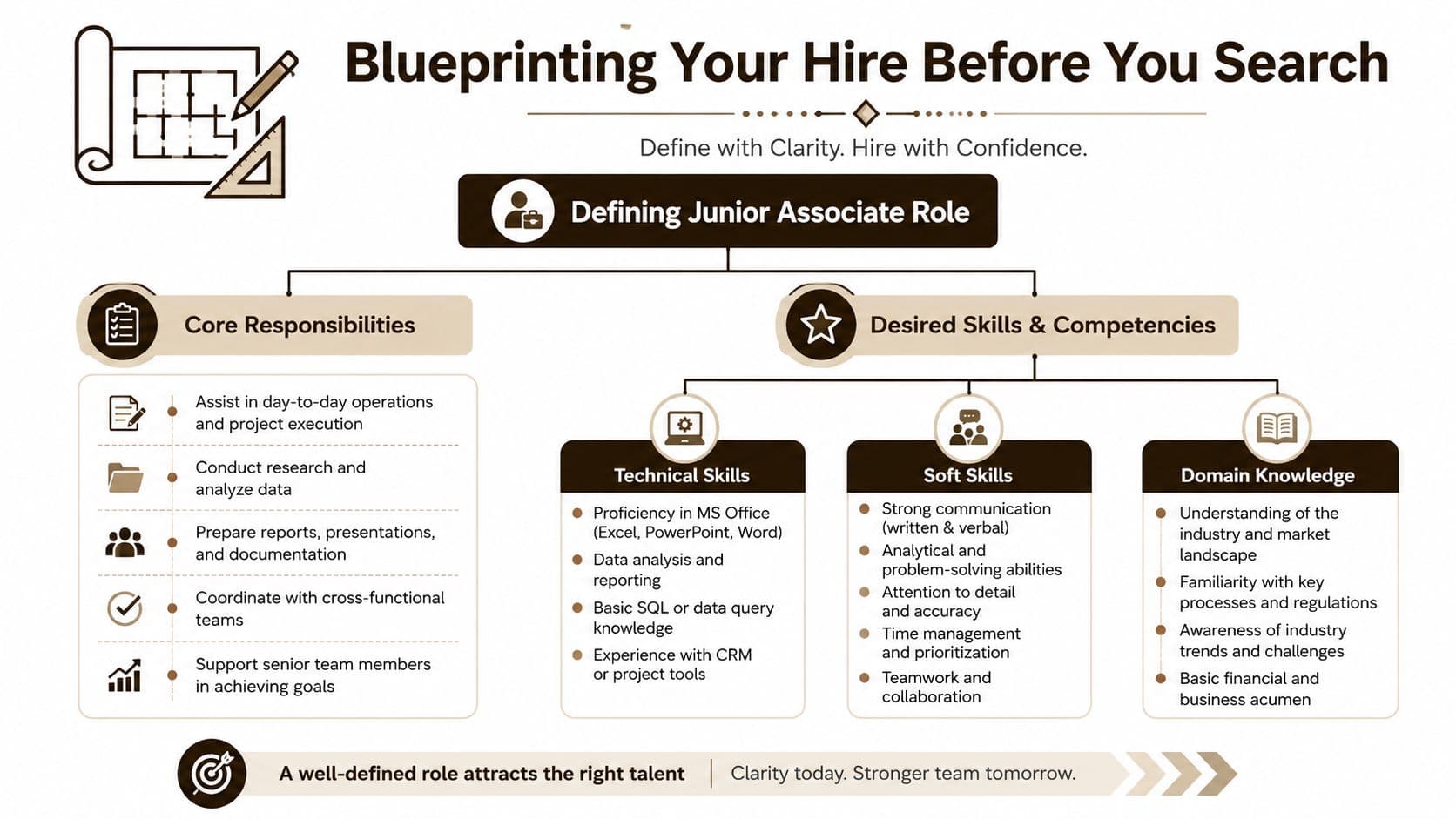
A vague job description produces a vague hire. If the role says “strong legal skills” and “team player,” you will get polished resumes and very little clarity about who can do the work. The better move is to build a skills matrix before you post the role, then get agreement on what success looks like.
Build the matrix around the work, not the title
Start with the matters the associate will handle. A junior litigator, a family-law associate, and a business associate need different early strengths, even if their titles sound similar. Translate the role into must-have competencies, then divide them into technical legal skills, writing and research ability, client readiness, and practice-specific tools.
That structure matters because it lets you compare every candidate against the same benchmark. A strong matrix does more than describe the job, it gives you a defensible way to reject non-matches quickly and consistently, which is exactly what a high-signal hiring method should do (JobTeaser).
Turn the matrix into a scorecard
Once the competencies are defined, convert them into pre-selection criteria. You are not asking, “Do I like this candidate?” You are asking whether the applicant shows evidence of reliable drafting, research discipline, communication under pressure, and the ability to learn the firm's systems. If one of those is optional, say so in advance.
A practical scorecard also keeps internal politics out of the process. When team leaders agree on the same competency profile before screening begins, you reduce the common problem where one lawyer wants pedigree, another wants a familiar clerkship path, and a third wants someone available immediately. The candidate who wins should be the person who best fits the work. If you need help defining that blueprint, contact our team to discuss your hiring needs at Five Star Placements.
Use this test: if two interviewers cannot independently explain why a candidate fits the same role, the role was not defined tightly enough.
Strategic Sourcing for a Diverse Pipeline
Many firms still rely on the easiest channel, wait for resumes to arrive, then complain that the pool is thin. That approach narrows the pipeline before the search even starts. If you want stronger junior associates, you need to widen the net deliberately and stop assuming the same schools, same referrals, and same recruiting calendars will surface the best people.
Broaden the inputs that feed the funnel
Sourcing should reach beyond the places where every competitor is fishing. That means alumni networks, targeted outreach to practice-area groups, and a more disciplined use of recruiter relationships. It also means broadening which schools and experiences you treat as viable signals. A candidate who wrote well, handled a demanding clinic, or showed strong responsiveness in a less traditional setting may outperform someone with a more familiar pedigree.
The key is not to lower standards. It's to use standards that are tied to actual performance. Research on underrepresented hiring emphasizes removing biased language and using clear, competence-based criteria so you can evaluate candidates fairly and predict retention more accurately (HR Future).
Write for inclusion and screen for capability
Job language shapes applicant behavior. If your posting overemphasizes prestige signals or uses phrases that imply a narrow cultural fit, you'll lose capable people before they apply. Clear, competence-based language helps candidates self-select more accurately and gives recruiters a fairer basis for review.
For firms that need outside help, Five Star Placements' blog is a practical example of how legal recruiting guidance can support a more structured search process. Use that kind of resource as a supplement, not a replacement, for your own internal discipline.
A strong pipeline doesn't come from more posting. It comes from more intentional sourcing, clearer criteria, and fewer assumptions about where talent has to come from.
The Structured Interview and Evaluation Playbook
A junior associate interview process should predict performance, not just reward polish. Unstructured conversations tend to overvalue confidence, similarity, and prestige. A structured process makes it easier to compare candidates fairly and identify the people who can handle legal work.
Start with screens that test the basics
Begin by reviewing the resume, transcript if you use it, and writing samples side by side. Look for evidence of clean writing, careful editing, and a logical presentation of ideas. Then run an initial phone or video screen to test communication, responsiveness, and whether the candidate can explain prior work without drifting off course.
That first screen should also check practical expectations. A candidate who wants hand-holding on every task or who cannot explain how they manage deadlines may look impressive in an interview but create friction once the work starts. The point is not to trap people, it is to find out whether the resume matches the actual person.
Use behavioral questions that mirror the job
The next round should be behavioral and scenario-based. Ask candidates how they handled a complex research assignment under a tight deadline, how they reacted when a supervisor changed direction late in the process, or how they proofread work that had to go out the same day. These questions reveal judgment, coachability, and follow-through better than general “tell me about yourself” prompts.
A strong legal interview also tests whether the candidate can take feedback without becoming defensive. You are hiring someone who will be edited constantly, sometimes by multiple lawyers on the same matter. If they cannot describe a time they revised work after criticism and improved the result, that is a useful signal.
Add a work sample before you decide
A data-backed hiring process uses structured screening, behavioral interviews, and work-sample tests rather than unstructured interviews alone (Lawyers Mutual NC). For junior associates, a short memo edit, a research assignment, or a drafting exercise often tells you more than another round of conversation. You want to see how they think, how they organize, and whether they can deliver clean work without overexplaining it.
Practical rule: if you would not trust the candidate's work product without a second read, do not pretend the interview solved that problem.
Use a scorecard, not memory
A junior associate interview scorecard should make comparison simple and repeatable.
| Competency | Evaluation Criteria | Score (1-5) | Notes / Red Flags |
|---|---|---|---|
| Writing quality | Clear structure, grammar, concision, legal tone | ||
| Legal research | Uses sources accurately, identifies issues, avoids drift | ||
| Responsiveness | Answers directly, follows instructions, communicates clearly | ||
| Coachability | Accepts feedback, shows learning mindset, adapts quickly | ||
| Client readiness | Professional judgment, clarity, poise, practical instincts | ||
| Team fit | Collaboration, reliability, respect for workflow |
The scorecard matters because it disciplines the final decision. If one candidate wins on writing but loses on responsiveness, you will see the trade-off clearly instead of relying on a general impression. That makes the hiring decision easier to defend later, especially when multiple stakeholders are involved.
One more operational point matters. Top junior candidates often hold multiple offers, so firms should move from final interview to verbal offer within 24 hours and written offer within 48 hours to avoid losing them late in the process (Lawyers Mutual NC). Speed will not fix a weak candidate, but delay can lose a strong one.
Beyond the Hire Onboarding for Retention
A good hiring decision can still fail if the first months are chaotic. Junior associates don't just need work, they need context, access, and feedback that teaches them how the firm operates. If onboarding is loose, the partner ends up paying for confusion, duplicated effort, and avoidable attrition.
A 2024 survey found that 45% of junior associates said their law school education did not adequately prepare them for practical legal work (Reuters). That's the reason onboarding can't be an afterthought. The gap between academic training and day-one practice has to be bridged on purpose.
Structure the first week
The first week should cover introductions, systems access, matter workflow, billing expectations, and the small administrative details that new associates are often reluctant to ask about. If the associate doesn't know who approves drafts, where documents live, or how assignments are distributed, they'll waste time guessing. That confusion is preventable.
A mentor helps, but only if the role is real. The mentor should be someone who can answer workflow questions quickly and normalize the early learning curve. Pair that with regular check-ins from the supervising partner so feedback doesn't only appear when something is wrong.
Use the first 90 days to build trust
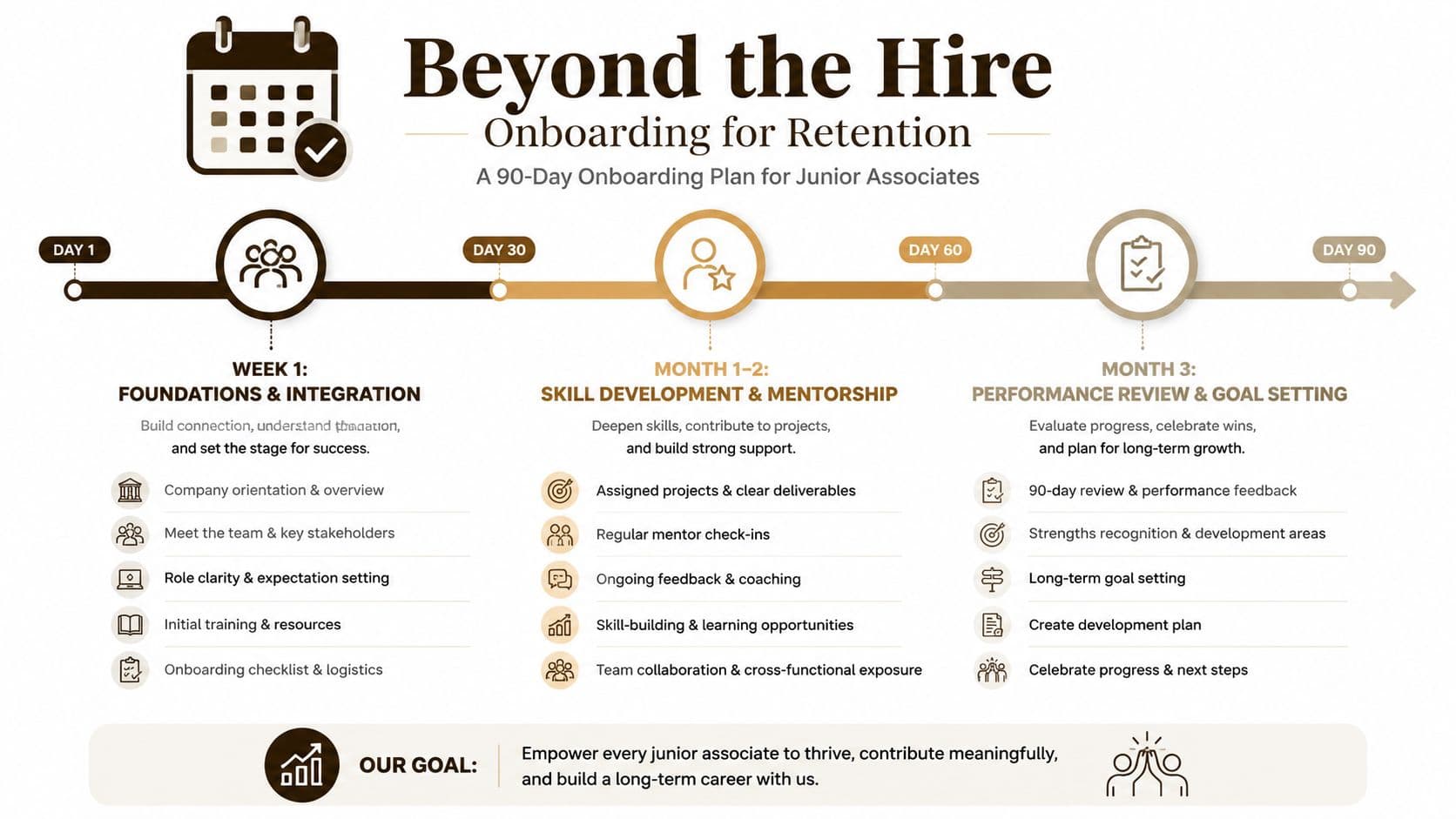
An effective 90-day plan should move from orientation to supervised responsibility, then to a real conversation about performance and development. If the associate gets only generic praise or only correction, they won't know how to improve. They need both.
The simplest retention move is often the most overlooked one, make sure the new hire feels visible. A junior who understands expectations, gets timely edits, and knows who to ask for help is much more likely to settle into the team. That doesn't just improve morale, it shortens the path to useful contribution.
If the first 90 days feel improvised, don't be surprised when the associate starts looking elsewhere.
Measuring Success and Optimizing Your Process
Hiring improves when you treat it like a business function, not a one-time event. Firms often celebrate the signed offer and move on, but the more important question is whether the junior associate is producing useful work, fitting the team, and staying in the role after the first stretch of real responsibility. If those outcomes are not measured, the process cannot improve.
Track the metrics that show whether the process works
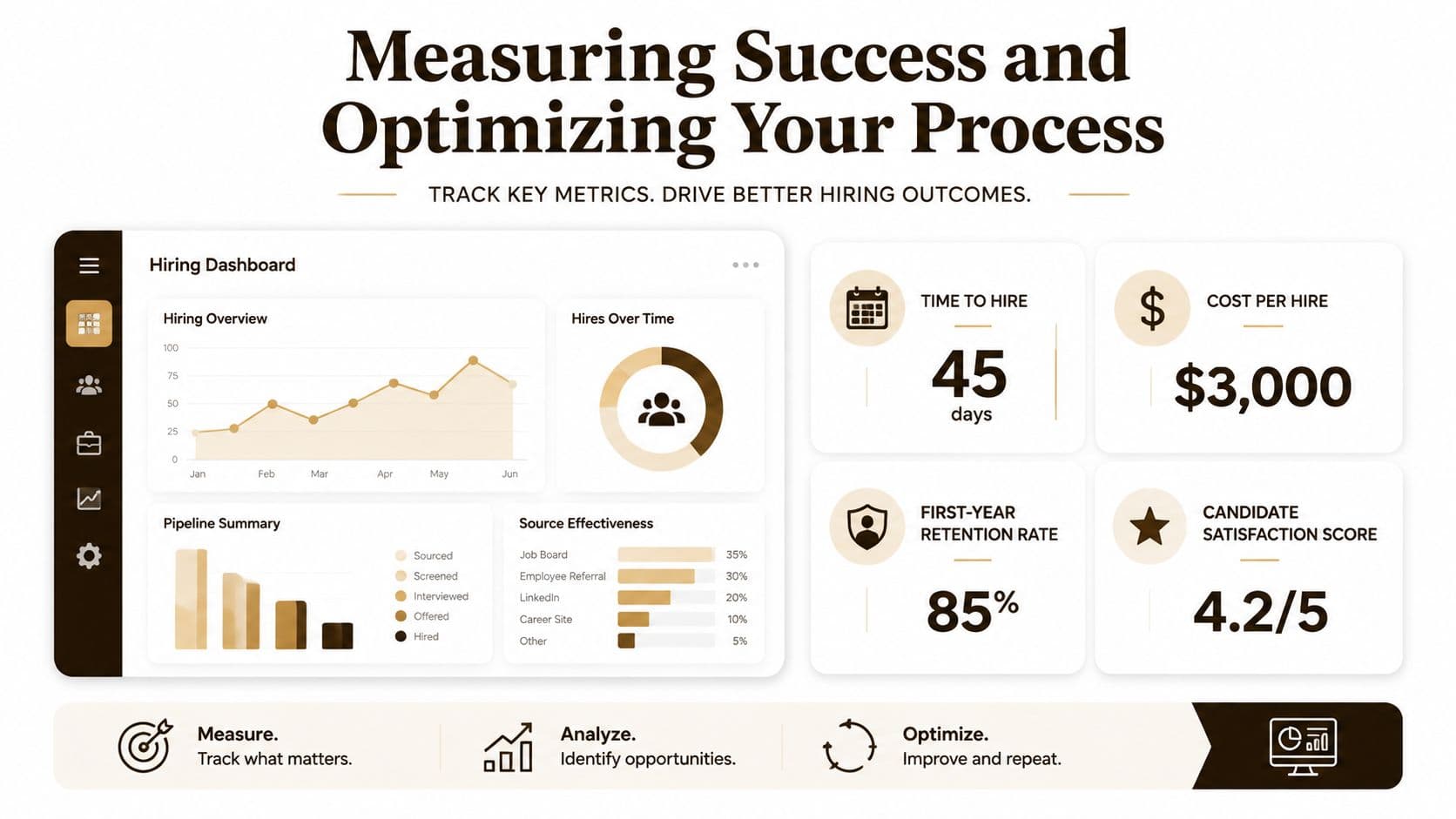
Start with time to hire, offer acceptance rate, first-year retention, and the quality of work product in the first months. Those measures show whether the process is fast enough, competitive enough, and selecting candidates who can do the work. If acceptance is strong but retention is weak, the problem is usually fit or onboarding, not sourcing.
A simple dashboard should also show where candidates drop out. If strong prospects disappear after the first interview, the issue may be speed, clarity, or compensation positioning. If they leave after the work sample, the criteria may be too demanding or too far removed from the day-to-day role.
Review the process, not just the person
After each hire, ask three questions. Which stage produced the clearest signal? Where did the process slow down? What did the new associate need that the interview process did not reveal? The answers usually point to one or two fixes that matter more than a full redesign.
A firm that keeps refining its scorecard, sourcing, and onboarding becomes more predictable over time. That matters even more when junior hiring is more selective and each new associate carries more strategic weight than before. Process quality becomes part of the talent advantage.
If you want support building a junior-associate search that is practical, discreet, and based on the demands of legal hiring, talk with Five Star Placements. They work on legal recruiting and screening across law firms and legal departments, and they can help you tighten the process so you are not just filling a seat, you are making a hire that fits the work.
Need help filling a legal role?
Five Star Placements partners with law firms and legal departments nationwide.
Schedule a Call