
Attorney Recruiting Coordinator: Duties, Skills and Pay
November 7, 2026 · 14 min read · Five Star Placements

Table of contents
A hiring partner wants résumés today, a promising candidate is waiting for feedback, and nobody can confirm whether the approved salary matches the role. Your calendar is full, but the search isn't moving. That's the situation an effective attorney recruiting coordinator helps prevent, not just by arranging interviews, but by keeping hiring decisions tied to clear requirements, reliable candidate information, and named owners.
Table of Contents
- What an Attorney Recruiting Coordinator Does Day to Day
- Career Levels and the Market Behind Each Title
- Coordinator Skills and Candidate Judgment Checks
- The Hiring Workflow From Intake to Offer
- Pipeline Metrics That Show Where Searches Stall
- Compensation and Bar Checks Before Presenting Candidates
- Sample Job Description and How to Adapt It
- Decide Whether to Build or Buy Coordinator Support
What an Attorney Recruiting Coordinator Does Day to Day
An attorney recruiting coordinator runs the logistics, information flow, and candidate communication for attorney searches at a law firm or legal department, sitting between the hiring partner and the candidates.
Think of a production manager on a film set. The director makes the creative decisions, but the production manager makes sure people, materials, and approvals arrive when they're needed. In attorney hiring, the coordinator keeps the process moving while partners and legal leaders decide who fits the work.
Core responsibilities of an attorney recruiting coordinator
| Responsibility | What It Involves | Output |
|---|---|---|
| Intake | Meet hiring partners to capture role scope, must-have experience, and approved pay range | Signed-off search brief |
| Sourcing and screening | Review applicants against practice area, seniority, and bar status | Qualified candidate list |
| Shortlisting | Confirm each candidate's interest and fit before presenting them | Shortlist with fit notes |
| Interview coordination | Schedule multi-round interviews across partners and associates | Confirmed interview calendar |
| Feedback and offers | Collect written feedback, then coordinate offer terms and start dates | Feedback log and offer tracker |
The difference from a general HR recruiter is the attorney-specific evidence involved. A litigation résumé might mention trial preparation without showing whether the lawyer has taken depositions independently. A partner candidate might describe client relationships without establishing what business could realistically move.
The coordinator needs to recognize those gaps and route substantive questions to the right reviewer. They also need to distinguish a preliminary conflicts concern from formal clearance, rather than treating a completed questionnaire as approval.
Ownership without hiring authority
A coordinator doesn't have to make the final decision to own the next action. If interviewers disagree, the coordinator can organize their feedback against the search criteria and ask the hiring partner to resolve the disagreement.
Practical rule: Every active candidate should have a current status, a named next-step owner, and a promised communication date.
Compare the table with your firm's current process. Mark the handoffs where nobody clearly owns the output, especially between interview completion and a decision.
Career Levels and the Market Behind Each Title
Career levels for attorney recruiting coordinators
| Level | Typical Title | Core Scope |
|---|---|---|
| Entry | Recruiting Assistant or Coordinator | Scheduling, résumé screens, and candidate logistics |
| Mid | Attorney Recruiting Coordinator | Full search support, interview panels, and feedback capture |
| Senior | Senior Recruiting Coordinator | Multi-role pipelines, intake calls, and compensation data |
| Management | Manager of Attorney Recruiting | Recruiting team, budget, and hiring strategy |
| Leadership | Director of Legal Recruiting | Firm-wide hiring plan and partner-level searches |
Treat this as a scope guide, not a universal promotion ladder. A coordinator at a boutique may own the whole process, while someone with the same title at a larger firm may specialize in lateral associates or law-school recruiting.
The market also changes what the job requires. In its survey covering 434 U.S. law offices and firms and 4,295 lateral lawyer hires, NALP's 2024 Lateral Hiring Survey found that lateral associate hiring rose 24.9% from the prior year, while lateral partner hiring increased 2.3%.
Those different growth rates matter operationally. An associate search may require a broad pipeline of lawyers with comparable matter experience. A partner search calls for a smaller, more carefully managed network and deeper conversations about business, leadership, and transition risk.
Build capability around search complexity
At entry level, accuracy and dependable follow-through matter most. At senior level, the coordinator should be able to explain why a search is struggling and recommend a change, rather than only report that applications are low.
Counsel and staff attorney searches need their own criteria, too. Don't assume that a strong associate candidate wants a non-partnership role or that a partner candidate would consider counsel status.
Place your current role on the ladder by actual responsibility, not title. Then name the next skill to build: better intake questioning, compensation analysis, partner-search support, or management reporting.
Coordinator Skills and Candidate Judgment Checks
Strong coordination starts with structured questioning, disciplined records, confidentiality, and concise writing. Partners don't need a transcript of every conversation. They need an accurate summary of what the candidate can do, what remains unverified, and which decision is required.
Use an applicant tracking system to record stage changes and permissions. Keep sensitive compensation and conflicts information in access-controlled fields, not scattered across calendar invitations and email chains.

Assess judgment rather than software familiarity
AI capability adds another screening challenge. LawNext's legal-industry coverage reports that AI-related lateral hiring grew 68% in 2025, while associate hiring in that specialty increased 106%.
That doesn't make frequent AI use a reliable proxy for good lawyering. A cautious candidate who documents verification may demonstrate better judgment than someone who confidently lists tools.
Candidate judgment rubric for AI-era hiring
| Competency | Strong Signal | Weak Signal |
|---|---|---|
| Technical fluency | Names the tools used and how outputs were checked | Lists AI tools with no verification step |
| Professional judgment | Explains what a lawyer reviewed before use | Treats AI output as finished work |
| Data security | Describes how client and confidential data were handled | Uses public tools for client material without asking |
| Quality control | Documents source checks and error logs | Cannot describe a past error or its fix |
| Stakeholder communication | Explains AI limits clearly to partners and clients | Overclaims capability or hides usage |
Use consistent prompts and record evidence rather than impressions:
- Source verification: Ask the candidate to describe how they checked an AI-generated legal proposition against an authoritative source.
- Client restrictions: Ask how they handled a client's prohibition or limitation on a tool.
- Delegation boundaries: Ask what work they wouldn't delegate to AI and why.
Apply the rubric to the practice. Litigation candidates should explain defensible research workflows; transactional candidates should describe contract-review controls; in-house counsel should understand governance and vendor risk.
Keep human review in the process. Don't reject candidates through opaque automated scores or infer competence from brand-name tools alone. Choose candidate screening tools that support documented, job-related evaluation rather than replace it.
The Hiring Workflow From Intake to Offer
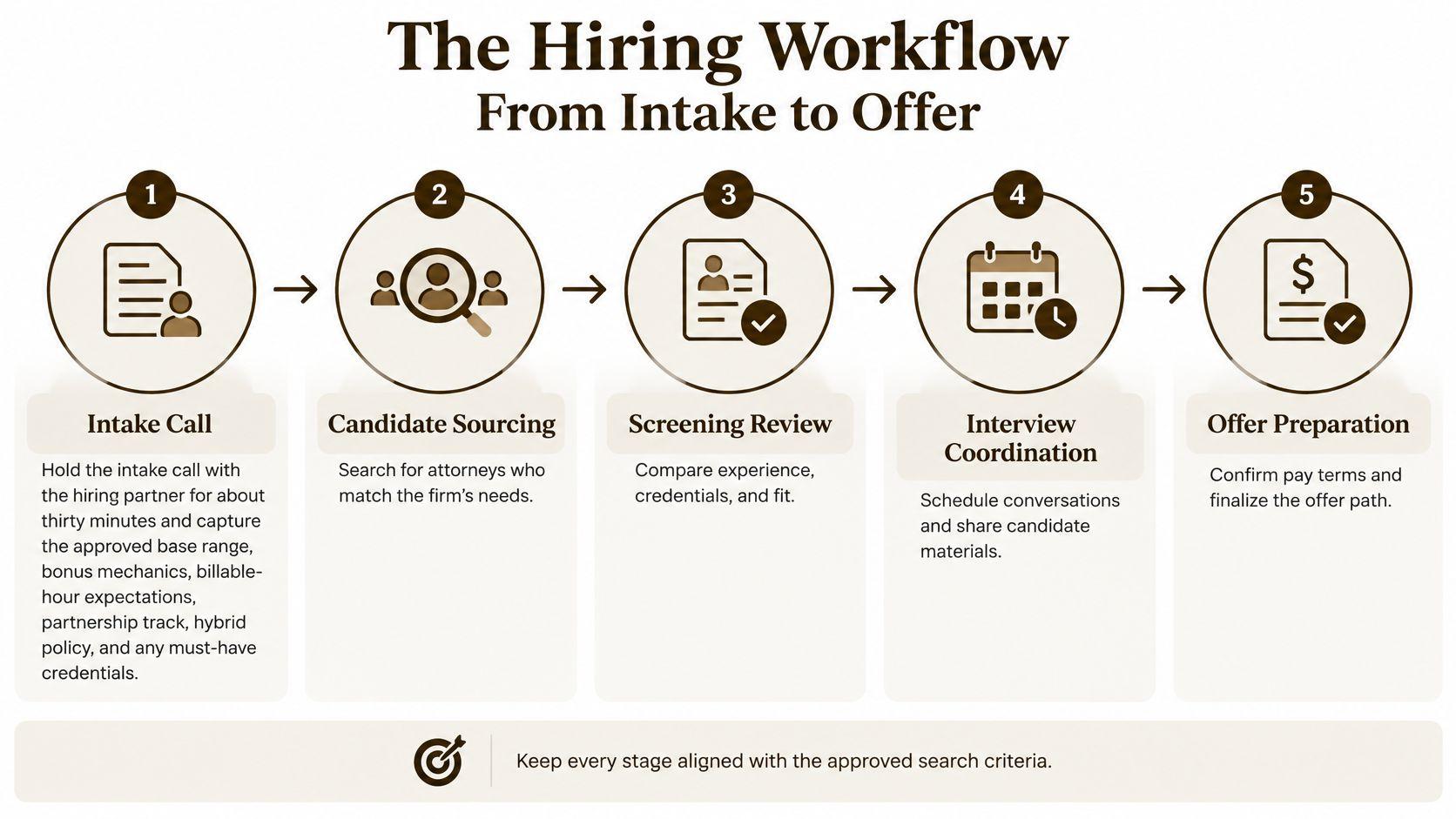
A search needs a decision path, not just a series of appointments. NALP's 2025 survey of U.S. law-school career-services offices describes how accelerated BigLaw hiring timelines have expanded coordinators' involvement in employer outreach and earlier candidate engagement.
For selective hiring, that supports talent mapping before the vacancy becomes urgent. Identify relevant candidate communities and likely availability early, without representing an unapproved position as an active opening.
Assign an owner to every decision
-
Start with an approved intake. Capture the base range, bonus mechanics, billable expectations, partnership track, hybrid policy, and any origination requirements. At Five Star Placements, we ask clients for a thirty-minute role discussion before every search; the common slip is leaving compensation vague.
-
Build a role-specific pipeline with deadlines for outreach, résumé review, interviews, feedback, offers, and follow-up. Common slip: A stage has a deadline but no person responsible for completing it.
-
Screen for evidence and genuine interest. Establish relevant matters, responsibility level, potential conflicts constraints, and eligibility to practice, while confirming interest in this particular role. The common slip is allowing candidates to go quiet during internal review without agreeing on the next update.
-
Present a shortlist with fit notes that connect each candidate's experience to the approved requirements. Common slip: Copying résumé language instead of explaining why the experience matters to the hiring partner.
-
Coordinate interviews around evaluation goals. Tell interviewers what they should assess and send a feedback request with an agreed response window. The common slip is collecting general enthusiasm without evidence about the candidate's ability to do the job.
-
Review open files weekly and escalate stalled decisions to the hiring partner. Common slip: Discovering a delay only after the candidate has accepted another opportunity.
-
Test the offer before issuing it. Confirm likely acceptance terms and tell the client where expectations remain unresolved. The common slip is introducing a material condition the candidate hasn't previously discussed.
Change the evidence with the search
Junior hiring calls for attention to law-school performance, recruitment-cycle timing, and evidence of developing legal skills. Lateral evaluation should focus more directly on matter experience and readiness to perform the work.
Partner evaluation adds portable business, compensation structure, conflicts, and transition risk. Don't ask a coordinator to independently validate business portability or approve conflicts; assign those decisions to the appropriate partners and reviewers.
Our Senior Legal Recruiter, CJ Ohm, manages each search from first call to accepted offer. That continuity gives both sides a clear route for resolving questions instead of restarting the conversation at each handoff.
Pipeline Metrics That Show Where Searches Stall
In 2025, U.S. lateral hiring rose 16.4% across reporting law offices, but only 46.9% of offices experienced an increase of at least 16%, according to NALP's lateral hiring findings. A national increase doesn't mean every firm has the same candidate pool or hiring conditions.
The coordinator needs a dashboard that distinguishes applicant activity from practice-ready talent. A large résumé count isn't useful if the applicants can't handle the matters behind the vacancy.
Pipeline metrics for diagnosing a legal search
| Metric | How to Calculate | Warning Sign |
|---|---|---|
| Stage aging | Median days candidates spend in each stage | Any stage above the client's service-level target |
| Applicant-to-shortlist ratio | Shortlisted candidates divided by applicants | A falling ratio over several weeks |
| Time-to-shortlist | Days from intake call to first shortlist | Shortlist later than the agreed window |
| Source quality | Interviews generated per source | A source producing applicants but no interviews |
| Candidate drop-off | Share of candidates lost at each stage | Sharp losses at the feedback stage |
| Offer acceptance rate | Accepted offers divided by offers made | Repeated declines tied to pay or title |
Read combinations, not isolated scores
High applicant volume with a low shortlist ratio suggests a sourcing mismatch or an unclear brief. Before buying more advertising, check whether the posting describes the actual experience required.
Losses during feedback review point to a different problem. Look at decision ownership, interviewer availability, and whether candidates receive meaningful updates. Record voluntary withdrawals separately from employer rejections so the dashboard doesn't blur different causes.
For source quality, compare interview output with the volume and effort invested in each source. For time-to-fill metrics, define the start and finish consistently so comparisons remain useful.
A faster process isn't automatically a better process. Measure whether the firm reaches qualified candidates and makes defensible decisions.
Set an escalation rule before launch
Agree on a review point during intake. If the search hasn't produced a realistic candidate pool by then, the coordinator should bring evidence to the hiring partner: recurring experience gaps, compensation objections, location constraints, and reasons for withdrawal.
The response might be a revised brief, wider geography, or different seniority mix. Don't remove requirements just to produce a shortlist.
Connect the dashboard to the work the hire must support. Ask which matters need coverage, whether partner originations require additional delivery capacity, and how hiring managers will assess retention and performance after placement.
Choose a small reporting set you can maintain accurately next month. Start with the measures that answer your firm's biggest unresolved hiring questions, not every field your software can export.
Compensation and Bar Checks Before Presenting Candidates
Compensation-gap ratio means candidate expectation divided by the approved midpoint. In a hypothetical search, a candidate expecting $210,000 against a $180,000 midpoint would produce a ratio of about 1.17, a reason to discuss the gap before arranging interviews, not a market benchmark.
Compare like with like. Separate base salary from bonus, equity, signing incentives, and benefits; then establish whether flexibility, title, or advancement could realistically address the mismatch.
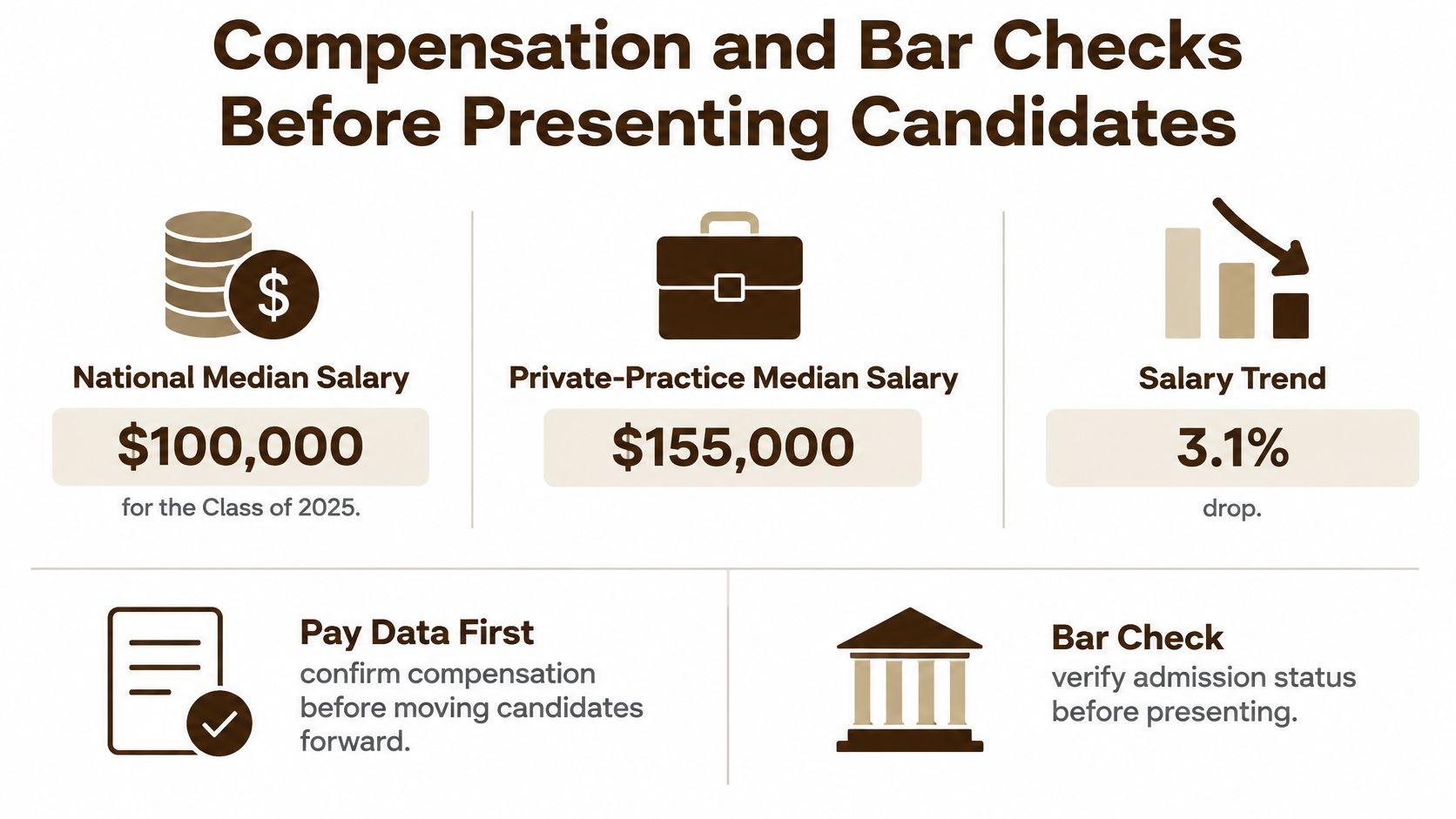
NALP's Class of 2025 selected findings report a $100,000 national median salary, a $155,000 private-practice median, and a 3.1% decline in private-practice compensation from the prior class.
Keep attorney pay separate from coordinator pay
Those figures describe graduate compensation, not attorney recruiting coordinator salaries. They also aren't a substitute for a role-specific attorney budget segmented by seniority, practice, geography, firm size, class year, and position type.
If you're hiring a coordinator, set that role's range using comparable recruiting positions and the scope you expect. A job focused on scheduling shouldn't be benchmarked as though it carries firm-wide hiring strategy.
Use a documented submission gate
Build these checks into your employment screening process:
- License status: Check the relevant licensing authority's record and document when you checked it.
- Admission date and jurisdiction: Confirm where the lawyer is admitted and route eligibility questions to the appropriate reviewer.
- Practice-area evidence: Record representative matters and the candidate's personal responsibility without requesting privileged material.
- Compensation alignment: Capture expectations and any unresolved conditions separately.
- Conflicts constraints: Flag potential issues for authorized review; don't label preliminary screening as clearance.
- Location requirements: Confirm relocation, office attendance, and remote-work expectations.
Submission standard: Clearly distinguish verified information, candidate statements, and questions still awaiting review.
Every candidate we present at Five Star Placements has spoken with us on a call first. We vet credentials, bar status, matters handled, and fit, and confirm interest in the specific role before the client sees the candidate.
Sample Job Description and How to Adapt It
A useful posting tells applicants what they'll own and how the firm will judge success. Use this outline as a starting point, then replace every bracketed field before publishing.
Sample posting
Job title: Attorney Recruiting Coordinator
Reporting line: Reports to [recruiting manager, HR leader, or designated hiring partner].
Role summary: Coordinate attorney searches across [practice areas served], maintain accurate candidate information, and support timely, evidence-based hiring decisions.
Core responsibilities
- Search intake: Translate hiring-partner requirements into approved search briefs.
- Candidate screening: Document relevant experience, interest, and outstanding qualification questions.
- Interview operations: Organize panels, distribute materials securely, and maintain candidate communication.
- Decision support: Collect written feedback and escalate unresolved approvals.
- Pipeline reporting: Maintain stage records and report time-to-shortlist, candidate withdrawals, and offer outcomes.
Required qualifications: [Years of experience] in recruiting or legal staffing; working knowledge of attorney hiring cycles; strong pipeline-reporting habits; clear written communication; and demonstrated confidentiality discipline.
Preferred qualifications: Experience inside a law firm or legal department, familiarity with an applicant tracking system, and exposure to lateral and partner searches.
Pay range: [Approved base salary range], with [applicable bonus and benefits information].
Adapt scope before adding requirements
A boutique focused on a single practice should emphasize depth in that practice and direct partner communication. A multi-office firm should specify responsibility for location-level reporting, competing calendars, and consistent candidate records.
A corporate legal department may need stronger governance and vendor-risk awareness. A partner-heavy hiring program needs more capability in intake, business-portability documentation, and discreet communication.
Don't turn every preferred skill into a mandatory qualification. Separate what the coordinator must know on arrival from what the firm can teach.
Finally, check the outputs. A posting that lists duties without naming measurable results, such as shortlist delivery or reliable offer tracking, leaves strong applicants guessing about what success means.
Decide Whether to Build or Buy Coordinator Support
Choose support based on hiring volume, seniority mix, and internal capacity, not the apparent simplicity of scheduling. A firm with steady lateral demand across several practices has a stronger case for an in-house coordinator who maintains the pipeline daily.
Irregular demand or an urgent specialist search may justify outside help. A hybrid arrangement can also work: an internal coordinator owns records and approvals while an external recruiter handles targeted outreach.
Test your actual workload
- Volume: Count last year's lateral hires and identify whether demand was continuous or concentrated around isolated vacancies.
- Seniority mix: List associate, counsel, and partner searches separately, noting which required specialized evaluation.
- Capacity: Record the weekly time spent on intake, screening, candidate communication, and feedback follow-up.
Before outsourcing, establish who owns confidentiality, verification, and decisions. At Five Star Placements, applications are confidential, and we won't contact an applicant's employer without permission; we also ask clients for prompt, candid feedback and adjust the search accordingly.
This week, write a one-page intake list and choose a small set of dashboard measures your team can maintain. If outside support fits the workload, arrange a role discussion with a recruiter rather than sending an undefined vacancy and hoping for suitable résumés.
Five Star Placements helps law firms and legal departments recruit through role-specific intake, candidate vetting, interview coordination, and offer guidance. Visit Five Star Placements to schedule a call about your hiring needs and clarify where your team needs recruiting support.
Need help filling a legal role?
Five Star Placements partners with law firms and legal departments nationwide.
Schedule a Call