
Mid Level Associate Recruiting: Proven Hiring Strategies
August 12, 2026 · 16 min read · Five Star Placements

Table of contents
A managing partner gets the notice on a Thursday afternoon. By Friday morning, two active matters have already been reassigned, a client wants to know who's handling the next call, and the team is talking about “coverage” instead of growth. That's a significant pressure point in mid level associate recruiting, because the problem usually isn't finding a body, it's replacing a practice-ready lawyer before the work, the client relationship, and the morale all start to fray.
The market has changed in a way that makes that scramble more common. Reuters reported a 15% year-over-year increase in lateral associate transitions in 2026 in U.S. law firms, and a separate industry post cited by LinkedIn said 49% of associate hires were lateral hires in 2025, while only 38% were entry-level hires, with lateral hiring up 16.4% year over year across U.S. law firms (Reuters). That isn't a temporary blip. It's a market where the mid-level seat gets filled by competing firms, not by waiting on a campus pipeline.
Table of Contents
- Why Mid-Level Seats Keep Slipping Away
- Defining the Seat Before You Source Anyone
- Sourcing Channels That Produce Mid-Level Candidates
- Screening and Interview Design That Predicts Retention
- The Offer Stage Is Where Most Searches Die
- Onboarding and the First 12 Months of Retention
- Measuring Whether the Hiring System Is Working
Why Mid-Level Seats Keep Slipping Away
A common story repeats itself in large and small firms alike. A productive third- or fourth-year associate gives notice, the practice leader assumes the replacement search should be simple, and then every competitor in the market starts calling the same narrow group of candidates. The firm is not really recruiting from a broad pool anymore. It is trying to win a lateral race that most other firms are running at the same time.
That is why the old campus-hiring mindset does not fit this seat. In major legal markets, mid-level associate recruiting is largely a lateral market rather than an entry-level pipeline, and that dependence has become more pronounced in recent years. Firms want lawyers who can step into billable work, client service, and matter execution immediately.

The consequence is structural. A mid-level search no longer turns on who can post the job fastest. It turns on who can define the seat crisply, reach the right lawyers first, and present a move that feels materially better than the candidate's current path. Compensation still matters, but so do practice fit, supervision quality, and whether the candidate believes the new firm will use them well instead of just billing them harder.
Why the same candidate pool keeps recycling
The pool is small because experienced associates are already employed, already getting calls, and often already thinking about their next move before a recruiter reaches them. That means firms are competing over the same practical questions, not abstract talent branding. Can this lawyer do the work on day one? Will the team respect the lawyer's time? Does the path here look clearer than the one they are leaving?
The firms that win mid-level seats usually do not source harder. They make the move easier to justify.
The management lesson is simple. If a search keeps slipping away, the issue is rarely a lack of names. It is usually a mismatch between the seat the firm needs and the seat the market thinks it is offering.
Defining the Seat Before You Source Anyone
A mid-level search usually goes off course before the first candidate call. The firm thinks it is hiring a “litigation associate” or “corporate associate,” but the market reads that as a broad ask with no clear work, no clear pace, and no clear supervision structure. A better starting point is the matter pipeline, because it shows what needs to get done now, not what the practice group hopes to staff later.
The strongest internal brief is usually shorter than a standard job posting and far more concrete than most partners expect. It should turn the current caseload into a seat definition, then narrow the field before outreach starts. That is the working style used in mid level associate recruiting, where the firm defines the role from the matter pipeline, maps the candidate pool by practice and class year, and checks actual matter experience before anyone gets into interviews (Sartori Global).
Build the seat from work, not from wish lists
Start with three questions. What matters are coming in? Which partner or team is carrying them? What level of associate can absorb that work without a long ramp?
From there, define the class year, the billable expectations, and the must-have experience, then separate those items from the nice-to-haves. If the brief blurs those lines, the search turns into a sorting exercise instead of a hiring decision.
A litigation team with a heavy deposition calendar and active discovery disputes does not need a generic litigator. It needs someone who has already handled deposition prep, ESI issues, and live-matter pressure. A candidate with the right résumé but no useful matter exposure will slow the team down, even if the paper profile looks polished.
| Seat Brief Template | ||
|---|---|---|
| Field | Purpose | Example |
| Practice need | Anchors the seat to current work | Business litigation with active discovery |
| Class year | Narrows to the right seniority | Fourth year |
| Matter experience | Separates relevant experience from pedigree | Depositions, ESI, motion work |
| Billable expectations | Clarifies workload reality | Full-time billable role |
| Must-haves | Filters the funnel early | Prior large-firm litigation seat |
| Stretch criteria | Expands options without weakening fit | Clerking experience, niche exposure |
If the brief runs long, it is usually still hiding uncertainty. The best briefs are short enough that a recruiter can use them as a screen and a partner can use them as a hiring standard. That kind of clarity is also how Five Star Placements describes its legal recruiting approach and practice coverage on its about page, and that is the right standard for internal seat design too.
Practical rule: If the seat brief cannot be understood in one minute, the market will treat it as open-ended, and open-ended searches attract weak fits.
The goal is not to shrink ambition. It is to narrow the search until the firm can hire for the work it has, not for the work it hopes to win later.
Sourcing Channels That Produce Mid-Level Candidates
Posting a seat and waiting is a weak strategy for experienced associates. The legal market does not reward passive sourcing in this segment, because the candidates you want are usually already embedded in a firm, already busy, and rarely sorting through generic job boards. Reuters' reporting that only 24% of 2024 summer associate offers came through on-campus interviews, while 56% came from direct outreach, referrals, or resume submissions, shows how heavily legal hiring already depends on proactive sourcing rather than passive applicant flow (Reuters).
That pattern matters even more for laterals. Broader recruiting benchmarks show U.S. average cost per hire at $4,700 in 2025, with mid-level professional roles averaging $4,500 to $7,200, and median time-to-fill around 44 days for nonexecutive roles, while extra-large organizations were closer to 60 days (Traffi benchmark reporting). The message is plain. A mid-level search gets expensive when it drifts, and it gets more expensive when firms rely on weak channels.
The four channels that move the needle
A useful sourcing mix usually includes four lanes:
- Practice-specific alumni and competitor lists. These are the names most likely to understand the work and the culture quickly. They are not random prospects, they are lawyers whose current practice already resembles the seat.
- Referral-driven outreach from current attorneys and partners. Internal people know who left a good impression at a prior firm, who is frustrated, and who can be approached credibly.
- Specialized legal recruiters. A recruiter with a real network in the practice area and class year can surface people who will not touch a public posting. Five Star Placements offers contingency-based legal recruiting across attorney placements, which fits searches where the firm wants curated introductions without upfront cost. For a closer look at how legal recruiters frame this work, see the Five Star Placements blog.
- Selective use of job boards. These work best for harder-to-fill niches or where the practice area is not already saturated with inbound interest.
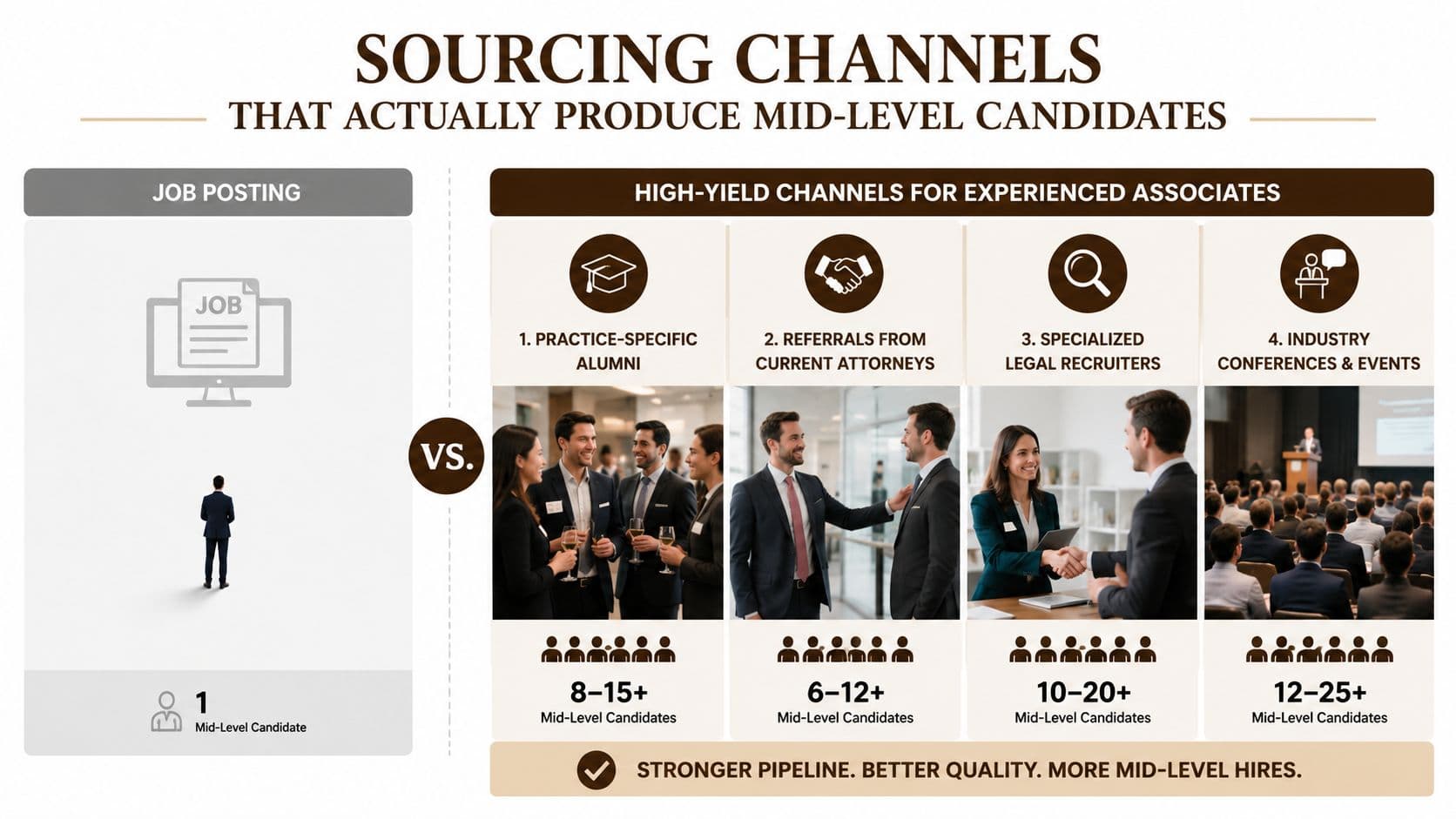
The strongest searches usually do not rely on one channel. They combine a narrow target list, warm outreach, and a recruiter partner who knows the practice language well enough to screen out false positives quickly. That shortens the list before partners waste time on people who were never serious fits.
A common rescue pattern looks like this. A search drags for weeks with no qualified interest because the posting is too generic and the outreach is too broad. The firm rebuilds the strategy around direct outreach to practice-specific lawyers, adds referral asks to current partners, and gives a contingency recruiter a precise seat brief. The shortlist arrives faster because the search is finally aimed at people who can say yes.
What not to waste time on
Broad blast emails, vague “exploring opportunities” messages, and mass job-board posting usually create noise, not candidates. They also create a false sense of activity, which makes teams think the market is the problem when channel choice is the actual issue. For mid-level recruiting, reach matters less than relevance.
Screening and Interview Design That Predicts Retention
A mid-level hire can look strong on paper and still be the wrong move once the firm starts using the person for real work. The interview process has to test whether the candidate will stay productive under the seat's actual demands, whether the practice group can supervise them in a way they can work with, and whether the schedule and flexibility match what the firm is prepared to offer. A legal-industry whitepaper on associate retention found that more than a dozen variables were linked to attrition, but work satisfaction, partner-associate relations, and family friendliness explained much of the model's predictive power. That changes what the screen should focus on. The ALM whitepaper belongs in the conversation only if it helps the team understand why some hires stay and others wash out.
Build the interview around what causes people to stay or leave
A strong interview loop tests workload realism, supervision quality, and flexibility fit. School rank, firm brand, and generic “culture fit” say less about whether the lawyer will stay engaged once the novelty wears off.
Use a scorecard with a few clear categories:
- Workload realism. Ask how the candidate has handled pressure, why they left prior seats, and what they consider a sustainable pace.
- Supervision quality. Learn whether they want close oversight, autonomy, or a mix, then compare that against the practice leader's style.
- Flexibility expectations. Do not oversell the schedule. Make expectations explicit.
- Matter readiness. Validate whether the candidate has done the specific work the seat requires.
- Path clarity. Explore how the firm talks about advancement, client development, and partnership.
Structured interviews matter because they force partners to ask the same questions, in the same order, before enthusiasm starts to distort judgment.
Law-firm interview loops break down when partners treat the meeting like a conversation instead of a screen. They ask what they enjoy asking, not what the role requires. The result is a polished interview and a weak prediction.
Calibrate before the offer, not after the regret
A debrief should compare notes against the scorecard, not against gut feel. If one partner likes the candidate and another sees a mismatch on workload or supervision, that disagreement should be resolved before any offer goes out. Targeted reference calls can also confirm the actual matter experience, especially on the work the résumé only hints at.
An unstructured process usually fails in familiar ways. The team talks itself into a polished candidate. The candidate later realizes the supervision style is wrong or the path is unclear. Then the search starts over.
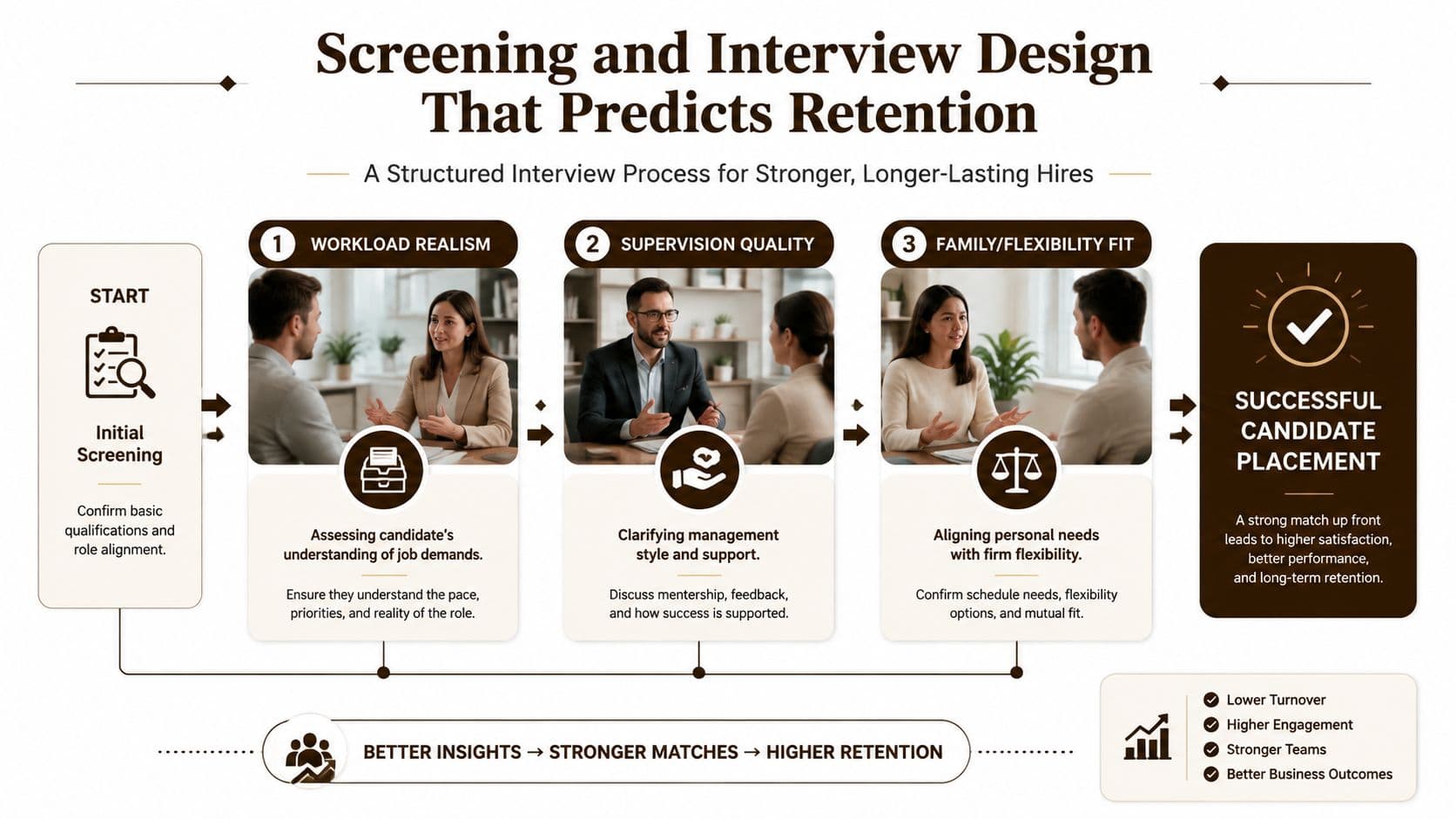
The practical fix is simple. Ask better questions, score them consistently, and confirm the candidate's real experience before anyone gets emotionally attached to the hire.
The Offer Stage Is Where Most Searches Die
A strong candidate can look committed right up until the offer is on the table. Then every weak spot in the search becomes visible at once. If the compensation range was fuzzy, if the role was described in broad strokes, or if the firm seemed to be making decisions on the fly, that candidate will hesitate or walk.
Offer timing matters because the process is already filtering harder than most firms admit. Broad recruiting benchmarks show employers averaged 180 applicants per hire in 2024, interviewed only 3% of applicants, and converted 27% of interviews to hires. In legal recruiting, healthier searches aim for 30-50% recruiter-screen-to-hiring-manager conversion and 30-50% onsite-to-offer conversion, with under 7 days spent in any active stage (Traffi benchmark reporting). When the process slows down, the best candidates usually have other options.
Pay for the seat, not for the spreadsheet
Compensation has to match the class year, the practice area, and the actual work the candidate will do. A vague range invites lowball assumptions. A late offer gives a competitor room to move first. If the firm avoids direct discussion of portability, bonus mechanics, or a guaranteed income piece where that belongs, a cautious lateral will often stay where they are.
Counteroffers make this stage even more fragile. Industry guidance on lateral recruiting notes that candidates often drop out when the process drags or the partnership path is unclear, and offer declines above roughly 15% usually point to compensation mismatch, late-stage competition, or weak process design. The response is not to push harder. The response is to surface the economics earlier and make them legible before the final decision.
Plan the decision path before the offer lands
A clean offer process starts with alignment inside the firm. The people who can approve the deal should already agree on the terms before the candidate hears anything.
From there, the explanation needs to be plain. Base, bonus, and any sign-on or guaranteed component should be laid out clearly, without spin. The candidate should also get a real deadline, not a drifting one that signals hesitation. If a counteroffer is likely, the team should know who will respond, when they will call, and which concerns they will address. If the firm wants the associate to think long term, it should say what long term means before the window closes.
A fifth-year corporate associate who leaves after ten days of negotiation is usually not reacting to one number. They are reacting to a move that never felt coherent. That is a process failure, not a market mystery.
Onboarding and the First 12 Months of Retention
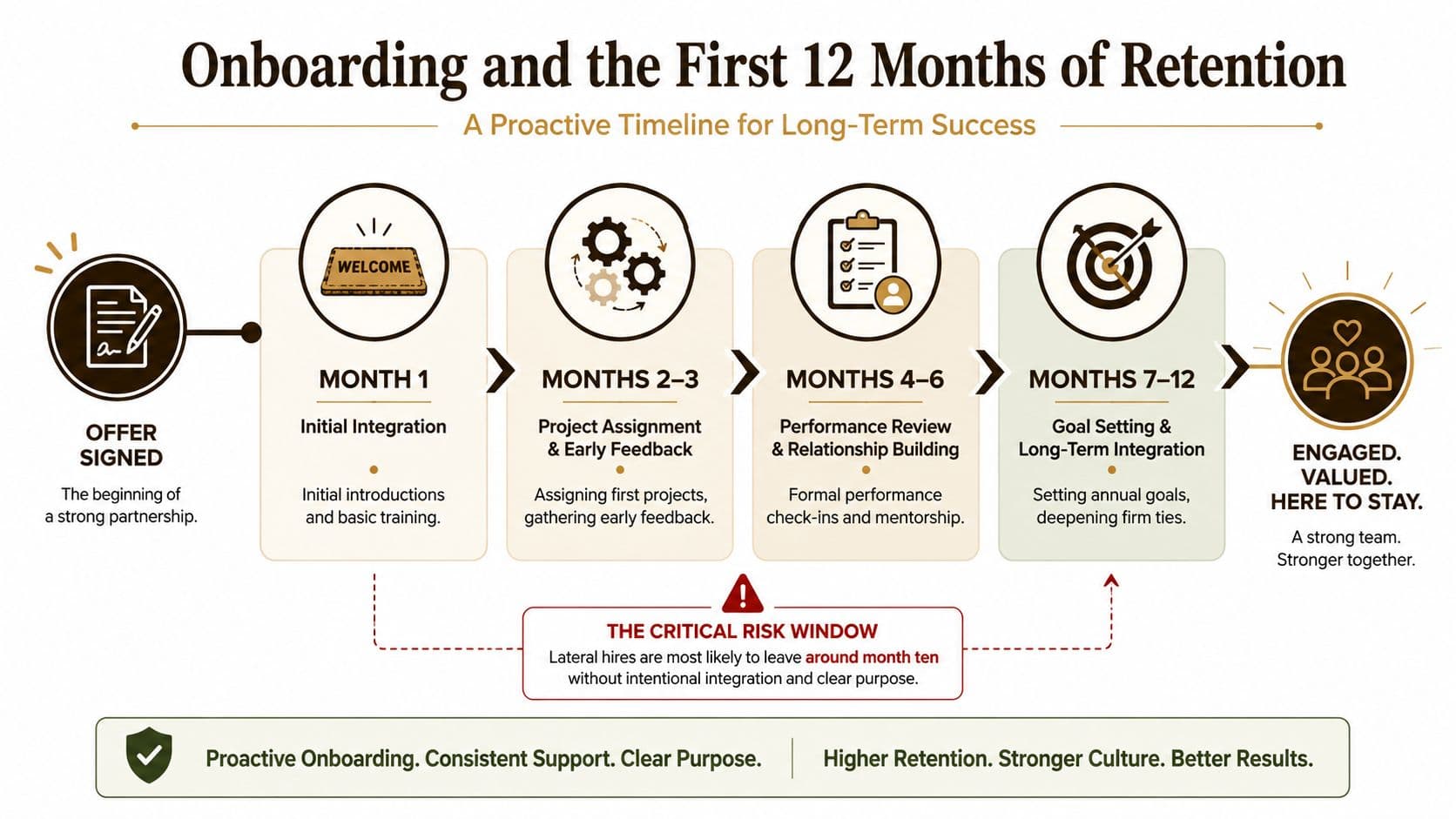
The signature is not the finish line. It is the first test of whether the hiring team understood the seat. A lateral associate can look strong in week one and still leave in month ten if the firm never clarified expectations, never built a real supervision relationship, and never gave the person a reason to stay beyond billable pressure.
That retention risk follows a pattern. Earlier research on associate attrition points to work satisfaction, partner-associate relations, and family friendliness as central factors. Onboarding has to manage those variables directly, because hoping they sort themselves out usually leaves the associate to do the interpreting.
Use a 30-60-90 arc, then keep going
The first 30 days should focus on integration. Introductions need to be real, not ceremonial, and the associate should know which matters matter, who to call for what, and how feedback gets delivered.
By month two and three, the work should start to settle into a pattern. The associate needs meaningful assignments, not only overflow, and the partner needs to know where the person is already strong and where they need support. That is also the point where informal drift starts to show. If nobody owns the relationship, the associate starts to feel like a spare set of hands.
A lateral who does not get early feedback usually fills in the blanks themselves, and those blanks are rarely flattering.
Months four through six should include a formal check-in on performance and relationship quality. That is when resentment can build if the workload was oversold or the supervision is inconsistent. Small disappointments become a story about how the firm operates, and that story is hard to reverse once it takes hold.
Months seven through twelve should turn toward goals, development, and the long-term picture. If the firm wants the lawyer to see a future there, the conversation has to become more explicit before the first anniversary arrives. That means talking plainly about advancement, exposure, and what staying actually looks like in practice, not just in recruiting language.
What a practice leader should track
A practical retention checklist is straightforward:
- Matter assignment balance. Is the associate getting the right mix of stretch work and executable work?
- Partner contact. Does one partner own the relationship, or is the associate floating?
- Feedback cadence. Are corrections specific and timely?
- Flexibility reality. Did the firm deliver the work pattern it implied during recruiting?
- Development clarity. Does the associate know what progress looks like over the next year?
The point is not to over-engineer the first year. It is to remove the predictable reasons mid-level laterals leave after the novelty wears off.
Measuring Whether the Hiring System Is Working
A filled seat can still be a bad hire. That's why the recruiting function needs to be measured as a system, not judged by the number of offers sent. The right dashboard shows whether the process is fast enough, selective enough, and durable enough to support the practice, not just to close a vacancy.
Use a simple spreadsheet with five core measures: time-to-fill by practice area, offer acceptance rate, 12-month retention, 24-month retention, and year-one billable attainment. Add a separation column that distinguishes voluntary departures from involuntary ones, because those tell very different stories. If time-to-fill is low but retention is weak, the process is probably optimized for speed instead of fit.
What should trigger a redesign
A metric should start a process conversation, not a blame session. If offers are getting declined, the firm should ask whether the compensation range was credible, whether the process moved too slowly, or whether the candidate heard a clearer story from another firm. If retention is poor at the one-year mark, the question isn't whether the associate “wasn't tough enough,” it's whether the seat brief, interview loop, or onboarding plan missed the underlying problem.
Five Star Placements describes legal recruiting and permanent placement across attorney and legal operations roles on its homepage, and that kind of service model fits a measurement-first hiring process because it ties search work to an actual outcome, not just to activity.
If you don't measure retention, you end up celebrating speed and paying for it later.
A good dashboard doesn't need to be fancy. It needs to be honest. If the data shows that certain practice groups consistently lose mid-level hires sooner than others, the system needs redesigning, not more optimism. That's the significant shift in mid level associate recruiting, the goal isn't to keep feeding the lateral market, it's to build a process that produces hires who stay, perform, and make the practice stronger.
Five Star Placements works on contingency-based legal recruiting and permanent placement for attorneys, legal support staff, and legal operations roles, which makes it a practical option when a mid-level seat needs targeted screening instead of a broad applicant pile. If your firm is trying to replace a lawyer, tighten the search process, or reduce short-tenure lateral turnover, visit Five Star Placements and see how a practice-aligned search can support the next hire.
Need help filling a legal role?
Five Star Placements partners with law firms and legal departments nationwide.
Schedule a Call