
Culture Fit Assessment Test for Legal Teams
September 25, 2026 · 14 min read · Five Star Placements
Table of contents
Most legal hiring advice treats culture fit as a final gut check: the partner likes the candidate, the candidate seems polished, and everyone leaves the interview comfortable. That approach is attractive because it feels efficient. It also lets personal familiarity masquerade as professional judgment.
A defensible culture fit assessment test asks a harder question: will this attorney, paralegal, legal operations leader, or in-house counsel perform effectively in this specific working environment? The answer depends on observable behavior, not shared hobbies, school pedigree, conversational ease, or whether a candidate resembles the people already in the room.
For legal teams, the distinction matters. Practice groups operate under different client demands, staffing models, feedback habits, and billable pressures. A litigation associate may need to manage rapid priority changes and intense collaboration, while an in-house M&A counsel may need to exercise independent judgment across business functions. Treating both roles as if they require one generic personality profile is poor selection practice.
Table of Contents
- Rethinking the Culture Fit Assessment Test in Law
- The Predictive Validity of Person-Organization Fit
- Overcoming Affinity Bias with Structured Rubrics
- Designing Job-Relevant Assessments for Legal Roles
- Evaluating Culture Add in Remote and Hybrid Models
- Integrating Competency Screening and Post-Hire Validation
- Building a Defensible Legal Hiring Strategy
Rethinking the Culture Fit Assessment Test in Law
The popular advice is wrong when it tells partners to trust their instincts. A partner's judgment can be valuable, but an informal “fit” conversation rarely separates role alignment from personal affinity. Interviewers may call a candidate practical because the candidate communicates like they do, or label another candidate difficult because the candidate asks questions that challenge the team's assumptions.
That creates a serious risk in legal recruiting. A firm can hire people who feel familiar rather than people who strengthen its ability to serve clients, collaborate across practices, and handle demanding matters. The result is often a homogeneous team with limited challenge, narrow problem-solving habits, and weak insight into clients whose backgrounds differ from those of the interview panel.
The financial consequences of a poor match are also substantial. A widely cited HR summary attributes 89% of hiring failures to poor cultural fit rather than insufficient technical skills, and reports that 73% of professionals have left a job because of poor culture fit. Those figures are presented in Hyring's cultural fit guidance, which also summarizes management literature linking strong cultural alignment with higher revenue growth and EBITDA, as well as turnover costs that can reach 50% to 60% of annual salary.
Why legal teams face sharper exposure
Legal work magnifies mismatch. A lawyer who dislikes collaborative drafting may struggle in a group handling complex litigation. A senior associate who expects constant autonomy may clash with a partner who reviews every strategic decision. A paralegal who needs clear sequencing may be placed in a practice group where urgent client requests routinely reorder the day.
Those problems don't always appear during a polished interview. A candidate can discuss teamwork convincingly and still fail to communicate under pressure, receive feedback, or manage competing deadlines. The interviewer needs evidence from prior behavior and a clear understanding of the role's operating conditions.
Practical rule: Don't ask whether a candidate would “fit in.” Ask which behaviors the role requires, then gather comparable evidence from every candidate.
Replace similarity with alignment
A structured culture fit assessment test isn't an invitation to score personality. It should examine work preferences, motivation, communication patterns, and decision-making behaviors against the actual practice group or legal department. It should also leave room for culture add, meaning a candidate can meet core professional expectations while bringing a perspective or working strength the team lacks.
Managing partners and general counsel should document the criteria before interviews begin. If an interviewer can't explain the decision using job-relevant evidence, “not a fit” isn't an adequate conclusion. It's a warning that the process has reverted to intuition.
The Predictive Validity of Person-Organization Fit
Person-organization fit has a long history in industrial-organizational psychology. Modern selection practice draws heavily from formal person-organization fit research, which treats compatibility as a relationship between an individual and the values, expectations, and working conditions of an organization.
The evidence supports a precise use of fit assessments. A major 2012 academic synthesis reported estimated true validity of 0.62 for perceived fit, 0.45 for subjective fit, and 0.26 for objective fit when predicting attitudes. The same synthesis placed fit at about 0.15 for job performance and 0.24 for turnover, as summarized in this overview of culture fit and culture add.
Those figures should change how legal leaders use the tool. Fit assessments are more useful for understanding commitment, satisfaction, and the likelihood of remaining engaged than for predicting whether an attorney will produce excellent legal work. They shouldn't replace a writing sample, matter-history review, technical interview, reference process, or practice-specific competency screen.
What the assessment can and can't tell you
A culture fit assessment test can help answer questions such as:
- Commitment: Does the candidate's preferred way of working match the team's actual level of supervision, collaboration, and autonomy?
- Satisfaction: Will the candidate find the role's pace, feedback style, and client exposure acceptable over time?
- Retention: Are there predictable sources of friction that could cause an early departure?
- Working relationship: How does the candidate approach disagreement, accountability, and shared ownership?
It can't establish that someone has sound legal judgment or can manage a complex caseload. It also can't justify rejecting a candidate because the person feels unfamiliar. A low fit score should trigger a closer examination of the work environment and the evidence, not an automatic rejection.
Put fit inside a hiring matrix
For a lateral attorney, competency evidence might include substantive knowledge, portable business, drafting quality, courtroom experience, and matter management. For a legal operations director, it might include systems implementation, financial discipline, process design, and stakeholder management. The fit component addresses whether the person is likely to operate effectively within the specific environment.
This distinction protects the decision from overreach. Legal leaders should use fit as a supporting hiring signal, especially for satisfaction and retention, while allowing validated competency evidence to carry the decision on technical performance.
Overcoming Affinity Bias with Structured Rubrics
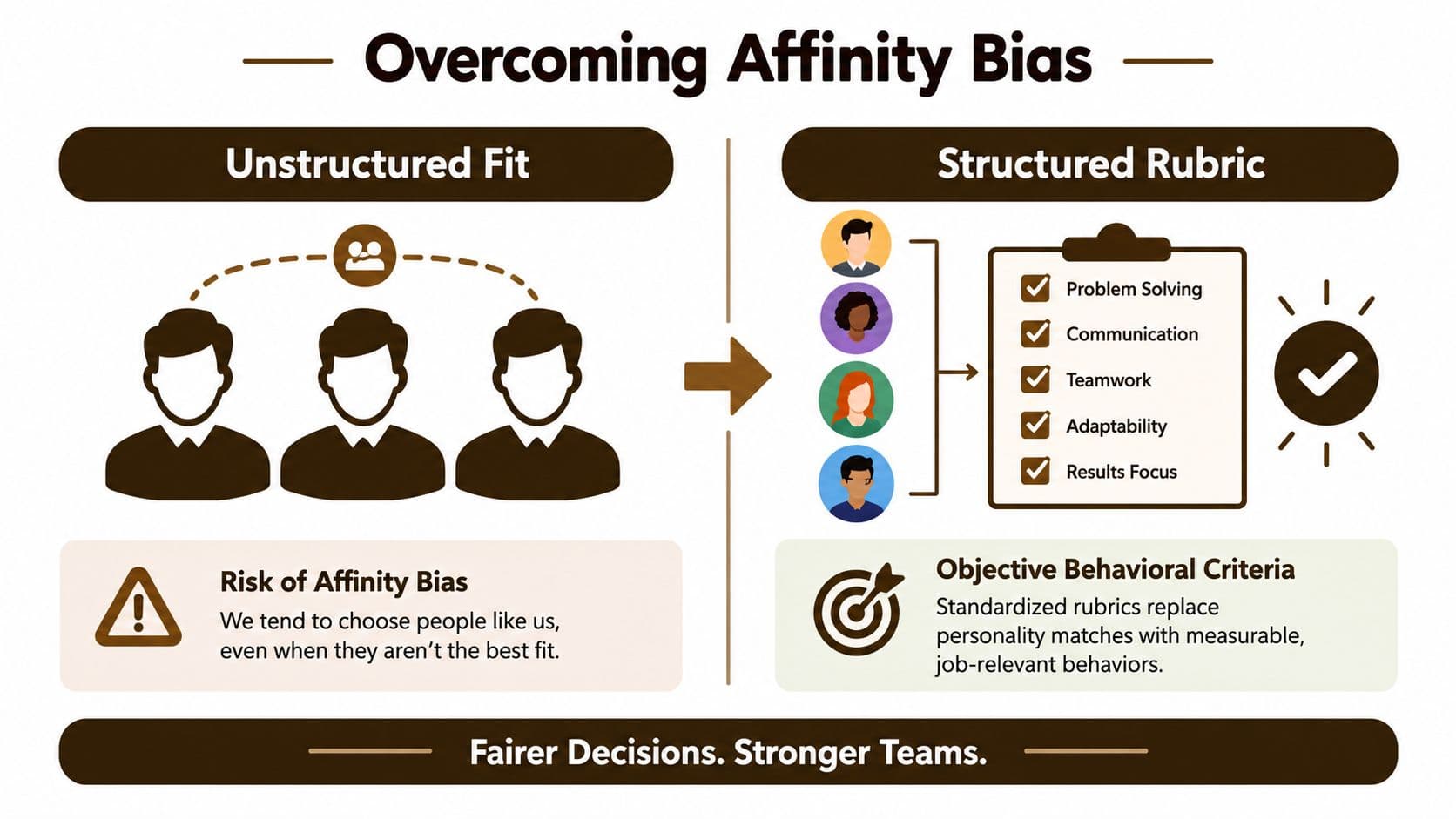
The central danger of culture fit is not that it measures alignment. The danger is that interviewers define alignment as likeness. In a law firm, that can mean favoring candidates who attended similar schools, worked at comparable firms, share the interviewer's communication style, or respond comfortably to informal social cues.
Unstructured interviews make that problem difficult to detect. The interviewer may remember chemistry rather than evidence, and a confident candidate may receive credit for qualities that aren't connected to the role. A structured behavioral interview creates a different record. Each candidate answers the same questions, and the panel scores the same predefined behaviors.
Define behaviors before meeting candidates
Start with three to five culture-related behaviors that matter to the position. Don't use labels such as “professional,” “polished,” or “good personality.” Those labels invite interpretation. Use observable behaviors instead:
- Cross-practice collaboration: Shares information early, clarifies ownership, and resolves disagreements without withholding work.
- Client communication under pressure: Explains risk clearly, avoids unnecessary alarm, and keeps stakeholders informed when facts change.
- Adaptability: Reorders work when a matter changes while preserving deadlines and quality controls.
- Feedback response: Seeks clarification, applies direction, and raises a reasoned objection when necessary.
- Accountability: Identifies errors promptly and proposes a corrective path.
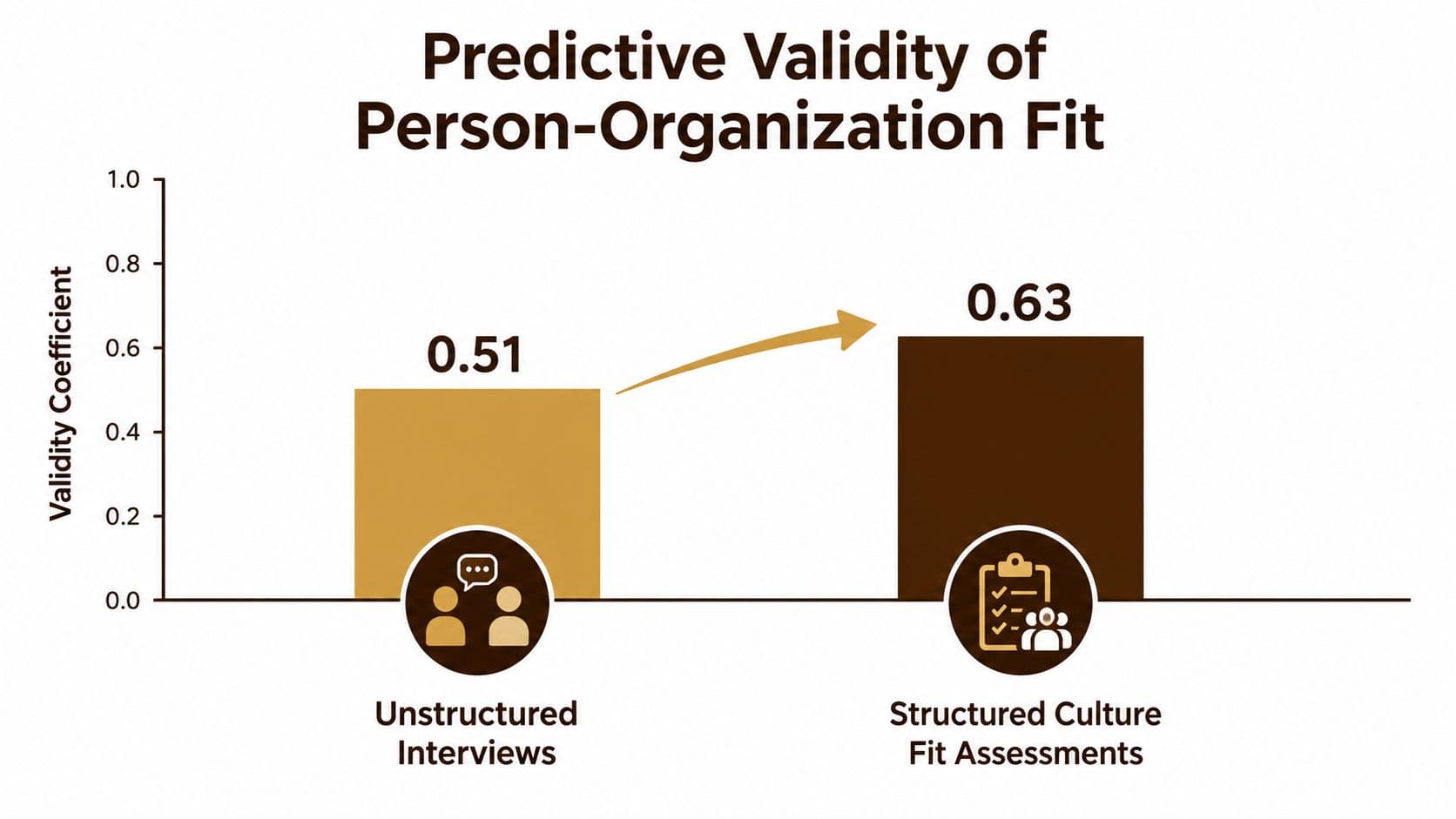
The SHRM discussion of culture fit summarizes evidence from a meta-analysis covering 245 validity coefficients across 86,311 people and emphasizes the advantage of structured interviews over unstructured conversations for predicting future behavior. The practical implication is straightforward: define the behavior, ask the same question, and score the evidence.
Use one rubric for the whole panel
A rubric should describe what weak, adequate, and strong evidence looks like. For example, a candidate discussing a missed filing deadline might receive a stronger score for describing immediate disclosure, client communication, root-cause analysis, and a preventive control than for merely stating, “I worked harder afterward.”
Have each interviewer score independently before discussion. Group consensus should follow individual scoring, not replace it. This prevents the most senior or forceful partner from setting the panel's interpretation before others record their observations.
Use the same process for a partner, associate, paralegal, or legal support professional, while changing the behaviors to match the work. A partner may need to demonstrate delegation and client leadership. A paralegal may need to show reliable handoffs, document discipline, and responsiveness to shifting matter priorities.
For additional perspective on standardizing selection methods, review candidate selection methods for legal hiring.
A structured rubric won't eliminate bias. It makes bias easier to identify, challenge, and reduce. It also gives the firm a defensible explanation for its decision that is grounded in conduct rather than personal comfort.
Designing Job-Relevant Assessments for Legal Roles
A culture fit assessment test is only useful when it reflects the actual job. “Collaborative culture” means something different in a high-volume litigation group, an in-house legal department, and a legal operations function. The assessment must follow the work, not the firm's marketing language.
Start with the operating environment
Write down how the role is performed before drafting questions. Identify the level of autonomy, frequency of urgent requests, client contact, review intensity, expected collaboration, and tolerance for ambiguity. Then separate essential behaviors from preferences that merely make an interviewer more comfortable.
A high-volume litigation associate may need to triage filings, coordinate with support staff, accept rapid feedback, and communicate clearly when deadlines collide. An in-house M&A counsel may need to balance legal risk against commercial urgency, explain tradeoffs to business leaders, and move matters forward without waiting for perfect information. A legal operations director may need to lead change across teams that don't report directly to them.
These are different environments. One generic personality profile can't measure them fairly.
Translate values into evidence
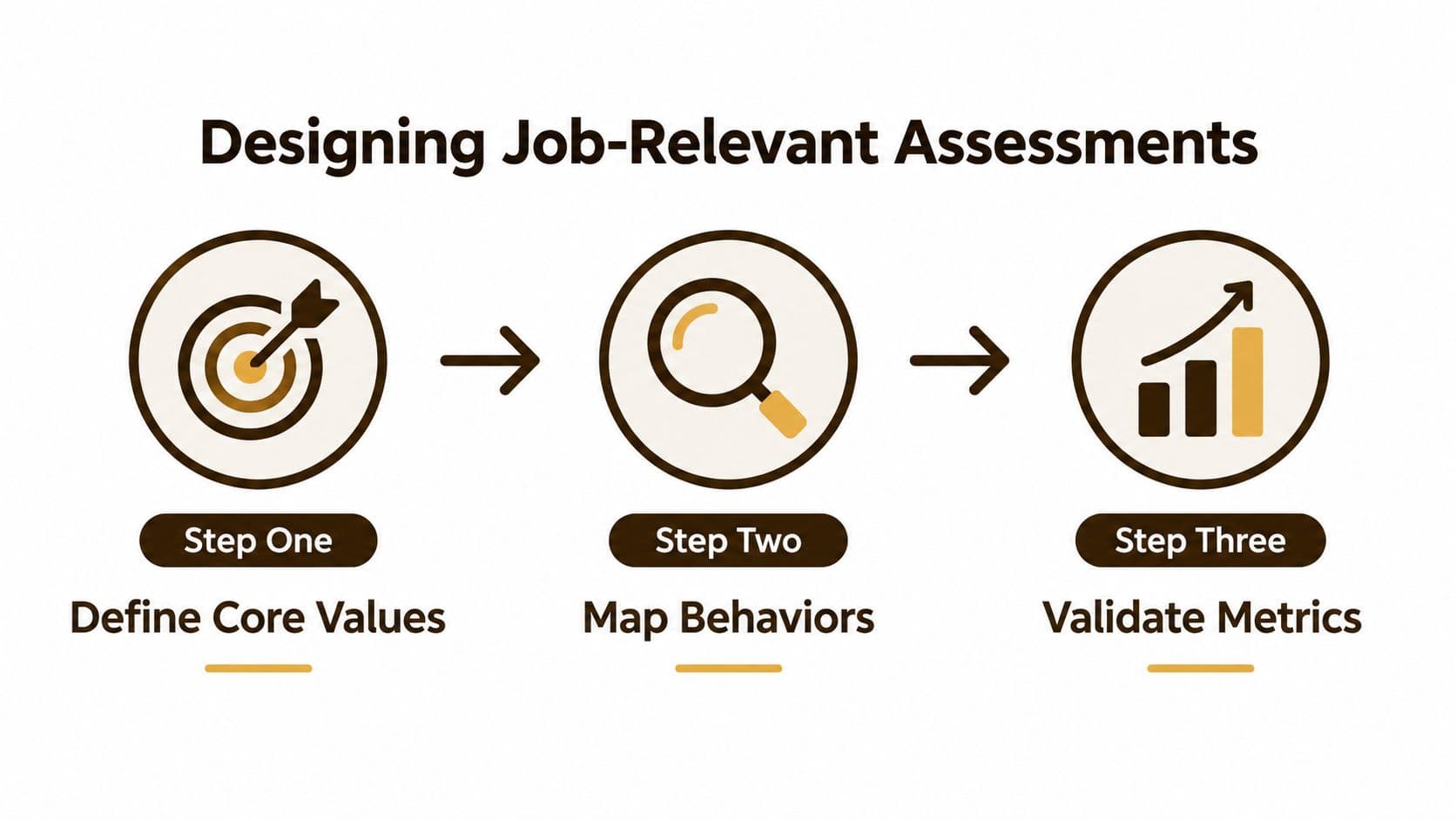
Use a three-part design process:
- Define core values in behavioral terms. Replace “teamwork” with “shares ownership of a matter when another lawyer faces a capacity problem.”
- Map behaviors to realistic prompts. Ask for a past example or provide a role-specific scenario involving deadlines, client demands, feedback, or disagreement.
- Validate the criteria after hiring. Compare assessment observations with later retention, performance, and manager feedback, then remove criteria that don't predict anything useful.
Measure preferences without stereotyping
Work preferences can reveal likely friction, but they aren't moral judgments. Someone who prefers written instructions isn't less collaborative. Someone who works best with autonomy isn't less committed. The question is whether the role can support the preference and whether the candidate can adapt when the work requires something different.
A useful assessment asks candidates to describe how they organize competing matters, communicate bad news, receive redlines, and work with people who have different priorities. It should test the candidate's reasoning, not reward a particular personality style.
For a practical complement to this process, see communication skills assessment for legal hiring. The assessment should remain tied to the role's communication demands, such as client updates, escalation, written analysis, or cross-functional translation.
Evaluating Culture Add in Remote and Hybrid Models
Remote and hybrid legal teams make office-based culture signals less reliable. A partner can't infer collaboration from who stays late in the office, and a candidate shouldn't be penalized for not participating in informal rituals that have little connection to client service.
Distributed teams need a clearer definition of culture. The relevant questions concern how work moves across locations, how people communicate asynchronously, how quickly they escalate risks, and whether they can maintain accountability without constant physical supervision.

Assess the distributed work itself
A remote or hybrid culture fit assessment test should include prompts that reflect digital work rather than office presence. Ask a candidate to explain how they would handle an unclear assignment received through email, a delayed response from a supervising attorney, or conflicting instructions from two matter leads.
Evaluate whether the candidate:
- Clarifies ambiguity: Identifies missing facts and confirms priority before proceeding.
- Writes for the reader: Uses concise, actionable communication instead of relying on a meeting to repair confusion.
- Escalates proportionately: Raises a material risk without turning every uncertainty into an emergency.
- Maintains visibility: Records decisions, deadlines, and ownership where the team can find them.
- Builds relationships deliberately: Creates reliable communication routines without depending on hallway access.
These behaviors can be assessed consistently across candidates. They also help the firm distinguish a genuine preference from an inability to work in a distributed environment.
Define culture add at team level
Culture add shouldn't mean hiring someone who disrupts every established practice. It means identifying a missing capability or perspective that improves the team while preserving professional standards. A multi-office firm may need someone experienced in cross-office matter management. An in-house department may need counsel who can translate legal risk for product, finance, or sales leaders.
Ask two separate questions:
- What core behaviors must the candidate share with the team?
- What useful capability or perspective does the candidate add?
Keep the answers separate in the scoring record. Otherwise, an interviewer may reward similarity and describe it as values alignment. Remote work makes that separation more important because informal impressions carry fewer reliable signals and can easily become assumptions.
Integrating Competency Screening and Post-Hire Validation
A culture fit assessment test should never operate alone. The strongest legal hiring process combines cultural alignment with competency screening, structured references, work samples, and role-specific interviews.
For an attorney, that may mean reviewing a redacted writing sample, discussing a representative matter, and testing judgment through a realistic client scenario. For a paralegal, it may include document organization, deadline control, and communication exercises. For legal operations leaders, it may involve process mapping, stakeholder planning, and systems judgment.
The sequence matters. Assess technical competence and cultural alignment as related but distinct dimensions. Don't let an attractive fit score rescue weak legal skills, and don't let impressive credentials excuse a clear inability to work within the role's actual environment.
Build a feedback loop
Post-hire validation turns the assessment from a subjective tie-breaker into a decision tool. Track whether the behaviors identified during selection correspond with actual outcomes over the agreed review window. The relevant measures include six- to twelve-month retention and performance, as recommended in the supplied guidance on distributed and skills-based hiring.
The review should ask:
- Retention: Did the person remain in the role through the review period?
- Performance: Did the manager observe the behaviors the panel scored?
- Integration: Did the hire collaborate effectively with the relevant practice group or department?
- Role conditions: Did the job differ from what the interview process described?
- Assessment quality: Did the rubric capture useful evidence, or did it reward style?
This process requires judgment. A departure doesn't prove that the assessment failed if the role changed materially or the firm misrepresented expectations. Conversely, retention alone doesn't prove success if the person stayed but failed to deliver.
Make validation operational
Assign ownership before the search begins. The hiring partner or general counsel should own role criteria. The recruiter should document evidence and challenge unsupported conclusions. HR or legal operations should maintain consistent records and review patterns across hires.
Use the quality of hire measurement framework to connect selection evidence with post-hire review. The point isn't to create a complicated dashboard. It's to establish enough discipline to learn which behaviors actually matter in each legal environment.
A score has no value if the firm never checks whether the underlying prediction was right.
Review the rubric when the practice group changes, the work model shifts, or managers report recurring friction. A culture assessment should evolve with the role, but changes must be documented so the firm can distinguish genuine improvement from moving the goalposts.
Building a Defensible Legal Hiring Strategy
Legal leaders don't need another vague values exercise. They need a repeatable process that identifies the behaviors required for a particular role, tests those behaviors consistently, and checks whether the hiring decision holds up after the person joins.
A practical implementation checklist looks like this:
- Define the environment: Document the practice group's pace, supervision, client demands, collaboration model, and work location expectations.
- Separate alignment from affinity: Remove schools, hobbies, social ease, and “executive presence” unless they connect to observable job behavior.
- Choose role-specific behaviors: Select three to five behaviors that matter to successful performance in that position.
- Standardize questions: Ask every candidate comparable behavioral or situational questions.
- Use independent scoring: Require panelists to record evidence before group discussion.
- Separate competencies: Test legal knowledge, drafting, matter experience, and technical skills independently from culture.
- Include culture add: Identify the capability or perspective the new hire should contribute.
- Calibrate the panel: Review sample answers and agree on what weak, adequate, and strong evidence looks like before interviews.
- Validate after hiring: Review retention and performance during the agreed six- to twelve-month window.
- Refine carefully: Change criteria only when evidence shows that the current rubric doesn't predict the work.
Treat hiring as risk management
The managing partner's responsibility isn't to assemble a team that feels familiar. It's to build a group capable of handling client pressure, changing matters, professional disagreement, and evolving delivery models. General counsel face the same obligation, with the added challenge of aligning lawyers to business priorities across functions and locations.
A structured culture fit assessment test supports that responsibility when it remains job-relevant. It gives interviewers a common language, helps candidates understand the environment, and creates a record that explains why the team made its decision. It also protects culture add from being crowded out by the comfortable shortcut of sameness.
Five Star Placements provides permanent legal recruiting for attorneys, partners, in-house counsel, legal support staff, and legal operations leaders, using customized screening around practice needs, experience, skills, motivation, and organizational alignment. If your team needs a more disciplined approach to a difficult search, visit Five Star Placements to discuss the role and hiring environment.
Need help filling a legal role?
Five Star Placements partners with law firms and legal departments nationwide.
Schedule a Call