
Communication Skills Assessment for Legal Hiring
August 26, 2026 · 14 min read · Five Star Placements
Table of contents
A candidate can charm every partner in the interview, submit a flawless writing sample, and still disappoint within months. I've seen attorneys explain doctrine with precision yet lose control of a frightened client call, or present confidently in person while sending vague status updates that leave a deal team guessing. The hiring file says “strong communicator.” The matter file tells a different story.
That gap exists because many legal employers treat communication as one impression rather than a set of job behaviors. A serious communication skills assessment must separate written precision, verbal advocacy, client-facing empathy, responsiveness, and asynchronous collaboration. The reason is practical: structured assessments can produce very different levels of agreement across communication behaviors. A 2017 peer-reviewed study reported only 31% to 77% absolute agreement across items, demonstrating that observers may assess some competencies consistently while disagreeing substantially on others (peer-reviewed communication assessment study).
Table of Contents
- Why Legal Communication Assessment Needs a Rethink
- Defining the Competencies That Actually Matter
- Designing Interview Questions and Role-Play Scenarios
- Building Scoring Rubrics That Reduce Subjectivity
- Addressing Bias and Fairness in Communication Scoring
- Turning Assessment Results Into Hiring and Development Decisions
Why Legal Communication Assessment Needs a Rethink
Consider the polished lateral candidate who interviews beautifully. They answer every partner's question without hesitation, discuss teamwork convincingly, and produce a clean memorandum from a dense fact pattern. Six months later, the client becomes anxious during a conference call. The attorney responds with more legal detail instead of acknowledging the concern, fails to establish next steps, and leaves the client unsure who owns the decision. In the next negotiation, the same attorney pushes back on opposing counsel so aggressively that a manageable disagreement becomes a relationship problem.
That isn't a contradiction. It's a measurement failure.
“Communication” covers behaviors that don't automatically travel together. A lawyer may write with surgical precision but freeze during oral advocacy. Another may be compelling in a conference room but produce incoherent email updates. A third may listen attentively to a client but struggle to translate the client's commercial objective into a concise recommendation for a partner.
The checkbox problem
Unstructured interviews reward fluency, confidence, familiarity, and personal chemistry. Those qualities can matter, but they're not reliable substitutes for role performance. The interviewer often leaves with a global judgment, such as “I liked them” or “They're not polished,” without recording which behavior created that conclusion.
That approach is especially risky because legal work now spans more channels. A recent workplace communication report states that 76% of professionals communicate across more channels than in the prior year, while 40% of respondents experienced burnout, stress, and fatigue tied to communication issues (2026 workplace communication report). A firm that evaluates only live interview presence misses the emails, matter updates, video calls, document comments, and escalations that shape client confidence every day.
Practical rule: If the role requires a communication behavior, assess that behavior in a setting that resembles the work.
The business stakes are also higher than a soft-skills label suggests. The same report estimates that poor communication costs between $9,284 and more than $30,000 per employee per year, with losses implying well over $2 trillion for U.S. businesses overall (workplace communication cost analysis). It also reports that 86% of employees and executives link workplace failures to weak collaboration and communication, and 79% say leader communication quality affects how well employees understand organizational goals (communication and leadership findings).
A legal employer shouldn't respond by adding another generic communication test. It should define the behaviors that matter in the role, observe them more than once, and score them separately. A single overall number can hide the exact weakness that later disrupts a client relationship or stalls a matter.
Defining the Competencies That Actually Matter
Start with the work, not the interview. Review the role description, recent matter demands, client expectations, and the points where a new hire will interact with partners, clients, opposing counsel, regulators, and support teams. Then reduce the broad label of communication to four or six observable competencies.
Four core dimensions for legal roles
Written precision is the ability to organize facts, identify the decision required, choose an appropriate tone, and draft for the reader. It includes emails, memoranda, board materials, diligence summaries, discovery correspondence, and internal updates. Strong writing isn't merely grammatical. It makes the legal and commercial consequence easy to identify.
Verbal advocacy covers structure, persuasion, responsiveness, and composure. A candidate should be able to state the position, explain the reasoning, answer an interruption, acknowledge a weakness, and move the conversation toward an outcome. The standard changes by practice. Litigation demands oral argument and examination skills. Corporate work may place greater emphasis on negotiation and recommendation framing.
Client-facing empathy means listening for the concern behind the question, checking understanding, explaining legal risk in usable language, and managing expectations without false reassurance. Empathy doesn't mean agreeing with the client or avoiding difficult advice. It means delivering that advice in a way the client can absorb and act on.
Async collaboration is the discipline of keeping others aligned without requiring another meeting. The attorney identifies what changed, what remains open, who owns the next action, and when a decision is needed. This competency matters in distributed teams, but it also matters in every busy practice group where partners cannot reconstruct a matter from scattered messages.
A fifth competency can be added where the role requires it: conflict navigation. Score how the candidate challenges an assumption, responds to pressure, and preserves the working relationship while maintaining the legal position.
Behavioral anchors interviewers can recognize
Use anchors that describe conduct rather than personality:
- Below expectations: The candidate answers around the issue, buries the recommendation, overlooks the listener's concern, or sends an update without a clear action or owner.
- Meets expectations: The candidate structures the message, identifies the relevant risk, answers questions directly, adjusts tone to the audience, and confirms the next step.
- Exceeds expectations: The candidate anticipates misunderstanding, distinguishes legal risk from business impact, surfaces an unresolved issue tactfully, and gives the listener a practical decision path.
The mix must shift with seniority. A junior associate may need stronger emphasis on precise drafting, responsiveness to feedback, and dependable updates. A senior associate or counsel candidate must show strategic framing, client confidence, and the judgment to challenge a partner or client without creating unnecessary friction. Guidance on communication testing similarly recommends separating meaning, structure, tone, and responsiveness from fluency or pronunciation, especially for multilingual candidates (role-specific communication assessment guidance).
| Competency | Junior Associate | Mid-Level Associate | Senior Associate / Counsel |
|---|---|---|---|
| Written precision | Core drafting and revision skill | Independent client and partner communications | Strategic framing for varied audiences |
| Verbal advocacy | Clear updates and supervised argument | Negotiation, presentations, and responsive discussion | Persuasion, leadership, and high-stakes judgment |
| Client-facing empathy | Professional listening and expectation setting | Translation of risk into advice | Trust-building, difficult conversations, and relationship stewardship |
| Async collaboration | Timely task and status updates | Matter coordination across teams | Communication architecture for teams and clients |
| Conflict navigation | Receives and applies challenge | Pushes back constructively | Resolves tension while protecting the client and firm |
Designing Interview Questions and Role-Play Scenarios
A useful assessment moves from evidence of past behavior to a controlled simulation of future work. Behavioral questions reveal what the candidate has done. Role-play reveals how they process pressure, ambiguity, and another person's reaction in real time.
Build questions around evidence
Avoid “Are you a good communicator?” The answer tells you almost nothing. Ask for a specific event, then probe the sequence.
For a litigation candidate, ask: “Tell me about a time you had to explain a complex legal risk to a client who wasn't comfortable with the subject.” Follow with: “What did you say first?” “How did you check whether the client understood?” “What changed after the conversation?” Listen for audience analysis, not just confidence.
For an M&A candidate, ask: “Describe a negotiation where the other side rejected a point you considered important.” Probe how the attorney separated the core issue from the preferred position, explained the consequence, and maintained momentum.
For a regulatory candidate, ask: “Tell me about a time you disagreed with a senior lawyer's legal assumption.” Ask how the candidate raised the concern, what evidence they used, and whether they offered a practical alternative.
Record the answer against the defined competency. Don't let a compelling story compensate for missing evidence of listening, clarity, or follow-through.
Use simulations that resemble legal work
An M&A role-play might begin with a mock client call about a troubling diligence finding. The candidate must acknowledge the concern, state what is known, distinguish what requires investigation, and recommend immediate next steps. The assessor should introduce a follow-up question that tests whether the candidate can stay organized rather than recite prepared language.
A litigation exercise can simulate a partner interrupting an argument with a difficult question. Score whether the candidate answers the question first, preserves the argument's structure, and concedes only what should be conceded. A regulatory exercise can ask the candidate to challenge a flawed assumption during a team meeting, with credit for respectful directness and a workable recommendation.
For a written exercise, provide a short negotiation summary and ask the candidate to draft a client email explaining the outcome and next steps. Score:
- Clarity: Can the reader identify the result and decision required?
- Audience judgment: Has the candidate removed unnecessary legal jargon?
- Structure: Does the message distinguish completed work, open issues, and action items?
- Tone: Does it communicate firmness or reassurance without overpromising?
- Responsiveness: Does it answer the client's actual concern?
Remote assessment needs the same discipline. Run live role-plays over a stable video platform, give every candidate the same instructions, and use a shared written workspace with version history for supervised exercises. For take-home work, set a transparent policy about outside assistance, use a short live follow-up in which the candidate explains their drafting choices, and treat the submitted work as one data point rather than proof of unaided performance.
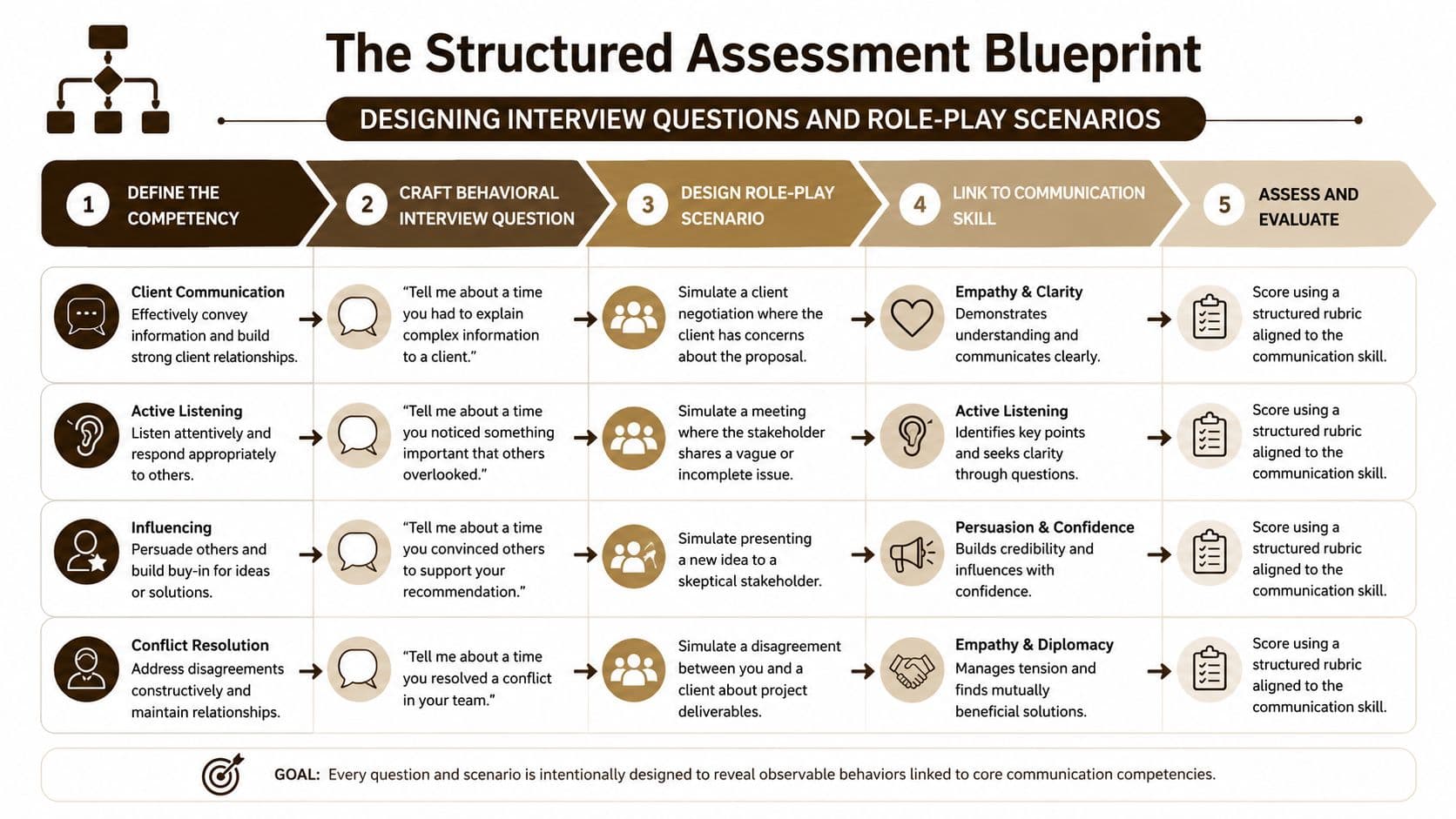
Interviewers should capture observations immediately after each exercise. Useful prompts include:
- What did the candidate do that demonstrated the target competency?
- What specific behavior reduced clarity, trust, or momentum?
- Did the candidate respond to the question asked, or to a question they preferred?
- What would this behavior look like in the role's actual workflow?
- Which rubric anchor best fits the observed performance?
For broader interview design, keep the same structured discipline used in attorney interview questions. Consistent prompts make comparisons more defensible and make it harder for one memorable exchange to dominate the decision.
Building Scoring Rubrics That Reduce Subjectivity
A rubric should make two things visible: what was observed and how much it matters for the role. “Good communicator” is not an anchor. “Restates the client's concern before recommending a response” is an anchor. “Cites the relevant rule or contractual language without hedging” is another.
Use a separate scale for each competency. A five-point scale can work if every point has behavioral meaning, but the number itself isn't the safeguard. The safeguard is requiring assessors to connect the score to observable evidence.
Separate dimensions before weighting them
Clarity asks whether the message is understandable and structured. Responsiveness asks whether the candidate addresses the actual question and adapts when the listener adds information. Professionalism covers judgment, tone, preparation, and respect. Strategic framing asks whether the candidate connects legal analysis to the client's objective.
Don't collapse these dimensions too early. A candidate who writes clearly but ignores a client's anxiety shouldn't receive the same communication profile as someone who does both well.
| Competency | Junior Associate Weight | Senior Associate Weight | Level 3 Anchor Example |
|---|---|---|---|
| Written precision | Higher | Moderate | Produces a concise, audience-appropriate draft with a clear recommendation |
| Verbal advocacy | Moderate | Higher | Answers interruptions directly and returns to a structured position |
| Client-facing empathy | Moderate | Higher | Restates the concern, explains the consequence, and confirms understanding |
| Async collaboration | Higher | Moderate | Identifies status, owner, deadline, and unresolved issue in each update |
| Strategic framing | Lower | Higher | Connects legal options to commercial priorities and recommends a path |
The table's weights should be set by the actual role, not by a universal template. A junior regulatory drafting role may require a high minimum in written precision while accepting a developing score in client-facing work. A counsel role may need the reverse profile, particularly if the attorney will handle sensitive business conversations independently.
Calibrate before you trust the scores
Calibration is where many employers fall short. Give interviewers the same recorded response or sample writing exercise. Have them score independently, cite the anchor they used, and then discuss why their ratings differ. If one assessor calls a response “confident” and another calls it “aggressive,” require both to translate those impressions into conduct, such as interruption frequency, directness, acknowledgment of opposing concerns, or failure to answer.
Use a scorecard that preserves the evidence:
- Competency score
- Behavioral evidence
- Concern or risk
- Follow-up question
- Hiring implication
A structured approach doesn't remove judgment. It makes judgment inspectable. For leadership-oriented roles, the same principle applies when assessing leadership potential. The evaluator should distinguish influence, listening, decision framing, and accountability instead of treating executive presence as a single instinctive reaction.
Addressing Bias and Fairness in Communication Scoring
A communication skills assessment can reduce subjectivity, but it can also formalize bias if the rubric rewards a preferred style instead of job performance. Research on automatic communication assessment in real job interviews notes that interviewer judgments can be affected by gender, race, age, ethnicity, religion, disability, and other factors, raising serious questions about validity and reliability (research on automatic communication assessment in job interviews).
The first safeguard is to separate communication effectiveness from language identity. Accent, pronunciation, and fluency may matter for a particular role only where they affect comprehension or a defined professional requirement. They shouldn't stand in for structure, listening, judgment, or the ability to explain a legal position. This distinction is essential in global hiring and for multilingual attorneys, whose polished English may differ from a hiring partner's preferred cadence without reducing their ability to advise clients.
Three common bias vectors
Accent bias appears when a listener treats unfamiliar pronunciation as evidence of weak reasoning. Score whether the candidate communicates meaning clearly in context, not whether they sound like the assessor.
Gender bias appears when the same direct behavior is labeled “confident” in one candidate and “abrasive” in another. Require the assessor to identify the actual interaction, such as dismissing a question, interrupting, or failing to acknowledge a valid concern.
Affinity bias appears when interviewers reward people who share their vocabulary, pacing, humor, educational background, or conversational style. A candidate doesn't need to resemble the panel to meet the role standard.
Use blind review for written work where practical, multiple independent raters for live exercises, and a shared calibration sample before interviews begin. A bias interruption checklist should ask each assessor to cite the relevant rubric anchor, separate observed behavior from inference, and explain whether the behavior affects a defined job requirement.
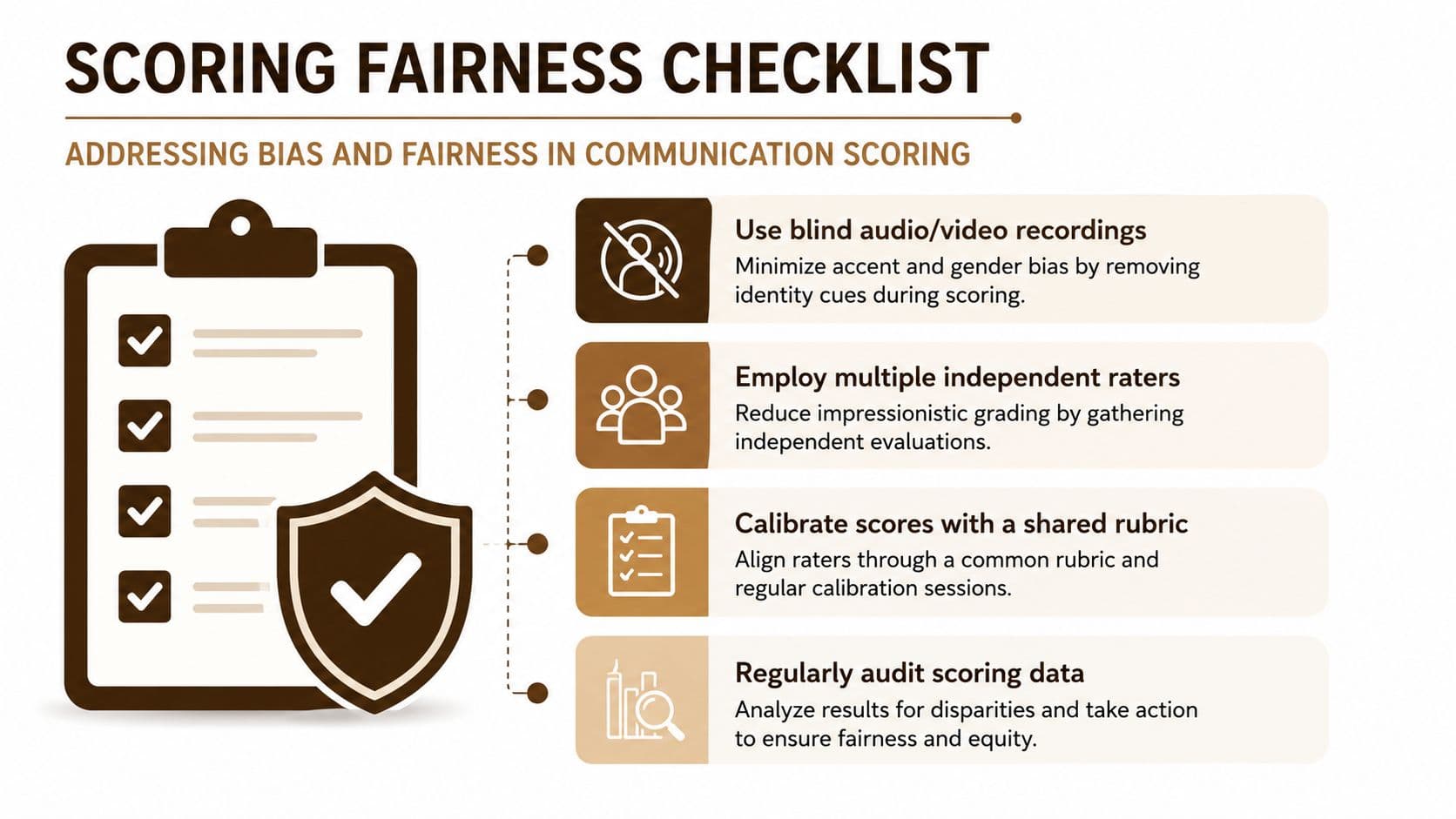
Before submitting a score: Describe what the candidate did, identify the competency, and remove any conclusion based only on style, accent, likability, or familiarity.
AI scoring requires extra caution. A tool that evaluates pace, vocabulary, or pronunciation may create a false appearance of objectivity if its relationship to legal performance hasn't been validated for the role. Use AI, if at all, as one input within a structured, multi-method process, never as a substitute for human review of role-specific work.
Turning Assessment Results Into Hiring and Development Decisions
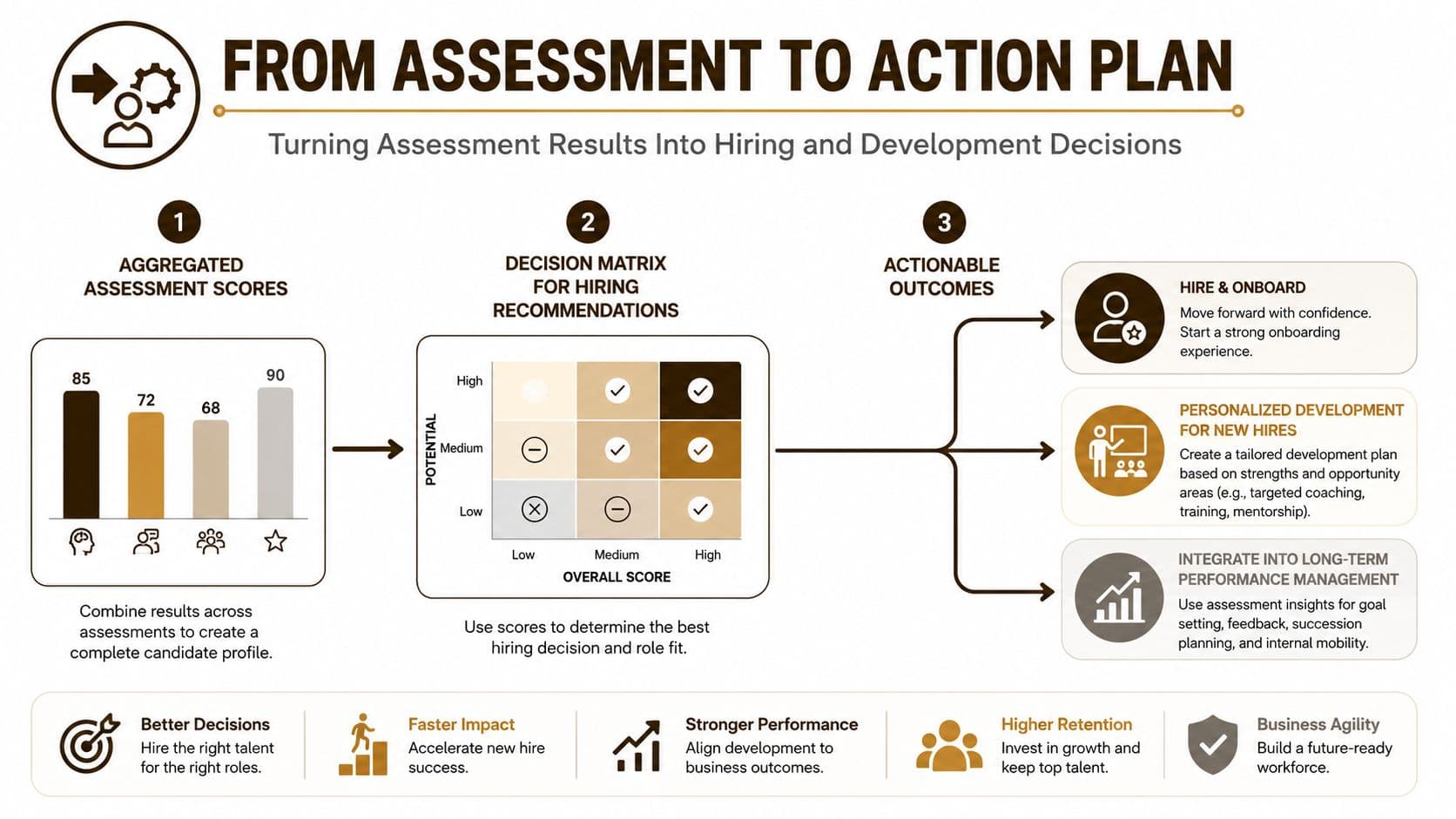
The useful output isn't a pass or fail label. It's a communication profile that shows where the attorney can perform immediately, where supervision is needed, and what development plan will close the gap.
Set minimum standards by competency and role. A regulatory drafting position may require a strong written precision score because unclear language creates immediate matter risk. A primarily internal role may allow more development time for client-facing empathy than a counsel position responsible for difficult business conversations. The threshold should follow the work, not an arbitrary average.
Convert scores into an operating plan
A candidate with strong analytical writing but weaker verbal advocacy might still be an excellent hire for a drafting-heavy role, provided the gap is visible and manageable. Onboarding can include observed client calls, deposition or hearing preparation, structured presentation practice, and a senior litigator who gives feedback against the same rubric used during hiring.
A candidate who scores well in client empathy but poorly in async collaboration needs a different intervention. Require written matter updates using a defined format, review early communications with the supervising partner, and revisit the competency after the attorney has handled representative work.
Connect the baseline to performance management. Supervisors can look for the same behaviors during reviews, including whether the attorney identifies the decision required, acknowledges uncertainty appropriately, responds to feedback, and keeps stakeholders aligned. If clients complain about unclear advice or partners report repeated missed handoffs, the assessment profile can help determine whether the issue is new, persistent, role-related, or caused by inadequate support.
Share findings with candidates in behavioral language. “Your writing was strong, and your response to the simulated client concern moved too quickly to solutions” is more useful than “You need better communication.” Candidates can act on a defined gap, especially when the employer explains what successful performance looks like.
For candidates preparing to demonstrate these competencies, targeted interview coaching for lawyers can help turn vague claims about communication into specific evidence, structured answers, and credible examples. Five Star Placements also uses customized screening for legal searches, including communication-focused conversations and recorded responses where appropriate, so hiring teams can evaluate clarity, judgment, and professional tone alongside practice experience.
Five Star Placements provides permanent placement for attorneys, legal support professionals, partners, in-house counsel, and legal operations leaders, with screening aligned to practice needs and organizational culture. If your firm or legal department needs a search built around distinct communication competencies rather than interview chemistry alone, visit Five Star Placements to discuss your hiring requirements.
Need help filling a legal role?
Five Star Placements partners with law firms and legal departments nationwide.
Schedule a Call