
How to Assess Leadership Potential in Legal Hiring
August 15, 2026 · 14 min read · Five Star Placements
Table of contents
A senior associate wins difficult matters, brings in work, and receives glowing reviews. The firm promotes that lawyer to a leadership role, then discovers that technical excellence doesn't automatically produce sound delegation, useful feedback, or durable client relationships. In-house teams make the same mistake when they treat subject-matter expertise as proof that counsel can influence business leaders or build a functioning legal department.
The practical question isn't whether a candidate has performed well in the current job. It's how to assess leadership potential for the next job, with evidence tied to the work that person will perform. A future managing partner, general counsel, and legal operations leader may all be impressive, but they need different forms of judgment, influence, and follow-through.
Table of Contents
- Why Assessing Leadership Potential Matters in Legal Hiring
- Core Leadership Competencies for Legal Environments
- Building Your Interview and Simulation Toolkit
- Scoring Rubrics and Tools That Reduce Bias
- Example Evaluations and Red Flags to Watch For
- Adapting Your Assessment for Law Firms and Corporate Teams
Why Assessing Leadership Potential Matters in Legal Hiring
Legal hiring often starts with visible proof. Reviewers look at matters handled, clients served, revenue originated, schools attended, publications, and the prestige of prior employers. Those signals matter, but they mostly describe current performance. They don't reliably show whether someone can set direction, develop people, resolve internal conflict, or make decisions when the facts remain incomplete.
A senior associate may personally produce excellent work while hoarding responsibility, correcting juniors without coaching them, or avoiding conversations with demanding partners. A practice leader may attract business but undermine colleagues who share the client relationship. A counsel may know the law thoroughly yet struggle to explain risk in terms that a product, finance, or operations executive can act on.
Those gaps rarely appear in a conventional interview. Candidates have rehearsed stories about teamwork and leadership, and interviewers often reward confidence, verbal fluency, or familiarity with their own professional background. A hiring team can leave the room with a strong impression and very little comparable evidence.
Potential belongs to the destination role
Leadership potential is future-role fit, not a permanent label attached to a person. The relevant question is whether the candidate's demonstrated behaviors match the demands of the specific role ahead.
That distinction aligns with the Talent Strategy Group's 2025 review of potential models and Aon's 2025-2026 leadership report. Aon describes models that commonly emphasize ability, ambition, and agility, while also reporting that organizations see untapped value in using assessment more systematically across the leadership pool. The report says driving results, building relationships, and coaching for performance remain among the most sought-after leadership skills over the last two years.
Those findings don't justify applying one generic test to every legal leader. They support a more disciplined approach: define the next role, identify the behaviors it requires, and gather evidence through more than one method.
The cost of a wrong promotion
A failed leadership appointment can damage more than morale. It can weaken succession planning, cause strong lawyers to leave, strain client confidence, and force the organization to repeat a search under pressure. In a law firm, the wrong partner-track decision may create resentment across a practice group. In a corporate department, an ill-equipped GC may lose credibility with the board and business executives before the organization recognizes the pattern.
A sound process begins with a role-specific profile, then tests that profile through structured questions, realistic simulations, calibrated scoring, and follow-up after hire. Leaders also enter junior and mid-level roles earlier than before, according to Aon's report, which makes targeted assessment earlier in the leadership pipeline especially relevant.
For a broader view of specialized legal hiring and screening, review Five Star Placements' legal recruiting approach. The principle remains simple: don't promote the person who merely looks strongest on paper. Select the person whose behavior fits the leadership work you need next.
Core Leadership Competencies for Legal Environments
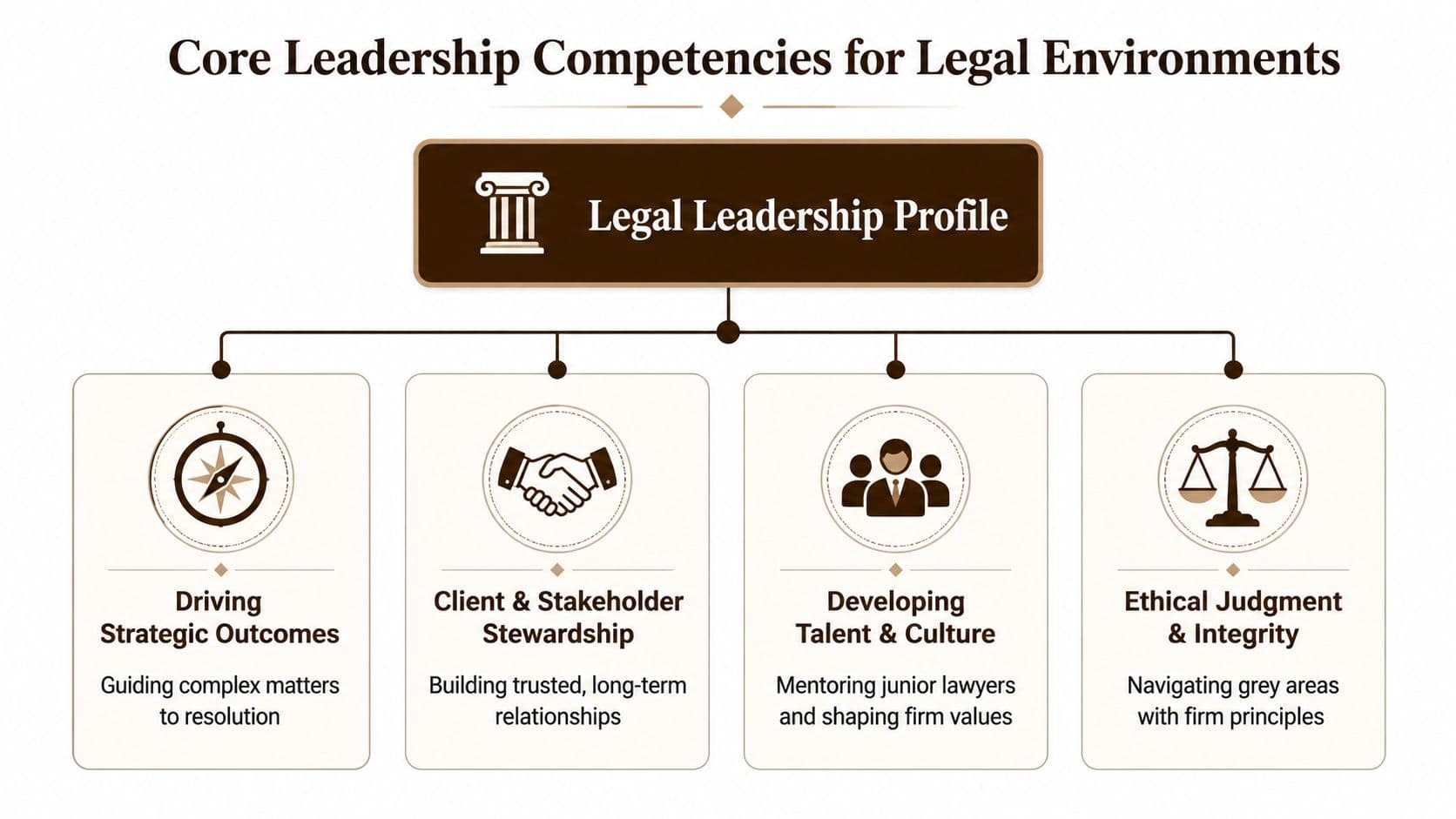
A useful legal leadership profile has four pillars. The pillars overlap, but their priority changes by destination role. Treating them as a universal checklist creates false equivalence between a rainmaking partner, a board-facing GC, and an operations executive responsible for process, data, and delivery.
The four-part profile
Driving strategic outcomes means turning legal judgment into an outcome that matters to the firm or business. For a partner, that may involve coordinating a complex matter, shaping a practice strategy, and converting client trust into sustainable work. For a GC, it includes prioritizing legal risk against commercial goals and giving executives a clear recommendation. For legal operations, it means improving how people, technology, budgets, and workflows support legal delivery.
Client and stakeholder stewardship is broader than being personable. Strong leaders clarify expectations, surface bad news early, and maintain trust when the preferred answer isn't available. A partner must manage clients and peers. A GC must influence executives and the board. An operations leader must earn cooperation from lawyers who may resist process changes.
Developing talent and culture requires observable behavior, not a statement that the candidate enjoys mentoring. Ask whether the person delegates meaningful work, gives specific feedback, protects standards, and changes their approach when a colleague needs a different form of support. A leader who produces results by doing everything personally isn't demonstrating a scalable leadership model.
Ethical judgment and integrity become most visible in grey areas. Look for candor about mistakes, respect for confidentiality, willingness to challenge a powerful stakeholder, and the ability to explain a principled decision without becoming self-righteous or evasive.
Weight the pillars by role
| Future role | Highest-priority evidence | Common overvaluation |
|---|---|---|
| Managing Partner | Business development, relationship stewardship, talent development, collaborative decision-making | Individual billing or matter brilliance |
| General Counsel | Enterprise judgment, executive influence, ethics, risk communication, team leadership | Technical legal depth alone |
| Legal Operations Leader | Strategic execution, change leadership, process discipline, cross-functional influence | Tool knowledge without adoption skill |
A managing partner needs to build a community, not just a book of business. A GC needs to translate uncertainty into decisions that executives can understand and own. A legal operations leader needs to make change usable for lawyers, finance, technology, and business teams at the same time.
Practical rule: Define what success looks like in the next role before you decide which assessment tool to use.
Create behavioral anchors for each competency. “Strong relationship builder” is too vague. “Raises a difficult client issue early, proposes options, and confirms the decision in writing” gives interviewers something they can observe and score. The profile should also identify disqualifying risks, such as compromised judgment, refusal to accept feedback, or a pattern of taking credit for team outcomes.
Building Your Interview and Simulation Toolkit
Interviews should collect evidence, not impressions. Use the same core questions for every finalist, ask for a specific event, and probe the candidate's actions, reasoning, and result. A polished answer isn't proof of leadership. The useful evidence often appears when you ask what happened next, who disagreed, and what the candidate would change.
Start with structured behavioral questions
Give interviewers a question set tied to the role profile. Useful prompts include:
- Partner disagreement: “Tell us about a time you disagreed with a partner or senior stakeholder about matter strategy. What did you say, what changed, and what would that person say about the interaction?”
- Coaching: “Describe a junior lawyer or team member whose performance was below expectations. How did you diagnose the issue, what feedback did you give, and what did you do after the conversation?”
- Competing priorities: “Tell us about a period when several clients or business leaders needed urgent support. How did you decide what to do first, and how did you communicate the trade-offs?”
- Accountability: “Describe a mistake you made that affected a client, matter, or internal team. When did you disclose it, and what did you change afterward?”
Probe for the candidate's own contribution. “We won” doesn't tell you whether the person led, supported, or participated. Ask what the candidate decided, delegated, challenged, and learned.
Add a role-specific simulation
Use a short scenario that resembles the actual job. A partner candidate might receive a fictional client problem involving a fee concern, a missed expectation, and disagreement among the matter team. Ask the candidate to conduct a client call, set an internal plan, and explain how they would protect the relationship.
For a GC candidate, provide a business leader with a proposed transaction, incomplete facts, and a serious but manageable legal risk. Assess whether the candidate identifies the decision that must be made, separates material risk from theoretical risk, and gives the executive a practical path forward.
For legal operations, use an in-basket exercise. Present competing requests involving staffing, a contract lifecycle process, a reporting issue, and a resistant stakeholder. Look for prioritization, communication, ownership, and the ability to make progress without pretending every issue has equal urgency.
Observe influence, not performance polish
Use two or more assessors where possible. One should track content and judgment, while another records behaviors such as listening, interruption, clarification, delegation, and response to challenge. A candidate who speaks smoothly but dismisses concerns may be less ready than a quieter candidate who asks precise questions and builds agreement.
Group exercises can reveal whether the person dominates, disappears, synthesizes, or helps others contribute. End with a debrief: “What did you notice about your approach?” and “What information would you want before acting?” Self-awareness and intellectual flexibility often appear more clearly in the reflection than in the initial exercise.
Practical templates and hiring process ideas can be adapted from the Five Star Placements legal hiring blog, but the exercise itself should come from the job, not from a generic leadership library.
Scoring Rubrics and Tools That Reduce Bias
A scorecard doesn't eliminate bias by itself. It makes reasoning visible, which gives the hiring team something concrete to challenge. Without that discipline, the most senior interviewer may offer a strong opinion late in the process, and everyone else may unconsciously adjust their assessment around it.
Use behavioral anchors
A practical four-point rubric can separate absence from development and consistency from exceptional performance:
| Score | Behavioral meaning |
|---|---|
| 1 | Inconsistent or not evident |
| 2 | Developing or basic |
| 3 | Proficient and consistent |
| 4 | Exemplary and model-setting |
Define the score before interviewing. For ethical judgment, a score of 1 might reflect minimizing a conflict or hiding bad news. A score of 3 might show timely disclosure, clear options, and appropriate escalation. A score of 4 would include those behaviors plus a repeatable way of helping others make sound decisions.
For talent development, don't award a high score because a candidate says they mentor. Look for evidence of diagnosing a person's needs, setting expectations, giving direct feedback, and checking whether performance improved. If the candidate can't identify the other person's growth, the example is incomplete.
Weight what the role needs
A scorecard may assign greater weight to strategic outcomes for a GC or to talent and relationship stewardship for a managing partner. The weighting should reflect the job description and stakeholder interviews, not a standard template copied from another organization.
The MIT Sloan Management Review discussion of data-driven future-leader identification highlights the value of multiple data points and methods. That principle matters because manager opinion, interviews, and single snapshots can create false confidence. More assessment isn't automatically better assessment if every method repeats the same assumptions.
Calibrate before and after the decision
Have assessors score independently before discussing candidates. Require each person to cite observed behavior, not “executive presence,” “fit,” or personal comfort. Then moderate differences by asking:
- What did the candidate say or do?
- Which role competency does that evidence address?
- Would we score the same behavior the same way in another department?
- Did the simulation support or contradict the interview story?
- What evidence is still missing?
Psychometric tools can add useful information when they are validated for the role, administered consistently, and interpreted by qualified professionals. They shouldn't replace work samples or be treated as a diagnosis of leadership character. A personality label may describe preferences, but it doesn't prove that a candidate can coach an underperforming associate or challenge a revenue-generating partner.
Track the assessment after hire. Compare the original scores with early observations about delegation, stakeholder trust, retention, and decision quality. That time-based validation helps identify which signals predict success and which merely sound persuasive in an interview.
Example Evaluations and Red Flags to Watch For
The strongest candidate isn't always the one with the most impressive current output. Consider a senior associate being considered for partnership. The associate handles complex matters independently, retains demanding clients, and speaks confidently about leadership. In the behavioral interview, however, every success is described as “my strategy” or “my client,” while junior lawyers appear only as people who needed correction.
In the simulation, the candidate receives a client complaint about inconsistent updates. The candidate immediately explains why the client is mistaken, assigns the associate responsibility for the communication gap, and proposes another status meeting. The response shows matter command, but weak listening, limited accountability, and little evidence of coaching.
A different candidate has a less spectacular individual production record but describes building a reliable matter team, sharing credit, and addressing a missed deadline directly with a junior lawyer. In the same exercise, that candidate acknowledges the client's frustration, asks what outcome the client needs, and explains how the team will prevent another lapse.
Read the evidence, not the label
| Evidence | Candidate A | Candidate B |
|---|---|---|
| Strategic execution | Strong personal control of complex work | Strong coordination and prioritization |
| Relationships | Persuasive with clients, defensive under criticism | Curious, candid, and repair-oriented |
| Talent development | Gives corrections, limited coaching evidence | Sets expectations and follows up |
| Accountability | Attributes failures to others | Owns contribution and names a remedy |
| Recommendation | High performer, leadership risk | Stronger future-role fit |
For a GC-track candidate, the contrast may be subtler. One counsel gives technically precise answers but frames every business request as a legal problem. Another explains the legal exposure, identifies the commercial objective, and gives the executive choices with consequences. The second candidate may not know every fact immediately, but demonstrates the judgment required to lead beyond a narrow subject-matter lane.
Red flags deserve a counter-signal
Watch for sole-credit narratives, especially when the candidate can't explain what colleagues contributed. Watch for feedback avoidance, such as describing a struggling employee as “not a fit” without a direct conversation or development attempt. Watch for rigidity under pressure, when the candidate repeats a preferred answer instead of updating it as new information appears.
Also examine inconsistency. A candidate may describe an inclusive leadership style yet interrupt every participant in a group exercise. Someone may claim to welcome challenge but become defensive when an assessor introduces an adverse fact. These contradictions don't automatically disqualify the person, but they require a deeper probe.
Counter-signals include specific ownership, curiosity about alternative views, a willingness to revise an initial position, and an ability to separate intent from impact. Coachability isn't passive agreeableness. It means the candidate can absorb difficult information, reason through it, and change behavior without abandoning standards.
Adapting Your Assessment for Law Firms and Corporate Teams
The same assessment architecture can serve a firm or a corporate legal department, but the destination competencies must change. Law firms usually need evidence of client development, collaborative rainmaking, matter leadership, and contribution to partnership culture. Corporate teams place more weight on cross-functional influence, risk prioritization, operational discipline, and the ability to help the business move responsibly.
For law firms
A managing partner or practice leader should be tested on how they share client ownership, resolve partner conflict, and develop successors. Ask for a concrete example of a business opportunity that required collaboration rather than individual control. A useful simulation may involve two partners competing for credit, a client seeking a fee change, and a junior lawyer whose development has stalled.
Don't confuse business generation with leadership. A candidate who brings work but damages team trust may create a succession problem rather than solve one. Score relationship stewardship and talent development alongside commercial results.
For corporate legal departments
A GC or senior in-house leader should explain how they would advise an executive who wants speed while the facts remain incomplete. The assessment should test whether the candidate can distinguish a legal prohibition from a manageable risk, state what information is missing, and recommend a decision path.
Legal operations leaders need a different exercise. Give them an implementation problem with competing stakeholders, unclear ownership, and imperfect data. Evaluate whether they can sequence work, gain adoption, define measures, and communicate trade-offs without making the process about the technology itself.
Keep the process fast without making it shallow
A contingency search doesn't require an elaborate assessment center. Use a focused intake with the hiring manager and key stakeholders, agree on the role profile, conduct a structured screen, and reserve a realistic simulation for finalists. External recruiters can improve consistency when they understand the competency anchors and document evidence rather than forwarding resumes based on pedigree.
After hire, schedule deliberate validation. Ask the manager for examples of delegation, stakeholder influence, coaching, and judgment at regular checkpoints. Compare those observations with the hiring scorecard, then revise the rubric when it rewards the wrong behavior.
For help designing a calibrated search or identifying legal leadership candidates, contact Five Star Placements. The best process is not the one with the most tests. It's the one that gives decision-makers reliable evidence about whether a person can lead the work, people, and relationships the role requires.
Five Star Placements provides permanent placement for attorneys, partners, in-house counsel, legal support professionals, and legal operations leaders across the United States. Their customized screening evaluates experience, leadership behaviors, and organizational fit, helping law firms and corporate legal departments make more defensible hiring decisions. Visit Five Star Placements to discuss a role-specific search and assessment process.
Need help filling a legal role?
Five Star Placements partners with law firms and legal departments nationwide.
Schedule a Call