
Partners Recruitment Solutions: Hiring Lateral Partners
November 17, 2026 · 16 min read · Five Star Placements

Table of contents
Am Law 200 firms made 3,009 partner hires in 2025, a five-year high and a 10% increase over 2024, according to Firm Prospects' analysis reported by PR Newswire. That number is the loudest signal in legal recruiting right now, and it's also the least useful one. Hiring volume tells you the market is open. It tells you nothing about whether the partner you signed in March will still be productive in year three.
Most of the risk in a partner hire sits after the signature. Sourcing gets a shortlist. Negotiation gets a yes. The months that follow decide whether the portable book moves, whether your existing partners share clients with the new arrival, and whether the guaranteed compensation turns into a permanent cost line or a revenue engine. Firms that treat partner hiring as a chain, with a handoff and an owner at the end, get different results from firms that treat it as a transaction.
Table of Contents
- What Partner Recruitment Solutions Cover
- Lateral Partner Demand Is Rising Again
- The Stage-by-Stage Partner Search Process
- Checking What a Non-Equity Partner Offer Really Means
- Screening for Portability, Collaboration and Culture
- Keeping the Partner Productive After Day One
- How to Evaluate a Partner Recruitment Provider
- Decide Whether a Specialist Search Fits Your Next Hire
What Partner Recruitment Solutions Cover
Partners recruitment solutions are outside services that find, screen, and place experienced lateral partners, the lawyers who move from one firm to another with a book of business, a client following, or a specialty behind them. The job is to make each hire fit the firm's practice mix, client base, and culture, not merely to fill a chair that opened.
The difference from a job board is the difference between a listing site and a buyer's agent. A listing site shows every house on the market and leaves you to work out which one sits on a flood plain. A buyer's agent knows which streets are turning over, which neighborhoods hold value, and which house fits a family of five. Generic recruiting behaves like the listing site. Lots of names, no judgment.
The work breaks into four parts:
- Lateral partner search builds a confidential shortlist of partners whose practices match a gap you can name.
- Candidate screening tests credentials, bar standing, matters handled, and genuine interest in this role rather than any role.
- Culture alignment looks at how a candidate shares credit, staffs work, and behaves when a partnership vote doesn't go their way.
- Specialist hiring support covers the work firms rarely run in-house, from market mapping to the integration handoff.
The need is real because the market swings hard. NALP reported that aggregate lateral lawyer hiring rose an unprecedented 110.9% in 2021, then fell 35.0% in 2023, while partner hiring fell only 10% that year (NALP research on lateral hiring). A firm with no external pipeline loses months every time demand turns, and in a partner search the lost months are billable capacity you never recover.
Quick self-test: you have an open practice gap, a partner retiring in the next eighteen months, or a growth plan your current bench can't staff. Any of the three justifies pricing a specialist search. None of the three means run the hire with your own team.
Lateral Partner Demand Is Rising Again
Two straight annual increases change the timing question. A faster market should move your start date earlier, not lower your standards.
The 2025 data in NALP's annual lateral hiring research covers 305 law offices and firms, which hired 3,535 lateral lawyers, an average of 11.6 and a median of 4.0 per organization. Partners accounted for 22.3% of those moves against 58.2% for associates, and partner hiring grew 17.8%, slightly ahead of 17.1% for lateral associates. Total lateral hiring rose 13.9% in 2024 and 16.4% in 2025.
| Year | Change in total lateral hiring | Context |
|---|---|---|
| 2021 | +110.9% | Rebound after the initial COVID-19 disruption; a poor benchmark for normal capacity |
| 2022 | -11.5% | Partner hiring rose 5.5% in the same year |
| 2023 | -35.0% | Lowest reported median and average lateral-hire levels since 2010 |
| 2024 | +13.9% | Partners were 22.5% of total lateral moves |
| 2025 | +16.4% | Partners were 22.3% of total lateral moves |

What rising demand does to your timeline
When demand climbs, your competitors are recruiting at the same time. Candidates have more options, they take longer to answer, and a well-briefed shortlist moves in weeks while a vague one stalls for a quarter. Precision is the only speed lever you control.
Say a firm decides to add two partners in commercial litigation. In a growth year, the brief should be signed off before the quarter ends, because every additional month without a shortlist is a month of unbilled matter capacity, and the strongest candidates are already in three other processes. In a contracting market the same search behaves differently. Senior talent becomes more available, timelines stretch, and a firm can afford to be pickier about book portability and cultural overlap because the pool is deeper.
A hot market is also where firms confuse an accepted offer with a finished search. The expensive part starts after signing: whether the book is portable, whether the work is collaborative enough to survive conflicts and compensation pressure, and whether matter handoffs, client introductions and staffing are planned for the first year. Compress administrative gaps. Keep the screening and integration work intact.
The planning rule that survives both directions
Tie the start date to your own practice plan and client commitments. If the practice needs the partner to cover a specific client relationship by a specific quarter, work backwards from that quarter and add a buffer for conflicts clearance and notice periods.
Then hold the timeline to what is realistic. Firms that start searches late and blame the market are usually firms that never wrote the brief.
The Stage-by-Stage Partner Search Process
A partner search runs in six stages. Skip one and you usually pay for it in the second year of the hire, when the book hasn't moved and nobody can say who was supposed to make it move.
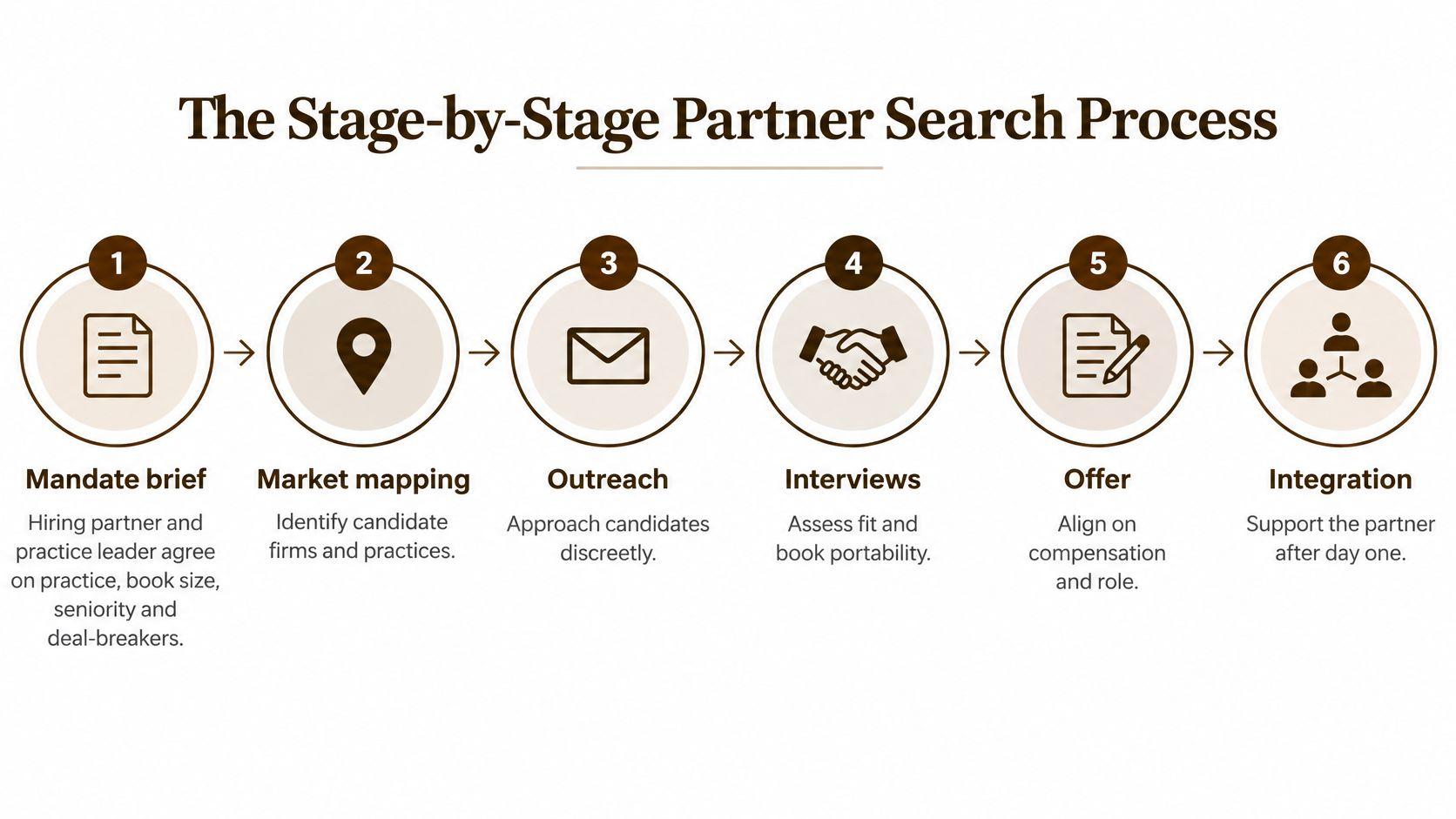
1. Mandate brief. The hiring partner and the practice leader agree on the practice, the realistic book size, seniority, and the deal-breakers that will kill a candidacy. One page, signed off before anyone is approached. Ambiguity here is what produces shortlists full of lawyers who were never going to fit.
2. Sourcing. The recruiter works a prebuilt network and proprietary tools to find attorneys who match the brief but don't surface in a standard search, including candidates already known through a referral network. Outreach goes to each attorney individually, with an honest account of why the role fits and where it might not.
3. Screening. Credentials, bar status, matters handled, and confirmed interest in this specific role get checked before your name appears anywhere. Every candidate we send has spoken with us on a call first, so you aren't the one discovering that the interest was vague.
4. Structured interviews. Practice-group leaders, finance, conflicts, and operations each get a session, not just the hiring partner. Score what you hear in writing, because impressions fade and a scored sheet survives the second interview.
5. Offer. Before the offer goes out, we tell the client what the candidate is likely to accept. That single conversation prevents the lowball that insults a candidate and the overpay that anchors a compensation committee for years.
6. Integration handoff. A named owner from the firm takes over with a written 30/60/90 plan. Without a named person, the plan is a document nobody opens.
The process is a loop, not a line. We ask clients for prompt, candid feedback on every candidate and adjust the next round from it, which is why a second shortlist usually lands closer than the first.
| Stage | Question it answers | Output | Who signs off |
|---|---|---|---|
| 1. Mandate brief | Which practice, book size and seniority are needed? | One-page search brief | Managing partner and practice leader |
| 2. Sourcing | Who can move, and who is reachable? | Long list of candidates | Recruiter |
| 3. Screening | Are credentials, matters and interest in the role confirmed? | Vetted shortlist | Recruiter, then client feedback |
| 4. Structured interviews | Can the candidate work with current partners? | Scored interview notes | Practice leaders, finance, conflicts and operations |
| 5. Offer | Will the candidate accept these terms? | Offer with likely-acceptance check | Hiring partner |
| 6. Integration handoff | Who owns the first 90 days? | Named owner and 30/60/90 plan | Managing partner |
Before any outreach starts, draft that one-page brief yourself: the practice gap, the book size range, the compensation parameters, and the names of the people who get to say no.
Checking What a Non-Equity Partner Offer Really Means
A partner title is not one job. It covers at least three, and they differ in pay, decision rights, and how client credit is allocated. Equity partners hold ownership and a vote. Income partners typically sit on a fixed or formula compensation track without ownership. Non-equity partners sit somewhere below both, and the label alone tells a candidate nothing about what is being offered.

The economics explain why candidates ask hard questions. At Am Law 200 firms, 38% of non-equity partners earn only slightly more than senior associates, and at mid-sized firms that figure reaches 52%, according to SurePoint's 2025 State of the Legal Industry Report. A separate survey cited in the same report found only 48% of non-equity partners satisfied with pay, with 27% dissatisfied and citing limited influence, stalled advancement, or promises that weren't kept.
Why the role often isn't a steppingstone
Assume the candidate will stay. Non-equity partners commonly hold the title for years, and many expect to keep it for the rest of their time at the firm. That changes the screening question from "will this person make equity here" to "is this the job this person wants long term."
Get the terms on paper before interviews start. Each line below is a promise a hiring partner can leave vague, and vague terms come back as a grievance after the first compensation cycle:
- Title and tier: equity, income, or non-equity, with the partnership agreement language attached.
- Decision rights: which committees the role votes on and what it can block.
- Compensation formula: base, formula, bonus pool, and what a bad revenue year does to it.
- Client-credit rules: who owns the relationship when the originating partner retires or leaves.
- Path to equity: whether it exists in writing, how long it typically takes, and who decides.
- Review timetable: the date, the criteria, and the person running the review.
A candidate who accepts on an implied promise becomes a retention problem inside a year. If the goal is equity within two years and the role has no written path, the mismatch surfaces as turnover after the offer is signed. Firms that want the seat to hold should understand what a non-equity partner position actually carries before they sell it in an interview.
Screening for Portability, Collaboration and Culture
Vetting starts with the basics, and the basics are where most searches often fail. Credentials, bar status, matters handled, and confirmed interest in this specific role get verified before a client sees a name. Every candidate we send has already been through that call, which means the first interview isn't wasted on a lawyer who was curious rather than serious.
Then comes the layer firms skip. Is the book portable, and will this person share it?
Map the expected portable work against the firm's existing capabilities. If a candidate's largest client is a sector your firm doesn't serve, the "book" is a handoff problem, not a revenue stream. Identify where cross-selling is plausible within the first year, and test whether the candidate has done it before. Ask for specific instances: a colleague they referred work to, a matter they co-staffed outside their group, a firmwide business development effort they joined without being asked.
Watch the originations story. A litigator with a loyal client base looks excellent on a book-of-business slide. If she has never shared a client with a partner in another practice, the screen should flag collaboration risk before the offer, not after the first compensation cycle.
Due diligence should cover the items that decide whether transferred work can be serviced:
- Client concentration: how much of the book sits with the top three clients, and what happens if one goes in-house.
- Collections and matter profitability: billed versus collected, and which matters were written down.
- Conflicts: the specific adverse parties and matters that could disqualify a large share of the book.
- Team composition: who comes with the partner, and whether the firm has the staffing to absorb them.
- Compensation history: the trailing multi-year record, not a single strong year.
- Operating resources: what the practice needs on day one, from paralegals to a specific research subscription.
Culture alignment shows up in habits, not answers. A 2025 American Bar Association analysis of lateral partner integration recommends aligning financial incentives with partner collaboration and client sharing, because those mechanisms decide whether a lateral contributes beyond an individual book. Build compensation that rewards originating work and collaborative production, rather than leaning entirely on guarantees. Structure the culture fit interview questions so they surface how a candidate behaves when credit is split.
Confidentiality holds the whole process together. Applications are confidential, and we won't contact an applicant's employer without permission, which is what allows a sitting partner to explore a move without putting the current book at risk.
Keeping the Partner Productive After Day One
The search doesn't end at the signature, and the numbers are blunt. Recent reporting indicates that 30% to 40% of lateral partners leave within five years, while many who stay fail to hit projected revenue targets (Reuters reporting on lateral integration). The same reporting found that 90% of firms experience business-development challenges with laterals, and that every surveyed firm struggled to transfer an incoming partner's book of business.

Read those numbers as an accountability problem, not a talent problem. A firm that hands a new partner a laptop and a matter management login has not integrated anyone. A firm that assigns an owner, a schedule, and named checkpoints has.
The seven items that decide the first 90 days
| Integration item | The checkpoint that proves it worked |
|---|---|
| Client-transition permissions | By day 30, written client consent is on file for the top relationships, and joint outreach has been scheduled |
| Conflicts continuity | By day 30, every open conflict on transferred matters has a documented resolution and a responsible lawyer |
| Matter and referral mapping | By day 45, the firm has a written map of active matters, referral sources, and which practice can serve each one |
| Internal introductions | By day 30, the partner has met the firm's top existing clients, not just the practice group |
| Cross-selling | By day 60, a first joint matter is staffed with a partner from another practice |
| Sponsorship | A senior partner is named as sponsor, with a standing monthly meeting on the calendar |
| Revenue indicators | By day 90, at least one referral has moved between practices, with originations and collections tracked monthly |
Write the plan before the offer is signed, and attach it to the offer letter if you can. A partner who negotiates compensation down to the decimal but never discusses who owns integration is buying a title and hoping for a practice. If a candidate resists written checkpoints during negotiations, that reaction predicts year-one performance better than any interview answer.
Name the owner
Assign a named owner for practice-level collaboration and a second owner for local or office-level integration. The practice owner runs matter and referral mapping; the local owner handles introductions, sponsorship, and the standing meetings. Do not assume the managing partner will track it. Put a name next to each milestone and review it on a fixed date.
A modest book with a managed integration will outperform a marquee book that nobody onboards. Weight your management effort toward the six months after the start date.
Pick three revenue indicators for each milestone review: originations, collections, and referrals moved between practices. Name the person responsible for each, and put the review dates in the partner's calendar before day one. When a checkpoint slips, escalate it at the next review rather than resetting the clock.
How to Evaluate a Partner Recruitment Provider
Provider selection is a diligence exercise, not a chemistry test. Talent attraction and retention sits high on the agenda for most legal employers: 73% of respondents identified the ability to attract, recruit, and retain talent as a key trend expected to affect law firms and legal departments over the three years following the 2024 survey, according to Wolters Kluwer's legal talent research. Choose a search partner the same way you'd choose outside counsel for a bet-the-practice matter.
Run five checks.
- Network depth in your practice. Ask how many partner placements the provider has made in that practice area and market, and which sourcing channels it uses beyond a standard database. A provider that can't name them is running a keyword search with extra steps.
- Fee basis in writing. What triggers payment, whether a guarantee or replacement period applies, and what's charged if you cancel. Contingency structures tie the fee to a completed hire, which keeps the incentive aligned with an accepted offer rather than a long shortlist.
- Confidentiality practice. How candidates are approached, when your firm is named, and whether a candidate's materials move only with permission. Ask what happens if a candidate's current firm is a client of yours.
- References from comparable hires. Firms of similar size, similar practice mix, similar timeline. Then ask a harder question: is post-placement integration support included, or sold separately?
- A sample search brief. Read it. If it asks only about originations and never about portable work, collaboration habits, or the integration owner, the provider is selling a transaction.
Compare providers against your own search brief and treat any provider that starts sourcing before the brief is signed off as a disqualifier. Understanding what retained search actually buys you helps you read fee proposals without confusing commitment with cost.
Decide Whether a Specialist Search Fits Your Next Hire
Three triggers justify outside help. The first is capacity: your team is running current matters and cannot map a market, screen candidates, and coordinate interviews in the same quarter. The second is reach: the practice gap needs partners who aren't in your firm's network, which is most of the market. The third is discretion and speed together, when a confidential approach matters more than building the process in-house.
It isn't always the right call. A single junior associate hire your own recruiter can run doesn't need a specialist. Neither does a role in a practice where no specialist network reaches, because you'd be paying for introductions that won't materialize.
Decision rule: if the hire changes your practice mix, affects client relationships across groups, or can't be discussed openly inside the firm, use a specialist. If it backfills a seat with a known profile, run it internally.
The first step is small. Schedule a thirty-minute call about the role before the search starts, and bring the one-page brief you drafted earlier. Every search we run begins with that call, and law firms and legal departments can book a call with Five Star Placements to have it.
Before that call, finish four things: confirm the brief, name the integration owner, set the three 90-day revenue indicators, and put the meeting on the calendar.
Five Star Placements runs confidential partner and lateral searches for boutique and midsize law firms and in-house legal departments, with screening that covers credentials, bar standing, matters handled, and fit before a client ever sees a name. Every search starts with a thirty-minute call about the role, and we tell you what a candidate is likely to accept before an offer goes out rather than after it's rejected. Visit Five Star Placements to start that conversation and build the brief for your next partner hire.
Need help filling a legal role?
Five Star Placements partners with law firms and legal departments nationwide.
Schedule a Call