
Non Equity Partner Roles and Law Firm Strategy
September 30, 2026 · 18 min read · Five Star Placements

Table of contents
An estimated 86% of the 100 largest U.S. law firms by revenue now have non-equity partner positions, according to Reuters reporting summarized in the State of the U.S. Legal Market report. That figure changes the management question. A non-equity partner isn't an unusual compromise for one attorney who missed the equity track. It's a deliberate operating layer that helps firms retain senior talent, expand leadership capacity, and protect ownership economics.
For managing partners, the title only works when the underlying design is clear. The firm must decide what authority the role carries, how compensation reflects value, which performance measures matter, and whether the position is a bridge to equity or a durable destination. Poorly designed tiers create frustration and hidden compensation liabilities. Well-designed tiers let firms reward client leadership and business development without granting every senior attorney an ownership stake.
Table of Contents
- The Rise of the Non Equity Partner in Modern Law Firms
- Key Distinctions Between Equity and Non Equity Tiers
- Compensation Structures and Financial Incentives
- Governance Limitations and Risk Management Strategy
- Career Progression and Transition Pathways
- Best Practices for Hiring and Integrating Lateral Talent
- Strategic Takeaways for Law Firm Leadership
The Rise of the Non Equity Partner in Modern Law Firms
Among firms with 500 or more lawyers, multiple partnership tiers appeared at only 27% of firms roughly 30 years earlier, reached 47% in 2001, and stood at 66% by 2009, according to Reuters legal-market reporting. That progression reflects a lasting change in how firms manage senior talent, ownership, and operating risk.
The non-equity partner emerged from a practical economic problem. Firms wanted to recognize attorneys who had outgrown senior-associate responsibilities, managed important client relationships, and led substantial matters. They also wanted to avoid expanding the ownership group with every promotion or requiring an immediate capital commitment. The result was a partner title without an equity interest.
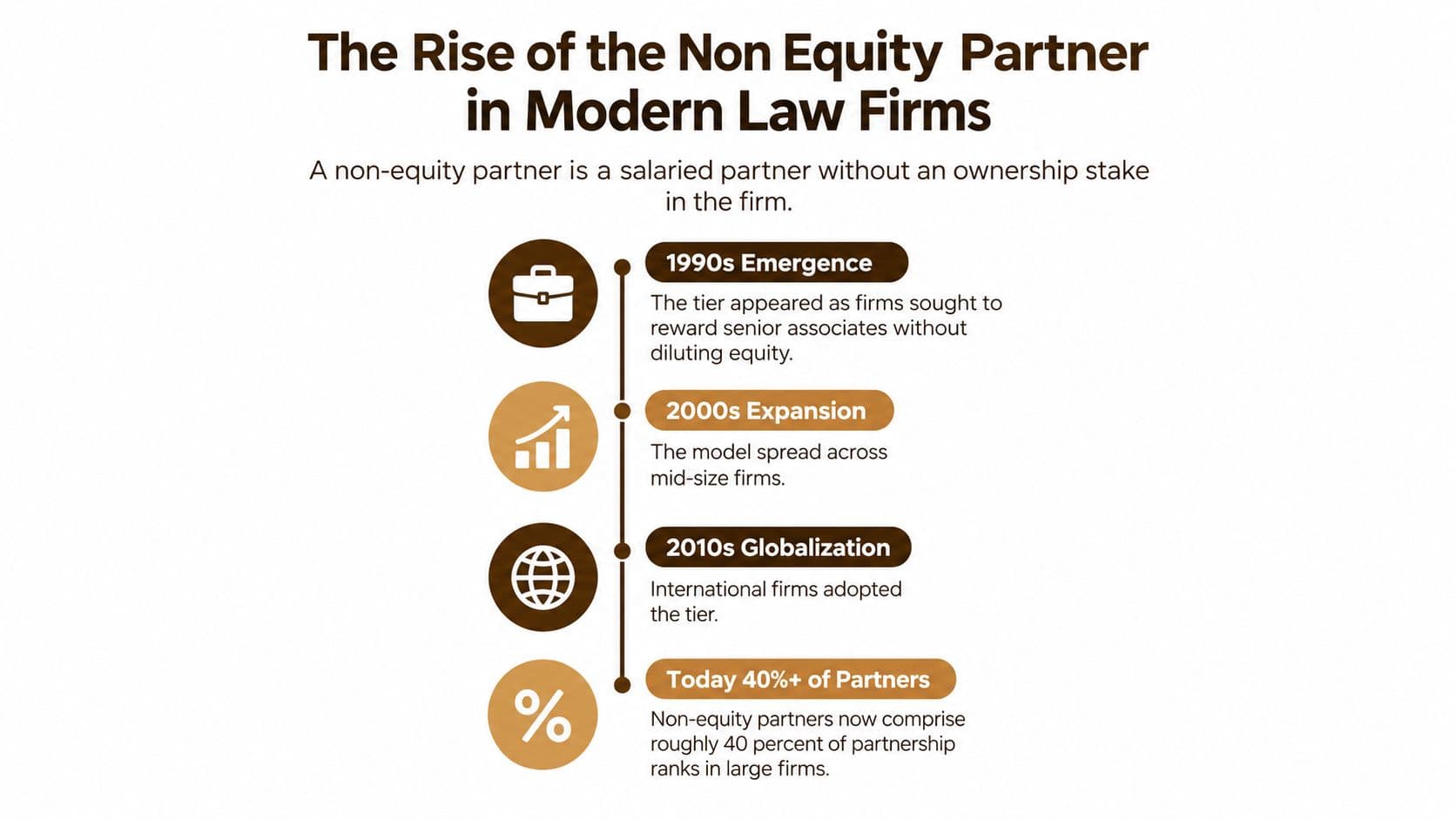
A non-equity partner is a senior attorney with partner status but no ownership stake. Compensation generally comes through salary, a fixed draw, a bonus, or another agreed formula, rather than a distribution of residual firm profits. The attorney may still carry major responsibility for client service, matter management, junior supervision, and business development. In economic terms, the role remains closer to a highly compensated employee than to an owner.
That design gives firm leadership several practical controls:
- Recognition: The title reflects seniority, judgment, and responsibility for clients and matters.
- Retention: The firm can keep valuable lawyers who may not yet justify, or may not want, an ownership position.
- Governance: Equity owners can preserve decision-making authority and avoid indiscriminate dilution.
- Financial control: Compensation can reflect productivity, client service, and business generation without distributing firm-wide profits.
- Risk management: The firm can assign leadership responsibilities without extending every ownership right or obligation.
- Capacity: Senior attorneys can supervise teams and manage matters without joining every ownership-level committee.
The tier has also become a material part of partner planning at large firms. Bloomberg Law reported that 85 of the 100 largest U.S. firms had non-equity partners in 2024, while those ranks grew 5.3% in 2023 even as equity-partner numbers declined. American Lawyer data cited in that reporting put non-equity partners at 49.4% of all partners at the largest firms. A later Reuters figure identified 87 of the 100 largest firms by gross revenue as having nonequity tiers, with 70 of those firms increasing their nonequity ranks since 2021, as summarized in this law-firm economics analysis.
For managing partners, the strategic question is whether the tier has defined authority, measurable accountability, and a compensation cost the firm can sustain. A well-designed non-equity tier supports retention and client leadership while protecting ownership economics. An unclear one creates frustrated attorneys, inconsistent expectations, and hidden compensation liabilities.
Key Distinctions Between Equity and Non Equity Tiers
The two partnership tiers can look similar on a business card while operating very differently inside the firm. An equity partner is generally an owner who participates in the firm's residual economics and governance under the applicable partnership, operating, or shareholder documents. A non-equity partner usually receives the partner title without the corresponding ownership interest.
That difference affects more than compensation. It influences capital, voting, information rights, tax treatment, exposure to firm obligations, and the attorney's expectations about advancement. The firm's admission documents and compensation plan control the outcome, not the title alone.
| Decision area | Equity partner | Non-equity partner |
|---|---|---|
| Ownership | Holds an ownership interest under the firm's governing documents | Usually holds no equivalent ownership interest |
| Capital | May be required to contribute capital or fund a buy-in | Usually avoids an ownership buy-in, subject to the firm's documents |
| Economics | Receives profit allocations or distributions and may share losses | Usually receives salary, draw, bonus, or another compensation arrangement |
| Governance | Usually participates in ownership-level voting and management | Generally has limited or no voting rights on major firm decisions |
| Risk profile | Capital and owner-level obligations may be at stake | Personal economic exposure is generally narrower, although professional duties remain |
| Advancement | Occupies the ownership tier | May have a path to equity, or may remain permanently non-equity |
| Exit terms | Governed by partnership or operating documents, including withdrawal or redemption provisions | Usually governed primarily by employment, service, or partner-status documents |
The non-equity role doesn't eliminate professional responsibility. A senior attorney can still supervise lawyers, manage significant matters, interact with clients, and influence risk even without an ownership vote. Firms should separate professional accountability from ownership authority in written policies, committee charters, and promotion letters.
Capital and control
Equity partners bear the economic consequences of ownership decisions. They may contribute capital, participate in profit and loss allocations, and vote on strategic matters. A non-equity partner typically doesn't receive that residual ownership position, so the firm can expand its senior leadership group without expanding the voting constituency to the same extent.
That arrangement can be valuable, but only if the boundaries are explicit. A lateral candidate should understand whether the title includes a vote, whether the attorney can sign firm obligations, how compensation can change, and what happens if the firm later changes the tier. The firm's documents should answer those questions before the attorney accepts the promotion.
Practical rule: Never explain the distinction with the title alone. Put ownership, voting rights, compensation mechanics, review rights, and departure terms in writing.
For a broader explanation of how ownership affects professional-firm economics, see this guide to equity partnership. It's particularly useful when a candidate is comparing a non-equity offer with an equity opportunity at another firm.
The right comparison isn't “partner versus not partner.” It's owner versus senior professional with delegated authority. That framing gives candidates a more accurate picture and helps the firm avoid promising governance rights it never intended to provide.
Compensation Structures and Financial Incentives
Compensation is where the non-equity model either earns credibility or loses it. A partner title paired with an opaque salary and discretionary bonus can feel like a relabeled senior-associate position. A transparent structure, by contrast, can reward the behaviors the firm needs without transferring ownership economics prematurely.
Industry reporting places average non-equity partner compensation at about $345,679 annually, with roughly $106,000 in bonuses, and cites a $300,000 median salary in one ALM survey covering Am Law 200 and midsize firms. Those figures come from reporting on non-equity partner compensation. They're useful reference points, not automatic offer ranges. Practice, geography, collections, client books, and firm profitability can produce materially different packages.
Start with the economic purpose
A sound compensation plan answers one question first: What value is this tier meant to buy?
If the firm needs a matter leader, the plan should recognize profitable delivery, client satisfaction, delegation, and supervision. If it needs a rainmaker, the plan should address origination, retention, collections, and cross-selling. If it needs a practice leader, the plan should include team development, staffing judgment, knowledge management, and succession work.
A practical structure often has three components:
- Stable base compensation: Provides predictability and distinguishes the role from an owner distribution.
- Performance incentive: Rewards measurable contributions such as collections, realization, matter profitability, or business generation.
- Review mechanism: Explains who evaluates performance, when the review occurs, and how the bonus or salary decision is made.
The bonus should not be a mystery reserve controlled by one partner. Firms can retain discretion while still publishing the categories, definitions, data sources, and approval process that shape the decision.
Measure what the firm actually wants
Billable production alone can produce the wrong behavior. A non-equity partner who hoards work may generate personal hours while reducing influence and slowing associate development. A partner who originates matters but fails to supervise delivery can create client and profitability problems. The compensation plan should therefore balance individual output with firm-level contribution.
Useful measures include:
- Collections and realization: Did the work convert into collected revenue at an acceptable level?
- Matter economics: Does the attorney manage scope, staffing, write-offs, and client expectations responsibly?
- Origination and retention: Does the attorney bring in appropriate work and maintain durable client relationships?
- Cross-selling: Does the attorney identify opportunities for colleagues when another practice can serve the client better?
- Supervision and development: Does the attorney build capable teams instead of becoming the only person who can deliver the work?
- Firm citizenship: Does the attorney contribute to recruiting, training, risk review, or practice management in a way the firm values?
The firm shouldn't attach a precise formula to every contribution if the data isn't reliable. It should fix the measurement problem first. Billing and practice-management systems must identify the source of collections, responsible lawyers, matter roles, realization, and credit allocation before a formula can be defended.
Protect the equity pool without underpaying talent
The financial appeal of the tier is that the firm can pay for senior value without distributing the full economics of ownership. One market analysis cited compensation of roughly $775,000 for non-equity partners versus $3.24 million for equity partners in AmLaw 50 firms, a gap of about 4.2 to 1, as reported in the industry compensation analysis. The gap illustrates the economic distinction, but it doesn't justify treating every non-equity partner as interchangeable.
Pay can be bespoke. Reporting on the tier notes that some attorneys earn substantially more than associates and, in select cases, approach or exceed equity-partner compensation when their economics and origination justify it. The best plans therefore protect the equity pool while paying aggressively for scarce client relationships, technical expertise, and leadership that the firm would struggle to replace.
A candidate evaluating the role should also review the firm's discussion of per-partner profits. The central question is not whether non-equity compensation equals equity compensation. It's whether the package clearly reflects the authority, revenue responsibility, and long-term opportunity attached to the role.
Governance Limitations and Risk Management Strategy
Limited voting rights are often described as a status disadvantage. From a management perspective, they can be a carefully constructed risk-control mechanism.
Law firms need senior attorneys to lead clients, supervise teams, and manage major matters. They don't necessarily need every person performing those functions to vote on mergers, capital commitments, lateral partner buyouts, strategic direction, or changes to the ownership structure. Keeping those decisions with equity owners allows the firm to widen its leadership bench without distributing control across a larger class.
Delegate execution, reserve ownership decisions
The non-equity tier works best when the firm distinguishes operational authority from ownership authority. A non-equity partner might lead a client team, approve matter staffing within a budget, participate in a practice-management committee, or supervise associates. The same attorney might not vote on a merger, approve a lease, elect the managing partner, or commit the firm to a major capital investment.
That division should appear in committee charters and governance policies, not remain an unwritten convention. Ambiguity creates two risks. Attorneys may assume they have authority they don't possess, while equity leaders may rely on informal influence without defining accountability.
Build a governance firewall
A durable framework usually answers four questions:
- Which decisions require an equity vote? List ownership, capital, merger, dissolution, major borrowing, and strategic matters precisely.
- Which decisions can non-equity partners make? Define spending, staffing, client-service, and practice-management authority.
- Which committees can include non-equity partners? Use participation to access expertise without confusing committee membership with voting ownership.
- How are conflicts escalated? Establish a route from matter leader to practice leader, general counsel, risk committee, or equity board.
The model also helps manage economic risk. Firms can expand responsibility without immediately increasing the number of owners exposed to capital obligations or profit volatility. Non-equity partners receive a senior platform, while the firm retains control over the balance sheet and the ownership group retains responsibility for major financial decisions.
Avoid the false safety of a restricted title
Limited ownership doesn't mean limited risk. A non-equity partner can still create malpractice, supervisory, employment, client-conflict, cybersecurity, and reputational exposure through decisions made on behalf of the firm. The firm should define reporting duties, approval thresholds, insurance coverage, conflicts procedures, and document-retention responsibilities.
A restricted vote is useful only when the firm gives the non-equity partner enough authority to perform the job and enough guidance to know when authority ends.
The result should be a role with real influence but clear escalation. That balance protects the firm from uncontrolled commitments and protects the attorney from accepting obligations that were never part of the promotion.
Career Progression and Transition Pathways
A senior associate or counsel usually enters the non-equity tier after demonstrating more than technical competence. The attorney has begun to manage matters, communicate directly with clients, supervise junior lawyers, and generate confidence that extends beyond individual assignments. Promotion changes the evaluation standard. The firm is no longer asking only whether the lawyer produces excellent work. It's asking whether the lawyer can create and sustain a practice.
The transition often feels attractive because it delivers recognition without requiring an immediate ownership commitment. It can also expose a mismatch that was hidden at the associate level. An attorney who enjoys complex legal work but dislikes business development may find the new expectations uncomfortable. A firm that offers the title without explaining those expectations creates avoidable resentment.
A realistic progression
Consider a senior litigator with strong matter-management skills and trusted client contact. The firm promotes the attorney to non-equity partner, gives the attorney responsibility for a client portfolio, and sets expectations around collections, staffing, team development, and new-work identification.
At the first review, the attorney may have performed well on delivery but contributed little to new business. The firm shouldn't respond with a vague warning about “partnership potential.” It should identify the missing behavior, provide access to client-development support, and specify what evidence would demonstrate progress. That could include participation in client pitches, expansion of existing relationships, or leadership in a defined market initiative.
The attorney then faces several legitimate outcomes:
- Equity consideration: The firm may invite the attorney to pursue ownership when the business case, leadership record, and economic contribution support it.
- Long-term non-equity practice leadership: The attorney may remain in the tier while leading matters and clients without taking on ownership responsibilities.
- Lateral movement: Another firm may offer a different mix of authority, compensation, practice resources, or equity timing.
- Specialized senior role: The attorney may move into counsel, of-counsel, professional-development, risk, or another specialist position if that better matches the work.
Make the path credible
A promotion rubric should distinguish between eligibility for consideration and guaranteed advancement. The firm can define the relevant categories without promising equity on a fixed schedule.
A useful rubric covers:
- Client retention and relationship depth.
- Business-generation activity and converted work.
- Matter profitability and collections.
- Supervision, delegation, and associate development.
- Contribution to practice strategy and firm operations.
- Professional judgment, collaboration, and risk discipline.
The attorney should receive periodic feedback against those categories, supported by data and specific examples. A non-equity partner who understands the route can make an informed choice. One who doesn't will interpret every compensation conversation as a referendum on personal worth.
The permanent option deserves equal respect. Some attorneys value predictable compensation, reduced capital exposure, and freedom from ownership administration. Treating that choice as failure drives experienced lawyers away and narrows the firm's available leadership models.
Best Practices for Hiring and Integrating Lateral Talent
Hiring a lateral non-equity partner on the strength of a résumé is a costly shortcut. The résumé can show titles and matters, but it won't answer the questions that determine whether the hire works: Which clients will follow? Which relationships belong to the attorney rather than the current firm? Can the lawyer collaborate across practices? Will the candidate build a team or operate as a standalone producer?
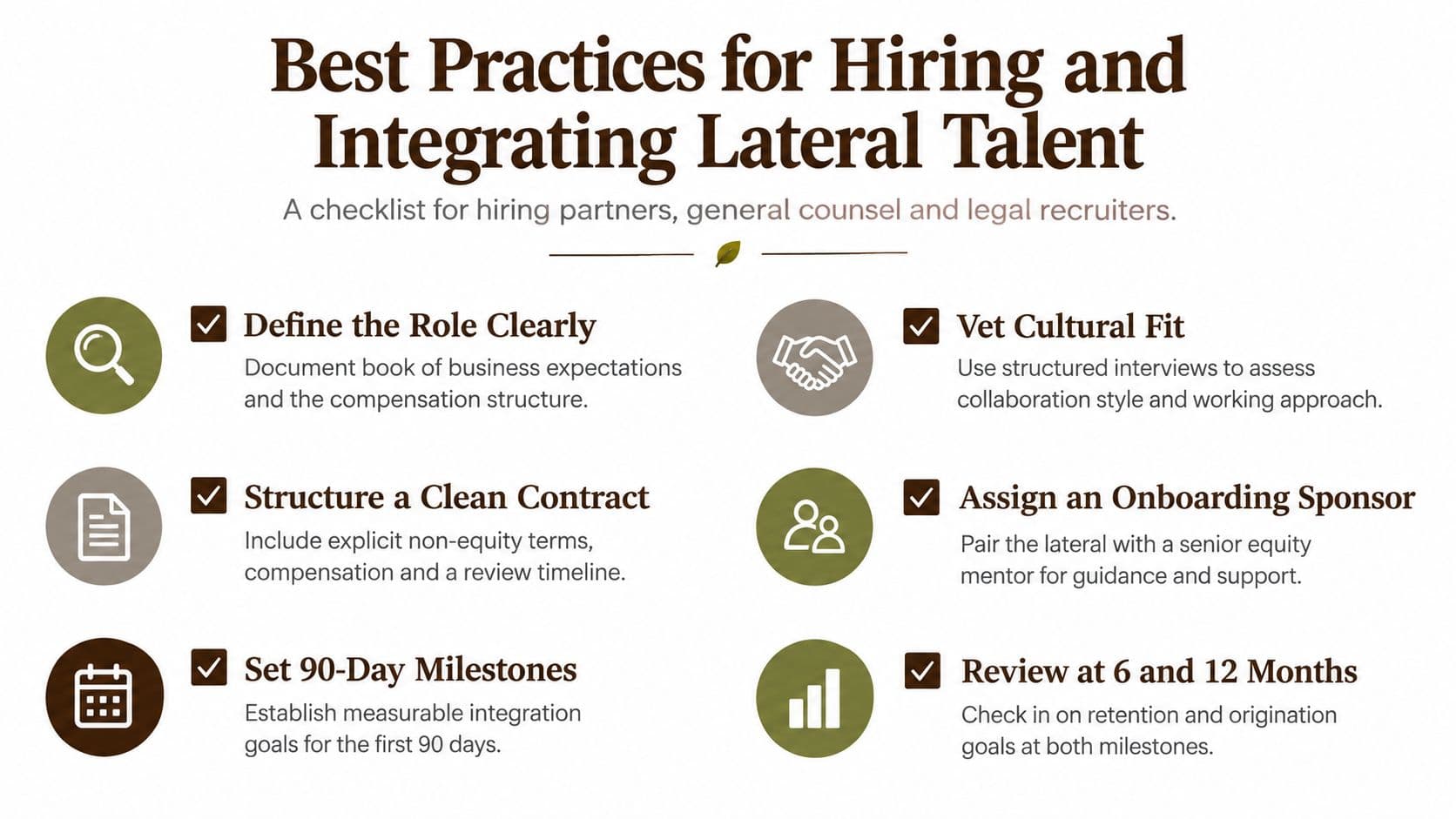
The firm should assess the role as an operating system, not a vacancy. Before sourcing begins, the hiring partners should define the practice need, expected client contribution, decision rights, compensation logic, conflicts constraints, and integration sponsor.
Test the business case
A structured interview should require evidence rather than broad assurances. Ask the candidate to explain the origin and durability of key relationships, the type of work each client needs, the colleagues who support delivery, and the restrictions that may affect portability. Review representative matters, billing history, collections context, conflicts issues, and client-service expectations within appropriate confidentiality limits.
Cultural fit also needs behavioral testing. A candidate may have impressive credentials and still resist shared credit, refuse collaborative staffing, or bypass operational controls. Include peers, practice leaders, associates, finance, conflicts, and operations in the process. Each group sees a different risk.
The offer should state:
- Role scope: Practice, reporting line, client and matter responsibilities.
- Economic terms: Base compensation, bonus categories, payment timing, and review authority.
- Governance status: Voting rights, committee participation, and approval limits.
- Performance expectations: Business development, collections, supervision, and integration objectives.
- Departure provisions: Notice, client transitions, confidentiality, and treatment of unfinished matters.
Integrate before the start date
A lateral partner doesn't integrate through a welcome email. The firm should prepare conflicts intake, client-transition planning, matter-system access, marketing support, billing setup, and introductions to relevant practice leaders before the first day.
The first meetings should focus on live work. Identify which clients need immediate contact, which matters require staffing changes, which cross-practice opportunities are credible, and which internal relationships will support delivery. Assign one senior equity sponsor with responsibility for removing obstacles, not merely checking in.
A practical integration cadence includes:
- Initial operating plan: Confirm clients, matters, systems, introductions, and early priorities.
- First review: Test whether promised access, staffing, and support are in fact available.
- Business-development review: Separate activity from converted work and identify gaps.
- Client-service review: Check responsiveness, matter quality, billing, and team health.
- Retention decision: Address compensation, authority, resources, and the attorney's long-term path before dissatisfaction becomes a departure process.
A contingency-based recruiter can be one sourcing option when the firm wants external capacity without an upfront search fee. Five Star Placements provides permanent placement and customized screening for attorneys, partners, and legal leadership, including lateral searches where role structure and organizational fit require careful evaluation. Its lateral partner hiring strategies are relevant to firms building a more disciplined process.
The principle is simple. Hire for portable value, but integrate for shared value. A lateral who brings clients but never becomes part of the firm's delivery network may remain expensive single-point dependency.
Strategic Takeaways for Law Firm Leadership
The non-equity partner tier isn't a waiting room by definition. Firms turn it into a waiting room when they leave the role's purpose, authority, and advancement standards vague.
The market evidence points in the opposite direction. Non-equity partnership is now a mainstream feature of large-firm structure, and the largest firms continue to expand the tier even while equity-partner ranks move differently. The leadership question isn't whether to have a non-equity class. It's whether the class is producing the strategic value the firm expects.
Design the role around work, not title
Start with the firm's operating needs. A non-equity partner may be a practice leader, client relationship owner, technical specialist, matter executive, or succession candidate. Those roles shouldn't all carry the same compensation formula or committee access.
A strong design has five characteristics:
- Defined authority: The attorney knows what can be approved independently and what must go to equity leadership.
- Documented economics: Salary, bonus, credit, review, and adjustment mechanics are understandable.
- Measured contribution: The firm tracks collections, realization, client development, supervision, matter economics, and leadership where relevant.
- Credible progression: Equity is available when the business case supports it, but long-term non-equity status is treated as legitimate.
- Operational support: Finance, conflicts, marketing, recruiting, and knowledge systems support the role rather than expecting the attorney to build everything alone.
Use the tier to manage partner capacity
Equity owners shouldn't spend every management hour handling responsibilities that a capable non-equity partner can own. Delegating client and practice execution gives equity leadership more time for capital allocation, strategic planning, succession, risk, and firmwide decisions.
That delegation only works when equity leaders provide direction and review. They must resist two opposite mistakes. The first is granting a title without authority. The second is granting authority without controls. The right model gives the non-equity partner room to lead and gives the firm reliable mechanisms for escalation.
Make retention an economic decision
A senior attorney may accept non-equity status for a long-term career, or may view it as a test before equity. Both choices can be rational. Leadership should ask what the firm needs from the person and what the person needs to remain committed, then align compensation and governance accordingly.
The most damaging model is one that demands ownership-level performance while offering no ownership path, no transparent bonus logic, and no meaningful authority. That arrangement invites lateral recruitment and weakens succession planning. A well-architected tier, by contrast, lets the firm retain specialized leaders, protect the equity pool, and maintain control over major financial decisions.
Managing partners should review the tier as a business product. If attorneys can't explain its value, if committees can't explain its authority, or if finance can't explain its cost, the structure needs redesign.
Five Star Placements offers contingency-based permanent recruiting for attorneys, partners, legal leadership, and legal operations roles, with customized screening for experience and organizational fit. Visit Five Star Placements to discuss a lateral non-equity partner search or a broader partnership-talent strategy.
Need help filling a legal role?
Five Star Placements partners with law firms and legal departments nationwide.
Schedule a Call