
What Is an Equity Partnership and How It Works
September 23, 2026 · 15 min read · Five Star Placements

Table of contents
An equity partnership is an ownership role in which partners contribute capital, share residual profits and losses, and participate in governance. In the Am Law 100, average profits per equity partner reached $3.59 million in 2026, up 14.0% year over year, showing why the role remains the top economic tier in major legal markets.
You may be hearing “equity partner” in a recruitment call, partnership meeting, or compensation discussion and wondering whether it means a promotion, a pay arrangement, or actual ownership. The answer matters because an equity offer can change how you earn income, how much capital you need to contribute, and how much influence you have over the firm's future.
An associate may spend years building a practice, then receive two possible paths: a salaried non-equity partnership or an equity position that requires a buy-in. The titles may sound similar, but the financial and governance consequences aren't. A non-equity partner may receive senior status and a regular compensation arrangement without owning part of the firm. An equity partner accepts a business investment, with potential upside tied directly to firm performance and exposure to losses when results weaken.
This distinction also matters to hiring partners. A firm that separates equity and non-equity roles is deciding who receives ownership economics, who contributes capital, and who participates in strategic decisions. Candidates evaluating a lateral move need to understand those choices before they compare compensation figures.
The practical question isn't, “How much does an equity partner make?” It's, “What am I buying, what risks am I accepting, and what decisions will I help make?” This guide answers those questions step by step, from the basic meaning of ownership to profit distributions, tiered partnership structures, capital commitments, and the path toward partnership. For a broader look at how law-firm partnership structures affect career decisions, see this guide to partnership in a law firm.
Table of Contents
- Introduction to Equity Partnership in Law Firms
- Understanding What an Equity Partnership Really Means
- How Profit Sharing and Financial Mechanics Work
- Equity vs Non Equity Partnership Compared
- Why Equity Partnership Has Become More Selective
- Career Pathway to Becoming an Equity Partner
- Key Takeaways for Candidates and Hiring Partners
Introduction to Equity Partnership in Law Firms
A senior associate named Maya has just received a partnership proposal. The managing partner calls it a major career milestone, and the offer includes the title “partner,” a compensation figure, and an explanation of expected client-development responsibilities. Maya is pleased, but she notices that the proposal doesn't clearly say whether she'll own part of the firm.
That uncertainty is common. “Partner” can describe a person with seniority, client responsibility, or status, while equity partner describes a specific economic relationship. The equity partner owns an interest in the firm, contributes capital under the partnership agreement, shares in residual profits, and typically has a voice in governance. A title alone doesn't establish those rights.
The difference becomes important when Maya compares the proposal with another firm's offer. One firm offers a substantial fixed compensation package as a non-equity partner. The other offers equity, but requires a capital contribution and uses draws that may change as the firm's profits change. The second offer could provide greater long-term participation, but it also places more of Maya's personal finances and professional future alongside the firm's results.
Why the label affects a career decision
Equity partnership changes more than a business card. It can affect:
- Income structure, because compensation generally comes from the firm's profit pool rather than a simple salary.
- Cash requirements, because the partnership agreement may require a capital contribution or buy-in.
- Decision-making power, because equity partners often vote on matters such as strategy, leadership, hiring, and compensation.
- Risk exposure, because ownership links the partner's financial outcome to the firm's performance.
The structure also helps explain why large firms often use more than one partnership tier. A firm may want to recognize a senior lawyer's contribution without extending ownership economics to every person carrying the partner title.
Practical rule: Treat an equity offer as an investment proposal, not only as a promotion.
Candidates should ask how profits are allocated, how losses are handled, when capital is due, how draws are calculated, and what happens to the capital account on departure. Hiring partners should communicate the same points clearly, because unclear distinctions create unrealistic expectations on both sides.
Understanding What an Equity Partnership Really Means
Start with a simple comparison. A highly paid employee sells professional services to a business in exchange for compensation. An owner also helps operate the business, but owns a stake in its economics and accepts a share of the business risk.
An equity partner sits in the second category. The partner isn't merely receiving a senior title or a larger salary. The partner owns an interest in the law firm and participates in the results that remain after the firm pays its operating costs.
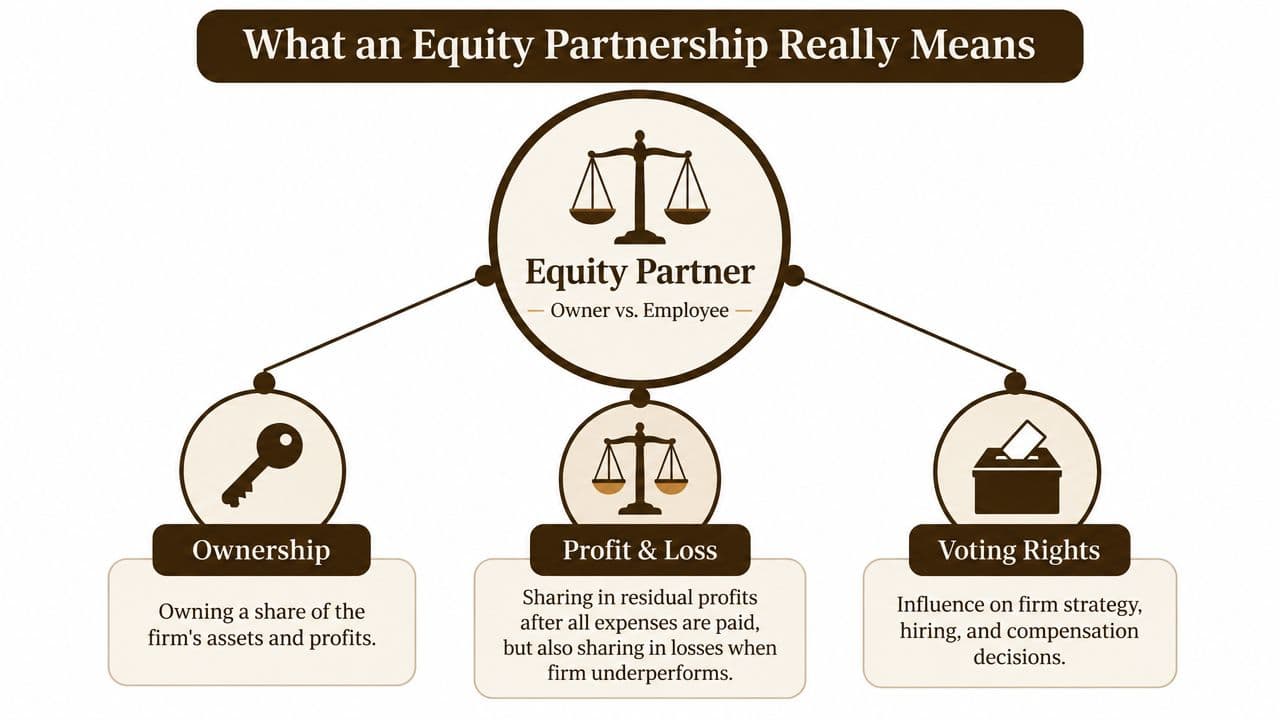
Core definition: An equity partnership is an ownership-based structure in which partners share profits, losses, and governance.
The three pillars of ownership
Ownership means the partner holds an interest in the firm rather than working for it. The partnership agreement determines the scope of that interest, including capital obligations, allocation rules, and rights on withdrawal or retirement.
Profit and loss participation means the partner's financial result depends on what the firm earns after it pays expenses. If the firm performs strongly, the residual pool may support larger distributions. If profitability falls, the partner can feel that decline through lower distributions or other adjustments.
Governance means the partner has some formal role in deciding how the firm operates. The precise voting rights vary by agreement, but governance can involve firm strategy, leadership selection, compensation policies, lateral hiring, office expansion, or practice-group priorities.
These elements distinguish equity ownership from senior employment. A lawyer may have a large book of business and substantial influence without holding equity. Another lawyer may hold an equity title but have limited authority under a particular agreement. The documents matter more than the label.
Title, compensation, and ownership are separate questions
Candidates often ask whether a non-equity partner is “really” a partner. The answer depends on the context. The lawyer may be a partner for client-facing, organizational, or status purposes, but may not own part of the firm or receive residual profit participation.
A useful evaluation separates three questions:
- What is the title?
- How is the person paid?
- What ownership and voting rights come with the role?
That framework prevents a compensation conversation from hiding the central issue. Equity partnership combines professional leadership with an ownership investment. A senior salaried role can be valuable, but it represents a different bargain.
How Profit Sharing and Financial Mechanics Work
Equity compensation usually starts with revenue generated by the firm and ends with the profit that remains after operating obligations are paid. The firm collects fees, pays expenses such as rent, insurance, salaries, and other costs, then calculates the residual profit available for allocation.
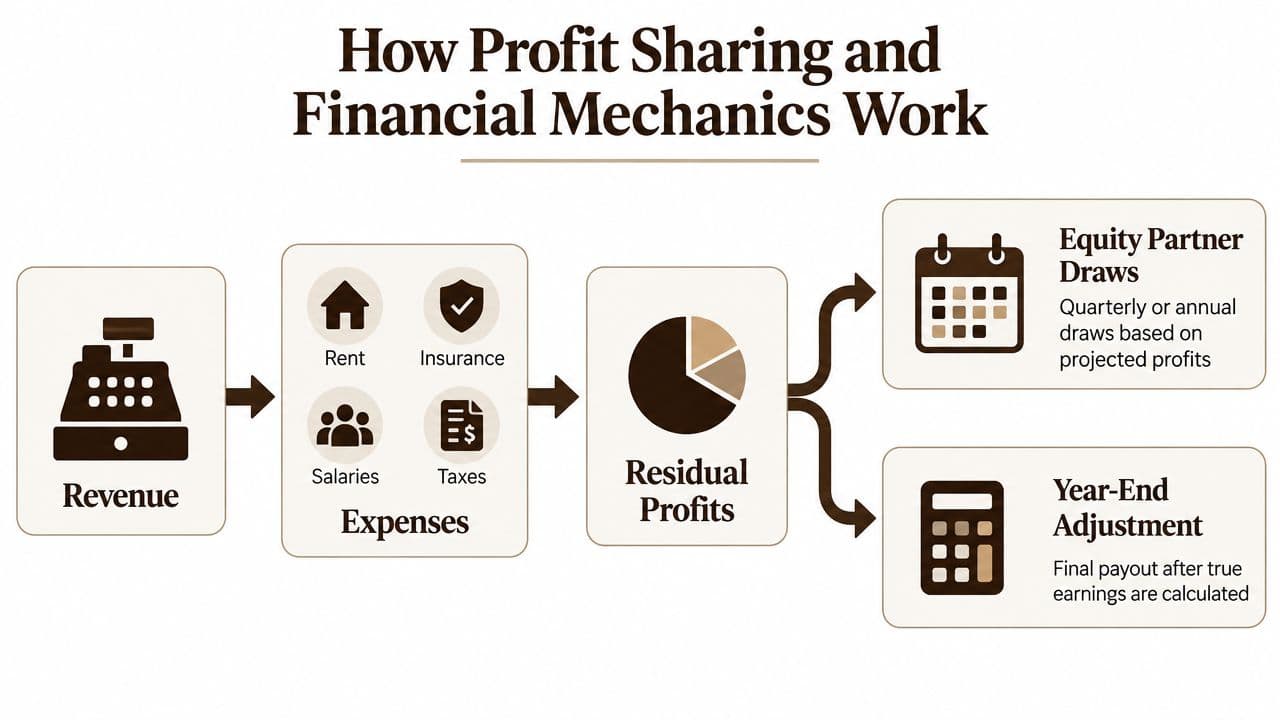
That sequence creates the central cause-and-effect relationship in equity partnership. Firm profitability influences partner income because equity compensation is generally paid from the leftover profit pool rather than from a fixed wage. A partner with strong personal production can still be affected by firmwide expenses, collection performance, investment decisions, and the results of other practice groups.
Draws are advances, not always the final answer
Many firms provide equity partners with regular draws. A draw is a distribution made during the year based on an estimate of expected profits. It gives the partner cash flow while the firm continues to close its books and determine final results.
The partnership may distribute draws monthly or quarterly, depending on its agreement and internal practice. At year-end, the firm compares the amounts already distributed with the partner's actual allocation. A true-up then adjusts the total, either by providing an additional distribution or by addressing an overpayment under the firm's rules.
A candidate should ask:
- How are draws set? Is the amount based on prior performance, projected profits, an allocation formula, or another method?
- When are adjustments made? The timing affects personal budgeting and liquidity.
- What happens if projections miss? The agreement may address repayment, reduced future draws, or another reconciliation process.
A careful explanation of profits per partner can help candidates understand why a headline compensation figure shouldn't be treated as guaranteed salary.
The upside comes with exposure
The ownership model can create meaningful upside when the firm generates strong residual profits. It also removes some of the predictability associated with a fixed employee wage. A partner may need to plan for changing distributions, capital obligations, and the possibility that firm performance affects personal income.
The capital contribution adds another layer. The partner puts money into the business, then expects the partnership agreement to govern how that capital is treated during the relationship and at departure. The amount, payment schedule, return terms, and treatment of outstanding obligations should be reviewed with professional advisers before signing.
For candidates, the right comparison isn't salary against salary. It's fixed compensation versus ownership economics, measured alongside liquidity needs, risk tolerance, governance rights, and confidence in the firm's financial management.
Equity vs Non Equity Partnership Compared
Equity and non-equity partnership can sit next to each other on an organization chart while representing very different economic relationships. Equity partners are owners who share in residual profits and usually contribute capital. Non-equity partners generally occupy a senior role without receiving the same ownership interest.
A non-equity partner may lead matters, supervise lawyers, develop clients, and contribute to firm management. Those responsibilities can be substantial. The difference is that the role usually doesn't provide the same claim on the firm's residual profit pool or the same ownership-based voting rights.
Equity vs Non-Equity Partner at a Glance
| Dimension | Equity Partner | Non-Equity Partner |
|---|---|---|
| Economic status | Owner with an interest in firm economics | Senior role without the same ownership interest |
| Compensation | Generally tied to residual profits and distributions | Generally structured around salary, fixed compensation, or another non-ownership arrangement |
| Capital contribution | Typically requires a buy-in or capital contribution | Usually doesn't require the same ownership contribution |
| Profit participation | Shares in residual profits after expenses | Typically receives compensation without the same residual profit claim |
| Loss exposure | Directly exposed to weaker firm performance through ownership economics | Usually has less direct exposure to firm losses |
| Governance | Often includes voting or other governance rights under the agreement | Rights may be limited or defined separately |
| Financial predictability | Can vary with firm profitability and distribution policy | Usually more predictable than equity compensation |
| Career meaning | Ownership and long-term participation in the firm | Seniority, leadership, and recognition without equivalent ownership economics |
The table isn't a judgment about which path is better. A lawyer may prefer predictable compensation, limited capital exposure, or flexibility outside firm governance. Another may value control, profit participation, and a long-term ownership position.
Why non-equity isn't simply junior equity
Treating non-equity partnership as “junior equity” creates confusion. The two roles may have different incentives, obligations, and decision rights from the beginning. A non-equity partner may be an important leader and rainmaker, but the firm hasn't necessarily transferred an ownership interest.
Candidates should read the offer and partnership agreement for exact language about compensation, capital, voting, profit allocation, retirement, departure, and advancement. They should also ask whether a path from non-equity to equity is defined or merely possible.
A comparison with of counsel versus partner roles can further clarify how titles may signal different levels of integration, responsibility, and economic participation. The central question remains consistent: What rights and obligations attach to the role in writing?
Why Equity Partnership Has Become More Selective
A lawyer can receive the partner title and still lack an ownership stake. In large firms, that distinction has become more common. In Am Law 100 firms, equity partners represented 72% of partners in 2010, but the share fell to 43% by 2024, while non-equity partners reached 57%. The same projection suggests equity partners could represent 34% by 2030. The reported partnership economics and projected tiering trend illustrates how firms are narrowing the group that shares ownership economics.
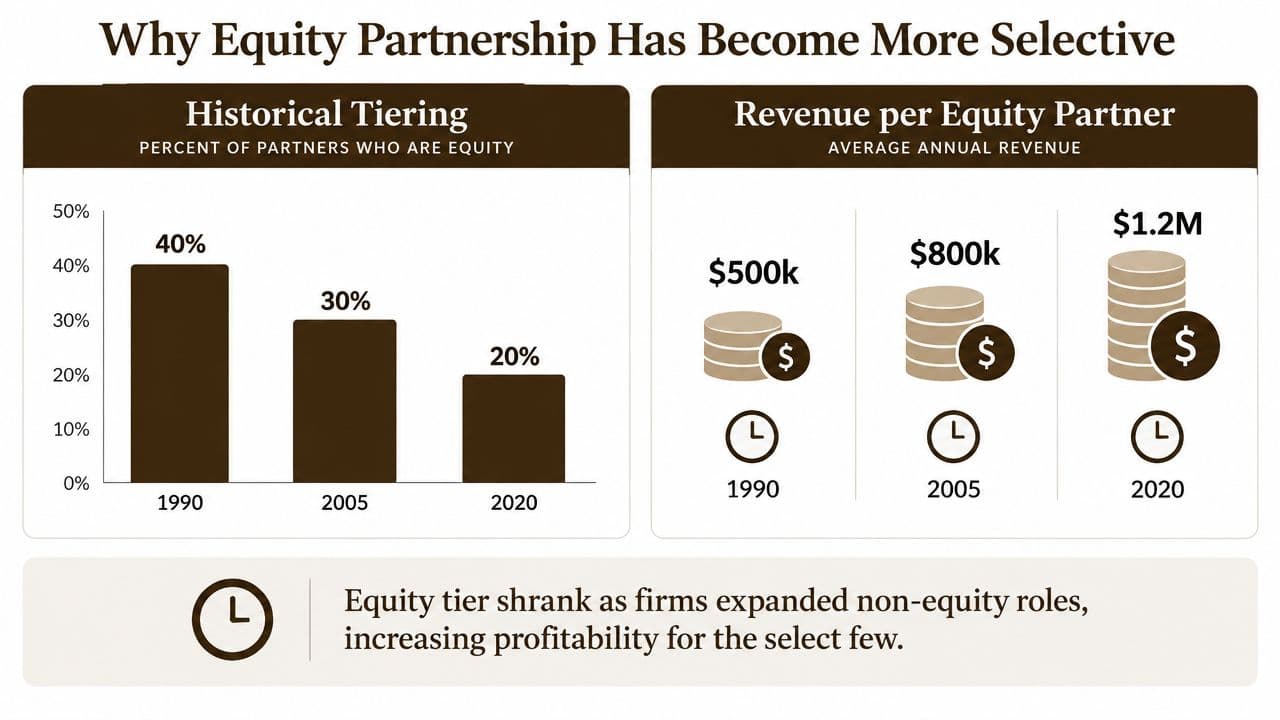
A tiered structure lets a firm recognize senior lawyers without granting every partner an ownership interest. Non-equity partners may lead teams, bring in clients, or shape a practice, while the firm limits the number of people sharing profits, governance, and capital exposure. The arrangement can also help the firm control financial risk and retain valuable lawyers before it is ready to offer equity.
Tiering changes the candidate's question
In a single-tier firm, “partner” may imply ownership. In a multi-tier firm, the title is only the starting point. Candidates need to identify the rights attached to the specific offer:
- Is the offer equity or non-equity?
- What triggers advancement into equity?
- Who decides whether advancement occurs?
- Does the candidate receive voting rights immediately?
- What capital contribution is expected?
Firms may assess production, client development, leadership, or several factors together. Time served alone may not move a lawyer from one tier to another.
Ownership requires capital
Equity ownership also resembles an investment. The reported range runs from about $150,000 in boutique firms to $550,000 in Am Law 50 firms, often representing 25% to 30% of expected first-year compensation, according to the same law-firm economics analysis. That contribution makes equity a financial decision, not a promotion.
The partnership agreement should explain whether the payment is made at once, funded in stages, financed, or deducted from distributions. It should also state what happens to the capital account if the partner leaves, retires, or is removed.
Selectivity therefore affects both sides of the deal. The firm preserves a smaller ownership group and a wider senior leadership tier. The candidate must weigh expected profit participation and governance rights against the required capital and financial risk. A strong business case helps, but the offer still deserves the same scrutiny as any investment.
Career Pathway to Becoming an Equity Partner
The path to equity usually begins before a formal partnership discussion. A firm is assessing whether a lawyer can help generate durable revenue, strengthen client relationships, lead people, and make decisions as an owner. Strong technical work remains essential, but it isn't the entire business case.

Build evidence of ownership readiness
Develop client relationships. Track how you contribute to client retention, new matters, referrals, and the broader strength of the practice. A firm needs to understand not only the work you perform, but also the relationships you can help protect and expand.
Create a portable business case. Portability doesn't mean promising that every client will follow you. It means presenting credible evidence about your market position, relationships, matter history, and ability to develop work within the firm's platform.
Lead beyond your matters. Mentor associates, improve workflows, participate in recruiting, and take responsibility for practice-group priorities. Equity partners help operate the institution, not just their own caseload.
Understand cultural fit as a business issue. Partners share governance, expenses, reputation, and difficult decisions. A candidate who produces revenue but cannot collaborate may create ownership risk that a firm won't accept.
Ask for the financial terms early
Candidates should request the partnership agreement or a detailed term sheet before treating the offer as complete. Review the allocation formula, draw policy, capital contribution, voting rights, benefits, tax responsibilities, departure provisions, and any restrictions affecting clients or practice development.
A lateral candidate should also compare the opportunity against the current platform. Ask whether the new firm can support the practice, whether conflicts will restrict clients, how collections are managed, and whether the proposed role offers actual authority or only a more impressive title.
A recruiter can help test the market, but the candidate still needs independent legal and financial advice before signing. Five Star Placements provides permanent placement and customized screening for attorneys, partners, legal support professionals, and legal leadership, so its recruiting process can be relevant when a lawyer or firm is evaluating a lateral partnership match.
This video offers another way to think about the transition from professional contributor to firm owner:
Timing also matters. A lawyer may be ready for equity at one firm but need a different role at another because the firms value practices differently, use different allocation systems, or have different governance needs. The strongest candidates don't present partnership as a reward for tenure. They present a reasoned ownership proposal that connects clients, leadership, capital, and long-term contribution.
Key Takeaways for Candidates and Hiring Partners
Equity partnership answers a business question, not only a career-status question. The partner becomes an owner, contributes capital, participates in residual profits and losses, and usually gains governance rights under the partnership agreement.
Candidates should evaluate the offer through several decision checks:
- Ownership: Confirm whether the role includes an actual ownership interest or only a partner title.
- Cash flow: Understand how draws work, when distributions occur, and how final results are reconciled.
- Capital: Identify the required contribution, payment terms, financing options, and repayment treatment.
- Risk: Consider how weaker firm performance could affect income and whether the personal balance sheet can absorb that variability.
- Voice: Ask which decisions require a vote and whether your rights differ from those of other equity partners.
- Exit terms: Review what happens to capital, unfinished matters, compensation, and obligations when the relationship ends.
Hiring partners should apply the same discipline from the other side. A clear tier structure helps candidates understand whether a role offers ownership, senior employment, or a defined route between the two. Written explanations of compensation, advancement, governance, and capital reduce misunderstandings during recruitment and later partnership discussions.
The economic data reinforces the distinction. Average profits per equity partner across the Am Law 100 reached $3.59 million in 2026, while equity partners in Am Law 50 firms averaged $3.24 million compared with $775,000 for non-equity partners, a difference of about 4.2 times, according to the reported Am Law compensation figures. These figures describe a powerful economic tier, but they don't eliminate the need to examine capital, risk, governance, or firm quality.
The most useful mindset is simple: equity is an investment decision attached to a legal career. Candidates should match the opportunity with their financial capacity and professional goals. Hiring partners should design tiers that align ownership with the contributions and responsibilities the firm needs.
Five Star Placements connects law firms and legal departments with attorneys, partners, legal support professionals, and legal operations leaders through customized search and screening. If you're evaluating an equity partnership move or structuring a search for a partner who fits your firm's practice and culture, visit Five Star Placements to discuss the opportunity.
Need help filling a legal role?
Five Star Placements partners with law firms and legal departments nationwide.
Schedule a Call