
Partnership Law Firm: A Guide to Modern Structures
July 14, 2026 · 15 min read · Five Star Placements
Table of contents
You're likely dealing with one of three pressure points right now. A senior associate expects a partnership conversation. A lateral partner wants clarity on economics before bringing over a book of business. Or an older equity partner is hinting that succession can't stay informal much longer.
In each case, the legal structure of your firm stops being background paperwork and becomes a recruiting weapon, a retention lever, or a liability trap. Managing partners often treat partnership design as a governance issue for lawyers to document after core business decisions are made. That's backwards. In a competitive market, the structure of a partnership law firm determines who joins, who stays, who gets paid, who has authority, and who leaves angry enough to take clients with them.
Most commentary stays too abstract. It explains definitions. It rarely deals with the hard questions: What kind of ownership story are you selling to talent? What happens when a partner underperforms? How should you think about outside capital changing the meaning of “equity”? Those are the questions that shape growth.
Table of Contents
- Introduction Why Your Firm's Structure Is a Strategic Choice
- The Anatomy of a Partnership Law Firm
- Comparing the Most Common Partnership Structures
- The Equity vs Non-Equity Partner Tiers Explained
- Financial and Governance Implications of Your Model
- How Partnership Models Impact Recruitment and Retention
- Building a Future-Proof Firm with Strategic Partner Hiring
Introduction Why Your Firm's Structure Is a Strategic Choice
A managing partner at a growing firm usually starts with a talent decision and ends up facing a structural one. You want to reward a rainmaking litigator. You need to integrate a lateral corporate team. You're trying to keep a high-performing senior lawyer from taking a competing offer. The question sounds like compensation, but it's really about architecture.
If your firm has a vague path to ownership, top talent notices. If your equity tier is too easy to enter, current partners notice. If governance rights don't match business expectations, everyone notices. That tension is why a partnership law firm can't treat structure as a technicality. It's the operating system of the business.
I've seen firms lose strong candidates because the title “partner” meant three different things depending on who was speaking. I've also seen firms overpromise ownership to close a lateral, then create resentment inside the existing partnership when economics and voting rights weren't aligned. Those are preventable mistakes.
A firm's structure should answer practical questions fast:
- Who owns the firm
- Who controls key decisions
- Who contributes capital
- Who shares profits and losses
- How someone moves in or out of the partnership
If you're revisiting your leadership bench or planning a strategic hire, it helps to assess your model with the same rigor you'd apply to a high-stakes search. That's one reason firms turn to legal talent specialists with a broader market view, including teams like Five Star Placements' legal recruiting practice, before they finalize the partner profile they think they need.
Practical rule: If your partnership model isn't clear enough to explain in one recruiting conversation, it isn't clear enough to scale.
The Anatomy of a Partnership Law Firm
A partnership law firm is a business owned and operated by its principal lawyers. That sounds simple. It isn't. Ownership in a law firm carries economic rights, management expectations, and legal duties that go well beyond a prestigious title.
A solo practice is one driver in one car. A partnership is a racing team that owns the vehicle together. Everyone cares about performance, but they also share the consequences of a bad decision in the pit, a blown engine, or a driver who ignores the track conditions. That's why partnership structure affects behavior so strongly.
Ownership means shared upside and shared exposure
Partners generally participate in profits and, depending on the structure, may share losses and liabilities. They also influence firm direction. That's the distinction between an employee and an owner. Employees perform a role. Owners bear responsibility for the enterprise.
In practice, ownership usually turns on a few recurring elements:
- Economic participation: The partner receives a share of profits, distributions, or compensation tied to firm performance.
- Capital commitment: Many firms require a buy-in or ongoing capital account contribution from true owners.
- Decision rights: Voting power may be broad or narrow, but ownership without meaningful governance is often ownership in name only.
- Risk allocation: The firm's entity choice and agreement determine how personal exposure is handled.
That last point matters more than many firms admit. Lawyers love discussing compensation formulas. They spend less time discussing how risk is allocated when something goes wrong.
Fiduciary duty is not a ceremonial phrase
Partners owe duties to each other and to the firm. The language varies by jurisdiction and agreement, but the business reality is consistent. A partner can't treat the firm as a temporary platform for personal advantage while expecting everyone else to carry institutional risk.
That's why cultural fit at the partner level is never just about chemistry. It's about judgment. Will this lawyer invest in associates, share credit, support firm decisions, and protect the enterprise when it would be easier to optimize for self-interest?
A bad partner hire rarely fails because of legal skill. It fails because the person and the structure were incompatible from the start.
The best partnership law firms make the ownership bargain explicit. They define expectations around production, cross-selling, mentorship, capital, governance, and exit. Firms that leave those points fuzzy create conflict later, usually when money or control is on the table.
Comparing the Most Common Partnership Structures
The label “partnership” hides major differences. If you're running a law firm, the meaningful question isn't whether you have partners. It's what legal form governs ownership and liability.
Here's the visual summary most firm leaders need before they get pulled into the finer points.
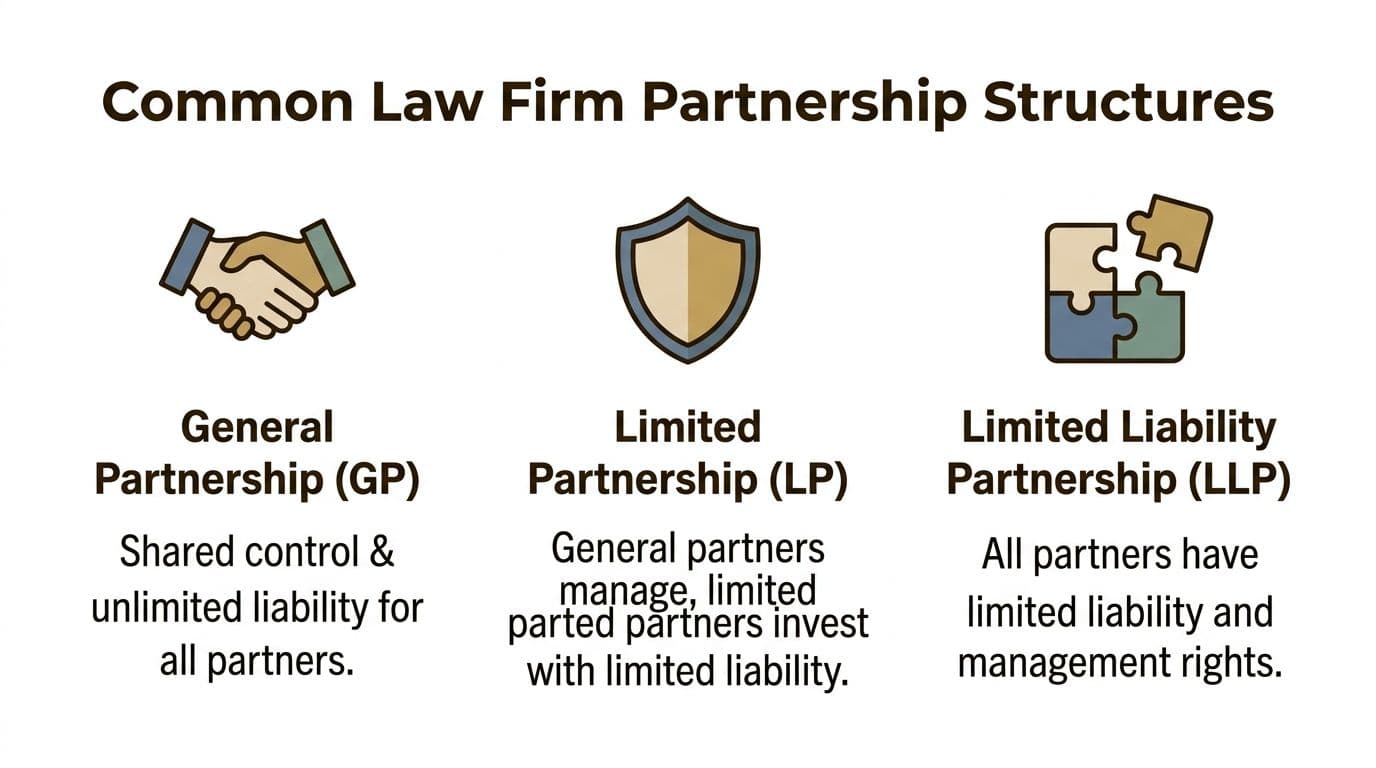
What changes from one structure to another
A General Partnership (GP) is the simplest conceptually. Partners typically share management authority, and personal liability exposure is broad. That simplicity can work in a very small operation, but it becomes less attractive as the firm grows and risk expands.
A Limited Partnership (LP) splits the partner class into managers and passive investors. General partners manage. Limited partners usually contribute capital and receive limited liability tied to their role. For most operating law firms, that's a narrower fit because law firm leadership usually expects active lawyers, not passive owners.
A Limited Liability Partnership (LLP) is often the practical choice for professional firms because it combines partner governance with liability protection that is better suited to modern practice. It doesn't remove all risk. It does create a more workable framework for firms that want ownership participation without the blunt exposure of a GP.
Law Firm Partnership Structures Compared
| Feature | General Partnership (GP) | Limited Partnership (LP) | Limited Liability Partnership (LLP) |
|---|---|---|---|
| Liability | Partners generally face broad personal liability for firm obligations | General partners manage and face broader exposure, limited partners typically have liability protection tied to investment status | Partners generally receive liability protection for firm debts and obligations, subject to applicable law |
| Management control | Usually shared among general partners | General partners control management, limited partners usually do not | Management rights are usually shared or allocated by agreement |
| Best fit | Small firms with high trust and low complexity | Situations involving passive investment and a clear manager-investor divide | Operating law firms that want active partner governance with more liability protection |
| Recruiting impact | Harder sell for risk-aware laterals | Usually less aligned with traditional partner expectations in a law firm | Easier to explain to candidates who want ownership and institutional stability |
| Governance flexibility | Moderate, but can become messy without strong agreements | More segmented by role | High, because the agreement can define voting, economics, and authority with more precision |
Two mistakes show up repeatedly in real firms.
- Mistake one: choosing a structure for tax or filing convenience and ignoring talent implications.
- Mistake two: assuming the entity choice alone solves internal governance. It won't. The agreement does the essential work.
If you want a scalable partnership law firm, choose the entity that fits your risk profile, then draft the internal economics and authority model with equal care. The entity is the shell. The agreement is the machine.
The Equity vs Non-Equity Partner Tiers Explained
The biggest source of confusion in partner recruiting isn't usually the legal entity. It's the title itself. When a firm says “partner,” candidates immediately want to know whether that means owner, senior employee, or probationary status with a better business card.
That distinction matters because the economics are enormous. Average compensation for equity partners at U.S. law firms reached $1.9 million in 2024, and total average partner compensation across all partnership types hit $1.41 million, according to the Major, Lindsey & Africa partner compensation survey press release. If the financial stakes are that high, firms can't afford fuzzy definitions.
Here's the simplest visual split.
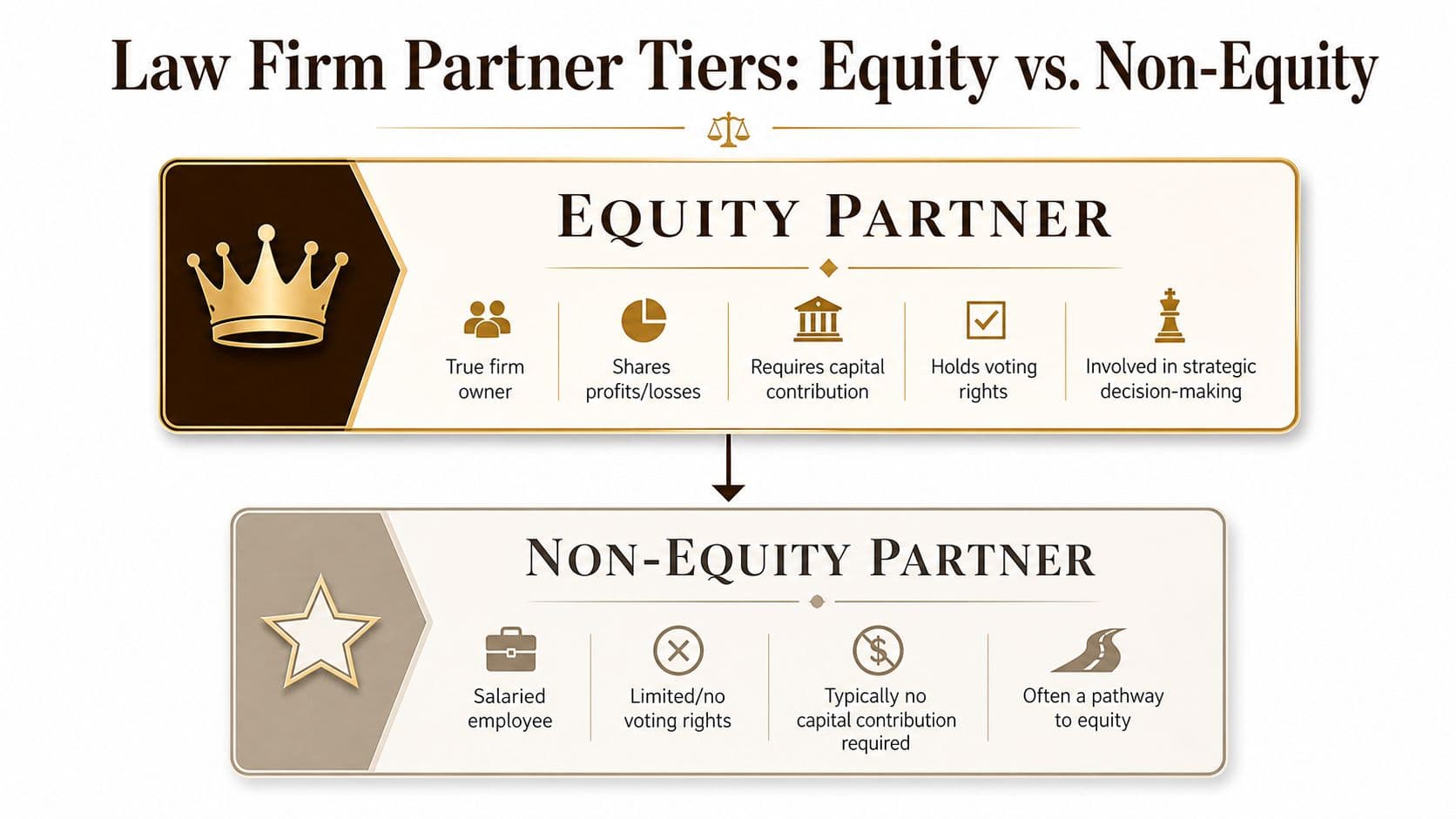
Why firms split the partner class
An equity partner is a genuine owner. That usually includes some combination of capital contribution, profit participation, voting rights, and responsibility for the firm's long-term health.
A non-equity partner is usually a senior lawyer with status, a favorable compensation arrangement, and internal credibility, but without true ownership rights. In many firms, that role serves one of three purposes:
- A proving ground: the lawyer is being tested before admission to equity.
- A retention device: the firm wants to keep a valuable senior attorney without diluting ownership.
- A specialist track: the lawyer has deep expertise or institutional value but isn't expected to function as a full business owner.
The title isn't the issue. The mismatch is. Problems start when firms present non-equity partnership as ownership-adjacent, then structure it like employment.
A short video can help frame how candidates think about the distinction.
What candidates hear when you say partner
When a managing partner says “we can make you partner,” the candidate hears a cluster of unspoken questions:
- Do I have to buy in
- Do I vote
- How is my compensation determined
- What's the timeline to real equity if this is non-equity first
- What happens if performance dips or leadership changes
Strong candidates won't ask all of that in the first conversation, but they're evaluating it. They know that “partner” can mean owner, highly paid employee, or transitional status.
If your firm uses a two-tier model, define the difference in plain English. Ambiguity helps you close no one worth hiring.
The firms that recruit best are brutally clear. They tell candidates whether the role includes buy-in, governance, profit participation, and a timetable for movement. They don't hide the ball, and they don't assume prestige can substitute for terms.
Financial and Governance Implications of Your Model
Most partnership fights are described as personality problems. They're often design problems. The compensation model rewards one behavior. The governance model expects another. Then leadership acts surprised when partners pull in opposite directions.
That's why the financial constitution of a partnership law firm matters more than the promotional language around it.
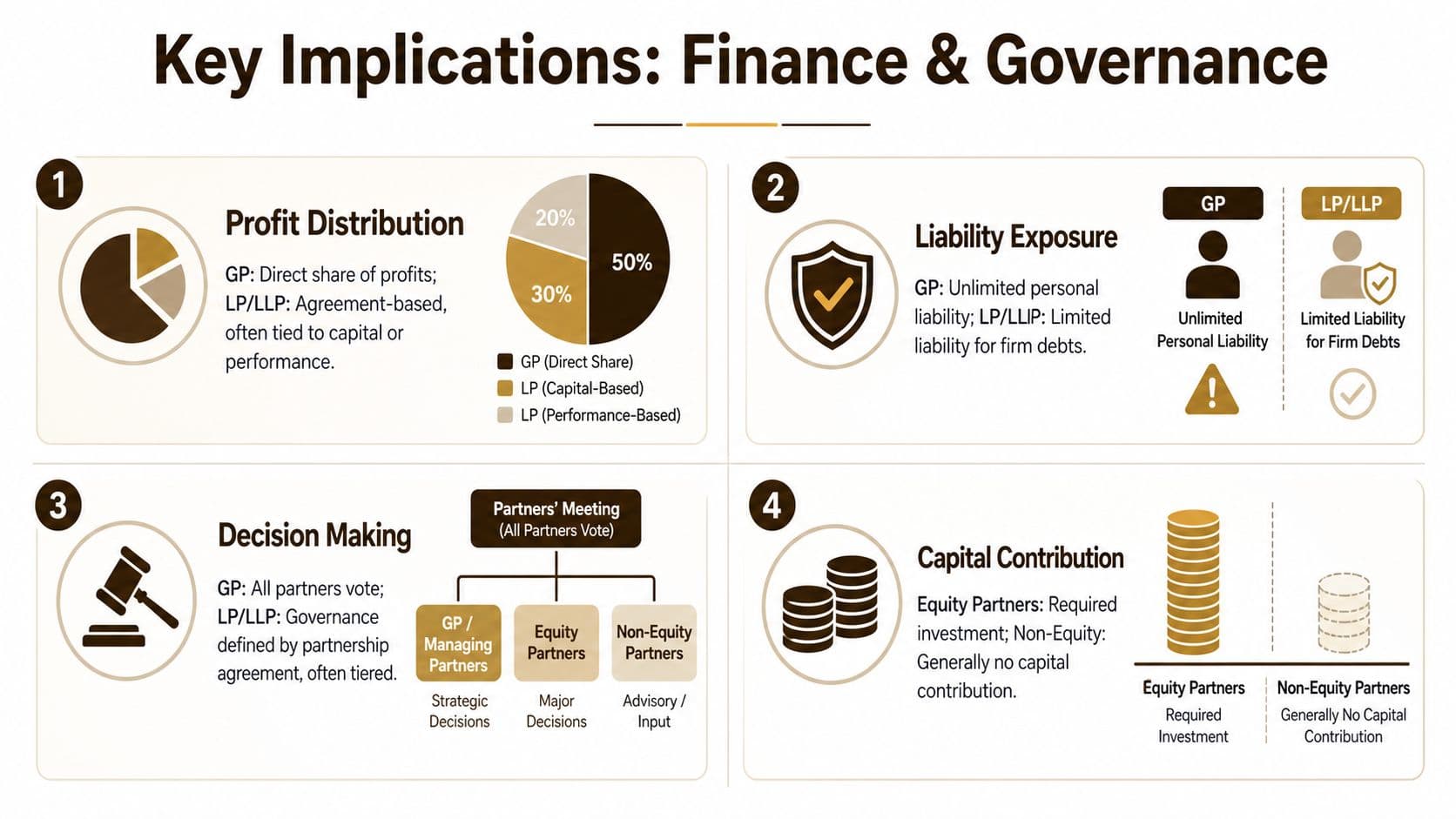
Compensation systems shape behavior
A lockstep model signals institutional loyalty, patience, and shared success. An eat-what-you-kill system rewards originations and individual production. A hybrid model tries to capture both, but only works if the formulas are coherent and credible.
None of these systems is automatically right. The right model depends on your firm's strategy.
- If you want team selling, don't let origination rules punish collaboration.
- If you want entrepreneurship, don't bury rainmakers under rigid seniority economics.
- If you want succession, make sure senior partners don't have incentives to hoard client relationships.
- If you want lateral growth, define how portable business is credited and how long guarantees last.
Capital rules matter just as much. Buy-in requirements communicate seriousness, but they can also block excellent candidates if the amount, timing, or financing method is unrealistic. A capital account should support the business, not become a recruiting obstacle created by tradition.
Governance is where many firms quietly fail
Governance isn't just voting on major decisions. It's deciding who gets to make which decision without asking everyone else. Firms bog down when every issue becomes a referendum or, worse, when authority exists only as unwritten custom.
Strong agreements usually answer questions like these:
| Governance issue | What a strong model clarifies |
|---|---|
| Admissions | Who approves new partners and by what threshold |
| Compensation | Who sets it, reviews it, and adjusts it |
| Capital calls | When additional contributions can be required |
| Practice investment | Who authorizes hiring, office growth, and strategic spending |
| Partner discipline | What happens when a partner underperforms or breaches obligations |
The higher the economics, the less room you have for governance by vibe.
That's not theory. The money involved is executive-level. The same Major, Lindsey & Africa data shows equity partner compensation averaged $1.9 million in 2024, with Corporate and M&A partners averaging $1.92 million, compared with $1.054 million for litigation partners and $1.145 million for tax partners. When partner economics diverge that sharply, governance has to be disciplined or resentment will fill the gaps.
How Partnership Models Impact Recruitment and Retention
Your partnership agreement is one of your strongest talent tools. It's also one of the fastest ways to lose trust if the details don't match the recruiting pitch.
Laterals don't just compare compensation. They compare clarity. They want to know whether the firm has a believable path, an understandable decision structure, and a fair exit process. If you can't explain those points crisply, candidates assume the internal reality is worse than the presentation.
Opaque partnership terms repel strong laterals
The best partner candidates don't get impressed by vague talk about collegiality and upside. They ask practical questions early, even if indirectly.
They're evaluating points like these:
- Path transparency: Is equity admission discretionary forever, or is there a defined process?
- Credit integrity: How are origination, cross-selling, and inherited clients handled?
- Capital realism: Can a candidate join without taking on disproportionate personal strain?
- Authority alignment: Does the title come with actual influence, or only internal expectations?
Firms often think opacity protects flexibility. It usually just weakens recruiting. Top lawyers have options. They don't need to walk into an unclear ownership story.
A broader market read on partner movement, compensation expectations, and firm messaging helps leadership pressure-test whether its offer is competitive. That's the type of perspective often found in legal hiring market insights for firms.
Partner exits expose weak operating documents
Retention isn't only about keeping people happy. It's also about making sure departures don't become destructive. Unfortunately, many firms are dangerously underprepared in this regard.
Only 12% of surveyed firms have a written, partner-signed agreement specifying share disposition in cases of death or disability, 45% of lateral partner exits involve disputes over client origination credits, and firm turnover rates among equity partners rose 18% in the last 12 months, according to Attorney at Work's discussion of partnership risk and exit issues.
Those numbers should concern every managing partner because they point to a simple truth. Most firms spend more time negotiating entry than planning separation.
A practical exit framework should address:
- Client ownership and transition protocols
- Origination credit after departure
- Capital account treatment
- Restrictive covenant limits where permitted
- Liability allocation for unfinished matters and firm obligations
A partner departure shouldn't feel like emergency litigation triage. If it does, leadership waited too long to define the rules.
The firms that retain partners best don't just pay well. They reduce uncertainty. Lawyers stay where the economics are understandable and the downside risk is contained.
Building a Future-Proof Firm with Strategic Partner Hiring
A lot of firm leaders still talk about partnership as if it's a closed internal system. It isn't anymore. Outside money, aggressive lateral competition, and shifting economics have changed what partnership can mean in practice.
That shift is easy to miss if you focus only on profits per partner.

Private capital changed the conversation
An often-overlooked challenge is the rise of external capital in legal markets. Thirty percent of U.S. law firms now have external backing, according to David Morley's analysis of private capital in law firms. That matters because investor pressure can change compensation priorities, alter equity expectations, and push firms toward structures that feel less like traditional partnership and more like a financially engineered platform.
Managing partners should stop assuming that “equity” means the same thing it meant a decade ago. In some firms, outside capital can accelerate growth. It can also narrow autonomy, change payout expectations, and create de-equitization risk that candidates don't fully understand on first pass.
Hiring the right partner now requires deeper diligence
This is why partner hiring has become a strategy function, not just a recruiting task. A lateral partner may look strong on paper and still be wrong for your model. The opposite is also true. A lawyer with a more modest profile may become a cornerstone hire if their practice, expectations, and governance style fit your structure.
Managing partners should scrutinize partner candidates on four fronts:
- Business compatibility: Can this lawyer thrive under your compensation logic?
- Governance fit: Will they operate well inside your decision structure?
- Capital alignment: Are their ownership expectations realistic for your model?
- Exit resilience: If the relationship changes later, can the firm unwind it without chaos?
If your firm is building leadership capacity, entering a new market, or replacing aging equity, treat partner hiring as a firm design decision. That means using a process that evaluates legal skill, portable business, economics, and culture in one frame, not four disconnected conversations. Firms that want a national search partner for that kind of work often start with Five Star Placements.
If you're weighing partnership design, lateral partner hiring, or succession planning, Five Star Placements can help you approach the decision like a market operator instead of a résumé collector. The firm works with law firms and legal departments across the United States on attorney, partner, in-house, and legal operations hiring, with customized screening that goes beyond surface credentials to assess business fit, culture fit, and long-term stability. Explore Five Star Placements if you want a more disciplined approach to high-stakes legal hiring.
Need help filling a legal role?
Five Star Placements partners with law firms and legal departments nationwide.
Schedule a Call