
Litigation Support Staffing: Your 2026 Playbook
September 7, 2026 · 13 min read · Five Star Placements

Table of contents
A discovery surge rarely arrives with a convenient hiring window. A partner may learn that a major matter has entered document review, a production deadline is approaching, and the team's most experienced paralegal is already supporting several active cases. Within days, attorneys are asking who can control exhibits, coordinate vendors, validate review work, and keep the case calendar intact.
That pressure exposes the weakness of generic headcount ratios. Two matters may each count as one file, yet one may involve a manageable record set while the other demands intensive discovery review, complex ESI coordination, trial preparation, and daily vendor management. Litigation support staffing works best when capacity follows workload, not file count.
This playbook uses that principle to define roles, source candidates, onboard efficiently, retain experienced staff, monitor performance, and decide when a contingency recruiter should supplement internal recruiting. The practical objective isn't to add people automatically. It's to build a flexible operating model that places the right capability against the work that needs to be completed.
Table of Contents
- Introduction to Litigation Support Staffing
- Defining Roles and Competency Frameworks
- Sourcing and Screening Candidates Strategically
- Structuring Onboarding and Training Plans
- Driving Retention and Career Growth
- Monitoring KPIs and Engaging Contingency Recruiters
- Conclusion and Next Steps
Introduction to Litigation Support Staffing
A mid-sized litigation practice often discovers its staffing problem too late. The matter list looks stable until a new production arrives, a deposition schedule accelerates, or a client requests a faster reporting cycle. Then attorneys begin reviewing documents after hours, case managers absorb administrative work, and senior paralegals spend their time fixing preventable errors instead of managing substantive case priorities.
A simple ratio can't distinguish between those situations. Headcount may appear adequate on paper while the team struggles with discovery review, exhibit control, cite checks, or vendor coordination. Adding a permanent employee may solve the immediate shortage, but it can also create excess capacity when the surge passes. Relying on existing staff may protect the budget, but it can increase rework, fatigue, and deadline risk.
The first management decision is therefore diagnostic: what work is arriving, how difficult is it, and where does it stall? A weekly review of active discovery volume, ESI complexity, and the first point of delay gives leaders a more useful picture than a matter count alone. A workload-based staffing method assigns units to recurring tasks, then translates those units into role requirements and hiring priorities. Practical litigation-support staffing guidance supports this workload-oriented approach.
Practical rule: Staff the bottleneck you can measure, not the anxiety you feel during a busy week.
The rest of the playbook follows that rule. Define responsibilities before posting a role, screen for demonstrated capability rather than polished resumes, train people against the systems they'll use, and track completion quality alongside utilization. Use internal recruiting for predictable needs, then bring in contingency support when urgency, specialization, or limited recruiting capacity makes an external search more effective.
Defining Roles and Competency Frameworks
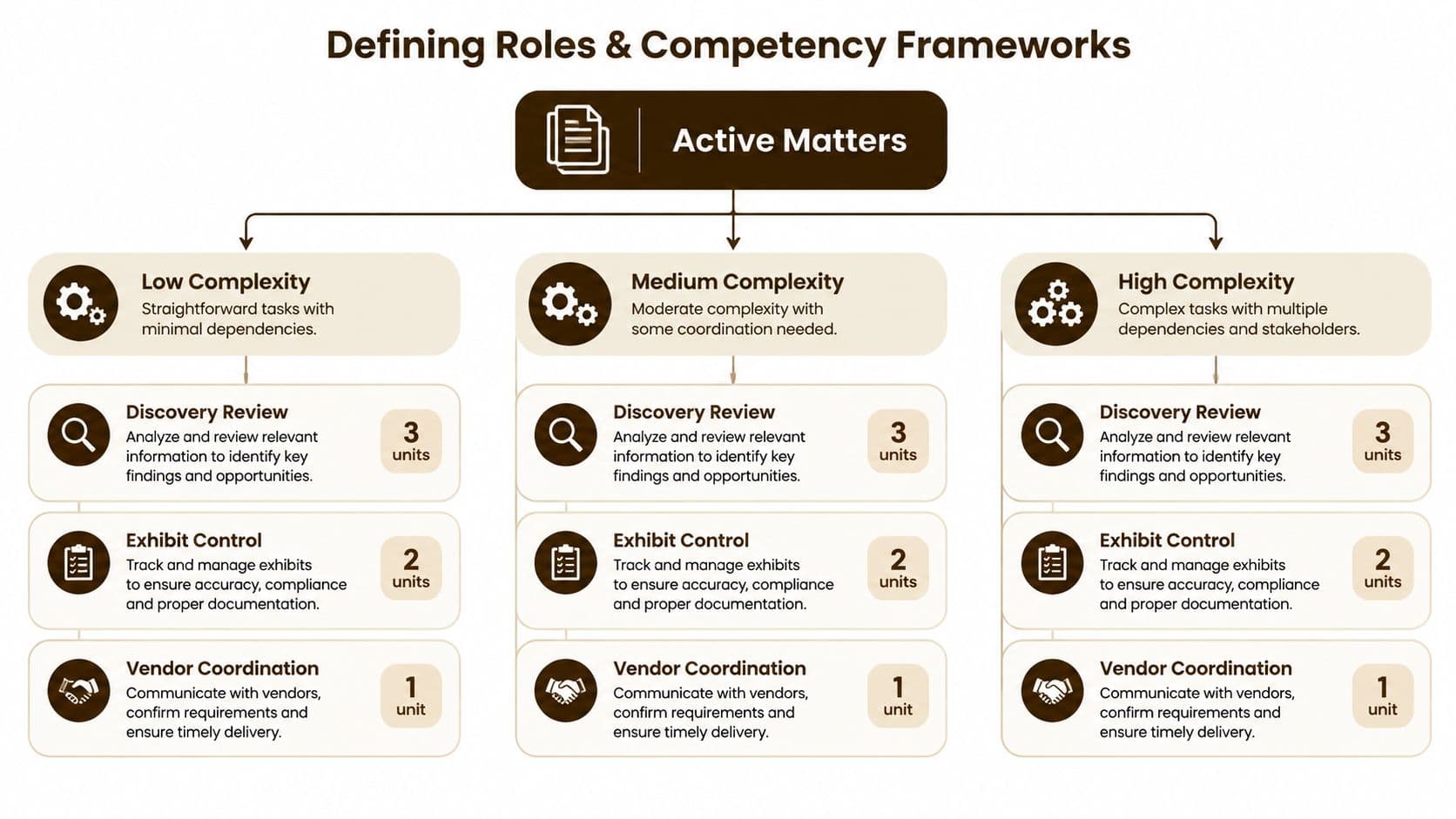
Start with the active matters, not the organizational chart. Classify each matter as low, medium, or high complexity using factors such as discovery volume, ESI structure, number of custodians, production demands, exhibit requirements, and vendor dependencies. Then assign workload units to the tasks that consume team capacity.
A practical model might assign three units to discovery review, two to exhibit control, and one to vendor coordination. Those units aren't universal production standards. They're an internal measurement system that helps managers compare demand across matters and identify where capacity is being consumed. Review the allocation weekly and adjust it when a matter changes phase.
Translate workload into accountable roles
Once the units are visible, map them to responsibilities rather than assigning every task to the most senior person available.
| Role | Primary ownership | Competency evidence |
|---|---|---|
| Intake personnel | Matter intake, conflict-related information capture, routing, and status documentation | Accurate data entry, organized communication, and reliable escalation |
| Paralegal | Case chronology, cite checks, records organization, and attorney-facing support | Strong legal research habits, deadline control, and document judgment |
| Litigation support specialist | Discovery workflows, review and production systems, case data, and trial presentation support | Platform fluency, troubleshooting ability, and defensible process execution |
| Case manager | Cross-matter coordination, calendars, handoffs, and work allocation | Prioritization, stakeholder management, and operational ownership |
| Litigation support manager | Capacity planning, quality controls, vendor governance, and reporting | Leadership, workflow design, coaching, and performance analysis |
The litigation support specialist role should be written around actual systems and deliverables. “Supports litigation” is too broad. Specify whether the person will manage Relativity workflows, coordinate productions, prepare deposition materials, maintain exhibit logs, or support trial presentation.
Build the job description around proof
Each job description should contain four parts: the work performed, the tools used, the decisions the employee can make independently, and the quality standard that defines acceptable output. A senior role might own vendor escalation and production readiness, while a junior role might execute controlled review tasks under supervision.
The U.S. labor market provides a useful baseline for planning. In May 2023, the Bureau of Labor Statistics counted 354,890 paralegals and legal assistants, with a mean annual wage of $66,460 and a mean hourly wage of $31.95. The agency projected about 40,800 openings per year for the occupation across the 2025 to 2035 decade, despite little or no expected employment growth, which reinforces the importance of replacement planning.
Don't approve a requisition until the workload units identify the gap and the competency framework explains what success looks like. That combination gives finance a defensible hiring rationale and gives candidates a more accurate picture of the job.
Sourcing and Screening Candidates Strategically
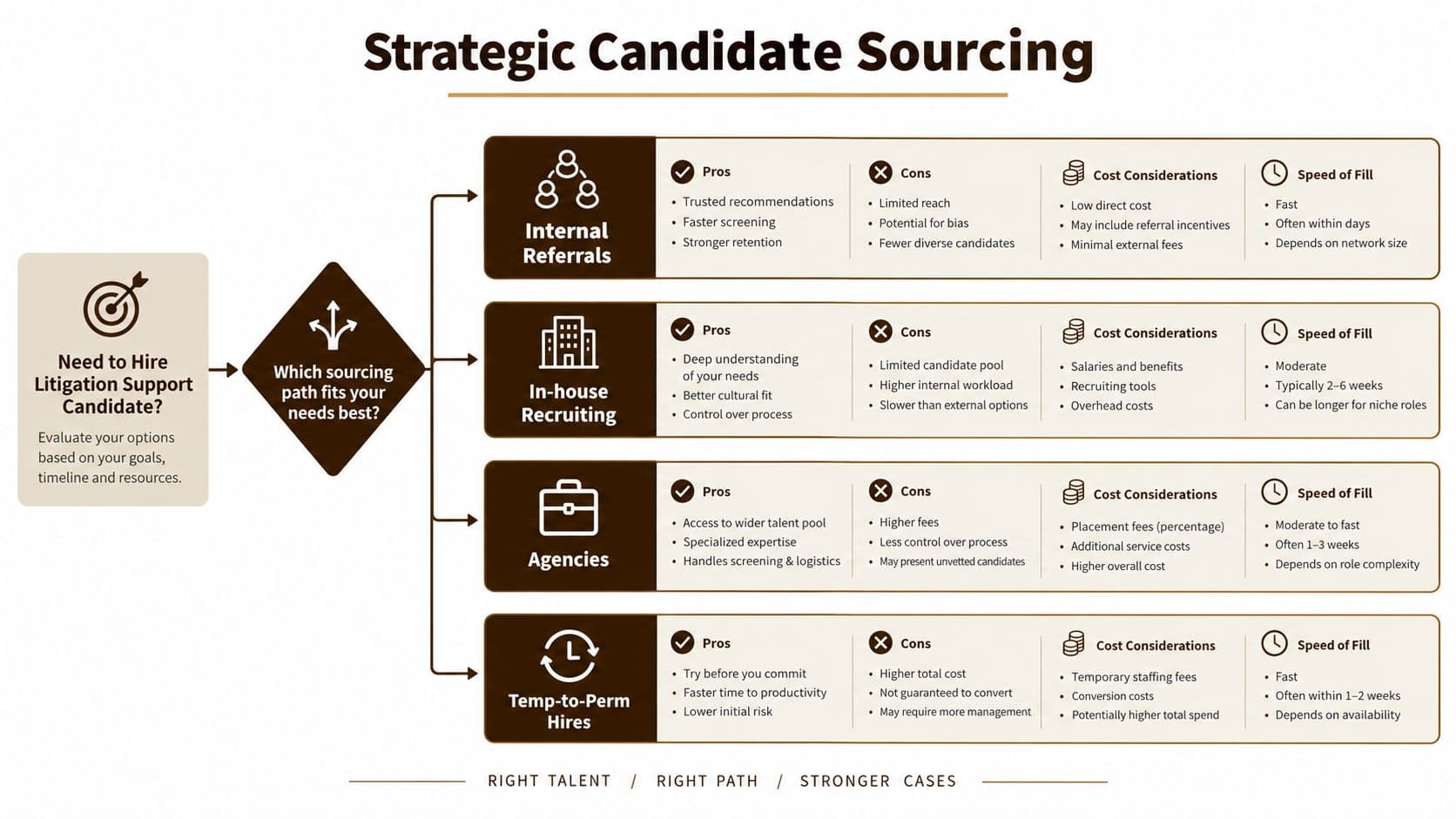
Internal referrals, in-house recruiting, agencies, and temp-to-perm hiring solve different problems. Treating them as interchangeable leads to predictable mistakes, especially when a firm needs a specialized litigation support profile on a short timeline.
| Sourcing path | Strength | Limitation | Best use |
|---|---|---|---|
| Internal referrals | Trusted introductions and strong cultural context | Narrower reach and possible similarity bias | Known local talent and repeatable roles |
| In-house recruiting | Better control over process, messaging, and candidate experience | Internal teams may lack specialized litigation networks | Planned hiring with available recruiting capacity |
| Contingency agency | Faster access to screened legal candidates and targeted outreach | Placement fee and less direct control over sourcing | Urgent, specialized, or hard-to-fill searches |
| Temp-to-perm | Lets the team evaluate working style and practical performance | Conversion terms and continuity need careful review | Uncertain volume or a role requiring immediate coverage |
The cost decision isn't only a fee comparison. A vacancy can consume attorney time, delay matter work, or force senior staff to handle tasks below their level. On the other hand, an agency search is wasteful when the internal team already has qualified candidates and enough time to screen them properly.
The market also shows why technology and role design belong in the sourcing decision. Recent legal AI market coverage reports that 44% of firms held paralegal headcount flat while absorbing 15% to 35% more matter volume, while 31% reduced paralegal headcount by an average of 22% after AI deployment. Those findings point to a more useful question: which tasks should a person own, which can technology assist, and which work should be redeployed?
Screen for operating judgment
Use a structured interview with the same core questions for every candidate, then add a practical exercise. Useful prompts include:
- Discovery judgment: “You find inconsistent metadata during a production check. What do you verify before escalating?”
- Prioritization: “Three attorneys request urgent support on the same day. How do you assess and sequence the work?”
- Exhibit control: “Walk through how you'd prepare, label, track, and reconcile deposition exhibits.”
- Vendor management: “A vendor misses a delivery commitment. What information do you document, and who do you notify?”
- Technology adoption: “Describe a time you learned a new review, document-management, or presentation platform.”
The exercise should resemble the job. Give the candidate a controlled set of documents, an exhibit log, and a short instruction sheet. Evaluate accuracy, issue spotting, organization, and communication, not just speed. References should confirm the same competencies, including deadline reliability, response to correction, and ability to work with attorneys without constant supervision.
Use internal sourcing for stable, repeatable hiring. Use an agency when the role is specialized, the vacancy is creating operational risk, or internal recruiters can't reach the right market quickly. A blended model often works best: internal leaders define the role and assess culture fit, while a contingency recruiter expands reach and manages targeted candidate flow.
Structuring Onboarding and Training Plans
A new hire shouldn't spend the first weeks guessing how the firm works. Build onboarding around access, controlled practice, and gradually increasing matter responsibility. The sequence matters because a technically capable employee can still create risk if the firm hasn't explained naming conventions, escalation paths, confidentiality expectations, or approval controls.
A practical onboarding calendar
Week one focuses on orientation and access. Confirm email, document management, case management, eDiscovery, timekeeping, secure file transfer, and communication permissions. Review confidentiality, information security, conflicts procedures, records retention, and the firm's matter-opening process. Pair the employee with a designated mentor who can answer workflow questions without diverting a supervising attorney.
Week two introduces systems through demonstration and repetition. Use a sandbox or training matter where possible. Have the employee create a document structure, apply naming rules, locate a record, update a task, and document a handoff. A vendor representative can explain platform functions, but the internal manager should define the firm's required process and quality checks.
Week three moves into supervised production. Assign a limited discovery review batch, a cite-check drill, or a deposition exhibit exercise. The employee should explain the reasoning behind the work, record uncertainties, and receive prompt feedback. Managers should track accuracy and completeness without treating early training output as a permanent performance baseline.
Week four tests independent execution. Give the employee ownership of a defined workstream with a clear deadline, escalation rule, and reviewer. End the week with a documented review of system proficiency, task quality, communication, and remaining training needs.
A strong training plan benefits from the broader principles in this guide to training and development for legal teams. Keep a simple checklist for access completion, compliance training, mentor meetings, system exercises, supervised work, and manager sign-off.
Don't overload the new hire with every platform at once. Teach the systems connected to the assigned work, then expand responsibility as the employee demonstrates reliable judgment. That approach protects active matters while giving the person a clear path to competence.
Driving Retention and Career Growth
Retention is a capacity strategy, not just an employee-relations initiative. Experienced support professionals carry institutional knowledge about matter history, attorney preferences, vendor performance, filing routines, and recurring quality risks. Losing that knowledge creates disruption even when the firm fills the vacancy quickly.
The succession risk is becoming harder to ignore. BigHand's 2026 legal workflow report says 51% of firms expect to lose 21% to 50% of support staff to retirement within five years, and 24% report that turnover already affects billable hours and revenue. Those figures make cross-training and knowledge transfer operational necessities.

Design a visible career ladder
A career path should show how responsibility expands, not how titles change.
- Junior paralegal: Executes defined tasks, maintains organized files, and escalates uncertainty early.
- Paralegal: Owns recurring case-support workflows, performs quality checks, and coordinates with attorneys.
- Litigation support specialist: Manages discovery, case data, review or production systems, and technology-enabled workstreams.
- Senior specialist or case manager: Coordinates complex matters, trains colleagues, and manages cross-functional dependencies.
- Litigation support manager: Plans capacity, governs vendors, sets standards, and develops the team.
Connect each step to observable evidence, such as independent ownership of a workstream, successful training of another employee, or consistent adherence to quality controls. Compensation matters, but so do decision authority, meaningful feedback, learning access, and recognition for work that prevents problems before they reach a partner or client.
Run stay interviews before someone starts searching. Ask what work is most energizing, what creates unnecessary friction, which skills the employee wants to develop, and what support would make the role sustainable. Convert the answers into a professional development plan with a mentor, target capabilities, practice assignments, and a review date.
A quarterly retention roundtable can surface patterns across the team. If several employees cite the same workflow bottleneck, fix the process instead of asking individuals to work harder. Retention improves when leaders address workload design, career visibility, and management quality together.
The following video can support a team discussion about collaboration and development:
Monitoring KPIs and Engaging Contingency Recruiters
A staffing dashboard should answer one question: is the team completing the right work at an acceptable level of quality and cost? Utilization alone can't answer it. A person may appear busy while work queues grow, or appear underused because automation removed repetitive tasks from the role.
Track four measures together. Utilization rate shows how available capacity is being applied to assigned work. Matter completion time reveals whether tasks move through the workflow as planned. Error rates expose defects in cite checks, exhibit logs, coding, production, or handoffs. Cost per matter helps leaders compare staffing choices, vendor use, technology support, and rework.
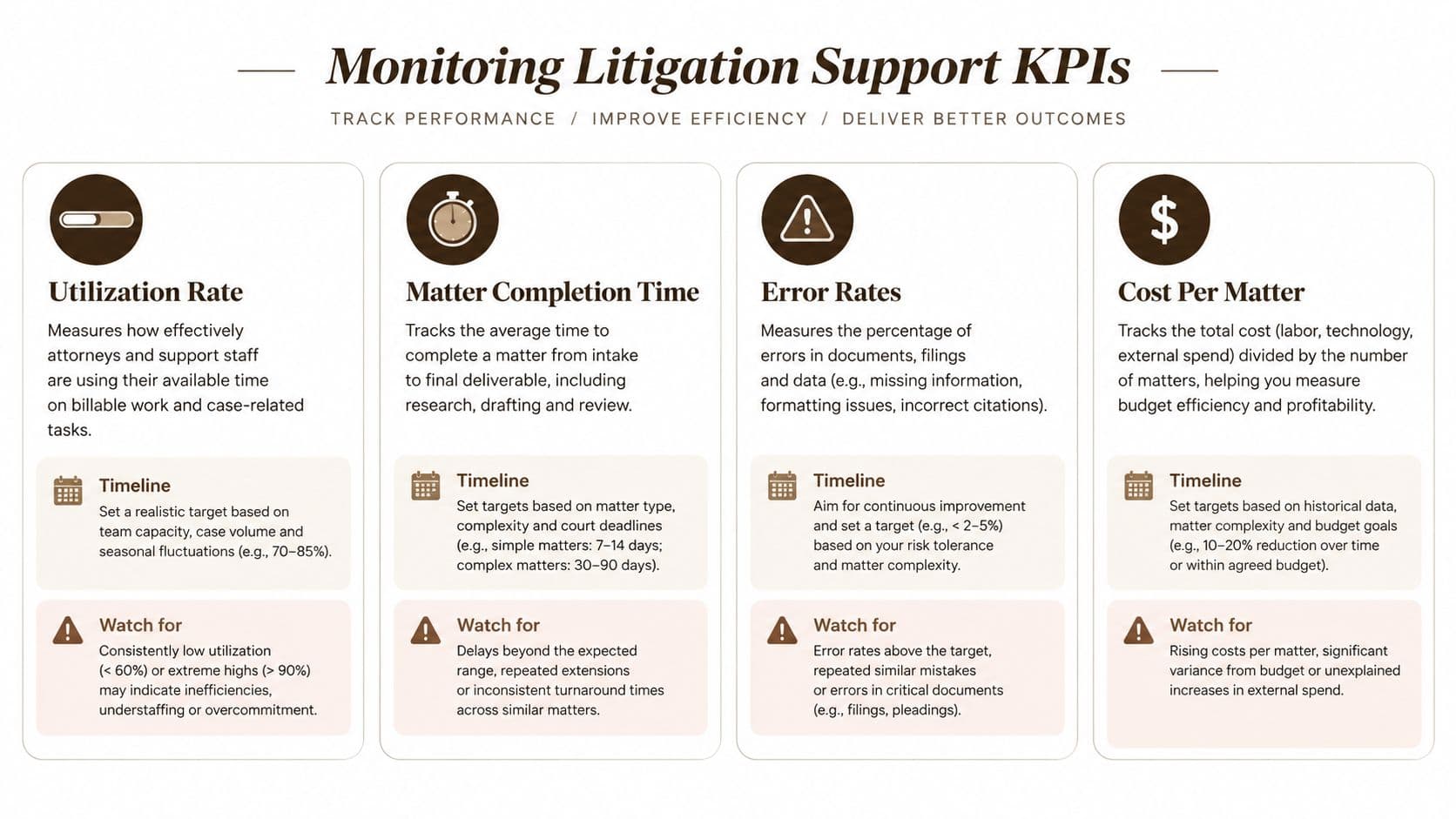
Set the baseline during ordinary work, then review the measures by matter type and complexity. A sudden completion delay paired with high utilization may indicate understaffing. A stable completion time paired with rising errors may indicate a skill gap, weak supervision, or an unsuitable workflow. A falling cost per matter isn't a success if quality defects create later rework.
Scale also changes the management problem. An ACC and MLA benchmark discussed by Thomson Reuters found a median legal team size of 4 for companies under $1 billion in revenue and 158 for organizations above $20 billion, with 14% of lawyers dedicated to litigation. The lesson isn't to copy another organization's ratio. It's to recognize that support design must reflect matter mix, organizational scale, and workflow complexity.
Trigger external search support deliberately
Bring in a contingency recruiter when the role is specialized, the vacancy threatens matter delivery, internal sourcing has produced a thin slate, or the recruiting team lacks time to conduct a disciplined search. Choose a partner that can explain its candidate network, screening process, communication cadence, replacement terms, and fee obligations before the search begins.
Keep ownership inside the firm. The hiring manager should define competencies, approve the scorecard, conduct the substantive interview, and make the final decision. The recruiter should provide market reach, candidate qualification, scheduling support, and transparent updates. Use a documented intake brief so every external candidate is assessed against the same workload and competency requirements.
For a practical framework on evaluating hiring outcomes, use quality-of-hire measurement. Review the dashboard monthly and trigger external help based on evidence, not panic. A recruiter should extend internal capacity, not replace the operating discipline that makes a hire successful.
Conclusion and Next Steps
Effective litigation support staffing is a managed system. Map active matters by complexity, assign workload units to discovery review, exhibit control, vendor coordination, and related tasks, then match those demands to clearly defined roles. Source candidates through the channel that fits the urgency and specialization, screen with practical exercises, and onboard through controlled system training.
Use cross-training and career ladders to protect institutional knowledge. Review utilization, completion time, errors, and cost per matter together. Pilot a new role on a high-priority matter, hold monthly KPI reviews, and schedule quarterly retention roundtables. If the workload is urgent or specialized and internal recruiting can't produce qualified candidates, engage a contingency recruiter with a clear brief, scorecard, and service expectations.
Start with the bottleneck creating the greatest operational risk today. Measure it, assign ownership, and make the next staffing decision from evidence rather than a generic ratio.
Five Star Placements provides contingency-based permanent placement for litigation support specialists and other legal support professionals, with screening aligned to role requirements and organizational fit. Visit Five Star Placements to discuss a workload-aligned search for your firm or legal department.
Need help filling a legal role?
Five Star Placements partners with law firms and legal departments nationwide.
Schedule a Call