
What Is Training and Development: A Practical Guide
September 3, 2026 · 16 min read · Five Star Placements

Table of contents
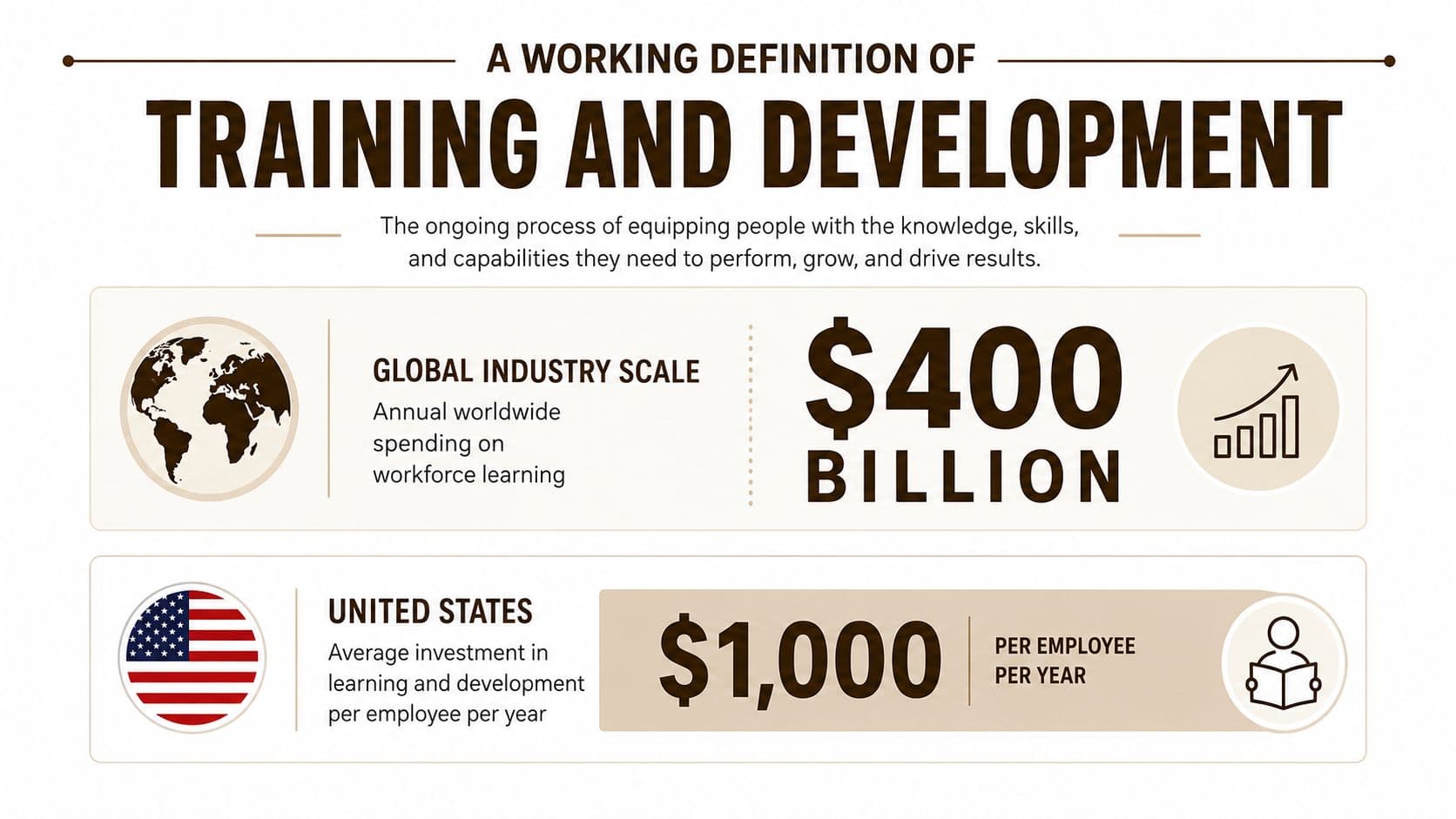
A global workplace training industry estimated at almost $401 billion in 2024 makes one point clear: training and development is no longer a minor HR activity. U.S. training spending reached roughly $102.8 billion in 2025, and organizations averaged about $1,254 per employee on learning in 2024, according to the compiled employee training data from Lorman. For a law firm or corporate legal department, the practical question isn't whether learning matters. It's whether the learning being funded makes attorneys, paralegals, and legal operations professionals ready for real work.
Table of Contents
- A Working Definition of Training and Development
- How Training and Development Differ and Connect
- Core Components of a Modern Program
- The Business Case for Legal Employers
- Training and Development Inside Law Firms and Legal Departments
- Implementing a Program That Actually Sticks
- Measuring ROI Without Drowning in Metrics
- Key Takeaways and What Legal Employers Should Do Next
A Working Definition of Training and Development
In a law firm or legal department, training and development is the structured process an employer uses to build the knowledge, skills, and judgment needed for current and future work. Training addresses an immediate performance gap. Development expands capability so an attorney, paralegal, or legal operations professional can handle more complex matters, supervise others, or move into a different role.
A managing partner can view the distinction through the maintenance and extension of a legal practice. Training is learning to perform today's work correctly. Development is preparing someone to handle tomorrow's work with less supervision. The first protects current execution. The second builds the bench for broader responsibility.
A first-year associate might receive training on the firm's document-management system, time-entry rules, privilege review, and citation standards. A paralegal might learn a contract automation platform rather than compare every agreement version manually. These interventions address immediate gaps that affect accuracy, efficiency, and billable readiness.
Development goes further. The associate could receive mentoring on case strategy, client communication, and matter ownership. The paralegal could take on increasingly complex contract workflows while receiving coaching for a future legal operations role. The activities differ, but both belong to one connected system.
What the definition means in practice
A useful program answers three questions:
- What is missing? The employer identifies a skill, knowledge area, or work behavior that needs attention.
- What must change? The program defines the workplace result, such as producing cleaner drafts, reviewing privilege more consistently, or managing a client call.
- What comes next? The employer connects current learning with future responsibilities, mobility, or leadership.
That structure distinguishes training and development from a calendar of disconnected webinars. A CLE, workshop, coaching conversation, stretch assignment, or technology demonstration can qualify when it addresses a defined capability need. A course alone does not show that an attorney or paralegal can apply the skill on a live matter.
About 50% of the global workforce completed formal training in 2025, compared with 41% in 2023, according to the Lorman summary of workforce training data. For legal employers, the implication is practical: connect learning opportunities to the work professionals must perform, rather than measuring progress only by course availability or attendance.
How Training and Development Differ and Connect
Training and development address different points on the same career path. Training asks, “What does this person need to do better now?” Development asks, “What capability will this person need for a larger or different role later?” For a legal team, training may prepare a new associate to handle a deposition. Development may prepare that associate to lead witness strategy and manage the matter.
Training usually targets a defined responsibility in the current role. Development has a wider horizon and can include coaching, mentoring, informal learning, and preparation for changing responsibilities. The distinction matters because a course can improve knowledge without showing that an attorney or paralegal can apply it under client or matter pressure.
| Dimension | Training | Development |
|---|---|---|
| Primary purpose | Close an immediate skills or knowledge gap | Build capability for future responsibilities |
| Typical horizon | Current role and near-term performance | Longer-term career and organizational needs |
| Legal example | Deposition-skills workshop for a new litigation associate | Mentoring that prepares the associate to run matters |
| Common formats | Workshops, demonstrations, onboarding, required instruction | Coaching, sponsorship, stretch assignments, leadership programs |
| Success signal | The employee performs a defined task more effectively | The employee takes on broader work with growing independence |
A new litigation associate attending a deposition workshop is receiving training. The session might cover questioning technique, exhibit handling, objections, and preparation standards. If a senior partner later invites the associate to observe strategy meetings, reviews post-deposition performance, and gradually assigns ownership of witness preparation, the same learning relationship has become development.
The two functions work like the foundation and upper floors of a building. Training supplies the technical base. Development gives a legal professional room to handle broader judgment, client responsibility, and leadership. Training without development can leave people performing assigned tasks without a clear path to more complex work. Development without foundational training can place them in stretch assignments before they are ready.
One talent system, not two budgets
Law firms often place CLE administration, onboarding, mentoring, and leadership programs with different owners. In-house departments may divide legal-technology education, business training, and succession planning among legal operations, HR, and practice leaders. Employees experience these activities as one career environment, regardless of the internal budget code.
The connection affects retention and readiness. A lawyer is more likely to view an employer as serious about growth when immediate instruction leads to visible opportunities for complex matters, client contact, or leadership. Research on training and retention, including findings discussed in the linked employer-employee panel study on training and retention, supports treating learning as more than a short-term performance intervention.
Practical rule: Give every important training intervention a development path, even if that path is only the next matter type, client responsibility, or leadership assignment.
Core Components of a Modern Program
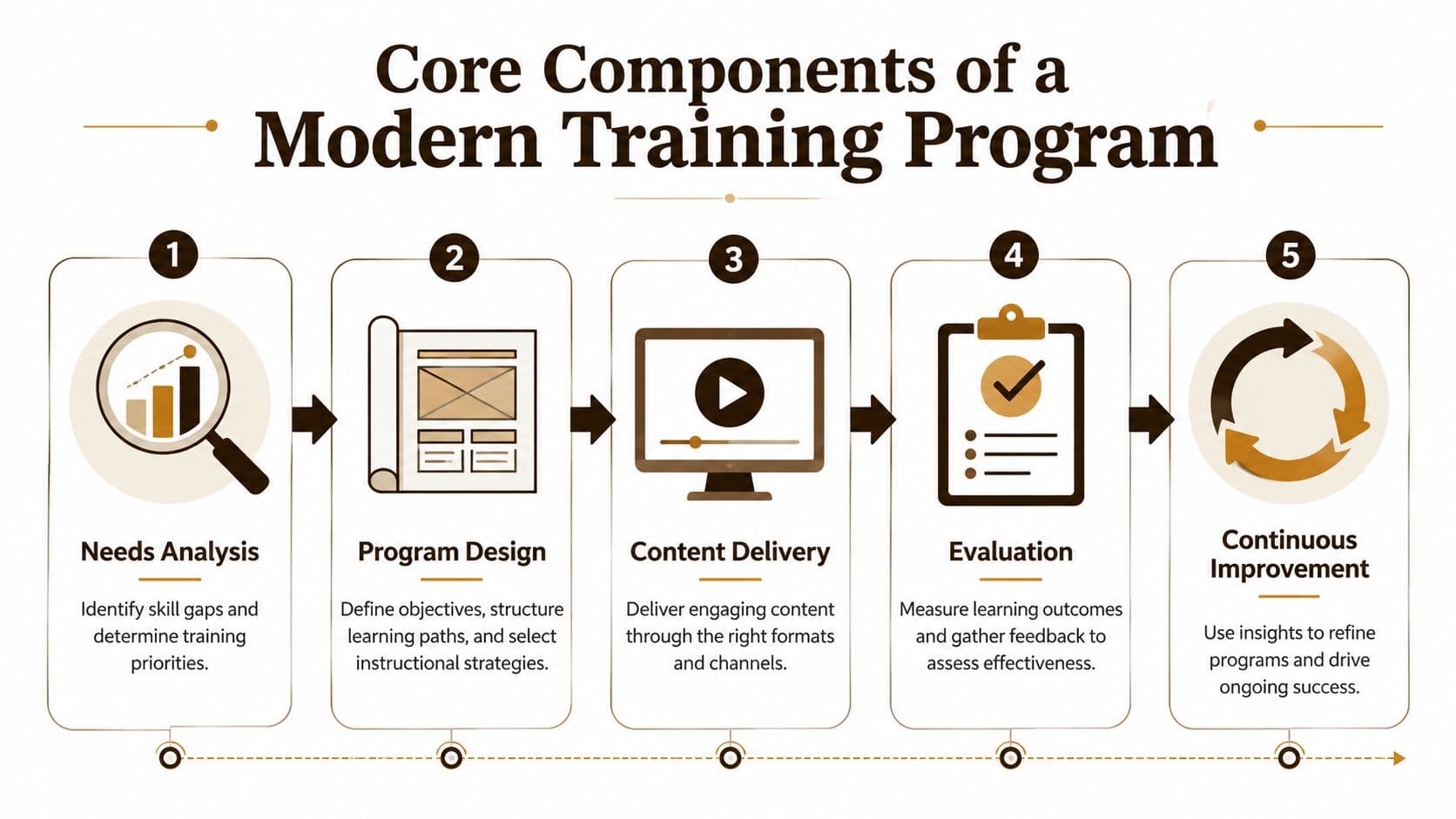
A functioning program follows a loop. The employer identifies a need, designs a response, delivers it, reinforces the behavior, and checks whether the response worked. Skipping any step can turn a sensible idea into expensive content that employees complete without applying.
Start with needs analysis
Needs analysis is the diagnostic stage. A firm might compare drafting revisions, matter staffing patterns, partner feedback, and associate self-assessments. An in-house team might examine recurring questions from sales, delays in contract review, or inconsistent escalation of privacy issues.
The aim is to identify the actual gap. “Associates need better communication” is too broad. “Associates need to summarize risk and recommend a decision in a client email” gives the program a teachable target.
Design for the audience
Design turns the diagnosis into learning objectives and a delivery plan. A paralegal learning a new document-review tool may need a guided demonstration followed by supervised work on a live project. Senior counsel preparing for a leadership role may benefit more from coaching, stakeholder simulations, and feedback on delegation.
Legal employers should also account for personalized and AI-supported learning. Gallup reports that 45% of U.S. employees participated in training or education to build new skills for their current job in 2024, while 58% sought at least one learning and development experience beyond what their employer formally offered, according to Gallup's analysis of barriers to employee development. Those findings suggest that a program should respond to employee needs instead of assuming a standard course catalog is enough.
Deliver and reinforce
Delivery can combine live workshops, on-demand modules, coaching, peer review, and supervised stretch work. Reinforcement is what happens afterward. A partner reviews the first few drafts, a practice group discusses application during a matter meeting, or a legal operations manager observes whether the new workflow is being used correctly.
For a practical communication baseline, teams can also use a structured communication skills assessment before assigning coaching or client-facing work.
The evaluation stage closes the loop. A Kirkpatrick-style review can examine reaction, learning, behavior, and results. A Phillips-style approach can add a financial view. The precise model matters less than linking the program to a business outcome that leaders recognize.
The following video provides another visual explanation of how organizations can approach workforce learning:
The Business Case for Legal Employers
Training earns a place in a legal budget when leaders can connect it to output, retention, risk, or capacity. A public-sector upskilling program illustrates the possible effect. After a 16-week program, frontline workers completed about 10% more work in the following 12 weeks, managers achieved 3% more of their strategic goals, and supervisors working closest to trained employees improved productivity by about 8% because employees sent fewer help emails, according to Harvard Business School's summary of the research.
A law firm should not assume those results transfer automatically. The useful lesson is the mechanism. When people know how to perform a task, they ask fewer basic questions, need fewer corrections, and keep matters moving with less interruption. For a legal team, that can mean a billable-ready associate needs less partner rescue before producing usable research, drafting, or analysis.
Translate productivity into legal work
For a legal employer, the relevant outcome might be:
- Faster matter readiness: A new associate handles a defined research or drafting assignment with less partner intervention.
- Higher supervisory capacity: A senior associate spends less time correcting preventable process errors and more time on strategy.
- Better technology adoption: A paralegal uses document automation, e-billing, or case-management tools consistently rather than returning to manual work.
- Lower operational risk: Lawyers receive timely updates on changing rules, client requirements, and internal protocols.
Retention creates a second business case. The employer-employee study discussed earlier found that training participation was associated with higher retention in the training establishment, including stronger results for training viewed as credible and useful. Its analysis also reported an 8.7 percentage-point increase in next-year retention, as reported in the published retention study.
That evidence does not mean every course will prevent a departure. It supports a more practical question: does the program give a lawyer, paralegal, or other legal support professional credible growth connected to the work they want to perform?
| Research Statistic | Legal Workforce Outcome |
|---|---|
| About 10% more work after a 16-week upskilling program | More matter output from trained staff, subject to local measurement |
| About 8% productivity improvement among nearby supervisors | Less time spent answering routine questions and correcting workflow issues |
| Up to 14% higher retention overall | Lower turnover risk where training is relevant and credible |
| Up to 18% higher retention for credible training | Stronger case for programs tied to real career and work opportunities |
Training is therefore risk management and capacity planning, not merely a perk. A firm's investment protects institutional knowledge, improves delegation, and helps preserve client service when roles change. In-house departments gain the same protection when training keeps legal professionals ready to support business priorities without placing every new task on the most senior lawyer.
Training and Development Inside Law Firms and Legal Departments
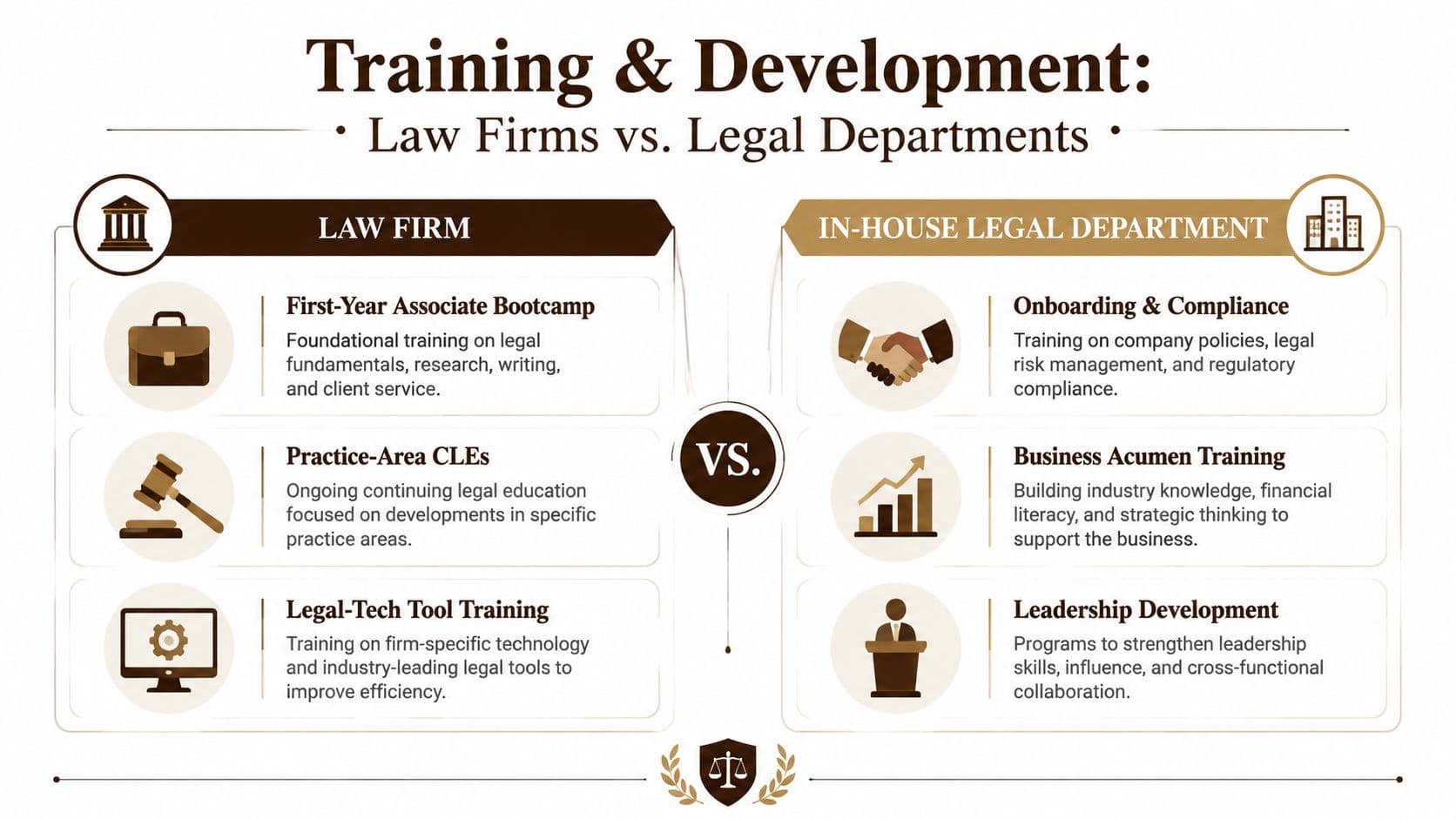
A law firm and an in-house department may both use the phrase “training and development,” but their programs should look different. A firm develops people across practice groups, levels, offices, and client matters. An in-house team develops people inside one commercial environment, where legal judgment must connect with product, sales, finance, security, and operations.
A law firm example
A mid-market litigation firm building a stronger litigation track might combine several activities:
- First-year foundations: Legal writing, research standards, deposition preparation, time entry, and file organization.
- Practice-area learning: CLE sessions on substantive updates, procedural changes, and recurring client issues.
- Matter simulations: Mock oral arguments, witness-preparation exercises, and settlement strategy discussions.
- Technology adoption: Training on document review, case-management software, e-billing, and approved AI-assisted drafting workflows.
- Career development: Mentoring, sponsorship, feedback training, and preparation for senior associate or partner responsibilities.
The program works because each activity supports a recognizable progression. A junior lawyer learns the mechanics, practices the skill in a controlled setting, applies it on a matter, and receives feedback from someone responsible for the work.
A paralegal pathway may follow a similar pattern. Someone who currently performs manual review could learn a contract automation tool, apply it to a supervised workflow, and then help standardize the process for the practice group. That's training, operational improvement, and development in one sequence.
An in-house example
An in-house department needs a different emphasis. Counsel may need business fluency to advise product or sales teams, privacy and AI governance knowledge to support new tools, and negotiation training to manage vendors and outside counsel. Junior counsel can receive stretch assignments that expose them to commercial decisions while a senior lawyer provides review and coaching.
The cadence also differs. A firm may organize learning by class year and practice group. An in-house team may organize it around product launches, regulatory change, contract volume, or succession needs. Accountability belongs with the people who control the work, whether that's a practice leader, general counsel, legal operations leader, or supervising attorney.
A generic course library rarely solves a specific legal capability gap. The program must show where the new skill will be used, who will reinforce it, and how the legal employer will recognize progress.
Implementing a Program That Actually Sticks
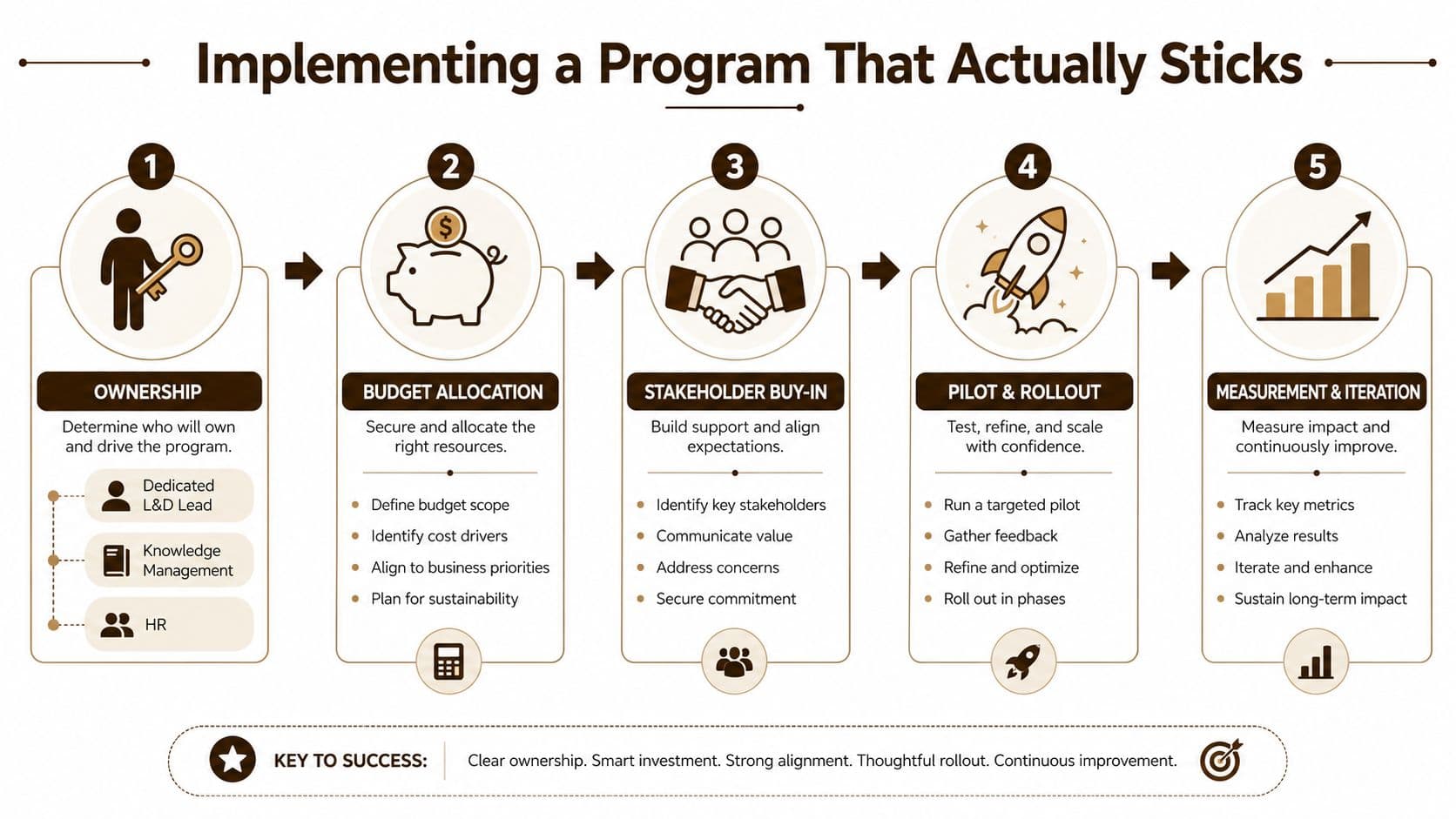
Implementation starts with ownership. Someone must have authority to define priorities, coordinate delivery, collect feedback, and challenge partners or legal leaders when reinforcement disappears after the class ends.
Possible owners include:
- A dedicated L&D lead: Appropriate where the organization has enough scale for a specialized role.
- Knowledge management or practice innovation: A natural fit for research, precedents, legal technology, and workflow skills.
- The chief legal officer or managing partner: Effective when the program is tightly tied to strategic priorities and delegated clearly.
- A shared-services model: Useful for smaller firms or departments that need coordinated support without a standalone function.
Match the design to the legal employer
A 50-lawyer firm may need a small number of priorities, such as first-year readiness, practice-specific drafting, and technology adoption. A partner committee can set direction while an administrator or HR leader coordinates delivery. Informal coaching by matter leaders may carry more weight than a large learning platform.
A 500-lawyer firm needs stronger governance. It may require a learning leader, practice-group champions, a common skills framework, and reporting that distinguishes attendance from application. Central resources can support consistency, while practice groups retain responsibility for technical relevance.
A 40-person in-house team can focus on business-linked capability. The general counsel may set a quarterly priority, such as privacy review or commercial contracting, and assign legal operations or senior counsel to manage delivery. Cross-functional sessions with sales, product, procurement, or security can make the learning immediately useful.
The formal and informal mix should also be deliberate. Required CLE, onboarding curricula, and cohort programs provide consistency. Stretch assignments, peer coaching, matter reviews, and project-based learning create application. There isn't one correct balance for every legal employer, so leaders should test the mix against workload, matter demands, and employee experience.
Build reinforcement into the workflow
Modality should serve the work. A live workshop may be best for oral advocacy or difficult conversations. A self-paced module can cover a system feature. Short learning bursts can address a recurring drafting issue. AI-supported personalization may help direct each person toward practice exercises that match an identified gap, but a supervisor still needs to verify performance.
For attorney-specific support, employers can incorporate structured coaching for attorneys alongside formal instruction. Governance should include a defined budget owner, regular review meetings, and named partners or legal leaders who model the expected behavior.
A program sticks when the person who assigns the work also expects the new behavior. If no one reviews the first contract, brief, intake decision, or client communication produced after training, employees correctly conclude that completion matters more than application.
Measuring ROI Without Drowning in Metrics
Legal employers don't need a dashboard full of activity counts to determine whether a program works. They need a baseline, a defined intervention, and a small set of measures reviewed after implementation.
Start by selecting one business problem. For a new practice area, measure how long it takes an associate to perform a defined matter task without extensive rework. For a technology rollout, examine adoption and the time required to complete a recurring workflow. For retention, compare whether high-performing employees remain with the organization over the relevant review period.
A practical measurement sequence
- Establish the baseline. Record the current result, such as revision cycles, time-to-readiness, or matter throughput.
- Run the intervention. Deliver training, coaching, supervised application, or a combination.
- Review after 90 days. Look for early behavior change and identify where managers aren't reinforcing the skill.
- Review after 180 days. Check whether the change persists and whether it affects capacity, quality, mobility, or retention.
- Compare costs and benefits. Estimate recovered productive hours, multiply them by the appropriate blended rate, and subtract the fully loaded program cost.
The formula should stay conservative. If training reduces avoidable rework, count only the hours that the legal employer can reasonably verify. If the program improves readiness, define the task and the level of supervision required rather than treating course completion as proof of competence.
| Metric | What It Measures | Data Source | Review Cadence |
|---|---|---|---|
| Billable-hour throughput | Whether trained staff move more work forward | Timekeeping and matter systems | Quarterly |
| Time-to-readiness | How quickly an employee handles a defined matter task | Supervisory assessments and matter records | At 90 and 180 days |
| High-performer attrition | Whether development supports retention | HR and recruiting records | Quarterly or semiannually |
| Revision cycles | Quality and independence of drafting | Document review and partner feedback | Monthly or quarterly |
| Internal mobility | Whether employees move into broader work | HR records and staffing data | Semiannually |
Attendance, completion rates, and satisfaction surveys still have a role. They're leading indicators, not final proof. A person can enjoy a workshop and still fail to apply the skill, while a demanding program can produce valuable behavior change without receiving enthusiastic ratings.
For a broader framework, legal leaders can review quality-of-hire measurement when connecting development outcomes with recruiting and workforce decisions. The strongest review pairs financial ROI with indicators such as engagement, internal mobility, manager confidence, and quality.
Key Takeaways and What Legal Employers Should Do Next
Training and development is one connected talent system. Training closes an immediate gap. Development builds the capacity for future responsibility. Both become more valuable when they're tied to the work a legal professional must perform, whether that's drafting a brief, managing discovery, advising a product team, or leading a client relationship.
The strongest programs begin with needs analysis. They identify the specific behavior or capability that's missing, design learning around the audience, reinforce the skill on real matters, and evaluate results through performance, readiness, quality, retention, or capacity. A course catalog alone doesn't create billable-ready talent.
Legal employers planning for 2026 should consider several practical shifts:
- AI-assisted knowledge transfer: Capture approved workflows, precedents, and review standards so lawyers and support professionals can apply them responsibly.
- Microlearning tied to legal work: Deliver short updates on litigation practice, regulatory developments, technology, or client requirements when employees can use them.
- Skills-based mobility: Define capabilities clearly enough for associates, paralegals, and counsel to move into adjacent practice areas or responsibilities with targeted support.
- Manager-led reinforcement: Make supervising attorneys accountable for reviewing and applying new skills after formal instruction.
Before approving a program, a managing partner or general counsel should ask:
- What behavior will change on a real matter?
- How will we know it worked after 90 days?
- Who owns reinforcement after the class?
- Which partners, senior lawyers, or business leaders will model the learning?
- What evidence would justify expanding, changing, or ending the program?
Start with one current skill gap and one concrete intervention in the next quarter. For example, select inconsistent contract review, pair a targeted technology workshop with supervised application, and measure revision cycles and readiness afterward. That approach gives the legal employer a clearer answer to what is training and development, and whether its investment is producing capability the business can use.
Five Star Placements provides permanent placement for attorneys, legal support staff, partners, in-house counsel, and legal operations leaders, along with candidate interview coaching and training and development services aligned to client processes. Visit Five Star Placements to discuss a legal hiring or capability need with a recruiting team that screens for practice experience, skills, and organizational fit.
Need help filling a legal role?
Five Star Placements partners with law firms and legal departments nationwide.
Schedule a Call