
Coaching for Attorneys: A Practical Guide to Career Growth
August 28, 2026 · 14 min read · Five Star Placements

Table of contents
A mid-level associate can deliver excellent work, receive positive client feedback, and still remain years away from partnership because no one has defined the path. A rainmaking partner can maintain strong relationships while watching new matters, origination credit, or internal influence flatten. Both may reach the same conclusion: outside help could be useful.
That conclusion is only partly right. Coaching for attorneys works when the obstacle is a controllable skill, behavior, or habit. It won't repair a practice area with weak demand, create a partnership track that doesn't exist, or make a poor firm fit tolerable. The practical question is not whether coaching sounds helpful. It's whether the problem is one a coach can change, or one that calls for a different role.
Table of Contents
- When Attorneys Start Looking for Outside Help
- What Attorney Coaching Actually Is
- The Five Main Types of Coaching for Attorneys
- Benefits and Measurable Outcomes
- When Coaching Is the Right Move and When It Is Not
- How to Choose the Right Coach
- Where Coaching Ends and Placement Begins
When Attorneys Start Looking for Outside Help
The associate usually starts without fanfare. A promotion conversation produces encouraging language but no written criteria. The partner says the lawyer is “on track,” yet the target keeps moving, client-development expectations remain vague, and the most valuable matters continue going to someone else. After several review cycles, the lawyer begins comparing firms, in-house roles, and coaching programs.
The partner's situation looks different but carries the same uncertainty. Their legal work remains strong, but referrals have slowed, a practice group has changed direction, or younger partners are receiving more credit for new business. They may wonder whether they need sharper business-development habits, a stronger leadership presence, or a platform with better market alignment.
These are not unusual reasons for attorneys to seek help. Lawyers pursue coaching while preparing for partnership, evaluating a lateral move, interviewing for in-house positions, managing teams, rebuilding after burnout, or recovering from a professional setback. The label matters less than the diagnosis.
Start with the actual bottleneck
Before paying for coaching, separate three possible causes:
- Skill gap: You struggle with delegation, client development, interviews, persuasive writing, or difficult conversations.
- Behavior gap: You know what to do but don't do it consistently. Follow-up slips, feedback goes unused, or urgent work crowds out relationship building.
- Environment gap: The firm lacks the work, sponsorship, economics, geography, or advancement structure required for your goal.
A coach can work directly on the first two. The third may require a new platform, a new practice, or a confidential market conversation with a recruiter. Treating an environment problem as a personal deficiency wastes money and can damage your confidence.
Recruiter's rule: Don't hire a coach until you can state the problem in observable terms. “I need more confidence” is a starting feeling, not a measurable objective. “I need to lead client calls without partner rescue” is a workable coaching target.
This guide takes a deliberately practical view. Coaching can improve performance and retention when firms connect it to feedback, supervision, workload, and career progression. It can also become expensive encouragement with no effect on the lawyer's trajectory. Your first responsibility is to determine which category you're facing.
What Attorney Coaching Actually Is
Attorney coaching is a structured engagement designed to change professional behavior. A trained coach helps a lawyer identify a performance gap, define an outcome, practice specific responses, review evidence, and remain accountable between sessions. The engagement should have a scope, a cadence, and a point at which both parties evaluate whether the work is producing movement.
That makes coaching different from adjacent forms of support:
| Support | Primary role | Typical contribution |
|---|---|---|
| Coaching | Builds repeatable behavior | Practice, accountability, feedback, and goal tracking |
| Mentoring | Shares professional judgment | Advice based on the mentor's experience and network |
| Consulting | Diagnoses and prescribes | Expert recommendations for a defined business problem |
| Therapy | Addresses clinical or emotional health | Treatment and support that require a clinical framework |
A mentor may tell an associate how they built a book of business. A coach may require the associate to identify a target relationship, draft a specific outreach message, rehearse the conversation, and review what happened. A consultant may redesign a firm's business-development process. A therapist handles clinical concerns that coaching isn't qualified to treat.
The mechanism is practice, not inspiration
The legal-performance framework described in a law-firm-focused coaching analysis starts with evidence. That evidence can include 360-style feedback, time sheets, realization rates, billing rates, work assignments, and direct work samples. The coach then converts the diagnosis into specific objectives, stepwise instruction, repeated practice, and feedback loops.
This approach matters because broad advice is difficult to execute. “Be more strategic with clients” doesn't tell a lawyer which behavior should change on Monday morning. “Schedule two relationship conversations, ask one business-oriented question in each, and record the next action” gives the lawyer something observable to practice and review.
A useful engagement usually includes:
- Baseline assessment, using feedback and objective work evidence where available.
- A narrow target, such as delegation, client communication, interview performance, or matter management.
- Rehearsal, including role-play, writing review, difficult-conversation practice, or meeting preparation.
- Between-session application, so the lawyer tests the behavior in real matters.
- Review and adjustment, based on the same indicators used at baseline.
The lawyer supplies the effort. A charismatic coach can't create discipline, sponsorship, or a viable market. Coaching can clarify choices, expose patterns, and accelerate practice, but it can't guarantee promotion, eliminate every source of stress, or substitute for clinical care.
The Five Main Types of Coaching for Attorneys
Attorneys often use the word “coaching” to describe very different services. Match the format to the bottleneck instead of buying a broad package because it sounds thorough.
Career coaching
Career coaching suits lawyers who need to choose among partnership, a lateral move, in-house work, a different practice, or a nontraditional legal path. The useful output isn't a personality profile. It's a decision supported by clarified priorities, market positioning, an inventory of transferable skills, and a realistic action plan.
Interview coaching
Interview coaching helps with lateral interviews, partnership presentations, in-house transitions, and executive conversations. The coach should work on substantive positioning, concise answers, compensation discussions, and examples that show judgment and client value. Lawyers considering this route can review interview coaching for lawyers before selecting a provider.
Leadership coaching
Leadership coaching is for practice group leaders, new partners, managing partners, and senior lawyers who now manage people as well as matters. The focus should be concrete: delegation, accountability, feedback, conflict management, meeting leadership, and developing junior talent. Legal excellence doesn't automatically produce management skill.
Business-development coaching
Business-development coaching turns relationship building into a repeatable process. It can cover target selection, outreach, follow-up, client conversations, referral networks, pitch preparation, and converting existing relationships into mandates. A partner whose origination has stalled needs a behavior audit, not generic advice to “network more.”
Resilience and performance coaching
This format supports lawyers dealing with pressure, burnout recovery, workload boundaries, or sustained performance. It can help identify work patterns, improve prioritization, and prepare difficult conversations about capacity. It shouldn't be presented as a way to make an unsafe or structurally unhealthy environment acceptable.
| Coaching Type | Best For | Typical Length | Primary Outcome |
|---|---|---|---|
| Career | Lawyers deciding what role or platform fits | Defined engagement tied to a decision | Career direction and action plan |
| Interview | Candidates pursuing lateral or in-house roles | Short, focused preparation | Clearer positioning and stronger interview execution |
| Leadership | Lawyers managing teams or practices | Ongoing or milestone-based | Better delegation, accountability, and team leadership |
| Business development | Partners and senior lawyers building relationships | Repeated practice over a sustained period | Consistent outreach, follow-up, and client development |
| Resilience and performance | Lawyers managing pressure or recovering from strain | Time-bound, with progress reviews | More sustainable work habits and performance |
A combination can make sense, but only when the objectives connect. For example, a lateral candidate might need interview coaching and career coaching, while a newly promoted partner might need leadership coaching and business-development coaching. Combining every category usually signals that the initial diagnosis is too vague.
Benefits and Measurable Outcomes
The strongest legal coaching evidence supports a structured, measured model rather than an inspirational one. A 2018 Volta Coaching Insights Report found that 89% of respondents at Global 100 firms used coaching for their lawyers, and 63% of those firms rated it extremely effective or very effective in achieving organizational and individual goals. The report also found that 65% used annual or other regular coaching programs, which points to coaching as a recurring talent-development tool rather than a one-time rescue. These figures appear in the benefits of business coaching for lawyers guide.
A separate 2023 Canadian Bar Association article notes that the coaching industry grew by 54% since 2019 and says businesses have reported nearly six times return on investment from coaching. The same article identifies the Law Society of Ontario's 2016 launch of a Coach and Advisor Network for lawyers and paralegals. Those figures show adoption and reported return, not proof that every coaching engagement caused a specific promotion, origination result, or retention outcome. Firms should keep that distinction clear.
Measure the behavior before judging the result
The right metrics depend on the objective. A firm measuring leadership coaching shouldn't use the same scorecard as a partner working on client development.
| Metric Category | Example Metrics | Evidence Strength | Typical Timeframe |
|---|---|---|---|
| Hard performance | Billable targets, realization, work allocation, matter productivity | Stronger when measured at baseline and reviewed consistently | Depends on matter cycle and role |
| Business development | Outreach activity, follow-up completion, qualified opportunities, origination credit | Useful when the lawyer controls the underlying actions | Requires repeated activity |
| Leadership | 360 feedback, delegation patterns, team responsiveness, development conversations | More reliable when multiple observers provide feedback | Usually requires several review points |
| Career progression | Defined promotion criteria, sponsorship activity, role scope, partner-track readiness | Depends heavily on firm structure and available opportunities | Tied to firm review cycles |
| Soft indicators | Confidence, decision quality, burnout experience, perceived control | Valuable but more subjective | Can shift before hard results |
The quality-of-hire measurement framework is relevant to firms evaluating coaching because it reinforces a basic management principle: define the outcome, collect comparable evidence, and review the result instead of relying on impressions.
Know what coaching can't move alone
Coaching won't create billable capacity that firm economics don't support. It won't increase demand for a weak practice area, change an arbitrary compensation system, or force partners to sponsor an associate. Burnout may also require workload changes, staffing support, policy reform, and better supervision, not just individual resilience work. Legal education materials emphasize safe environments, progress tracking, and changes to firm practices alongside attention to lawyer competence and wellness, as discussed in these stress, competence, and wellness materials.
When Coaching Is the Right Move and When It Is Not
Use a simple decision rule: coach an internal gap, recruit for an external constraint.
Coaching is appropriate when you control the behavior that needs to change. You may need to delegate earlier, lead meetings more effectively, ask for business, prepare for interviews, or manage pressure without becoming reactive. The desired destination can also exist at your current firm. If the partnership criteria are clear, the practice has room to grow, and senior sponsors are willing to engage, coaching can help you close the remaining gap.
Placement is more appropriate when the firm cannot provide the platform required for your goal. Common examples include a practice area with little demand, a compensation structure that doesn't reward your contribution, a geography that limits your client base, or a partnership track that exists in name only. No amount of polished communication fixes a structural ceiling.
Apply this self-diagnostic
Ask yourself:
- What do I control? Identify the specific action, skill, or habit that is underperforming.
- What evidence supports that diagnosis? Use reviews, work samples, client feedback, assignments, and business-development records.
- Does the opportunity exist here? Can your current firm realistically offer the matters, sponsorship, seniority, compensation, or flexibility you want?
- Have decision-makers explained the path? Vague encouragement isn't a performance framework.
- Would a better platform solve most of the problem? If yes, coaching should not delay market exploration.
Practical test: If you improved the behavior tomorrow, would the firm have a credible way to reward it? If the answer is no, investigate the market before treating yourself as the problem.
The choice isn't always binary. An attorney can use coaching to improve interview performance while a recruiter tests the market. A partner can refine leadership habits while evaluating firms with stronger platform support. The sequence should follow the diagnosis, not a sales package.
How to Choose the Right Coach
Choose a coach as carefully as you would choose a professional adviser. Legal experience doesn't automatically make someone a good coach, and coaching credentials don't automatically mean the person understands law-firm economics.
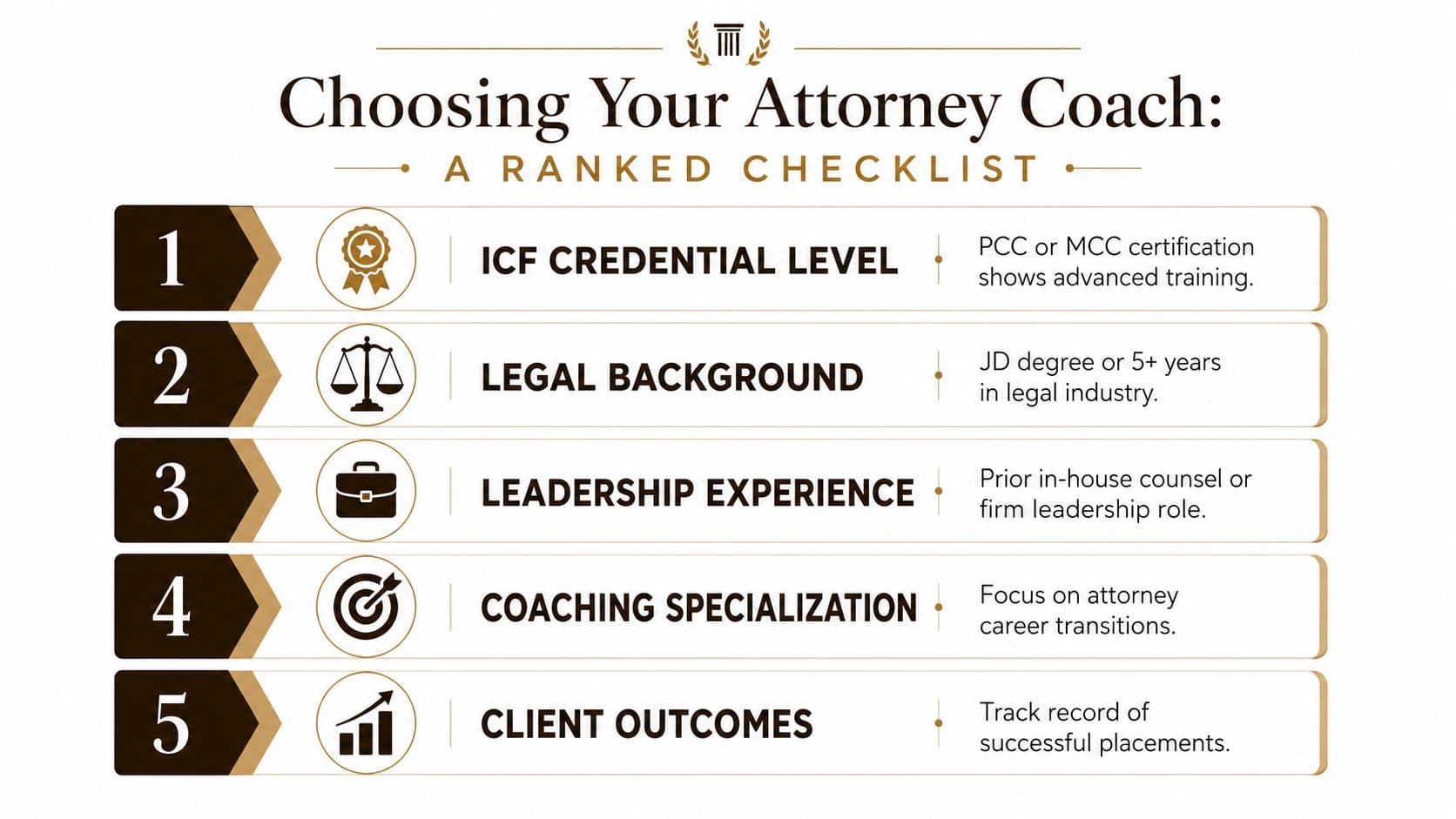
Rank these criteria in order:
- Coaching training and credentialing. Ask about International Coaching Federation training and certification level. A coach should explain the limits of the credential rather than use it as a substitute for relevant experience.
- Legal-industry context. A JD, prior practice, in-house experience, or substantial work with law firms can help the coach understand partnership structures, client confidentiality, utilization pressure, and professional hierarchy.
- Specialization. Select someone who regularly handles the actual issue, whether that's partner business development, associate progression, leadership transition, lateral interviewing, or burnout-related performance support.
- Measurement design. The coach should propose a baseline, defined objectives, review points, and deliverables. If success means only “feeling better,” ask how professional behavior will be assessed.
- References and transparency. Request relevant references, written fees, cancellation terms, and a clear explanation of what the engagement includes.
The contract should address confidentiality. Coaching communications generally shouldn't be assumed to have attorney-client privilege, and a firm-sponsored engagement requires clarity about what the coach can report to the sponsoring firm. Ask whether the coach keeps notes, who receives progress summaries, and whether the lawyer approves any report before it is shared.
Watch for avoidable red flags
Walk away from a coach who guarantees placement, promotion, compensation, or a particular business result. Also be cautious if the coach lacks legal-industry context, offers a generic personality program, cannot describe a measurement plan, or appears to be selling recruiting services without separating the two roles.
Shortlist three candidates, conduct discovery calls, and request a sample 90-day plan. The plan should name the target behavior, the activities between sessions, the evidence to review, and the point at which you decide whether to continue. If the coach's specialty doesn't match the gap you identified, don't sign because you like the coach personally.
Here is a useful introduction to the difference between coaching, recruiting, and career support:
Where Coaching Ends and Placement Begins
Coaching and legal recruiting solve different problems. Coaching changes how you perform within a chosen direction. Placement changes the opportunity set by connecting you with firms or legal departments that may offer the practice, platform, compensation, leadership scope, or work environment you can't access where you are.
Placement usually deserves priority in three situations:
- Persistent role-environment mismatch: Your values, work style, practice, or preferred level of autonomy conflicts with the firm's operating model.
- A stalled seniority or compensation trajectory: Your work is strong, but the firm has no credible opening, sponsorship path, or economic reason to advance you.
- A deliberate practice or sector shift: You want to move in-house, change practice areas, join a different market, or pursue a role with responsibilities your current employer doesn't offer.
Consider an eight-year associate with solid legal performance and disappointing business development. If the associate avoids outreach, fails to follow up, and struggles to convert conversations, coaching addresses the execution gap. If the associate has built relevant relationships but the current firm doesn't serve the sectors those contacts need, the central problem is market fit. More coaching may improve technique, but a different platform may create the actual opportunity.
| Situation | Best Path | Why |
|---|---|---|
| You know the target role exists and lack a repeatable skill | Coaching | Practice can change the behavior |
| Your firm cannot offer the desired matters or advancement path | Placement | A new platform addresses the constraint |
| You need to present yourself better for a role already identified | Interview coaching plus placement | One improves execution, the other creates access |
| You want to change practice area or move in-house | Placement with targeted coaching | Market positioning and interview preparation work together |
| Burnout reflects workload, staffing, or firm policy | Firm-level intervention, and possibly placement | Individual coaching can't repair structural conditions |
A recruiter adds confidential market mapping, compensation benchmarking, interview positioning, and access to roles that may not be publicly advertised. The process also tests whether your expectations match current demand before you commit to a move.
Five Star Placements provides permanent placement for attorneys, partners, in-house counsel, legal support professionals, and legal operations leaders, and it also offers candidate interview coaching and training support aligned with client processes. Learn how to prepare for a productive search with this guide on how to work with a legal recruiter. A confidential consultation can identify whether you need a market-positioning review, coaching referral, or both.
If your career problem may be a platform mismatch rather than a skill gap, visit Five Star Placements for a confidential conversation about permanent legal roles, lateral searches, partner opportunities, and in-house counsel placement. Bring your current objective, practice profile, and preferred direction, and ask for a market-positioning review before deciding whether coaching should come first.
Need help filling a legal role?
Five Star Placements partners with law firms and legal departments nationwide.
Schedule a Call