
Resume Should Be One Page: When It Works and When It Hurts
October 18, 2026 · 14 min read · Five Star Placements

Table of contents
Yes, a resume should be one page for most candidates, and 92% of hiring professionals in a survey recommended that length for the average job seeker. But the question is career stage and relevance density, not whether every legal candidate can satisfy a universal formatting rule.
The popular advice gets the starting point right and the application wrong. A law student and a managing partner aren't presenting the same case for employment. Treating their resumes identically can leave the student padding weak material and the partner deleting the evidence that makes the move worth discussing.
My recommendation is straightforward: choose the shortest format that lets a hiring decision-maker understand your qualifications without guessing. Don't confuse a concise resume with an incomplete one.
Table of Contents
- Rethinking the One Page Resume Rule
- How Recruiters Actually Read a Resume
- What the Data Says About One Page Versus Two
- Matching Resume Length to Legal Career Stage
- How to Compress a Legal Resume to One Page
- Building a Strong Second Page When You Need One
- Common Misconceptions Hiring Partners Still Hold
- The Decision Rule and Your Next Move
Rethinking the One Page Resume Rule
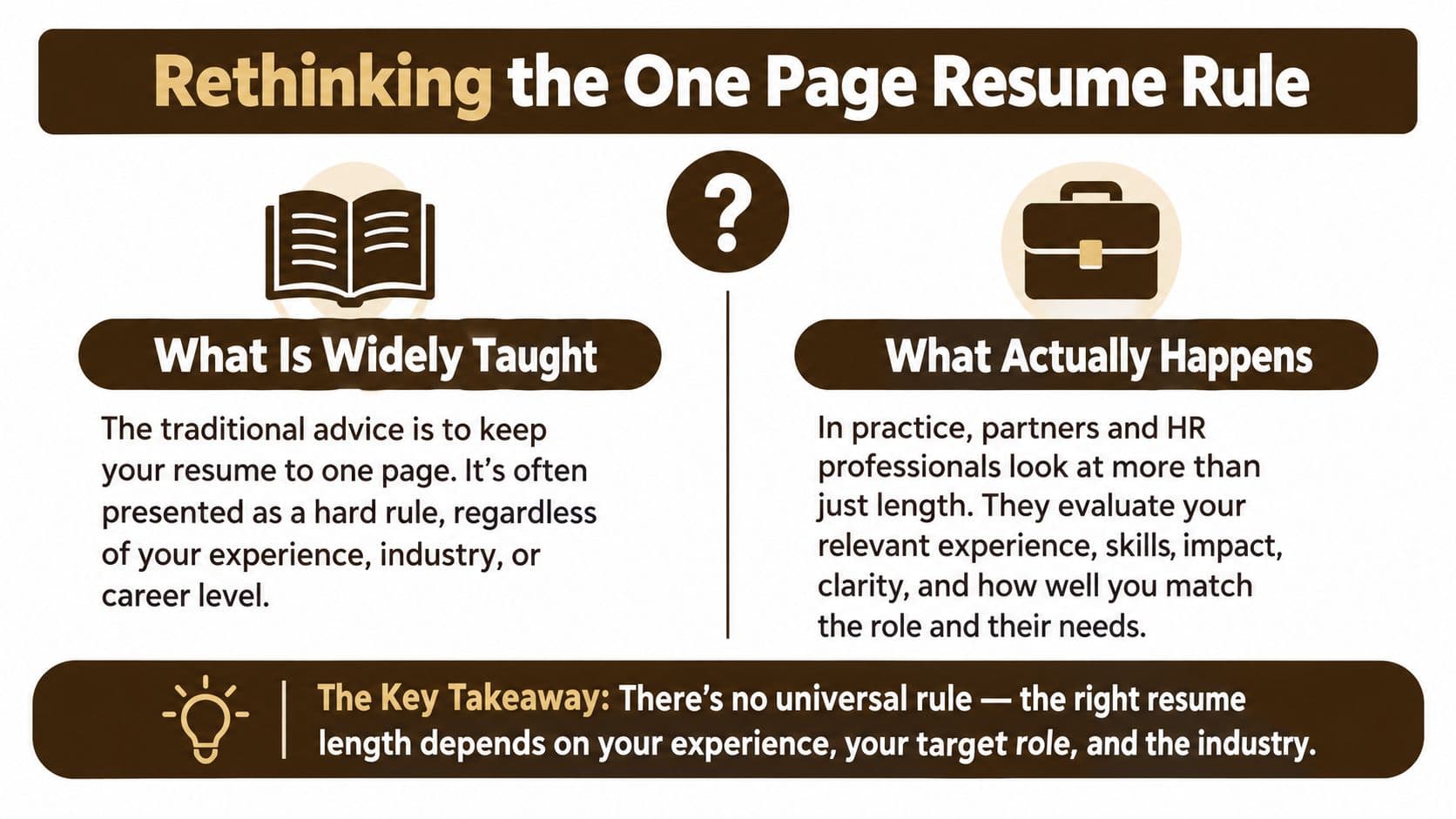
A resume isn't a record of everything you've done. It's an argument for why you belong in a particular role. Page count matters only after you know what that argument requires.
For a junior litigation associate, the case might rest on relevant employment, drafting experience, court exposure, education, and admission status. For a partner, it may require practice depth, client relationships, leadership, and business-development evidence. Cutting both profiles to the same length doesn't demonstrate equal editorial discipline.
Why the convention still deserves respect
The one-page default gives candidates a useful constraint: prioritize rather than inventory. It discourages exhaustive job descriptions, unrelated history, and introductory language that says little beyond wanting another job.
That's a sensible starting point, especially when your relevant experience is concentrated. Santa Clara University's resume guidance identifies one page as the most common length for undergraduate, graduate, and new-graduate resumes, while allowing a maximum of two pages. The distinction matters because a default isn't a prohibition.
Where the rule stops helping
I'd judge a legal resume by whether it answers the hiring question, not whether the candidate performed impressive compression. A clean document that omits the relevant jurisdiction, matter responsibility, or leadership scope leaves the reader with work you should have done.
Use relevance density as your editorial standard. Each entry should contribute something distinct to the assessment of your fit. Another description of familiar responsibilities doesn't qualify because it belongs to a different employer.
Practical rule: A line earns space when removing it would make your suitability for the target role harder to assess.
That standard is more demanding than a page limit. It requires you to understand the opportunity, select evidence deliberately, and distinguish professional history from hiring value. Brevity is useful when it sharpens the argument. It becomes counterproductive when it removes the proof.
How Recruiters Actually Read a Resume
Your resume has to work before someone reads it carefully. That means the first task is information retrieval, not storytelling.
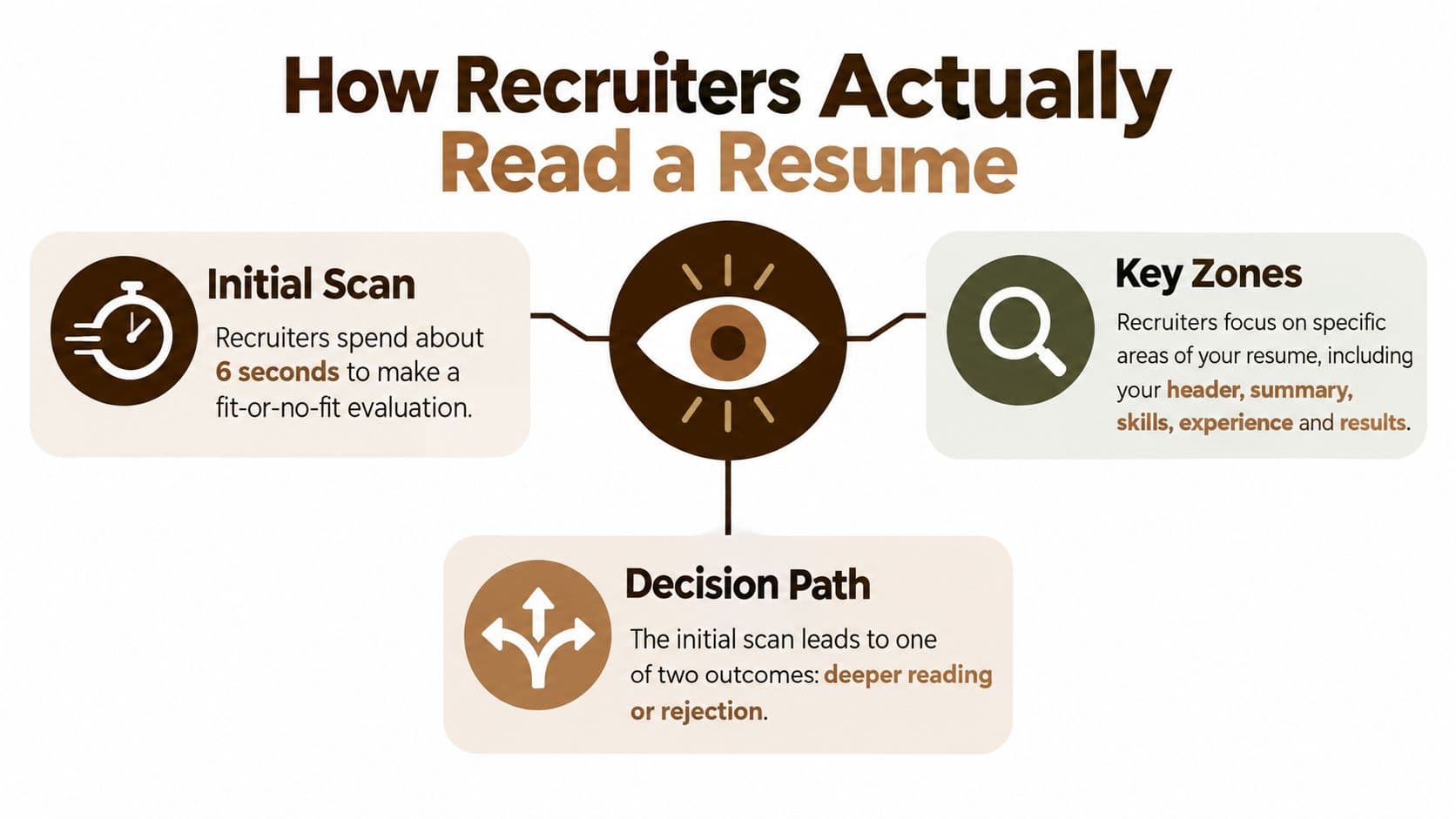
In TheLadders' eye-tracking study of professional recruiters, the average initial fit-or-no-fit review lasted approximately six seconds, with about 80% of attention concentrated on the candidate's name, current and previous titles and employers, employment dates, and education. Those findings describe an initial screen, not the total time every employer spends evaluating every candidate.
Give the reader a clear route
Make the factual skeleton obvious. A reviewer shouldn't have to decode whether an entry is an employer, a client, a secondment, or a practice description. Keep titles, organizations, and dates visually consistent.
For legal applications, I recommend placing target-role terminology in the top third and making the following evidence easy to locate:
- Practice identity. Identify litigation, corporate transactions, employment counseling, legal operations, or the relevant specialty rather than relying on a broad attorney label.
- Current responsibility. Distinguish supporting a matter from owning a workstream, supervising colleagues, or advising business leadership.
- Eligibility. Keep jurisdiction and bar admission status visible. Don't make the reviewer infer whether you can practice where the role requires.
- Relevant proof. Put your strongest matter, transaction, or operational accomplishment where it supports the initial assessment.
The visual below separates the opening scan from the decision to read further.
Make depth available without obstructing orientation
Use recognizable section headings such as Experience, Education, and Bar Admissions. Within experience, favor short accomplishment bullets that establish scope, action, and result, rather than paragraphs listing everything assigned to you.
A legal recruiter can help translate your background into the signals a particular search requires. Understanding what legal recruiters do for candidates also helps you distinguish resume positioning from the broader work of evaluating opportunities and preparing for interviews.
Don't expect a reviewer to reconstruct your professional identity from scattered clues. Establish it clearly, then provide the detail that justifies a closer conversation.
What the Data Says About One Page Versus Two
The evidence supports a default, not an absolute. It also distinguishes what hiring professionals recommend in a survey from what reviewers select when comparing actual documents.
Those are different questions. Someone can recommend brevity generally while preferring a longer resume that contains stronger, more complete evidence.
What the Research Actually Shows
| Source | Sample | One-page preference | Two-page preference | Key finding |
|---|---|---|---|---|
| ResumeGo's 2024 resume-length survey | 418 hiring professionals | 92% recommended one page for the average job seeker | 8% recommended two pages | 81% commonly encountered one-page submissions; more than half believed irregular length could harm their impression to some degree |
| Reporting on the ResumeGo hiring simulation | 482 reviewers assessing nearly 8,000 resumes | Comparable one-page versions were evaluated | Two-page versions were preferred 2.3 times as often | Two-page resumes received a 21% higher quality rating; review time was about 4 minutes versus 2 minutes and 24 seconds |
| HR preference findings summarized by AI ATS Checker | 1,013 HR professionals | No standalone one-page percentage stated in the cited summary | 51% specifically preferred two pages | 82.1% considered one to two pages ideal |
Don't turn these findings into a claim that longer legal resumes automatically perform better. The samples concern general hiring, and the simulation isn't evidence that a second page causes more offers for attorneys. Nor should you interpret the survey recommendation as proof that an experienced candidate will be rejected for exceeding the default.
The useful distinction is recommendation versus demonstrated preference. General advice favors restraint. Comparative screening can favor additional relevant information.
Choose completeness without rewarding excess
If you're early in your career, the general recommendation gives you a clear starting position. You probably don't need extensive space to establish relevant education, employment, credentials, and developing responsibility.
If you're experienced, test what compression would remove. Deleting repetitive descriptions is editing. Deleting the only evidence of supervisory responsibility, specialized transactions, or a required admission is a different decision.
Don't mistake additional reading time for an unconditional advantage, either. A longer document must justify the attention it asks for. More words about familiar duties don't become more persuasive because a reviewer spends longer with them.
Keep one page when it presents your relevant qualifications clearly. Add a second page only when compression would remove decision-useful evidence.
That's the defensible interpretation of the comparison. Neither format wins independently of the content, and neither lets you avoid the harder task of selecting what matters.
Matching Resume Length to Legal Career Stage
Start with your career stage, then adjust for the scope of the target role. Don't use seniority as permission to retain everything, and don't use junior status as a reason to omit a material credential.
Early-career candidates should default to restraint
For law students, recent graduates, clerks, junior associates, and early-career paralegals, I recommend a single page. Lead with what supports the next step: relevant placements, substantive assignments, education, admission status, and applicable technical capabilities.
A career changer should follow the same principle, but not erase useful prior experience. If you're moving into legal operations, previous work involving vendor management, budgeting, process design, or organizational leadership may strengthen your candidacy. Preserve transferable evidence rather than giving every former role equal coverage.
- Law students and recent graduates. Emphasize relevant academic and practical work. Don't inflate routine assignments into lengthy matter descriptions.
- Junior legal professionals. Show what you personally drafted, managed, researched, or coordinated, with clear limits on responsibility.
- Career changers. Explain the connection between your previous work and the legal role. Cut unrelated detail, not the connection itself.

Mid-career and senior candidates need different tests
For a mid-career attorney with a defined practice, I'd still attempt a focused single-page draft. You may be able to establish progression and substantive capability without repeating similar responsibilities across employers.
Partners, senior in-house counsel, legal-operations leaders, and experienced support professionals should test whether the shorter format accurately represents their scope. Multiple jurisdictions, management responsibility, specialized matters, and meaningful business outcomes may justify additional space.
For a managing partner or equity partner search, I wouldn't celebrate a short document that leaves the business case unexplained. In my assessment, that omission risks communicating poor judgment about the role's requirements, not admirable discipline. That's a recruiting recommendation, not a finding that every partner interprets length the same way.
Ask yourself what the next employer needs to assess that your earlier employers didn't. If the answer includes materially broader leadership, practice, or commercial responsibility, your resume needs to show that progression rather than merely announce a senior title.
How to Compress a Legal Resume to One Page
Cut content before touching typography. If you begin by reducing font size, you're treating an editorial problem as a layout problem.
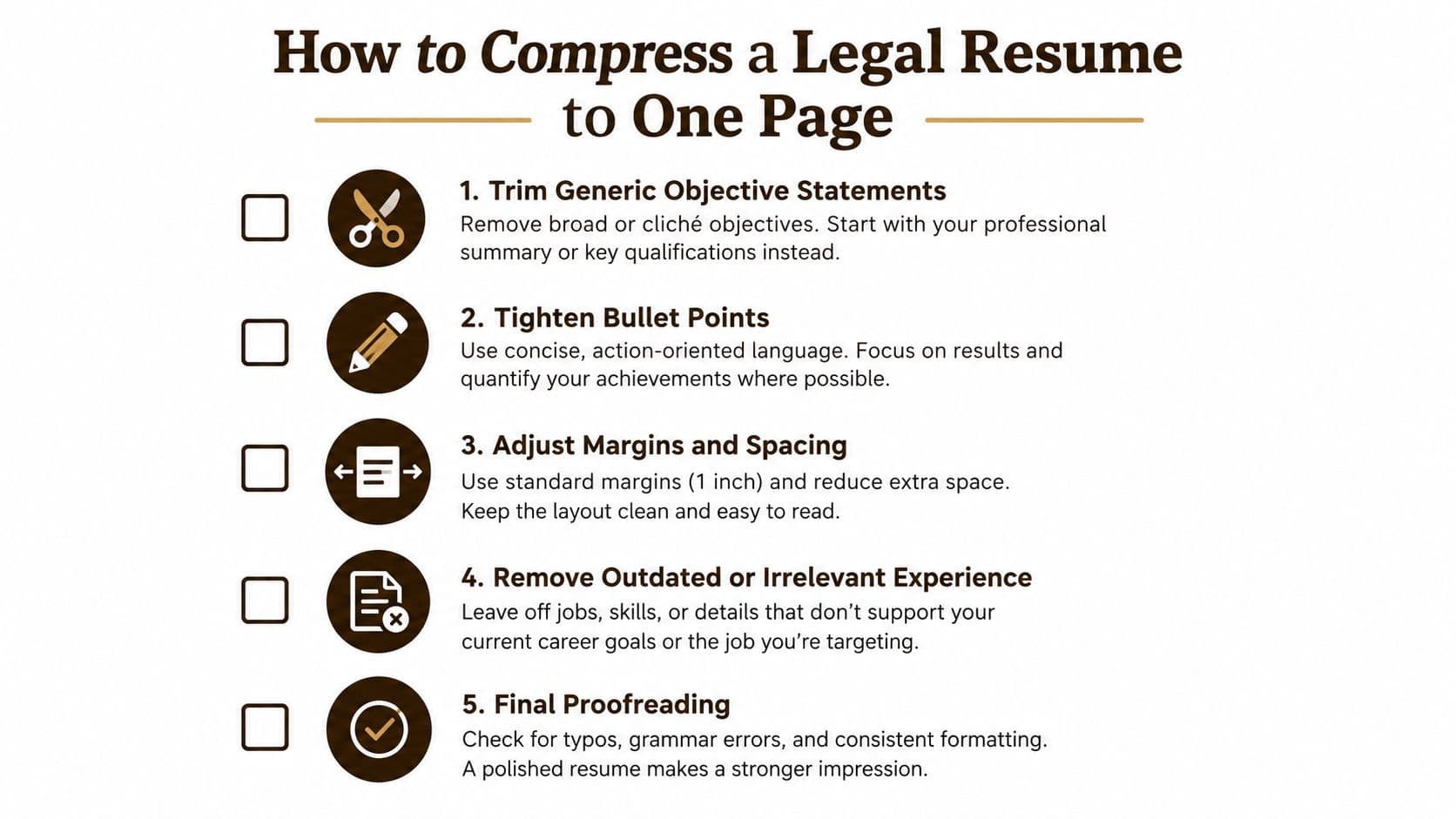
Use the checklist below to identify expendable material before rearranging the document.
Edit in order of hiring value
- Replace the generic objective. Remove language about seeking a challenging opportunity. If a summary is necessary, identify your target practice and distinguishing experience.
- Consolidate peripheral history. Reduce older unrelated positions to employer, title, and dates when chronology still matters. Retain substantive coverage only if it supports the application.
- Remove unsupported self-descriptions. Replace claims about being detail-oriented or collaborative with evidence of responsibility. Keep concrete credentials, relevant languages, and e-discovery platforms you've used.
- Prune educational and technical clutter. I'd remove high-school education and obsolete tools unless the role gives them a specific purpose.
- Revise repetitive bullets. Don't delete a bullet merely because it begins with a common verb. Delete it when it adds nothing distinct about your work.
For structural choices, consult this attorney resume format guide. Keep spacing consistent and type comfortable to read; don't recover space by making credentials difficult to decipher.
Replace duty lists with precise responsibility
Consider this hypothetical editing example, not a candidate case study.
Before
Responsible for legal research, drafting pleadings, assisting with discovery, and communicating with clients on litigation matters.
After
Drafted dispositive motions and coordinated discovery responses in commercial litigation, synthesizing factual records for supervising counsel.
The revision specifies the work and context without inventing a victory, financial result, or volume of matters. Use it only if it accurately describes your experience. If you have a documented outcome, add it; if you don't, accurate scope is stronger than fabricated achievement.
For a visual complement to the editing exercise, use the video below.
Finish by reading the resume against the job description. Compression succeeds when you remove distractions while preserving the evidence the employer needs. A shorter document that no longer explains your fit isn't an improvement.
Building a Strong Second Page When You Need One
A second page should supply depth, not rescue a weak opening. Keep the initial page sufficient to establish your professional identity and the strongest reasons to consider you.
Think of the additional space as room for substantiation. The reader should find information that supports a more informed interview, not a second version of the summary.
Compare repetition with substantive detail
Consider a hypothetical partner-track attorney evaluating a lateral move. A weak continuation repeats client service, drafting, negotiation, and supervision under every previous employer. The resume gets longer without explaining what the attorney could contribute to the new practice.
A stronger continuation organizes distinct evidence around the target opportunity:
- Representative matters. Describe the legal issue, your responsibility, relevant complexity, and the outcome when you can disclose it accurately.
- Practice development. Separate client origination, relationship management, and support for another partner's clients. Don't imply those categories are interchangeable.
- Leadership. Explain responsibility for staffing, mentoring, practice administration, or cross-office coordination.
- Professional authority. Include relevant publications, speaking, board service, and specialized credentials selectively.
For an in-house leader, the emphasis may instead be on business advisory scope, regulatory exposure, legal-team management, and operational improvements. Don't copy a law-firm partner structure because both roles are senior.
Preserve distinctions that matter
Be precise about ownership. Participating in a transaction isn't the same as leading it, and servicing a client doesn't establish that the relationship will follow you. If portability or financial contribution requires a confidential discussion, identify the relevant experience without overstating what you can substantiate.
Older work can remain when it demonstrates a capability the current role doesn't reveal. An earlier position might contain your clearest evidence of a specialized regulatory practice or a relevant leadership assignment. Age alone isn't a reason to cut it, but chronology alone isn't a reason to keep it.
Second-page standard: Every entry should establish a qualification, demonstrate scope, or document an outcome tied to the opportunity.
Keep related content together and avoid separating a heading from the evidence underneath it. The continuation should feel deliberately edited, not like leftover material moved below a page break.
Common Misconceptions Hiring Partners Still Hold
The claim that an applicant-tracking system requires a single page is a poor reason to delete relevant experience. Available resume-statistics evidence indicates that ATS software generally doesn't impose a page limit and that reviewers in screening studies often considered resumes too short, viewing insufficient information as worse than excess information.
That doesn't mean formatting is irrelevant. It means document length and successful information extraction aren't the same problem.
Separate system requirements from reviewer preferences
Follow the application's file instructions, use recognizable headings, and make role-specific terminology explicit. Don't assume automated screening will supply context you haven't written.
The common shortcuts need different corrections:
- A shorter file must be safer. Not if it removes the required credential or relevant experience.
- Smaller type proves concision. It proves only that you fitted more text into less space.
- Every legal employer needs the same evidence. Tailor the emphasis to the assignment rather than assuming firm size dictates a universal format.
For an Am Law opportunity, boutique practice, or corporate department, I'd start with the actual role requirements. A specialized associate search and a department leadership search call for different evidence, even when both employers value concise writing.
Ask what the rule is protecting
A hiring partner who insists on brevity may be trying to avoid unfocused applications. Honor that concern by editing sharply, rather than stripping out substantive qualifications.
Use these resume dos and don'ts as an additional review checklist. Then distinguish an employer's explicit instruction from generic advice. Follow a stated application requirement; otherwise, make a deliberate choice based on the evidence your candidacy requires.
The Decision Rule and Your Next Move
Choose the format after editing, not before. Your first draft should capture relevant evidence; your final draft should present only what supports the particular opportunity.
Apply this test to each line: Would removing it conceal a qualification, responsibility, or outcome the target employer needs to assess? If not, cut it. If the remaining material won't fit comfortably, use the additional space deliberately.
Quick Decision Rule for Legal Resume Length
| Career stage | Recommended length | Reason |
|---|---|---|
| Law student, recent graduate, or junior legal professional | One page | Present developing qualifications without padding |
| Career changer entering a legal role | One page by default | Prioritize relevant transferable experience |
| Mid-career attorney or legal support professional | One page when substantive and readable | Show progression without duplicating duties |
| Partner, senior in-house counsel, or legal-operations leader | Two pages when justified | Preserve distinct practice, leadership, and business evidence |
Run a focused final review
Work from the job description, not from your attachment to individual entries. Check the document in its final exported format so you're reviewing what the employer will receive.
- Remove the generic opening. Replace it with relevant positioning or start directly with experience.
- Check repeated responsibilities. Keep the strongest evidence and eliminate redundant descriptions.
- Verify admission visibility. Confirm that jurisdictions and status are accurate and easy to locate.
- Inspect readability. Review type, margins, spacing, and page breaks without relying on zoom.
- Test the continuation. Ask a trusted recruiter, partner, or HR contact which additional entries would materially affect their assessment.
Ask for specific feedback, not whether the resume looks good. You want to know what's missing, what's unnecessary, and whether your level of responsibility is clear.
Don't aim to summarize an entire career. Aim to give the right employer enough reason to invite the conversation, with enough substance to make that conversation productive.
Five Star Placements provides permanent legal placement for attorneys, partners, in-house counsel, legal support professionals, and legal-operations leaders, along with candidate interview coaching. Visit Five Star Placements to discuss your target role and how to present the experience that justifies your next move, whether it fits on one page or needs a focused second page.
Need help filling a legal role?
Five Star Placements partners with law firms and legal departments nationwide.
Schedule a Call