
Attorney Resume Format That Wins Interviews
October 12, 2026 · 14 min read · Five Star Placements

Table of contents
You've sent a polished application to a firm that appears to be an excellent fit. Your writing is strong, your experience is relevant, and your credentials are in order. Then the inbox stays silent. Often, the problem isn't the quality of the legal work behind the resume. It's that the document makes the reader work too hard to find the evidence.
An effective attorney resume format functions as a structured evidence brief. It should identify your level, practice area, jurisdiction, employers, representative matters, and outcomes quickly, then support those claims with concise detail. A hiring partner shouldn't have to infer whether you've handled depositions, negotiated transactions, counseled business teams, or developed portable client relationships.
Table of Contents
- Why the Attorney Resume Format Matters More Than Ever
- The Section Order That Works for Most Attorneys
- Writing Bullets That Prove Practice Readiness
- Tailoring the Resume by Practice Area and Seniority
- Matching the Resume to a Specific Vacancy
- Handling Career Gaps and Non-Linear Paths
- Final Pre-Send Checklist for Any Attorney Resume
Why the Attorney Resume Format Matters More Than Ever
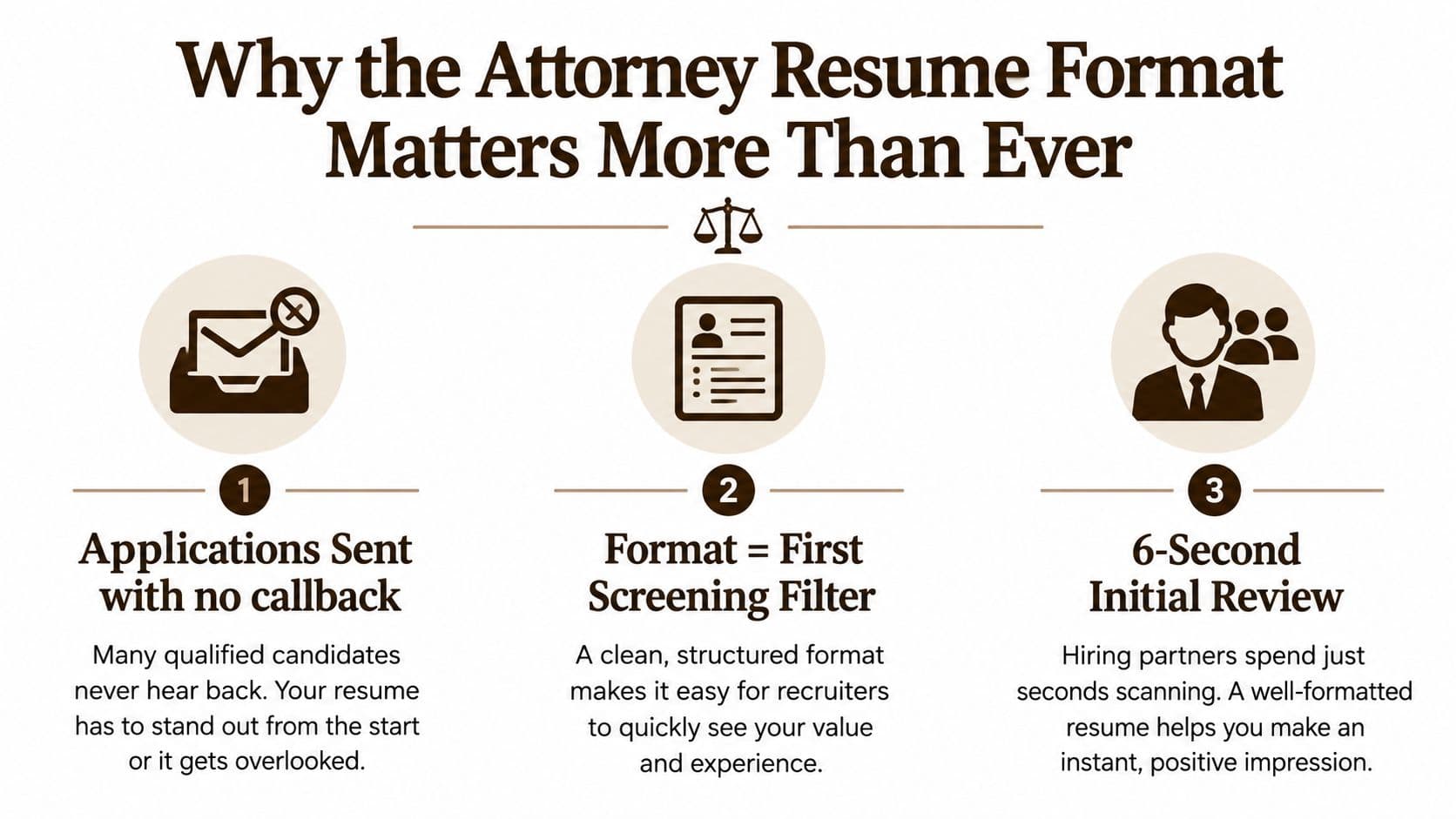
A lateral candidate can have strong legal work, relevant credentials, and a respected employer on the page, yet still lose the reader if the document does not establish fit quickly. The resume must function as a vacancy-specific evidence document. Its format should direct attention to the experience that answers this employer's needs, not present a universal career history in equal detail.
The hiring market reinforces that pressure. Per Reuters coverage of NALP's 2024 lateral hiring data, U.S. law-firm lateral hiring increased 14% in 2024 after two consecutive years of decline. Lateral associate hiring rose approximately 25%, lateral partner hiring increased 2%, and the survey covered nearly 4,300 lateral lawyer hires across 434 U.S.-based offices and firms. Lateral associates represented 59% of hires, compared with 23% for lateral partners and 19% for other lateral lawyers, including counsel and staff attorneys.
That distribution does not make a generic resume adequate. It makes positioning more important. A hiring team needs to identify your practice fit, seniority, jurisdictional eligibility, matter complexity, and level of responsibility without reconstructing them from dates and titles.
What the first review usually looks for
The first reader may be a recruiter, recruiting coordinator, human resources professional, practice-group leader, or hiring partner. Their priorities differ, but the initial scan usually tests five points:
- Current level: Are you an associate, counsel, partner, in-house attorney, or legal operations professional?
- Practice alignment: Does your work match commercial litigation, employment, M&A, real estate, tax, compliance, intellectual property, or the vacancy's actual focus?
- Employer progression: Do firms, companies, clerkships, contract roles, and titles establish a credible path?
- Licensing: Is the required bar or court admission easy to find?
- Evidence of readiness: Have you handled comparable work with meaningful responsibility?
Your structure should make the target role apparent before the reader reaches the second half of the first page. A litigation resume should foreground disputes, hearings, depositions, and outcomes. A transactional resume may need to emphasize deal type, drafting, negotiation, and client contact. A lawyer moving in-house may need to bring business counseling and cross-functional work forward, even if those responsibilities were secondary at a firm.
Recruiting observation: Interview-generating resumes make the intended role obvious early. Archived resumes often contain relevant experience but bury it beneath generic summaries, duty-heavy paragraphs, or academic detail that no longer answers the vacancy.
A clean layout reduces reading friction. Reverse chronology shows progression, practice-specific bullets establish scope, and conventional headings help people and electronic systems locate information. Design matters only when it supports a faster, more accurate evaluation of your legal evidence.
The Section Order That Works for Most Attorneys
Most attorneys should use a single-column, reverse-chronological resume with familiar headings. Legal employers need to verify role progression, experience, bar admissions, and practice-specific work without navigating a decorative layout.
Use this sequence as a starting point:
- Contact block: Include your full name, phone number, professional email address, city and state, and a LinkedIn profile only if it is current and consistent with the resume.
- Targeted summary: Add a short summary when it clarifies your practice, seniority, or transition. Experienced candidates shouldn't use an objective statement that merely announces a desire for employment.
- Experience: Lead with employer, location, title, and month/year dates. Use reverse chronology and give the most space to relevant recent work.
- Bar Admissions: List jurisdictions and material court admissions in a clearly labeled section. Recruiters often need to confirm jurisdictional eligibility early.
- Education: List law school and undergraduate education in reverse chronological order. Experienced attorneys generally place substantive work before older academic details.
- Selected Matters or Representative Transactions: Use this section when your work needs additional context or confidentiality prevents detail in employer bullets.
- Publications and memberships: Include material publications, professional leadership, or bar involvement that supports the target role.
- Skills: Keep this section focused on practice capabilities and relevant tools. Avoid turning it into an inventory of personality traits.
A law student or junior attorney will usually benefit from a one-page resume. Experienced attorneys, partners, and candidates with substantial relevant matters or publications may use two pages, but the additional space must contain evidence, not repetition. UC Berkeley Law's legal resume guidance identifies one page as the typical standard, with exceptions for substantial prior experience or public-interest content, and describes 11- or 12-point Times New Roman as typical.
Standard Attorney Resume Section Order
| Section | What to include | Skip when |
|---|---|---|
| Contact block | Name, phone, professional email, location, relevant profile | You're adding a full street address or personal details that don't support hiring |
| Summary | Target practice, level, distinctive focus, and credible evidence | It would repeat the first bullets in your experience section |
| Experience | Employers, titles, dates, practice areas, outcomes, and responsibility | Never skip it, but reduce older or unrelated detail |
| Bar Admissions | State bars and relevant court admissions | Don't omit because the vacancy assumes licensure |
| Education | J.D., undergraduate degree, honors, journal, or moot court where relevant | Remove dated detail that no longer supports your candidacy |
| Selected matters | Confidentiality-safe matter types, forums, transaction categories, and scope | Your experience bullets already provide sufficient context |
| Publications and memberships | Relevant writing, leadership, and professional involvement | The item is minor, outdated, or unrelated to the role |
| Skills | Legal research platforms, matter systems, languages, and technical capabilities | The list would only contain generic traits |
Keep typography restrained. Use a readable serif font such as Times New Roman, clear margins, consistent spacing, and standard bullet characters. Avoid photographs, graphics, tables, text boxes, headers and footers for important contact information, and dense multi-column designs. A visually elaborate resume can look polished on your screen while becoming difficult to parse elsewhere.
Writing Bullets That Prove Practice Readiness
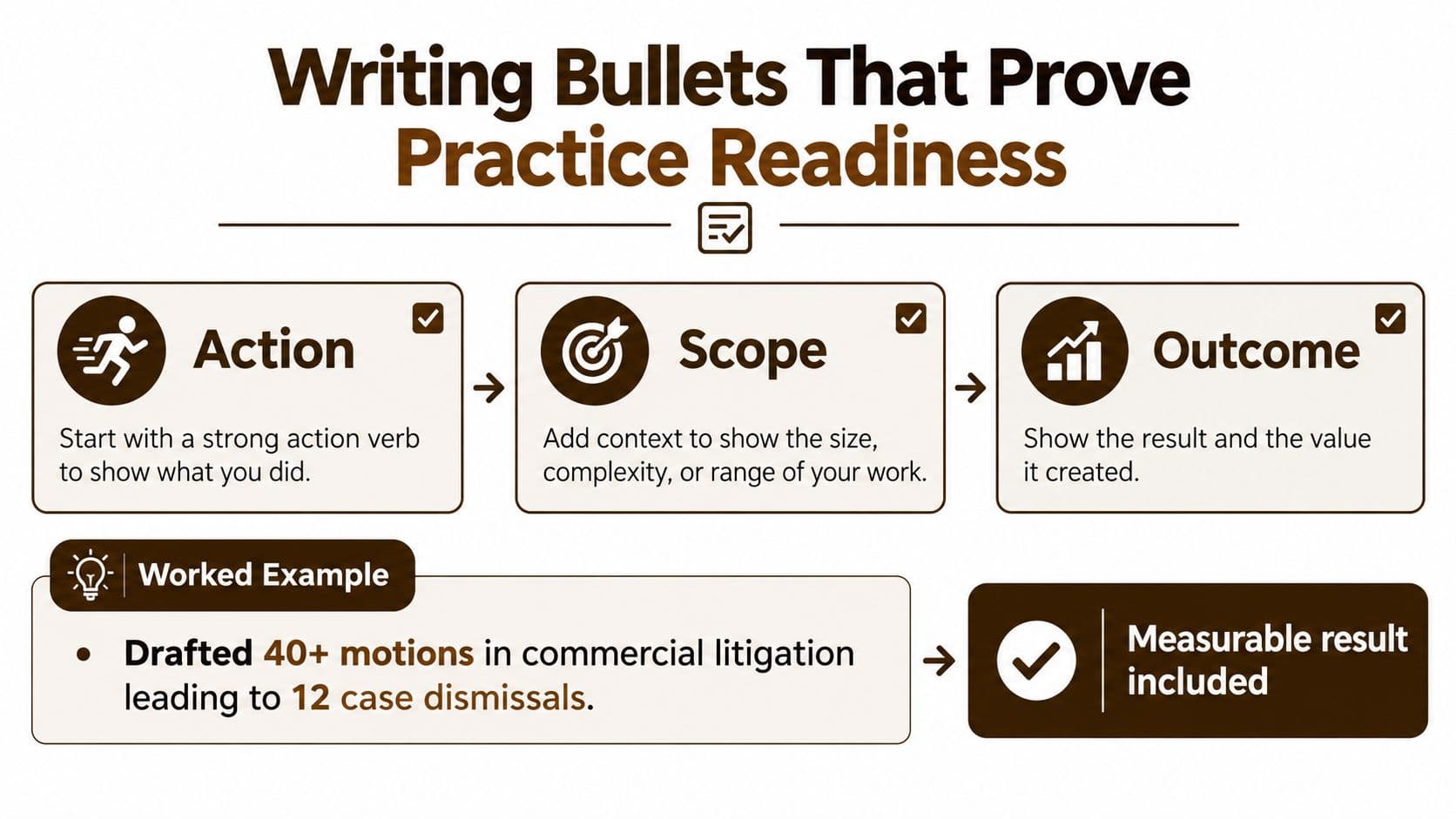
A legal resume bullet should answer three questions: What did you do? At what scale? What changed because of your work? The most reliable structure is action plus scope plus outcome.
“Responsible for discovery” doesn't tell a hiring partner whether you organized document review, argued a discovery motion, defended a deposition, or supervised a team. “Drafted and argued discovery motions in commercial disputes, narrowing document requests and preserving the client's position for summary judgment” gives the reader a clearer role, even when confidential facts must remain private.
Apply the formula by practice
For litigation, describe the forum, matter type, procedural stage, and your role. Distinguish first-chair work from second-chair or supporting work. Name courts or agencies when that information is material and can be disclosed.
- Before: “Assisted with commercial litigation matters.”
- After: “Drafted pleadings, dispositive motions, and deposition outlines in commercial contract disputes before state and federal courts, supporting favorable resolution across a varied caseload.”
For transactional work, identify deal type, responsibility, industry, and business consequence.
- Before: “Worked on M&A transactions and reviewed contracts.”
- After: “Led diligence coordination and negotiated ancillary agreements for technology acquisitions, aligning legal issues across finance, tax, employment, and regulatory workstreams.”
For in-house work, shift from billable activity to commercial judgment. Show how you advised business teams, managed risk, improved contracting, or coordinated outside counsel.
- “Counseled sales, procurement, and finance teams on commercial agreements, translating legal risk into practical approval paths and contract terms.”
- “Built a repeatable intake process for vendor agreements, improving visibility into escalation points and renewal obligations.”
Quantification helps when it's accurate and safe. You can report matter count, transaction value bands, caseload, settlement ranges, team size, turnaround time, docket volume, or process improvements without naming clients or exposing privileged information. For example, “managed a portfolio of commercial disputes across multiple jurisdictions” is useful, while a confidential client name or sensitive litigation strategy isn't.
Remove language that weakens your position
Replace “responsible for,” “helped with,” and “assisted with” when they inaccurately minimize your contribution or conceal routine work. Use precise verbs such as drafted, negotiated, argued, defended, advised, managed, supervised, conducted, resolved, coordinated, and implemented.
Before saving, test every bullet against this list:
- Action: Does the opening verb identify your actual contribution?
- Scope: Does the reader understand the matter, deal, forum, client group, or workload?
- Outcome: Is there a result, decision, improvement, or business consequence?
- Role clarity: Does the bullet distinguish lead responsibility from support?
- Confidentiality: Have you removed names and details that shouldn't be disclosed?
- Relevance: Does the bullet support this vacancy rather than merely describe your past job?
Your resume should also agree with your writing sample. Candidates preparing one can use this legal writing sample resource to think through how the resume's claims and submitted work should reinforce each other.
Tailoring the Resume by Practice Area and Seniority
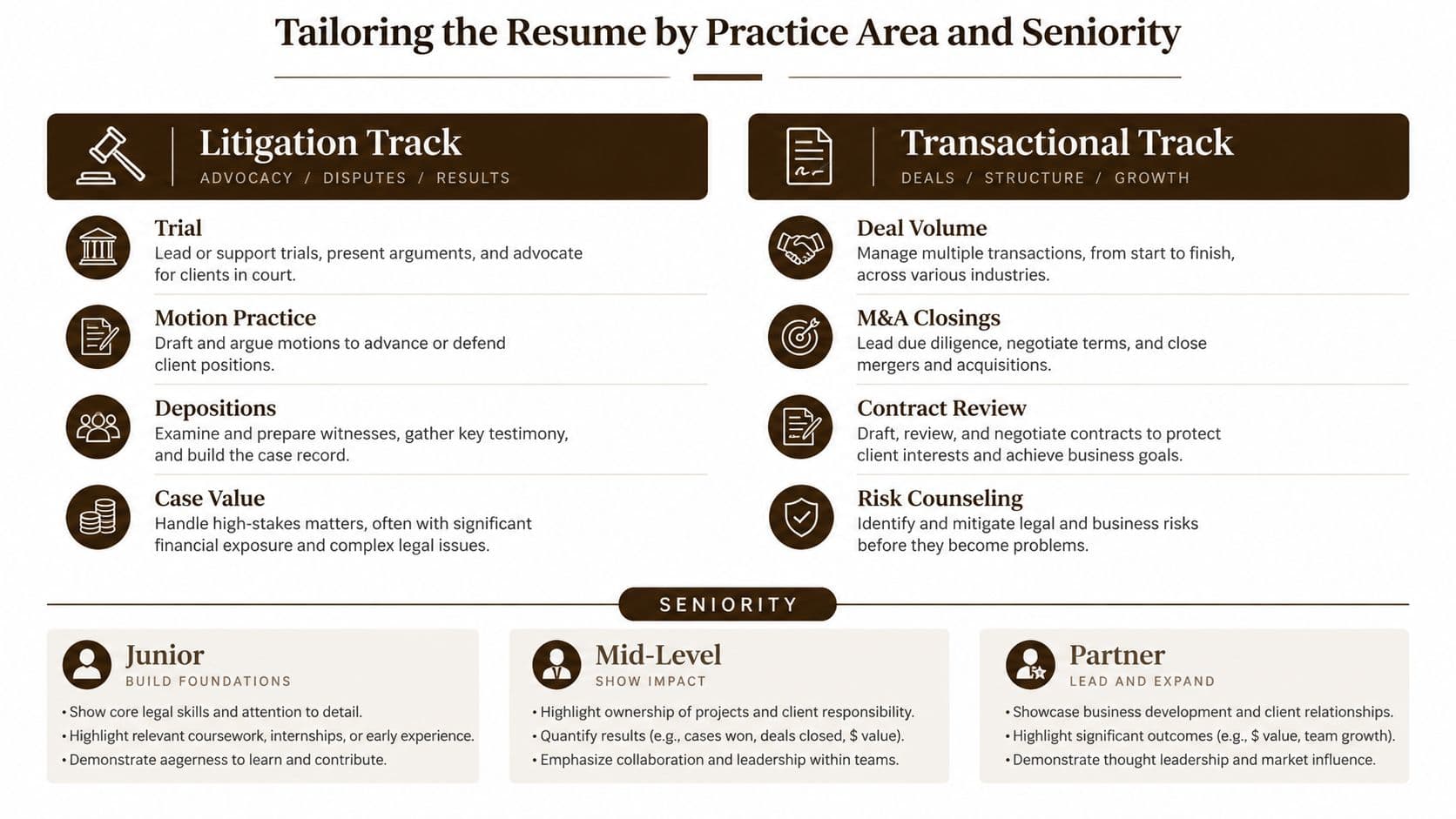
The same attorney resume format cannot communicate every kind of legal readiness. Layout can remain stable, but the evidence must change with the practice and level.
A litigation resume should put trial experience, motion practice, depositions, discovery, forums, and case-value scope near the top. A transactional resume should emphasize deal type, transaction responsibility, diligence, drafting, negotiation, industries, and closing work. An in-house resume should focus on cross-functional counseling, risk management, commercial agreements, compliance, and business judgment.
Adjust the evidence, not the entire document
| Candidate profile | Lead with | Keep secondary |
|---|---|---|
| Junior associate | Training, representative matters, drafting, research, clinics, externships, and pro bono work | Broad career claims without practical examples |
| Mid-level associate | Independent responsibility, matter ownership, client contact, depositions, negotiations, or deal work | General law school detail |
| Counsel | Specialization, judgment, complex matters, supervision, and internal or client-facing influence | A long list of every matter touched |
| Partner | Practice depth, client relationships, leadership, originations or portable business when relevant, and team development | Routine task descriptions |
| In-house counsel | Business partnership, contract work, risk decisions, compliance, outside counsel management, and operational improvements | Firm-style billable descriptions |
| Legal operations leader | Process design, systems, budgeting, staffing, reporting, and cross-functional implementation | Purely doctrinal legal analysis |
Partner resumes require careful judgment around business information. Include a portable business summary when the role evaluates client development and the information can be disclosed accurately. Don't use vague statements such as “strong book of business.” Describe the industries, relationships, practice sources, and nature of the work in a way that respects confidentiality and avoids unsupported claims.
Counsel candidates often make the opposite mistake. They present themselves as versatile generalists when the vacancy needs a recognizable specialist. If the role centers on employment counseling, intellectual property, M&A, or regulatory compliance, the resume should make that concentration unmistakable.
Junior candidates can use a Selected Matters section to give clinics, externships, judicial work, and pro bono projects proper weight. The section should clarify the legal activity and the candidate's role, not compensate for an empty experience section with inflated language.
Attorneys moving from private practice into corporate legal departments can find additional positioning guidance in this resource on going in-house. The central principle is simple: keep the underlying timeline stable, then reorder emphasis so the reader sees the capability the vacancy needs.
Matching the Resume to a Specific Vacancy
A generic legal biography rarely performs as well as a targeted evidence document. Tailoring doesn't mean copying every phrase from a job posting. It means identifying the vacancy's actual requirements and matching each one to truthful proof.

Use a four-step matching process
First, extract the practice terms. Mark phrases such as commercial litigation, discovery, contracts, M&A, employment counseling, regulatory compliance, intellectual property, or a required bar jurisdiction. Separate genuine requirements from broad employer language.
Second, map each term to evidence. For every important phrase, identify the employer, matter, project, or credential that proves it. If you can't support a term truthfully, don't add it merely to improve keyword coverage.
Third, place the language naturally. Use standard headings and ordinary body text. A bullet that says “Negotiated commercial agreements and advised procurement on regulatory compliance” is stronger than a visible keyword list that just repeats “commercial agreements, regulatory compliance, contracts.”
Fourth, test the file. Save a text-selectable DOCX or verify the PDF by copying all text into a plain-text editor. Check that your name, phone number, email, dates, employer names, bar admissions, headings, and bullets appear in logical order.
Electronic review creates a practical reason to keep the layout conservative. The ATS resume study from ATSChecker describes two-column layouts and contact information in headers or footers as parsing risks, while also cautioning that vendor and secondary analyses aren't universal legal-industry benchmarks. Treat those findings as risk indicators, not guaranteed rejection rates.
Document-engineering rule: Use one column, conventional headings, simple bullets, no icons, no charts, and no tables. The standard is zero parsing ambiguity.
Keep separate versions for materially different openings. A commercial litigation application may need trial and motion evidence near the top, while an in-house contract role needs commercial counseling and cross-functional work. The employers may receive the same career history, but they shouldn't receive the same emphasis.
Before sending a customized file, read it as if you're the hiring partner. Can you identify the candidate's level, target practice, jurisdiction, and closest matching matter without searching? If not, revise the first half of the document.
Handling Career Gaps and Non-Linear Paths
A perfectly continuous chronology isn't the only credible career story. Clerkships, contract attorney assignments, government service, caregiving periods, delayed bar admission, and moves from firms to in-house roles are all easier to evaluate when the resume labels them plainly.
Use concise descriptions such as:
- Judicial clerkship: Identify the court and the nature of the work.
- Contract attorney: State the employer or staffing context, assignment type, and substantive practice.
- Government service: Name the agency, role, jurisdiction, and relevant legal responsibilities.
- Career pause, caregiving: Use a direct label with dates, without a defensive explanation.
- Bar admission pending: Identify the jurisdiction and expected timing accurately.
- In-house transition: Show how firm-based legal work translated into business counseling, risk management, or contract responsibility.
Recent recruiting data makes chronology especially important. The NALP Class of 2025 selected findings reports that the share of law offices recruiting 3L students rose from 14% in 2024 to 22% in 2025, while overall legal employment contracted by more than 2,700 jobs compared with the prior year. In a selective market, unexplained dates can create more concern than a clearly contextualized transition.
Preserve the timeline while adding context
Don't hide a contract role by folding it into another employer. Don't present a clerkship as ordinary firm experience. Don't describe a bar admission as complete when results are pending. Accurate labels help reviewers distinguish an ordinary legal-career sequence from a genuine issue requiring follow-up.
A Selected Matters section can help when the chronology is varied but the candidate has strong transferable work. A short competency section can also be useful for a transition into legal operations or an in-house role, provided it supplements rather than replaces the employment timeline.
The right tone is factual and brief. The resume isn't the place to defend a caregiving decision, explain every short tenure, or narrate a career change in full. It should give the reader enough context to understand the sequence and enough evidence to assess what you can do now.
Final Pre-Send Checklist for Any Attorney Resume
Run this review before every application:
- Layout: Confirm one column, readable typography, consistent margins, and clear section headings.
- Contact details: Test the phone number, email address, and profile links.
- Dates: Verify every month, year, title, employer, and location.
- Licensure: Check bar and court admissions, including pending status.
- Evidence: Replace generic duties with precise action, scope, and outcome.
- Targeting: Match the vacancy's practice terms to truthful resume evidence.
- Confidentiality: Remove client names, privileged facts, and identifying matter details.
- File test: Copy the document into plain text and confirm the order remains logical.
- Final read: Make sure the resume sounds like the attorney you are today, not a collection of old job descriptions.
A resume format serves the hiring conversation. It shouldn't become a design project that hides the legal work that makes you qualified. For guidance on personal branding details that can distract from attorney resume substance, review this discussion of headshots and resumes.
Five Star Placements provides permanent placement for attorneys, partners, in-house counsel, legal support professionals, and legal operations leaders, with screening aligned to practice needs and organizational culture. If you're ready to turn a carefully prepared resume into a focused search, visit Five Star Placements to explore its legal recruiting and candidate services.
Need help filling a legal role?
Five Star Placements partners with law firms and legal departments nationwide.
Schedule a Call