
Legal Writing Sample Guide for Job Applications
October 11, 2026 · 13 min read · Five Star Placements
Table of contents
You're staring at two files before an application deadline. One is polished, impressive, and full of work your supervisor shaped. The other is rougher, but you wrote the analysis, checked the authorities, and know exactly what changed. The first may look stronger. The second may be the only one you can safely submit.
That choice exposes the core legal writing sample problem. Reviewers assess more than grammar and citations. They look for legal judgment, independent authorship, authorization, confidentiality discipline, and fit with the role. A sample that violates privilege or exaggerates your contribution can damage an application faster than a plain but honest document.
The practical sequence is straightforward: choose the right format, confirm who wrote it, resolve confidentiality, revise the substance, run a separate quality review, and match the finished document to the employer's needs.
Table of Contents
- The Two Binders on Your Desk
- Choosing the Right Document for the Role
- Confirming Authorship and Getting Permission
- Revising for Substance Before Subtracting
- Running a Two-Pass Quality Review
- Building a Small Portfolio Instead of One Sample
- Submission Checklist and Final Don'ts
The Two Binders on Your Desk
A candidate walks into an interview with two binders. One holds a sleek appellate brief from a well-known firm. The headings are sharp, the authorities are well chosen, and the prose reads like finished product. The problem is obvious once you ask a few follow-up questions. The candidate drafted only a small portion, and senior lawyers reshaped the argument, rewrote the analysis, and supplied much of the final language.
The other binder holds a predictive memorandum from law school. It is less polished. It also gives me far more confidence. The candidate researched it, wrote it, revised it, and can explain every analytical move without guessing where someone else stepped in.
Treat the sample as proof of your own legal judgment. Treat the glossy document with caution if the best parts are not really yours. Georgetown's guidance on choosing a legal writing sample makes the right point: submit work that fits the employer or judge and reflects your own analysis. That standard should decide what stays in contention and what goes back in the drawer.
Recruiter's rule: The strongest sample is the strongest document you're authorized to submit and prepared to explain line by line.
Use a simple submission matrix. If a document is strong, clearly yours, and safe to share, it belongs at the top. If it is impressive but heavily edited, confidential, collaborative, or hard to defend in detail, its score drops fast. Reviewers are grading more than style. They are scoring for independent thinking, ownership, risk control, and role fit.
That is why the comparison by polish alone fails. A hiring partner or recruiter reads for signal quality. A plain memorandum with clear rule synthesis, disciplined factual application, and honest limits often beats a dazzling brief you barely touched. Practice-ready writing shows up in the candidate's choices on the page: what authority to emphasize, how to frame uncertainty, what facts matter, and when to stop overstating the point.
Start there. If you get this first decision wrong, every later edit is cosmetic.
Choosing the Right Document for the Role
Start with the job, not your archive. A predictive memorandum usually demonstrates research, rule synthesis, and objective analysis. A persuasive brief shows advocacy, authority selection, counterargument management, and control of the requested relief. A contract analysis reveals whether you can translate language into business and legal consequences. A client-facing communication tests whether you can prioritize and explain rather than just recite.
The recruiter's role matters here. A legal recruiter's responsibilities include assessing fit between a candidate's demonstrated skills and the employer's actual needs, not merely forwarding the most polished file.
| Sample Format | Best-Fit Roles | Typical Length | What It Signals |
|---|---|---|---|
| Predictive memorandum | Law-firm associate, judicial clerkship, research-heavy role | Use the length requested by the employer | Objective analysis, research discipline, rule-to-fact reasoning |
| Persuasive brief or motion | Litigation, appellate, public-sector advocacy | Use the length requested by the employer | Issue framing, authority hierarchy, persuasion, counterarguments |
| Transactional or contract analysis | Corporate, real estate, employment, tax, in-house counsel | Use a focused excerpt or complete analysis as appropriate | Risk spotting, drafting judgment, commercial awareness |
| Client-facing email or update | In-house, legal operations, client-service roles | Keep it concise and audience-specific | Prioritization, plain-English communication, practical recommendations |
Match the document to the reader
For a law-firm role, a predictive memorandum or persuasive brief is usually a reliable choice because it exposes legal analysis. Georgetown's career guidance identifies a predictive memorandum or persuasive brief as typical material for law-firm applications and a trial-level brief or memorandum as appropriate for judicial clerkships, while stressing that the sample should match the organization or judge.
That match changes for corporate work. An in-house hiring team may learn more from a concise risk email, contract-clause explanation, or decision memorandum than from an academic discussion of doctrine. The document should show what you'd tell a business client, what you'd escalate, and what you'd recommend.
A transactional excerpt can work well, but don't submit pages of agreement language without context. Include enough explanation to show the problem, the proposed change, and the consequence for the client. For legal operations, a process memo or playbook can demonstrate whether you make a complex workflow usable for other people.
Don't force every application to use the same file. A litigation partner may want advocacy. A clerk may want disciplined trial-level analysis. A general counsel may want concise risk prioritization. The sample should answer the employer's practical question: can this candidate produce the kind of work this role requires?
Confirming Authorship and Getting Permission
A document can be public and still be collaborative. It can be your work and still be confidential. Those distinctions determine whether submission is safe.
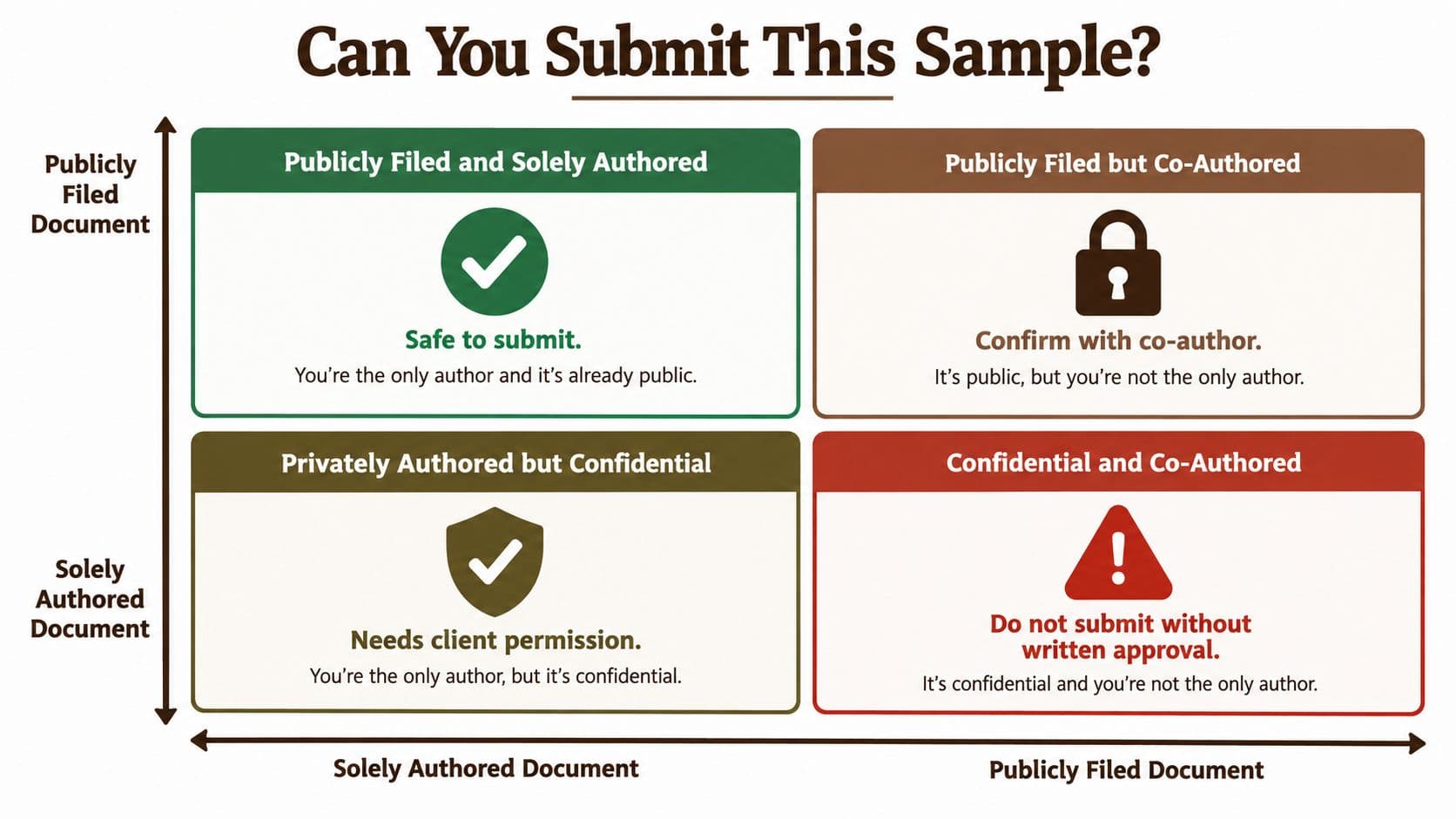
Use this matrix before you edit:
| Category | Submission position | Required action |
|---|---|---|
| Publicly filed and solely authored | Generally the safest option | Confirm your authorship and verify that no nonpublic material remains |
| Publicly filed but collaborative | Public status doesn't erase contribution concerns | Explain your contribution and confirm whether co-author or employer approval is needed |
| Privately authored but confidential | Your authorship doesn't defeat confidentiality | Obtain written permission, redact appropriately, and replace identifying information as authorized |
| Confidential and co-authored | Highest risk | Don't submit without written approval from the relevant client, employer, supervisor, or other rights holder |
Redaction isn't a magic eraser. Internal research memoranda may be privileged. Judicial work may be confidential. Replacing a client name while leaving distinctive facts, dates, transaction details, or opposing-party information can still identify the matter. Guidance collected in the University of San Francisco legal writing sample resource warns candidates to obtain permission for nonpublic work and to replace identifying information rather than relying only on blacked-out text.
Use a controlled selection process
Follow these steps in order:
- Identify the target reader and matter type. Decide whether the document is for a litigation partner, judge, in-house lawyer, or operations leader.
- Select a legal document. Choose a predictive memorandum, persuasive brief, trial-level filing, contract analysis, client update, or comparable work that reflects the role.
- Confirm authorship. Determine whether you researched, wrote, and edited the sample primarily or entirely yourself. Separate your work from supervisor, co-counsel, or editor contributions.
- Remove confidential information and obtain permission. Ask before using employer work. Don't assume a public filing authorizes every attached draft, fact, or internal comment.
- Revise the analysis. Check issue framing, rule accuracy, fact-specific application, counterarguments, and a restrained conclusion.
- Proofread the document. Audit citations, grammar, organization, sentence precision, defined terms, and formatting.
Attach a short cover sheet when the history isn't obvious. It should state the document type and intended audience, identify your authorship, disclose material edits, confirm permission or public filing status, describe redactions or altered facts, and identify any supervisor or co-author contribution. If a tool assisted with brainstorming, proofreading, or research, disclose that assistance accurately and distinguish it from your legal analysis and verification.
A transparent cover sheet can strengthen the submission. It shows the reviewer that you understand authorship and confidentiality as professional obligations, not administrative details.
Revising for Substance Before Subtracting
You cut a sample from twelve pages to eight, tighten a few sentences, delete block quotes, and feel productive. Then a recruiter reads it and still cannot tell what legal question you answered, which rule controls, or why your reasoning should be trusted. That is what happens when candidates edit length before judgment.
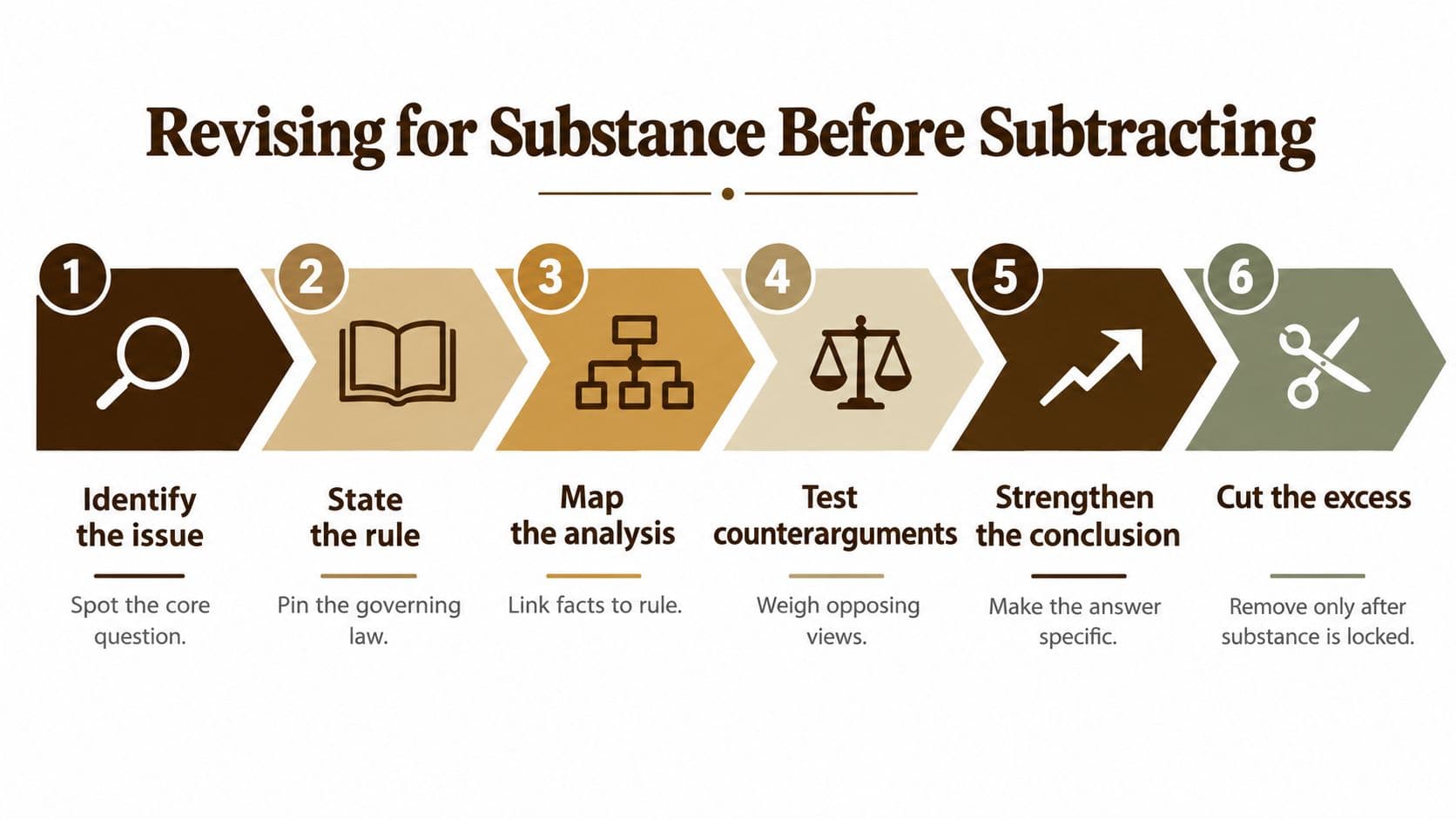
Use a simple scoring rubric before you delete a single paragraph. Score each major issue on 10 total points: 2 points for issue identification, 2 points for governing rules, 4 points for application and analysis, and 2 points for conclusion. The weighting is the point. Employers can forgive a sample that needs trimming. They do not forgive one that states rules cleanly and then fails to apply them to contested facts.
Diagnose the reasoning
Issue identification, 2 points. The reader should know exactly what the document decides. Replace broad labels with a decision-ready issue. “Whether the employee violated policy” says almost nothing. Identify the conduct, the governing standard, the disputed element, and the requested outcome.
Governing rules, 2 points. Strip out legal background that never affects the answer. State the controlling rule accurately. Break out the elements the decision-maker must apply. Make the hierarchy clear if you use both binding and persuasive authority. Recruiters notice when a writer hides a weak command of the rule inside a long doctrinal summary.
Application and analysis, 4 points. This is where strong samples separate themselves. Tie specific facts to specific elements. Explain why each fact matters. Confront the strongest adverse authority or counterargument directly. If the result is uncertain, say why. Vague lines such as “the facts support liability” or “the court may find” do not show judgment unless you explain the path from rule to result.
Conclusion, 2 points. End with a bounded answer. Give the likely result, the main reason, and any material qualification. Keep it specific. Overconfident predictions make candidates look inexperienced.
Then ask the only question that matters: Could a busy partner see your judgment from the application section alone? If not, stop editing at the sentence level and fix the analysis.
Use this check on every major issue:
- Write the issue in one sentence.
- Underline the controlling rule.
- Circle every fact tied to an element.
- Mark the strongest counterargument.
- Rewrite the conclusion so it answers the actual question.
After that, cut background, repeated propositions, ornamental transitions, and long quotations. Make the analysis stand on its own before you shorten anything else.
The principles in this legal-writing video resource help most at this stage. Use them to sharpen structure and presentation after the reasoning is already sound.
Running a Two-Pass Quality Review
A polished document can still contain a defective legal argument. Separate the review into two passes so surface improvements don't distract you from material errors.
Pass one checks legal reasoning
Read the sample as if you're unfamiliar with the matter. Don't correct commas yet. Test whether each major issue follows an intelligible IRAC or CREAC sequence:
- Question: Does the section identify the legal issue?
- Authority: Does it state the controlling rule and use authority in the right hierarchy?
- Facts: Does it connect legally significant facts to each relevant element?
- Opposition: Does it address adverse authority, weaknesses, or counterarguments?
- Conclusion: Does it reach a specific and limited answer?
The Federal Judicial Center's Judicial Writing Manual identifies wordiness, imprecision, unclear writing, poor organization, cryptic analysis, and pomposity as major writing problems judges commonly encounter. Those defects often begin as reasoning problems. A vague topic sentence can hide a missing issue. A long background section can signal that the writer hasn't prioritized the facts that control the result.
Pass two checks execution and risk
Now read as an editor and risk manager. Look for:
- Clarity: Replace ambiguous subjects, passive constructions, and undefined references.
- Organization: Make headings and topic sentences tell the reader where the argument is going.
- Citations: Verify every authority, pinpoint, quotation, signal, and citation format.
- Consistency: Check defined terms, party names, tense, capitalization, and headings.
- Professional risk: Remove confidential data, internal comments, tracked changes, metadata, and unsupported assertions.
- Mechanics: Correct grammar, punctuation, typographical errors, and sentence-level clutter.
A document shouldn't pass because it “reads well.” Accept it only when there's no confidentiality breach, no material citation or legal-rule error, every conclusion has explicit rule-to-fact support, and no major defect remains in organization, legal reasoning, audience clarity, legal-English style, or mechanics. Those dimensions are also suitable for independent review by two assessors, which reduces the chance that one reviewer's familiarity or stylistic preference controls the result.
Before sending, create a clean PDF, reopen it, inspect every page, and confirm that comments and tracked changes are gone. If the recipient requested an editable file, use the requested format only after checking its revision history and metadata.
For broader document preparation habits, compare the quality-control approach with these resume dos and don'ts. The same discipline applies: accuracy and relevance matter more than decorative polish.
Building a Small Portfolio Instead of One Sample
One document rarely demonstrates every skill an employer needs. Prepare a small set of role-specific samples, then send only what the employer requests.
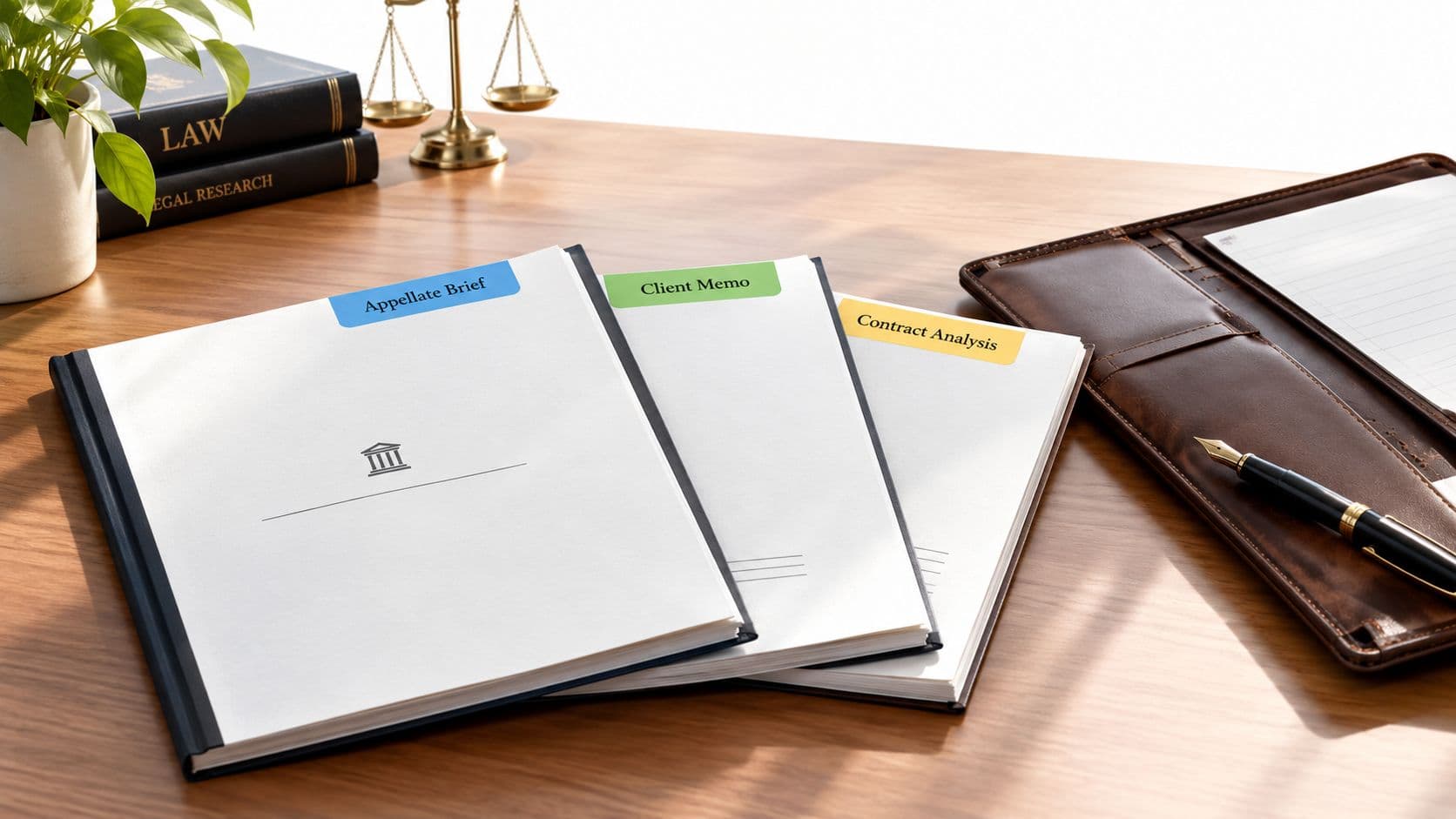
A practical portfolio might include:
- In-house counsel: A short executive risk email, a contract-clause explanation, or a decision memorandum showing prioritization and a recommendation.
- Litigation: A motion, persuasive brief, or reply section demonstrating authority selection and counterargument control.
- Transactional practice: A contract analysis or markup explanation that connects language to commercial consequences.
- Legal operations: A process memo, playbook, or workflow guide that makes a recurring legal task understandable and repeatable.
A flawless academic memorandum may show doctrinal competence without showing whether you can advise a busy client in plain English. That's why the American University guidance on legal writing samples supports matching samples to the role and considering more than one document.
Disclose tool assistance precisely
If generative AI or another tool helped with brainstorming, proofreading, or research, don't make a sweeping statement that obscures your responsibility. State what the tool did, what you did, and how you verified every legal proposition and citation. A tool can assist with organization or language, but it doesn't own your legal judgment, and you remain responsible for confidentiality and accuracy.
The portfolio should remain controlled. Don't overwhelm a reviewer with unrelated files. Prepare alternatives, document your authorship and permissions, and select the one that answers the employer's actual question.
Submission Checklist and Final Don'ts
Run this list before you press send:
- Confirm authorship: Identify your contribution and disclose material collaboration.
- Match the role: Send a brief to a litigation employer, a practical analysis to a transactional team, and concise client-oriented work to an in-house audience.
- Score the reasoning: Test issue, rule, application, and conclusion, with special scrutiny on application.
- Run two passes: Review legal reasoning first, then clarity, citations, mechanics, and confidentiality.
- Attach context: Include a cover sheet when authorship, permission, redactions, or tool assistance needs explanation.
- Protect confidential work: Don't submit privileged, judicial, or employer material without authorization.
- Reject borrowed polish: Don't present a document primarily written by someone else as your own.
- Don't polish around a weak argument: Fix missing analysis before shortening sentences.
- Avoid generic submissions: A single file sent to every employer signals convenience, not judgment.
Your writing sample is evidence of writing, but it's also evidence of professional judgment. The reviewer is asking whether you know what to submit, what not to disclose, what matters in the analysis, and how to communicate with the intended reader. Even the rest of your application should reflect that same care, including the presentation choices discussed in this headshot and resume guidance.
Five Star Placements provides permanent placement for attorneys, in-house counsel, legal support professionals, partners, and legal operations leaders, with screening aligned to practice needs and organizational culture. If you want help positioning your legal writing sample for a specific role, visit Five Star Placements to explore its recruiting and candidate coaching services.
Need help filling a legal role?
Five Star Placements partners with law firms and legal departments nationwide.
Schedule a Call