
Legal Recruiter Boston: The Complete Hiring Guide
October 9, 2026 · 14 min read · Five Star Placements

Table of contents
Boston–Cambridge–Newton's mean legal-occupation wage is $84.93 per hour, compared with $43.09 across all occupations, so the right legal recruiter can protect far more than hiring time. In Boston, a bad hire or prolonged vacancy can affect billable work, client service, team capacity, and compensation economics at the same time.
That gap changes the hiring conversation. Boston isn't a market where a generalist recruiter can forward a stack of resumes and expect good results. Employers compete for a relatively concentrated pool of attorneys, paralegals, in-house counsel, partners, and legal operations professionals, while candidates compare firms and corporate departments on more than salary. Practice fit, portable business, progression, workload, technology fluency, and organizational culture all influence whether a placement succeeds.
The recent rebound in lateral movement makes speed tempting. It also makes judgment more valuable. A fast search that overlooks conflicts, production history, compensation structure, or team compatibility can create a more expensive problem than the vacancy it was meant to solve.
Table of Contents
- Understanding the Boston Legal Market
- What Legal Recruiters Actually Do in Boston
- Why Law Firms and In-House Teams Use Recruiters
- Contingency versus Retained Search in Legal Recruiting
- How to Evaluate a Legal Recruiter in Boston
- How Five Star Placements Handles Boston and Remote Searches
- The Hidden Risks of Fast Hiring in a Booming Market
Understanding the Boston Legal Market
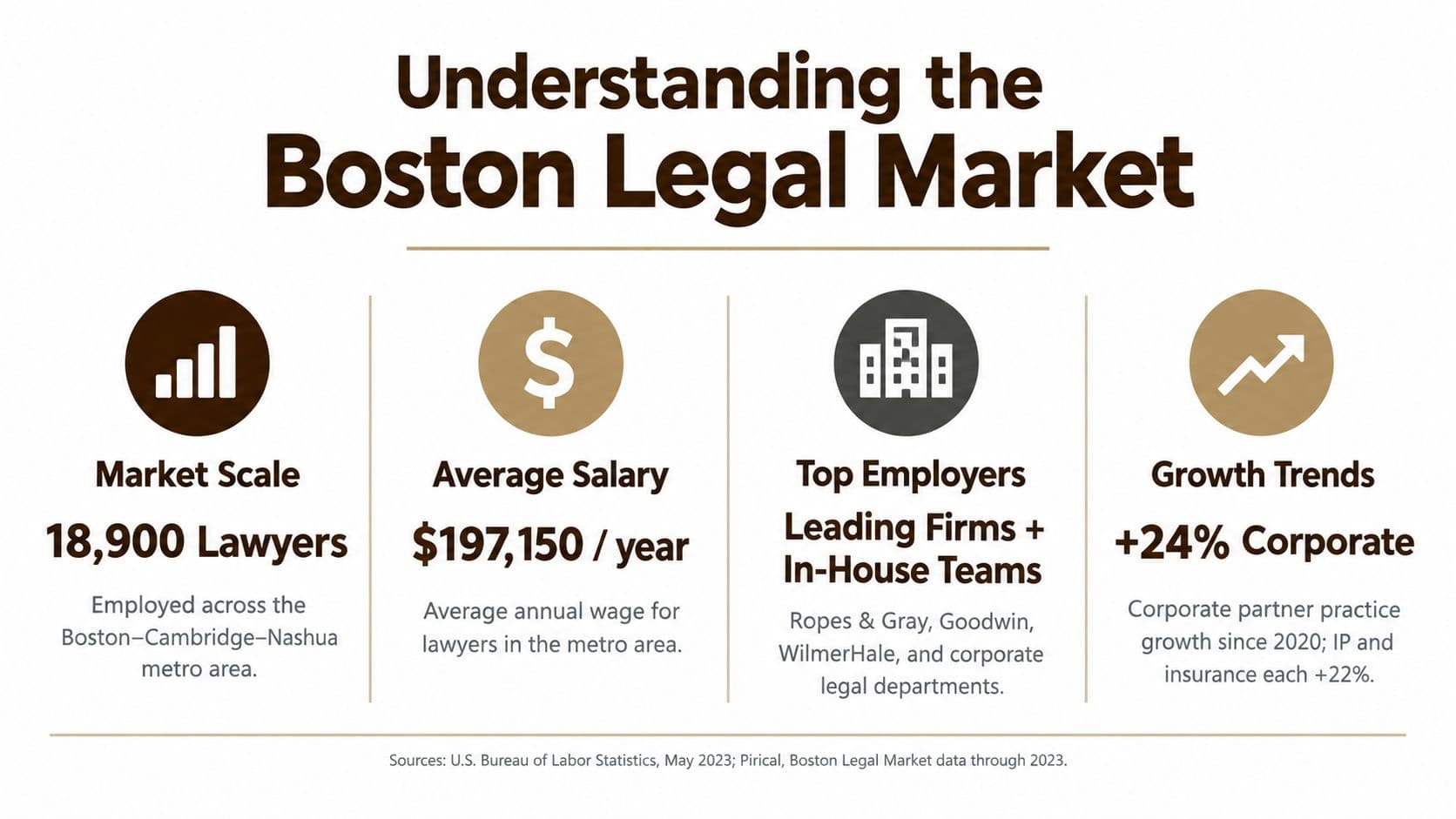
Boston's legal market carries premium economics. In May 2025, the Boston–Cambridge–Newton metropolitan area recorded a mean legal-occupation wage of $84.93 per hour, nearly twice the $43.09 mean hourly wage across all occupations in the region, according to the Bureau of Labor Statistics Boston occupational wage release. Legal jobs represented approximately 1.1% of regional employment, a relatively small occupational base supporting unusually high compensation.
That combination creates a clear hiring implication. A firm isn't filling an ordinary administrative vacancy when it seeks a practice-ready lawyer, senior paralegal, or legal operations leader. It is competing for scarce expertise in a market where candidates have strong alternatives and where an open seat can interfere with matters already promised to clients.
The market has real institutional depth
The earlier BLS baseline reinforces Boston's scale. In May 2021, the Boston–Cambridge–Nashua metropolitan area employed 16,730 lawyers, equal to 6.47 lawyers per 1,000 jobs, with a location quotient of 1.34, meaning lawyer employment was approximately 34% more concentrated than the national average, as reported in the BLS occupational employment and wage data. Mean hourly pay was $82.53, corresponding to an annual mean wage of $171,660. Massachusetts overall employed 19,050 lawyers at an annual mean wage of $167,980.
These figures don't mean every legal role commands the same compensation. They do mean employers need role-specific benchmarking. A corporate associate, litigation partner, in-house compliance counsel, paralegal, and legal operations executive belong to different labor segments and should be assessed against different evidence of value.
Boston is more than a regional market
A 2019 analysis of Boston's law-firm office market counted 26,942 legal-services employees, more than 15,000 of them within Boston itself. The same analysis identified 40 Am Law 100 firms operating in the market and 3,509 Am Law 100 attorneys, averaging 88 attorneys per firm, according to Newmark's analysis of the evolving law-firm office market.
Downtown and Back Bay formed the primary legal-office clusters, while the Seaport District was emerging as another significant location. National firms, regional practices, government employers, universities, healthcare organizations, and life sciences companies draw from overlapping talent networks. That is why a legal recruiter Boston employer can trust must understand both practice specialization and the competitive geography around each role.
Hiring rule: Treat every Boston legal vacancy as a market-pricing and revenue-capacity decision, not merely an open requisition.
What Legal Recruiters Actually Do in Boston
A capable legal recruiter doesn't begin by searching for anyone with a law degree. The work starts with translating the hiring manager's need into evidence.
Suppose a Boston firm needs a litigation associate. “Strong litigation background” isn't enough. The recruiter should clarify the candidate's matter ownership, deposition or trial exposure, client contact, discovery responsibility, writing demands, and expected level of autonomy. For an in-house role, the relevant questions may involve contract throughput, compliance-program scope, commercial judgment, and experience working with business leaders.
The recruiter then maps the talent market. That may include active applicants, passive candidates, attorneys considering a move from another Boston firm, professionals relocating from a different market, and candidates moving between private practice and corporate legal departments. A local network helps, but local knowledge only matters when it produces a more accurate shortlist.

Screening is a judgment exercise
Resume review is the visible part of recruiting. The more important work happens before a candidate reaches the hiring partner.
A specialized recruiter tests whether the candidate's experience matches the actual work. That means distinguishing a lawyer who observed complex matters from one who owned them, a partner with a portable book from one with only historical origination credit, and a paralegal who performed task support from one who can manage deadlines, clients, filings, and case systems independently.
The recruiter also tests motivation. A candidate who wants a higher salary may still reject an offer if the role reduces autonomy, changes progression, increases workload, or removes access to the work that built their reputation. Those details often determine acceptance and retention more reliably than a title.
For a practical breakdown of the role, review what a legal recruiter does in the placement process.
The process continues after the introduction
A good search partner coordinates communication, prepares both sides for interviews, identifies concerns before they become surprises, and keeps the process moving through references, conflicts review, compensation discussions, and the offer stage. The recruiter should know when to challenge a hiring manager's requirements and when to protect a candidate's confidentiality.
In Boston's concentrated market, that judgment prevents indiscriminate outreach. The goal isn't to contact the largest possible number of people. It is to identify candidates whose practice history, expectations, and working style line up with the employer's actual needs.
Why Law Firms and In-House Teams Use Recruiters
Boston employers use recruiters because internal hiring usually breaks down at the point where the search becomes most valuable. Internal teams can post a role, screen applications, and schedule interviews. They often struggle to reach a passive attorney who isn't applying, assess specialized production history, or keep a demanding search moving while the legal department is already overloaded.
The opportunity cost is especially serious in legal work. A missing associate can leave partners carrying matters that should be delegated. An open paralegal seat can slow filings, discovery, or client communication. A vacant in-house counsel role can leave commercial teams waiting for contract review or escalate routine decisions to senior legal leaders.
Recruiting support matters when the employer needs a tighter process, not merely more names.
External reach improves the starting point
A recruiter with legal networks can approach candidates who won't respond to a generic job advertisement. The value isn't access alone. It is the ability to explain the role credibly, preserve confidentiality, and determine whether the move makes sense before asking the employer to invest interview time.
That distinction is important for partner and lateral hiring. A candidate may look attractive because of firm brand, title, or academic credentials, but the underlying question is whether the candidate can perform the work the hiring team needs now. Recruiters should probe client ownership, matter type, deal or case responsibility, collections, realization, and business-development evidence where relevant.
Screening reduces mismatch risk
Credential depth doesn't equal production readiness. The employer needs someone who can operate within its workflows, communicate with its clients, and collaborate with its lawyers or business stakeholders.
A structured screening process can examine:
- Practice alignment: Does the candidate's experience match the matters, industries, and level of responsibility in the role?
- Work output: Can the candidate describe concrete ownership of cases, transactions, contracts, compliance work, or operational systems?
- Team compatibility: Will the person work effectively with the supervising partner, general counsel, support staff, and business leaders?
- Motivation: Is the candidate moving toward a defined opportunity, or merely away from a current frustration?
- Expectations: Do compensation, progression, workload, flexibility, and location align before the employer invests further?
Capacity expands without fixed hiring overhead
Growth periods create a practical problem. The internal recruiting function may understand the organization well but lack the bandwidth to run several specialized searches simultaneously. An external contingency partner can add sourcing and evaluation capacity without requiring the employer to build a permanent recruiting team for a temporary hiring surge.
That model only works when the recruiter communicates clearly and submits selectively. A high volume of weak profiles shifts work back to the hiring manager. The right partner acts as an extension of the team, with a defined intake, agreed evaluation criteria, regular updates, and accountability for candidate quality.
Contingency versus Retained Search in Legal Recruiting
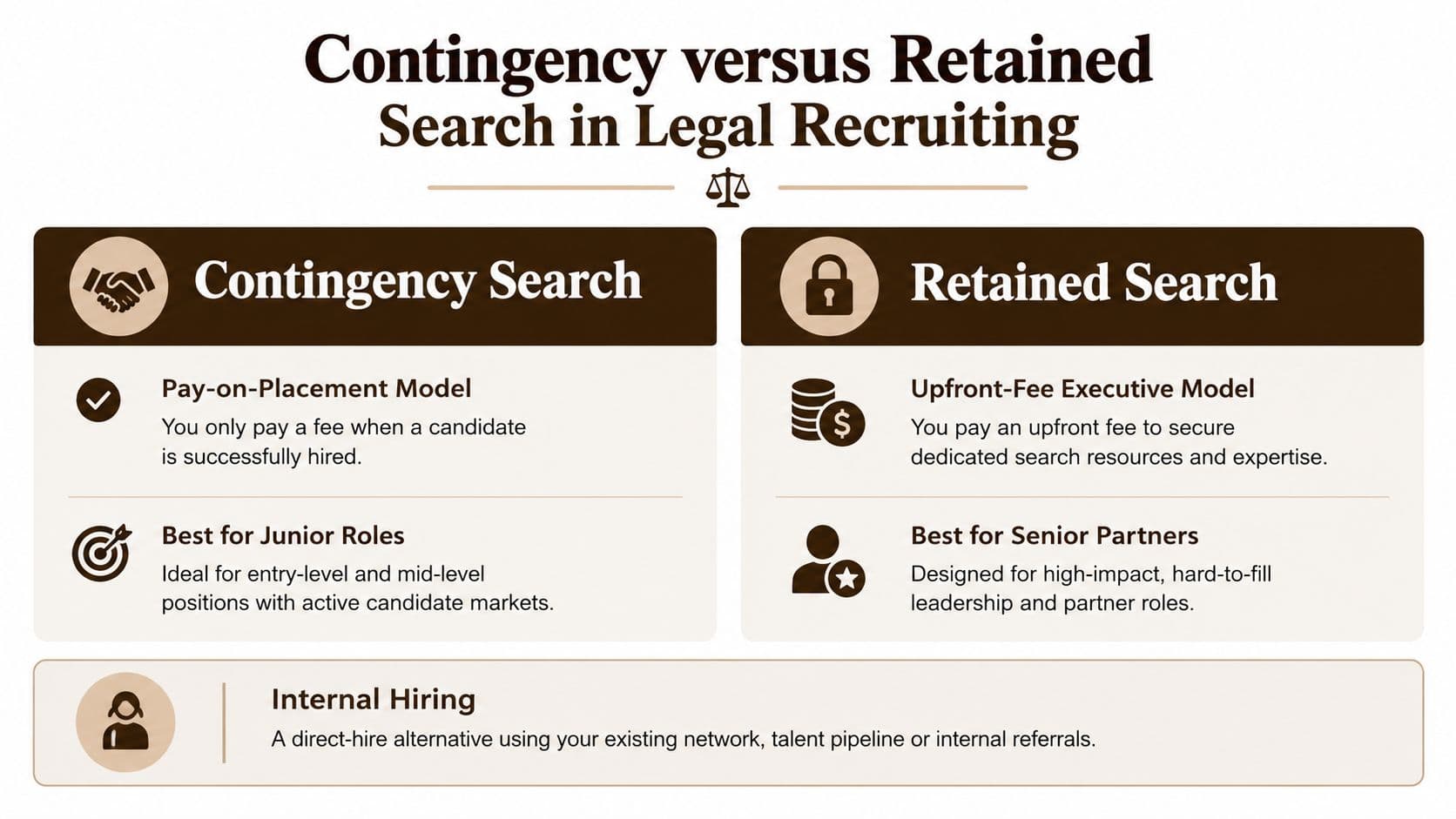
The right recruiting model depends on the role's seniority, urgency, confidentiality, and difficulty. Contingency search is generally strongest when an employer wants speed and financial flexibility. The recruiter is paid after a successful hire, so the employer can test the relationship while preserving cash until the search produces an outcome.
Retained search makes more sense when the employer needs a dedicated, highly confidential campaign for a senior partner, general counsel, or executive legal leader. The upfront commitment gives the search firm a stronger mandate to map the market, manage a controlled process, and devote sustained attention to a narrow candidate pool.
Internal hiring remains appropriate when the organization already has the network, recruiting expertise, and time to manage the search without outside support.
Compare the models by decision criteria
| Hiring consideration | Contingency search | Retained search | Internal hiring |
|---|---|---|---|
| Payment structure | Payment follows a successful placement | Fees begin under an agreed engagement | Recruiting costs remain internal |
| Best fit | Associates, support professionals, in-house roles, and many permanent searches | Senior partners, general counsel, and confidential executive roles | Roles with an established internal talent pipeline |
| Speed | Can move quickly when requirements are clear | Deliberate market mapping and controlled outreach | Depends on team capacity and network depth |
| Customization | Strong when the recruiter conducts tailored screening | Typically highly customized and dedicated | Depends on internal legal recruiting capability |
| Employer risk | Lower financial exposure before placement | Higher upfront commitment, with greater dedicated focus | No external placement fee, but internal time has a cost |
The mistake is treating the fee model as the only economic variable. A contingency search can be inexpensive to start but wasteful if the recruiter submits poorly matched candidates. A retained search can justify its structure when the role is strategically important and confidential, but it may be excessive for a clearly defined position with an accessible talent pool.
For a deeper explanation of the retained model, see how retained search works for senior legal hiring.
Decision test: Choose contingency when you need selective speed with limited upfront exposure. Choose retained search when the search requires exclusivity, discretion, and sustained executive-level market work.
Internal hiring wins when a firm already has credible relationships with the target candidates and can assign a decision-maker who understands the practice. It loses when the legal team is too busy to source, screen, and close candidates while managing active client work.
How to Evaluate a Legal Recruiter in Boston
Don't select a legal recruiter Boston firm because its website lists many practice areas. Ask how the recruiter will evaluate the exact work your hire must perform, how candidates will be sourced, and what the employer will see before an interview.
Start with market knowledge, then test the process. A recruiter should be able to discuss Boston's law-firm and in-house environment without reducing every search to a salary conversation. The recruiter should also understand that a partner, associate, paralegal, and legal operations leader require different screening standards.
Use this evaluation checklist
-
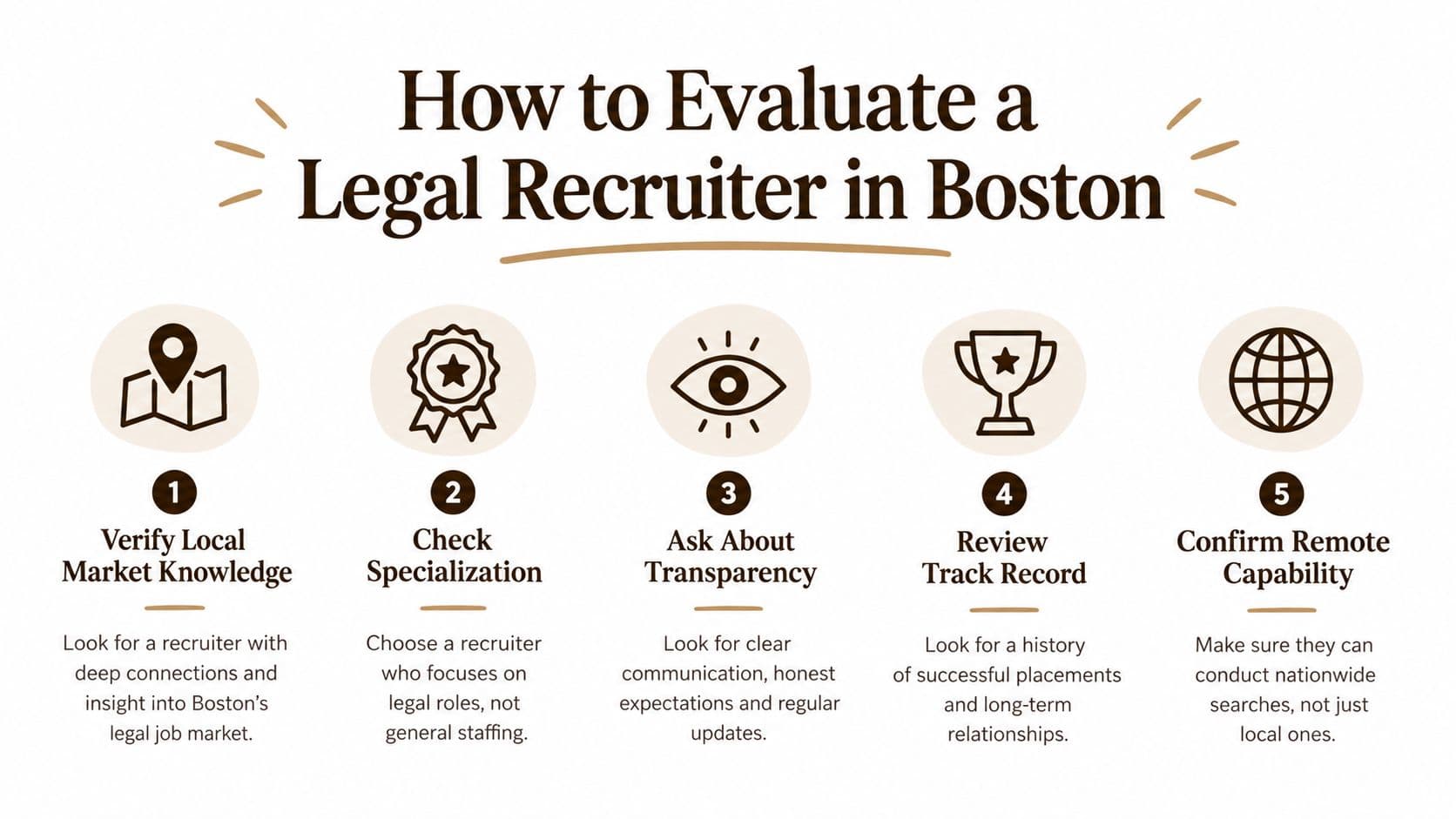
Verify local market knowledge. Ask which Boston firms, corporate legal departments, industries, and practice communities the recruiter knows. The answer should include a sourcing strategy, not just neighborhood names.
-
Check specialization. Confirm experience with the role category you need. A recruiter who places litigation attorneys may not know how to evaluate an in-house commercial counsel or a legal operations executive.
-
Ask about screening. Require an explanation of how the recruiter tests bar status where relevant, matter ownership, technical skills, client development, technology fluency, motivation, and culture fit.
-
Review the track record. Ask for relevant placement examples in qualitative terms if confidentiality limits disclosure. You should still learn whether the recruiter handles comparable seniority, practice areas, and employer types.
-
Confirm remote capability. If the role can be performed remotely or the search covers multiple offices, determine whether the recruiter can source and coordinate candidates beyond the immediate Boston area.
Watch for warning signs
A recruiter who promises an immediate shortlist before understanding the role is optimizing for submission volume. So is a recruiter who cannot explain why a candidate fits, hides fee terms, or treats conflicts review as the employer's problem.
Use the legal recruiting firm comparison guide to structure your evaluation, then ask each firm the same questions. Consistent questions expose differences in process quality.
Communication is another practical test. Strong recruiters confirm priorities, report market feedback, flag compensation tension early, and explain candidate withdrawals. If updates arrive only after the hiring manager asks, the engagement is unlikely to improve once interviews begin.
How Five Star Placements Handles Boston and Remote Searches
Five Star Placements provides contingency-based permanent placement for law firms and corporate legal departments, covering attorneys, partners, in-house counsel, legal support staff, and legal operations leaders. Its stated operating model uses payment upon successful hire with no upfront costs, while screening extends beyond resumes to experience, skills, practice fit, and organizational culture.
That structure fits a Boston search when the employer needs targeted sourcing without committing to a retained executive campaign. It also gives the hiring manager a clear test of process quality. The recruiter must understand the role, present relevant candidates, and keep the employer informed before any placement fee becomes due.
The role scope is broad, but the screening should stay specific
The firm's coverage includes litigation, personal injury, trusts and estates, family law, immigration, construction, business and corporate law, labor and employment, tax, real estate, and healthcare. It also handles partner and lateral team searches, including managing, equity, senior, junior, corporate, employment, real estate, and tax partners.
For corporate legal departments, the stated areas include general counsel, corporate counsel, compliance, intellectual property, mergers and acquisitions, contracts, and tax. Support and operations searches include paralegals, legal assistants, legal secretaries, law clerks, records clerks, case managers, intake specialists, litigation support specialists, firm administrators, finance leaders, legal recruiting directors, human resources leaders, and related management roles.
Breadth only creates value when the intake remains disciplined. A recruiter shouldn't apply the same questions to a trial lawyer and a legal operations candidate. Each search needs a scorecard tied to the work, reporting line, decision rights, and success measures of that position.
A credible process stays collaborative
The stated service also includes candidate interview coaching and training and development support aligned to client processes. That can help when candidates need to present their experience clearly, especially in lateral searches where the employer is evaluating both legal capability and business fit.
The firm describes its engagement as an extension of the client team, with transparent communication and proactive updates. Those claims should be tested during the intake conversation. Ask who owns the search, how often feedback is shared, how candidate concerns are escalated, and how the recruiter handles a change in requirements.
For Boston and remote searches, nationwide reach can widen access while local market knowledge keeps the shortlist relevant. The employer should still insist on evidence of practice readiness, compensation alignment, and genuine interest in the specific role.
The Hidden Risks of Fast Hiring in a Booming Market
Boston's lateral market has accelerated sharply. Available coverage reports a 156% year-over-year increase in Boston lateral hiring, with average lateral associate hires per office rising 138.9% and partner hires rising 116.7% among reporting offices, as summarized in Sartori Global's Boston legal recruiting coverage.
Those figures signal activity, not guaranteed quality. They don't establish whether the rebound reflects durable demand, concentrated hiring by elite firms, a small-base effect, or movement in particular practices. A busy market can make employers feel pressure to accept a candidate before the evidence is complete.
Speed amplifies familiar hiring failures
Conflicts of interest require careful review, especially when a lateral lawyer brings relationships, matters, or information from a former firm. A partner's claimed book of business also needs validation. Ask for evidence of portable clients, origination responsibility, realization, collections, and the likelihood that clients will follow.
Compensation creates another trap. A high base salary may conceal weak progression, limited origination credit, heavy workload, or a mismatch between promised and achievable economics. Firms should benchmark against national alternatives as well as Boston expectations, then compare the full structure rather than one headline figure.
Culture mismatch often appears after the offer because rushed processes focus on credentials and urgency. Interviewers should test how the candidate handles supervision, delegation, business development, feedback, technology, and client pressure. Candidates should ask the same questions about workload, advancement, evaluation, and decision-making.
The practical conclusion: A booming lateral market increases the value of careful screening. Speed gets the candidate into the process, but evidence determines whether the hire deserves an offer.
Five Star Placements offers contingency-based permanent placement for Boston and remote legal searches, including attorneys, partners, in-house counsel, support professionals, and legal operations leaders. If you need a practice-specific shortlist with screening focused on fit and readiness, visit Five Star Placements to discuss the role.
Need help filling a legal role?
Five Star Placements partners with law firms and legal departments nationwide.
Schedule a Call