
Legal Recruiting Firm Comparison That Actually Works
July 24, 2026 · 14 min read · Five Star Placements

Table of contents
Most advice on a legal recruiting firm comparison gets the decision backwards. It starts with brand names, office count, or who appears first on a search page, then pretends that prestige tells you whether the recruiter can fill your role. It doesn't. The right question is simpler and more useful, which recruiter model fits the hiring problem you have in front of you.
That matters because the U.S. legal recruiting market is fragmented, with 902 legal recruiting office locations across the country serving over 1.3 million licensed lawyers legal recruiter directory data. In a market like that, the strongest firm is usually the one that understands your vacancy type, your urgency, and the level of risk you're willing to take on a bad hire. A large brand can still be wrong for the job.
| Recruiter model | What it signals | Best fit |
|---|---|---|
| Contingency permanent placement | Pay on hire, no upfront fee | Mid-level attorneys, support staff, many in-house roles |
| Retained search | Upfront commitment, tighter control, exclusivity | Partners, general counsel, senior leadership |
| Contract or project staffing | Faster coverage, flexible duration | Urgent backfills, leave coverage, project spikes |
| Hybrid model | Mix of search and staffing behavior | Mixed pipelines, uncertain scopes, evolving needs |
The cleanest way to compare firms is to stop asking, “Who's the biggest?” and start asking, “Who can solve this specific hiring problem without wasting partner time?”
Table of Contents
- Why the Biggest Legal Recruiter Is Rarely the Best One
- Recruiter Business Models and What Each One Actually Costs
- The Seven Criteria That Actually Predict Recruiting Quality
- Interview Questions That Expose Weak Legal Recruiters
- Matching Recruiters to Real Hiring Scenarios
- Cost, Opportunity Cost, and ROI in Legal Recruiting
- Running a 30-60-90 Day Search Engagement
- Choosing the Right Firm and Common Buyer Questions
Why the Biggest Legal Recruiter Is Rarely the Best One
The biggest mistake in a legal recruiting firm comparison is assuming scale equals fit. It doesn't. A firm can have a broad footprint and still be the wrong choice if its process is built for senior partner searches when you need a fast mid-level backfill, or if it's optimized for temporary coverage when you need a confidential lateral move.

Contingency permanent placement
This model is paid only when you hire. It usually fits mid-level roles and other searches where you want competitive sourcing without paying up front. The upside is clear, no fee unless the hire lands. The trade-off is that the recruiter has to move quickly and screen hard, or you end up with a flood of resumes and little signal.
Retained search
Retained search is built for senior, partner, and high-stakes in-house roles. You're buying exclusivity, deeper intake, and a search that behaves more like a project than a resume pipeline. That's the right move when the cost of a miss is high, but it's usually overkill for a standard associate replacement.
Contract and project staffing
Contract staffing is the blunt instrument in the best sense. It's for urgent coverage, project spikes, leave replacement, and situations where you need a qualified body in seat quickly. It won't solve every hiring problem, but it will solve the ones that punish delay.
Hybrid models
Hybrid firms blur the lines, sometimes mixing permanent placement, contract staffing, and advisory support. That can be useful when the vacancy is still forming or when the department wants flexibility on search scope. It can also hide confusion. If a firm can't clearly explain its model, assume the candidate experience will be messy too.
Practical rule: match the recruiter's business model to the vacancy's business impact. If the role is mid-level and urgent, contingency usually makes more sense than retained search.
Legal hiring volume also moves in cycles. A data-driven analysis reported that 2023 lateral hiring was down 16.9% from 2022 and 19.3% from 2021, with corporate laterals rebounding to 529 hires in Q4 2023 but still below the 1,139 corporate lateral hires in Q2 2022 legal talent market analysis. That kind of volatility is why brand-name comfort isn't enough. You want a recruiter who knows how to work in a softer market, not one who only looks strong when demand is easy.
Recruiter Business Models and What Each One Actually Costs
The most common error I see is treating all recruiters as if they sell the same thing. They don't. Fee structure, speed, and candidate access all change depending on the model, and that changes what you should expect from the search.
Recruiter engagement models at a glance
| Model | Typical Fee | Typical Timeline | Best For |
|---|---|---|---|
| Contingency permanent placement | Success fee on hire | Faster once intake is clear | Mid-level attorneys, legal support, many routine backfills |
| Retained search | Upfront and milestone-based fee | Slower, more controlled | Partners, general counsel, leadership roles |
| Contract staffing | Hourly or project-based pricing | Fastest for immediate coverage | Leave coverage, overflow, short-term needs |
| Hybrid | Mixed structure | Depends on scope | Unclear or changing hiring needs |
Contingency is simple. The firm gets paid when you hire, so the recruiter has an incentive to keep the pipeline moving and present candidates who can close. The downside is that the firm may prioritize searches that look winnable.
Retained search is different. You're paying for commitment, market mapping, and a process that usually includes tighter exclusivity. That's sensible for a partner move or a senior in-house seat where discretion matters. It's not sensible if you just need a capable litigation associate who can start quickly.
Contract staffing solves a different problem entirely. It's about coverage, not permanent placement. If your department is underwater because of leave coverage, a matter spike, or a temporary surge in document-heavy work, contract talent is usually the cleanest route.
A hybrid firm can be useful when you aren't fully sure whether the need is interim or permanent. But you need clarity early. If the firm can't explain whether it is acting as a staffing shop, a search firm, or both, the search will usually drift.
A useful comparison site should make these distinctions obvious. The clearest external guide I'd point buyers to is the legal recruitment services for firms guide, because it draws a clean line between contingency placement, retained search, and contract staffing instead of flattening them into one generic service.
The Seven Criteria That Actually Predict Recruiting Quality
A good recruiter doesn't just know the market. It knows how to run a search. That sounds obvious, but most vendor calls are still packed with vague claims about “deep networks” and “strong relationships.” Those phrases tell you almost nothing.
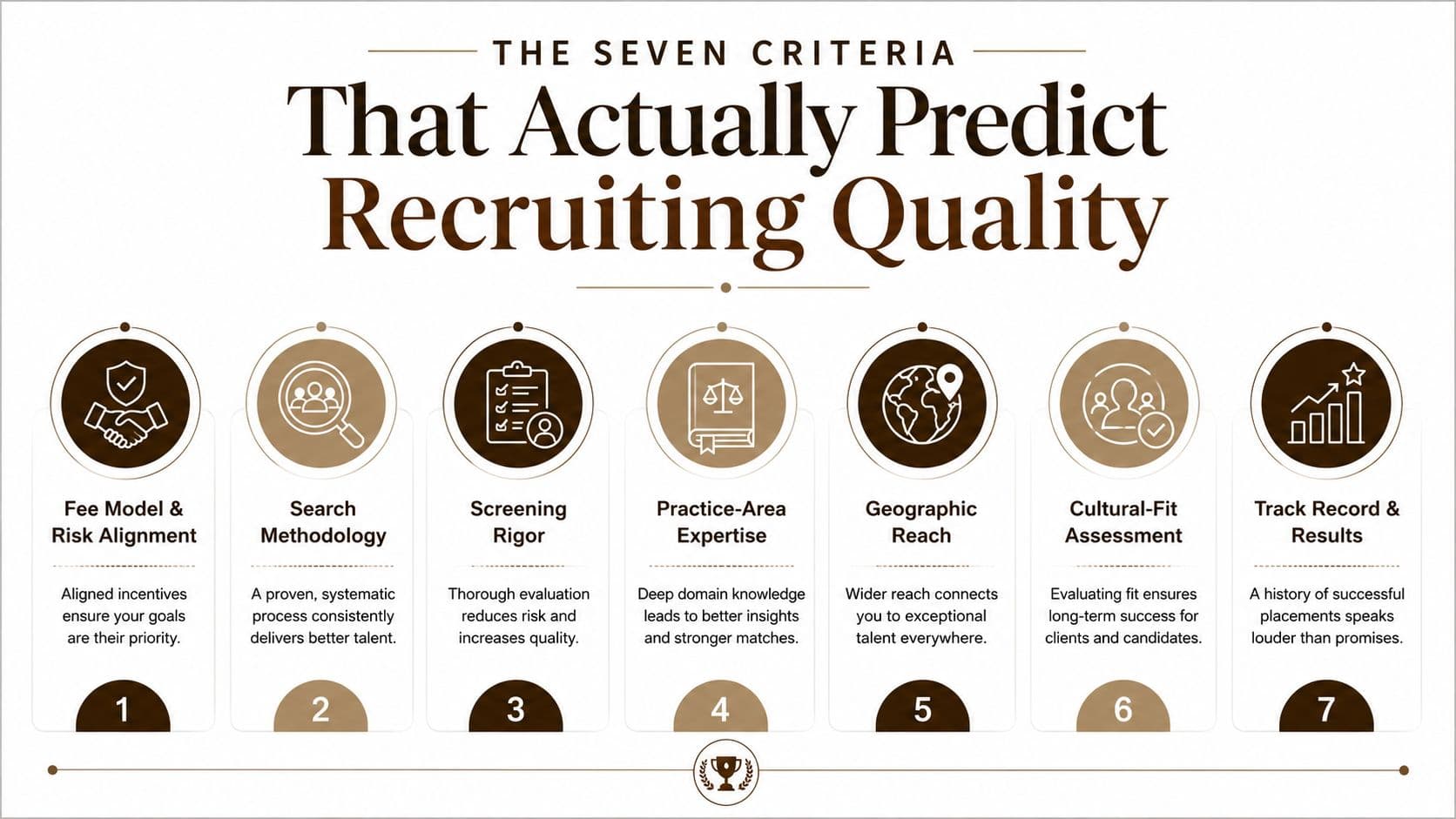
The scorecard worth using
Use the same seven criteria on every shortlist. Score each firm on a simple scale, then compare totals only after you've read the notes.
- Fee model and risk alignment. Ask whether the payment trigger matches your tolerance for risk. A weak answer sounds like a slogan. A strong answer explains exactly when money changes hands.
- Search methodology. You want to hear how the firm sources, screens, and calibrates candidates. If the answer is mostly “we know people,” keep moving.
- Screening rigor. Look for proof of role-specific vetting, not a promise to “send great people.” Weak screening usually shows up as broad, unfocused submissions.
- Practice-area expertise. A recruiter who can talk intelligently about one practice area may still be weak in another. Don't assume cross-coverage.
- Geographic reach. Reach matters, but only if it's tied to the right candidate pool. A national network is useful if the recruiter can also narrow quickly.
- Cultural-fit assessment. Many firms stay vague. Ask what they test. If they only mention “personality,” that's not enough.
- Reporting cadence. You need a firm that gives timely updates, not one that disappears until a candidate declines.
Strong signal: if a recruiter can't explain its screening process in plain language, it probably doesn't have one that you'd want to rely on.
For a firm that wants a benchmark on how recruiters present themselves, the Five Star Placements blog is a useful example of how a recruiter can frame practice coverage, timing, and fee clarity without hiding the operating model. I'd still judge the firm on the seven criteria above, not on marketing language.
A final point. Don't compare every search the same way. Associate hiring, partner search, and in-house leadership all weight these criteria differently. For a partner search, practice-area depth and discretion matter more. For a faster in-house backfill, reporting cadence and speed matter more.
Interview Questions That Expose Weak Legal Recruiters
Most recruiters sound competent until you ask them a question that forces specificity. Then the weak ones start talking in circles. That's why vendor interviews should feel less like a sales call and more like a diagnostic.
Ten questions that separate real operators from resume distributors
- What kinds of roles have you filled recently in this practice area? You want recent, relevant placements, not a general story about “legal recruiting.”
- How many candidates do you usually submit before a placement closes? This reveals whether the firm screens tightly or sprays and prays.
- How do you screen for bar status, practice fit, and cultural fit? If the answer is vague, the process is weak.
- What's your process from intake to first submittal? A disciplined firm can walk you through it without improvising.
- Who does the screening, and who handles candidate communication? You want to know where accountability sits.
- How do you handle confidentiality on lateral or replacement searches? If the recruiter seems casual about discretion, that's a problem.
- What happens when a candidate drops out after interview one? Strong firms have a response pattern. Weak firms blame the market.
- How do you talk through fee structure and replacement terms? Fee ambiguity is a warning sign.
- What feedback do you want from us after each round? Good firms use feedback to tighten the search. Bad ones ignore it.
- What's the best reason to choose your firm over another one on this shortlist? This forces the recruiter to stop reciting the brochure.
The single most diagnostic question is this, “Show me how you screen candidates before submission.” If the answer is generic, the rest of the pitch usually is too.
The most reliable benchmark I'd add is operational, not rhetorical. A high-performing recruiter should deliver first qualified candidates within 3 to 5 business days from the job brief, while a weak process often shows up when the firm needs to review 8 candidates per placement recruitment benchmarks. Those numbers don't tell you everything, but they do tell you whether the firm is efficient or just busy.
A weak recruiter can also hide behind confidence. Don't let it. If the answers sound rehearsed, push harder. If they still sound vague, drop the firm.
Matching Recruiters to Real Hiring Scenarios
Different vacancies need different recruiter behavior. That's the heart of a real legal recruiting firm comparison, and it's where most generic ranking pages fall apart. They tell you who is “good,” but not who is good for the exact problem you have.
Mid-level litigation associate replacement
A regional firm replacing a mid-level litigator should usually start with contingency permanent placement. The need is real, the timeline matters, and the seat probably doesn't justify retained economics. The shortlist should be built around recruiters who can show recent associate placements, not just senior names.
Screen for one thing above all else, submission quality. You want candidates who already clear practice fit and bar requirements before they hit the partner's inbox. If the recruiter floods you with near-misses, the problem isn't the market. It's the filter.
Partner move into a growing boutique
A boutique adding a partner needs a different tool. Retained search starts to make sense, because the move is usually confidential, the compensation structure is sensitive, and the cultural risk is high. A recruiter that does partner work should know how to frame platform, books, and lateral fit without overselling.
In-house compliance lead hire
An in-house compliance lead is often a hybrid of legal judgment, policy fluency, and operational discipline. For that kind of seat, the recruiter has to understand adjacent leadership roles, not just attorney titles. That's where the 2025 hiring split matters, because the market is increasingly divided between traditional legal roles and adjacent leadership functions like legal operations, finance, HR, compliance, and technology-adjacent positions legal staffing trends.
If you need one provider that can cover both attorney placement and legal support staffing, Five Star Placements is one option among several. Use that kind of firm when your search spans attorneys, legal operations leaders, and support staff, but still hold it to the same standard as every other recruiter on the list.
Cost, Opportunity Cost, and ROI in Legal Recruiting
Fee panic leads buyers astray. A lower fee does not automatically mean lower cost. A slow search, a bad submission cycle, or a weak hire can cost more than the recruiter's invoice ever will.
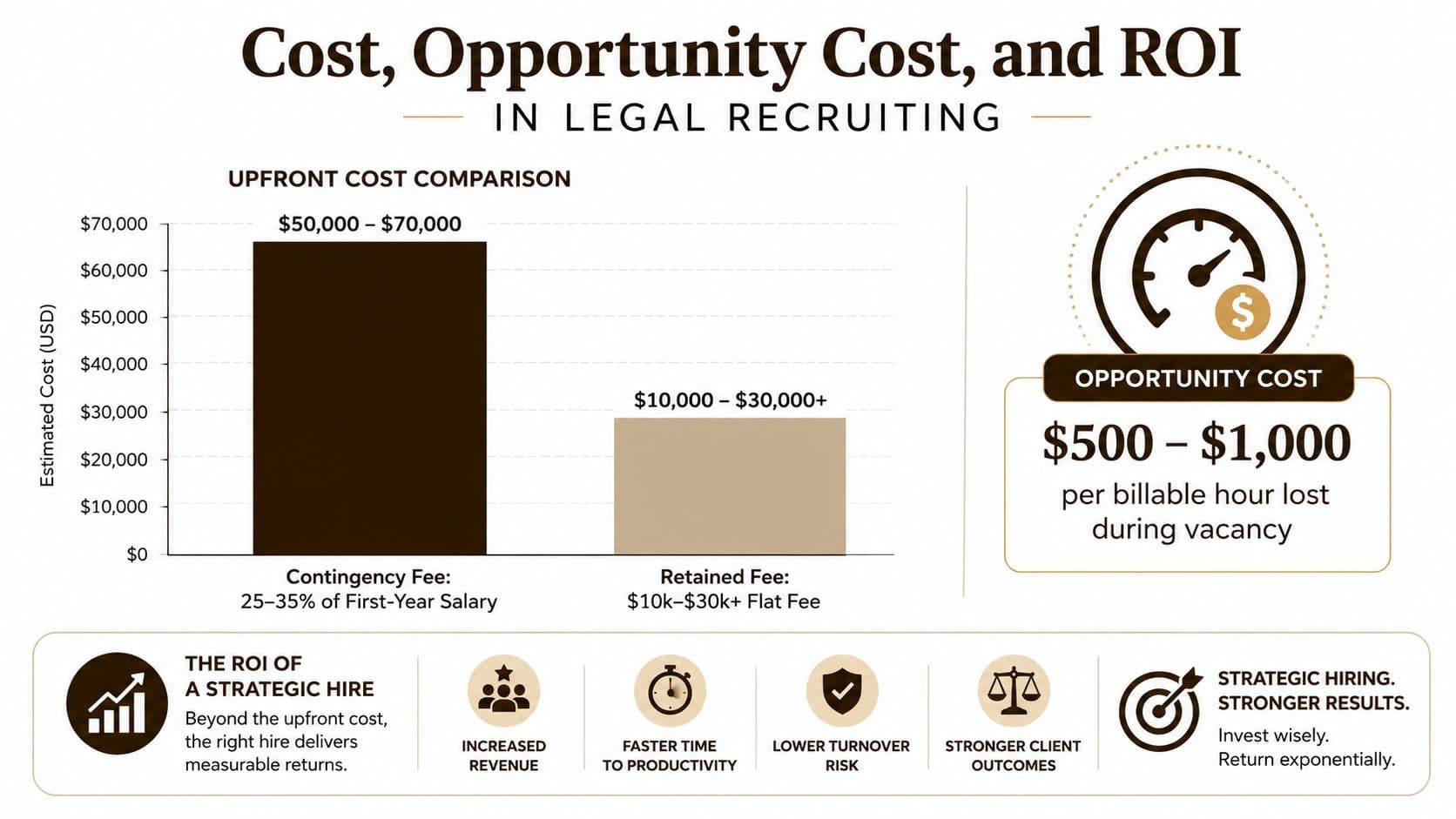
The real math
Contingency pricing is straightforward because the fee is tied to the hire. Retained search is different because some of the cost is paid before the placement closes. Either way, the fee should be compared against the cost of a seat that stays open too long, because vacant roles create coverage gaps, slow matters, and increase pressure on the people who are already there.
The more useful proxy is not the invoice. It's screening precision. If a recruiter brings fewer, better candidates and gets to an accepted offer faster, the search is cheaper in practical terms even if the fee looks higher on paper.
How to think about ROI
The finance team will ask for cost-per-hire. Give them the fee, the time-to-fill, and the business impact of the open seat. Then compare that to the internal time your partners or legal leaders are spending on interviews, re-reviews, and candidate follow-up. That's the cost stack.
If the recruiter shortens the vacancy and reduces partner time, the search can justify a higher fee.
The phrase “opportunity cost” gets used loosely, but in legal hiring it's real. Matters wait. Clients notice when coverage gets thin. Teams stretch. A recruiter that helps you close the seat faster can create better ROI even if its fee is not the cheapest on the slate.
Running a 30-60-90 Day Search Engagement
A recruiter should be managed like any other outside advisor. If you don't set checkpoints, you'll find out too late that the search has drifted. The cleanest way to do that is a 30-60-90 day cadence.
What good looks like early
By day 30, the firm should have done the intake work, aligned on target profiles, and started delivering a calibrated shortlist. If the recruiter hasn't asked sharp questions about the role, the team, and the culture, the search is already soft.
By day 60, you should be talking to interview-ready finalists, not recycled resumes. You should also be hearing market feedback that helps you adjust the pitch if needed. If the recruiter only reports activity and never gives you signal, that's a problem.
By day 90, a serious search should be closing or at least in offer-stage motion. That's the point where candidate drop-off, slow internal feedback, or weak positioning usually becomes visible.
Red flags that justify a switch
- Missed intake meetings. If the first step gets sloppy, the rest usually follows.
- Generic submissions. This means the recruiter isn't really filtering.
- Slow response times. Candidates move on, especially in competitive searches.
- Weak candidate storytelling. If experience is being oversold, expect disappointment later.
A good cadence also includes weekly check-ins. Those don't need to be long, but they do need to be disciplined. You're looking for movement, candidate reactions, and any change in the market that affects your close rate.
If a firm stops creating momentum, replace it. Don't let a search bleed time.
For firms that want a direct line of communication rather than a generic intake form, the Five Star Placements contact page is a straightforward place to start if you're comparing how different recruiters handle early engagement.
Choosing the Right Firm and Common Buyer Questions
The right choice is simple once you stop comparing by logo. Match the vacancy to the recruiter model, then judge the firm on screening rigor, practice knowledge, and responsiveness. If the role is mid-level and time pressure is real, contingency permanent placement is usually the right first call. If the role is senior, confidential, or highly strategic, retained search deserves a look.
Common buyer questions
Can I negotiate fees? Yes, but negotiate around scope and replacement terms, not just percentage. A lower fee is useless if the recruiter can't fill the seat.
Should I use multiple recruiters on the same search? Only if the role is broad enough and you can manage the process. For high-stakes searches, too many cooks usually creates candidate confusion.
What retention guarantee should I ask for? Ask every firm what happens if the hire leaves early. The answer should be clear, written, and tied to replacement or credit terms.
Boutique or national firm? Choose by placement history, not geography. A boutique that knows your practice area beats a national firm that only knows the market in theory.
You can review a firm's scope and services on the Five Star Placements about page, but don't let any single profile do the thinking for you. Use the same yardstick on every recruiter.
The takeaway is blunt. Pick the firm that fits the vacancy, not the one with the loudest name.
A CTA for Five Star Placements.
Need help filling a legal role?
Five Star Placements partners with law firms and legal departments nationwide.
Schedule a Call