
Corporate Litigation Attorneys: Roles, Skills, and Hiring
September 20, 2026 · 18 min read · Five Star Placements

Table of contents
If you're hiring for a litigation role because one major case just landed on your desk, you're already late. Most legal leaders call for help when the pressure is visible: a regulator asks questions, a vendor dispute turns ugly, a class claim arrives, or the board wants a clean risk picture by Friday. By then, the issue isn't just courtroom capacity. It's whether the lawyer can stabilize the business around the dispute.
That's the mistake a lot of companies make when they think about corporate litigation attorneys. They picture brief writing, depositions, and maybe a trial. The modern job is wider than that. In practice, the strongest litigators now sit at the intersection of disputes, investigations, data governance, executive communication, outside counsel control, and operational risk.
I say that plainly because the hiring market rewards the wrong signals all the time. A polished resume can hide weak judgment. A candidate with fewer headline credentials can outperform in-house because they know how to manage facts, people, vendors, and business fallout at the same time. That gap matters when legal spend is climbing and matter complexity keeps spreading into privacy, cybersecurity, and AI-related exposure.
Table of Contents
- Who Corporate Litigation Attorneys Really Serve
- What the Role Actually Covers Day to Day
- Skills and Experience That Define Strong Candidates
- Where Modern Corporate Disputes Are Heading
- Hiring Criteria That Matter Most in 2026
- How to Source and Evaluate Litigation Talent
- Compensation Benchmarks and Negotiation Ranges
Who Corporate Litigation Attorneys Really Serve
A common situation looks like this. A legal operations leader at a growing software company starts the week with one active commercial dispute. By Thursday, there are multiple subpoenas, a regulator wants records, a former vendor alleges breach, and employment counsel flags class exposure. Nobody inside the company experiences those as separate legal events. They experience them as one business problem with legal consequences.
That is who corporate litigation attorneys really serve. Not just the company in the abstract, but the people inside it who need legal risk translated into decisions. That includes the general counsel, yes, but also the board, finance, HR, security, product, compliance, and business unit leaders whose records, witnesses, budgets, and timelines are suddenly part of the matter.
The internal client is broader than most job descriptions admit
The weakest role descriptions still describe litigators as if their job begins with a filed complaint. In reality, the better ones are brought in earlier, when facts are still being gathered and when a company can still avoid making the case worse.
Internal clients usually include:
- Board and executives: They want exposure framed in business terms, not memo language.
- Finance leaders: They need reserve thinking, spend visibility, and outside counsel discipline.
- HR and people teams: They often hold key documents, policies, and witnesses in employment and retaliation matters.
- Privacy, security, and product leaders: They become central when the dispute touches data use, breach response, model outputs, or platform design.
That overlap is one reason the line between litigation and legal operations keeps getting thinner. The legal department doesn't just need a courtroom advocate. It often needs someone who understands where the dispute sits in the larger law department structure. That distinction matters when companies compare in-house counsel and general counsel responsibilities because a litigation hire may end up supporting both strategic and operating functions.
The external audience shapes the work
Corporate litigation attorneys also serve audiences outside the company. Courts, regulators, arbitrators, opposing counsel, insurers, and e-discovery vendors all influence strategy. A strong litigator knows each audience requires a different kind of precision.
Practical rule: The lawyer who can explain one matter three ways, to a judge, to a CFO, and to an engineering lead, is usually far more valuable than the one who only writes well to other lawyers.
This is part of why the role has shifted from episodic trial work to continuous risk-preparedness. Litigation hold decisions, preservation scope, custodian management, and early document collection can affect the outcome long before anyone argues a motion. So can choices about what the company says publicly, how it characterizes an incident internally, and whether product teams keep shipping while legal reviews facts.
Corporate litigation has also stayed expensive enough that leadership notices. In a litigation trends survey, 82% of companies said they were involved in at least one lawsuit in 2024, and respondents with revenue above US$1 billion reported average annual litigation spending of US$4.3 million, up from US$3.9 million in 2023. The same survey found 61% expected an increase in the number of in-house litigators. Another industry survey noted that nearly half of departments said matter times were increasing, while average cost per matter exceeded US$100,000, all of which reinforces why companies treat litigation staffing as a risk-management decision, not just a legal one, as summarized in the ACC corporate litigation report.
What the Role Actually Covers Day to Day
Ask hiring managers what they want and you'll hear abstractions. Strategic. Responsive. Business-minded. That language isn't useful unless it ties to work product. Good corporate litigation attorneys produce recognizable outputs, and their value shows up in the quality of those outputs under pressure.
The deliverables that show whether someone can really do the job
On a normal week, the role may include a demand response to a former customer, a preservation notice to internal custodians, a draft opposition to emergency relief, witness preparation for a Rule 30(b)(6) deposition, a revised budget from outside counsel, and a matter update for the executive team.
Those aren't interchangeable tasks. Each one tests a different muscle.
- Demand and cease-and-desist responses: These reveal judgment. Can the lawyer lower the temperature without conceding something harmful?
- Motion drafts and briefs: These test legal writing and issue framing. A strong litigator knows what to leave out.
- Deposition and witness outlines: These show whether the attorney understands both record development and witness psychology.
- Litigation dashboards and status reports: These expose business fluency. If the lawyer can't explain posture, spend, and next-step risk clearly, executives stop trusting the function.
A legal department that handles complex discovery will also need coordination with records teams, internal custodians, and technical support. That's where adjacent roles become part of the equation. Companies that underinvest in litigation support specialists often end up asking litigators to do project-management work they shouldn't be doing.
The recurring skill clusters behind the work
The strongest candidates usually stand out in five areas.
Legal writing that drives decisions
Plenty of lawyers can write at length. Fewer can write for action. The better litigators draft a motion or internal memo that lets the reader decide what to do next.
A weak writer tends to overstate, bury the point, and imitate appellate prose in places where a practical recommendation is needed. In-house teams feel that drag immediately.
Case strategy under incomplete facts
Most disputes start with bad information. Documents are scattered. Internal narratives conflict. Business people are defensive. Opposing claims arrive before the company has a clean timeline.
Strong litigators don't panic in that environment. They build a provisional theory, identify what fact would change the theory, and direct the next round of collection around that.
A good litigation hire doesn't need perfect facts to form a sound first strategy. They need to know which facts matter enough to chase first.
Vendor and spend management
This gets ignored in interviews and then dominates the job. The in-house litigator often has to challenge staffing models, push back on overbroad review plans, manage e-discovery vendors, and keep matter costs aligned with what the business can justify.
Cross-functional communication
A brilliant brief writer who can't talk to security, HR, or finance becomes expensive. Corporate litigation attorneys need enough fluency in the business to ask useful questions and enough discipline to avoid turning every meeting into a law school seminar.
Judgment under time pressure
Emergency filings, regulator deadlines, witness prep, and internal reporting often hit at once. The strongest attorneys know what must be perfect, what must be good enough today, and what can wait until morning.
What hiring managers should ask for
Instead of generic writing samples, ask for examples of work product categories the role needs, with confidential details removed if necessary.
A useful interview packet might include:
- A motion or opposition sample: To test structure and written persuasion.
- A witness prep or deposition outline: To see how the candidate organizes facts and themes.
- An executive matter update: To test communication with non-lawyers.
- A budget or outside counsel management example: To reveal whether the candidate has ever controlled litigation as a business process, not just worked inside one.
Skills and Experience That Define Strong Candidates
The first cut in litigation hiring should be based on fit for the stage of role, not prestige. That's where many searches go off course. Firms and legal departments ask for someone "seasoned" when they really need someone who has handled the right slice of responsibility at the right depth.
Match the candidate to the seat
For junior in-house litigation roles, candidates often come from litigation-heavy firms where they've had meaningful drafting, discovery, and witness-prep responsibility. At the senior counsel level, the more important question is whether they've led matters, supervised outside counsel, and advised business teams directly rather than staffing cases.
For partner-track or business-building roles, the conversation changes again. The issue isn't just technical quality. It's whether the candidate brings a usable niche, referral credibility, or a client-facing profile that can translate inside the target platform.
A quick self-check helps:
- Early-career litigators: Have you owned pieces of matters or just supported them?
- Mid-level candidates: Can you explain decisions you made, not just assignments you completed?
- Senior counsel prospects: Have you delivered advice to executives and managed external teams?
- Partner-level laterals: Is your practice portable in reality, not in theory?
Credentials that actually matter
Some credentials signal immediate usefulness.
- Bar admission in the company's primary venue: This matters more than candidates want to admit.
- Federal court admission: Especially useful where the matter mix skews toward federal disputes.
- Privacy credentials such as CIPP/US or CIPP/E: Worth real attention when the role touches data-heavy products, breach response, or privacy class exposure.
- Trial or arbitration experience: More probative than generic "litigation experience" if the company needs someone who can credibly push a matter toward hearing.
The broader labor market also matters. The U.S. Bureau of Labor Statistics reported 731,340 lawyers employed in May 2023, with a mean annual wage of US$176,470 and a mean hourly wage of US$84.84. Earlier BLS data listed 707,160 lawyers in May 2022 and 681,010 in May 2021, showing steady growth. A labor-market analysis cited within this same data set estimated more than 247,426 litigation attorneys in the United States and projected 10% job growth from 2018 to 2028, with about 80,200 new jobs expected over that decade. The underlying occupational data appears in the BLS lawyer employment and wage tables.
Specialization is no longer optional in many searches
General commercial litigation still matters, but many strong searches now turn on adjacent specialties. Securities, antitrust, IP, employment, white-collar, and privacy each carry different screening standards. The newer lane is AI-related product and risk work, where the best candidates can reason through regulatory overlap, data sourcing questions, model-output claims, and traditional tort theories at the same time.
For candidates assessing themselves, a practical benchmark is whether your profile shows repeatable strength in one lane plus enough breadth to handle neighboring issues. That is usually more marketable than being a pure generalist with no obvious edge. A useful cross-check is to compare your profile against the core skills lawyers need to have, then ask whether your examples are litigation-specific and commercially relevant.
Where Modern Corporate Disputes Are Heading
The old picture of corporate litigation was a contract case, a trade secret fight, maybe an employment suit, and occasional securities work. Those cases still exist. They just no longer define the full perimeter.
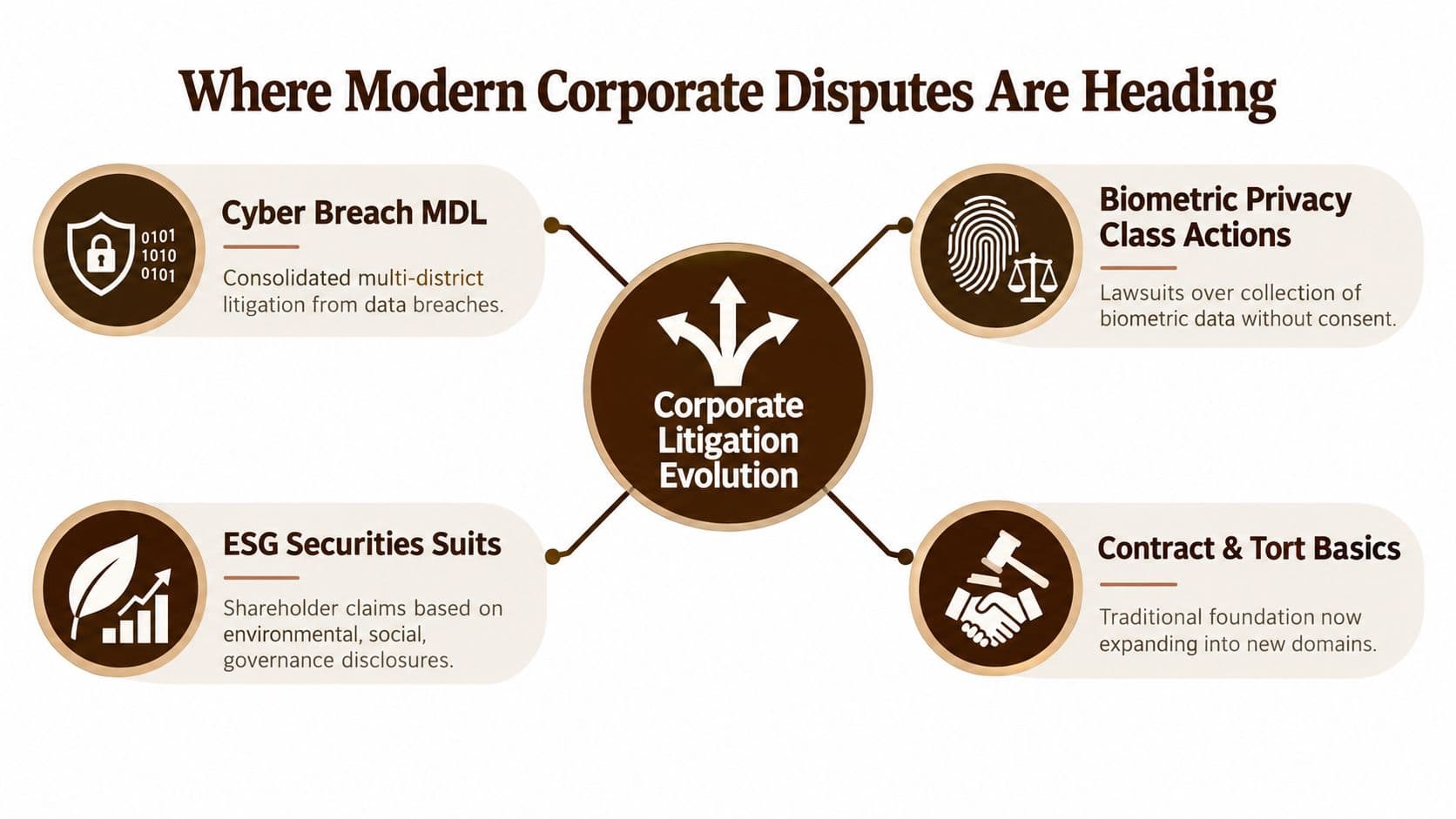
Three modern matter patterns hiring teams keep seeing
A company suffers a ransomware event and suddenly the legal problem is not one case. It's insurer notice, regulator response, preservation, outside forensics coordination, consumer exposure, and class-action defense strategy moving in parallel.
A manufacturer faces one communications statute claim and one biometric privacy claim at the same time. The facts overlap. The forums don't. Settlement logic in one matter can distort the other.
A software business gets questions about pricing tools or automated decision-making. The first phase may look like an inquiry rather than a classic lawsuit, but the attorney still needs to think like a litigator because every document position, internal explanation, and remediation step can shape later claims.
Why this changes the profile of a strong litigator
These matters require venue awareness, regulatory sensitivity, and a feel for insurance posture. They also require comfort with technical teams. A litigator who only knows how to react after a complaint is filed won't be enough for many companies now.
That shift is visible in reported risk patterns. A 2026 litigation survey found cybersecurity and data privacy exposure was the leading increase in risk, with 38% of organizations reporting higher exposure in 2025. Among companies that faced class actions, cybersecurity and data privacy class actions rose to 40%. The same survey reported rising AI-related concern across privacy violations at 47%, bias or discrimination claims at 43%, and regulatory investigations at 42%. It also noted that only 29% of U.S. corporate counsel said they felt very prepared for the next year, down from 46%. Those findings are discussed in the 2026 Norton Rose Fulbright litigation trends survey summary.
The companies making the smartest litigation hires now aren't asking, "Who can defend the case?" They're asking, "Who can help us avoid turning one event into five proceedings?"
Hiring Criteria That Matter Most in 2026
Most hiring teams overweight pedigree and underweight transferability. The candidate may have the right firm name, clerkship, or school, but still fail in the role because they can't run a matter in the company's actual environment.
Use a tighter screen.
Top Hiring Criteria for Corporate Litigation Attorneys, 2026
| Criterion | Weight | Interview Test Question |
|---|---|---|
| Bench depth at the candidate's level | High | Tell me which parts of your last two matters you owned personally, and which parts a partner or client handled. |
| Venue and forum experience | High | Which courts, agencies, or arbitration forums have shaped your judgment most, and why? |
| Business and financial literacy | High | How would you explain this matter's likely spend, timeline, and settlement pressure to a CFO in three minutes? |
| Specialization fit | High | Which recurring fact patterns do you handle better than a general commercial litigator? |
| Culture integration | Medium | What kind of legal team makes you more effective, and what kind slows you down? |
| Executive communication | Medium | Walk me through a time you had to give bad news to a business leader without losing credibility. |
| In-house operating maturity | Medium | When outside counsel sent a plan you disagreed with, what did you change and why? |
| Academic pedigree or firm brand | Low to medium | What in your training still affects how you handle live matters today? |
What each filter really predicts
Bench depth
This is the first real predictor. A fourth-year associate who has substantively argued strategy, drafted key motions, and managed witnesses can outperform a more senior lawyer who has mostly edited from above.
Red flag: the candidate describes every matter in plural terms. "We decided." "We handled." "We argued." Push until you know what they did.
Venue and forum experience
Relevant venue experience often beats generalized prestige. A judicial clerkship in the district where the company repeatedly litigates can matter more than a famous resume line with no practical carryover.
Business literacy
Many excellent firm lawyers struggle. Can they talk about proportionality, budget, reserves, insurance, and settlement not as abstract ideas but as operating constraints?
Interview note: If a candidate can't explain litigation risk without legal jargon, don't assume they'll improve once hired. They usually won't.
Specialization fit
A broad background sounds attractive until the company needs someone who has seen privacy claims, class certification pressure, or regulatory spillover before. Breadth is useful. Repeatable relevance is better.
Culture integration
Litigation is stressful enough without adding communication friction. Some attorneys thrive in highly autonomous environments. Others need a more collaborative loop with legal ops, compliance, and business leaders. Neither is wrong. The mismatch is what hurts.
How to Source and Evaluate Litigation Talent
Posting the role and waiting for applicants is the legal hiring version of hoping discovery will organize itself. You will get volume. You probably won't get the right shortlist.
The problem is structural. Posted jobs attract active candidates. Many strong litigators, especially the ones handling valuable matter mix inside stable firms or companies, aren't applying anywhere. They're open to the right move, not broadly looking.
A stronger approach starts with a role scorecard tied to actual matter needs. Not "must be strategic." Instead: has managed outside counsel, has handled privacy-adjacent disputes, can brief executives, can work across product and security, has relevant forum exposure, can own preservation and investigation workflow.
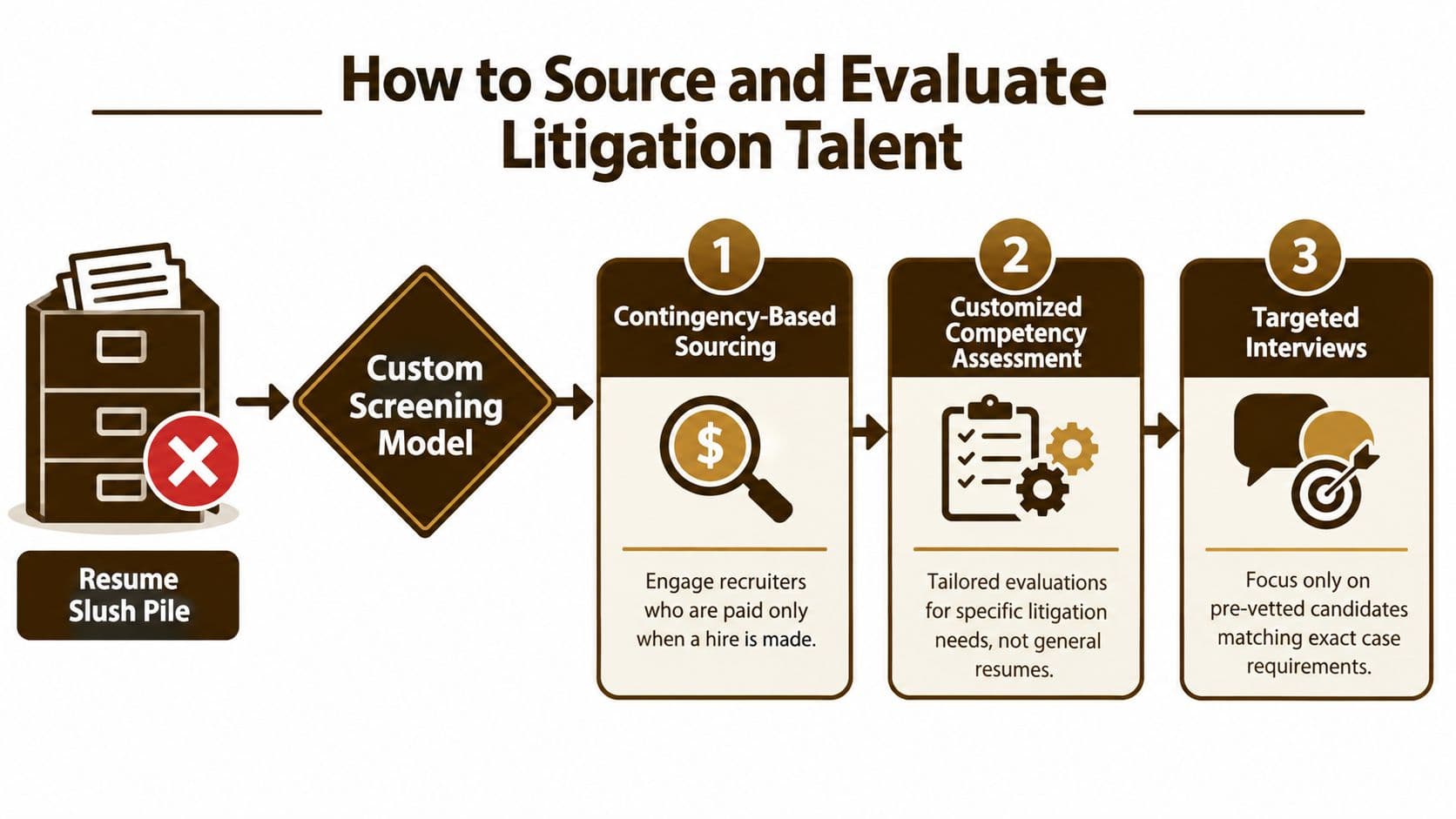
Why customized screening beats a resume pile
A contingency-based search model can work well in legal hiring when the recruiter understands the practice and screens beyond resume labels. That matters because some of the best candidates for a corporate litigation seat may not come from a cleanly labeled "corporate litigation attorney" track. They may sit in white-collar, regulatory, privacy, or investigations practices and be highly transferable.
A recruiter or internal talent lead should screen for things a resume won't show:
- Case theory formation: Can the candidate explain how they sized up a matter early?
- Judgment under ambiguity: What did they do when facts were incomplete?
- Non-lawyer communication: Can they simplify without becoming vague?
- Operational maturity: Have they managed vendors, budgets, and internal stakeholders?
This is also where one market option like Five Star Placements fits. The firm works on contingency-based permanent placement and screens for practice fit and culture alignment across law firms and in-house legal departments, which is often more useful than forwarding a stack of resumes with similar credentials.
A short discussion of sourcing strategy is useful here:
The trade-offs nobody likes to say out loud
A customized search isn't magic. It usually requires a little more upfront discipline from the client.
- Longer setup before the shortlist: Someone has to define what success looks like in the role.
- More transparency about the seat: If the internal politics, reporting line, or matter load are messy, candidates need the truth.
- Partner or GC involvement: The best screens happen when decision-makers engage early, not after HR has already filtered out strong profiles for the wrong reasons.
One practical advantage is the ability to test actual federal-court exposure instead of taking claimed experience at face value. Legal analytics platforms can track litigators across more than 100,000 attorneys at over 775 firms, using attorney appearance data drawn from U.S. District Court and Court of Appeals dockets filed from January 1, 2007 to the present, as described in this overview of litigation analytics and attorney tracking tools. That kind of screening is often more revealing than a polished matter list.
Compensation Benchmarks and Negotiation Ranges
This is the section where most articles start inventing salary grids. I won't do that because reliable, role-specific market numbers for every city and title in your requested format aren't provided in the verified data. What can be said with confidence is narrower, but still useful.
The broad U.S. benchmark from the Bureau of Labor Statistics is a mean annual wage of US$176,470 for lawyers in May 2023, with a mean hourly wage of US$84.84, based on the BLS data cited earlier. That figure is a labor-market anchor, not a clean compensation guide for corporate litigation attorneys by market, seniority, bonus, or equity structure.
2026 Corporate Litigation Attorney Compensation by Role and Market
| Role | New York | San Francisco | Chicago | Dallas | Atlanta |
|---|---|---|---|---|---|
| Mid-level law firm litigation associate | Varies by firm, specialty, and matter mix | Varies by firm, specialty, and matter mix | Varies by firm, specialty, and matter mix | Varies by firm, specialty, and matter mix | Varies by firm, specialty, and matter mix |
| Senior counsel or non-equity partner-track litigator | Varies by originations expectations, trial record, and niche demand | Varies by originations expectations, trial record, and niche demand | Varies by originations expectations, trial record, and niche demand | Varies by originations expectations, trial record, and niche demand | Varies by originations expectations, trial record, and niche demand |
| In-house corporate litigation lead | Varies by industry, reporting line, and scope of outside counsel management | Varies by industry, reporting line, and scope of outside counsel management | Varies by industry, reporting line, and scope of outside counsel management | Varies by industry, reporting line, and scope of outside counsel management | Varies by industry, reporting line, and scope of outside counsel management |
What candidates should negotiate for instead of chasing a headline number
Because precise city-by-city figures aren't verified here, the better negotiation advice is to focus on the elements that change total value.
- Scope of role: A title matters less than whether you'll own matters, supervise firms, or just support.
- Matter mix premium: Privacy-heavy, securities, white-collar, and technically complex disputes often justify stronger packages than generic commercial dockets.
- Bonus mechanics: Ask how bonuses are triggered, who decides, and whether the metrics are realistic.
- Equity and long-term incentives: In-house candidates should examine vesting, clawbacks, and what happens on a change in control.
- Originations and credit rules: Partner-track candidates should get credit formulas in writing, especially where existing client relationships may be shared.
When to push and when to walk
Push harder when the role requires niche expertise, direct forum familiarity, or immediate management of sensitive disputes. Push less on title if the scope gives you the right next step. Walk away when the employer won't define authority, won't explain bonus criteria, or wants senior-level judgment at a discount because the title sounds narrower than the work.
The hidden compensation issue in litigation roles is often control, not cash. If you're the person accountable for outcomes but have no authority over outside counsel, staffing, budget, or settlement posture, the package can look fine on paper and feel underpowered in practice.
Five Star Placements recruits attorneys, in-house counsel, legal support professionals, and legal operations leaders on a permanent-placement basis, which is directly relevant when you're hiring corporate litigation attorneys who need the right mix of matter experience and business judgment. If you're building a litigation team, replacing a key lawyer, or trying to assess whether your current candidate pool is too narrow, visit Five Star Placements.
Need help filling a legal role?
Five Star Placements partners with law firms and legal departments nationwide.
Schedule a Call