
What Is Skills-Based Hiring for Legal Teams
August 23, 2026 · 14 min read · Five Star Placements
Table of contents
Skills-based hiring evaluates candidates on demonstrated competencies and job-relevant tasks rather than degrees, firm names, or job titles alone. NACE reported that 70% of surveyed employers use skills-based hiring practices, while TestGorilla reported that 85% of employers used the approach in 2025.
That should make managing partners and general counsel question the most popular advice in legal recruiting: hire the pedigree and trust the outcome. An elite law school, prestigious clerkship, or recognizable firm name can provide useful context, but none proves that a candidate can draft the work product, manage the client, control the matter budget, or operate the technology your team uses every day.
Legal employers don't need lower standards. They need better evidence.
Table of Contents
- Rethinking How Law Firms Hire Legal Talent
- Skills-Based Hiring vs Credential-Focused Hiring
- Why Legal Employers Are Adopting Skills-First Screening
- Implementing Skills-Based Hiring for Legal Roles
- Real-World Applications Across Legal Positions
- Measuring Outcomes and Managing Compliance
- Getting Started with Skills-Based Legal Recruiting
Rethinking How Law Firms Hire Legal Talent
Pedigree-based hiring became entrenched for understandable reasons. Law firms operate in a risk-sensitive profession, clients often recognize institutional brands, and academic credentials have historically correlated with training and selectivity. A law school ranking or BigLaw background can help a hiring committee make a fast decision when the committee lacks better information.
The problem is that speed and familiarity aren't the same as accuracy. A prestigious background may tell you something about a candidate's prior environment, but it doesn't tell you how that person handles a difficult redline, prepares a witness, explains risk to a business client, or manages a document-heavy matter under pressure.
Recruiting principle: Credentials can open the conversation. Demonstrated capability should determine the hire.
This distinction matters most outside the narrowest definition of elite associate recruiting. A mid-level lateral may have built strong deposition skills at a regional firm. A paralegal may have deep subject-matter knowledge and excellent litigation judgment without a conventional academic path. A legal operations candidate may have learned matter management, billing analysis, and technology implementation through business operations rather than a traditional legal career.
Skills-based hiring treats those capabilities as hiring evidence. The method starts with the work, identifies the competencies required to perform it, and tests whether the candidate can demonstrate them. It doesn't pretend that credentials are irrelevant. Bar admission, licensing, court experience, and specialized training can remain essential. The change is that credentials become one data point, not a substitute for evaluating the job itself.
The evidence behind the shift is significant. NACE reported that skills-based hiring rose from 65% to 70% among surveyed employers, and 71% of those employers used it at least half the time, according to its reporting on employer practices (NACE's employer hiring data). NACE also found that 64.8% of employers used skills-based hiring for new entry-level hires, which is especially relevant to firms hiring junior associates, legal assistants, and early-career operations professionals.
The practical lesson is straightforward. If your hiring process still treats school, firm name, and title as the main filters, you're probably discarding useful information before you've tested the work that matters.
Skills-Based Hiring vs Credential-Focused Hiring
Credential-focused hiring and skills-based hiring can evaluate the same legal candidate, yet produce very different decisions. The first asks whether the resume resembles the profile of people who succeeded before. The second asks whether the candidate can perform the tasks this role requires.
| Recruitment Stage | Credential-Focused Approach | Skills-Based Approach |
|---|---|---|
| Initial screening | Law school ranking, GPA, law review, clerkship, firm brand, and years of experience dominate the screen. | Required competencies, representative matters, writing quality, technical fluency, and evidence of task execution drive the screen. |
| Lateral attorney review | A recognizable firm or title is treated as a proxy for training and quality. | The reviewer examines practice depth, client exposure, ownership of matters, and examples of actual work product. |
| Paralegal review | Formal education and employer names may outweigh practical experience. | Document control, case management, discovery workflow, calendaring, drafting, and communication skills are tested directly. |
| Legal operations review | Brand-name employers and general operations titles carry disproportionate weight. | Matter budgeting, systems implementation, reporting, process design, and stakeholder management are evaluated through scenarios. |
| Interview design | Unstructured conversation about career trajectory, personality, and shared background. | Structured questions and consistent scenarios tied to the role's recurring work. |
| Final decision | Interviewer instinct and pedigree signals often decide between otherwise similar candidates. | A scored rubric combines work samples, structured interview evidence, references, and required credentials. |
Consider an associate candidate with strong law review credentials but limited practical drafting experience. A conventional interview may focus on grades, class rank, and the name of the candidate's firm. A skills-based process would ask the candidate to analyze a fact pattern and draft a motion in limine, then evaluate the legal reasoning, organization, precision, and judgment reflected in the work.
The reverse can also happen. A regional-firm lateral may have no nationally recognized brand on the resume, but a work sample can reveal excellent issue spotting and client-ready writing. That candidate shouldn't receive an automatic pass because the prior employer lacks prestige.
Skills-based hiring also helps uncover people whose careers don't fit a tidy legal template. A paralegal with extensive discovery experience may not have the academic profile a posting originally requested. A career-changer moving into legal operations may understand project management, vendor evaluation, and data reporting better than a candidate whose resume contains a more familiar title.
That doesn't mean every credential should be removed. Bar status, jurisdictional eligibility, security requirements, and technical certifications may be genuine job requirements. The discipline is to separate essential qualifications from convenient proxies.
Why Legal Employers Are Adopting Skills-First Screening
A prestigious law degree or recognizable firm name can still miss the candidate who will perform best. Legal work is too specialized for broad background signals to carry the assessment. A litigation associate may need persuasive writing, deposition preparation, discovery judgment, and client communication. A legal operations manager may need systems thinking, financial analysis, vendor management, and the ability to explain operational data to lawyers. A credential rarely shows that full combination.
The broader hiring market has moved toward skills-based evaluation. National University's overview describes candidate-pool expansion of 15.9 times in the United States and 6.1 times globally when employers shift from job titles to skills (National University's hiring statistics overview). For legal employers, a larger pool has value only when the process can distinguish capability. Removing a degree filter without changing the interview creates more resumes for the same subjective review. Replace the proxy with evidence tied to the work.
The performance case
BCG reported that a skills-based hire was five times more likely to predict job performance than a hire based on education, while promotion rates were nearly comparable with traditionally hired peers (BCG's analysis of skills-based hiring). The practical implication for law firms and legal departments is direct: assess candidates on the tasks they will perform, not only on where they studied or worked.
That approach matters across legal roles. For a partner, the evidence may include client development judgment, matter leadership, delegation, and team retention. For an associate, it may include written analysis, oral advocacy, research discipline, and responsiveness under pressure. A paralegal's value may rest on discovery coordination, filing accuracy, and deadline control. Legal operations professionals may need to configure workflows, audit processes, manage vendors, and explain technology risk.
Legal technology makes pedigree an even weaker substitute for evidence. E-discovery platforms, contract lifecycle management systems, matter management tools, and AI-assisted research workflows create requirements that a conventional resume may not reveal. A candidate's ability to set up a workflow, identify a control failure, or guide adoption can matter more than a recognizable firm name.
Managing partners and general counsel also face unfilled roles, overloaded teams, costly searches, and resumes that do not match daily responsibilities. A skills-first process clarifies the work before sourcing begins and gives interviewers consistent evidence to review. Leaders can use structured methods for assessing leadership potential, especially when hiring partners, department heads, and legal operations executives.
The evidence also sets a limit on what changing requirements can accomplish. Harvard Business School and the Burning Glass Institute found that employers dropping degree requirements increased the share of workers without a bachelor's degree in affected roles by about 3.5 percentage points, but only 3.6% of roles dropped the requirement. Across all hires, the net increase was 0.14%, or roughly 97,000 additional workers annually out of 77 million yearly hires (Harvard Business School and Burning Glass Institute report). Legal employers should treat that finding as a warning: rewriting a posting is not a hiring strategy. Screening, interviews, assessments, and decision rules must all measure the skills the role requires.
Implementing Skills-Based Hiring for Legal Roles
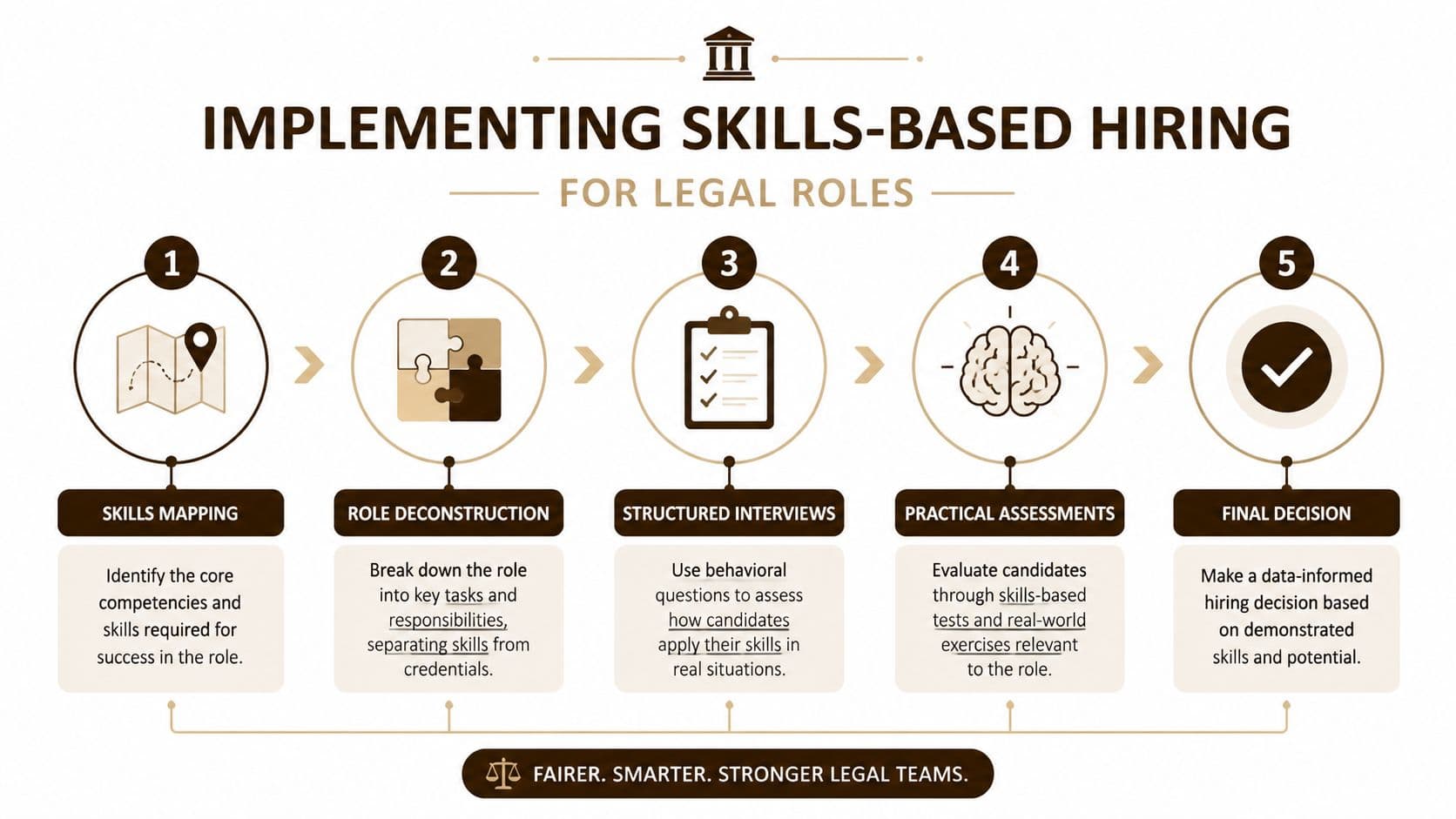
Start with the job, not the incumbent. A legal job description often combines actual requirements with inherited language that has survived from prior searches. Separate the recurring work from the preferred biography.
Build a role-specific skills map
For a commercial counsel role, the map may include contract drafting, negotiation, issue spotting, client counseling, and escalation judgment. For a paralegal, it may include docket control, discovery coordination, document organization, filing accuracy, and communication with attorneys and clients. For legal operations, it may include matter budgeting, reporting, process design, vendor management, and technology implementation.
Rank each competency as essential, trainable, or preferred. Don't label every desirable trait as mandatory. That only recreates the same narrow funnel under a different name.
Replace resume assumptions with evidence
Screening questions should require candidates to describe what they personally did. Ask an associate to explain a complex motion they drafted, the legal theory supporting it, the review process, and the result. Ask a paralegal to walk through a discovery workflow from collection through production. Ask a legal operations candidate to describe how they diagnosed a broken process and gained stakeholder adoption.
The answer should reveal scope, judgment, and ownership. “I supported the matter” tells you little. “I built the privilege log workflow, resolved inconsistent coding instructions, and escalated the quality issue” gives the interviewer something to evaluate.
Use practical assessments carefully
A work sample should resemble the role without demanding free labor or testing irrelevant trivia. Useful formats include:
- Transactional associate: Redline a commercial agreement and provide a short explanation of the highest-priority changes.
- Litigation associate: Prepare a concise legal memo from a supplied fact pattern, with clear authority and recommended next steps.
- Paralegal: Complete a document review or litigation-calendar simulation that tests organization, accuracy, and deadline judgment.
- Legal operations manager: Build a matter budget and present a comparison of technology vendors against stated requirements.
Give candidates clear instructions, a reasonable scope, and the same materials. A poorly designed test can measure familiarity with the test rather than competence in the job.
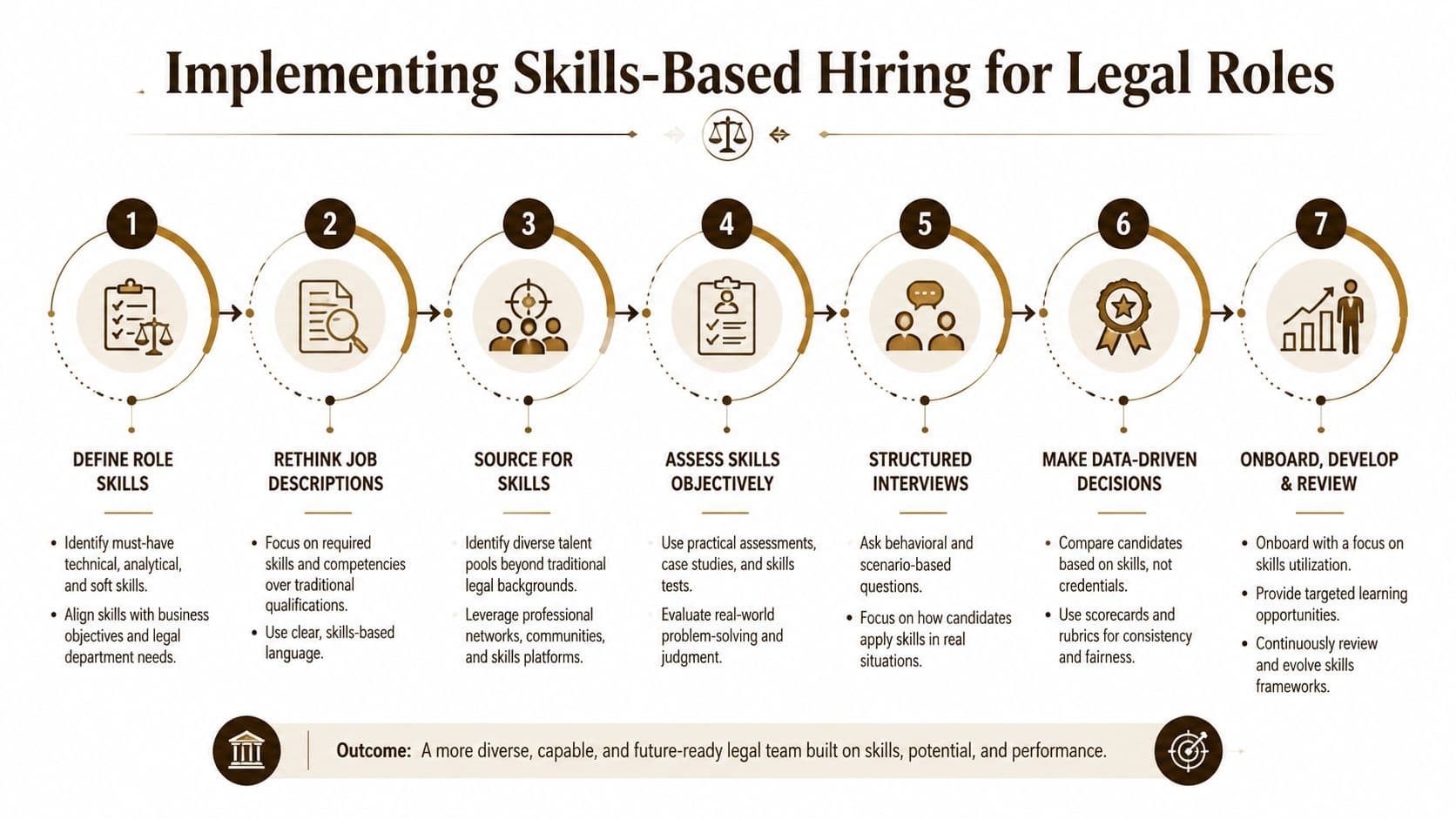
Score consistently
Create a rubric before reviewing submissions. For a contract redline, score issue identification, legal reasoning, commercial judgment, drafting clarity, and prioritization. For a paralegal simulation, score accuracy, organization, deadline management, and escalation behavior.
Use the same core questions and scoring anchors for every candidate. Interviewers should record evidence, not impressions. A panel can still discuss judgment and team needs, but discussion should begin with observable work.
Finally, sequence the process so each stage answers a different question. Resume review confirms baseline eligibility. A recruiter screen tests communication and motivation. The work sample tests execution. The structured panel tests collaboration, judgment, and client orientation. Onboarding should then address the skill gaps identified during selection rather than repeat generic training. Interview panels can improve consistency by using a defined set of questions for interviewers.
Real-World Applications Across Legal Positions
A skills-based legal hiring process looks different by role because the work differs. The right assessment for a partner isn't the right assessment for a paralegal, and a legal operations manager shouldn't be judged by an attorney-centered interview.
Consider a mid-size firm hiring a litigation associate. Instead of treating law school tier and clerkship history as the primary screen, the firm could review representative matter experience, administer a timed writing exercise, and conduct a structured interview focused on client-facing scenarios. The exercise might ask the candidate to analyze a procedural issue and draft a motion in limine. Partners could then evaluate organization, accuracy, strategic judgment, and whether the writing is usable with appropriate supervision.
A corporate legal department hiring a paralegal might prioritize discovery workflow, calendar control, and communication. A practical exercise could require the candidate to organize deadlines, identify a conflict in a litigation schedule, and explain the escalation path. The hiring manager would see how the candidate works, not how the resume describes prior responsibilities.
For a legal operations manager, the strongest evidence may come from a matter-budget exercise and a vendor comparison presentation. The candidate can demonstrate financial reasoning, technology evaluation, stakeholder communication, and implementation judgment. A brand-name employer may be helpful context, but it shouldn't outweigh a clear demonstration of operational competence.
| Legal Role | Key Competencies Assessed | Assessment Method | Outcome Observed |
|---|---|---|---|
| Litigation associate | Legal analysis, persuasive writing, procedural judgment, client communication | Motion or memo work sample plus structured behavioral interview | Hiring committee receives comparable evidence of written and interpersonal performance |
| Transactional associate | Contract analysis, risk prioritization, drafting, negotiation judgment | Timed agreement redline with written rationale | Review focuses on commercial judgment and drafting quality |
| Paralegal | Discovery workflow, docket accuracy, organization, escalation judgment | Document review and litigation-calendar simulation | Managers can identify practical readiness and training needs |
| Legal operations manager | Matter budgeting, process design, systems fluency, vendor management | Budget exercise and technology vendor presentation | Interviewers evaluate operational thinking rather than employer branding |
These are hiring scenarios, not guaranteed outcome claims. The important point is the design choice. Each employer defines the work, tests a meaningful part of it, and gives the hiring committee a common basis for discussion.
Measuring Outcomes and Managing Compliance
A skills-based process needs a scorecard. Otherwise, the firm may adopt new assessments while continuing to make decisions by instinct. Establish a baseline from the existing process, then compare later hiring cohorts using the same definitions.
Track measures that reflect the role's actual business value:
- First-year attrition: Monitor whether new hires remain in the role and investigate whether departures reflect skill mismatch, supervision, workload, or compensation.
- Time to productive contribution: For associates, measure time to reliable billable or matter-support work. For paralegals, assess how quickly they handle assigned workflows with limited correction.
- Work-product accuracy: Review filing, calendar, discovery, drafting, or reporting errors according to role-specific standards.
- Hiring-manager satisfaction: Ask whether the candidate's demonstrated abilities matched the expectations formed during selection.
- Process consistency: Audit whether interviewers applied the same questions, assessments, and scoring criteria.
Don't claim success because candidates performed well in an interview. Compare hiring evidence with post-hire performance and document where the assessment predicted accurately or failed.
Compliance requires discipline
Skills-based hiring can support fairer access when employers remove unnecessary barriers and assess candidates consistently. It can also create new risks if a work sample tests irrelevant knowledge, disadvantages candidates with disabilities, or relies on opaque automated scoring.
Employers should define the business reason for every assessment, provide reasonable accommodations where required, protect candidate information, and retain records showing how decisions were made. Background review remains a separate process. Legal employers should use a consistent, role-related protocol such as the one described in attorney background checks, rather than letting informal concerns enter the process unevenly.
Culture fit without pedigree bias
“Culture fit” is often where credential preferences return through the back door. Replace vague judgments such as “polished” or “someone who gets it” with observable requirements: collaborative matter management, responsiveness to clients, comfort with feedback, respect for confidentiality, and commitment to the practice area's work.
Compliance rule: If an interviewer can't explain how a preference relates to successful performance, it doesn't belong in the rubric.
A balanced scorecard should combine essential credentials, demonstrated skills, structured interview evidence, reference information, and job-related cultural behaviors. That gives managing partners and general counsel a defensible view of quality without pretending that any single assessment can predict every aspect of legal performance.
Getting Started with Skills-Based Legal Recruiting
Law firms and corporate legal departments don't need to rebuild every role at once. A phased rollout is more credible and easier to defend, especially when partners are skeptical of replacing familiar hiring signals.
Take these three actions within the next 30 days:
-
Audit one difficult or high-volume role. Select an associate, paralegal, legal assistant, or operations position. Mark every requirement as essential, trainable, or merely preferred. Remove credentials that don't relate to the work, while preserving genuine licensing and legal eligibility requirements.
-
Create one realistic work sample. Use a contract redline for a transactional role, a short memo for a litigator, a docket scenario for a paralegal, or a matter-budget exercise for legal operations. Keep the assignment focused, standardized, and connected to the first responsibilities the hire will assume.
-
Train the interview panel on a scoring rubric. Give interviewers the same questions, scoring anchors, and instructions to record evidence. Require the panel to discuss the work sample before discussing school, firm pedigree, or personal familiarity.
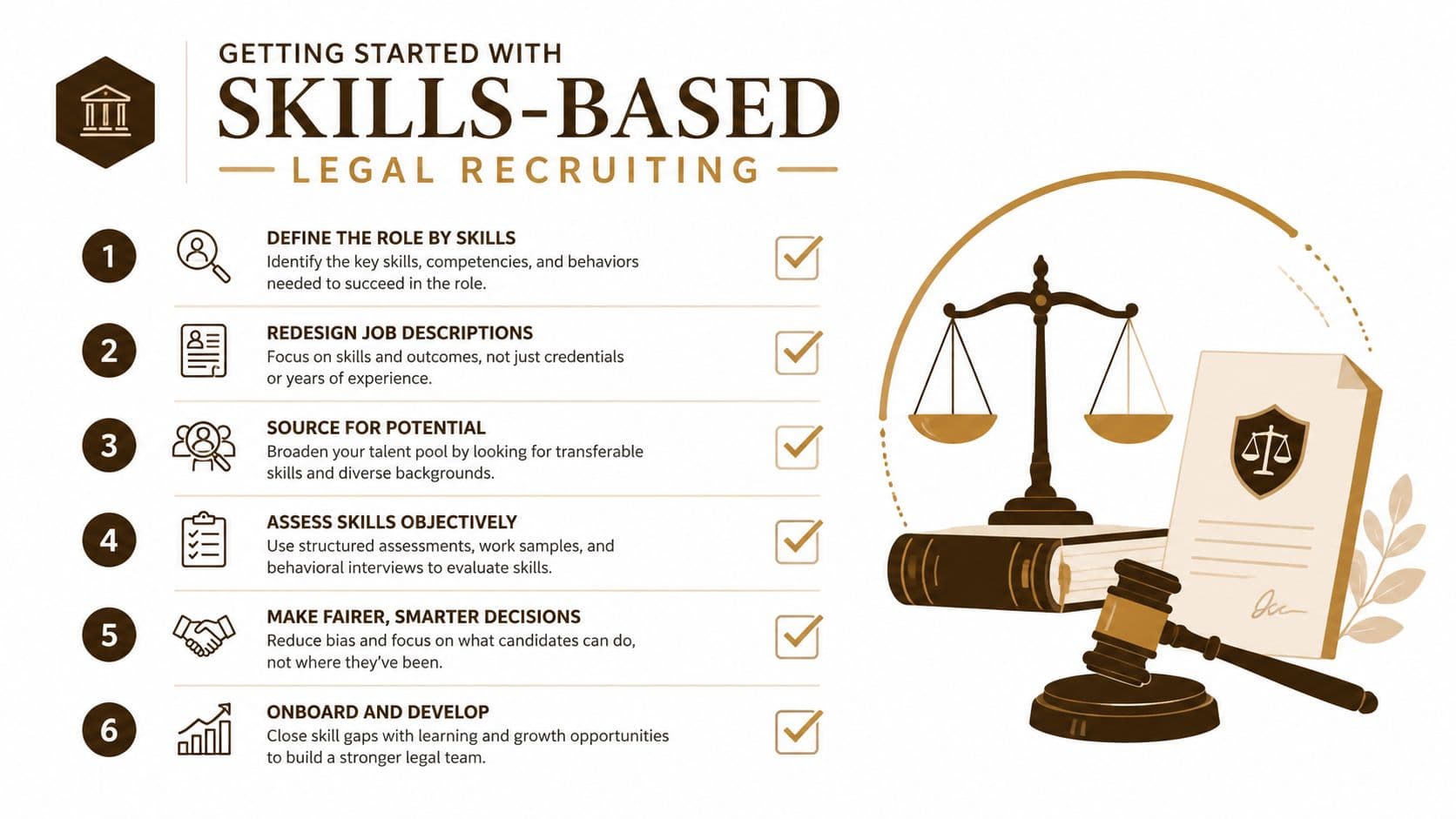
The strongest legal employers won't abandon judgment. They'll improve the information available to exercise it. Skills-based hiring expands the search beyond familiar biographies, tests the capabilities that drive matter and business outcomes, and gives the hiring committee a clearer basis for saying yes or no.
Five Star Placements provides permanent placement for attorneys, partners, in-house counsel, legal support staff, and legal operations leaders, with screening to experience, skills, and organizational fit. If your firm or legal department wants a skills-focused search without upfront costs, visit Five Star Placements to discuss the role and hiring requirements with its recruiting team.
Need help filling a legal role?
Five Star Placements partners with law firms and legal departments nationwide.
Schedule a Call