
Legal Recruiting Manager: Role, Skills, and Hiring Guide
October 16, 2026 · 11 min read · Five Star Placements
Table of contents
The calendar fills up fast, the practice groups are busy, and the partners still want one thing: people who can keep up. Then two associates leave in 60 days, a lateral partner search stalls, and the person "handling recruiting" is buried in résumés, scheduling, and apologies to candidates who've already taken other offers. That's usually the moment a firm realizes the recruiting function isn't admin work. It's a growth lever that got treated like overhead for too long.
A strong legal recruiting manager doesn't just fill openings. They protect revenue when turnover hits, keep hiring momentum alive when the firm is expanding, and stop bad fits before they become expensive departures. The right answer is not always a full-time internal hire, and it's not always outsourcing either. It depends on hiring volume, practice mix, geography, and how much retention risk the firm can tolerate before growth starts slipping.
Table of Contents
- The Moment Every Managing Partner Recognizes
- What the Legal Recruiting Manager Does
- The Skills That Separate Strong Legal Recruiters
- How Firms and Legal Departments Structure the Role
- Hiring Tips for Building a Recruiting Function That Delivers
- Why Retention Is the Scorecard That Matters
- When to Replace the Function With a Search Partner
The Moment Every Managing Partner Recognizes
A managing partner usually doesn't ask for a legal recruiting manager until the pain is obvious. The litigation group is overcapacity. A partner wants a replacement fast. HR is screening far too many applicants who look fine on paper but can't handle the demands of the role. The firm keeps saying it needs "better candidates," but nobody owns the market long enough to produce them.
That's the core problem. When recruiting is fragmented, the firm pays twice, once in lost time and again in lost productivity. A vacancy in a revenue-producing seat slows matters, burdens the remaining team, and makes the next departure more likely because the people left behind are carrying the load.
Practical rule: If recruiting only starts after someone resigns, the firm is already behind.
The legal recruiting manager exists because legal hiring is not a generic HR exercise. The talent market is large and concentrated, with 1,322,649 active lawyers nationwide as of January 1, 2024, and New York and California alone accounting for roughly 27.5% of the national total (American Bar Association demographics). That concentration matters. A firm trying to hire in New York is not playing the same game as a firm hiring in Texas, Illinois, or Colorado.
That's why the best legal recruiting manager is part market operator, part matchmaker, and part risk manager. They know which offices are competing for the same talent, which practice groups can move quickly, and which roles need a broader search strategy than the firm has used before. If your current setup can't do that, it's not a recruiting function. It's a bottleneck.
What the Legal Recruiting Manager Does
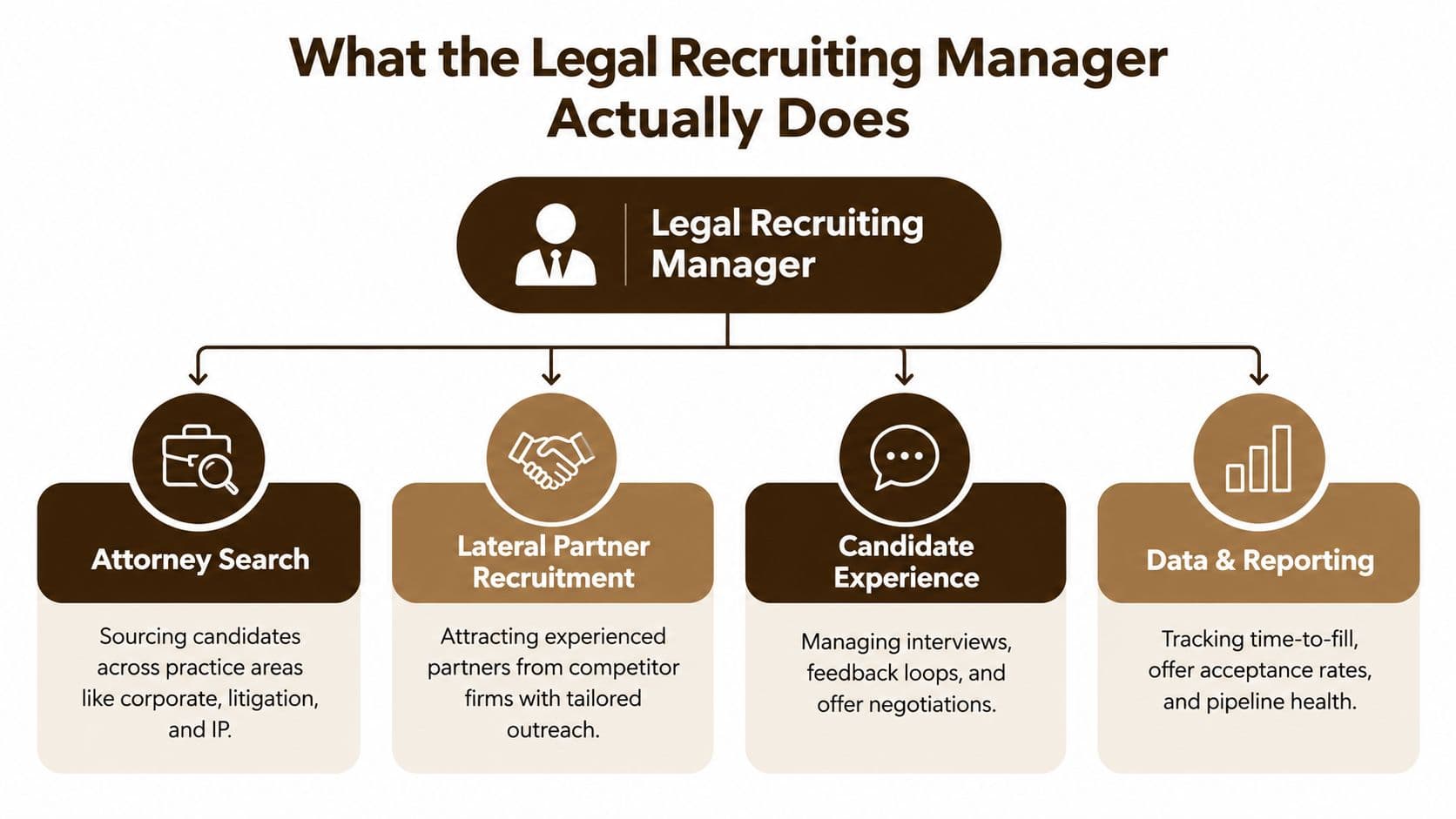
A legal recruiting manager works across the full hiring stack, not just posted openings. They forecast needs before the panic starts, build relationships with candidates before roles open, and keep searches moving when multiple decision-makers get involved. That matters in a profession that is aging and uneven at the top, where women make up a far larger share of U.S. lawyers than of law-firm partners, as noted earlier. Succession planning cannot be left to chance, and someone has to own it.
The job also spans multiple talent categories. In one week, the same person might be sourcing a litigation associate, screening a partner with a portable book, coordinating an in-house counsel search, and checking whether a legal operations hire can support the department's systems. That breadth is the point. Legal employers don't get to run separate hiring processes for every function. Someone has to own the full picture, and this is the person who does.
Search, coordination, and offer control
The first half of the job is operational. The manager defines the role, sources candidates, screens for fit, schedules interviews, gathers feedback, and keeps the process from stalling. In legal hiring, that means moving quickly without getting sloppy, because the market rewards firms that can make a credible offer before the candidate has three others on the table.
Candidates remember how the process felt. Slow feedback reads as weak leadership, not caution.
Pipeline work that pays later
A strong legal recruiting manager does not wait for a vacancy to begin outreach. They maintain a live network, watch for attorneys nearing a move, and stay in touch with people who weren't right six months ago but may be right now. This pipeline work is hard to measure in the short term, which is why weak firms cut it first and then wonder why every search feels urgent.
The role should also hand off properly. Onboarding is not an afterthought. If a recruit gets sold on one thing and experiences another after the start date, the firm has damaged the hire before the first month is over. That's why the recruiting manager needs enough authority to shape expectations, not just coordinate calendars.
The Skills That Separate Strong Legal Recruiters
A good legal recruiting manager is not defined by generic HR polish. They need real market judgment. They need to know which candidates are portable, which are overqualified, which practice areas are crowded, and which ones are thin in a given city or jurisdiction. Without that, they'll screen for the wrong signals and present the wrong shortlist.
The scale of the market makes this blunt. As noted earlier, New York alone has 187,656 active lawyers and California has 175,883. Recruiting in that environment is not about "finding talent." It's about understanding where the talent sits and how concentrated the competition is in each jurisdiction. A recruiter who ignores regional competition, compensation differences, or bar-admission constraints will miss badly, and the firm pays for it in wasted partner time.
What to look for in the interview
- Market mapping ability: They should be able to explain where they source candidates, which jurisdictions matter, and why.
- Relationship discipline: Senior legal hiring runs on trust, follow-up, and credibility, not mass outreach.
- Role diagnosis: They should ask sharper questions than the hiring partner asked, especially about supervision, matter mix, and pace.
- Offer judgment: They need to spot when a candidate is a fit on paper but likely to leave if the actual work doesn't match the pitch.
Don't overvalue software familiarity if the person can't talk concretely about the legal market. Don't hire someone who sounds smooth but can't explain why a candidate wants one office over another. In this role, conversation quality matters more than keyword density on a résumé.
Strong recruiters don't just find people. They translate the firm's actual working conditions into a candidate story that holds up after the offer is signed.
If you're interviewing for this role, ask for examples of difficult searches, not just successful ones. The best evidence is how they handled pressure when the first plan failed.
How Firms and Legal Departments Structure the Role
Most organizations land in one of three structures. The right one depends on hiring volume, internal complexity, and how expensive a vacancy is in your business.
| Structure | Best Fit | Key Trade-Off |
|---|---|---|
| Dedicated in-house legal recruiting team | Larger firms with steady annual hiring and multiple practice groups | More control, but higher fixed cost and more internal coordination |
| Embedded generalist legal recruiting manager | Mid-size and boutique firms with moderate, uneven hiring | Lean and flexible, but vulnerable when volume spikes |
| Corporate legal department model | In-house teams hiring counsel and related roles under HR or legal ops | Good alignment with broader talent processes, but legal nuance can get diluted |
The dedicated team model makes sense when hiring never really stops. That's where structured oversight, candidate pipelines, and process consistency pay off. A single embedded manager works better when the firm has enough hiring to justify dedicated ownership, but not enough to build an entire department.
For corporate legal departments, the role often sits under HR or legal operations. That can work if the department values legal-specific judgment and doesn't treat counsel hiring like a generic corporate search. If recruiting is buried too far down in general HR, candidates feel it immediately.
If you want a deeper look at what a director-level legal recruiting setup can look like inside a firm, this overview of the director of legal recruiting role is worth comparing against your current structure.
A hybrid model is often the smart middle ground. Keep one internal owner for process, culture, and continuity, then add external search help when the firm is under pressure or needs reach beyond its own network.
Hiring Tips for Building a Recruiting Function That Delivers
Start with the workload, not the title. If you need someone to coordinate interviews and keep requisitions moving, a senior coordinator may be enough. If you need market intelligence, candidate persuasion, and partner-level search management, hire for recruiting judgment, not administrative polish.
The first 90 days should be measured by quality of process, not volume alone. Are interviews structured? Are candidates being screened against the same criteria? Are hiring managers giving feedback on time? If those basics aren't in place, more résumés won't fix anything.

Make the role accountable for the right outcomes
Tie success to candidate quality, retention, and manager satisfaction, not just time-to-fill. Give the recruiting manager a scorecard that includes what happens after the hire starts, because that is where the true value shows up. If you compensate purely for closes, you'll reward speed over fit.
Test for legal market fluency
Ask candidates to walk you through a real search in a tight market. Then ask how they'd adapt if the first sourcing channel failed. If they can't explain jurisdictional constraints, compensation tension, or the practical difference between a posted role and a relationship-led search, keep looking.
Pick the tools that match the volume
You don't need a bloated tech stack. You need an applicant tracking system that the team will use, a sourcing process that can be repeated, and reporting that shows where searches stall. If the manager can't tell you which stage breaks most often, the tools aren't helping.
For teams comparing internal build against outside support, this piece on legal talent acquisition strategies is a useful benchmark for how a leaner process can still stay disciplined.
Why Retention Is the Scorecard That Matters
The only recruiting metric that matters is whether the hire stays and performs. Everything else is a partial view. The NALP Foundation's 2025 dataset covered 141 U.S. and Canadian firms, with 6,335 associate hires and 4,442 departures, and overall associate attrition ran at 19%. Firms with 100 or fewer attorneys saw 24% attrition, while larger cohorts came in lower at 16% to 18%, and 83% of departures happened within five years of hire (NALP Foundation attrition update)).
That data tells you exactly what a legal recruiting manager should be doing. They should screen for the conditions that make people leave, not just the credentials that get them hired. If the manager doesn't understand workload expectations, supervision style, advancement path, compensation architecture, matter mix, and flexibility requirements, they're approving risk and calling it progress.
Build the scorecard around fit
A retention-first scorecard should answer a few hard questions:
- Workload reality: Can the candidate handle the pace the team runs?
- Supervision match: Does the hiring partner manage people in a way this candidate can sustain?
- Growth path: Is there a credible path forward, or just a promise?
- Compensation structure: Does the package match the role and the market?
- Flexibility boundaries: Will the arrangement fit how the candidate works?
Post-placement reporting should track retention at 12, 24, and 60 months by practice group, source, and hiring manager. If those numbers are weak, the recruiting function is failing no matter how fast it fills the seat.
If you don't measure durability, you're not measuring hiring. You're measuring turnover with a delay.
That's why a legal recruiting manager should sit close to performance data. Their job is to make better predictions, not just faster introductions.
When to Replace the Function With a Search Partner
Not every firm should build a permanent internal recruiting engine. If hiring volume is low to moderate, if the firm experiences peaks and valleys, or if the open role is especially hard to fill, a contingency search partner can be the better economic choice. That's especially true when the cost of a bad hire is high and the firm doesn't have enough recurring demand to justify a full-time recruiter.
A contingency model also helps when the internal team is already stretched. Instead of asking one person to source, screen, coordinate, and negotiate every search, the firm can bring in outside help for the roles that need reach and speed. A partner search, an urgent in-house counsel opening, or a practice-specific attorney hire may justify that approach immediately.
Five Star Placements works as a contingency-based legal recruiting firm for attorneys, partners, in-house counsel, legal support staff, and legal operations roles across the United States. Its model is payment on successful hire, with customized screening and collaborative communication built to function as an extension of the client team. That makes sense when the firm wants external search support without adding a permanent internal headcount.
If you want to compare the economics of a retained or contingency engagement, this explanation of retained search is a useful reference point for deciding how much control and urgency you need.
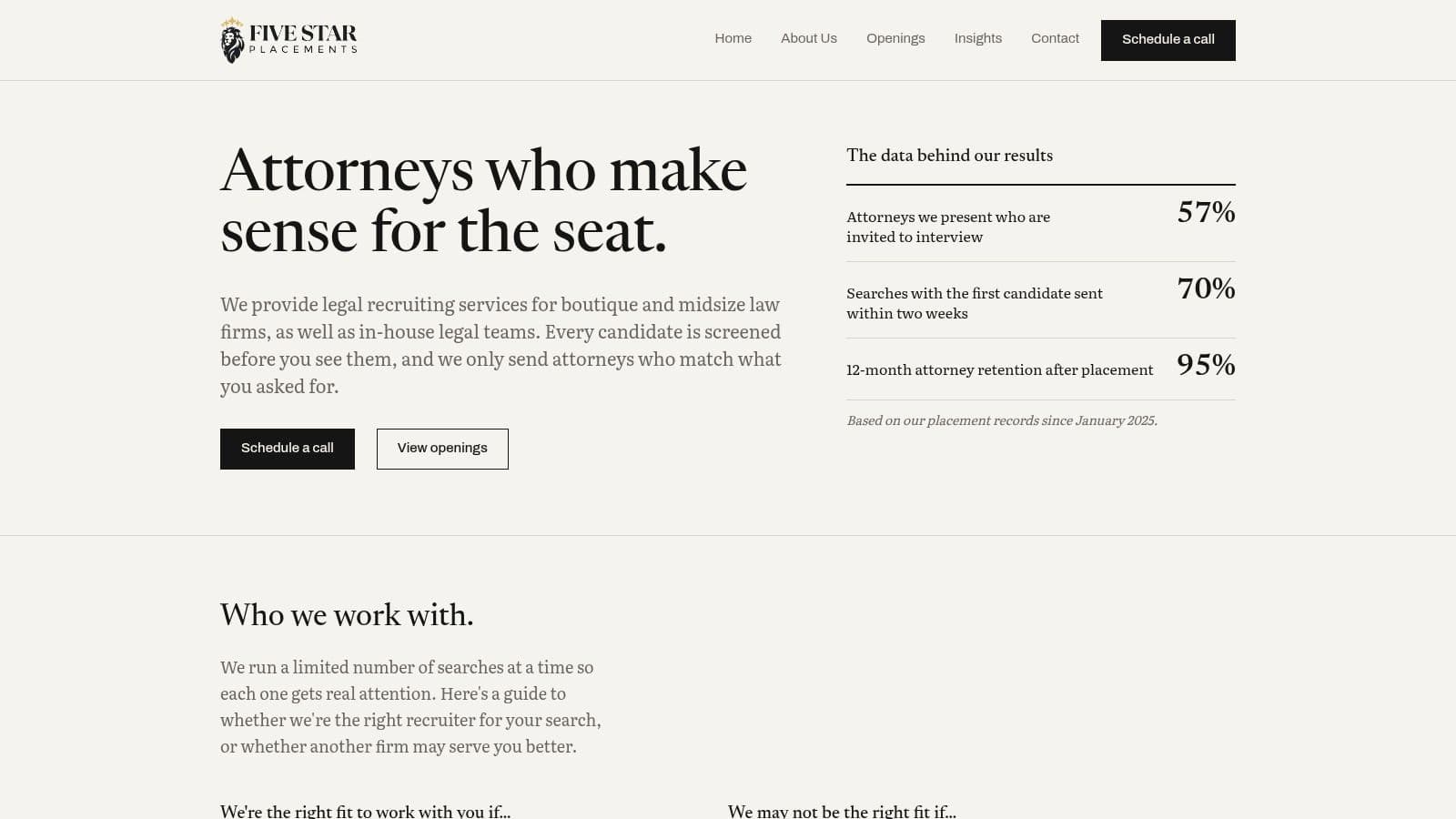
The right question isn't whether to use outside help. It's whether the firm needs a permanent operator, a flexible extension of the team, or both. In many cases, the smart answer is a hybrid: one internal owner for process and culture, plus a search partner for reach, speed, and hard-to-fill roles.
Five Star Placements helps law firms and legal departments with contingency-based permanent placement for attorneys, partners, in-house counsel, legal support staff, and legal operations roles. If your recruiting function is slowing growth or you need a more disciplined search process, visit Five Star Placements to see how a focused legal recruiting partner can support your hiring plans.
Need help filling a legal role?
Five Star Placements partners with law firms and legal departments nationwide.
Schedule a Call