
Law Firm Recruiting Challenges: A Practical Guide
July 27, 2026 · 14 min read · Five Star Placements

Table of contents
The call comes in late on a Tuesday. A partner-track associate has given notice, a litigation seat has sat open for three months, and the HR generalist is juggling recruiting, onboarding, benefits, and two other urgent openings. Everyone says the same thing, the firm cannot find lawyers. That answer is too vague to be useful, and in most firms it hides the core problem, which is not one recruiting issue but five separate bottlenecks that need different fixes.
Table of Contents
- Why Law Firm Recruiting Feels Harder Than Ever
- The Time-to-Fill Bottleneck and Its Hidden Costs
- Candidate Quality Is Really a Skills-Combination Problem
- Culture Fit and Retention Are the Same Hiring Problem
- Capacity Constraints During Growth and Peak Demand
- When to Fix Recruiting Internally and When to Hire a Legal Recruiter
- Choosing and Working With the Right Legal Recruiting Partner
- A 90-Day Diagnostic Checklist for Your Hiring Funnel
Why Law Firm Recruiting Feels Harder Than Ever
The managing partner usually feels the strain before the numbers make it obvious. A practice group loses a rainmaker associate, the replacement search lingers, and by the time the first round of interviews finishes, the work has already bled into other teams. At that point, the firm is not just short-staffed, it is paying for delay in partner time, missed capacity, and a worsening candidate experience.
Five bottlenecks, not one problem
The first mistake is treating every hiring failure as the same failure. Time-to-fill is different from candidate quality, and both are different from culture fit, capacity, and retention. A firm can have a strong pipeline and still lose candidates at offer stage, or it can make good offers and still lose people six months later because the job and the culture don't match what was sold.
Practical rule: if you don't name the bottleneck, you'll keep buying the wrong remedy.
The market itself has changed in ways that expose weak internal systems. Reuters reported that U.S. law-firm summer associate recruitment hit a historic low in 2024, with the median number of summer associate positions per office falling to six, down from seven in 2023 and the lowest level since the National Association for Law Placement began tracking the metric in 1993. Reuters also reported that 56% of incoming summer associates received offers through direct outreach, referrals, or resume submissions rather than formal law-school recruiting events, and that 2024 lateral placements were up 14% overall while lateral associate hires rose nearly 25%. Reuters on the 2024 recruiting reset
That is the backdrop for the rest of this guide. Firms are recruiting earlier, fishing outside campus pipelines, and leaning more heavily on experienced laterals because the old model is tighter than it used to be. If you keep calling every vacancy a sourcing problem, you'll keep solving the wrong thing.
The Time-to-Fill Bottleneck and Its Hidden Costs
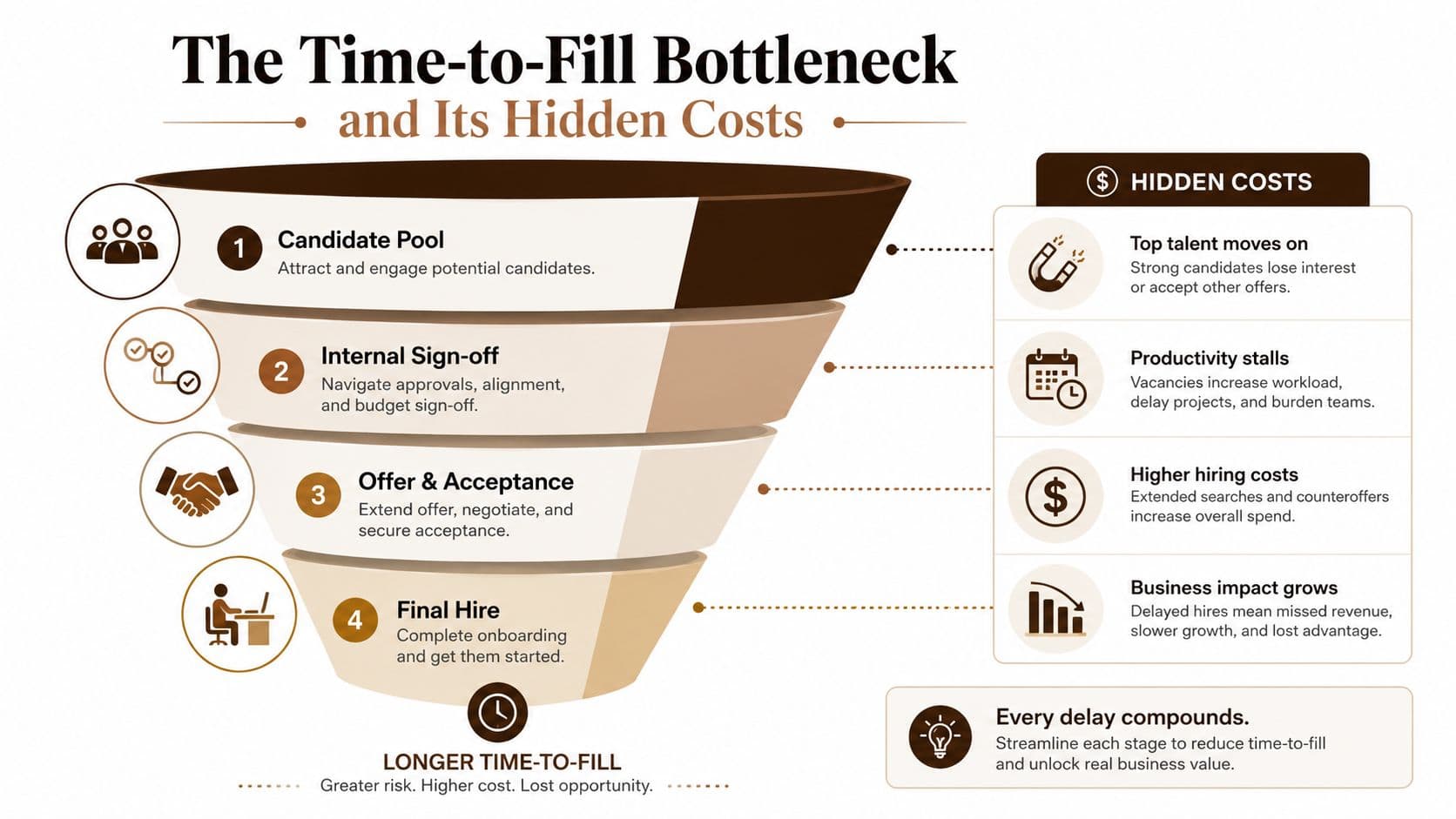
A seat that stays open for ninety days rarely stays “just” open. Matter coverage gets spread across the team, partners absorb work they shouldn't be doing, and clients start noticing the lag before the firm does. The visible problem is vacancy, but the actual problem is the work the vacancy forces everyone else to carry.
Why the clock runs out
Time-to-fill drags for three ordinary reasons. The candidate pool is thin, the internal approval chain is slow, and partners refuse to interview until the résumé looks perfect. None of those problems is solved by “posting harder.” A thin market needs broader sourcing. A slow sign-off chain needs process cleanup. A perfectionist interview culture needs a decision rule.
The Reuters data above matters because it shows firms are already moving earlier and outside standard channels. If your firm still depends on passive applicants and a once-a-week review cycle, you're behind the market before the search even starts. That gap gets worse in practice areas where demand is episodic or highly specialized.
What the vacancy really costs
You don't need a fake percentage to see the damage. A delayed hire means delayed matter delivery, more partner hours spent covering routine work, and a higher chance you say no to new work because the bench is too thin. In a law firm, that is not just staffing pain, it's lost optionality. The firm becomes less able to take on the next matter, which is often the cleanest way to grow.
Direct answer: if the search is stalled because nobody owns the calendar, fix the calendar. If it's stalled because the market is thin, bring in outside sourcing.
The question to ask on any attorney search is blunt. If your average time-to-fill is over ninety days, which of the four drivers is dominant, thin market, slow approvals, practice-specific scarcity, or partner indecision? The answer tells you whether you need a process fix, a recruiter, or both.
Candidate Quality Is Really a Skills-Combination Problem
Most firms say they want “strong candidates,” then screen as if legal pedigree alone proves readiness. That's lazy. The more common failure is not a shortage of licensed attorneys, it's a shortage of attorneys who can pair legal judgment with the tools the role demands.
Resume screens miss the real test
The core issue is a skills-combination problem. Firms want lawyers who understand legal work and can function in e-discovery platforms, cybersecurity-related workflows, legal software, and AI-enabled tools. Traditional legal training doesn't reliably produce that package. A résumé can tell you someone clerked well or billed solid hours. It won't tell you whether they can handle the technology layer that now sits inside routine practice.
That means the usual screen, school name, law review, firm pedigree, and a clean work history, is only a partial filter. It misses people who are technically useful but less polished on paper, and it can overrate people whose background looks strong but whose day-to-day execution will be weak. Firms that rely only on pedigree usually complain about quality while ignoring the fact that their screening criteria are outdated.
What better screening looks like
A serious screen should test how the candidate works, not just where they worked. That can include work samples, tool-specific exercises, and scenario questions tied to the actual role. If the opening is litigation-heavy, the candidate should talk through discovery workflow and document handling. If the seat touches privacy or cyber work, the interview should probe how the lawyer collaborates with technical teams and outside vendors.
NALP's summary of the ABA's guidance pushes firms to widen candidate evaluation beyond class rank and GPA to include skills, aptitudes, and personal qualities, while also calling for a larger candidate pool and more efficient assessment methods. NALP's summary of ABA hiring guidance
Practical rule: if your interview doesn't test the job's tools, you're selecting on theater, not performance.
Sourcing and selection diverge. If you're not finding enough people, you need reach. If you're seeing enough people but rejecting the wrong ones, you need a better rubric. Widening the top of the funnel won't fix a broken screen.
Culture Fit and Retention Are the Same Hiring Problem
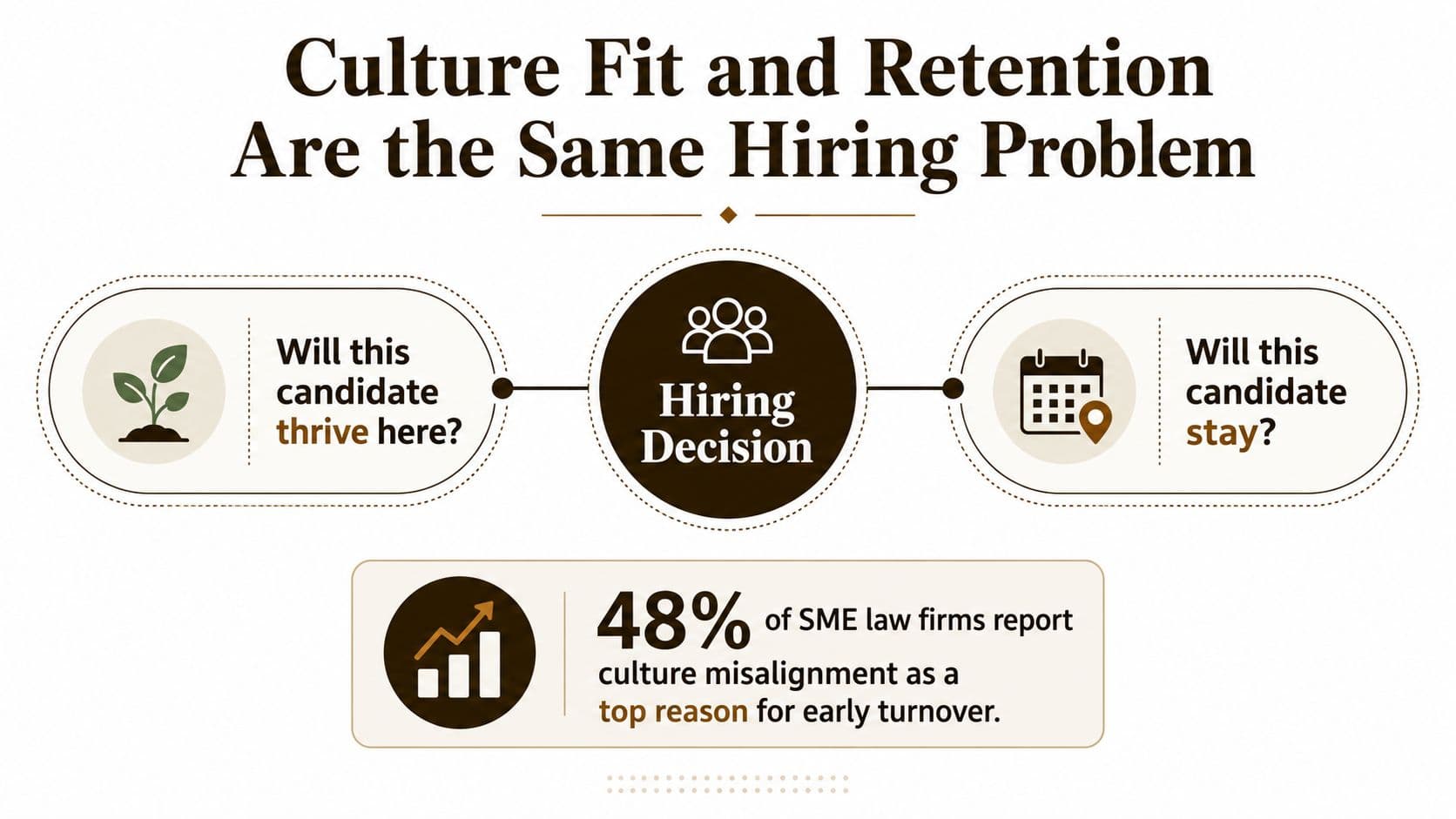
A firm can make a technically smart hire and still lose that lawyer fast if the job collides with how the firm operates. That's why “culture fit” and retention belong in the same sentence. If the work load, pay structure, and growth path don't line up with the candidate's expectations, the firm is planting an attrition problem at the offer stage.
What candidates are actually weighing
BARBRI's 2024 Barometer survey of 127 SME law firms found that 48% reported difficulty keeping talent on board, which is a retention pressure problem, not a branding problem. Wolters Kluwer's 2024 Future Ready Lawyer survey found that 81% of legal professionals consider acceptable work-life balance critical, while 79% expect competitive compensation and 79% want professional development and training. BARBRI and Wolters Kluwer on retention and candidate expectations
Those numbers tell you what a serious interview should be about. If the role requires constant fire drills, say so. If the compensation structure is narrow, say so. If the firm has a real training path, say so with specifics. Candidates don't leave because a firm uses the phrase “strong culture add.” They leave when the day-to-day reality doesn't match the pitch.
The three interview questions that matter
Forget vague reference-check language. Ask whether the candidate has worked in a pace, supervision style, and compensation environment similar to yours. Ask what kind of manager they need to do their best work. Ask what would make them leave in year one. Those answers are more predictive than a polished recommendation letter.
Direct answer: culture fit is not about sameness. It's about whether the firm can actually hold onto the person it is trying to hire.
One more point. If the compensation architecture is below market or the workload is permanently abusive, no recruiter can fix that. They can surface candidates, but they can't repair a promise the firm refuses to keep. The retention problem starts with leadership, not with the search.
Capacity Constraints During Growth and Peak Demand
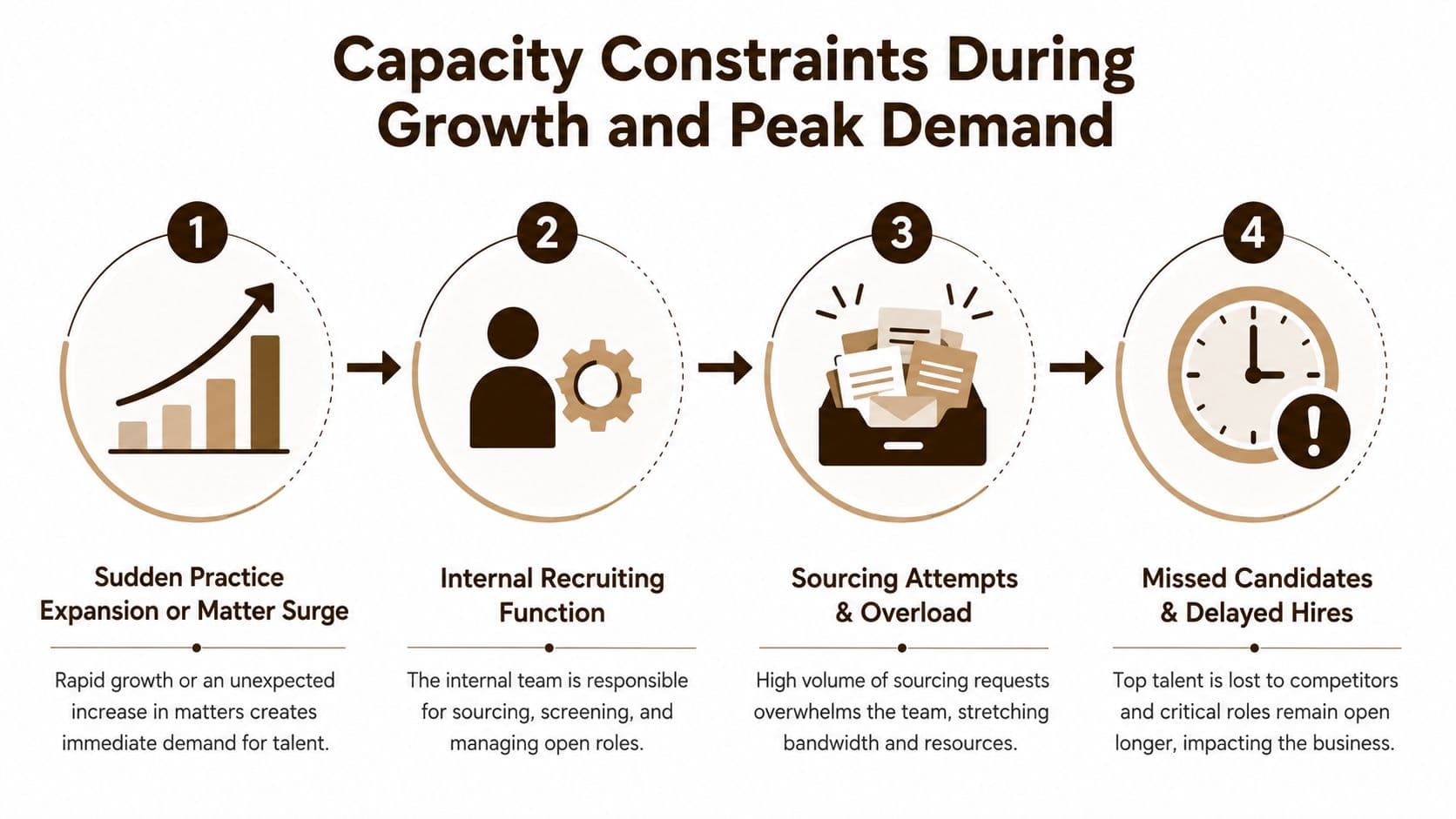
A law firm can have a solid recruiting process and still fail when demand spikes. Internal teams are usually staffed for ordinary months, then a practice grows, a matter turns urgent, or a partner needs support yesterday, and the same people are expected to source, screen, schedule, and negotiate at once. Momentum disappears fast when one team is carrying five jobs.
When internal teams hit the wall
The failure pattern is easy to spot. HR generalists get pulled into other projects, partners start running side searches without sourcing infrastructure, and requisitions sit because nobody owns the pipeline every day. That is not a talent problem. It is a workload design problem.
Growth exposes the difference between a process and actual recruiting capacity. If the need is episodic, adding permanent recruiting headcount can create idle overhead between surges. A contingency or engaged search can absorb the overflow without turning a temporary spike into a fixed cost. In a law firm, that trade-off matters because demand changes faster than staffing plans.
What external support should do
External help should cover the part of the process that does not scale cleanly, sourcing, screening, and shortlisting. It should not replace leadership attention or basic decision-making. During a surge, that support gets the firm from being overloaded to having real candidates on the calendar.
One option is Five Star Placements, which provides contingency-based permanent placement for attorneys, legal support staff, partners, in-house counsel, and legal operations leaders across practice areas and seniority levels. Five Star Placements contact page The point is not the logo. The point is whether the search model fits the hiring pattern.
Measure outside support on operational results, not on promises. Did the recruiter surface relevant candidates quickly? Did the shortlist match the role? Did the firm free up partner time that was previously spent on sourcing and screening? If the answer is no, the firm did not buy capacity. It bought more noise.
When to Fix Recruiting Internally and When to Hire a Legal Recruiter
A law firm that treats every hiring problem the same ends up fixing the wrong thing. The question is which bottleneck sits inside the firm's control and which one needs outside help. Internal changes work when the issue is process, clarity, or commitment. A legal recruiter makes more sense when the market is tight, the search is confidential, or the team does not have the bandwidth to run it properly.
Bottleneck to Fix Mapping
| Recruiting Bottleneck | Best Internal Fix | When to Use a Legal Recruiter |
|---|---|---|
| Time-to-fill | Tighten approval steps, assign one owner, set interview deadlines | When the role is hard to source or the calendar keeps slipping |
| Candidate quality | Redesign the screening rubric around skills and role-specific work | When you need a broader pool and better pre-screening |
| Culture fit | Make workload, supervision, and growth path explicit in interviews | When the search is sensitive or you need a confidential reset |
| Capacity | Reallocate internal recruiting time to the highest-value openings | When the search volume exceeds what the team can cover |
| Retention | Fix compensation, supervision, and advancement promises | When the hire requires targeted outreach to a narrow market |
That table is the right way to think about the search. Time-to-fill is usually an internal discipline problem. Candidate quality is usually a screening problem. Culture fit and retention usually fail because the firm is vague about the job it is offering. Capacity is the point where the recruiting team stops being a process owner and becomes a bottleneck itself.
The incentive math that matters
Contingency recruiting fits most permanent placements because the fee is tied to a hire, not to activity. That keeps the recruiter focused on outcomes instead of filler work. It also puts pressure on the search to stay disciplined, because nobody gets paid for endless meetings or broad, unfocused outreach. A retained search makes more sense when the role is unusually hard to fill, confidential, or strategically important enough to justify an upfront commitment.
The firm still owns the offer. If compensation is weak, the workload is unrealistic, or the partners will not make a decision, outside help will not fix the search. They can surface candidates, but they cannot fix a promise the firm refuses to keep. External recruiting works best after the firm has made the role credible.
For firms deciding whether contingency support fits the search, Five Star Placements' contact page is a direct place to start.
Choosing and Working With the Right Legal Recruiting Partner
A recruiter is not interchangeable with another recruiter. The wrong one wastes time by sending résumés that look active but aren't aligned to the seat. The right one narrows the search fast, understands the practice, and pushes back when the firm's wish list is unrealistic.
What to ask before you sign
Start with practice depth. A firm that says it recruits across Litigation, Personal Injury, Trusts and Estates, Family Law, Immigration, Construction, Business and Corporate, Labor and Employment, Tax, Real Estate, and Healthcare should be able to explain how it sources in each lane, not just claim coverage. Then ask who they place, from paralegals and legal assistants to partners and legal operations leaders, because seniority coverage changes the search method.
Practical rule: if the recruiter talks only about résumé review, they're selling volume, not judgment.
You should also ask how they screen beyond the résumé, what interview coaching they provide, and how they handle feedback loops with the client team. A good recruiter should function like an extension of your office, not a vendor dropping off names. They should also be clear about fee structure up front, because a risk-based contingency model makes the economics transparent and keeps both sides focused on a successful hire.
Red flags you should not ignore
If the proposal is vague on process, that's a bad sign. If the recruiter can't explain how they'll evaluate culture fit, that's a bad sign. If they promise speed without asking basic questions about the role, that's a bad sign.
The first thirty days should be simple. Set the target profile, define the essential requirements, agree on interview cadence, and decide who gets final say. Then make sure the recruiter is reporting progress in plain language, not hiding behind activity counts.
For firms that want a recruiter with direct legal search experience, Five Star Placements' about page gives a clear view of the firm's placement focus and operating model.
A 90-Day Diagnostic Checklist for Your Hiring Funnel
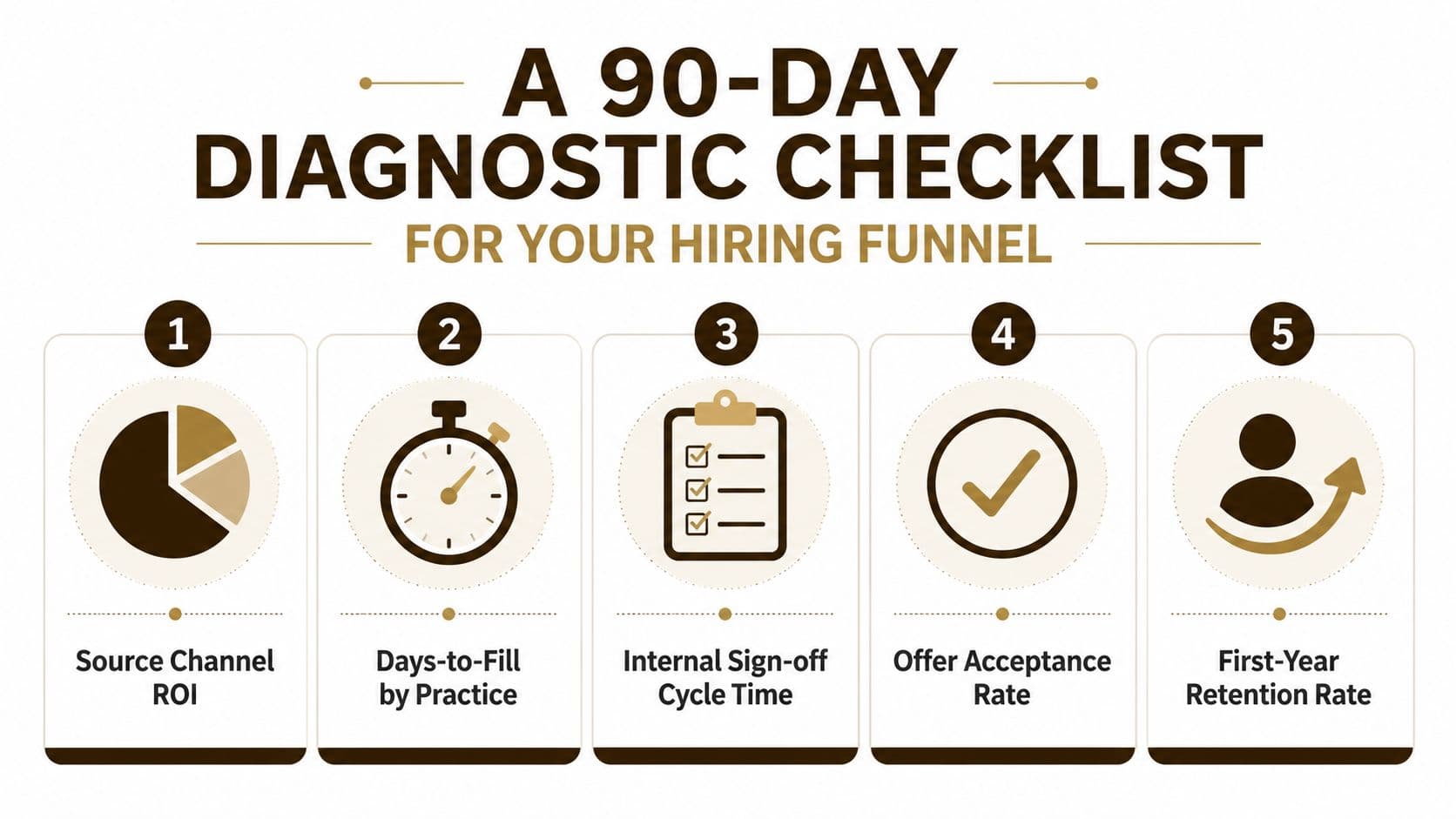
The best firms stop talking about recruiting in generalities and start measuring the funnel. If you can't see where candidates are dropping, you can't know whether your problem is sourcing, screening, culture fit, or internal delay. Ninety days is enough time to get honest data, even if it's not enough time to fix everything.
The metrics worth tracking
- Source Channel ROI: Which channels produce interviews and hires, not just résumés.
- Days-to-Fill by Practice: Which openings move and which ones stall.
- Internal Sign-off Cycle Time: How long approvals, interviews, and offers take.
- Offer Acceptance Rate: Where candidates are dropping after the firm makes an offer.
- First-Year Retention Rate: Which hires stay and which ones expose a mismatch.
Those metrics tell the truth faster than gut feel. If a recruiter is involved, compare before and after. Did sourcing improve? Did the shortlist get tighter? Did the offer process speed up? If the answers are yes, the fee earned its keep. If the answers are no, the firm bought more activity, not better hiring.
What to fix in the next quarter
Change the interview rubric so every candidate is assessed on skills, working style, and role fit, not just pedigree. Assign one owner to each search. Cut the number of people who can stall an offer. Then review every open role against the five bottlenecks in this article and decide which ones are internal fixes and which ones need outside help.
For firms that want a practical way to keep improving beyond the first search, Five Star Placements' blog is a useful place to track recruiting topics, role fit, and hiring process questions.
If your firm is dealing with open seats, slow searches, or candidates who keep disappearing late in the process, Five Star Placements helps law firms and legal departments hire attorneys, partners, legal support staff, and legal operations leaders through contingency-based permanent placement. Visit Five Star Placements if you want a recruiting partner that can help you diagnose the bottleneck, tighten the screen, and move the search forward without wasting another quarter.
Need help filling a legal role?
Five Star Placements partners with law firms and legal departments nationwide.
Schedule a Call