
Quality of Hire Measurement: The Complete Guide
August 24, 2026 · 16 min read · Five Star Placements
Table of contents
A hiring partner approves a lateral associate after several rounds of interviews. The candidate has the right credentials, speaks confidently about client work, and receives strong references. Six months later, the partner still can't answer a basic question: has this person delivered enough value to justify the time, cost, and disruption involved in making the hire?
That uncertainty is common in law firms and corporate legal departments. Recruiting teams track whether a role was filled, how long the search took, and whether the offer was accepted. Those measures describe the process, but they don't tell you whether the attorney, paralegal, legal operations leader, or partner succeeded after joining.
Quality of hire measurement provides that missing view. It connects the hiring decision to post-hire outcomes, including retention, performance, manager confidence, and productivity. For legal teams, the discipline matters because a person's value rarely appears in a single early impression. Matter complexity, client relationships, billing expectations, supervision, and firm economics all shape the result.
Table of Contents
- What Quality of Hire Means for Legal Teams
- The Core Metrics and KPIs That Define Quality of Hire
- Quantitative Methods for Measuring Quality of Hire in Legal Hiring
- Qualitative Methods That Capture What Numbers Miss
- Legal Industry Benchmarks and Real-World Examples
- Best Practices for Implementing Quality of Hire Measurement in Law Firms
- Why Quality of Hire Measurement Should Be a Strategic Priority
What Quality of Hire Means for Legal Teams
A law firm can spend weeks assessing a candidate and still decide mainly on instinct. The hiring partner remembers an impressive interview, the recruiter points to a strong practice history, and the managing partner approves the hire because the vacancy is disrupting the team. The file closes when the candidate accepts.
The evaluation begins after the start date.
The Society for Human Resource Management's guidance on quality of hire defines the metric through the immediate and long-term value a new hire delivers. Its guidance emphasizes post-hire indicators such as performance, retention, manager satisfaction, and time-to-productivity. For legal hiring, the practical question is whether the attorney or legal professional contributes effectively to matters, clients, colleagues, and the firm over time.

Why legal hiring needs a different lens
A junior associate may need substantial supervision before handling work independently. A lateral partner may bring portable relationships yet struggle with the firm's billing practices, conflict procedures, or collaboration expectations. A legal assistant can be technically capable and still fail when the practice group demands a different pace or communication style.
One interview and one early review cannot judge these outcomes fairly. Retention, performance, productivity, and manager satisfaction must be considered together, using expectations suited to the role. Billable output matters for some attorneys, but it does not replace judgment, client service, teamwork, or professional development. A legal operations hire may create value through reliable processes and adoption rather than billable hours.
Partner-level decisions also require attention to firm economics. A placement can look successful on paper while consuming excessive supervision, missing billing expectations, or weakening client confidence. Quality-of-hire measurement makes those costs visible alongside positive contributions.
The metric also helps distinguish a hiring problem from an onboarding or role-design problem. If several strong candidates struggle after joining the same team, the firm should examine supervision, workload, authority, and expectations before blaming sourcing alone.
Practical rule: A successful placement is a person who continues to deliver the value the role requires.
The Core Metrics and KPIs That Define Quality of Hire
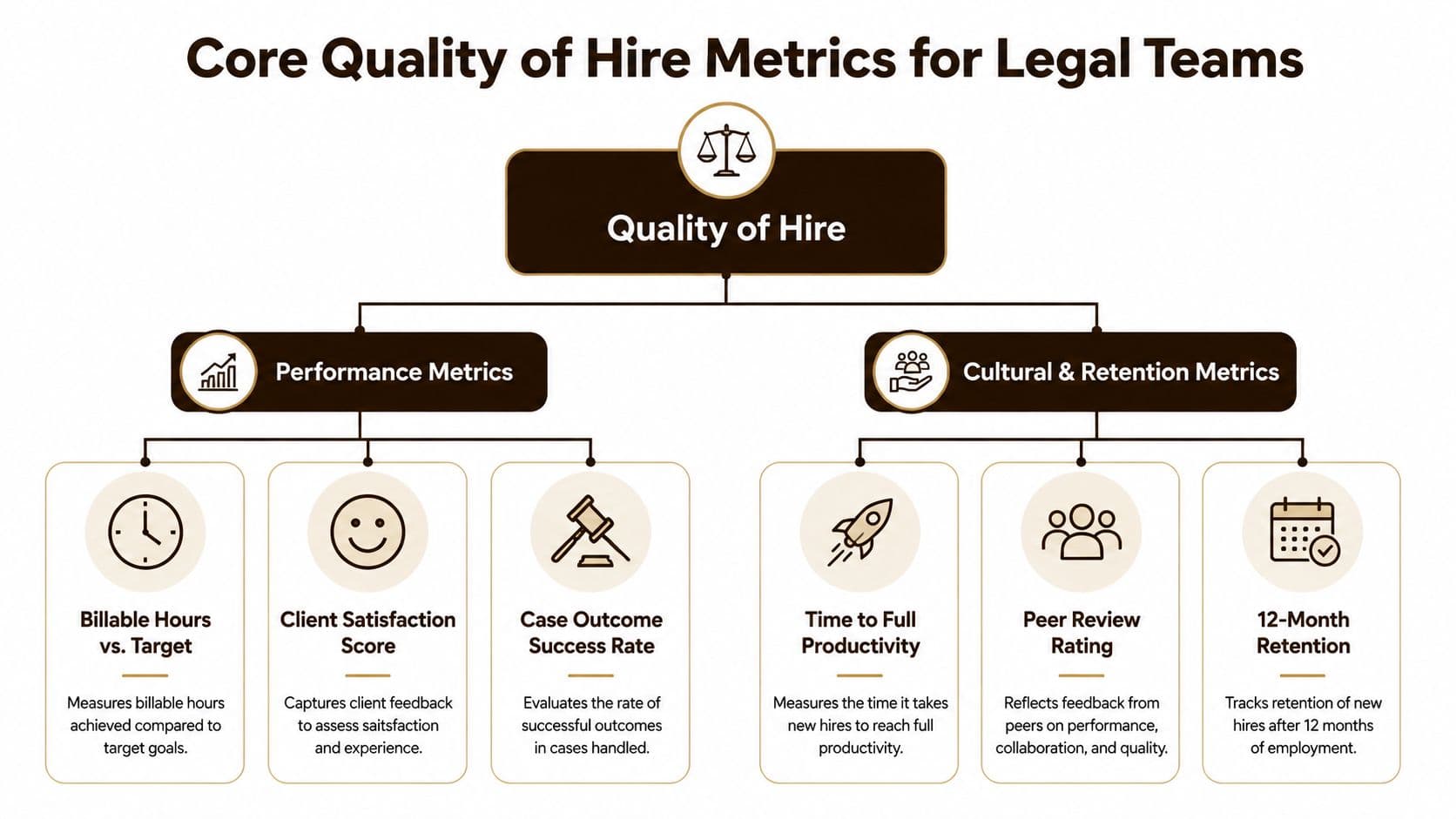
A law firm can make a costly hiring mistake while every early impression looks positive. A lateral partner may win work but create conflicts or miss billing expectations. A junior associate may produce accurate drafts yet require more partner correction than the role can support. Quality of hire is strongest as a multi-signal, post-hire composite, not a single score or opinion. The Society for Industrial and Organizational Psychology on measuring quality of hire recommends combining several indicators so short-term impressions do not obscure effectiveness over time.
Retention shows whether the match holds
Twelve-month retention helps reveal whether the job, practice, and firm matched what the candidate was promised. An attorney may remain engaged during the first months of learning a practice, then leave after discovering a different matter mix, supervision model, compensation structure, or partnership path.
Retention needs context. A person can stay while contributing below expectations, while an early departure may result from restructuring or personal circumstances rather than poor selection. Track retention at agreed checkpoints, then review the reason for departure and the value delivered before drawing conclusions.
Performance needs observable evidence
Performance ratings should reflect the work the role requires. For an associate, that may include research quality, drafting accuracy, responsiveness, judgment, and assignment management. For a partner, it may include matter leadership, client stewardship, collaboration, and business development when those duties belong to the position.
Use anchored prompts instead of asking whether someone is a “good fit.” Record what the hire demonstrated, which work required correction, and whether performance matches the written expectations. A litigation associate who can analyze precedent but repeatedly misses filing-deadline procedures presents a different hiring outcome from one whose writing needs occasional edits.
Productivity must account for ramp time
Time-to-productivity measures how long a hire takes to operate at the expected level. Define productivity for the role. It may mean handling assignments with limited supervision, managing a caseload, supporting a partner reliably, or implementing an agreed legal operations process.
A rushed target produces misleading results. New hires need system access, matter context, feedback, and an appropriate workload. Without those conditions, the metric measures onboarding and role design as much as candidate capability.
Satisfaction exposes manager confidence
Hiring-manager satisfaction captures whether the responsible partner, department leader, or administrator believes the hire solved the underlying need. Collect it through structured check-ins, not hallway comments. Ask what the person now handles, what still requires intervention, and whether the manager would make the same hiring decision based on current evidence.
Quantitative Methods for Measuring Quality of Hire in Legal Hiring
A law firm does not need an expensive analytics platform to measure hiring outcomes. A shared spreadsheet, standardized form, or ATS fields can work when leaders define the criteria before collecting data and apply them consistently across comparable legal roles.
Build a role-specific scorecard
Start with the work the position must deliver. A litigation associate scorecard might assess written work, legal analysis, matter management, responsiveness, and supervision needs. A transactional attorney's scorecard may focus on drafting, negotiation support, accuracy, client communication, and handling closing demands.
Keep each category separate. “Strong attorney” is too broad to explain why a hire succeeds or struggles. Require the responsible partner or manager to record evidence for every category, including the type of work completed and the level of correction required.
For practical guidance on evaluating senior associate candidates before and after placement, use this resource on how to hire senior associates.
Standardize the review rhythm
Use the same checkpoints for comparable roles. Post-hire reviews can include performance at six and twelve months, retention, manager satisfaction, and time-to-productivity. Legal teams should also schedule earlier operational reviews, because problems with training, matter assignment, or supervision can appear before a resignation.
At each checkpoint, collect:
- Performance evidence: What work has the hire completed, and how much supervision did it require?
- Productivity evidence: Which responsibilities can the person now perform independently?
- Manager assessment: What value has the hire created, and which concerns remain?
- Retention status: Is the person still in role, and are warning signs developing?
A partner's rating deserves context. A high score may reflect strong technical work, a light caseload, or limited exposure to demanding clients. Record the conditions behind the rating so hiring leaders can distinguish attorney capability from favorable assignment conditions.
Compare patterns, not isolated scores
Review results by job family, recruiter, hiring manager, practice area, and source channel. The purpose is to identify correctable patterns, not to create a league table that ignores the economics and demands of each practice group.
If litigation hires receive strong early ratings but show weaker later retention, the firm may be presenting an inaccurate picture of progression or workload. If support staff ramp slowly in one office, training or systems access may be the cause. If one practice group rates every hire at the top of the scale, calibrate its reviewers before comparing results with another group.
Use a composite score only after every component has a clear definition. Keep the underlying results visible. A strong retention outcome can conceal weak performance, while a positive manager rating can hide a delayed ramp or excessive partner intervention.
Qualitative Methods That Capture What Numbers Miss
A lateral associate leaves after several months and says the work was not what the firm described. The partner remembers strong writing but frequent revisions. The associate remembers unclear expectations, limited access to substantive matters, and feedback that changed from one supervisor to another. Those details can explain a departure that retention data alone cannot.
Numbers may show that a new hire is struggling. Qualitative evidence identifies whether the cause is contradictory supervision, work withheld by a partner, a poor handoff to support staff, or a communication mismatch within a hierarchical practice group. Use it to explain objective results, not replace them.

Make manager conversations evidence-based
A partner debrief should produce observed examples, not polite reassurance. Ask:
- Which responsibility has the hire handled successfully?
- Where has the work required more correction or supervision than expected?
- How does the person respond to feedback?
- Do partners trust the hire's judgment on appropriately difficult matters?
- Does the hire work effectively with paralegals, assistants, and other attorneys?
- What support could change the current result?
Hold the conversation privately and, where possible, separate it from compensation or disciplinary decisions. Managers share more useful information when the purpose is improving the hiring and supervision process rather than assigning blame.
Use peer feedback with boundaries
Peers often see conduct a supervising partner misses. They can describe whether an attorney shares information, treats support staff respectfully, communicates under pressure, and contributes to matter teams.
Give reviewers a defined structure. Ask for an observed behavior and its effect on the work. Avoid questions about whether they “like” the person or whether the person fits an undefined culture. Those answers invite bias and give hiring leaders little direction.
Treat exits as process evidence
One lateral associate's explanation should not determine a recruiting decision, but it may expose a recurring flaw. Ask what the person expected, what differed from the recruiting discussion, which parts of the role worked, and what might have changed the decision to leave.
Compare themes across departures. Repeated comments about unclear advancement, unrealistic workload, or inconsistent supervision may point to role design or leadership rather than candidate quality. Before extending an offer, firms should also apply a consistent process for attorney background checks.
Feedback is useful only when the question invites a specific observation. “How's it going?” produces courtesy. “What work still requires intervention?” produces information.
Legal Industry Benchmarks and Real-World Examples
Quality of hire measurement remains uncommon, even though recruiting leaders widely recognize the need to evaluate outcomes after placement. The SHRM 2025 Talent Access Report reports that 27% of surveyed organizations, from a sample of 1,143, measured quality of hire. A separate SHRM 2025 benchmarking report reports that 20% of organizations track it.
The difference between those figures likely reflects differences in survey wording or samples. The operational conclusion is consistent: many organizations still don't have enough standardized post-hire data to evaluate recruiting outcomes consistently.
For law firms, that gap creates an opening. A firm that records retention, performance, productivity, and manager confidence can compare hiring outcomes across sources and decision-makers instead of relying solely on interview impressions. It can also distinguish a sourcing issue from a supervision issue, which prevents expensive but ineffective changes to the recruiting process.
What the checkpoints should reveal
| Checkpoint | Metric | Why It Matters for Legal Roles |
|---|---|---|
| Early post-hire review | Manager satisfaction | Shows whether the hire is addressing the immediate need and whether expectations were aligned |
| Initial performance review | Role-specific performance | Tests work quality, judgment, responsiveness, and supervision requirements |
| Productivity review | Time-to-productivity | Shows whether the person is reaching the expected level of independent contribution |
| Six-month review | Retention and performance trend | Identifies whether early success is holding as matter complexity and workload increase |
| Twelve-month review | Retention, performance, and manager satisfaction | Provides a fuller view of first-year value and fit |
These checkpoints don't create a universal benchmark for every attorney. A new lawyer, senior lateral, partner, paralegal, and legal operations executive have different definitions of contribution. The firm must set expectations before the search begins and record whether those expectations were met.
Examples require honest limits
A legal department might discover that lateral hires leave after repeated confusion about reporting lines. A firm might learn that associates with strong technical credentials still struggle because the interview process never tested client communication or collaboration with support staff. Those findings are actionable, even without claiming a precise improvement percentage.
Avoid publishing a success story that says a new scorecard “proved” one school, recruiter, or sourcing channel produces better lawyers unless the data is comparable and the sample is sufficient. Quality of hire measurement is valuable because it improves decisions, not because it creates impressive marketing numbers.
Best Practices for Implementing Quality of Hire Measurement in Law Firms
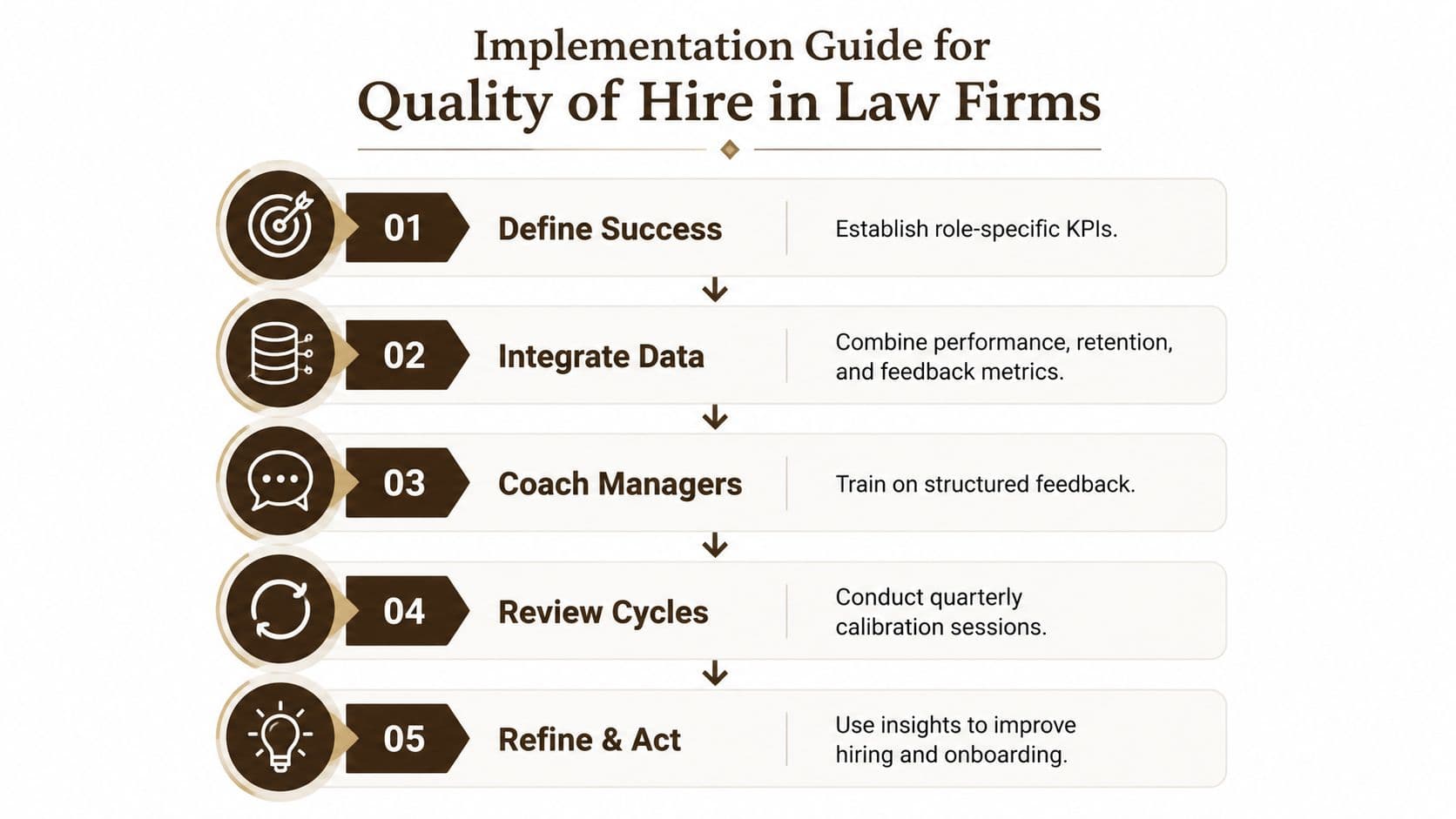
A partner should know what a successful hire must deliver before approving the search. For an associate, that may include drafting accuracy, matter ownership, responsiveness, supervision needs, and development. For a lateral partner, the expectations may involve client continuity, team leadership, portable relationships, and fit with the firm's strategy. A paralegal or legal operations hire requires a different scorecard.
Start with one practice group or role family. Define the outcomes, assign owners, and set review dates before collecting data across the firm. A smaller pilot exposes disagreements in scoring before they become a firmwide reporting problem.
Build the scorecard around observable work
Write each criterion in terms a supervising partner can verify. “Strong communicator” is too vague. “Updates the matter team when deadlines or assumptions change” gives reviewers something specific to assess. “Fits the culture” should become observable behaviors such as collaboration with support staff, response to feedback, and sound judgment under pressure.
Keep the scorecard short enough that partners will use it. A spreadsheet works if the fields, rating definitions, evidence requirements, and review dates remain consistent. A detailed dashboard cannot correct vague criteria or missing follow-up.
Use a practical manager feedback template
After each review, ask the manager to record:
- Observed contribution: What work did the hire complete independently?
- Quality and judgment: What was accurate, and what required correction?
- Matter-team impact: How did the person affect deadlines, supervision, clients, or support staff?
- Development need: What coaching, training, or clearer instruction is required?
- Hiring signal: Which interview assumption proved accurate or inaccurate?
Require examples rather than personality judgments. This format gives partners a common language and creates evidence for coaching, onboarding changes, and future interview design.
Calibrate before results become political
Hold a short quarterly calibration meeting with the hiring partner, supervising managers, recruiting lead, and, where appropriate, a representative from the relevant practice group. Review the rating definitions first, examine a small sample of completed scorecards, challenge unsupported ratings, and agree on one process change. Protect individual confidentiality and keep the discussion focused on recurring causes rather than blame.
External recruiters should receive the role scorecard and post-hire feedback. Reviewing outcomes after placement improves future candidate assessment and strengthens legal talent acquisition strategies for the firm's practice structure.
Review the system regularly, then adjust job descriptions, interview questions, onboarding, supervision, or sourcing when patterns appear. Measure fewer things consistently before measuring many things badly.
Why Quality of Hire Measurement Should Be a Strategic Priority
Six months after an associate joins, the hiring partner should not have to reconstruct the decision from memory. A structured review can show whether the associate produces accurate work, handles assignments with the expected level of supervision, supports the matter team, and is developing the capabilities the role requires. If performance is mixed, the firm can determine whether coaching, clearer instructions, or stronger onboarding will address the gap. If results remain poor, leaders can examine which hiring assumption failed.
The business impact is especially sharp in law firms. A partner-level lateral who cannot transfer clients, fit the firm's service model, or work effectively within its billing and matter systems can occupy a high-value seat while creating client displacement risk. The firm may lose partner attention to supervision, redirect work to other attorneys, and spend months rebuilding the search. The cost includes recruiting expense, lost billable capacity, disrupted client relationships, and the opportunity cost of delaying a better hire.
Measurement connects recruiting to firm economics
Time-to-fill helps leaders understand recruiting speed, but it does not show whether the placement created value. A quick hire who leaves early or cannot perform the core work may improve a recruiting report while weakening a practice group.
Quality of hire measurement gives managing partners a more useful discussion with recruiting and HR leaders. Instead of asking only how quickly a requisition closed, they can ask:
- Did the person remain in the role?
- Did performance match the role's requirements?
- Did productivity reach the agreed standard?
- Does the responsible manager believe the hire solved the business problem?
- Did the process accurately represent the work and expectations?
These questions carry added weight in partner-level decisions. A lateral partner may bring strong credentials and a portable practice, yet fail to integrate with the firm's systems, pricing approach, or client-service model. Several signals should support the decision before leaders call the search successful.
Subjectivity is a reason to structure the process
Legal work requires judgment, so no measurement system can remove interpretation. A structured process can still limit the influence of recency, hierarchy, and personal preference through defined ratings, documented examples, consistent questions, and repeated checkpoints.
Context must remain visible. A low productivity rating may reflect inadequate training rather than capability. A departure may follow a change in firm strategy. A strong manager rating may conceal dependence on one partner who is absorbing too much supervision. Reviewing the components together prevents leaders from treating a single score as the explanation.
Start with a workable operating model
A practical rollout can follow this sequence:
- Choose a role group: Start with a repeat hiring need, such as associates, paralegals, or legal assistants.
- Define success: Agree on role-specific performance and productivity expectations.
- Collect baseline feedback: Begin with manager satisfaction and retention.
- Add depth: Introduce performance and time-to-productivity after managers complete early reviews consistently.
- Review patterns: Compare outcomes by practice area, recruiter, manager, and source.
- Act on findings: Improve screening, interviews, onboarding, supervision, or the role itself.
The data does not need to be perfect before leaders use it. It needs consistent definitions, completed reviews, and enough detail to support a decision. A smaller set of measures applied reliably will expose recurring problems faster than a large dashboard filled with incomplete ratings.
A firm does not gain an advantage by collecting another report. It gains one by learning from each hire before making the next similar decision.
Quality of hire measurement belongs with the people responsible for legal capacity, client service, and financial performance, not only inside an HR dashboard. When hiring leaders connect selection decisions to first-year outcomes, they can identify preventable mismatches, protect billable capacity, and build a more dependable talent pipeline.
Five Star Placements helps law firms and corporate legal departments recruit attorneys, partners, in-house counsel, legal support staff, and legal operations leaders through customized screening and permanent placement. Visit Five Star Placements to discuss a search built around the role outcomes, practice needs, and organizational fit that make quality of hire measurable.
Need help filling a legal role?
Five Star Placements partners with law firms and legal departments nationwide.
Schedule a Call