
What Is a Lateral Partner? a Guide for Law Firms
October 10, 2026 · 12 min read · Five Star Placements

Table of contents
A lateral partner is an attorney who joins a new firm at partner level while bringing an established practice, client relationships, or specialized capability, rather than advancing through the internal associate track. The 2024 U.S. market recorded a 2.3% increase in lateral partner hiring, after a 10.0% decline in 2023, according to NALP's lateral hiring data.
But what is a lateral partner really worth if the reported book of business doesn't follow the lawyer through conflicts clearance, client consent, pricing differences, and integration? That question exposes the gap in conventional definitions. A lateral partner isn't a senior attorney changing employers. The receiving firm is buying a potential transfer of revenue, relationships, matters, leadership, and market capability, while accepting the risk that some of those assets won't transfer at all.
Table of Contents
- Defining the Lateral Partner Role
- Evaluating Portable Business and Revenue
- The Lateral Hiring Process and Due Diligence
- Partner Equity and Compensation Models
- Post-Hire Integration and Retention Strategies
- Key Considerations for Law Firm Leadership
Defining the Lateral Partner Role
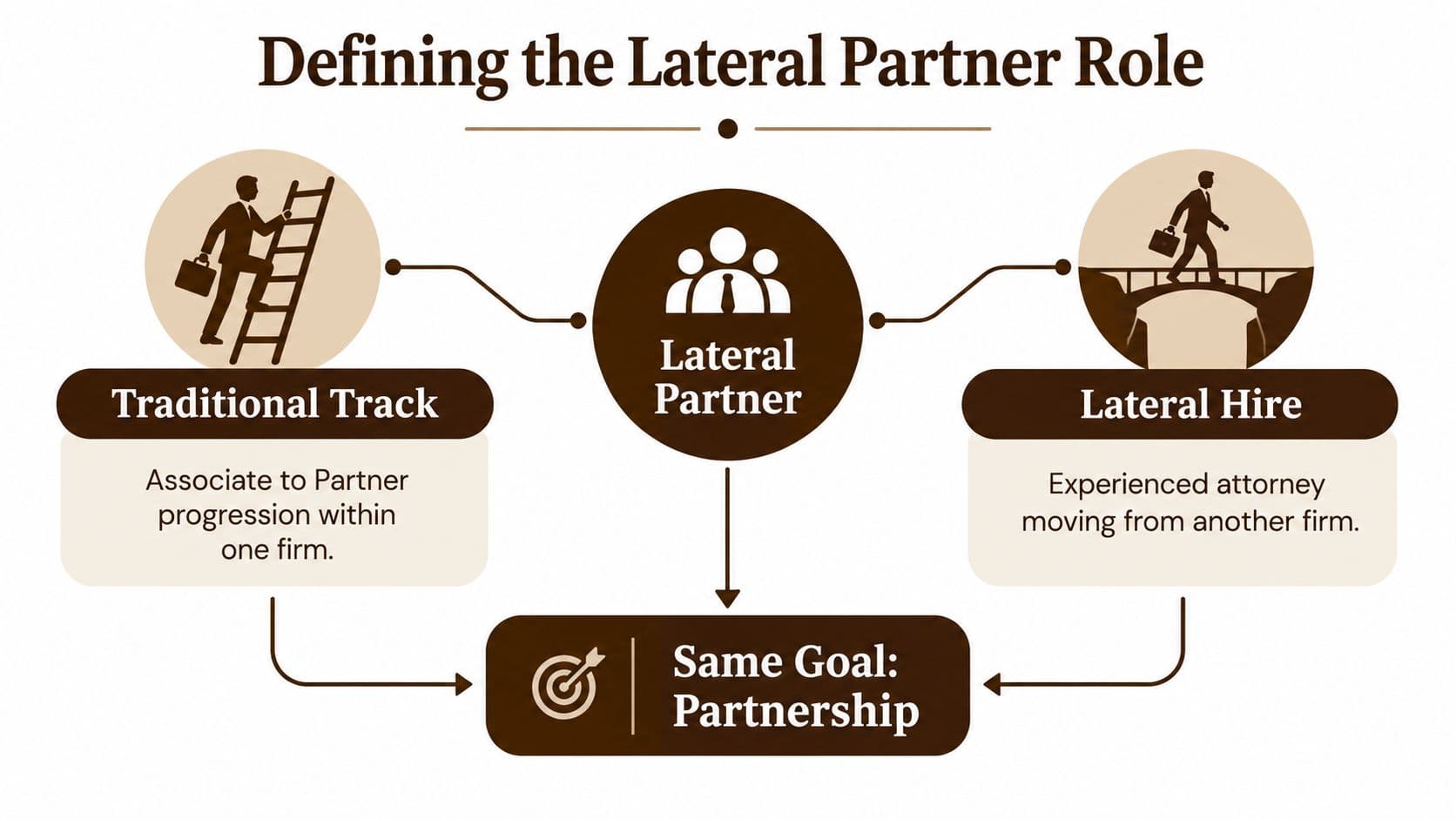
A lateral partner is an attorney who moves from one law firm to another while joining the destination firm at partner level. The lawyer may already be an equity partner, a non-equity partner, an income partner, or a salaried partner, depending on the structure of the current and receiving firms. The defining feature is the level of entry and the expectation that the lawyer brings more than individual legal skill.
An associate usually builds toward partnership through the firm's internal promotion process. The firm evaluates legal performance, judgment, client service, business development, and leadership over time. A lateral partner enters with a pre-existing professional record and is generally expected to contribute an established practice, client relationships, matter experience, reputation, or a specialized capability from the outset.
Why the distinction matters
The difference changes how the firm assesses the candidate. An associate lateral may be evaluated primarily on legal ability, experience, references, and future potential. A lateral partner must also explain the economics and mechanics of the proposed move:
- Portable business: Which clients are likely to instruct the new firm?
- Matter continuity: Which active matters can transition lawfully and practically?
- Originating relationships: Does the partner personally control the relationship, or does the client primarily rely on the departing firm or a broader team?
- Practice leadership: Can the candidate recruit, mentor, delegate, and collaborate?
- Strategic fit: Does the practice strengthen a priority market or complement existing capabilities?
The move became a recognized feature of the profession as lateral mobility increased during the 1990s and became accepted by the 2000s, according to the ABA Journal's history of lateral partner movement. The same source reported that the 200 largest U.S. firms averaged approximately 2,532 lateral-partner moves annually during the period discussed after 2009.
That history explains why firms treat lateral recruitment as a growth strategy rather than ordinary hiring. A lateral may transfer revenue-generating capacity and institutional relationships faster than an associate class can develop into leadership. The trade-off is that the firm must validate what is transferable before it assigns value to the move.
For attorneys comparing partner status with another senior arrangement, the distinction also matters because title alone doesn't determine economic rights or responsibilities. The practical differences between of counsel and partner roles can affect authority, compensation, client expectations, and the candidate's role in firm governance.
Evaluating Portable Business and Revenue
How much of a reported book will land, collect, and stay profitable after the move?
That is the question that matters in a lateral partner search. The most common financial error is to treat gross originations as if they will convert cleanly into revenue at the new firm. In practice, a stated book is only a working hypothesis until client consent, conflicts, collections history, and economics support it.
Start with a client-by-client review. Historical originations can show who received credit for bringing in work at the current firm, but they say much less about who owns the relationship, whether the client will follow, whether active matters can move, and whether the receiving firm's rates and staffing model leave enough margin to justify the hire. I have seen laterals with impressive originations struggle because the client was loyal to a broader team or because the work no longer made sense at the new platform's price point.
From reported book to usable forecast
A sound review separates several related measures that firms often blur together:
| Question | What the firm should verify |
|---|---|
| Who generated the work? | Originations by client, matter, and period |
| What was collected? | Billing and collections history, not only billed work |
| Who controls the relationship? | The partner's personal connection, institutional ties, and shared coverage |
| What can transfer? | Client consent, conflicts status, matter stage, and file-transfer constraints |
| What will remain profitable? | Pricing, staffing, overhead, compensation, and integration requirements |
The NALP lateral partner audit checklist points to portable business, business-generation method, billing and salary history, seniority, and compensation relative to comparable partners as core variables. Those categories push the analysis away from salesmanship and toward evidence.
The forecast should reflect discounts for client consent, conflicts, relationship dependence on the former firm, pricing differences, and the time required to transition matters. A client may value the partner and still be unable to move quickly because of procurement rules, panel restrictions, conflicts, or internal approval requirements. Institutional clients also tend to have multiple touchpoints at the old firm, which means personal loyalty may only explain part of the revenue.
Profitability needs its own review. A receiving firm should test whether the book survives rate pressure, staffing realities, and overhead by reviewing its profit per equity partner implications. Collected revenue that requires heavy discounting, partner-level staffing, or significant integration cost can disappoint very quickly.
What works and what fails
What works is a documented schedule showing recent collections, key client contacts, matter status, relationship ownership, and a specific explanation for why each material client would continue instructing the new firm. Direct client indications can strengthen the case, provided those conversations are handled consistently with professional obligations and the candidate's duties to the current firm.
What fails is accepting one originations figure at face value. Concentration, collection quality, shared credit, conflicts, pricing, and transition timing all matter. A book can look strong on paper and still produce weak economics once conflicted matters are excluded, a relationship partner keeps the client, or the compensation package assumes revenue will arrive faster than it can.
The right financial question is practical: which matters can this firm ethically accept, bill, collect, staff, and retain under the proposed deal? The answer should determine value far more than gross production credit.
The Lateral Hiring Process and Due Diligence
A typical search starts with a partner whose practice appears strategically relevant. Suppose the candidate handles a specialized commercial practice, has active institutional clients, and works with a small group of associates. The receiving firm may see an opportunity to add capability and enter client conversations more quickly, but it shouldn't move directly from interest to compensation discussions without controlled diligence.
The first task is to define the information needed for an initial conflicts review. The firm should request a lateral questionnaire covering current matters, former matters, substantially related matters, clients, adverse parties, affiliates, and relevant closed files. The candidate shouldn't provide unrestricted confidential information. Instead, the receiving firm needs enough detail to identify potential conflicts while protecting privilege and avoiding prejudice to clients.

A controlled review in practice
The receiving firm can then compare the matter history against its conflicts database. The review should include more than the matters the candidate expects to bring. Current matters that won't move may still create conflicts, and closed matters may be substantially related to work the new firm handles.
A responsible process usually follows this sequence:
- Set the disclosure boundary. Identify the minimum client and matter information required for conflict detection.
- Collect the questionnaire. Obtain current, former, substantially related, and closed-matter information in a controlled format.
- Run the database review. Compare clients, adverse parties, affiliates, and matter descriptions against the receiving firm's records.
- Resolve identified issues. Determine whether the firm can proceed, whether a waiver is available, or whether a screen may be appropriate.
- Confirm transfer mechanics. Assess client instructions, file transfer, staffing, billing, technology, and timing.
- Document the decision. Preserve the analysis supporting the hire, any waivers, and any restrictions.
ABA Formal Opinion 09-455 permits limited disclosure of client identity and matter information for conflict detection during a lawyer's move, but the disclosure must be no greater than reasonably necessary and must not compromise privilege or prejudice the client. The receiving firm should treat that limitation as a process requirement, not a courtesy.
Fit is part of diligence
Conflicts clearance doesn't answer whether the platform can support the practice. The firm should also test matter staffing, pricing authority, billing systems, technology, client-service expectations, and collaboration with existing partners. A candidate may have transferable relationships but still struggle if the proposed firm lacks the specialists, geographic reach, or operational support those clients expect.
The lateral hiring process for law firms works best when recruitment, conflicts, practice leadership, finance, and operations share responsibility before the offer is final. A rushed process may secure the signature while leaving the firm unable to accept or service the work that justified the hire.
Partner Equity and Compensation Models
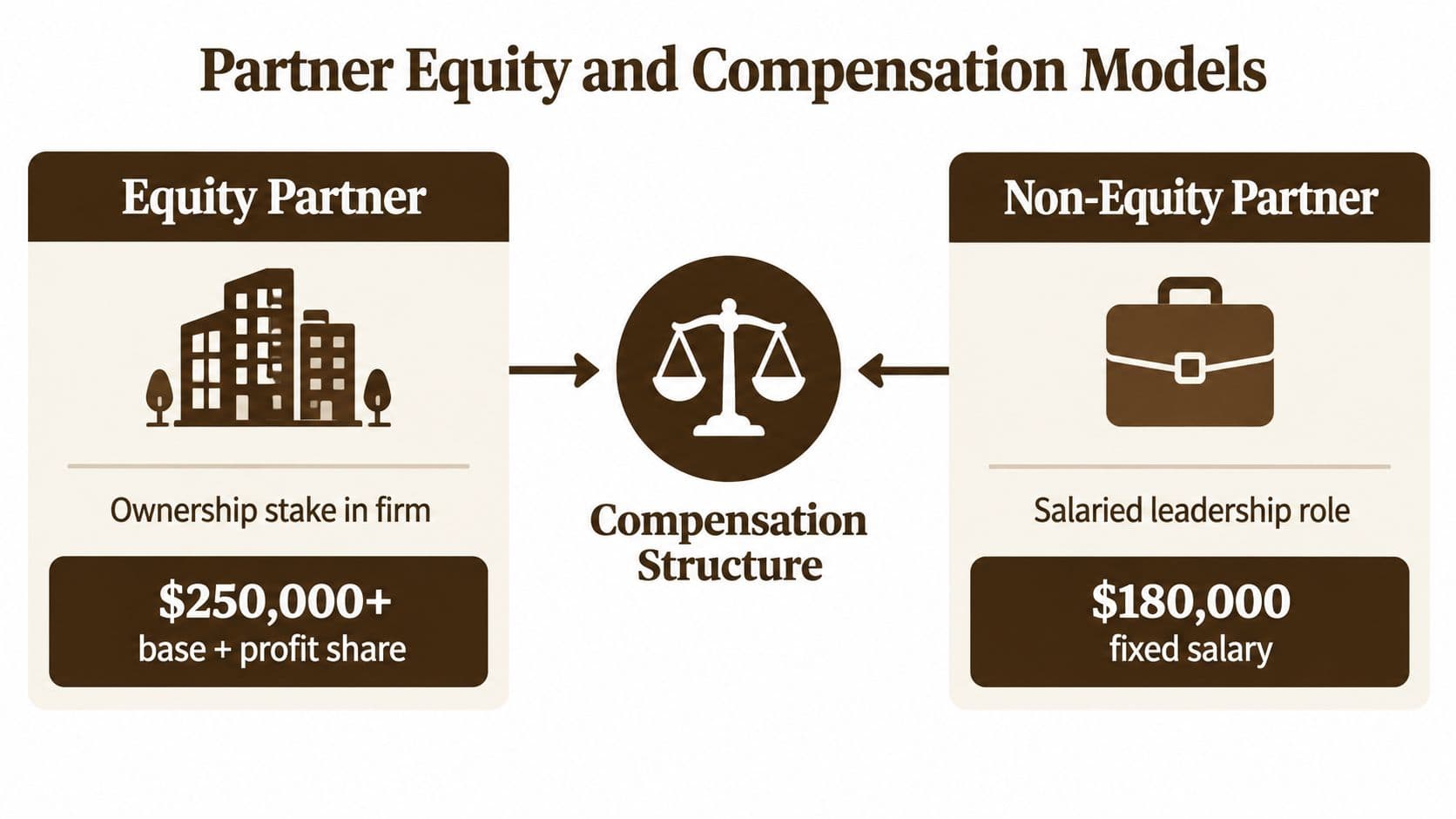
Partner status doesn't describe one universal economic arrangement. An equity partner generally owns an interest in the firm and participates in profits. A non-equity, income, or salaried partner generally holds a leadership title whose status and economic rights are defined by the receiving firm's governing documents and compensation policies.
Comparing the structures
| Model | Candidate receives | Firm must manage |
|---|---|---|
| Equity partner | Ownership interest and participation in firm profits, subject to the firm's structure | Capital requirements, governance rights, profit expectations, and valuation or withdrawal terms |
| Non-equity partner | A salary, income arrangement, or other defined compensation without the same ownership interest | Scope of authority, compensation reviews, leadership expectations, and promotion or transition terms |
| Hybrid or transitional arrangement | A negotiated path that may combine income security with a later equity opportunity | Milestones, timing, business-performance assumptions, and conditions for changing status |
The right model depends on the candidate's practice, the firm's capacity, and the reliability of the projected business. Equity can align the partner with long-term firm performance, but it may also introduce capital obligations and variable compensation. A non-equity structure can provide clearer income expectations and let the firm test integration before extending ownership, but it may feel limiting to a candidate seeking governance rights and profit participation.
Compensation should connect to verified economics rather than reported originations. The parties need to address base or draw, profit allocation, collections responsibility, credit for originated matters, cross-selling, team compensation, capital, benefits, guarantees, and what happens if projected work doesn't transfer.
The title is only meaningful when the economic rights and obligations are written clearly.
A firm should also model the cost of integration before agreeing to guarantees or signing payments. Compensation commitments may begin before the partner's clients transition, while conflicts review, staffing, technology, and business-development support create additional costs. A candidate, meanwhile, should understand whether the promised structure reflects actual governance participation or a senior title with limited control.
Post-Hire Integration and Retention Strategies
The hire is not the result. It is the point at which the firm must prove that its platform can support the practice it evaluated.
Current market reporting illustrates why this matters. NALP-reported hiring volume increased 16.4% among offices providing comparable 2024 and 2025 data, and separate 2025 industry reporting identified 3,009 lateral partner hires, a 10% year-over-year increase. The industry report on lateral partner movement and retention also described partner retention after three years at 76% in the Am Law 200. Those figures make post-placement accountability a management issue, not a recruiting footnote.
The first operating plan
The partner needs a written transition plan that names owners and deadlines. It should cover:
- Client communication: Decide who contacts each client, when the communication occurs, and how continuity will be protected.
- Matter staffing: Match the incoming practice with lawyers who can handle work immediately and support future capacity.
- Billing and technology: Complete onboarding before administrative friction reaches clients.
- Internal introductions: Connect the new partner with colleagues whose practices complement the incoming relationships.
- Business development: Identify realistic joint opportunities rather than promising vague cross-selling.
- Feedback ownership: Assign a managing partner, practice leader, or integration sponsor to address obstacles.
A partner can arrive with a strong practice and still underperform if promised support never materializes. Isolation, unclear credit for shared work, incompatible pricing, and slow administrative onboarding can damage client confidence faster than the recruitment team can repair it.
Measure more than first-year revenue
First-year collections matter, but they don't tell the whole story. Leadership should also monitor client continuity, matter acceptance, staffing stability, collaboration with existing partners, associate development, cross-practice activity, and the partner's participation in firm initiatives. These indicators show whether the practice is becoming part of the firm or remaining a separate island.
A lateral partner's first-year revenue is an output. Retention and collaboration determine whether the investment compounds.
The firm should schedule formal reviews rather than wait for a problem to become visible through missed financial targets. If clients aren't transitioning, conflicts are limiting the practice, or internal support is inadequate, leadership needs to revise the business case and the operating plan. Retention begins with a credible reason for the partner to stay, including meaningful work, reliable support, fair economics, and a role in the firm's direction.
Key Considerations for Law Firm Leadership
What does firm leadership need to know before approving a lateral partner hire?
Start with four questions, and answer them with numbers the firm can defend.
First, what exactly is portable? Gross originations are a starting point, not a forecast. Separate originations from collections, identify who truly owns each client relationship, test whether clients are likely to move, and strip out matters that conflicts or client instructions may prevent the firm from taking. A sound business case shows expected usable revenue after those filters, because historical production alone does not pay the guarantee.
Second, can the firm support the practice? Review conflicts, staffing depth, pricing flexibility, technology, billing operations, geographic coverage, and complementary capabilities before making promises in the market. I have seen laterals with real books struggle because the platform could not deliver the service model their clients expected.
Third, does the proposed structure match the risk? Equity, non-equity, income, and transitional arrangements shift control and economic exposure in different ways. Compensation guarantees, capital terms, profit participation, and performance expectations should line up with the reliability and timing of the projected revenue. If collections are likely to lag, the deal terms should reflect that.
Fourth, who owns integration? Assign a leader with authority, then set client-transition, staffing, onboarding, collaboration, and review milestones. Cultural fit matters because it affects whether the incoming partner shares relationships, uses the firm's platform, supports colleagues, and stays committed when early friction appears.
These questions matter across the market, including smaller and midsized practices, where the same discipline applies. As noted earlier, NALP reported increased partner lateral hiring among firms with fewer than 250 lawyers in 2022. The strategic appeal is speed. The financial reality is that speed creates value only when leadership validates portability, prices risk correctly, and funds integration.
Five Star Placements provides contingency-based permanent placement for attorneys and partners, including confidential lateral partner searches with screening for experience, practice fit, portability, and organizational culture. Visit Five Star Placements to discuss a partner search built around the economics and integration requirements of your firm.
Need help filling a legal role?
Five Star Placements partners with law firms and legal departments nationwide.
Schedule a Call