
Profit Per Equity Partner: A Complete Guide for Law Firms
October 6, 2026 · 15 min read · Five Star Placements

Table of contents
The average profit per equity partner across the 2025 Am Law 100 reached approximately $3.15 million, up 12.3% year over year for fiscal year 2024, according to the published Am Law 100 results. That figure is impressive, useful, and dangerously easy to misunderstand.
Profit per equity partner, or PPEP, is not a partner's salary. It's not a guarantee of what a lateral will earn. It isn't even a complete measure of whether a firm is healthy. PPEP is a firmwide profitability ratio shaped by pricing, collections, staffing, associate workload, partner classification, profit allocation, and the number of people included in the equity denominator.
Managing partners should still care about it. They just need to stop treating the headline number as the answer.
Table of Contents
- Why Profit Per Equity Partner Matters More Than Ever
- The Profit Per Equity Partner Formula Explained
- Am Law 100 Benchmarks and What They Reveal
- Metrics That Sit Alongside PPEP
- The Hidden Distortions Behind a Headline PPEP Number
- Levers That Actually Move PPEP
- Using PPEP to Evaluate Lateral Hires and Partner Search
- Putting It All Together as a Managing Partner
Why Profit Per Equity Partner Matters More Than Ever
Sixty-eight firms recorded PPEP growth of at least 10% in the 2025 Am Law data, as reported in the Am Law performance summary. That result explains why partners use profit per equity partner as a reference point when judging firm performance, compensation, and competitive position.
A managing partner weighing a lateral rainmaker should start with the candidate's effect on collected profit, not the size of the portable book. Guarantees, support costs, billing and collection risk, and origination credit rules can determine whether the hire strengthens or weakens the firm's profit per equity partner. The equity denominator matters just as much. Moving a partner into or out of the equity class, changing the number of nonequity partners, or admitting additional equity partners can change the reported ratio without a matching change in underlying economics.
That makes PPEP more useful than a revenue headline, but less definitive than many partners assume. Revenue per lawyer describes production across the platform. Utilization shows capacity. Realization shows how much billed work survives write-downs. PPEP brings the result of pricing, staffing, collections, compensation, and profit allocation into one figure that equity partners recognize immediately.
A firm can post impressive revenue while owners receive disappointing returns if expenses rise faster than collections. It can also report strong PPEP by keeping the equity group narrow, shifting economic costs to nonequity partners or associates, or distributing profit aggressively. Origination rules can further distort the recruiting picture when a lateral's book benefits one partner while the firm carries the hire's guarantees and operating costs.
The number partners compare
Partners use PPEP to judge whether their firm is gaining ground, losing pricing power, or distributing profit less effectively than comparable firms. The movement affects more than annual compensation. It shapes lateral recruiting, equity admissions, partner retention, and the firm's appeal to lawyers choosing where to build a long-term practice.
Practical rule: Treat PPEP as the lens for a decision, not the decision itself.
A high PPEP can signal strong pricing power and disciplined cost control. It can also reflect a narrow equity class or compensation rules that leave an incoming partner with less upside than the headline suggests. Before approving a lateral, ask two questions: how much collected profit will the hire add, and how will the hire change the denominator? Those answers matter more than the candidate's marketing narrative.
The Profit Per Equity Partner Formula Explained
The formula is straightforward:
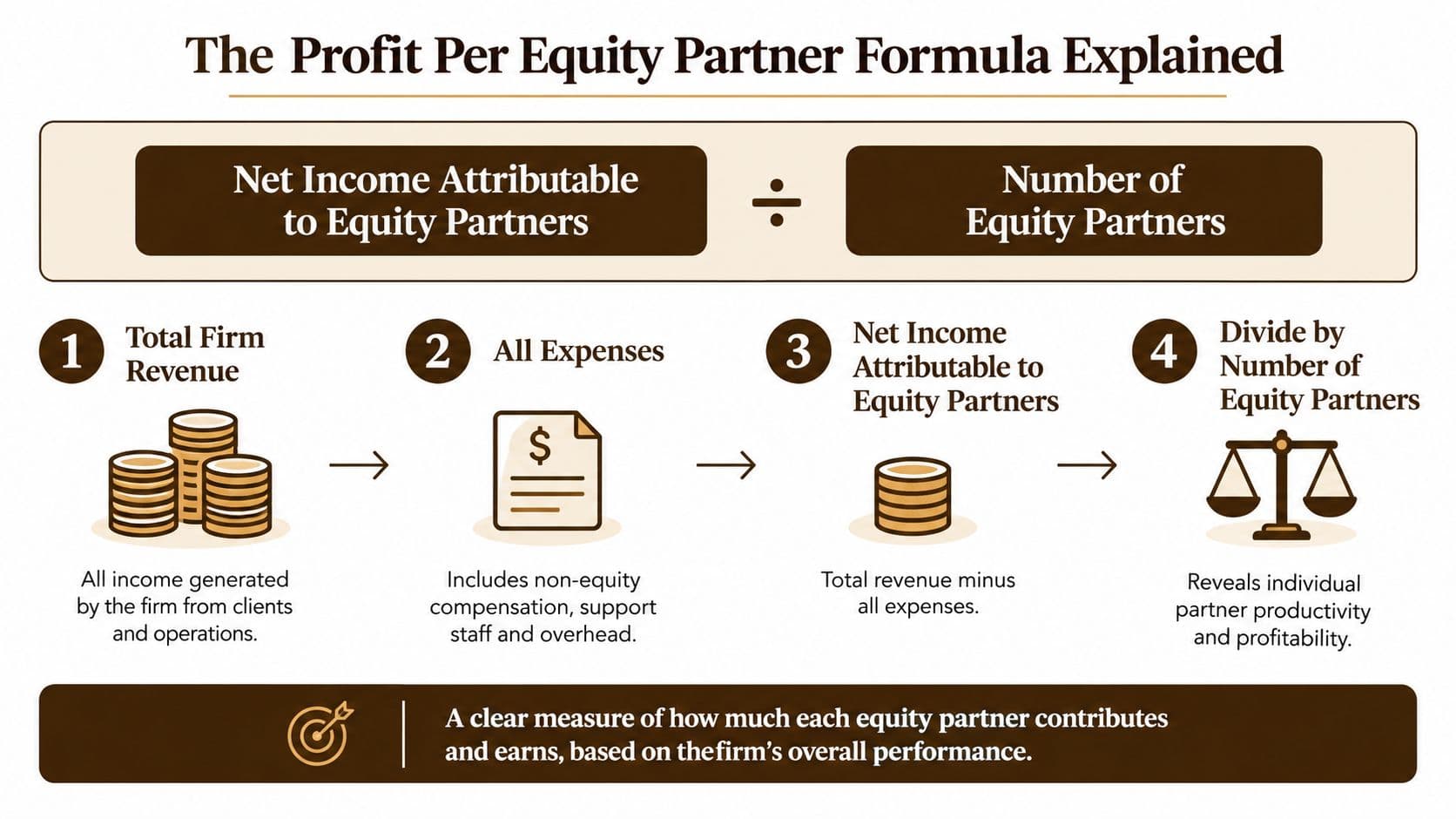
PPEP = distributable firm profit ÷ number of equity partners
A more precise version is net income attributable to equity partners divided by the number of equity partners. The numerator starts with total firm revenue and subtracts operating expenses, lawyer compensation, non-equity partner compensation, support costs, technology, occupancy, recruiting expenses, and other costs recognized by the firm's reporting policy.
The arithmetic is easy. The accounting choices are not.
Start with the numerator
First, define the profit figure. Does the firm use total net profit, distributable profit, or profit after retaining cash for investment? Does it include or exclude expenses associated with lateral guarantees? Does it treat deferred compensation as a current expense? Does it allocate shared services consistently across offices and practice groups?
Two firms with similar operating economics can report different PPEP if one distributes more profit and the other retains more for technology, reserves, expansion, or partner obligations. That difference doesn't automatically mean one firm is better managed. It means the reported ratio reflects a policy choice as well as operating performance.
Then audit the denominator
Next, identify who counts as an equity partner. Equity partners share ownership economics, while nonequity or income partners generally receive salary and bonuses without the same direct ownership interest. Firms may also classify of-counsel lawyers, retired partners, special counsel, or lawyers in transition differently.
That classification can materially change the result. A firm that moves partners out of the equity tier reduces the denominator. If profit stays constant, PPEP rises even though the firm hasn't generated another dollar of revenue or improved its margins.
For a practical explanation of how ownership status affects law-firm economics, see this guide to equity partnerships. When reviewing a reported figure, request both the calculation and the partner census behind it. Without those inputs, PPEP is a polished output with an uncertain meaning.
Am Law 100 Benchmarks and What They Reveal
The 2025 Am Law 100 results, covering fiscal year 2024, place average PPEP at approximately $3.15 million. The reported figures for leading firms were approximately $9.253 million at Kirkland & Ellis, $9.036 million at Wachtell Lipton, $8.643 million at Quinn Emanuel, $7.800 million at Davis Polk, and $7.664 million at Simpson Thacher, according to the published ranking data.
That spread reflects different rates, matter mixes, collection records, partner structures, and equity admission policies. It also reflects the denominator. A firm can raise reported PPEP by moving lawyers out of the equity class, while another can report a lower figure by keeping more partners in that group.
2025 Am Law PPEP benchmarks by tier
| Firm tier | Example firm | Approx. PPEP | Key driver |
|---|---|---|---|
| Am Law 100 average | Am Law 100 overall | $3.15 million | Broad mix of markets, practices, associate-to-partner ratios, and partner structures |
| Top tier | Kirkland & Ellis | $9.253 million | Pricing power, scale, associate-to-partner ratios, and profitable practice mix |
| Top tier | Wachtell Lipton | $9.036 million | Premium work, high rates, and concentrated partner economics |
| Top tier | Quinn Emanuel | $8.643 million | High-value litigation work and strong profitability |
| Top tier | Davis Polk | $7.800 million | Premium institutional practices and pricing strength |
| Top tier | Simpson Thacher | $7.664 million | High-value transactional and institutional work |
These are firmwide averages, not compensation promises. A partner's actual economics depend on originations, collected revenue, seniority, practice area, geography, and the firm's compensation system.
The denominator deserves a direct review before any recruiting decision. Ask how many equity partners the firm reports, how many nonequity partners sit outside that count, and whether recent reclassifications changed the result. A firm with fewer equity partners may show higher PPEP without producing more total profit. A firm with a broader equity group may show lower PPEP while offering a stronger path to ownership.
Guarantees create another adjustment. A lateral partner may receive guaranteed compensation that affects near-term profit, while the firm's origination-credit rules determine whether that hire can build durable economics after the guarantee expires. Examine both before treating a high headline figure as proof of superior partner opportunity.
PPEP also does not prove that heavier staffing always works. More associates can expand partner capacity only when demand, supervision, realization, and collections support the payroll. For a recruit, request the compensation architecture, origination-credit rules, equity admission requirements, nonequity partner count, and treatment of guarantees. The ranking starts the conversation. The denominator and credit rules determine whether the opportunity holds up.
Metrics That Sit Alongside PPEP
PPEP becomes useful inside a broader diagnostic panel. A managing partner should ask three questions: how much revenue the platform produces, how reliably that revenue becomes cash, and how much lawyer capacity supports each equity partner. A high PPEP with weak answers elsewhere deserves scrutiny before it shapes hiring or compensation decisions.
Revenue per lawyer
Revenue per lawyer, or RPL, divides firm revenue by its lawyer population. It includes equity partners, nonequity partners, associates, counsel, and other eligible lawyers, so it tests productivity across the operating platform rather than within the equity class alone.
Strong RPL paired with strong PPEP usually indicates that the firm creates value broadly and distributes a healthy share of it to equity partners. High PPEP paired with weak RPL points to a narrower result. The firm may be producing acceptable profit through a smaller equity group while the wider lawyer base generates less revenue than the headline suggests.
For recruiting, compare RPL by practice and office where available. A platform that supports high-value work across multiple teams gives a lateral partner more room to grow. A firm with concentrated production may offer an attractive current number but less dependable support for future originations.
Utilization and realization
Utilization measures how much available lawyer capacity goes to productive work. Realization measures how much recorded or billed work becomes revenue after discounts, write-downs, and client concessions. Keep the measures separate. They identify different operating problems.
A lawyer may be busy while recording too little time. A partner may bill substantial hours while clients or the firm reduce their value through discounts, write-downs, or scope disputes. PPEP improves only when that work becomes collected revenue.
Thomson Reuters' performance-metrics guidance identifies realization, utilization, contributions per equity partner, full-time-equivalent allocation, and staffing structure as complementary indicators. Use that combination. PPEP shows the outcome, while these measures show whether the operating model can repeat it.
Staffing depth and associate ratios
Associate and counsel capacity shows how many lawyers support each equity partner and what work they perform. A balanced ratio can give partners more time for origination, client management, and high-value matters. Excess capacity becomes expensive when demand softens, supervision absorbs partner time, or clients resist rates that support the staffing model. A narrow ratio can constrain growth and push partners into work that should sit lower in the team.
Use the following profiles as diagnostics, not market benchmarks:
| Firm | PPEP | RPL | Utilization | Realization | Staffing ratio |
|---|---|---|---|---|---|
| Firm A | High | $1.1M | Strong | 92% | 3.5 lawyers per equity partner |
| Firm B | High | Moderate | Mixed | Weak | Narrow |
| Firm C | Moderate | High | Strong | Strong | Developing |
| Firm D | Moderate | Low | Weak | Weak | Heavy |
Firm A has the strongest operating case because its profit measure sits beside broad production, reliable conversion, and identifiable staffing depth. Firm B may be benefiting from a narrow equity population or distributions that are difficult to sustain. Firm C may have room to improve partner economics through pricing, collections, or compensation design. Firm D needs operational correction before adding equity partners or expensive lateral guarantees.
The Hidden Distortions Behind a Headline PPEP Number
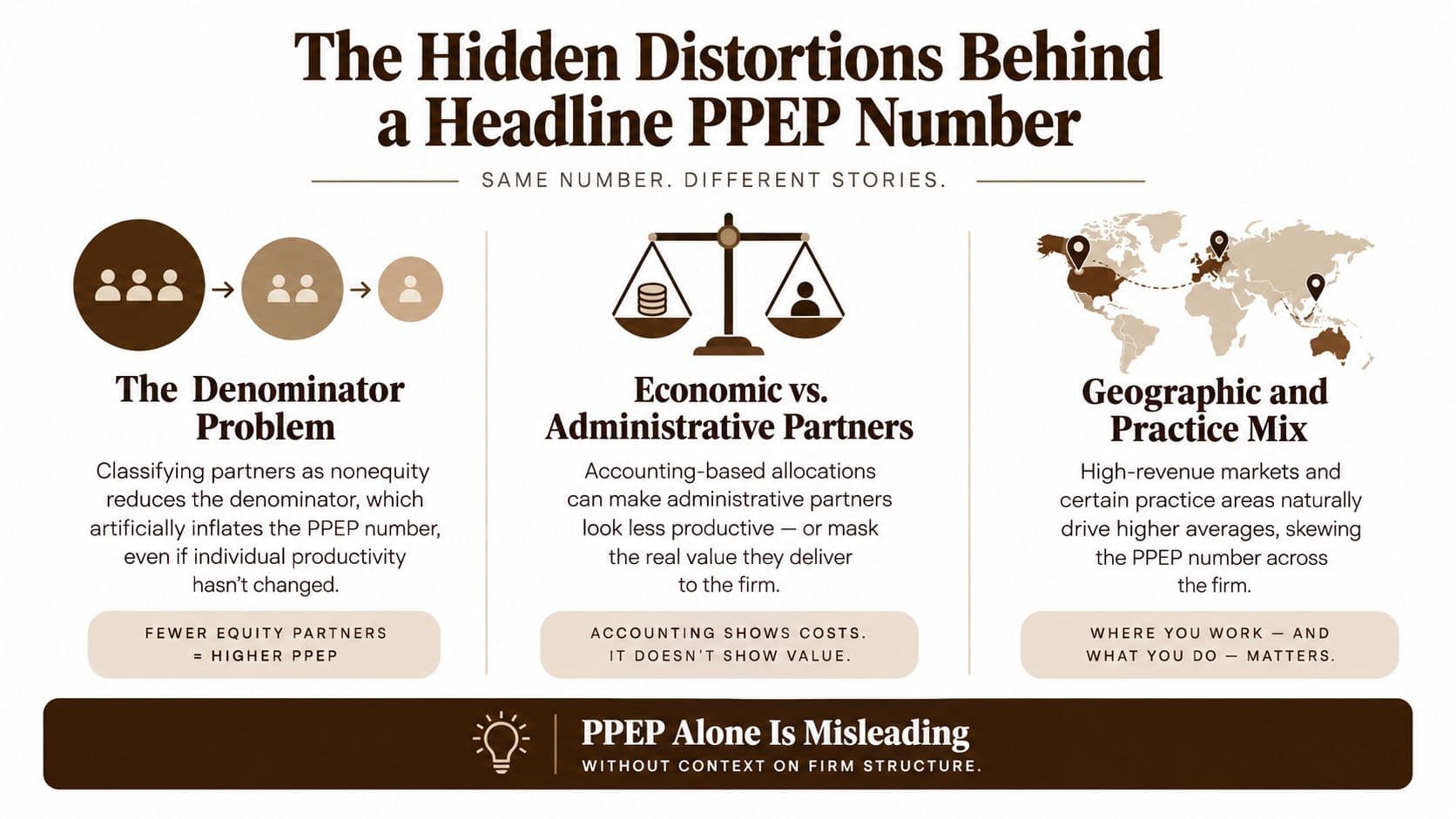
PPEP is a poor standalone measure of partner economics. The ratio can move because the firm earns more, but it can also move because the firm changes who counts as equity, how it distributes profit, or how it records obligations to incoming partners.
The denominator problem
Nonequity partner classification is the most obvious distortion. Across the Am Law 100, nonequity partners represented 50.9% of all partners, while average profits per nonequity partner were reported at $687,824, according to the 2025 Am Law analysis. Those lawyers can receive economically significant compensation even though their economics are excluded from PPEP.
A firm can therefore report a strong PPEP while shifting substantial compensation outside the equity denominator. That may be an intentional and sensible structure. It becomes misleading when the firm presents PPEP as though it describes the earnings opportunity available to every partner.
Guarantees and profit retention
A lateral guarantee creates a timing problem. The firm may pay guaranteed compensation before the partner's matters produce collected revenue, so the hire can depress current PPEP even when the long-term strategy is sound. The opposite problem also occurs. A firm may retain profits or use a different allocation policy, producing a reported PPEP that doesn't match the cash economics a partner expects.
Origination-credit rules add another layer. If one partner receives full credit for a client relationship, the firm may report that partner's contribution differently from a firm that shares credit across a team or office. The underlying client revenue hasn't changed, but the internal profit story has.
The right question isn't “What is your PPEP?” It's “What economic assumptions created that PPEP, and do they apply to my practice?”
Managing partners should publish a bridge from firm profit to distributable profit, identify the equity and nonequity populations, and explain guarantee treatment. Candidates should ask for the same information before treating a headline figure as a compensation signal.
Levers That Actually Move PPEP
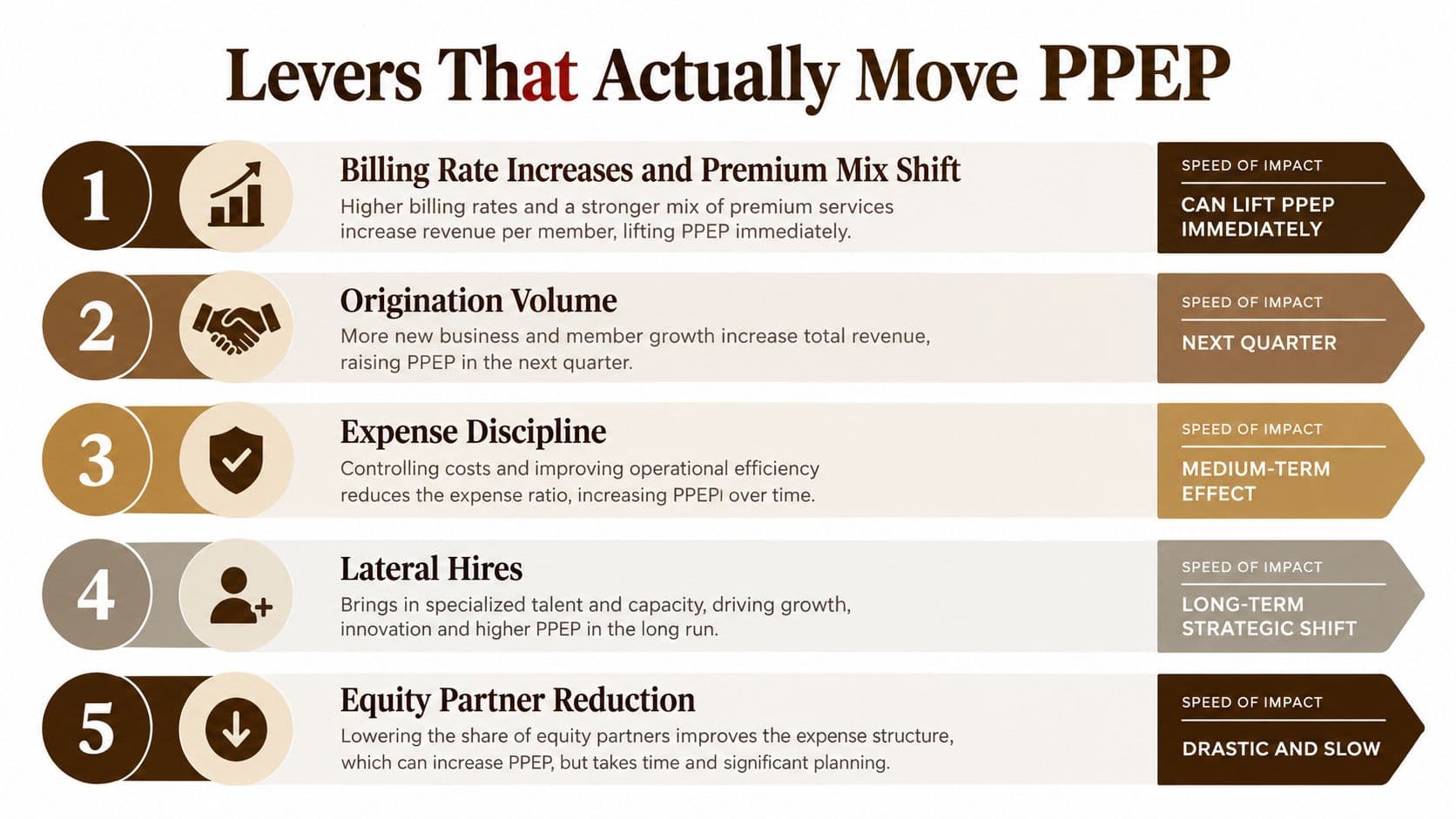
A firm can move PPEP through several levers, but they don't operate at the same speed or carry the same risk. Start with changes that improve the numerator without damaging demand.
Begin with pricing and premium mix
Billing-rate increases and a shift toward higher-value work can affect PPEP quickly when clients accept the rates and lawyer capacity already exists. The relevant measure is not the rate printed on the invoice. It's collected revenue after discounts, write-downs, and collection delays.
Use matter-level pricing data. Identify clients who receive repeated discounts, practices with strong demand, and work that consumes senior partner time without producing an appropriate margin.
Repair realization before adding capacity
Realization improvement often comes from better scoping, disciplined pre-bill review, earlier conversations about budgets, and alternative fee structures that match client expectations. A firm that bills more hours but writes down a larger share hasn't solved the economic problem.
Track realization by partner, client, matter type, and practice group. Firmwide averages can hide a partner who consistently accepts work at terms that undermine the numerator.
Control expenses deliberately
Expense control should focus on structural costs, not indiscriminate cuts. Review support-staff allocation, technology overlap, office use, recruiting spend, and the cost of guaranteed compensation. Cutting resources that protect realization or client service can reduce PPEP later, even if it improves the current period.
Tune leverage to actual demand
More associates per equity partner can improve economics when the work supports them and partners can supervise effectively. Excess staffing creates the opposite result when associates sit underutilized or clients reject the blended cost of the team.
Treat the equity count as a strategic decision
Changing the equity-partner population has a direct effect on PPEP, but it can damage trust if leaders use admissions or de-equitizations as an accounting maneuver. Sequence the work in a mid-sized firm by first testing pricing and realization, then reviewing expenses and staffing, and only afterward making equity-structure decisions.
A managing partner should model each lever separately before combining them. That prevents the committee from claiming that a projected PPEP improvement comes from “efficiency” when the actual driver is a smaller denominator or a temporary rate increase.
Using PPEP to Evaluate Lateral Hires and Partner Search
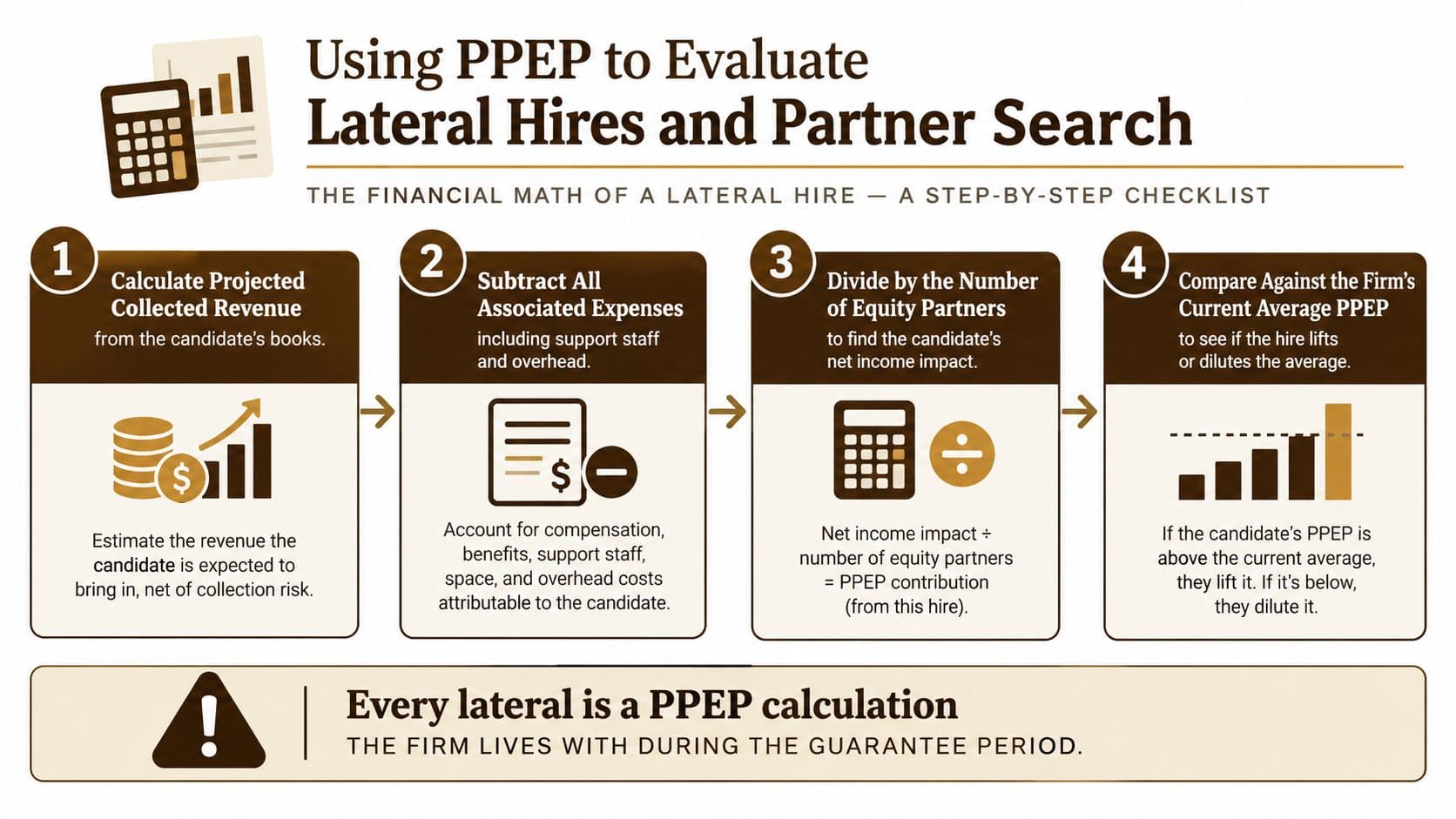
Every lateral partner should be evaluated as a PPEP calculation the firm will live with during the guarantee period. Don't start with the candidate's billed book. Start with the revenue the firm realistically expects to collect, then subtract every cost required to support and retain that work.
The working model is:
Expected collected revenue − compensation and guarantees − support costs − allocated overhead = expected incremental profit
Then ask whether the candidate changes the number of equity partners. If the candidate joins the equity class, divide the expected profit by the resulting denominator. If the candidate remains nonequity, model the compensation and profit allocation separately. The firm needs both views because the same hire can improve revenue while weakening equity economics.
What the recruiting model must test
A candidate's portable book is a starting point, not cash in the bank. Verify the client relationships, matter status, billing history, collection behavior, conflicts, transition risk, and the share of revenue that depends on the candidate personally.
Use this screening checklist:
- Verify originations: Compare claimed originations with collected revenue and client records across the candidate's recent billing history.
- Stress-test realization: Model the practice under an 85% realization assumption, using the Reuters coverage of the Wells Fargo survey as the cited context for rate and PPEP sensitivity. Don't assume every billed dollar will be collected.
- Separate the admission year: Model the guarantee period, the first equity year, and the steady-state economics as different cases.
- Price the support requirement: Include associates, paralegals, legal assistants, office resources, technology, conflicts work, and recruiting fees.
- Test the opportunity cost: Ask whether the equity slot could support an existing partner's growth or another practice group.
The negotiation terms can determine the result. Lockstep compensation, eat-what-you-kill structures, origination-credit splits, deferred compensation rollovers, and client-transition obligations all affect the candidate's actual contribution. A recruiter who doesn't surface those terms early is handing the executive committee an incomplete model.
For firms building a more disciplined search process, these lateral partner hiring strategies provide a useful recruiting framework. The financial model should sit beside that process, not after it.
Putting It All Together as a Managing Partner
PPEP should appear in the quarterly decision process, not only in the annual compensation packet. The managing partner's job is to connect the reported result to the operating choices that created it.
Start by producing two views of profit. Show the firm's accounting-based net income and its distributable profit definition. Reconcile retained earnings, guarantees, deferred compensation, and unusual expenses so partners can see why the figures differ.
A practical 90-day review
Use the next quarter to complete four actions:
- Rebuild the denominator: Confirm every equity, nonequity, income, of-counsel, and transitional partner classification.
- Choose the right peer set: Compare against firms with similar practices, markets, pricing position, and ownership structures, not only a national ranking.
- Audit the profit bridge: Trace revenue through realization, collections, compensation, overhead, guarantees, and distributions.
- Model pending decisions: Run every lateral hire, equity admission, de-equitization, and major compensation guarantee through the expected PPEP effect.
A finance leader should own the reporting discipline, but the managing partner must own the choices. This overview of CFO duties and responsibilities is relevant because PPEP decisions depend on reliable financial reporting, forecasting, and operational accountability.
PPEP is a decision lens, not a scoreboard. It earns its weight when it changes who the firm hires, what it charges, how it staffs matters, and who receives equity.
The strongest firms do not chase a larger ratio in isolation. They protect collected revenue, maintain credible compensation rules, apply leverage wisely, and explain the denominator before partners have to ask. That approach produces a number people can trust because it reflects the economics they experience.
Five Star Placements provides permanent placement for attorneys, partners, legal support staff, in-house counsel, and legal operations leaders, including customized partner and lateral-team searches. If your firm needs recruiting support that accounts for practice fit, compensation structure, and the economic impact of a hire, visit Five Star Placements to discuss your search.
Need help filling a legal role?
Five Star Placements partners with law firms and legal departments nationwide.
Schedule a Call