
Lateral Partner Hiring Strategies: A Practical 2026 Playbook
August 3, 2026 · 13 min read · Five Star Placements

Table of contents
In 2024, the U.S. lateral hiring market covered 4,295 lateral lawyers, yet the bigger lesson is uglier than the headline looks, nearly one-half of lateral partners leave within five years, and some market research says 62% fail to bring the book they promised. That's why lateral partner hiring is not a talent hunt first, it's an integration and screening problem first, because a bad hire can cost $2.3 million on average, or roughly $4.2 million when two years of compensation are included, while failed laterals can cost the largest U.S. firms $9.1 billion annually. NALP's 2024 lateral hiring research and Thomson Reuters' lateral hiring forum notes make the economics plain, and the playbook below follows that reality instead of the usual recruiting fantasy.
Table of Contents
- Why Most Lateral Hires Fail Before the Search Even Starts
- Defining the Role With a Written Scorecard
- Sourcing Channels and How to Use Them
- Due Diligence That Predicts Success
- Compensation Structures That Don't Backfire
- A 100-Day and First-Year Integration Plan
- Retention Metrics and Early Warning Signals
Why Most Lateral Hires Fail Before the Search Even Starts
The numbers are already large enough to force discipline. Lateral partner moves are recurring, not rare, with one industry source estimating roughly 3,000 annual lateral partner moves in the Am Law 200, or about 15 per firm per year. Historical data also show the scale is not trivial, with almost 9,000 lateral partner moves between 2014 and 2018 and about $31 billion in revenue movement in 2018 alone. Those figures explain why firms keep chasing laterals, and why so many searches start with the wrong assumption. NALP's research summary
The core challenge is not sourcing. It is screening and integration. If nearly 50% of lateral partners leave within five years, and if replacement can cost 200% to 400% of first-year compensation, then the first job is to decide whether the firm can absorb the move and turn it into durable revenue. A partner with a strong pitch deck does not solve weak internal planning. Thomson Reuters and the industry estimates it cites point in the same direction.
Practical rule: If you cannot explain how the hire will be integrated before you explain how big the book is, you are not ready to make the hire.
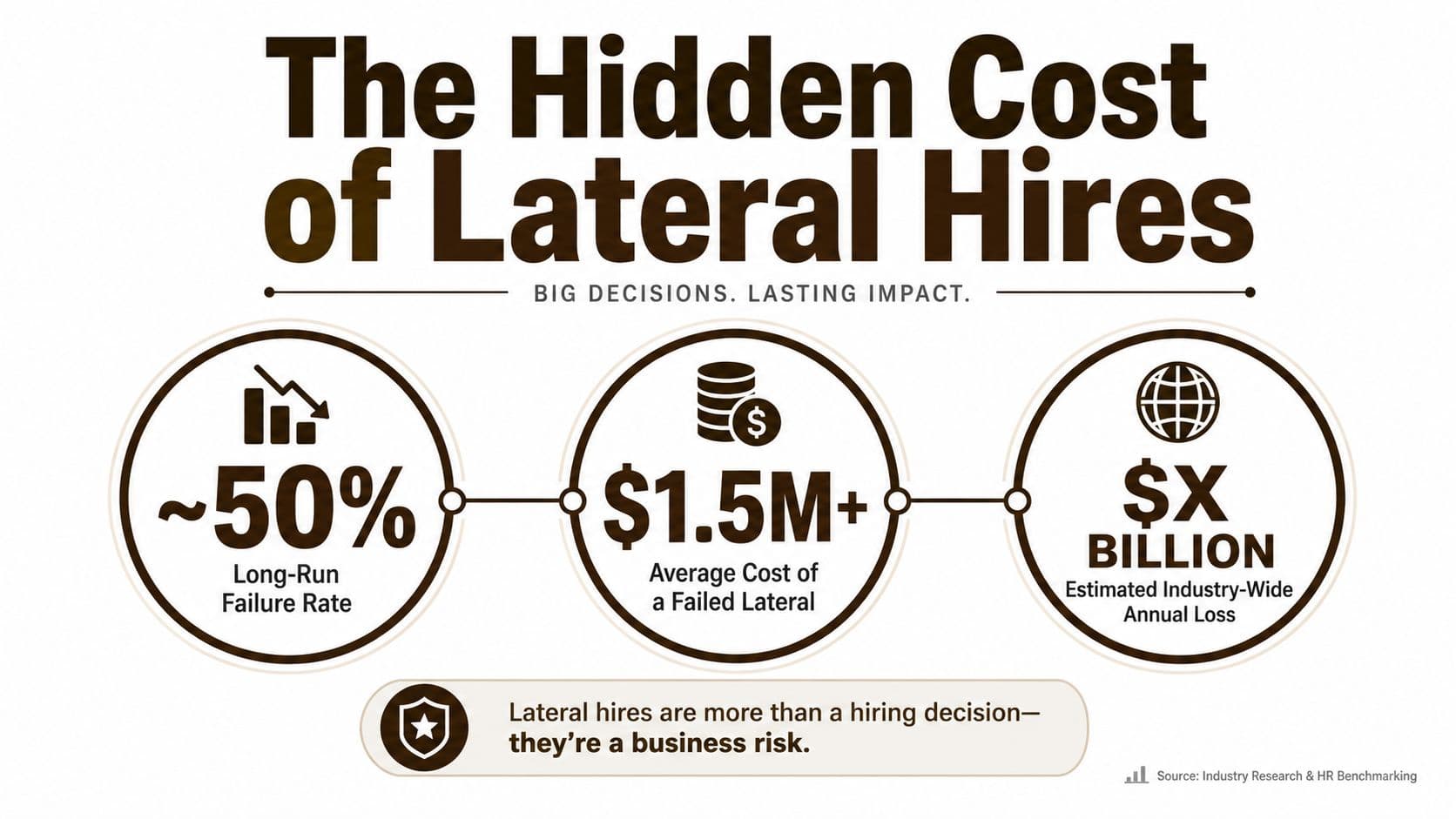
That is why I tell firms to reverse the usual sequence. Start with the failure modes, then work backward to sourcing. The hiring committee should treat portable revenue as unverified until proven otherwise, conflicts as deal-breakers until cleared, and integration risk as material until a sponsor and plan exist. The firms that win in a tighter market handle lateral partner hiring strategies as a controlled process, not a popularity contest.
Five Star Placements sits inside that process as a contingency-based recruiting partner that screens for fit and practice need, but even a strong recruiter cannot repair a weak internal process. If the firm's own diligence and integration discipline are sloppy, the market will collect the bill.
Defining the Role With a Written Scorecard
A vague mandate like “we need a corporate partner” is how firms waste time. A written scorecard forces the hiring committee to say what it wants, what it can support, and what it will not compromise on. If those three things aren't in writing before outreach starts, the search will drift toward whoever sounds impressive in a conversation.
Write the needs brief before anyone picks up the phone
The managing partner should lock down the practice gap first. Is the firm trying to deepen a sub-specialty, cover an industry vertical, or expand geography? Then the committee needs to identify conflict exposure, realistic revenue expectations tied to verified portable work, leadership duties, and the cultural behaviors that matter inside that firm, not at a generic “top firm.”
A good scorecard doesn't ask whether the candidate is famous. It asks whether the candidate is portable, compatible, and usable on day one.
A workable model should grade the candidate on things the partnership can defend. I'd put the weight on portable client quality, matter complexity, origin coverage, and integration risk, not just headline book size. Book value matters, but only if the client relationships are real, the matters can move, and the candidate's practice doesn't depend on a platform that the new firm can't replicate.
Use weighted criteria, not gut feel
A mid-sized firm running a Corporate search could score the role like this, and I've seen this kind of structure keep teams honest:
- 40% portable revenue and origin client relationships, because the work has to move, not just the title.
- 25% technical depth, because the firm is buying judgment as much as business.
- 20% cultural and leadership fit, because partners affect the whole platform, not just their own matters.
- 15% cross-sell potential, because a laterally hired partner should create paths to other partners, not a silo.
That scorecard should change if the market forces it to. If the firm learns that a target profile is over-leveraged, conflict-heavy, or unrealistic on compensation, the committee should tighten the criteria instead of pretending the first wish list was strategic. Good lateral partner hiring strategies are disciplined enough to adapt, but only after the firm has written down the first standard.
Sourcing Channels and How to Use Them
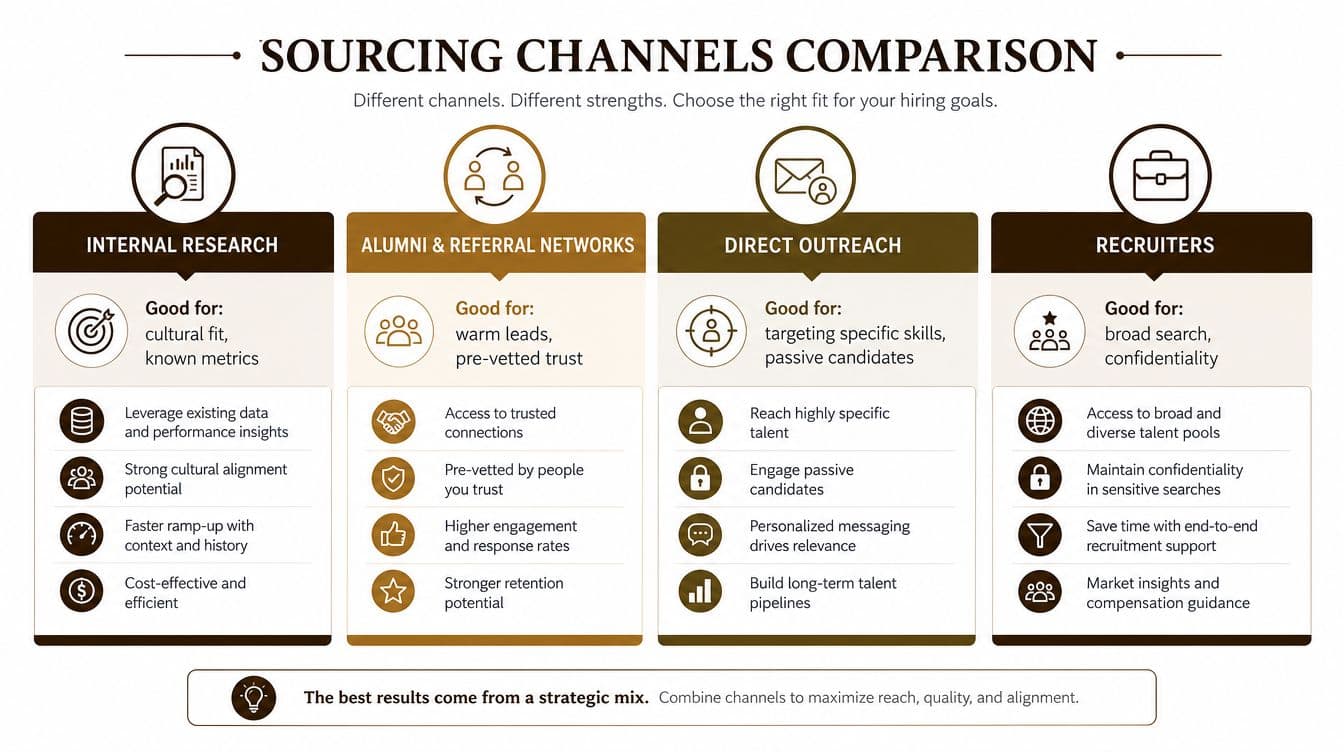
Sourcing is useful only if the firm knows what each channel can deliver. Internal research finds candidates the partnership already has some context on. Alumni and referral networks surface warmer leads that travel faster through trust. Direct outreach works when the firm knows exactly what it needs and is willing to be patient with passive candidates. External recruiters add breadth, confidentiality, and market intelligence when the internal team is too small or too close to the problem.
The 2024 survey material says 69% of respondents would prioritize identifying and sourcing lateral candidates, and external recruiters were the source for 32% of partner hires, which tells you two things. First, firms know they need dedicated sourcing capacity. Second, they're still leaning on specialized intermediaries because partner searches are too hard to run casually. The 2024 industry survey material makes that dependence obvious.
Match the channel to the search
Internal research is strongest when the committee wants a candidate whose economics, personality, and conflicts are partly known already. Alumni and referral networks are better when speed and trust matter more than breadth. Direct outreach is the right move when the firm wants a specific skill set or a niche book and is willing to keep the search quiet.
External recruiters help most when the search requires market mapping, confidentiality, and a longlist that doesn't already live inside the firm's own social circle. That's the core value of a recruiter, not magic access. The recruiter knows how to build a pipeline, test interest without burning the market, and separate candidates who talk well from candidates who can meaningfully move.
A serious firm runs sourcing like a pipeline, not an emergency. One partner owns the market map, one person owns outreach sequencing, one person owns conflict triage, and one person tracks weekly activity against the scorecard. If there's no weekly review, the search becomes a collection of nice conversations that never become a hire.
In practical terms, I'd split effort this way for a high-value search, one internal partner as the sponsor, one external recruiter to broaden the market, and a curated longlist of passive candidates built from industry relationships. If the practice is niche or the candidate pool is thin, lean harder on direct outreach and recruiter mapping. If the firm already has deep industry ties, lean harder on alumni and referral networks. The channel should follow the role, not the other way around.
Due Diligence That Predicts Success
Due diligence separates serious lateral partner hiring strategies from lazy ones. NALP's lateral partner recruiting guide puts the Lateral Partner Questionnaire and background checks inside the workflow, not at the end, and that sequence is right. If you wait until late-stage enthusiasm to start checking conflicts and verifying claims, you are doing damage control, not diligence. NALP's recruiting guide is blunt on that point.
Start with the written record
The LPQ should force precision. It needs to ask about portable clients, conflict risks, notice obligations, non-compete or restrictive provisions, deferred compensation, and who controls client consent. A candidate who cannot answer those questions cleanly is already telling you something important about portability.
Then do the checks in order. Run background checks, conflict analysis, bar standing review, and litigation searches before momentum outruns facts. If the candidate's story changes after the paperwork starts, that is not a paperwork issue, it is a truth issue.
Verify the book, don't admire it
The most important step is also the one people fake most often, verifying the claimed book of business. You need independent references, matter-level evidence, and, where appropriate, client outreach that confirms the work is real and likely to move. “The candidate says they have $4 million” is not diligence. It is a sales claim.
A stronger process asks a sponsor and a finance contact to compare the candidate's claimed work against actual matters, relationship depth, and likely portability. If the candidate's best clients depend on the current platform, the firm needs to know that before offer terms are discussed. That is where Five Star Placements' recruiting perspective fits naturally, because the practical issue is always the same, which matters move, which clients stay put, and which relationships collapse when the platform changes.
Bottom line: If the firm has not verified portability, it has not verified the opportunity.
Culture fit belongs in this same stack, not in a separate “soft skills” interview. A senior sponsor should be in the room early enough to judge how the partner handles hierarchy, feedback, collaboration, and internal referrals. If the candidate cannot work the firm's internal muscles, the external book will not save the hire.
Compensation Structures That Don't Backfire
Compensation decides whether the candidate trusts the firm's judgment on risk. Lateral partner hiring is expensive, and that cost makes a weak package a real mistake, not a minor negotiation miss. The compensation research from Thomson Reuters underscores the point, because the wrong structure turns a hire into an expensive repair job.
Pay for verified portability, not projected glory
A guaranteed draw has a place when a firm needs to bridge a transition. A credit split also makes sense when it reflects how the work will be generated and serviced. The problem starts when the entire package assumes the book will arrive intact. Then the firm is paying for hope.
Lockstep systems can create resentment if the lateral is viewed as getting a custom deal on arrival. Eat-what-you-kill models can fit portable revenue better, but only if the firm measures origination cleanly and keeps internal credit disputes under control. Equity timing matters too, because full equity too early sends a message of certainty when the hire should still be treated as a test.
Use a two-track structure
The cleanest offer I've seen uses two tracks. One track is guaranteed compensation tied to verified portability in year one. The second track is equity progression, and it should be gated on cross-sell, internal referrals, and integration milestones.
That structure tells the partner exactly what the firm values. It also protects existing partners from the sense that a lateral was paid for a story instead of for results. A serious committee should ask direct questions before anything is signed.
- How much is guaranteed? If the guarantee is carrying the whole deal, the firm is probably overpaying.
- What triggers the origination threshold? If that is vague, disputes are coming.
- How is client portability confirmed? If the answer is “the candidate is confident,” stop there.
- What happens if year-one results miss by 20%? If nobody has modeled the downside, the package is incomplete.
The compensation structure should reinforce the diligence, not replace it. If the candidate's work is real and portable, the deal can be generous. If it is not, a bigger package just makes the mistake more expensive. For firms that want a sharper read on package design and candidate screening, Five Star Placements keeps the discussion tied to what laterals bring over, not what they promise in the room.
A 100-Day and First-Year Integration Plan
Most firms say they have an integration plan. They mean they have an onboarding checklist. Those are not the same thing. A real plan names a sponsor, defines checkpoints, and assigns responsibilities that force the lateral partner into the platform instead of leaving them to wander around the office and hope for chemistry.
Days 1 through 14 should be operational, not ceremonial
The first two weeks should cover introductions, conflicts, IT access, finance setup, and a written development plan owned by the sponsor. The sponsor should already know which partners need to meet the lateral, which clients need immediate coordination, and which internal systems the new partner has to learn before billing work gets messy. If those things are still being improvised after arrival, the firm is already behind.
Weeks 3 through 12 are the proving ground
That's when the lateral needs client transition checkpoints, visible matters, and cross-sell introductions to existing partners. The goal isn't to make the new partner feel welcomed. The goal is to make the new partner productive inside the firm's actual operating model.
If you want a north star, think of the process this way. The sponsor is responsible for the relationship between the new partner and the rest of the platform. The lateral is responsible for showing that the portable work is real and that the internal team can help amplify it. The managing partner is responsible for making the whole thing visible enough that nobody can pretend things are going well when they aren't.
A firm that hands a lateral partner a laptop and an org chart isn't onboarding. It's outsourcing the hardest part of the deal.
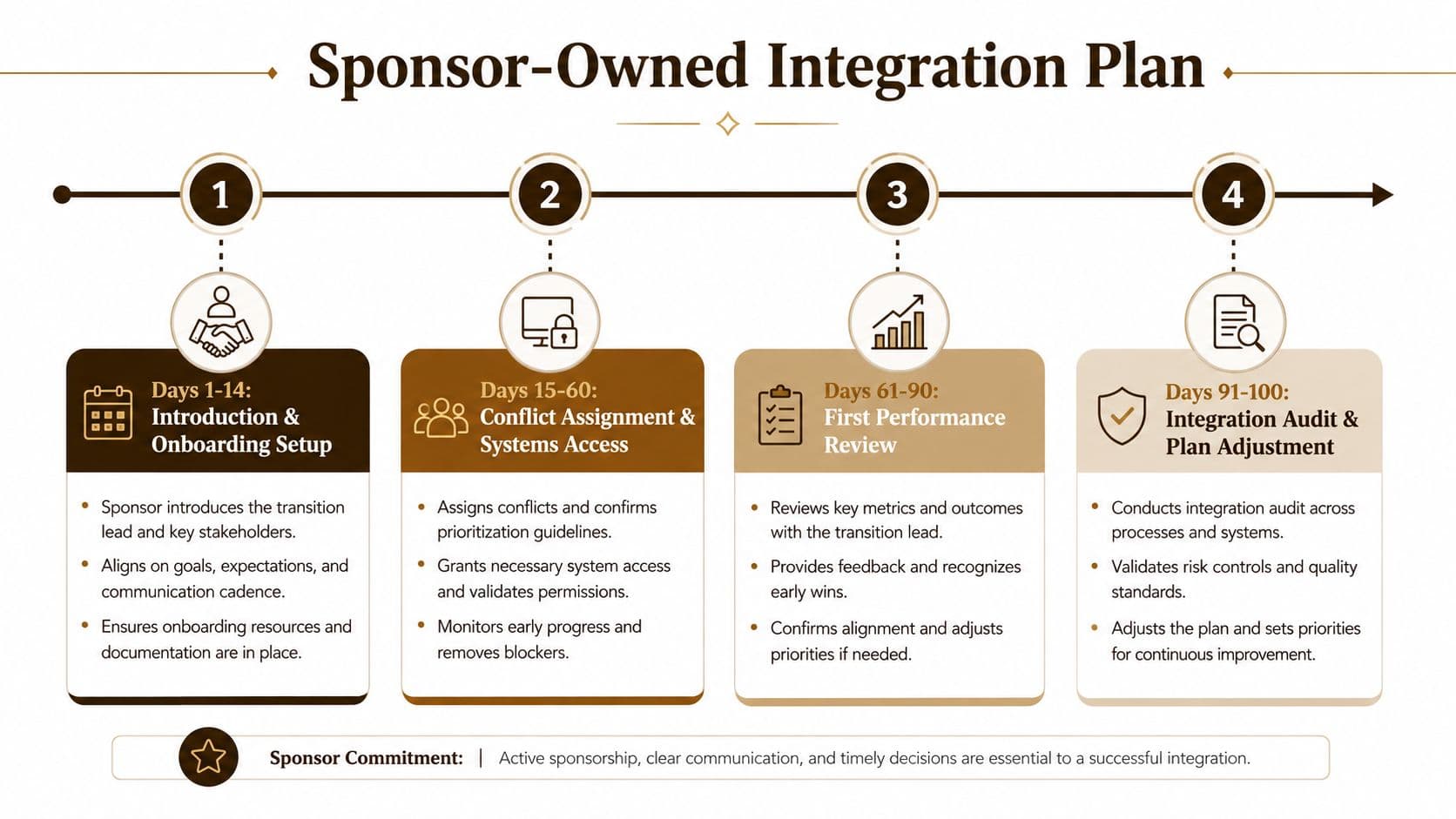
Months four through twelve should become a formal review cycle, not a vague “how are things going” conversation. That's where the sponsor checks the actual client transitions against the original scorecard and decides whether the offer matched reality. I'd direct firms to Five Star Placements' contact page when they want help structuring that kind of search and transition around the firm's actual needs, not a theoretical ideal.
Retention Metrics and Early Warning Signals
Success after the hire should be measured the same way it was sold. If the lateral was brought in on the promise of portable work, the firm should track retention of that named book, origination credit brought in, cross-sell activity, internal referrals, and partner survey signals on inclusion and workload. Weak methodology is why success rates keep swinging between 40% and 60% depending on the study, and why the firm needs a real dashboard instead of post-hoc storytelling. Fairfax Associates' lateral growth analysis is a good reminder that the definition of success matters almost as much as the hire.
Track the right warning signs on a schedule
| Signal | What to Measure | When to Review | Action to Take |
|---|---|---|---|
| Client retention | Which named clients and matters actually moved | Quarterly | Escalate if core relationships stall or begin reversing |
| Origination vs. scorecard target | Realized origination credit against the agreed plan | 90 days and quarterly | Recalibrate support or tighten expectations |
| Cross-sell | New matters generated through other partners | Quarterly | Add sponsor-led introductions if the number is flat |
| Internal referrals | Matters sent to and from the lateral partner | Quarterly | Address silo behavior directly with the partner |
| Inclusion and workload | Partner survey feedback and matter distribution | Quarterly | Bring in the managing partner if friction persists |
At 90 days, any gap between the plan and reality should trigger a direct sponsor conversation. At six months, repeated misses should go to the hiring committee for a formal review. If the partner is still missing the core metrics after that, the firm should move to a structured exit conversation rather than let the relationship bleed for another year.
Retention discipline is the cheapest insurance in the whole process. It protects the firm from the replacement cost, it protects internal morale, and it keeps the partnership from learning the same expensive lesson twice.
If you're evaluating a lateral partner move, Five Star Placements can help you screen candidates, pressure-test portability, and align the search with the role you need filled. Visit Five Star Placements to start a search with a stronger screening and integration plan, not just a longer list of names.
Need help filling a legal role?
Five Star Placements partners with law firms and legal departments nationwide.
Schedule a Call