
Time to Fill Metrics for Legal Hiring: A Practical Guide
September 26, 2026 · 14 min read · Five Star Placements

Table of contents
A senior associate's office has been empty for weeks. A client deadline is approaching, the replacement requisition is still moving through partner approval, and two promising candidates have already accepted counteroffers elsewhere. The recruiting report shows a respectable average, but nobody in the practice group feels reassured.
That's the problem with treating time to fill metrics as a single speed number. A blended result can hide an approval delay, an unresolved conflicts review, or a partner search that was always going to take longer than a support-role hire. Used properly, time to fill is a diagnostic lens. It shows where a legal hiring process stalls, who controls the delay, and whether the response should be faster sourcing, tighter governance, or more patience.
Table of Contents
- The Empty Office and the Open Requisition
- What Time to Fill Actually Measures
- Benchmarks That Make the Number Useful
- Time to Fill Across Legal Roles
- What Drives Time to Fill Inside Law Firms and Legal Departments
- How to Improve Time to Fill Without Lowering the Bar
- When a Slower Search Is the Better Search
- A Practical Measurement Plan for the Next Quarter
The Empty Office and the Open Requisition
Time to fill begins with the vacancy that business leaders feel. An empty office can mean redistributed matters, delayed client work, heavier workloads for existing lawyers, or a practice group declining new instructions because capacity is uncertain. The recruiting dashboard may record one open requisition, but the firm experiences a chain of operational decisions.
The first instruction is simple: don't start by asking whether the average is good. Start by asking where the current requisition spent its calendar days.
Find the first point of friction
Was the role approved promptly? Did the hiring partner agree on the level and compensation range? Did recruiting have a credible scorecard before outreach began? Were interviews available in the same week, or did the candidate wait for several partners to return from court, trial, leave, or client travel?
These questions matter because the clock usually includes much more than candidate outreach. Time to fill captures the full period from an approved opening to an accepted offer, so a firm can have effective recruiters and still report a slow result if internal decisions happen late.
Practical rule: Treat every long requisition as a process investigation, not a recruiter performance verdict.
Legal hiring adds another complication. Partners often court candidates informally before a requisition exists, while corporate legal departments may discuss a future counsel hire long before finance or the general counsel authorizes it. That pre-requisition activity can be strategically useful, but it doesn't remove the days between formal approval and acceptance from the standard metric.
A useful review separates three questions:
- What was approved? Identify the exact role, seniority, practice area, location, reporting line, and compensation assumptions.
- What moved slowly? Mark approval, sourcing, screening, interviews, conflicts or compliance review, negotiation, and acceptance as separate stages.
- What should change? Fix the controllable delay without shortening the evaluation that protects quality of hire.
This approach gives managing partners a more honest operating picture. A long search may reflect poor process, a genuinely narrow market, or a deliberate decision to protect client fit and firm stability. The number becomes useful only when those causes remain visible.
What Time to Fill Actually Measures
Think of time to fill as a courtroom timer. It starts when the position is formally approved and stops when the candidate accepts the offer. Every calendar day counts, including weekends and holidays.
The standard calculation is:
Time to fill = offer acceptance date minus requisition approval or job opening date
The start event must be recorded consistently. For most legal employers, that means the date the requisition is approved, not the date a recruiter begins sourcing and not the date a partner first mentions a possible hire. The end event is the accepted offer, not the candidate's first day.
That distinction prevents a firm from making a strong internal process look artificially fast by starting the clock late. It also makes comparisons possible across practice groups and hiring managers.
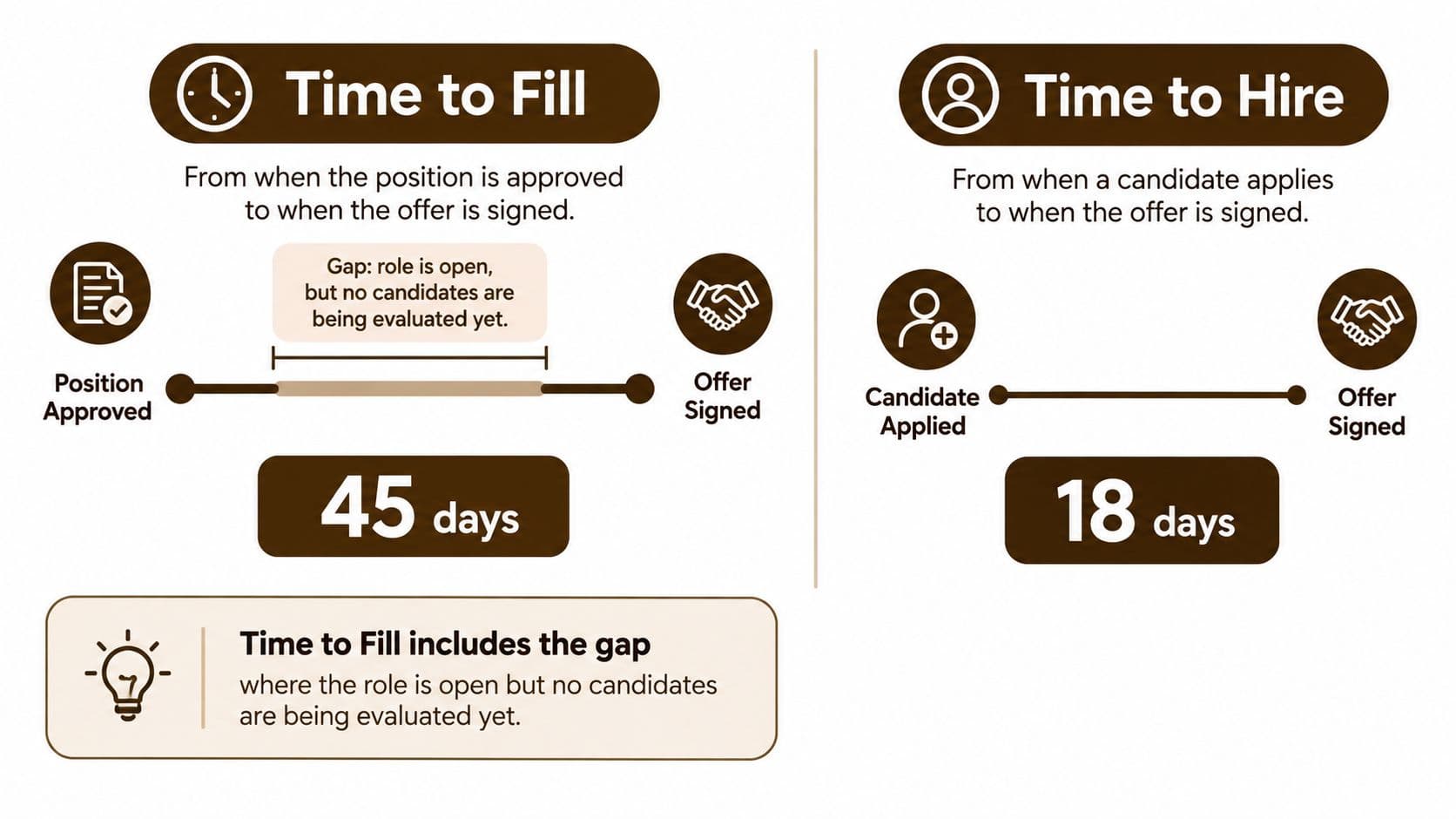
Time to fill and time to hire are different lenses
Time to hire begins when a candidate enters the pipeline, such as through an application or recruiter identification, and ends at offer acceptance. Time to fill starts earlier, at requisition approval, so it includes the period when the role may be open but no candidate is yet being evaluated.
For a law firm, the gap can be revealing. A low time to hire combined with a high time to fill points toward approval, role definition, or early sourcing problems. A high time to hire suggests friction after a candidate enters the funnel, such as interviews, conflicts review, compensation approval, or indecision.
One clarification matters in legal recruiting. Some teams use “time to fill” for offer acceptance, while others use it for the candidate's start date. Those are not interchangeable. Notice periods, bar admission timing, background checks, and partner transitions can extend the period between acceptance and commencement, so your dashboard should name the end event explicitly.
The metric also needs a reliable timestamp for every gate. Record approval, sourcing launch, qualified screen, first interview, final interview, offer approval, offer delivery, and acceptance. Without those dates, a blended number tells leadership that a delay occurred but not who can remove it.
Benchmarks That Make the Number Useful
A blended benchmark can hide the underlying hiring problem. SHRM reported an historical average time to fill of 33.28 calendar days, showing that a month-long cycle was already a common baseline before later labor-market friction intensified (SHRM's time-to-fill analysis). More recent reporting places median time to fill at roughly a month and a half across executive and nonexecutive roles, while other 2026 benchmark reporting puts U.S. averages around 44 to 45 days (JobScore's recruiting benchmarks).
Those figures are reference points, not legal hiring targets. A law firm comparing a partner search with a legal assistant requisition is combining different approval paths, candidate markets, and business risks. An in-house counsel search may wait for business-leader agreement, while a legal operations hire may require assessment across finance, technology, and compliance. The blended average can make either search look unusually slow or unusually fast.
Segment by seniority and market
Recent benchmarks place nonexecutive roles around 39 to 44 days, managers and directors around 45 to 75 days, and VP or executive searches at 90 days or more. A separate methodology reports a 43.0-day median, with the 25th percentile at 28.0 days and the 75th percentile at 52.3 days (HRBench's time-to-fill methodology).
Market conditions shift those ranges. Reported averages include 35 to 45 days in North America, 45 to 55 days in the United Kingdom, and 50 to 65 days for technology roles, while healthcare and life sciences often reach 55 to 75 days. Legal searches can run longer when they require practice-specific experience, conflicts clearance, client portability analysis, or several decision-makers.
| Role level | U.S. legal market | U.K. / EU | APAC |
|---|---|---|---|
| Support and junior roles | Around the lower end of general nonexecutive benchmarks | Often influenced by notice periods and local availability | Varies with market density and jurisdiction |
| Mid-level attorneys and counsel | Commonly within or above general nonexecutive benchmarks | Often longer where notice periods affect availability | Varies by specialty and local competition |
| Directors and senior legal operations | Often within the manager and director range | Can extend with governance and notice requirements | Often shaped by cross-border scope |
| Partners and executive legal leaders | Frequently 90 days or more for complex searches | May extend beyond the U.S. pattern | May extend where the candidate pool is narrow |
Read the metric by search type, not as a single speed score. Compare litigation associate searches with other litigation associate searches, and corporate partner searches with comparable partner mandates. Firms that pair speed with quality of hire can identify process delays without rewarding rushed appointments, using quality-of-hire measurement guidance to keep the evaluation grounded.
Time to Fill Across Legal Roles
Legal roles move through different decision paths, so their ranges should be reported separately. A paralegal search may depend on targeted local sourcing and a quick manager decision. A lateral partner search may require practice-group alignment, conflicts review, compensation modeling, client-portability analysis, and a partnership vote.
The figures below are indicative planning ranges, not universal legal-market averages. They translate the broader seniority benchmarks into a format a firm or legal department can use when building internal bands.
| Role | Typical time to fill, calendar days | Key reason for the range |
|---|---|---|
| Paralegal or legal assistant | 20 to 35 | Targeted sourcing and a focused hiring decision can move the search quickly |
| Lateral associate | 35 to 60 | Practice fit, matter experience, conflicts, references, and notice periods add review |
| Mid-level in-house counsel | 45 to 75 | Business stakeholders, legal leadership, and commercial judgment must align |
| Senior in-house counsel or general counsel | 60 to 90 or more | Executive visibility, board or GC involvement, and scope definition lengthen the process |
| Legal operations or e-discovery leader | 45 to 75 | Functional specialization and cross-department assessment require broader calibration |
| Partner-track or senior partner hire | 90 or more | Business plan, client relationships, economics, conflicts, and cultural fit receive deeper scrutiny |
Read the role, not just the average
Partner searches stretch because the firm isn't evaluating only legal ability. It is evaluating the overlap between the candidate's practice, clients, economics, leadership style, and the firm's appetite for integration. A candidate can be excellent and still be wrong for the platform.
In-house counsel searches sit in the middle because the employer must assess legal judgment alongside business fluency, stakeholder management, and the practical demands of the operating environment. Legal operations leaders face a similar issue, especially when the role touches finance, technology, compliance, and attorney workflows.
Support roles can move faster when the hiring manager has clear must-haves and interview availability. That doesn't mean they should be rushed. It means the selection criteria are often easier to define and fewer stakeholders need to approve the decision.
A blended average obscures all of this. It can make a firm look efficient because support roles close quickly, while senior searches lose candidates during slow approvals. Report the median and distribution within each role family, then attach a reason code to outliers.
What Drives Time to Fill Inside Law Firms and Legal Departments
Legal hiring delays rarely come from one dramatic failure. They accumulate through ordinary governance. Five separate stages can each add calendar days, and the same requisition may pass through all five.
Approval chains
A law-firm requisition may require a practice-group leader, managing partner, finance, and an executive committee. In a corporate legal department, the path may include the general counsel, finance, HR, and a business executive. Every additional approver creates a handoff, especially when the role wasn't included in the original workforce plan.
Drafting and sign-off
A partner hire often needs a business plan covering practice overlap, expected relationships, support requirements, and economics. If the plan changes while candidates are being approached, the recruiter is selling an unstable opportunity and the candidate receives mixed messages.
Compensation cycles
Compensation committees and fiscal calendars can delay otherwise viable searches. The issue isn't always the amount. It may be uncertainty over title, bonus treatment, draw, origination credit, equity participation, or internal parity.
Conflicts and compliance review
Lateral candidates can trigger conflicts checks, client restrictions, confidentiality concerns, licensing questions, or background review. Starting this work only after the final interview creates avoidable compression at the end of the funnel.
Interview scheduling and negotiation
A senior legal search may involve attorneys from several practice groups, the GC, business leaders, or partnership representatives. Calendar coordination is difficult, but an undefined decision owner makes it worse. Negotiation then adds another layer if compensation authority wasn't established before the offer stage.
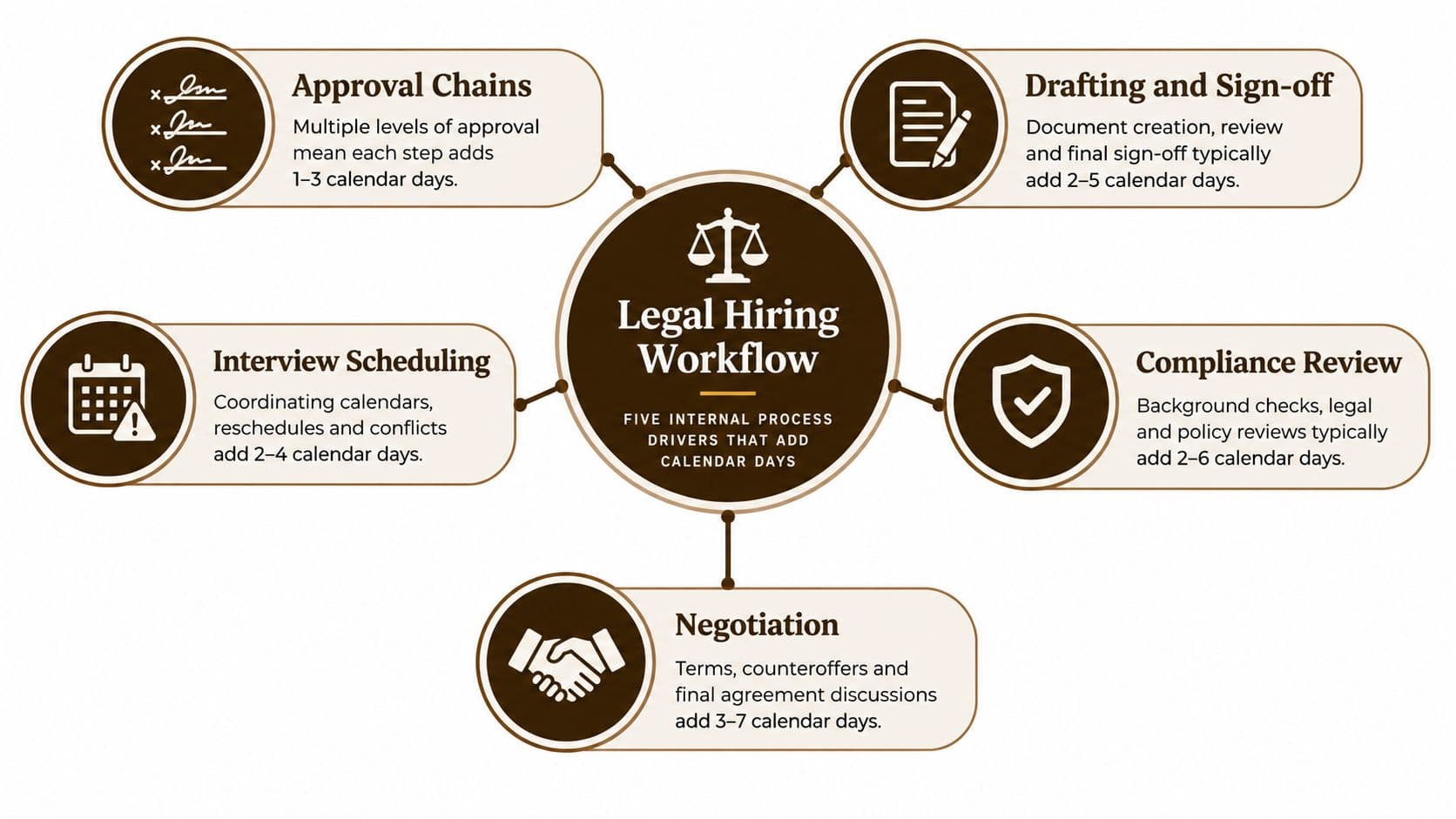
The diagnostic question: Which stage is waiting for a person, and which stage is waiting for a policy?
A retained search can be appropriate when a firm needs confidential market mapping, a narrow candidate pool, or sustained project management, but the engagement model doesn't replace internal decision discipline. The practical distinction between search approaches is outlined in this guide to what retained search means. Whether recruiting is internal, contingent, or retained, the hiring organization still controls approval, feedback, and offer authority.
How to Improve Time to Fill Without Lowering the Bar
Speed improves when the process removes waiting, not when it removes judgment. The most reliable gains come from deciding earlier what must be true of the hire and assigning ownership before candidates enter the funnel.
Start with a decision-ready requisition
Write a scorecard that separates must-haves, preferred experience, and trainable gaps. For a lateral associate, specify the matters, court exposure, client contact, and bar requirements that are essential. For a partner, define the platform fit and business assumptions before asking the market to respond.
Pre-agree the compensation range, interview participants, conflicts process, and final decision owner. A requisition that reaches recruiting without those answers isn't ready. It just transfers uncertainty into the candidate pipeline.
Source narrowly and screen consistently
Broad postings can generate activity without producing practice-ready candidates. Targeted outreach through partner networks, alumni relationships, bar associations, specialist communities, and prior candidate conversations usually gives the search a clearer starting point.
The first screen should test the scorecard, not invite an unfocused career conversation. Use consistent questions, identify disqualifiers early, and document the reason a candidate advances. That protects fairness while reducing repeated interviews with people who were never viable.
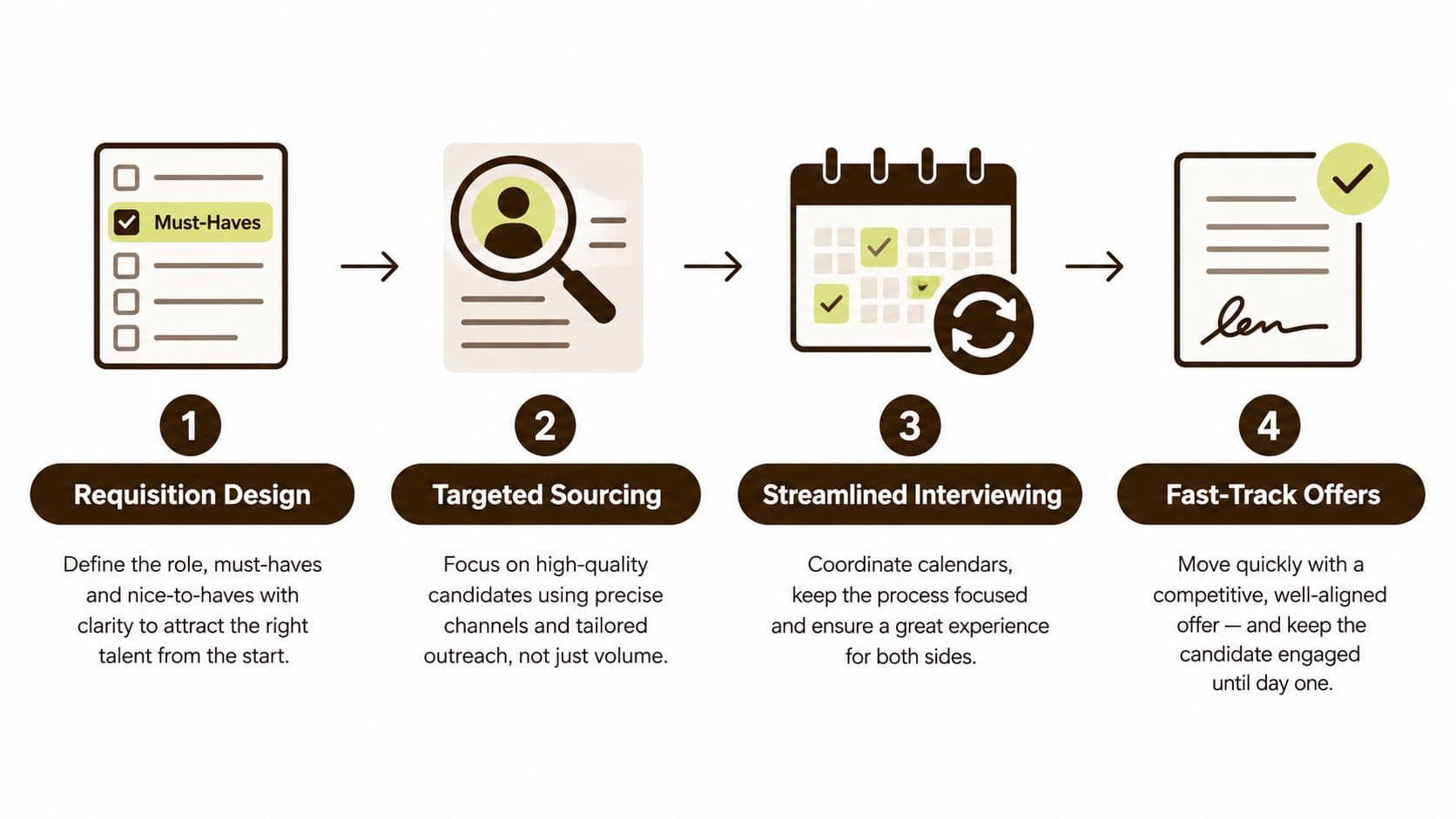
Design the interview stage before scheduling it
Reserve interview blocks before outreach begins, especially for partner and senior in-house searches. Give each interviewer a defined competency, use a shared rubric, and appoint one person to reconcile feedback. A committee can provide useful perspective, but a committee without a decision owner creates drift.
Offer management should follow the same discipline. Confirm compensation authority before the finalist stage, communicate the approval path, and use a same-day internal decision protocol when the candidate is ready. The aim isn't to bypass review. It's to stop the offer from waiting for a meeting that could have been planned.
For firms looking for outside support, how to hire lawyers faster is most useful when treated as an operating guide, not a promise that every legal search should close at the same pace.
The video below can reinforce the process discipline visually:
When a Slower Search Is the Better Search
A shorter time to fill isn't automatically a better outcome. A partner-level lateral move may justify a prolonged process because the firm is testing client portability, practice overlap, economics, leadership expectations, and the candidate's willingness to operate within the partnership.
The same logic applies to senior in-house counsel. If the position requires GC, board, or business-unit sign-off, rushing the process can produce a hire whose authority, reporting line, or commercial mandate remains unclear. That ambiguity usually surfaces after acceptance, when correcting the decision is more disruptive.
A lateral associate search may also pause for a legitimate reason. Waiting for a bar result, completion of a significant matter, conflicts clearance, or reliable reference information can protect the firm from hiring on an incomplete record.
A defensible hiring decision is the finish line, not the fastest acceptance.
Use a practical rule of thumb: if cutting the search by three weeks would lower first-year retention below 90% or create a meaningful risk of a failed partnership vote, the slower number is the correct metric. Those thresholds are decision rules, not universal legal-market benchmarks, so leaders should define them against their own risk tolerance and quality data.
Long vacancies still carry consequences. Existing lawyers may absorb work, client service can suffer, and billable coverage may remain thin. The right response isn't to defend every delay. It's to distinguish necessary diligence from avoidable waiting, then remove the latter without weakening the former.
A Practical Measurement Plan for the Next Quarter
A managing partner, legal department head, or HR leader can make time to fill a working diagnostic with four moves.
1. Segment every requisition
Tag each opening by role family, seniority, practice group, location, and requisition type. Keep partner, associate, paralegal, in-house counsel, and legal operations searches separate. Record whether the role is new, replacement, confidential, lateral, or growth-related.
2. Timestamp each gate
Capture approval, sourcing launch, qualified screen, interview, final decision, offer approval, offer delivery, and acceptance. The purpose isn't to create administrative work for its own sake. It's to identify whether the delay sits before candidate engagement, inside evaluation, or after selection.
3. Set target bands
Use a range for each segment rather than one firm-wide target. A support-role band should not govern a partner search, and a senior legal operations search shouldn't be judged against a junior administrative opening. Review both the central result and the upper end of the distribution.
4. Review outliers monthly
Hold a focused review for requisitions that breach their segment's upper band. Attach one written reason code, such as approval, role design, sourcing, interview scheduling, conflicts, compensation, or candidate decision. Then assign an owner and a next action.
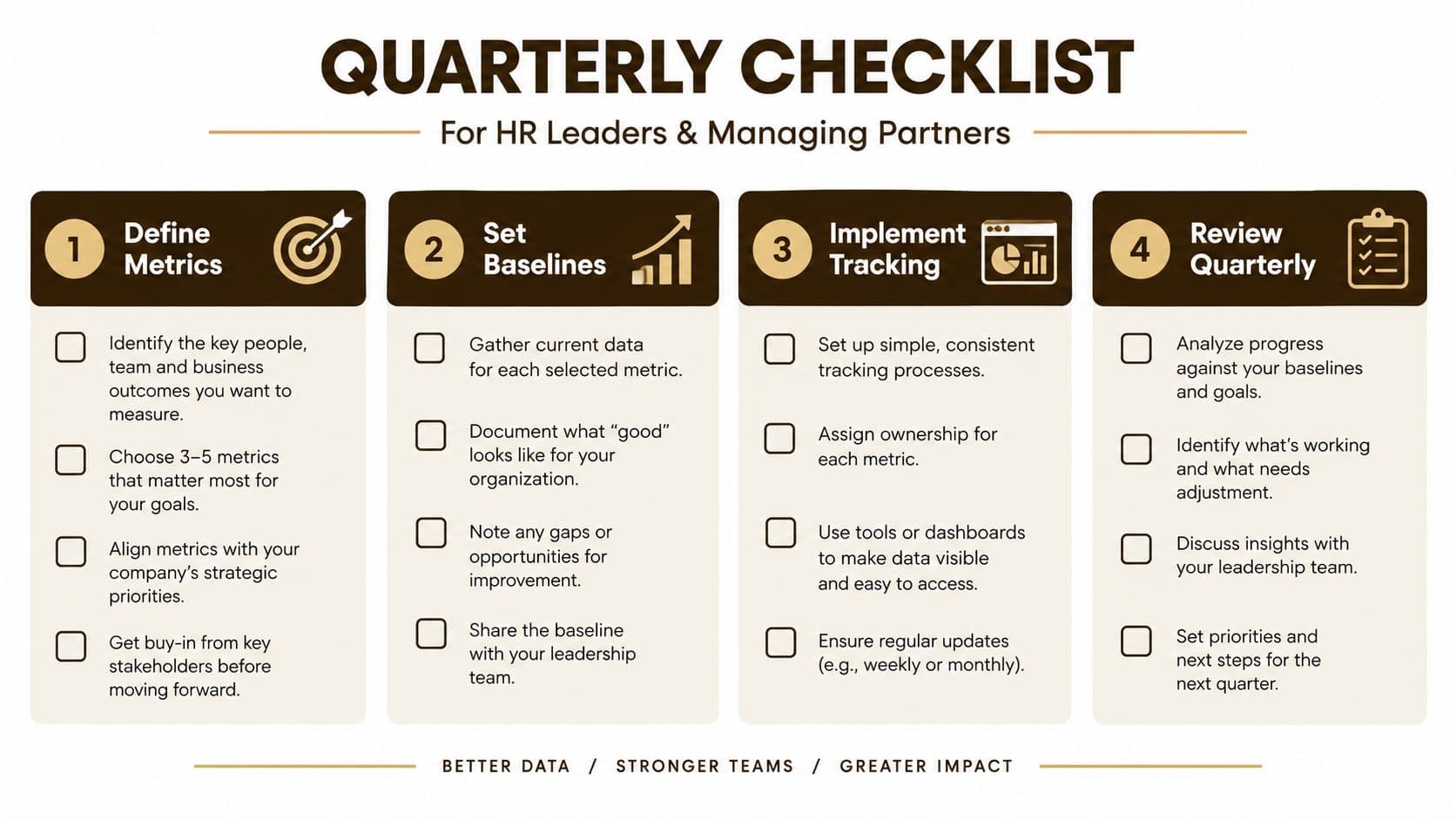
The rhythm should stay short and factual. Leaders don't need another dashboard that celebrates an average while senior vacancies remain unresolved. They need segmented evidence showing where the process is slow, whether the delay is justified, and what the firm will change before the next review.
Time to fill is a diagnostic lens, not a speedometer. Read it by role, seniority, and search complexity, then pair it with quality and retention outcomes so faster hiring doesn't become a substitute for sound legal judgment.
Five Star Placements provides permanent placement for attorneys, partners, in-house counsel, legal support staff, and legal operations leaders, with customized screening for practice needs and organizational culture. If your team needs a targeted shortlist or help reducing avoidable vacancy time without lowering the hiring bar, visit Five Star Placements.
Need help filling a legal role?
Five Star Placements partners with law firms and legal departments nationwide.
Schedule a Call