
How to Hire Lawyers Faster Without Sacrificing Quality
July 28, 2026 · 14 min read · Five Star Placements

Table of contents
Every managing partner knows the scene. A strong lateral lawyer is interested, the practice group needs help now, and the firm still hasn't agreed on who owns scheduling, who can say yes, or how fast feedback has to move. By the time the second-round meeting gets penciled in, the candidate has another offer, the associate search has gone quiet, or the internal committee is still “circulating thoughts.”
That's why how to hire lawyers faster is mostly a process problem, not a sourcing problem. The firms that move quickly usually don't have magical access to talent. They have tighter decision chains, clearer ownership, and a habit of treating each hiring stage like work that needs a deadline.
Table of Contents
- Why Most Law Firms Lose the Race for Top Legal Talent
- Designing an Expedited Attorney Hiring Workflow
- Sourcing Tactics and Screening Shortcuts That Preserve Quality
- Eliminating Internal Bottlenecks in Interviews and Decisions
- When to Partner With Contingency Legal Recruiters
- Metrics and Implementation Guide for Faster Legal Hiring
Why Most Law Firms Lose the Race for Top Legal Talent
A managing partner can do everything right on paper and still lose the candidate in front of them. The practice group identifies a needed hire, everyone agrees the profile is strong, and then the interview calendar starts drifting because one partner is traveling, another wants one more conversation, and nobody owns the clock. In the meantime, the lateral candidate is fielding multiple offers and starts reading silence as disorganization.
The primary bottleneck is usually inside the firm. The candidate pool may be fine, but slow coordination among partners, practice leaders, and administrators turns a promising search into a long, uncertain one. In major markets, that delay matters because strong lawyers often move quickly and expect a disciplined process.
Speed is a process discipline, not a scramble
A practical benchmark for a faster lateral search is 6 to 12 weeks. One legal recruiting framework breaks that into 1 to 2 weeks for stakeholder alignment and role definition, 3 to 5 weeks for sourcing and screening, and 2 to 4 weeks for interviews, evaluation, and offer negotiation, with feedback within 24 hours after interviews, weekly check-ins during active phases, and same-day replies to candidate questions (legal recruiting framework). That schedule works because it forces the firm to decide early, not because it cuts evaluation corners.
Practical rule: If the firm can't name the decision-maker, the scheduler, and the final approver before outreach starts, the search is already at risk.
The broader market makes this even more important. The U.S. legal services market was valued at $368 billion in 2026 and is projected to grow at 3.4% annually (legal market context), which helps explain why revenue-producing talent is fought over so aggressively. A delayed hire doesn't just postpone a start date, it can slow matter delivery and business development capacity.
What slow hiring usually looks like in practice
The pattern is familiar. A partner asks for a candidate list, the team reviews résumés at different speeds, and one interviewer comes back with vague feedback like “good, but I'd like to meet others.” That kind of open-ended response creates rework because nobody can turn it into a decision. The search then stretches from a manageable window into a drawn-out committee cycle.
A faster firm does the opposite. It defines the role tightly, sets expectations with candidates upfront, and treats each step as time-boxed work. That's how firms reduce vacancy drag without lowering the quality bar.
The best searches I've seen weren't the most aggressive, they were the most organized.
Designing an Expedited Attorney Hiring Workflow
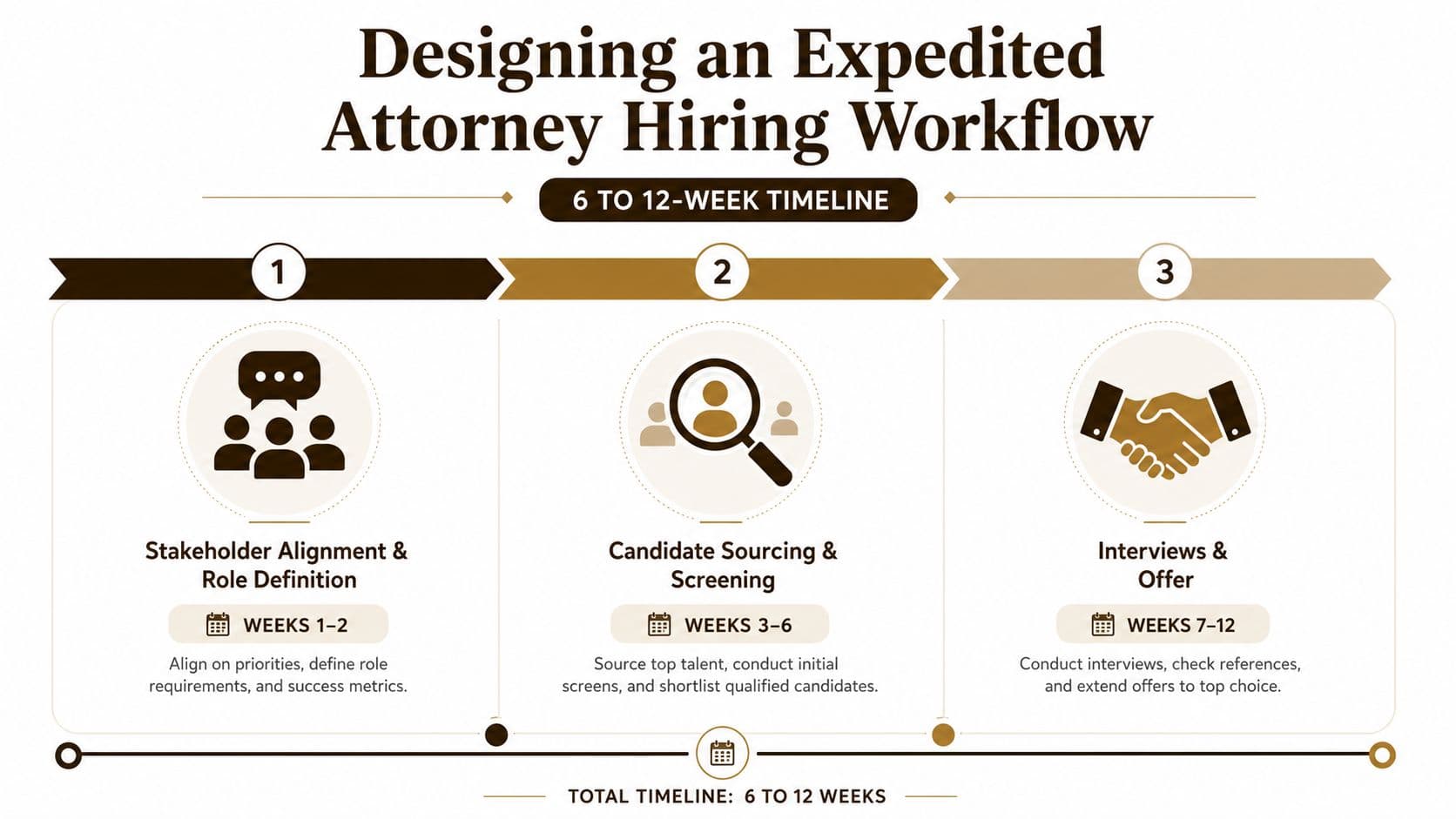
A compressed hiring workflow works when everyone knows what happens first, what happens next, and who is allowed to slow things down. The fastest attorney searches I've seen don't start with outreach. They start with a narrow role definition, a small decision group, and a calendar that's already protected.
Weeks 1 to 2, align the role before any outreach
The first step is to lock the target. That means practice area, seniority, portable work expectations, client-facing responsibilities, and the exact reason the seat exists. If the firm can't describe the role in plain English, candidates will hear the uncertainty immediately.
A kickoff meeting should end with three things in writing:
- Role scope: what the lawyer will do, and what they won't do.
- Decision authority: who interviews, who recommends, and who signs off.
- Timeline commitments: when candidates get updates, interviews, and an offer decision.
The benchmark here is simple. 1 to 2 weeks should be enough to align stakeholders and define the seat if the right people are in the room from the start (framework timeline). If that phase drags, the rest of the search inherits the delay.
Weeks 3 to 6, source with a short list in mind
Once the role is fixed, sourcing becomes more focused. Instead of casting a wide net and then arguing over a flood of mixed-fit résumés, the firm should identify where the likely candidates already are, then screen for the few traits that matter most. The point is not volume. It's controlled volume.
The service-level cadence that keeps momentum includes reviewing submitted candidates within 48 hours, holding first-round interviews within one week of identifying a viable candidate, debriefing the same day or next morning, and preparing offer terms before the final interview (attorney recruitment strategies). If the firm can't meet that pace, the process should shrink, not expand.
Weeks 7 to 12, close decisively
The final phase is where many searches stall. Interviewers like the candidate, but feedback is late, the second round gets deferred, and nobody wants to be the first to move on compensation. That's where the offer starts to feel theoretical instead of real.
A strong workflow ends by pre-building the offer package before the last interview. It also sets weekly check-ins and same-day candidate responses so the process doesn't go dark between meetings. For firms that want a simple visual, the timeline below is the right shape to start with.
Role-definition checklist for the kickoff meeting
- Practice need: confirm the actual workload driving the search.
- Success profile: define the skills that matter most on day one.
- Interview team: keep it small enough to move quickly.
- Offer path: name who can approve compensation and start date.
- Communication owner: assign one person to keep the candidate updated.
A tightened timeline helps because it makes delay visible. Once the calendar is public, drift is no longer invisible.
Sourcing Tactics and Screening Shortcuts That Preserve Quality
The fastest way to get a messy search is to ask for more résumés before the firm knows what it wants. Broad posting can fill an inbox, but it rarely solves the core problem, which is deciding quickly whether a candidate is worth serious time. A curated pipeline does better because it lets the firm screen for fit before interviews multiply.
I've seen many teams spend too much time reading too much. They think they're preserving quality, but they're creating delay. A leaner process protects quality better when the screening criteria are explicit.
Curated sourcing beats volume when the seat is specific
A legal search works best when the recruiter or internal team already has a network in the relevant practice area and seniority band. That makes the first candidate list more usable because the profiles are already closer to the mark. It also keeps the interview slate smaller, which shortens the decision cycle.
The internal workflow on Five Star Placements' blog reflects this approach well, with guidance that emphasizes defined roles, faster review, and structured feedback instead of open-ended search drift. That's the right direction for firms that are serious about speed.
Use structured scorecards, not casual impressions
A faster funnel depends on decision clarity. Scorecards help because they force interviewers to separate technical ability from cultural preference. First decide whether the lawyer can do the work. Then decide whether the fit is right.
That distinction matters more than most firms admit. Vague comments like “not sure about presence” or “seems strong, but I'd want to see more personality” slow things down because nobody can convert them into an offer decision. A scorecard turns the discussion into something the hiring group can use.
Best practice: Ask every interviewer to score the same core competencies, then collect written feedback before the debrief starts.
Where AI and ATS tools help, and where they don't
AI-assisted screening can reduce manual sorting, especially when the team is buried in résumés. ATS and CRM integration can also help centralize candidate status, notes, and follow-up. But those tools only speed things up when the process behind them is already clear.
If the intake questions are fuzzy, the tool just automates confusion. If the interview criteria are inconsistent, the software stores inconsistent feedback faster. Technology helps most when it supports a process that already has discipline.
| Sourcing Channel Effectiveness for Attorney Hiring | Time to First Candidate | Quality of Fit | Cost Structure |
|---|---|---|---|
| Internal referral network | Fast when the network is active | Usually stronger because the source knows the firm | Low direct cost, higher internal coordination |
| Practice-specific recruiter outreach | Fast when the role is clear | Strong when the recruiter knows the niche | Often contingency-based or search-based |
| Job board posting | Can produce responses quickly | Mixed, especially for specialized seats | Lower upfront cost, but higher screening time |
| LinkedIn outreach | Moderate, depends on response rates | Varies widely by role and message | Low direct spend, high internal time |
The takeaway is straightforward. If the role is specialized, the fastest path is usually the one that narrows the funnel early, not the one that widens it first and cleans it up later.
Eliminating Internal Bottlenecks in Interviews and Decisions
Most attorney searches don't die because the candidates are weak. They die because the firm can't move from interest to decision fast enough. A partner misses a debrief, someone wants one more round, and a candidate who was ready to engage starts hearing hesitation instead.
The fix is not more opinion. It's a clearer operating model. Once that changes, the search stops depending on who is least busy that week.
Assign one owner for the schedule and one owner for the decision
The search needs a dedicated scheduler or process owner from the start. When that role is missing, momentum gets lost in calendar back-and-forth, and every interview becomes a separate administrative project. The more senior the hire, the more dangerous that drag becomes.
Decision authority also has to be explicit. A partner can give input without being able to freeze the process, and the interview team should know who can say yes, who can say no, and who can recommend. That structure prevents a single unavailable stakeholder from blocking the whole search.
Run the interview cycle on service levels
The most useful cadence is simple:
- Review submitted candidates within 48 hours.
- Schedule the first interview within one week of identifying a viable candidate.
- Debrief the same day or next morning.
- Prepare offer terms before the final interview.
That rhythm comes directly from practical legal recruitment guidance (attorney recruitment strategies). It works because it puts pressure on the firm to stay ready, instead of asking candidates to wait while the team finds time.
Narrow the interview team if deadlines keep slipping
The contrarian answer is often the right one. If the team can't meet the timeline, reduce the number of interviewers or stages. More interviews don't improve quality when they create delay and force candidates to sit in limbo.
A simple debrief note keeps everyone aligned:
Debrief format: hire, no hire, or hold. Add one sentence on evidence, not personality, and send it before the end of the day.
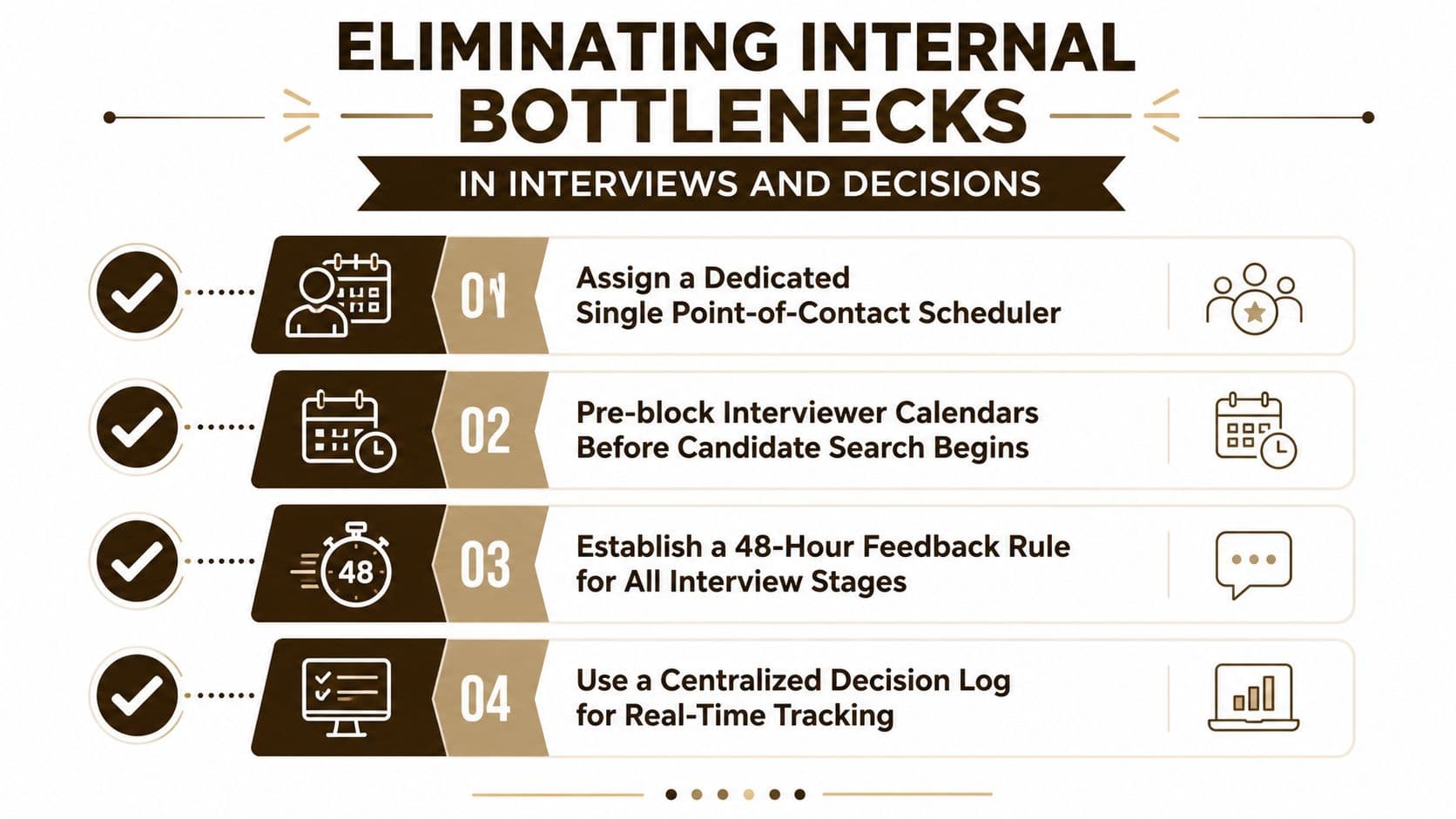
When firms tighten the process, candidates feel it immediately. They get updates on time, they know who is deciding, and they spend less time guessing whether the search is moving forward.
When to Partner With Contingency Legal Recruiters
Not every vacancy should be handled the same way. A firm with a stable pipeline and a clear internal process can run some searches on its own. A firm facing an urgent departure, a niche practice need, or a weak internal recruiting bench often needs a different model.
The key is to choose the resourcing strategy based on urgency, complexity, and internal bandwidth. That's a portfolio decision, not a loyalty test.
Compare internal search and contingency support honestly
A contingency recruiter is most useful when the firm needs broader reach without upfront cost. The model is designed so payment happens only upon a successful hire, which lowers risk for the buyer and makes the recruiter accountable for outcome. That can be useful when the internal team is stretched thin or the market is tight.
The publisher, Five Star Placements, works in that contingency model and provides screening beyond the résumé for permanent legal hires across law firms and corporate legal departments. That kind of external support can make sense when the search needs extra reach and better filtering, but the firm still wants to keep control of the decision.
Interim talent is sometimes the faster answer
There are cases where the best solution is not a faster permanent search. If a departure is already hurting matter delivery, interim or project-based legal talent can stop the disruption while the permanent process continues. That option is especially relevant when the ideal candidate isn't in the pipeline yet.
This is the piece many hiring guides skip. They assume every vacancy has to be solved by one permanent hire on one perfect timeline. In practice, a temporary layer of coverage can buy breathing room without forcing the firm to accept the wrong long-term fit.
Use the right model for the right problem
- Internal search works well when the role is known, the team has time, and the candidate pool is familiar.
- Contingency recruiter support works well when the role is specialized, the market needs broader reach, or the internal team is overloaded.
- Interim talent works well when the business can't wait for a long search to finish.
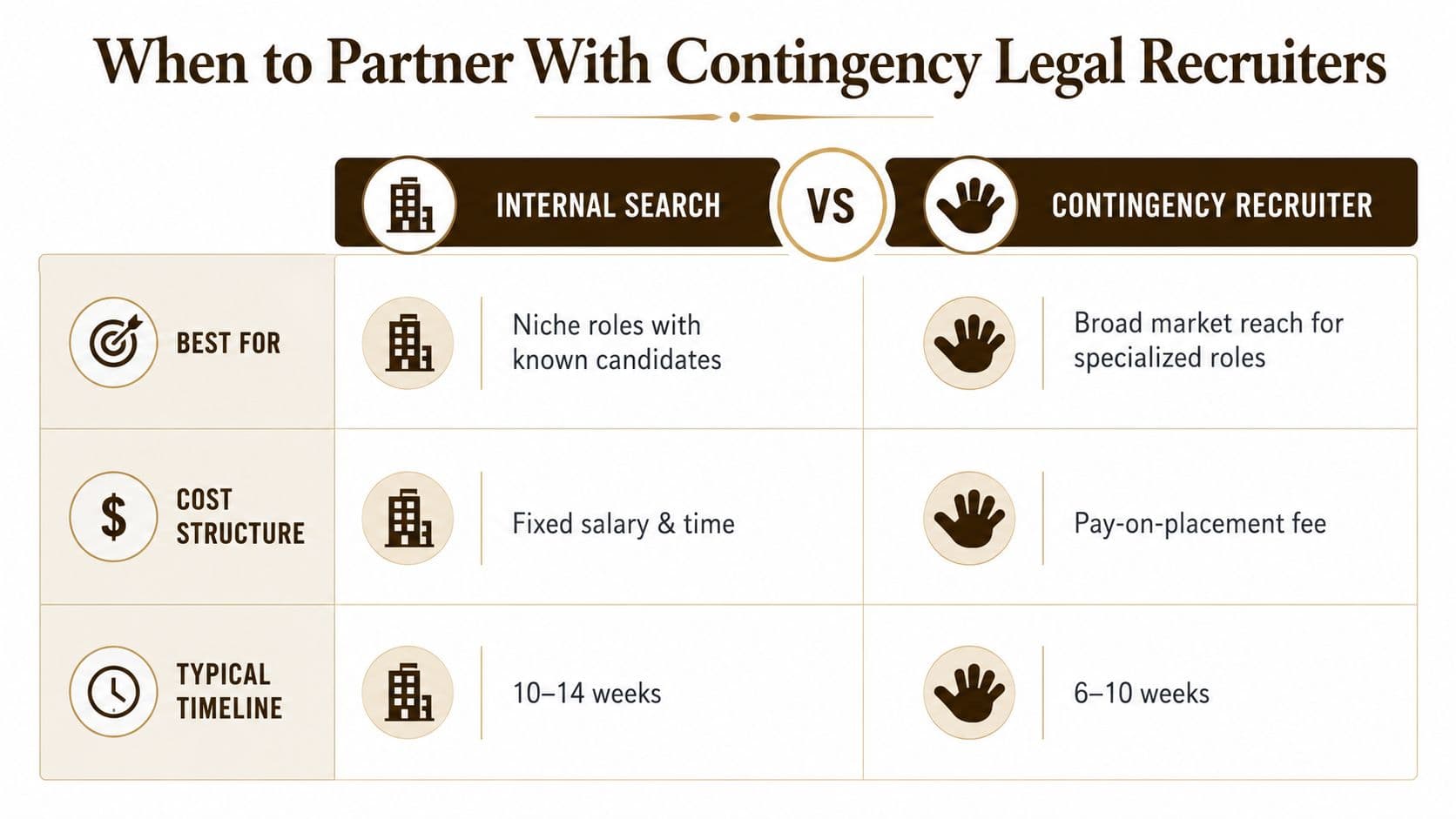
The right partner is the one that reduces vacancy drag without forcing the firm into a process it can't sustain.
Metrics and Implementation Guide for Faster Legal Hiring
Speed improves when the firm can see where time is disappearing. Without basic metrics, every delay feels anecdotal, and every hiring postmortem becomes a debate about personalities instead of process. The better approach is to measure the points where candidates stall and the firm hesitates.
Track the metrics that expose bottlenecks
The most useful measures are simple. Time-to-fill by role type shows where the process stretches. Offer acceptance rate tells you whether candidates are still engaged when the decision finally arrives. Stage-by-stage cycle time highlights which step is dragging. Candidate drop-off points show where momentum dies.
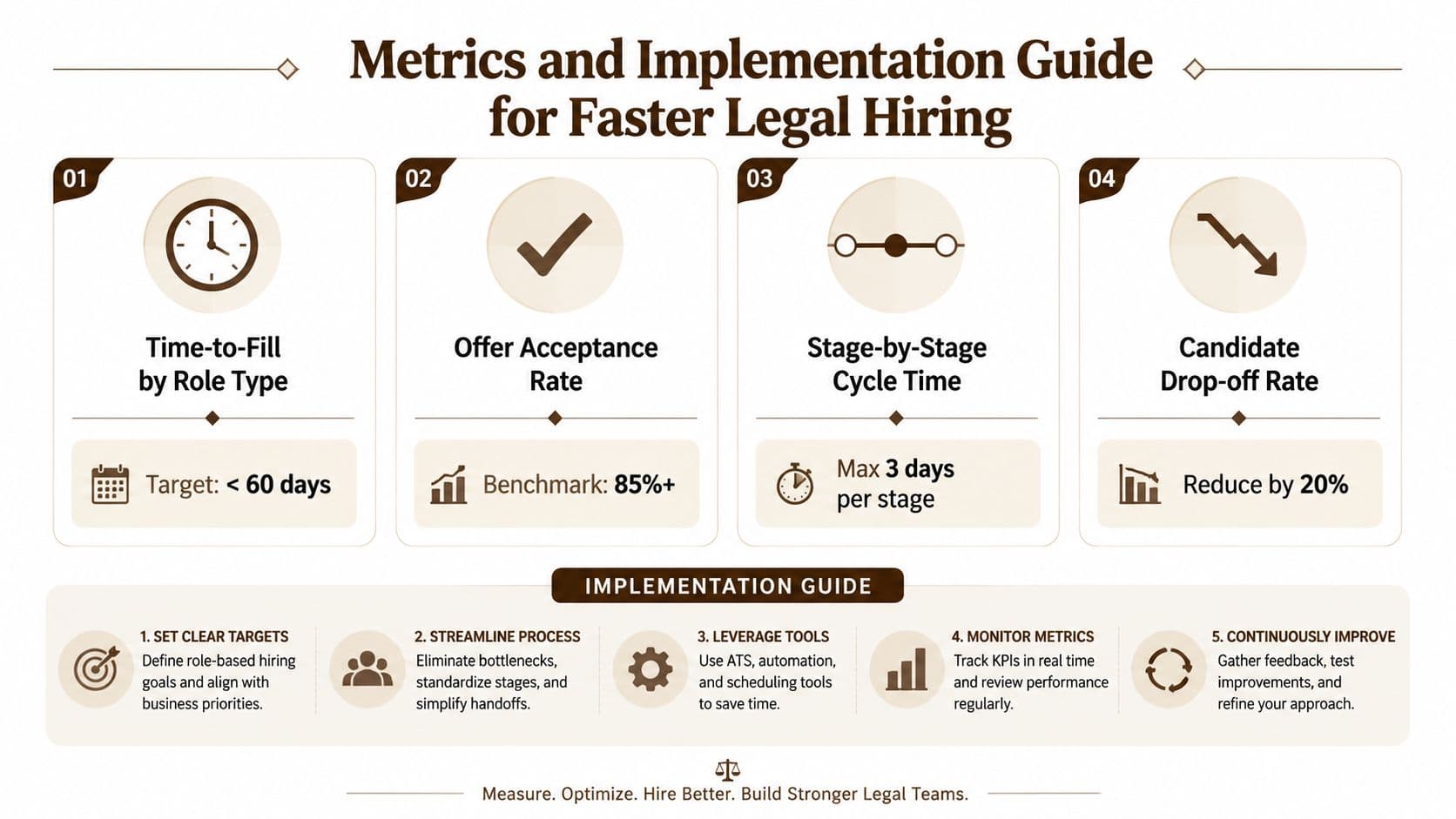
The broader legal-market benchmark matters too. Searches still commonly take 60 to 120 days, with 2 to 4 months often passing from identifying the need to accepting an offer, while associate-level lateral hires can fall in the 60 to 90 day range when the process is tight (legal industry statistics). That gives firms a realistic baseline to improve from.
Build a 90-day implementation plan
Start with an audit of the last search. Identify where the delay happened, who owned each stage, and where feedback went stale. Then set service-level expectations, pilot a scorecard, and review the next search against the same standard.
The first 30 days should be about process mapping. The next 30 should test the new cadence on a live opening. The final 30 should be a retrospective with the hiring partner, recruiter, and administrator so the firm keeps what worked and drops what didn't.
Use a simple internal dashboard
- Time-to-fill by role: measure the full search length by position type.
- Stage cycle time: track how long each step takes.
- Drop-off point: note where candidates exit or go silent.
- Offer acceptance: record how often the preferred candidate says yes.
For firms that want a place to start, Five Star Placements can serve as a reference point for permanent attorney placement, legal support staffing, and legal operations recruitment. The operational lesson is the same either way. If the firm wants to hire lawyers faster, it has to manage the search like a project with deadlines, ownership, and visible status.
If you're trying to tighten an attorney search, Five Star Placements can help with contingency-based legal recruiting for attorneys, legal support staff, and legal operations hires across law firms and corporate legal departments. Visit Five Star Placements to see how their screening and placement approach can fit a faster, more disciplined hiring process.
Need help filling a legal role?
Five Star Placements partners with law firms and legal departments nationwide.
Schedule a Call