
Legal Staffing vs Legal Recruiting: A Complete Guide For
July 30, 2026 · 13 min read · Five Star Placements
Table of contents
The vacancy looks manageable on paper, then it starts costing you real money. A litigation partner is covering too many files, a corporate counsel is slowing down because no one has bandwidth, and the open seat sits there long enough for everyone to call it “temporary.” That's the wrong instinct. In legal operations, the question is not whether you need help. It's whether you need capacity now or a durable hire that lowers future risk.
For managing partners and general counsel, legal staffing vs legal recruiting is a financial decision wrapped in a retention decision. Staffing protects matter flow when the work is immediate, uneven, or specialized. Recruiting is what you use when the seat itself matters, the role must stick, and the cost of a bad fit is worse than the cost of waiting.
| Criterion | Legal Staffing | Legal Recruiting |
|---|---|---|
| Primary use | Short-term capacity, interim coverage, project work | Permanent placement, laterals, in-house hires |
| Core optimization | Speed, utilization, margin | Fit, acceptance, retention |
| Risk profile | Reduces backlog and vacancy pressure quickly | Reduces long-term turnover and misalignment |
| Best fit | Surges, leaves, hard deadlines, overflow support | Strategic seats, leadership hires, team buildout |
| Cost shape | Variable spend tied to deployed work | Search fee tied to successful hire |
Table of Contents
- The Hiring Dilemma Facing Legal Leaders Today
- Defining Legal Staffing and Legal Recruiting
- Side-by-Side Comparison of Staffing and Recruiting
- Market Realities Shaping Legal Talent Decisions
- When to Use Each Approach
- Choosing the Right Legal Recruiting Partner
- Your Next-Step Hiring Checklist
The Hiring Dilemma Facing Legal Leaders Today
A managing partner looks at a six-week vacancy in a high-billing litigation seat and knows exactly what the delay means. Matters keep moving, but the remaining team is already stretched, client responsiveness slips, and the weakest files start absorbing the most attention. At the same time, a general counsel is staring at a sudden M&A workload spike and has no internal bench to absorb the rush. In both cases, the pressure is the same, but the right fix is not.
Vacancy pain is not abstract
The wrong response is to treat every open seat as a search problem. Sometimes the business needs a warm body who can start handling work quickly, especially when the gap is about output, deadlines, or support coverage. Other times, the seat itself is strategic, and a temporary fix just delays the final decision.
That difference matters because legal work compounds when it stalls. Backlogs get older, partners get less responsive, and internal teams start making bad tradeoffs just to keep moving. A short vacancy can look harmless, then suddenly become a client-retention issue.
Practical rule: If the work is piling up faster than the role can be filled, solve the backlog first, then solve the seat.
Staffing and recruiting solve different problems
Legal staffing is a capacity tool. You use it to absorb immediate demand, keep work moving, and protect billing or service delivery. Legal recruiting is a placement tool. You use it to find someone who will stay, grow, and fit the team over time.
That distinction is why the same vacancy can produce two very different costs. A temporary resource may reduce short-term disruption, while a permanent hire may lower the longer tail of turnover and repeated search costs. Leaders who confuse the two usually overspend in one direction and under-plan in the other.
The point is simple. If you need to keep a matter moving this week, staffing belongs in the conversation. If you need to rebuild a core function, recruiting belongs there instead.
Defining Legal Staffing and Legal Recruiting
What legal staffing does
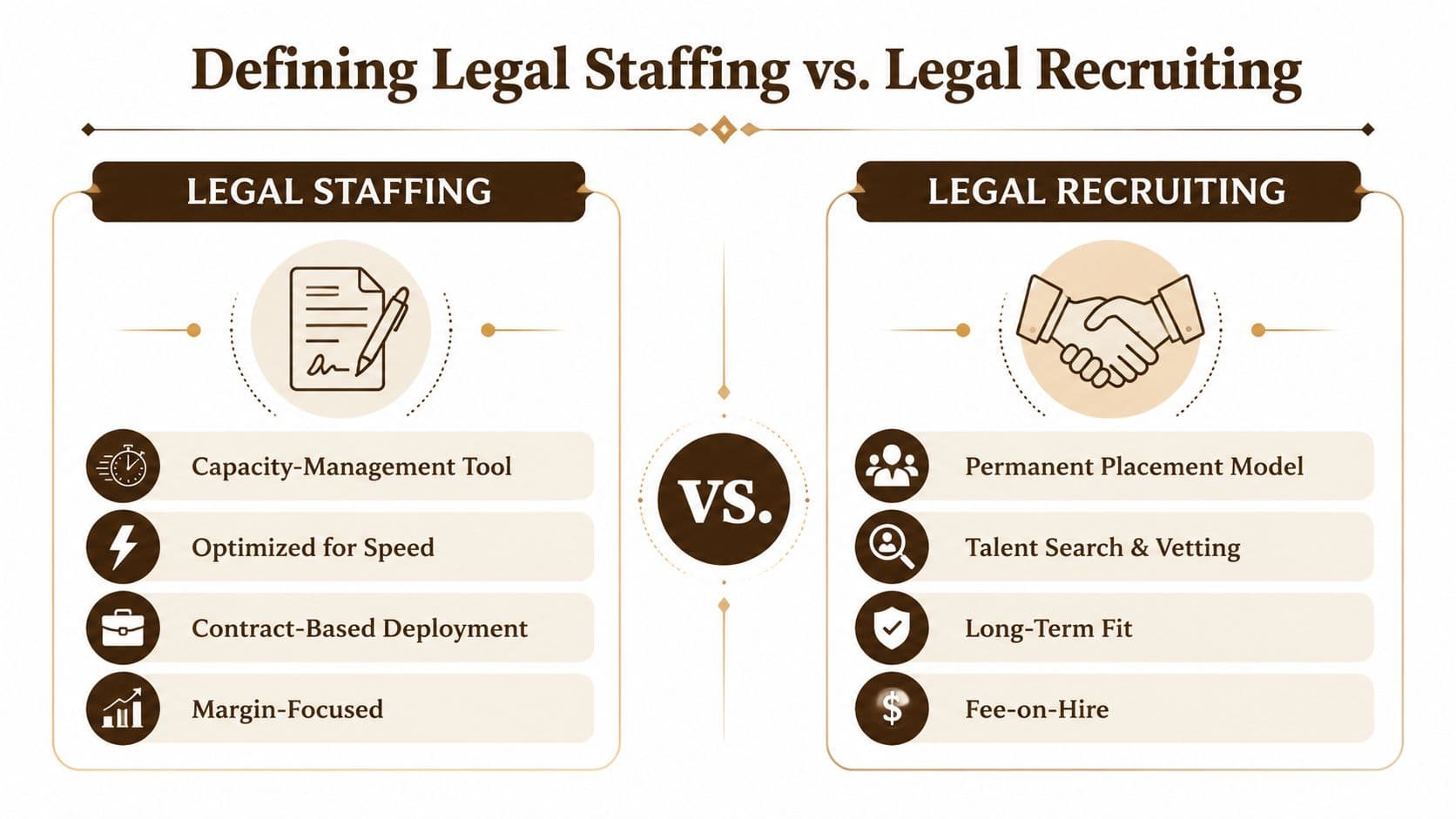
Legal staffing is a capacity-management tool. It covers contract attorneys, project paralegals, interim support, and other short-term placements that keep work moving when permanent headcount is not the right answer. The operational goal is fast deployment, steady utilization, and margin protection, not long-term retention.
That makes staffing the better fit for leave coverage, seasonal overflow, discovery support, document review, and other time-bound work. The role is judged by how quickly it can be deployed and whether it clears a workload problem without forcing a permanent hire too early. In staffing-oriented legal operations, the benchmarks are fill rate, deployment speed, and billable capacity, as reflected in legal staffing agency metrics.
In plain terms: staffing buys time and protects throughput.
What legal recruiting is designed to do
Legal recruiting is a permanent placement model. It focuses on sourcing, screening, and placing attorneys, partners, in-house counsel, and long-term support leaders into roles where fit matters as much as technical skill. The unit of optimization is different. Recruiting is measured by fill speed, acceptance, and retention, not just how quickly someone can start.
That is why recruiting is the right model for lateral partners, practice-area attorneys, and in-house counsel hires where the cost of a mismatch is high. The search process should screen for experience, role alignment, and culture fit, because the objective is a hire who stays and performs. In a tight labor market, treating this like staffing means paying for a temporary fix to a permanent problem.
Contingency, retained, and temp-to-perm arrangements
The service model matters as much as the title on the requisition. Contingency recruiting shifts search risk to the firm, because the fee is tied to a successful hire. Retained search is better for highly sensitive or executive placements where the client wants dedicated coverage and a more formal process. Temp-to-perm sits between the two, letting leaders evaluate a worker in real conditions before converting the role.
If you are deciding between legal staffing and legal recruiting, start with the unit of optimization. Staffing is about immediate capacity. Recruiting is about permanent fit. Temp-to-perm is a bridge, not a substitute for clear planning.
Side-by-Side Comparison of Staffing and Recruiting
The decision points that actually matter
The conversation gets messy when leaders compare staffing and recruiting only by fee structure. That's too shallow. The key variables are speed, risk, role type, and what happens after the hire starts. A cheaper short-term choice can become the more expensive option once vacancy cost and turnover are included.
| Criterion | Legal Staffing | Legal Recruiting |
|---|---|---|
| Candidate type | Contract attorneys, project paralegals, interim support | Permanent attorneys, partners, in-house counsel, support leaders |
| Time horizon | Immediate or short-term | Long-term |
| Hiring speed | Fast deployment | Search cycle tied to screening and acceptance |
| Risk allocation | Converts hiring into variable spend | Focuses risk on long-term fit and retention |
| Best outcome | Backlog control, workload smoothing | Durable team buildout |
| Common failure mode | Treating a permanent need as a temp fix | Waiting too long while work piles up |
Why risk looks different in each model
Staffing shifts the risk profile toward speed. If the matter load is spiking or a team member is out, a contract resource can stabilize operations before deadlines slip. Recruiting shifts the focus toward long-term performance. If the wrong person is hired into a critical seat, the cost shows up later in turnover, rework, and lost trust.
That's why the choice should not be made by instinct. It should be made by asking what breaks first, the timeline, the team, or the budget. If the answer is timeline, staffing usually wins. If the answer is team stability, recruiting does.
A useful test: If you'd regret having to re-open the search in six months, don't treat the opening like a staffing assignment.
Where the economics separate
A staffing decision makes sense when the business wants flexibility and immediate coverage. A recruiting decision makes sense when the business wants commitment and continuity. The mistake is to compare only visible costs and ignore the cost of delay, lost productivity, and the downstream churn that comes from hiring the wrong way.
That's why the best legal leaders don't ask, “Which model is cheaper?” They ask, “Which model is cheaper after the backlog, the vacancy, and the turnover are priced in?” That question leads to better decisions because it reflects how legal work behaves.
Market Realities Shaping Legal Talent Decisions
The legal talent market is tight, and the cost of hesitation is real. Work is piling onto already-employed candidates, which keeps both staffing and recruiting strategically relevant. Independent industry summaries put the U.S. legal staffing market at about $1.53 billion in 2023, $1.57 billion in 2024, and $1.60 billion in 2025. A broader market overview places annual U.S. legal staffing revenue at roughly $10 billion when temporary, contract, and permanent placements are included (market overview). That scale matters. It shows staffing is part of core workforce planning, not a side activity.
A labor market with almost no slack
Legal occupations had an unemployment rate of just 1.2% in January 2025. U.S. legal services employment reached 1.24 million in January 2026, the highest level in a decade (BLS labor data summary). Those figures explain why firms keep hitting the same wall. There are few idle legal professionals waiting to be hired.
The pressure shows up in lateral movement. A 2026 market review reported 28,000+ lateral hires in 2025, a 9% increase year over year, and said nearly 49% of new attorney hires were laterals versus about 38% from law-school recruiting. That means firms are competing for people who already have seats elsewhere. Recruiting is no longer just sourcing. It is a pitch to employed lawyers who have to be persuaded to move.
Technology is changing the channel mix
Talent-platform usage is projected to rise from 18% in 2023 to 27% in 2025. That does not replace human recruiters, but it changes how candidates are found and screened. Leaders who still rely on slow, internal-only processes are competing with firms that move faster and widen the funnel.
The break-even question many teams skip
The right question is not whether staffing or recruiting sounds cheaper. The right question is which option costs less after backlog, vacancy, and turnover are priced in. Vacancy costs hit hardest when work stalls, deadlines tighten, or client service slips. Turnover costs hit later, when a rushed hire creates rework, retraining, and a second search.
That is why the decision should be framed as a financial and risk model, not a vendor choice. If the work is urgent and the budget is bleeding from delay, legal staffing protects throughput. If the seat shapes retention, team stability, or long-term practice growth, legal recruiting is the better spend. For a practical view of how firms compare those trade-offs, see the Five Star Placements blog.
When to Use Each Approach
Use staffing when the work is immediate
If the seat exists because the work just spiked, staffing is the cleanest answer. That includes leave coverage, case overflow, discovery work, short-term project support, and administrative gaps that can't sit open for weeks. You need work product, not a long search cycle.
Use staffing when the cost of waiting is obvious. If the team is already behind, the right move is to add capacity now and protect service quality. Waiting for a permanent hire while the files pile up is not disciplined hiring. It's unmanaged delay.
Use recruiting when the role shapes the future team
Recruiting belongs in the conversation when the opening is tied to leadership, specialized expertise, or a role that should not be temporary. Partner-level laterals, in-house counsel backfills, and practice-area growth are classic examples. You are not just filling a chair. You are changing the structure of the business.
A practical decision matrix
| Situation | Better model | Why |
|---|---|---|
| Urgent matter coverage | Legal staffing | Keeps the file moving fast |
| Partner-level lateral move | Legal recruiting | The fit and long-term impact matter most |
| New practice area expansion | Legal recruiting | You are building durable capability |
| Seasonal workload spike | Legal staffing | Demand is temporary and capacity-driven |
| Long-term team building | Legal recruiting | Retention matters more than speed |
Leaders need to be disciplined. If the vacancy is temporary, staffing is usually the least disruptive answer. If the vacancy reflects a structural need, recruiting is the more economical path over time.
Decision rule: If the role will still matter after the current matter cycle ends, treat it as a recruiting problem.
The break-even question most teams skip
The wrong question is whether staffing is “cheaper.” The right question is whether a delayed permanent hire costs more than temporary coverage. Vacancy cost, productivity loss, and turnover are all part of the essential math. Once you account for those factors, the obvious choice often changes.
For urgent backfills, staffing usually wins because time is the scarce resource. For strategic hires, contingency recruiting can be economically superior because it aligns the fee with a successful placement and avoids paying twice for the same seat. Legal leaders should make that call with finance, not just with habit.
Choosing the Right Legal Recruiting Partner
The partner selection step matters because not every recruiter knows how to work in selective legal hiring environments. You want someone who understands practice-area nuance, can screen beyond a résumé, and can move without turning the process into a black box. A weak recruiter wastes time. A disciplined one narrows risk.
What to demand from a recruiting firm
Start with specialization. A recruiter who handles general professional hiring will miss the differences between a litigation associate, a compliance counsel, and a partner-level lateral. Then look at screening depth. Resume matching is easy. Real evaluation means checking experience, role fit, and culture fit before you burn stakeholder time.
Also look at fee structure and process discipline. Contingency search is the right fit when you want outcome-based economics and no upfront costs. Retained search can make sense for sensitive leadership roles, but the client should know exactly why that model is being used. Nationwide reach matters too, especially for multi-office firms and companies hiring across jurisdictions.
Five Star Placements is one option in this space. It provides contingency-based permanent placement for attorneys, legal support staff, partners, in-house counsel, and legal operations leaders, with customized screening and collaborative search support built around client teams. It also works in selective environments where less than 1% of applicants are hired, which is a useful signal if your own process is highly selective.
What good screening should look like
You should expect more than a forwarded stack of résumés. A serious recruiter will filter for the hard requirements first, then pressure-test communication style, team fit, and readiness for the actual environment. That matters because a technically strong candidate can still fail if the role, pace, or culture is wrong.
- Practice-area understanding: A recruiter should know the difference between filing someone into a generic legal role and filling a seat that changes how a matter runs.
- Culture fit screening: The right candidate should work in your actual environment, not just on paper.
- Process transparency: You need updates, not silence.
- Selective hiring experience: The harder the role, the more valuable it is to work with someone who has already handled difficult searches.
- Permanent-placement discipline: If the seat is strategic, the process should be built for retention, not just speed.
Five Star Placements also describes direct placement for full-time roles and a nationwide footprint, which matters if your opening spans offices or practice groups. For more on its approach, see the firm's about page.
Your Next-Step Hiring Checklist
Begin with the vacancies you already have open. Rank each one by urgency, business impact, and how badly delay is hurting the team. Then price the cost of waiting, including backlog, missed responsiveness, and the drag on everyone covering the gap.
Next, map each role to the right model. If the work is temporary, seasonal, or overflow-driven, use staffing. If the seat is strategic, leadership-oriented, or meant to last, use recruiting. When you're unsure, treat the role as a financial decision first and a title decision second.
Before you launch any search, write a short role brief that includes the must-have skills, the team environment, and the culture-fit signals that matter most. Then engage the right partner for the task, not the one that just answered first. If you need a permanent placement conversation, use a contingency recruiting model and keep the search tied to a successful hire.
For direct help with a current opening, use the firm's contact page and send over the role, timeline, and the primary reason the seat matters.
Five Star Placements helps law firms and corporate legal departments fill permanent legal and legal operations roles with contingency-based search and screening based on experience and culture fit. If you're weighing legal staffing vs legal recruiting for a live vacancy, visit Five Star Placements to discuss a search plan built around your backlog, your budget, and the kind of hire that will stay.
Need help filling a legal role?
Five Star Placements partners with law firms and legal departments nationwide.
Schedule a Call