
What Does a Case Manager Do at a Law Firm? Duties 2026
October 5, 2026 · 12 min read · Five Star Placements
Table of contents
A partner is preparing for a hearing, a client is asking for an update, and the discovery folder contains documents that nobody has reviewed in sequence. At the same time, a medical provider hasn't returned records and an outside expert is waiting for scheduling options. The attorney may know the legal strategy, but someone still has to make all the related work happen in the right order.
That person may be a case manager. The title sounds straightforward, but the work varies sharply between a high-volume personal injury practice and a complex litigation team. Hiring partners who treat the role as a generic administrative position often miss the operational judgment the job requires. Candidates who understand the difference can evaluate opportunities more accurately and contribute sooner.
Table of Contents
- The Case Manager Role in Modern Law Firms
- Core Responsibilities and Daily Operations
- How Case Manager Duties Vary by Practice Area
- Skills, Qualifications, and Technical Competencies
- Case Managers in Firm Workflow and Team Dynamics
- Hiring Case Managers and Career Progression Paths
The Case Manager Role in Modern Law Firms
A case manager enters the workflow where legal judgment meets operational pressure. The attorney decides how a matter should proceed. The case manager coordinates the documents, people, dates, and follow-up actions that allow that strategy to move forward without avoidable friction.
In a personal injury file, that might mean confirming that medical records have been requested, checking whether treatment documentation is complete, organizing insurance correspondence, and preparing a clear status summary for attorney review. In a litigation matter, it can mean coordinating discovery across multiple custodians, monitoring deposition logistics, and making sure the team has the right materials before a hearing or trial activity.

The operational bridge
The role has developed beyond simple file coordination. A current legal case manager job description describes responsibilities that include coordinating documents, deadlines, client communications, and outside parties, along with preparing case summaries, tracking discovery and evidence, and scheduling appointments, hearings, and follow-ups.
That combination matters because legal work rarely moves in a straight line. One missing document can affect a case summary. One unanswered client question can delay an appointment. One overlooked deadline can force an attorney to abandon substantive preparation to resolve an administrative problem. The case manager keeps these dependencies visible.
Practical rule: A case manager shouldn't merely know what has been completed. They should know what is blocked, who owns the next action, and when the matter will be checked again.
This is why the role is foundational in high-volume practices. The case manager connects attorney work with the administrative and logistical tasks that keep matters progressing through intake, investigation, discovery, negotiation, and resolution. The broader range of positions in a law firm helps explain why this role sits between traditional legal support and day-to-day matter operations.
Why the title creates confusion
“Case manager” isn't a standardized legal title. One firm may use it for a client-service coordinator focused on intake and pre-litigation follow-up. Another may expect the person to coordinate discovery, support trial preparation, and supervise junior staff.
The practical definition is therefore shaped by practice area, firm size, matter complexity, and litigation stage. A good job description should identify the phase of the matter, the systems the person will use, the decisions they may make independently, and the boundaries that require attorney involvement.
Core Responsibilities and Daily Operations
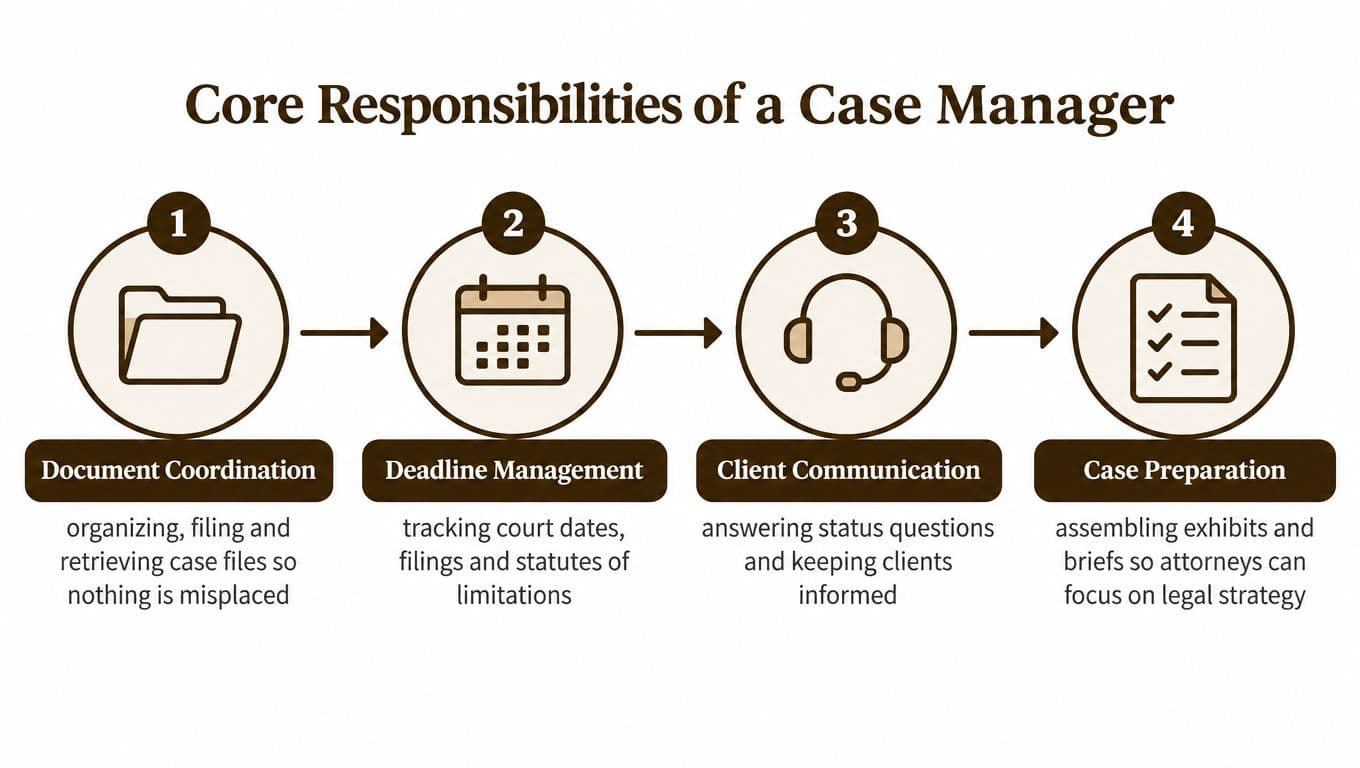
The most useful answer to “what does a case manager do at a law firm” starts with the work queue, not the job title. A case manager turns a collection of open tasks into an orderly matter plan. The work usually falls into four connected areas.
Document coordination
The case manager establishes a reliable home for pleadings, correspondence, medical records, discovery materials, exhibits, and internal notes. That includes applying naming conventions, checking whether a production is complete, recording what remains outstanding, and retrieving the right file when an attorney needs it.
The quality test isn't whether documents have been uploaded. It's whether another team member can understand the file without reconstructing its history from scattered emails. A well-maintained matter-management system should show the document's status, source, date received, and relationship to the next legal task.
Deadline management
Calendar ownership involves more than entering a hearing date. The case manager tracks filing dates, discovery obligations, appointments, follow-up commitments, and internal preparation milestones. They also create reminders early enough for the attorney or support team to act.
A useful process connects every important date to an owner and a deliverable. “Deposition scheduled” is incomplete. The team may also need a witness confirmation, exhibit set, transcript request, technology check, and client preparation appointment.
Client and outside-party communication
Case managers often provide routine status updates, manage intake and onboarding, and filter non-legal questions before they reach the attorney. They may coordinate with medical providers, experts, investigators, vendors, courts, opposing counsel, and other law firms.
That boundary requires judgment. A case manager can explain the next administrative step, confirm that a document was received, or tell a client that a message has been sent to the attorney. They shouldn't give legal advice or make a strategic decision reserved for counsel.
Case preparation
Case managers may prepare summaries, organize evidence, assemble exhibits, maintain witness schedules, and package information for attorney review. In a well-run team, the attorney receives a usable work product rather than an unfiltered document dump.
A typical day may move from a client intake call to records follow-up, then to deadline review and an afternoon coordination call with an expert. The work changes frequently, but the standard remains constant: the next person in the workflow should have what they need, when they need it.
The following video provides additional context for the operational function of legal case management:
How Case Manager Duties Vary by Practice Area
The same title can describe two very different jobs. A personal injury case manager may be responsible for keeping many pre-litigation files moving toward attorney review. A complex litigation case manager may work inside a smaller number of matters with heavier discovery, technical evidence, and courtroom preparation.
One personal injury firm job posting states that a case manager may oversee about 115 to 125 pre-litigation matters at once. That figure appears in the relevant litigation case manager posting, and it illustrates why a personal injury role often depends on disciplined follow-up, prioritization, and consistent client contact.
| Personal Injury Case Manager | Complex Litigation Case Manager |
|---|---|
| Manages intake, onboarding, and routine client updates | Coordinates matter activity across attorneys, experts, vendors, courts, and outside counsel |
| Requests and follows up on medical records and bills | Manages discovery across paper, PDF, image, audio, video, forensic, and proprietary file types |
| Tracks treatment-related documentation and unresolved file items | Prepares subpoenas, exhibit lists, witness schedules, and trial demonstratives |
| Packages a complete file for attorney review and settlement preparation | Supports hearings, depositions, trials, arbitrations, mediations, and courtroom logistics |
| Focuses heavily on volume, responsiveness, and pre-litigation momentum | Focuses heavily on evidentiary organization, procedural readiness, and complex coordination |
Personal injury operations
In personal injury work, the case manager is frequently the consistent voice the client hears. They may answer questions about what has been received, follow up with providers, coordinate appointments, monitor outstanding documentation, and identify issues that require attorney attention.
The trade-off is speed versus depth. A high-volume practice needs repeatable processes, clear escalation rules, and systems that make exceptions visible. A manager who treats every file identically may miss the matter with an unusual records problem or a time-sensitive client issue. A manager who handles every task manually may spend too much time on routine follow-up.
Complex litigation support
Complex litigation demands a different kind of control. The government legal-administrative posting describing litigation support includes management of varied discovery formats, case-management systems, subpoenas, exhibit lists, witness schedules, trial demonstratives, and courtroom support.
Here, organization has an evidentiary and procedural purpose. The team must preserve reliable handling of materials, understand where information came from, and prepare it for use by attorneys, experts, and the court. A case manager in this environment may also coordinate junior paralegals and support staff on large matters.
A hiring partner should define the work before approving the title. “Case manager” alone doesn't tell a candidate whether the job is primarily client service, pre-litigation operations, discovery management, or trial support.
The litigation support staffing perspective is useful when a firm needs to distinguish these functions before recruiting. The right candidate for a personal injury intake team may not be the right candidate for a document-intensive commercial dispute, even if both have strong organizational skills.
Skills, Qualifications, and Technical Competencies
Effective case managers combine workflow discipline, legal context, technical fluency, and interpersonal judgment. General administrative experience can help, but it won't by itself prove that a candidate can manage a matter where a missing document affects a filing, a client communication, or an attorney handoff.
The essential competency set
Start by testing how the candidate handles competing priorities. Ask them to explain how they would respond when a client needs an update, a provider has not returned records, and an attorney requests a case summary for the same afternoon. The strongest answer usually includes triage, documented ownership, a clear escalation point, and a follow-up time.
Look for these capabilities:
- Matter organization: The candidate can maintain a logical file structure, distinguish drafts from final materials, and retrieve information without relying on personal memory.
- Calendar control: They can connect dates to preparation tasks and identify which deadlines require attorney confirmation.
- Client communication: They can explain process without giving legal advice, communicate difficult updates calmly, and record the substance of important conversations.
- Evidence handling: They understand that discovery needs traceability, consistent labeling, and careful access control.
- Drafting support: They can prepare summaries, correspondence, schedules, exhibit indexes, and other materials for attorney review.
- Escalation judgment: They recognize when a factual development, client concern, or procedural issue belongs with counsel.
Technical readiness
A case manager should be comfortable using the firm's matter-management platform, document repository, calendar, email system, and collaboration tools. The specific product matters less than the habits behind its use. A candidate who knows how matter-management systems support legal workflows should still demonstrate that they can apply status fields, task ownership, permissions, and reporting consistently.
Technical skill also includes understanding the risks of incomplete discovery. Poor organization can increase attorney review time, delay preparation, and make it harder to establish procedural readiness. In litigation settings, the case manager may work with paper, PDF, image, audio, video, forensic, and proprietary materials, so the person needs a careful process for intake, classification, preservation, and retrieval.
The boundary that protects the firm
The case manager should flag issues, not provide legal advice. If incoming records suggest a significant change in the matter, the manager should identify and escalate the issue while preserving the underlying material. The attorney decides how to interpret it and what the client should be told.
Hiring partners should assess confidentiality, attention to detail, resilience under interruption, and willingness to document work. These qualities often determine whether technical knowledge becomes dependable case control.
Case Managers in Firm Workflow and Team Dynamics
A case manager's day rarely follows a neat sequence. The person may begin by reviewing urgent calendar items, then answer a client question, check a discovery production, coordinate with an expert, and prepare a status report before the first matter meeting ends.
Consider a litigation team preparing for a deposition. The attorney needs the witness materials. The paralegal needs the exhibit index. The client needs confirmation of logistics. The court reporter needs scheduling information. An expert may need selected documents, while an outside vendor is still processing a production. The case manager keeps these requests connected rather than allowing each person to manage an isolated part of the process.

Where the role sits
The reporting line differs by firm. Some case managers report to an attorney. Others work under an operations leader, litigation support manager, or practice group administrator. The reporting structure should clarify who sets priorities, who approves process changes, and who handles performance feedback.
Case managers often work alongside attorneys, paralegals, legal assistants, records staff, intake specialists, and vendors. On large matters, the role can extend to coordinating or supervising junior paralegals and support staff. That makes communication style important. A case manager needs enough authority to request action, but also enough tact to keep the team engaged when deadlines are tight.
A useful operating standard: Every handoff should identify the material transferred, the action required, the responsible person, and the next review point.
The role succeeds when it reduces avoidable interruptions without creating an information silo. Attorneys should receive concise escalations with supporting documents. Support staff should know which task matters most. Clients should receive consistent communication instead of conflicting answers from different members of the firm.
The role fails when the case manager becomes a passive inbox. Forwarding messages without assigning ownership, storing documents without context, or reporting delays without proposing the next action leaves the same operational burden with the attorney. A strong case manager converts activity into visible progress.
Hiring Case Managers and Career Progression Paths
Hiring should begin with the firm's actual workflow. A partner recruiting for personal injury pre-litigation needs someone comfortable with sustained client contact, records follow-up, prioritization, and high-volume file movement. A litigation group may need stronger discovery, evidence, scheduling, and trial-support capabilities.
The interview should test the work directly. Give the candidate a hypothetical matter with an approaching deadline, incomplete records, a demanding client, and several outside participants. Ask them to rank the actions, draft an escalation note, and explain what they would record in the case-management system. This reveals more than a general question about organization.
Evaluate three forms of fit:
- Practice fit: Has the candidate worked in the relevant matter phase and client environment?
- Technical fit: Can they use the firm's systems and manage the required documents, deadlines, and evidence?
- Team fit: Can they communicate with attorneys, clients, vendors, and support staff without losing accountability?
Career progression can move from case manager to senior case manager, litigation support specialist, practice group coordinator, or an operational leadership role. In larger litigation environments, senior professionals may supervise support staff or coordinate complex matters across attorneys, experts, courts, vendors, and outside firms.
For hiring partners, the central question isn't whether the candidate has held the exact title. It's whether they have owned the type of workflow the firm needs. A candidate with strong personal injury coordination may need training before taking on technical discovery. A litigation support professional may need a different onboarding plan before becoming the primary client contact.
Five Star Placements provides contingency-based permanent placement for legal support professionals, including case managers and litigation support specialists, with searches aligned to practice needs, skills, and organizational culture. If your firm needs to define the role clearly and find a practice-ready candidate, visit Five Star Placements to discuss the search.
Need help filling a legal role?
Five Star Placements partners with law firms and legal departments nationwide.
Schedule a Call