
Lawyers Practice Areas: Types, Employers and Career Paths
November 6, 2026 · 14 min read · Five Star Placements

Table of contents
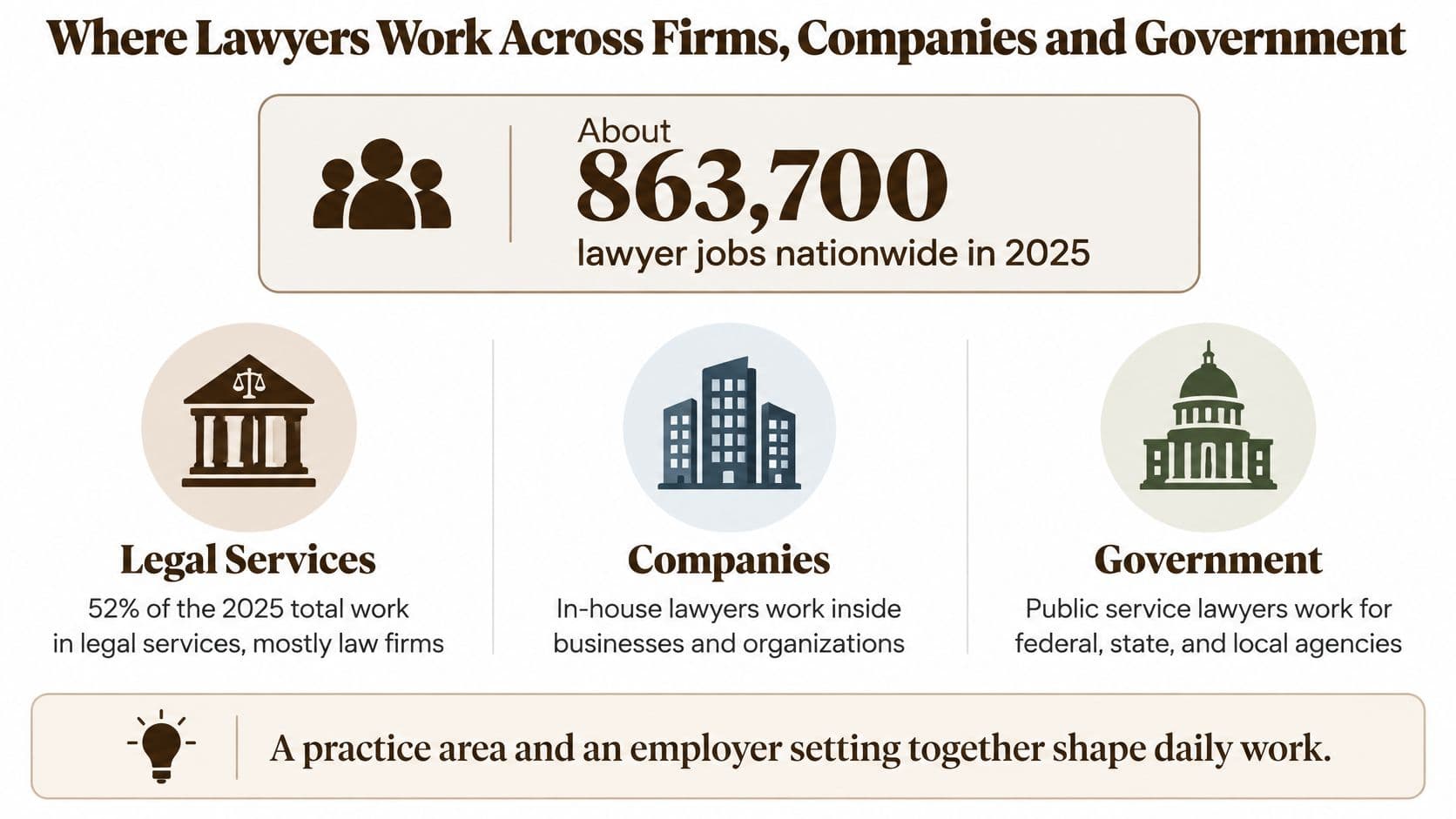
A lawyer's specialty doesn't tell you where they work. Legal services, primarily law firms, accounted for 52% of approximately 863,700 lawyer jobs nationwide in 2025, according to the Bureau of Labor Statistics. The rest worked across government, companies, and other organizations. That distinction matters whether you're choosing a career or hiring someone to handle a particular kind of legal work.
Understanding lawyers' practice areas starts with the subject matter, but it shouldn't end there. A useful career or hiring decision connects the legal specialty, the employer setting, and the work someone can perform.
Table of Contents
- Lawyers Practice Areas at a Glance
- Where Lawyers Work Across Firms, Companies and Government
- How Career Paths Split Between Firms, In-House and Public Service
- Where Demand Is Growing Across Practice Areas
- Why Practice Areas Overlap in Corporate Litigation
- Technology Skills Each Practice Area Now Expects
- Choose a Practice Area Before You Apply or Hire
Lawyers Practice Areas at a Glance
| Practice area | What it covers | Typical employers |
|---|---|---|
| Litigation | Disputes resolved in court or arbitration, from discovery to trial | Law firms, insurers, corporate legal departments, government agencies |
| Corporate and business | Formation, mergers and acquisitions, contracts and governance | Law firms, in-house legal departments |
| Real estate | Purchases, leases, financing and zoning | Law firms, developers, lenders, title companies |
| Tax | Planning, controversy with tax authorities and compliance | Accounting-linked firms, law firms, corporate tax teams |
| Family law | Divorce, custody and support | Small and midsize firms, solo practices |
| Criminal law | Defense and prosecution | Public defender offices, prosecutors, private firms |
| Immigration | Visas, asylum and removal defense | Immigration firms, nonprofits, corporate mobility teams |
| Intellectual property | Patents, trademarks and copyright | IP boutiques, large firms, technology companies |
| Labor and employment | Discrimination claims, wage-and-hour issues and employer advice | Management-side firms, plaintiff firms, corporate HR and legal teams |
| Personal injury | Negligence claims, often taken on contingency | Plaintiff firms, consumer advocacy practices |
| Trusts and estates | Wills, probate and trust administration | Trust and estate firms, banks with fiduciary units |
A practice area is the subject a lawyer focuses on, and many lawyers work across more than one. The table maps the main categories, but the boundaries aren't rigid.
Litigation describes a dispute-resolution process rather than a single subject. A litigator might question witnesses about a broken supply agreement, while a corporate lawyer drafts the agreement before anyone disagrees. Real estate lawyers handle the property documents and approvals when that same business leases a warehouse.
Tax lawyers examine the tax consequences of decisions and handle disputes with taxing authorities. Someone exploring tax law firms should distinguish transaction planning from tax controversy, because drafting acquisition advice and challenging an assessment involve different work.
Understand the client's problem
Family lawyers help clients resolve questions about marriage, parenting, and financial support. Criminal lawyers represent the government bringing charges or the person accused, roles with different responsibilities despite sharing the same courtroom.
Immigration lawyers might prepare an employment-based visa petition or defend someone facing removal. Intellectual property lawyers help protect inventions, brands, and creative work, but preparing a patent application isn't the same assignment as litigating an infringement claim.
Labor and employment lawyers advise on workplace decisions and represent parties in workplace disputes. Personal injury lawyers pursue compensation for injuries allegedly caused by negligence, often under an arrangement where their fee depends on recovery.
Trusts and estates lawyers prepare documents for transferring and managing assets, then help administer estates and trusts. Drafting a will and handling a contested estate may sit within the same broad practice while requiring different strengths.
Practical rule: Choose the client problem you want to solve before choosing the job title you want.
Find the row that matches your goal, then examine the employer and demand considerations. Familiarity with a subject is only the beginning of determining whether a particular role fits.
Where Lawyers Work Across Firms, Companies and Government
| Employer setting | Lawyers employed (BLS 2023) | Practice areas most often found |
|---|---|---|
| Legal services, mainly law firms | 445,110 | Litigation, corporate, real estate, family, personal injury |
| Local government | 57,160 | Prosecution, public defense, municipal and land-use law |
| State government | 47,650 | Prosecution, public defense, agency counsel, regulatory law |
| Federal and combined government | 40,630 | Immigration, regulatory, litigation, public policy |
| Management of companies and enterprises | 22,110 | Corporate, contracts, compliance, intellectual property, employment |
These BLS occupational counts describe employment settings, not the number of specialists in each practice. The practice-area examples help interpret the settings; they aren't separate employment estimates. The management-of-companies category also isn't a count of every in-house lawyer, because businesses employ counsel across other industries.
The broader employment picture makes the distinction visible.
Law firms serve separate clients
A firm lawyer may advise unrelated businesses or individuals, each with different priorities. Daily work can include client updates, drafting, negotiation, court appearances, and coordinating assignments with partners and support staff.
Say a business faces a contract lawsuit. Its outside litigation lawyer develops the case, manages discovery, and explains settlement options. Employers evaluating that lawyer should ask who supervised the work and which decisions the lawyer personally owned.
Companies and government change the assignment
An in-house lawyer works within an organization rather than serving it as an outside client. A commercial counsel role may require negotiating sales contracts while explaining risks to sales, finance, and procurement colleagues. The lawyer needs to understand how the organization makes decisions, not just whether a clause is legally sound.
Government lawyers work within public institutions. Agency counsel may advise officials about regulatory authority, while prosecutors and public defenders handle opposing sides of criminal proceedings. Municipal lawyers may address public contracts, land use, and local governance.
A litigator can therefore work at a firm, an insurer, or a government agency without changing the broad specialty. What changes is the client, the approval process, the reporting line, and the purpose of the assignment.
When comparing listings, identify both the specialty and the institutional setting. A description that asks only for litigation experience leaves unanswered whether the employer needs courtroom advocacy, outside-counsel oversight, or internal advice about disputes.
How Career Paths Split Between Firms, In-House and Public Service
Law-firm practice remains the main road into legal employment, while in-house and public-service roles have their own entry points. For the Class of 2025, 60.9% of employed graduates entered private practice, while public-service employers accounted for 31.0% of jobs, according to the National Association for Law Placement.
Choosing a route means considering the working environment as well as the legal subject.

Follow a possible career sequence
Consider an attorney interested in commercial contracts. At a firm, they might draft agreements for different clients, research unfamiliar issues, and learn negotiation under a partner's supervision. That route can provide exposure to different businesses, but the attorney must manage competing client requests.
An in-house move changes the emphasis. Instead of moving between unrelated clients, the attorney develops deeper knowledge of an organization's products, operations, and tolerance for risk. Understanding what in-house counsel does helps distinguish legal analysis from the broader task of helping colleagues make workable decisions.
A firm-to-company move is a possible sequence, not a prerequisite for every corporate role. Candidates should examine the responsibilities and supervision available rather than assuming that every in-house opening suits an early-career lawyer.
Public service offers another route through government roles, judicial clerkships, and public-interest organizations. A clerkship emphasizes research and judicial decision-making; a public-interest position may center on direct representation or advocacy. Neither should be treated as interchangeable with every other public-service job.
Career exploration can also include listening to how lawyers describe their working lives.
Choose the trade-off deliberately
Ask yourself:
- Client volume: Do you want to serve different clients or develop a sustained relationship with an organization?
- Business context: How closely do you want to work with commercial teams and operational decisions?
- Mission: How important is representing a public institution, a particular community, or a defined cause?
These aren't tests with a correct answer. They help reveal whether the route fits the work you want to do.
Where Demand Is Growing Across Practice Areas
Litigation and labor and employment together represented almost 40% of all lawyer work hours, and litigation demand grew 2.8% in 2023 and 3.3% in 2024, according to the 2025 State of the US Legal Market Report. The report also describes improvement in corporate, real estate, and tax work after those practices had weighed on performance in the preceding period.
That workload concentration matters to hiring partners. When a busy litigation team lacks someone who can manage discovery or prepare motions independently, partners must absorb the work or redistribute it. A stable smaller practice doesn't solve that capacity problem.
Translate demand into a screening test
| Practice area | Evidence to request | Useful screening exercise |
|---|---|---|
| Litigation | Discovery ownership, deposition preparation, motion drafting, trial exposure | Ask the candidate to explain a discovery dispute and the choices they made |
| Labor and employment | Workplace investigations, wage-and-hour analysis, employer advice or employee representation | Present a complaint and ask how they would investigate it |
| Corporate | Contract negotiation, due diligence, transaction documents, closing responsibilities | Ask them to explain a negotiated provision and the business trade-off |
| Real estate | Lease drafting, title review, financing documents, closing coordination | Have them identify issues in a fictional lease or title scenario |
| Tax | Planning analysis, transaction support, compliance work, tax disputes | Ask them to separate the substantive issue from the procedural next step |
These are recommended assessment methods, not additional market measurements. They turn broad demand signals into questions that reveal whether someone can perform the actual assignment.
Separate exposure from ownership
A résumé may list depositions even when the lawyer only prepared exhibits. Another candidate may have taken witness testimony, defended objections, and used the transcript in a motion. Both have exposure, but they aren't ready for identical responsibilities.
Apply the same distinction to transactional work. Participating in an acquisition doesn't establish that the candidate negotiated documents, managed diligence issues, or coordinated a closing.
Ask what the lawyer decided, drafted, negotiated, or delivered, not simply which matters appeared on the team's docket.
Candidates should prepare a matter narrative that identifies their contribution without disclosing confidential information. Recruiters should also explore concurrent caseload management, including how the lawyer prioritizes deadlines and raises capacity concerns.
Treat the published figures as evidence about the periods measured, not as a prediction of future hiring. The practical lesson is to assess matter-level readiness rather than using years of experience as a substitute for capability.
Why Practice Areas Overlap in Corporate Litigation
Corporate disputes often combine employment, privacy, cybersecurity, and regulatory questions. In a survey of more than 400 general counsel and in-house litigation leaders, 36% reported greater exposure to cybersecurity and data-privacy disputes, according to the Norton Rose Fulbright Annual Litigation Trends Survey.
Consider a departing employee suspected of downloading confidential customer records. The employer may need advice about the departure, access controls, contractual restrictions, potential privacy consequences, and a threatened lawsuit. Assigning the matter solely by its first label, such as employment, can leave important questions unattended.
Assess the connecting skills
- Incident-response coordination. The lawyer should know how to work with security staff to establish what happened without confusing preliminary technical assumptions with confirmed facts.
- Preservation and e-discovery. They should identify relevant email, messaging, devices, and logs, then coordinate preservation and defensible collection.
- Regulatory-investigation strategy. A candidate should be able to separate litigation needs from regulator requests and identify where specialist advice is necessary.
- Privilege controls. When technical experts join an investigation, the lawyer should consider their role, engagement structure, communications, and the limits of privilege.
- Employee-data governance. Reviewing employee records requires attention to access permissions, purpose, and applicable restrictions.
- Plain-language communication. Counsel must explain legal choices to compliance and information-security colleagues without burying the decision in technical vocabulary.
The goal isn't to find a lawyer who claims to know everything. It's to find someone who recognizes connected issues, knows when to involve another specialist, and can keep the response organized.
Test judgment across boundaries
For corporate litigation attorneys, technical fluency becomes useful when it changes a legal decision. Knowing what an access log contains matters less than explaining how that log affects a preservation request, witness interview, or claim.
A useful interview scenario introduces an unresolved fact. Perhaps the company knows that files were downloaded but doesn't yet know whether anyone shared them. Ask what the candidate would verify before recommending an allegation or an external communication.
Interview prompt: Describe a matter where legal specialties overlapped, then explain a decision you personally made.
A strong answer distinguishes known facts from assumptions, identifies the people involved, and explains the candidate's reasoning. A weak answer names several practice areas without showing how the lawyer connected them.
Technology Skills Each Practice Area Now Expects
31% of surveyed legal professionals used generative AI at work in 2024, up from 27% in 2023, according to the ABA Journal's reporting on the AffiniPay Legal Industry Report. Its practice-specific findings distinguish individual adoption from firm-level adoption, an important difference when assessing someone's experience.
Using an AI tool personally doesn't establish that a lawyer can design a supervised workflow for colleagues. An employer should test verification, confidentiality, disclosure decisions, and records handling separately.
| Practice area | Reported adoption | Competency to test |
|---|---|---|
| All surveyed legal professionals | 31% used generative AI at work in 2024, up from 27% in 2023 | Human review before any client use |
| Immigration practitioners | 47% individual adoption | Verification of output in filings and appropriate client disclosure |
| Personal injury | 37% individual adoption | Client confidentiality in intake and disclosure of AI use |
| Civil litigation firms | 27% firm-level adoption | Privilege protection and e-discovery review workflows |
| Trusts and estates and criminal-law firms | 18% firm-level adoption | Records retention and confidentiality controls |
Use work samples to reveal judgment
In immigration work, provide a fictional draft containing inconsistent dates, unsupported assertions, and an unreliable legal reference. Ask the candidate to compare it against the underlying documents and authoritative materials. The important skill is verification, not producing polished prose quickly.
For personal injury intake, ask which information an intake specialist may enter into an approved tool and which facts require escalation. The candidate should distinguish summarizing a client's account from drawing conclusions about liability or medical causation.
Civil litigation requires another kind of assessment. Give the candidate a fictional document-review workflow and ask where privileged material could be exposed, how review decisions would be checked, and who approves production.
Test governance as well as tool use
Trusts and estates and criminal-law work can involve highly sensitive family, financial, and personal information. A useful exercise asks where drafts and prompts are stored, who can access them, and how the team follows its retention requirements. Don't equate deleting a chat with resolving every records-management question.
Across practices, ask candidates to demonstrate how they would:
- Verify output: Check factual statements, citations, quotations, and document references against reliable originals.
- Protect information: Use approved systems and recognize when material shouldn't enter a tool.
- Document review: Record who checked the result and what changes were necessary.
- Introduce change: Explain the workflow to colleagues and define when they must stop and seek supervision.
These expectations extend to paralegals, legal assistants, intake specialists, and legal-operations leaders. Their responsibilities differ, but each needs clear review boundaries and data-handling rules.
Ask for a fictional or properly sanitized work sample, not confidential client material. An AI keyword on a résumé tells you far less than watching someone catch an error and explain the correction.
Choose a Practice Area Before You Apply or Hire
A useful choice ends with a specific assignment, not a broad label. Corporate lawyer could mean negotiating routine commercial agreements, supporting acquisitions, or advising a board. Applicants and employers need to resolve that ambiguity before investing in interviews.
Use this decision sequence:
- Choose the setting. Identify whether you want a law firm, company, government agency, or nonprofit, then consider its reporting structure.
- Identify the practice. Select the relevant specialty and narrow it to the client problem the role must address.
- Define readiness. Choose a matter-level assessment, such as explaining a negotiation, investigation, motion, or closing responsibility.
- Check connected issues. If the assignment touches employment, privacy, security, or regulation, establish what the lawyer must recognize and when they should involve specialists.
- Test the workflow. Assess the technology competency the person will need, including review and information-handling responsibilities.
Turn the choice into evidence
Candidates should prepare concise matter examples that explain their role, judgment, and contribution without revealing protected information. Recruiters should put the same expectations into job specifications so interviewers aren't judging applicants against different, unstated standards.
Before accepting an offer or making a hire, confirm what the person will own independently and what supervision they'll receive. That conversation can expose a mismatch that a familiar job title would otherwise hide.
At Five Star Placements, our candidate network and placement record are concentrated in boutique and midsize firms and companies hiring in-house counsel. Attorneys can browse current openings or tell us what they're looking for, and we'll contact them when a strong fit in our network opens up.
Choose a target role you can describe in terms of practice, setting, and responsibilities. Confirm those elements together before committing.
Five Star Placements provides permanent legal placement aligned with practice-area needs and employer settings. Visit Five Star Placements to share your next career goal, or schedule a call to discuss your law firm's or legal department's hiring needs.
Need help filling a legal role?
Five Star Placements partners with law firms and legal departments nationwide.
Schedule a Call