
How to Hire a Regulatory Compliance Attorney in 2026
August 21, 2026 · 14 min read · Five Star Placements
Table of contents
A missed filing lands in the general counsel's inbox days before a regulator's deadline. At the same time, a business team wants to launch a product that may collide with untested state requirements. The organization doesn't need another lawyer who can summarize a rule. It needs someone who can identify the exposure, build a workable control, document the decision, and persuade the business to follow it.
That's why hiring a regulatory compliance attorney under pressure often produces the wrong result. Managing partners and legal leaders screen for prestigious credentials, then discover that the candidate can't run an examination, explain a control to engineers, or challenge a revenue-driven shortcut without alienating the people responsible for implementation.
The right search starts with a clearer definition of the job. You need to understand what the attorney owns, which industry experience transfers, how firm-side and in-house backgrounds differ, and which interview signals predict durable performance rather than resume polish.
Table of Contents
- The Moment a Compliance Gap Becomes Urgent
- What a Regulatory Compliance Attorney Does
- Industries Where Compliance Attorneys Are Indispensable
- Qualifications That Set Strong Candidates Apart
- In-House Counsel or Law Firm Role
- The Hybrid Lawyer Employers Now Want
- Screening Signals That Predict Real Fit
- Bringing It All Together
The Moment a Compliance Gap Becomes Urgent
The meeting usually starts without drama. A mid-level GC opens a calendar, sees a filing deadline approaching, and realizes no one has confirmed the underlying data. A partner reviewing a client's launch plan notices that the business has documented a federal analysis but never tested the state-by-state consequences. The compliance question has become an operational emergency.
The organization then searches for a regulatory compliance attorney with an unrealistic brief. Leadership wants someone who knows the industry, can speak with regulators, understands internal audit, writes policies, manages investigations, and starts immediately. Those requirements are understandable. They also reveal that the company waited until a control failed before defining who should have owned it.
Recruiter's rule: Don't hire for the emergency alone. Hire for the recurring system that allowed the emergency to happen.
Why rushed searches produce weak hires
A reactive search overvalues availability. A candidate who can interview tomorrow may look attractive beside someone who needs time to complete a careful transition, but speed doesn't prove judgment, ownership, or staying power. Compliance work rewards a lawyer who can remain methodical when facts are incomplete and business leaders want an immediate answer.
The legal field itself developed through layers of continuing oversight. The history of U.S. compliance law traces important milestones from the Securities Exchange Act of 1934 and the National Labor Relations Act of 1935 through the Occupational Safety and Health Act of 1970, the Clean Air Act, and HIPAA in 1996. Those frameworks turned compliance from isolated legal advice into continuing monitoring, reporting, and audit obligations.
The brief a hiring manager should prepare
Before contacting candidates, write down the work that triggered the search. Was it an examination, a product launch, a privacy issue, a policy failure, an enforcement matter, or an overloaded legal department? Then separate the immediate need from the long-term mandate.
A strong brief identifies the relevant regulator, business owners, reporting lines, expected level of independence, and the controls the attorney must build or repair. It also states whether the role is primarily preventive, investigative, advisory, or a blend. Candidates can only be evaluated fairly when the employer stops describing compliance as a broad personality trait and defines the operating problem.
What a Regulatory Compliance Attorney Does
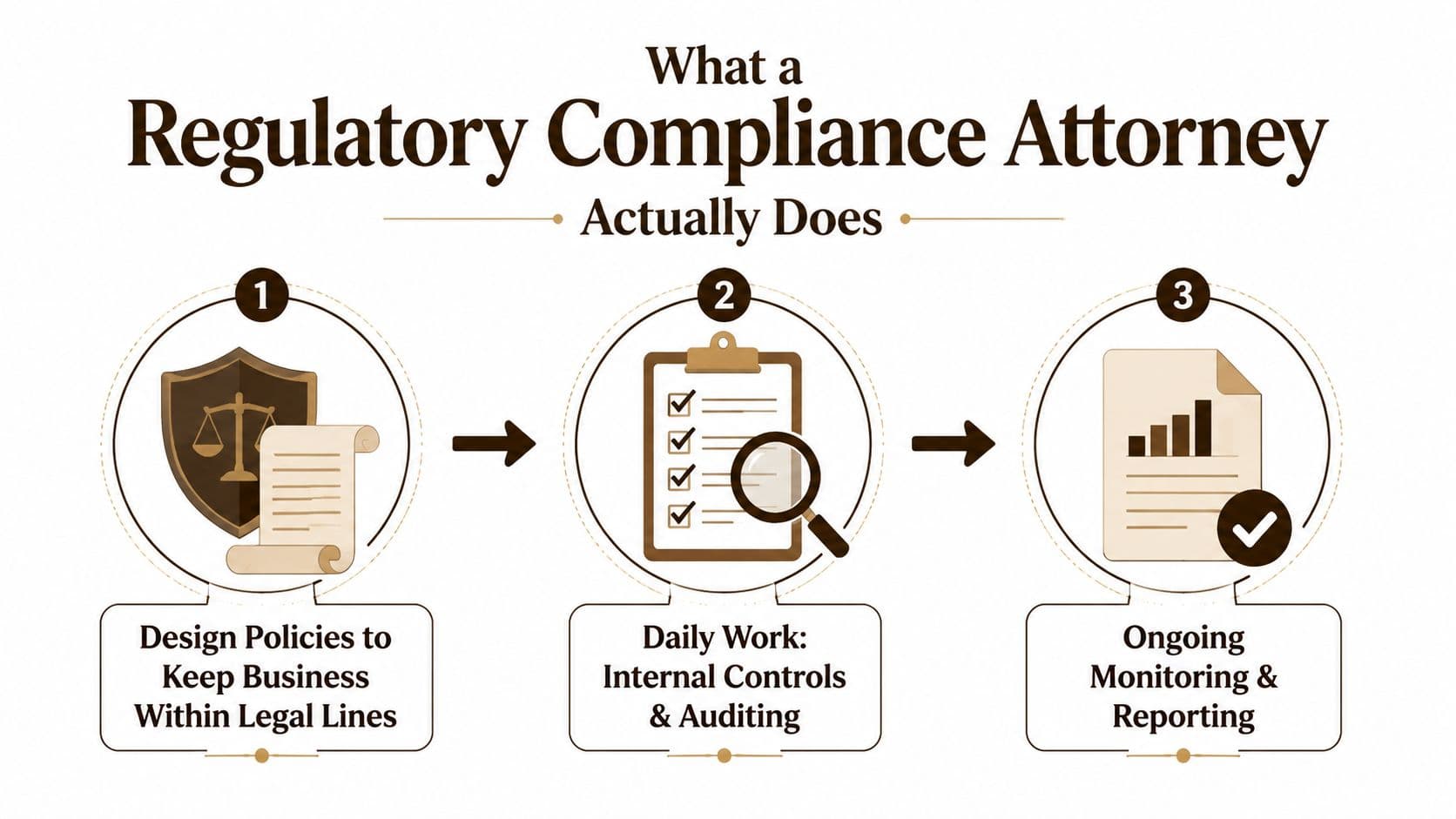
A regulatory compliance attorney turns legal requirements into operating rules that employees can follow and management can defend. The work starts with statutes, agency rules, guidance, and enforcement expectations, then connects them to how teams sell, approve, record, store, investigate, and report business activity. A strong candidate understands both the legal standard and the workflow that must meet it.
The technical core is consistent across sectors. A regulatory compliance attorney's role in control design and testing includes mapping requirements to business processes, conducting audits or gap analyses, revising procedures, and building monitoring and reporting frameworks that can withstand an examination or enforcement review.
The operating responsibilities
A capable attorney usually handles several connected tasks:
- Translate requirements: Convert a rulebook into obligations that product, finance, sales, human resources, and operations teams can understand and apply.
- Build controls: Create approval paths, information barriers, screening mechanisms, retention rules, escalation processes, and written procedures.
- Test the program: Review evidence, interview control owners, analyze exceptions, and identify gaps before an agency does.
- Prepare reporting: Give management and boards a clear account of incidents, remediation, open risks, and the evidence supporting compliance.
- Coordinate responses: Organize legal, operational, technical, and executive work when a regulator asks questions or an internal failure surfaces.
An audit-ready organization can show more than what its policy says. It can identify who approved the policy, how employees were trained, how exceptions were handled, and what monitoring uncovered. That evidence trail separates a functioning program from a folder of unused documents.
Prevention versus reaction
Reactive compliance defends a breach, answers an inquiry, or manages an enforcement matter. Proactive compliance builds controls that reduce the chance of those events and gives the organization a credible response when something still goes wrong. Documented monitoring helps demonstrate how risks were identified, addressed, and escalated during audits, inspections, and government inquiries.
Recruiters should screen for systems thinking and stakeholder management, not courtroom credentials alone. A brilliant litigator may struggle with recurring testing, process documentation, or persuading a skeptical business leader to change a profitable workflow. The stronger hire connects the legal rule to operational behavior, the evidence trail, and the human resistance that can prevent a control from working. That hybrid profile is more likely to stay effective after the initial compliance project ends.
Industries Where Compliance Attorneys Are Indispensable
Compliance counsel cannot be hired by title alone. Industry context determines which risks matter, which agencies demand answers, what evidence they expect, and whether a candidate's prior experience transfers. Recruiters should screen for sector fluency, not merely a polished regulatory résumé.
Financial services calls for lawyers who can work across sanctions, anti-money-laundering, conflicts, examinations, and securities rules. The securities enforcement and regulatory work described by Sidley highlights due diligence, information barriers, screening, surveillance, training, and coordination with regulators including the SEC and FINRA. A candidate who has only drafted broad policies may miss how quickly a weak control becomes an examination problem.
Healthcare presents a different set of demands. HIPAA, reimbursement rules, physician relationships, managed-care arrangements, and patient information connect legal advice to daily operations. Prior work involving privacy incident response, compliance committees, policy implementation, and investigations with clinical or administrative teams is a stronger retention signal than general healthcare familiarity.
Life sciences employers need counsel who understand the FDA environment, promotional review, clinical operations, manufacturing controls, labeling, and agency interactions. Energy and environmental roles require experience with permits, inspections, reporting, remediation, and physical facilities. Technology and telecom positions increasingly combine data privacy, cybersecurity, product governance, and cross-border data questions.
| Industry | Primary Regulators | Top Experience Signal |
|---|---|---|
| Financial services | SEC, FINRA, banking and financial regulators | Examination readiness, AML, sanctions, conflicts, and surveillance controls |
| Healthcare | HHS and healthcare program regulators | HIPAA response, compliance committees, reimbursement, and provider issues |
| Life sciences | FDA and related health authorities | Promotional review, clinical or manufacturing compliance, and agency interaction |
| Energy and environmental | EPA and state environmental agencies | Permit management, inspections, reporting, and remediation |
| Technology and telecom | Privacy, communications, and sector regulators | Product counseling, data governance, incident response, and cross-border analysis |
Food and drug regulation shows how narrow a specialty can become. The Food and Drug Law Institute's estimate, as reported in 2022, identified roughly 500 to 750 lawyers who specifically described themselves as food and drug regulatory attorneys, with the broader group of related practitioners reaching about 1,500. The limited talent pool makes adjacent experience useful, but it does not replace direct sector knowledge. A strong candidate can explain which rules they handled, which operators they advised, and how their work changed the organization's response to regulatory risk.
Qualifications That Set Strong Candidates Apart
Treat credentials as screening filters, not a checklist. A candidate who meets every formal requirement but has never owned a control may be weaker than someone with a less polished profile and direct examination experience.
The non-negotiables
Start with the legal foundation:
- Law degree: A JD from an accredited law school.
- Bar admission: Admission in at least one U.S. jurisdiction, with additional admission assessed against the role's geography.
- Relevant practice: At least 4 to 6 years of regulatory experience, as the role brief requires, inside or close to the relevant industry.
The experience requirement needs interpretation. Four years of writing issue-spotting memos isn't equivalent to four years of running audits, responding to regulators, and managing remediation. Ask what the candidate personally owned, how often they worked with control operators, and what changed because of their advice.

Differentiators that deserve a premium
The middle tier includes agency-specific knowledge and evidence of pressure-tested judgment. FDA, Federal Reserve, or EPA training can matter when it matches the employer's exposure. Prior agency work is useful because it can sharpen a candidate's understanding of how regulators frame questions, but it shouldn't substitute for business-side implementation experience.
Give extra weight to candidates who have managed examinations or enforcement matters without unnecessary escalation. They should be able to explain the chronology, the decision points, the people involved, the evidence preserved, and the remediation that followed. A candidate who says “we handled it” hasn't shown enough ownership.
Optional markers
Certifications such as CIPP/US, CHC, or CCEP can strengthen a profile when they support the actual mandate. Second-language fluency may help in cross-border environments, and published regulatory commentary can demonstrate disciplined thinking and communication. Neither should displace evidence of operational competence.
For a related leadership profile, compare the screening logic used for a director of compliance. The same principle applies here: prioritize the work the attorney can perform over the badges they can list.
In-House Counsel or Law Firm Role
The correct setting depends on the employer's workload, not on which path sounds more prestigious. In-house counsel owns the organization's risk over time. A law firm attorney brings broader matter variety, external perspective, and often more advanced mentorship.
| Dimension | In-House Counsel | Law Firm Role |
|---|---|---|
| Scope of ownership | Deep responsibility for one business and its controls | Multiple clients, matters, and regulatory environments |
| Day-to-day pace | Longer investigations and sustained implementation | Deadline-driven matters, examinations, and client requests |
| Compensation structure | Salary, bonus, and possible equity depending on employer | Salary, bonus, and firm progression tied to performance and platform |
| Career ceiling | General counsel, chief compliance, or business leadership paths | Partnership, practice leadership, or specialist counsel roles |
| Lifestyle trade-offs | More predictable integration, with incident spikes | Greater variety, travel, billable discipline, and client demands |
A fintech counsel moving to a financial services group at a large firm may look highly attractive to the firm because that lawyer understands product teams, launch pressure, and internal approvals. The same resume may worry an in-house hiring manager if it shows little experience with external clients, matter economics, or independent business development. Context changes the interpretation.
The in-house counsel recruiting perspective is useful because retention depends on matching the lawyer's preferred operating rhythm to the role. An attorney who wants a seat in product meetings may resent a firm position built around time recording and repeated advisory memos. A lawyer who thrives on varied regulatory questions may become frustrated inside a narrow corporate program.
Clean transitions usually come from candidates who can show both sides of the work. Firm lawyers should demonstrate implementation, not just advice. In-house lawyers should demonstrate disciplined legal analysis, matter management, and the ability to serve demanding internal clients. Hire for the environment the candidate is choosing, not merely the one they are leaving.
The Hybrid Lawyer Employers Now Want
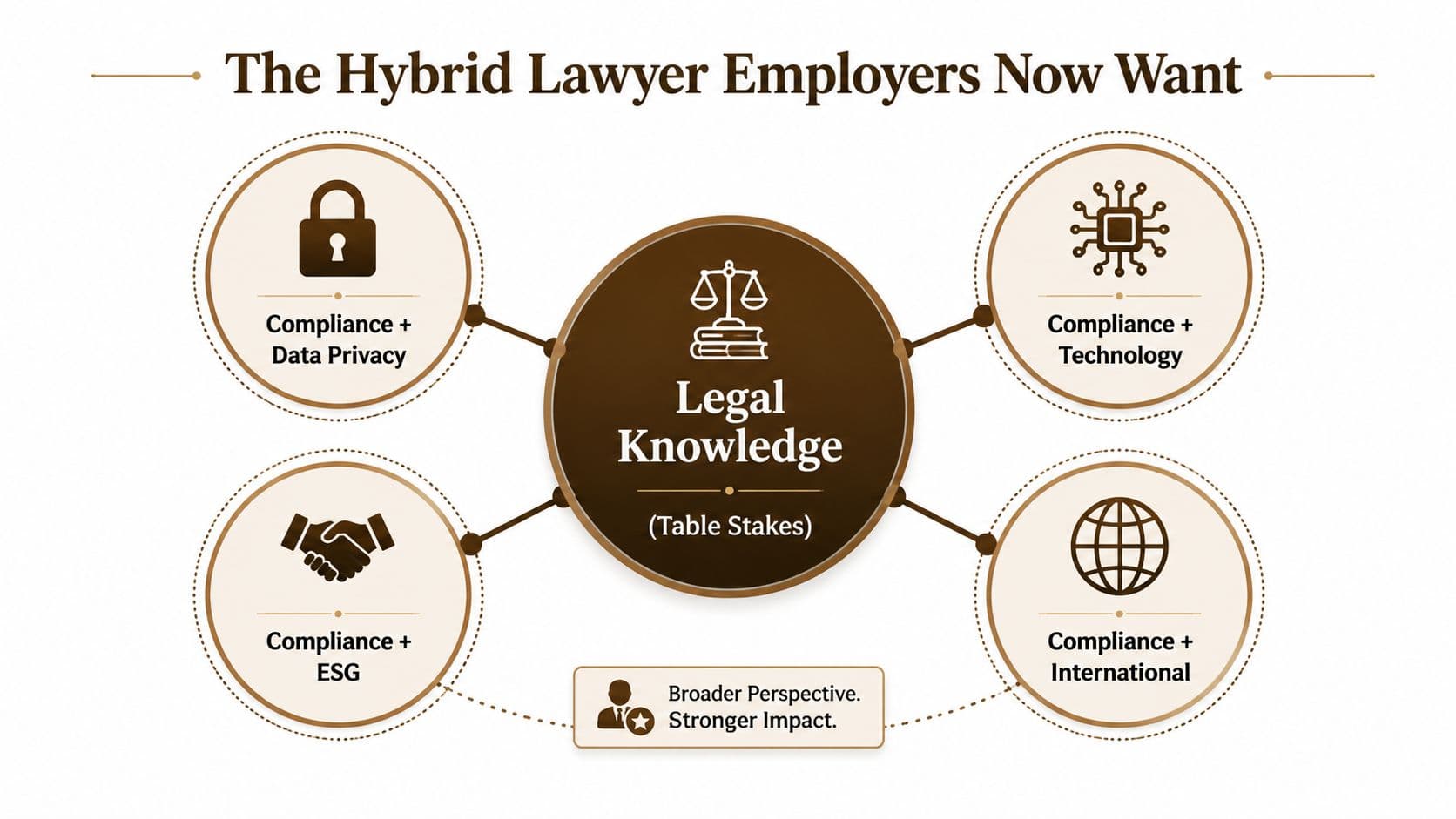
Legal knowledge is table stakes. Employers increasingly want a lawyer who can connect regulatory interpretation to privacy, technology, audit, government relations, ethics, and international operations. The 2025 legal and compliance market coverage describes demand for senior compliance talent in digital assets, regulated entities, and cross-border frameworks including DIFC, ADGM, SCA, DFSA, and VARA. It also highlights leadership and emotional intelligence as hiring priorities.
The combinations that matter
Compliance plus data privacy is valuable when the attorney can explain data restrictions to product and security teams, not merely identify a privacy principle. Look for experience with incident response, data inventories, vendor reviews, and clear executive briefings.
Compliance plus technology becomes decisive when the lawyer can work with engineers and internal audit on monitoring, workflow approvals, access controls, and evidence collection. The candidate doesn't need to be a developer. They do need to understand how a control operates inside a system.
Compliance plus government affairs helps in regulated markets where policy developments, agency relationships, licensing, and public positioning overlap. The attorney should know how to engage officials without promising outcomes or confusing advocacy with legal advice.
Compliance plus ESG and ethics requires judgment around disclosures, investigations, supply chains, conflicts, and corporate conduct. The strongest candidates can run a cross-functional risk discussion and give the board a concise answer when facts are still developing.
Why communication predicts durability
Leadership, listening, persuasion, and emotional control are not decorative qualities. Compliance attorneys routinely ask revenue teams to slow down, require documentation, or accept a control that creates friction. A technically correct lawyer who can't build cooperation becomes a bottleneck, and the business eventually routes around them.
Don't assume every adjacent skill can be learned after hiring. Technical frameworks can be taught more readily than credibility, curiosity, and the habit of translating complex risk into a decision. The market coverage cited above points to rising demand, turnover shaped by compensation, and growing use of contract and interim legal roles. That combination suggests employers are buying flexibility, but it also makes retention signals more important.
A hybrid candidate may command more because they solve several coordination problems at once. Pay the premium when the role uses that range. Don't overpay for a collection of keywords that never appear in the attorney's examples.
Screening Signals That Predict Real Fit
A strong resume gets a candidate into the process. It doesn't tell you whether the attorney will stay effective after the first difficult examination or disagreement with a business leader.
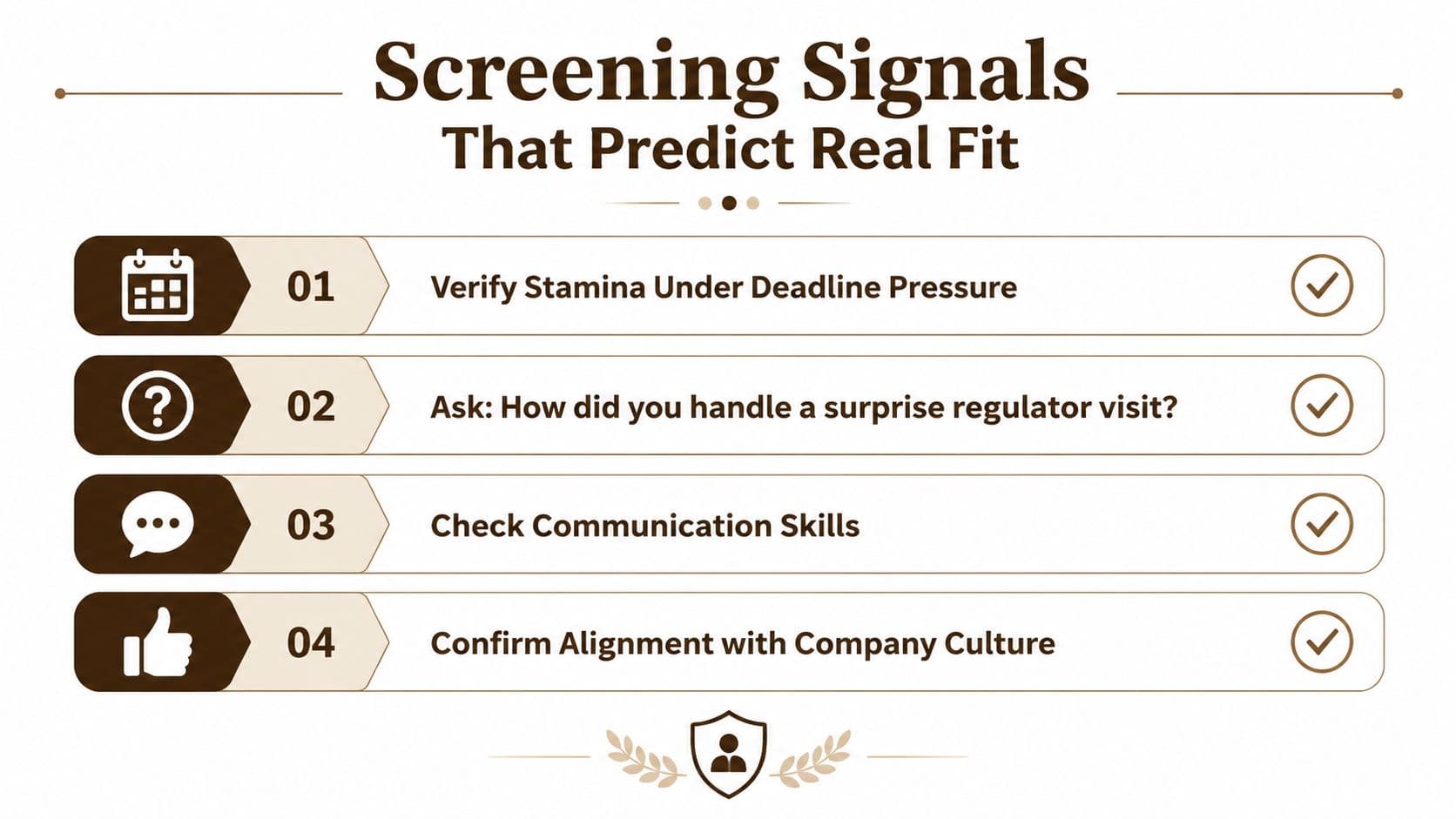
Use a structured interview that forces specific examples. Ask the candidate to describe a surprise regulator inquiry within the past year, if their experience includes one, and listen for sequence rather than drama. Who received the request? What did the attorney preserve? Which stakeholders did they involve? How did they decide what to disclose and what required further review?
The interview evidence that matters
- Ownership under pressure: Ask for one compliance failure the candidate personally corrected. Team accomplishments are useful, but they don't reveal individual judgment.
- Plain-language communication: Give the candidate a dense rule or hypothetical control and ask for a short explanation to a non-lawyer. Watch whether the answer produces an action or only a warning.
- Political skill: Ask about a time a business partner resisted a control. Strong candidates explain how they changed the conversation, not how they won an argument.
- Business curiosity: Ask what the company sells, how it makes money, and where the workflow creates risk. A lawyer who studies only the legal issue will miss the operational cause.
- Deadline stamina: Explore competing priorities, incomplete facts, and changing instructions. Compliance work rewards disciplined follow-through.
- Judgment with regulators: Ask how the candidate distinguishes a routine request from a matter requiring escalation. Look for respect, accuracy, and documented decision-making.
- Tenure logic: Three roles in five years without a clear promotion arc is a yellow flag, not an automatic rejection. Address each move directly and compare the explanation with references.
The attorney background check process should verify professional history and licensing, but references should also test working behavior. Ask former colleagues whether the lawyer completed remediation, communicated bad news early, and earned cooperation from teams outside legal.
Ask this directly: “What did you change after the last control failed, and how did you prove the change worked?”
A candidate who answers with dates, decisions, documents, and stakeholders is showing operational memory. A candidate who stays at the level of “we advised the client” may have had a narrower role than the resume suggests.
Bringing It All Together
A regulatory compliance attorney in 2026 is a business translator first and a lawyer second. That doesn't reduce the importance of legal knowledge. It defines how legal knowledge creates value. The employer needs someone who understands the industry rulebook and can convert it into controls, training, monitoring, evidence, and decisions that employees can execute.
The hiring choice should follow the work. Choose in-house when the organization needs sustained ownership, internal influence, and long-term program development. Choose a firm-side lawyer when the workload demands broader matter variety, specialist depth, or external examination and enforcement support. In either setting, screen beyond pedigree.
The compliance labor market is specialized and strategically important. Industry reporting based on Thomson Reuters-derived coverage estimated that 71% of companies consider regulatory compliance a high priority, while a legal-services summary reported that law-firm compliance costs increased by 18% between 2021 and 2023. Those figures appear in industry coverage of compliance's development, but the recruiting conclusion is practical: employers need lawyers who can justify controls and make them function.
Hiring conclusion: Select the candidate who can explain the rule, design the process, challenge the shortcut, and keep the business engaged after the crisis ends.
Build the search around sector experience, ownership, communication, leadership, and a credible reason for the candidate's career choices. That profile will do more for retention than another impressive line on a resume.
Five Star Placements provides permanent placement for compliance counsel, regulatory attorneys, in-house lawyers, and law-firm talent, with screening aligned to practice needs and organizational culture. If you need a regulatory compliance attorney who can operate inside your business rather than just discuss the rules, visit Five Star Placements to begin a focused search.
Need help filling a legal role?
Five Star Placements partners with law firms and legal departments nationwide.
Schedule a Call