
Chief Legal Counsel: Duties, Skills, and Hiring Tips
September 27, 2026 · 16 min read · Five Star Placements

Table of contents
The managing partner has a problem. A major M&A client is approaching a regulatory deadline, the general counsel is absorbed in a board matter, and no one has clear authority to make the call, coordinate outside counsel, and brief the business. The vacant seat called “chief legal counsel” suddenly looks less like a title and more like an operating failure.
That's the point many companies miss. Chief legal counsel isn't a static label. It can describe a senior deputy, the organization's top legal executive, or an enterprise risk leader with responsibility well beyond legal review. Before approving a search, decide what the role must own, who it reports to, and whether the business needs a promotion, an external hire, or a redesigned legal function.
Table of Contents
- What a Chief Legal Counsel Actually Does Day to Day
- Seniority, Reporting Line, and Strategic Scope
- Chief Legal Counsel vs General Counsel vs Chief Legal Officer
- Core Responsibilities of a Modern Chief Legal Counsel
- When a Company Should Hire a Chief Legal Counsel
- Sample Job Description for a Chief Legal Counsel Search
- Hiring Playbook for Succession, External Search, and Retention
What a Chief Legal Counsel Actually Does Day to Day
At 8:00 a.m., the chief legal counsel may be reviewing an acquisition agreement. By midmorning, that work can give way to a product committee discussing a launch in a regulated market. Before lunch, the counsel may need to challenge an outside firm's budget, explain a litigation exposure to the CFO, and help the CEO decide whether a commercial opportunity fits the company's risk appetite.
This is hands-on executive work, not ceremonial oversight. The role commonly combines complex contract review, strategic transaction advice, litigation supervision, regulatory judgment, and practical guidance for commercial teams. The counsel must understand what the company is trying to achieve before explaining which legal risks could block, delay, or reshape the plan.
The daily work behind the title
A credible chief legal counsel will usually spend time on:
- Commercial agreements: Reviewing high-value customer, vendor, technology, licensing, and partnership contracts while deciding which issues require escalation.
- Executive advice: Advising the CEO and leadership team on M&A, financing, market entry, governance, employment issues, and sensitive disputes.
- Outside counsel management: Selecting firms, defining scopes of work, challenging unnecessary effort, and monitoring spend against the matter's importance.
- Product and risk committees: Joining discussions early enough to influence product design, data use, marketing claims, and regulatory controls.
- Business translation: Converting legal exposure into decisions the C-suite can use, such as whether to proceed, renegotiate, insure, disclose, or stop.
The strongest counsel doesn't merely identify what could go wrong. They explain the available choices, the likely consequences, and the level of risk the business can reasonably accept. Thomson Reuters describes this model as a legal department embedded in business units, attentive to risk appetite, proactive about opportunities, and connected to overall company goals in its guidance on legal success metrics and business enablement.
Triage is the real operating skill
The job is a constant contest between urgent matters and work that prevents future emergencies. A threatened claim may need immediate attention, but policy design, M&A diligence, contract playbooks, regulatory mapping, and litigation oversight still require protected time.
Recruiter's rule: If every hour is consumed by escalations, the company hasn't hired a strategic chief legal counsel. It has hired an expensive emergency response system.
A candidate who can personally solve difficult legal problems but can't create prioritization, delegation, and reporting discipline won't fix a crowded legal function. Test how they decide what to handle, what to delegate, what to automate, and what to decline. That answer often tells you more than a list of practice areas.
Seniority, Reporting Line, and Strategic Scope
The modern role sits much closer to executive management than many job descriptions suggest. In a 2026 corporate law department survey, 86% of general counsel said legal was a significant contributor to the broader business, while only 17% of C-suite executives agreed, according to Thomson Reuters' analysis of the 2026 corporate law department report. That gap matters during a search because a candidate may have seniority on paper but lack the influence required to change how the business uses legal advice.
The same report found that 65% of general counsel have global responsibilities and 63% work in organizations with more than $500 million in annual revenue. Those findings point to a role shaped by cross-border operations, enterprise risk, and executive accountability. They don't mean every company needs a C-suite legal officer. They do mean the title should reflect the scope the business expects.
Reporting should match accountability
A true enterprise chief legal counsel will commonly report to the CEO, with a direct or dotted-line relationship to the board, audit committee, or another independent governance body. That structure protects the counsel's ability to raise significant risk without having the message filtered through the executive whose decision is under review.
A deputy general counsel usually reports to the GC. That person may lead commercial legal, litigation, compliance, or a region, but the GC remains the accountable legal executive. Confusing those structures creates predictable problems. Candidates don't know whether they're being hired to make decisions or prepare recommendations, and business leaders don't know whose direction controls.
| Attribute | Chief Legal Counsel | General Counsel | Chief Legal Officer |
|---|---|---|---|
| Primary position | Senior legal leader, either beside or below the GC | Top legal officer for the organization | Enterprise executive responsible for legal and often related risk functions |
| Typical reporting line | CEO, GC, or executive committee, depending on design | CEO, with board or committee access | CEO, with regular board or audit committee engagement |
| Operating scope | Defined legal portfolio, major matters, or day-to-day legal leadership | Organization-wide legal strategy and accountability | Legal, compliance, regulatory risk, and sometimes broader governance |
| Best fit | Larger enterprises, complex divisions, or a business adding a senior number two | Companies that need one accountable legal leader | Regulated or highly complex organizations elevating legal into enterprise risk |
The deciding factor is scope, not title prestige. If the person owns the legal budget, directs specialist teams, controls outside counsel strategy, joins executive planning, and carries board-level accountability, design the seat as a top legal officer. If the role runs daily legal execution under a GC, call it deputy GC or chief legal counsel and say so plainly.
Chief Legal Counsel vs General Counsel vs Chief Legal Officer
Titles send signals to candidates, boards, and internal stakeholders. They also affect who applies, how compensation is benchmarked, and whether the incumbent can recruit senior talent beneath them. Treat the title as part of the operating model, not as a branding exercise.
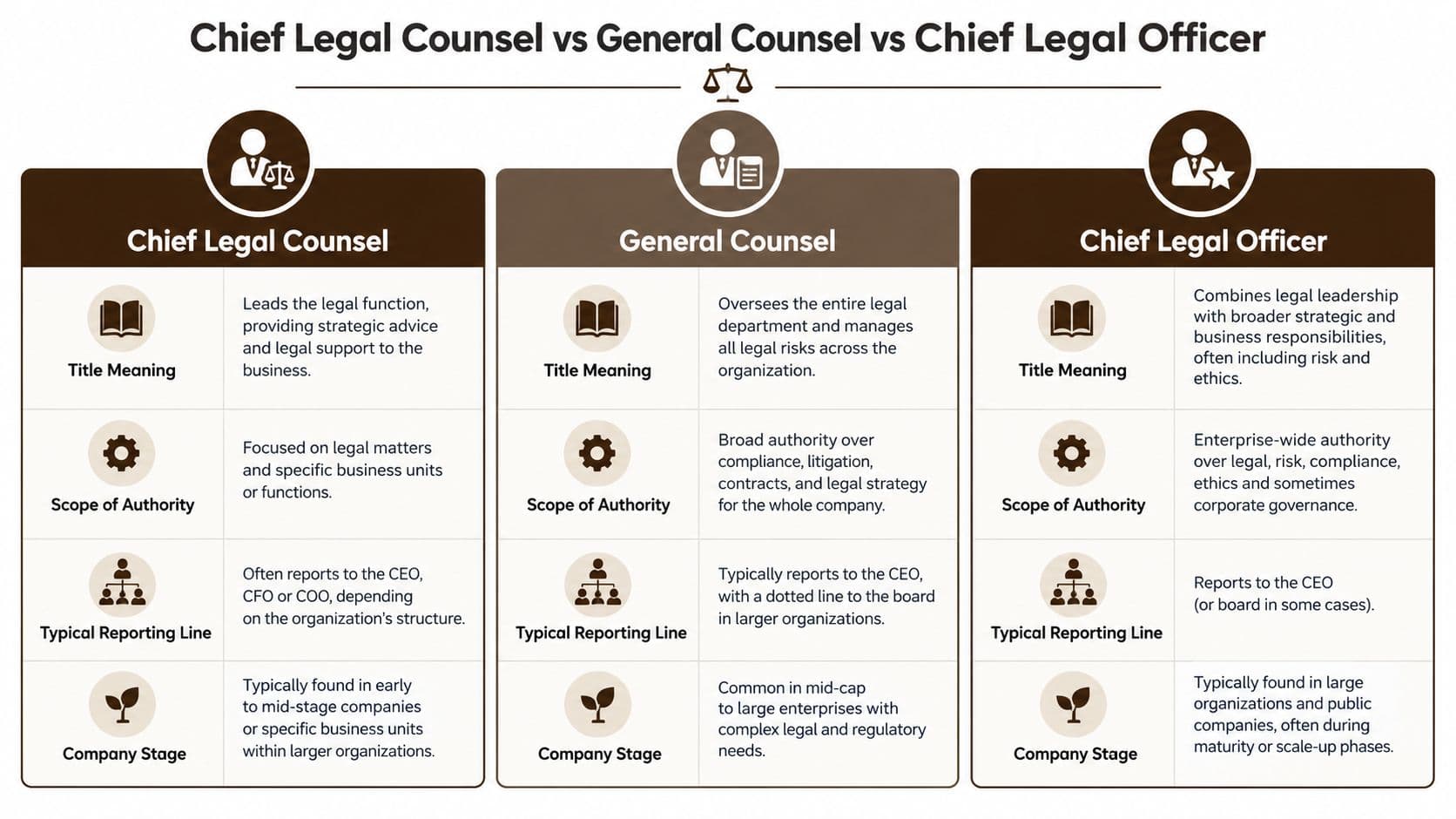
General counsel generally means the organization's principal legal adviser and top legal executive. The GC is usually a peer to other C-suite leaders, reports to the CEO, and owns the relationship with the board on legal matters. Use this label when one person is accountable for the full legal function.
Chief legal counsel is more flexible. It may describe a senior legal executive who works alongside a GC, a number two who owns day-to-day legal operations, or the top counsel in an organization that prefers a different naming convention. The ambiguity can attract candidates, but it can also create friction if authority isn't specified.
Chief legal officer signals the broadest enterprise mandate. Companies often use it when legal is closely connected to compliance, regulatory affairs, ethics, privacy, security, or enterprise risk. It can be the right choice in a regulated business, but the title creates expectations. A CLO who lacks authority over those functions will look over-titled and underpowered.
Make the title serve the hiring decision
Choose chief legal counsel when you need a senior operator but want the GC to remain the board-facing principal. Choose general counsel when the hire will own the entire legal department and advise the CEO directly. Choose chief legal officer when the organization expects the role to coordinate legal judgment with compliance, risk, and business transformation.
Don't hide an awkward reporting line behind an impressive title. A candidate who accepts “Chief Legal Officer” but discovers that every material decision requires GC approval will leave, disengage, or challenge the structure. Explain the distinction between these roles in the search brief and align compensation with actual authority, not the label alone. For a broader discussion of how senior in-house roles differ, see this guide to in-house counsel versus general counsel.
Compensation also follows scope. The 2025 law department survey data cited in the ACC materials placed median total target direct compensation at $503,000 for a general counsel or chief legal officer, compared with $280,000 for a single-lawyer general counsel seat and $378,000 for a division or subsidiary general counsel seat. Those figures appear in the ACC law department compensation survey materials, and they reinforce the point: title alone doesn't establish market value. Organizational scale, authority, complexity, and incentive design do.
Core Responsibilities of a Modern Chief Legal Counsel
A senior legal hire should be able to run an operating model, not just provide excellent legal analysis. Thomson Reuters' business-enablement guidance emphasizes embedded legal support, matter-level risk appetite, proactive opportunity spotting, and performance measurement against peer departments and year-on-year progress. Build those expectations into the role from the beginning.
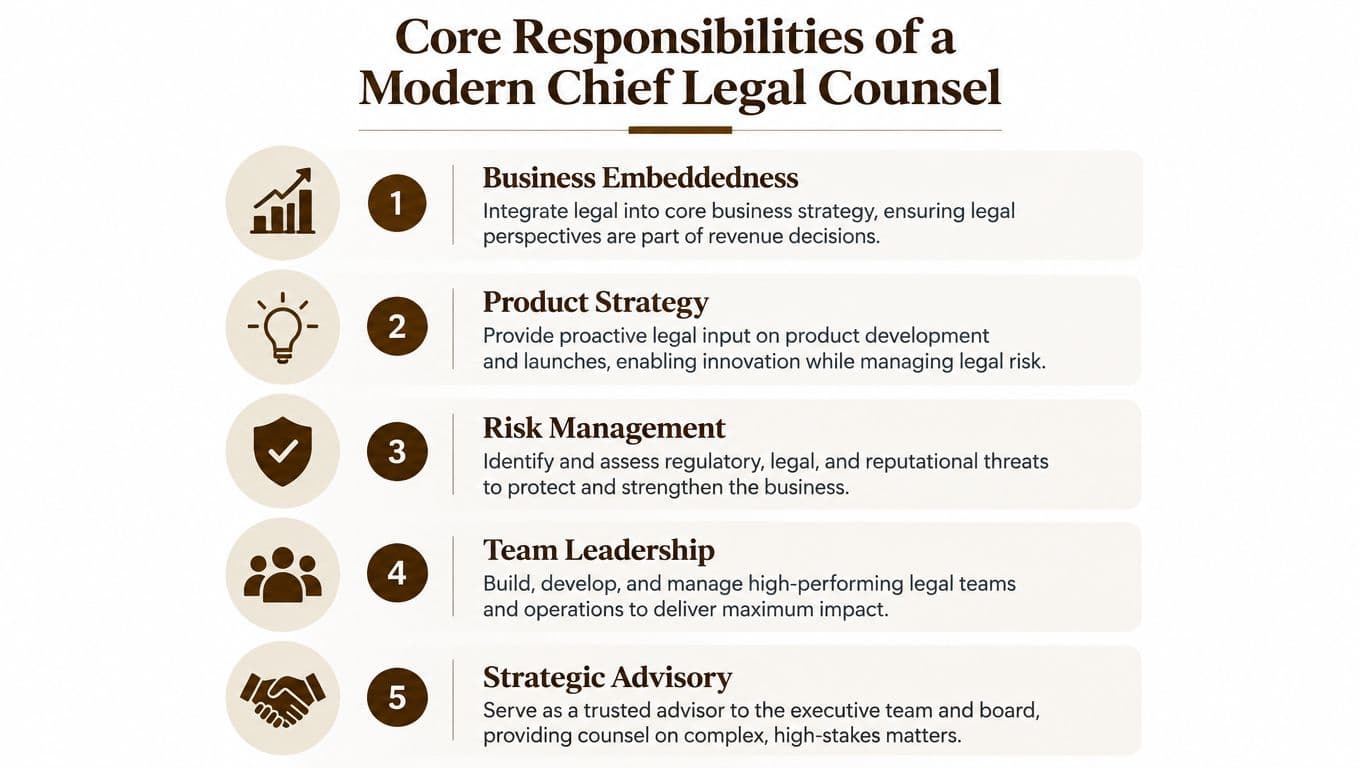
Five capabilities to test
- Business embeddedness: The counsel should join revenue, product, procurement, and market-entry discussions before the business has committed to an unworkable position.
- Product strategy: Legal input belongs in launch planning, not only at final approval. Ask candidates how they have built reusable guidance for product managers and sales teams.
- Risk management: Look for someone who can map regulatory exposure across jurisdictions, rank issues by business impact, and recommend controls that people will readily adopt.
- Team leadership: The role should create clear ownership across attorneys, legal operations, compliance professionals, and external firms. A leader who hoards every difficult matter becomes the bottleneck.
- Strategic advisory: Board interaction requires concise judgment, disciplined escalation, and the confidence to deliver unwelcome advice without turning every disagreement into a legal crisis.
Metrics replace anecdotal workload stories
A dashboard should show whether the function is improving. Useful measures include matter spend, cycle time, contract turnaround, open matters, spend-to-budget, outside counsel performance, and litigation exposure translated into financial and operational consequences.
The metric isn't valuable because it looks precise. It's valuable because it reveals a decision. If contracts stall in one business unit, change the intake process. If one firm consumes disproportionate budget without reducing risk, reset the scope. If litigation reporting only lists case names, convert it into exposure, timing, settlement posture, and operational disruption.
AI fluency belongs in the same baseline. The counsel doesn't need to become a machine-learning engineer, but should understand contract review tools, legal research platforms, LLM-assisted playbooks, data handling limits, validation requirements, and governance for unauthorized “shadow AI” use inside the department.
The ACC reports that 47% of CLOs say CEOs expect technology and AI fluency, 36% are already deploying GenAI, and 35% identify budget or resource constraints as their top barrier, as reported in ACC's discussion of changing CLO expectations. Those numbers make AI judgment a hiring requirement, not a future talking point.
When a Company Should Hire a Chief Legal Counsel
Hire the role when legal complexity has become a management problem. A company doesn't need a chief legal counsel because the title sounds senior. It needs one when important decisions lack a single accountable owner, the GC can't stay ahead of strategic work, or the company's regulatory footprint exceeds the current team's operating capacity.
Useful decision signals include:
| Indicator | Hire Now | Premature | Defer with Fractional or Deputy GC |
|---|---|---|---|
| Organizational scale | A growing business has multiple functions and legal demand is distributed across them | A small team has limited contracting and straightforward governance | The business is expanding but needs temporary senior coverage |
| Regulatory footprint | Operations span jurisdictions with materially different requirements | The company operates in one relatively simple regulatory environment | Expansion is planned but not yet active |
| Transaction activity | M&A or financing work repeatedly competes with daily legal delivery | Deal activity is occasional and manageable through outside counsel | A transaction is approaching but long-term volume is uncertain |
| Executive accountability | The CEO or board wants one senior owner for legal risk | No executive sponsor can define the role's authority | The GC needs a deputy to stabilize execution first |
Don't use arbitrary headcount thresholds as a substitute for diagnosis. A smaller regulated company can need senior legal leadership earlier than a larger business with simple operations. Conversely, a company with limited risk and modest deal activity may be better served by fractional support, a strong corporate counsel, or a deputy GC arrangement.
The mid-market warning signs
The role is overdue when the GC is personally reviewing routine agreements, outside counsel spend has no owner, product teams involve legal only after launch decisions, and board materials contain fragmented risk reporting. Add repeated missed deadlines, unclear escalation paths, and talented lawyers leaving because every decision waits for one person.
Workload data supports treating capacity as structural rather than personal. The ACC's 2024 in-house trends report found 51% of respondents oversee risk and compliance, 46% work 41 to 50 hours per week, and 49% reported workload increases, according to the 2024 In-House Trends Report. The same report describes a function handling broader responsibilities under pressure, which makes triage and operating discipline central to the hire.
Ask three questions before opening the search:
- Which decisions will this person own without GC or CEO approval?
- What work will stop sitting on the GC's desk?
- What evidence will show that the new structure is working?
If leadership can't answer those questions, the problem is role design, not recruiting.
Sample Job Description for a Chief Legal Counsel Search
A strong job description should let candidates understand the mandate before they decide whether to enter the process. Don't publish a grand title with a narrow brief. Write the document around authority, decisions, and outcomes.
Start with the title and reporting line
Use Chief Legal Counsel if the candidate will lead a defined senior portfolio or serve as the GC's operating partner. Use Deputy General Counsel when the hierarchy clearly places the hire beneath the GC. Use Head of Legal when the business wants a plain-language title and the role will be the top legal seat in a smaller or less formal organization.
State the reporting line in the first paragraph. “Reports to the CEO, with regular access to the audit committee” communicates a different role from “reports to the General Counsel and supports the executive team.” If the board relationship is dotted-line, explain when it applies and which matters trigger direct access.

Define the work in decision terms
A practical responsibility section might include:
- Leading commercial contracting strategy and approval standards.
- Advising the CEO and executive team on transactions, financing, market expansion, and major commercial decisions.
- Overseeing litigation, investigations, disputes, and resolution strategy.
- Owning regulatory, compliance, privacy, and governance programs assigned to the legal function.
- Selecting, supervising, and evaluating outside counsel.
- Building a scalable legal team, intake process, delegation model, and reporting dashboard.
- Establishing responsible use standards for legal technology and AI-enabled workflows.
- Briefing the board or audit committee on material legal and enterprise risks.
Avoid writing “other duties as assigned” for a role this senior. It signals that the company hasn't decided what it wants.
Set qualifications without shrinking the pool
For a complex enterprise search, 12 or more years of post-qualification experience may be a sensible target, but don't treat the number as a proxy for judgment. Require a mix of law firm and in-house experience when the job demands both technical depth and commercial execution. Sector experience matters most where regulation, product complexity, or board scrutiny is unusually specific.
Test for jurisdictional breadth, executive communication, transaction experience, outside counsel discipline, and evidence of team development. Ask whether the candidate has operated through disagreement, incomplete information, and competing business priorities.
For formatting and role-language examples, use this resource on attorney job descriptions, then adapt the language to the actual reporting structure.
Compensation should describe base salary, bonus, long-term incentives, and any sign-on or make-whole arrangement without promising terms the company can't approve. Leave room to negotiate vesting, severance, board access, title progression, relocation, and change-in-control treatment. The job description should attract the right level of candidate, while the offer process confirms the economics.
Hiring Playbook for Succession, External Search, and Retention
Succession, external search, and retention are one sequence. First identify the bench. Then decide whether to prepare an internal successor or go to market. Before the offer is signed, structure the conditions that will keep the hire engaged after the initial excitement fades.
Start with the internal review. Look for a deputy or senior counsel who already owns commercial negotiations, has handled audits or board-facing matters, understands the business model, and can make decisions without constant escalation. Excellent legal memoranda aren't enough. The chief legal counsel must manage priorities, influence executives, understand commercial trade-offs, and lead through uncertainty.
Decide whether the bench is real
An internal promotion is usually faster and preserves institutional knowledge. It can also reward someone who has earned trust with the CEO and business leaders. The risk is predictable: the candidate may be excellent at a specialized portfolio but untested in board communication, enterprise risk, budget ownership, or difficult people decisions.
An external search brings perspective, broader market exposure, and the ability to reset a stagnant model. It also carries integration risk. The new leader may underestimate informal decision paths, inherit a defensive team, or discover that the advertised authority doesn't exist.
| Decision Criterion | Internal Promotion | External Search |
|---|---|---|
| Business knowledge | Strong understanding of products, people, and history | Requires deliberate immersion and stakeholder mapping |
| Leadership evidence | Must prove readiness beyond technical excellence | Can bring tested executive leadership from a larger or more complex setting |
| Change mandate | May struggle to challenge processes they helped create | More likely to reset structure, tools, and outside counsel relationships |
| Retention risk | Promotion can strengthen loyalty, but unmet expectations can create resentment | New hire needs credible authority, integration support, and a compelling mandate |
| Succession continuity | Preserves institutional memory | May expose weak internal succession and create a new development path |
Use external search when there is no credible successor, the legal team has become dependent on one person, or the business needs a material change in operating model. Reference diligence should go beyond the supplied list. Speak with former supervisors, business partners, direct reports, and outside counsel where appropriate, and test the candidate's account of conflicts, departures, and difficult decisions.
The market is also changing at the top. The ACC reported that 55% of respondents use the General Counsel title and 34% use Chief Legal Officer, while a Fortune 500 analysis cited in recent market coverage found 65 companies appointed a general counsel in 2025, with 54% of those appointments external and 46% internal. That analysis appears in Sartori Global's 2026 general counsel hiring trends. Treat those figures as market context, not as a reason to copy another company's structure.
Retention begins with the mandate. Give the leader access to the CEO and relevant board committee, define a path from chief legal counsel to CLO where appropriate, and identify successors beneath the role. Consider equity refresh points tied to major renewal or M&A milestones, but don't use money to compensate for a weak reporting line or unclear authority.
For a focused senior search, general counsel recruitment should be treated as an operating-model exercise, not a resume-sourcing task. The right candidate must fit the legal work, executive culture, decision rights, and succession plan.
Five Star Placements provides permanent placement for in-house counsel and legal department leadership roles, including General Counsel and Corporate Counsel, with screening aligned to experience, skills, and organizational fit. If you're defining a chief legal counsel seat or deciding between an internal promotion and an external search, visit Five Star Placements to discuss the mandate and candidate profile.
Need help filling a legal role?
Five Star Placements partners with law firms and legal departments nationwide.
Schedule a Call