
Candidate Testing Service Explained for Legal Hiring
September 14, 2026 · 15 min read · Five Star Placements
Table of contents
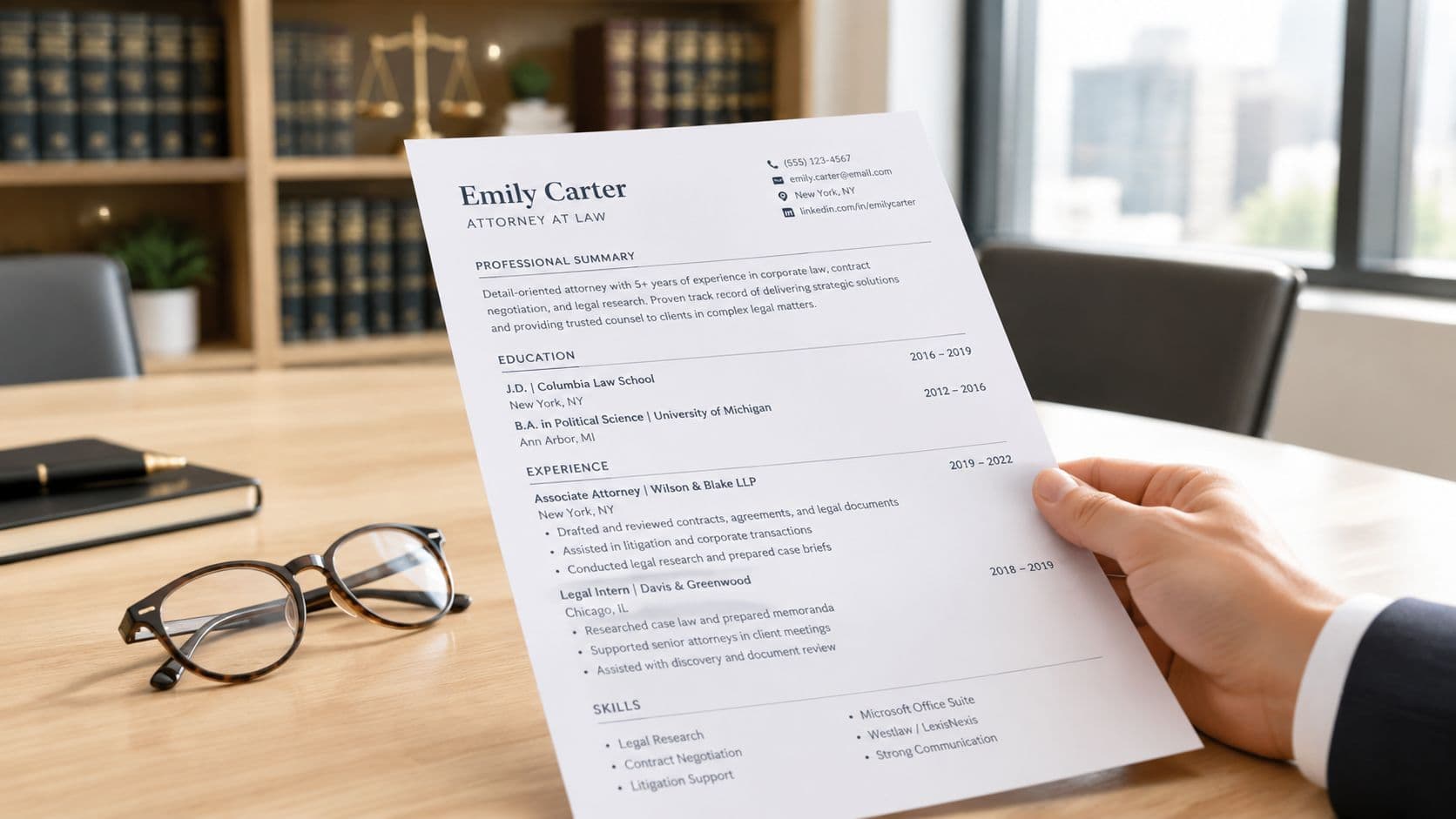
A partner calls at 8:15 on Monday morning. The firm needs a litigator who can manage demanding clients, write clearly under pressure, and exercise sound judgment without constant supervision. The first resume looks ideal. The candidate has the right title, respected employers, and an impressive list of matters. Yet the screening conversation reveals vague answers about case strategy, and the writing sample shows a level of imprecision that the resume never disclosed.
That situation is common because a resume records what a candidate says they have done, not necessarily how they'll perform the work your team needs today. Legal hiring makes that gap particularly consequential. A weak hire can affect client relationships, matter delivery, supervision time, team morale, and the credibility of a recruiter's shortlist.
A candidate testing service adds another form of evidence. Properly selected assessments can examine legal writing, issue spotting, prioritization, communication, technical skills, or judgment through consistent exercises. They don't replace interviews, references, or professional review. They give those conversations a firmer foundation.
The important question isn't whether your firm should test every applicant. It's which assessment matches the risk of the role, the practice area, the candidate's seniority, and the actual workflow. A paralegal handling discovery needs a different exercise from a partner expected to develop client relationships. This guide moves from the basic function of testing services to practical selection, evidence, governance, and integration into contingency legal hiring.
Table of Contents
- What a Candidate Testing Service Actually Does
- Common Test Types Every Legal Hiring Team Should Know
- Benefits and Limits of Testing in Selection Decisions
- How Candidate Testing Evolved Into Modern Digital Assessment
- How to Integrate Testing Into Contingency Hiring and Screening
- Choosing the Right Testing Approach for Your Firm or Legal Department
What a Candidate Testing Service Actually Does
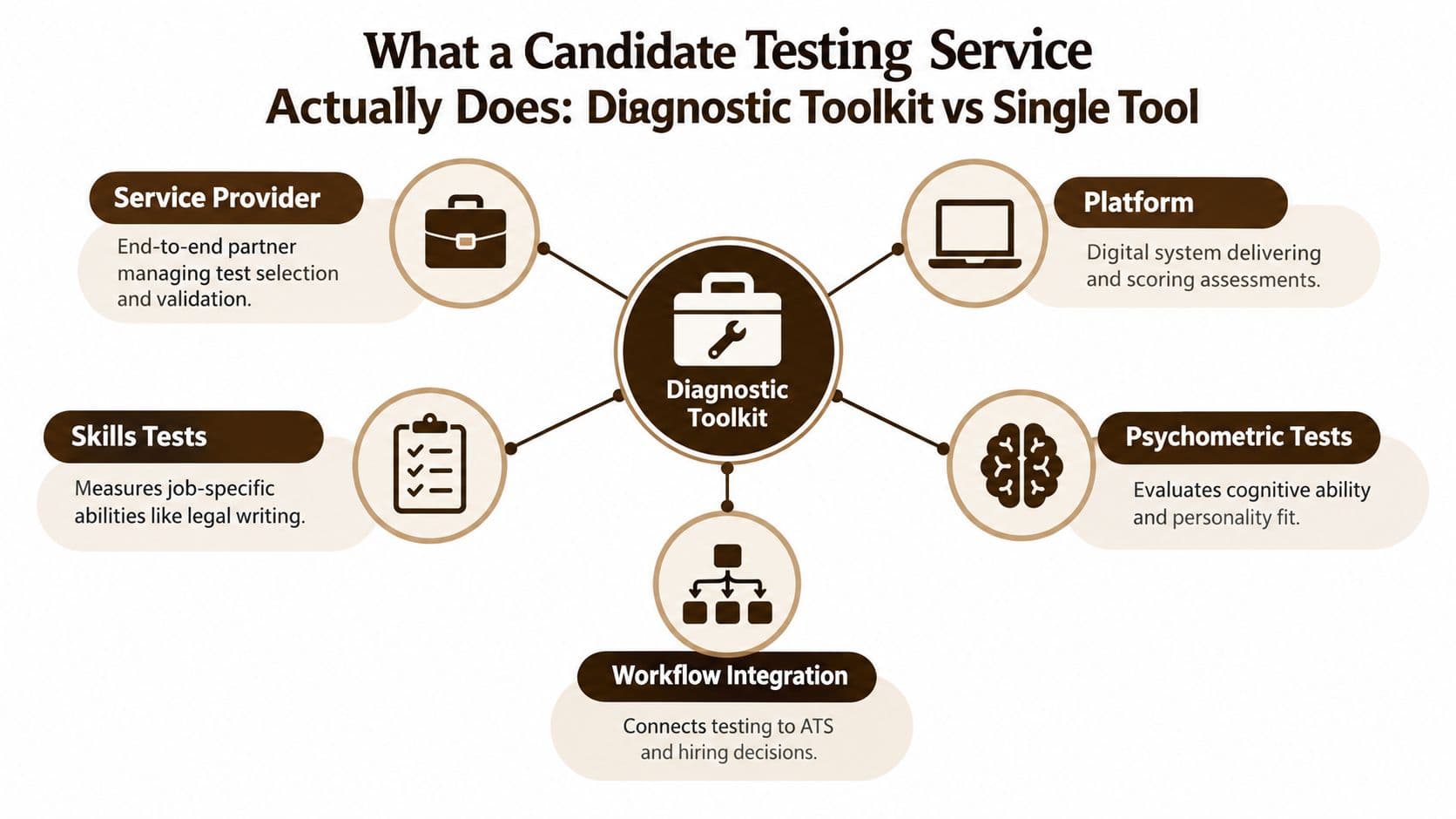
Think of a candidate testing service as a diagnostic toolkit, not a single examination. A mechanic doesn't use the same instrument to check a battery, a brake system, and an engine. In the same way, a legal hiring team shouldn't use a generic personality questionnaire to answer a question about contract drafting or client judgment.
The service may include a digital platform, an assessment library, professional guidance, scoring tools, reporting, and workflow support. The individual test is only one part of that arrangement.
A practical workflow usually has these stages:
- Define the job signal. The hiring team identifies what success requires, such as concise legal writing, accurate document review, calm client communication, or matter-management discipline.
- Select the assessment. The provider matches that need to a work sample, structured interview, cognitive measure, behavioral assessment, or legal knowledge test.
- Administer consistently. Candidates receive comparable instructions, questions, timing, and submission requirements. Consistency matters because a result is harder to interpret when each applicant completes a different exercise.
- Score and report. The service applies a rubric or scoring model and presents the output in a form recruiters and hiring managers can review.
- Combine the evidence. The score informs the shortlist, but the final decision also considers experience, interview performance, references, work history, and the requirements of the specific client environment.
Practical rule: Before buying a platform, write down the hiring question it must answer. “Is this person a good fit?” is too broad. “Can this candidate identify the material issues in a short fact pattern and explain the next steps to a client?” is actionable.
A service also differs from an applicant tracking system. An ATS organizes applications, communications, scheduling, and workflow. An assessment service evaluates selected capabilities and may connect results to that workflow. The two systems can work together, but they solve different problems.
For legal recruiting, reporting should be readable rather than ornamental. A partner needs to understand what the candidate did, how the response was scored, what limitations apply, and which interview questions deserve follow-up. A polished dashboard that hides the underlying evidence is less useful than a transparent report with a clear rubric.
The strongest services support structured comparison without pretending to eliminate judgment. They make the evidence easier to collect and discuss. They shouldn't turn a legal hiring decision into an automatic pass or fail based on one unexplained number.
Common Test Types Every Legal Hiring Team Should Know
Legal hiring teams often use the word “test” as if it describes one method. It doesn't. A skills exercise, a cognitive assessment, a behavioral questionnaire, and a legal knowledge test answer different questions. Matching the method to the job is more important than selecting the most elaborate platform.
Skills and work-sample tests
A work sample asks the candidate to perform a task that resembles the role. Examples include revising a demand letter, summarizing a deposition transcript, organizing a document-production issue, drafting a client update, or preparing a contract-markup explanation.
These tests are especially useful because they show how the candidate works, not merely how they describe their experience. They can expose attention to detail, prioritization, written communication, and practical judgment. For a junior attorney, the exercise might focus on issue spotting and analysis. For a senior associate, it might test delegation, strategic recommendations, or communication with a discerning client.
The exercise should reflect actual work without requiring unpaid production of something the firm could use. Clear instructions and a defined rubric protect both the candidate and the hiring team.
Cognitive ability tests
Cognitive assessments may examine reasoning, comprehension, pattern recognition, or problem-solving. They can provide a broad signal about how someone processes information, but they don't directly demonstrate legal writing, courtroom presence, or client empathy.
Use them cautiously for roles involving substantial analysis, complex information, or rapid learning. They're less persuasive when the job's central risk is practice-specific judgment that a general reasoning test doesn't capture.
Personality and behavioral assessments
Behavioral assessments explore preferences or tendencies related to collaboration, communication, adaptability, persistence, or response to pressure. They may help a team formulate interview questions, especially where supervision style and workload patterns matter.
They shouldn't be treated as a verdict on character or culture fit. A firm's preferred working style can also reflect habit rather than genuine job necessity. The hiring team should ask whether the measured trait connects to a defined responsibility and whether the result adds information beyond a structured conversation.
Legal knowledge tests
Legal knowledge assessments can cover doctrine, procedure, terminology, ethics, or practice-specific concepts. They may be appropriate for law clerks, paralegals, intake specialists, compliance professionals, or attorneys entering a specialized practice.
Knowledge alone doesn't establish readiness. A candidate can recall rules yet struggle to apply them to ambiguous facts or explain them to a client. Pair legal knowledge with a scenario or work sample when judgment and communication carry meaningful risk.
The comparison below provides a starting point. For a broader discussion of selection methods, see candidate selection methods and structured hiring approaches.
| Test Type | What It Measures | Best For | Watch Out For |
|---|---|---|---|
| Skills or work sample | Practical execution, writing, organization, and judgment | Attorneys, paralegals, legal assistants, and litigation support roles | An artificial task may not reflect the real workflow |
| Cognitive ability | General reasoning, comprehension, and problem-solving | Analytical roles with complex information demands | A broad score may miss practice-specific capability |
| Personality or behavioral assessment | Work preferences, interpersonal tendencies, and behavioral patterns | Roles where collaboration, resilience, or communication style matters | Don't equate preference with competence or “culture fit” |
| Legal knowledge test | Recall and understanding of legal concepts or procedures | Law clerks, specialized attorneys, compliance, and support roles | Knowledge may not translate into sound application or client communication |
A useful test is one that answers a specific hiring question. If the question is whether someone can prepare a precise client memo, use a writing sample. If it concerns resilience during a heavy caseload, use behavioral evidence as a prompt for deeper interviewing, not as a standalone decision.
Benefits and Limits of Testing in Selection Decisions
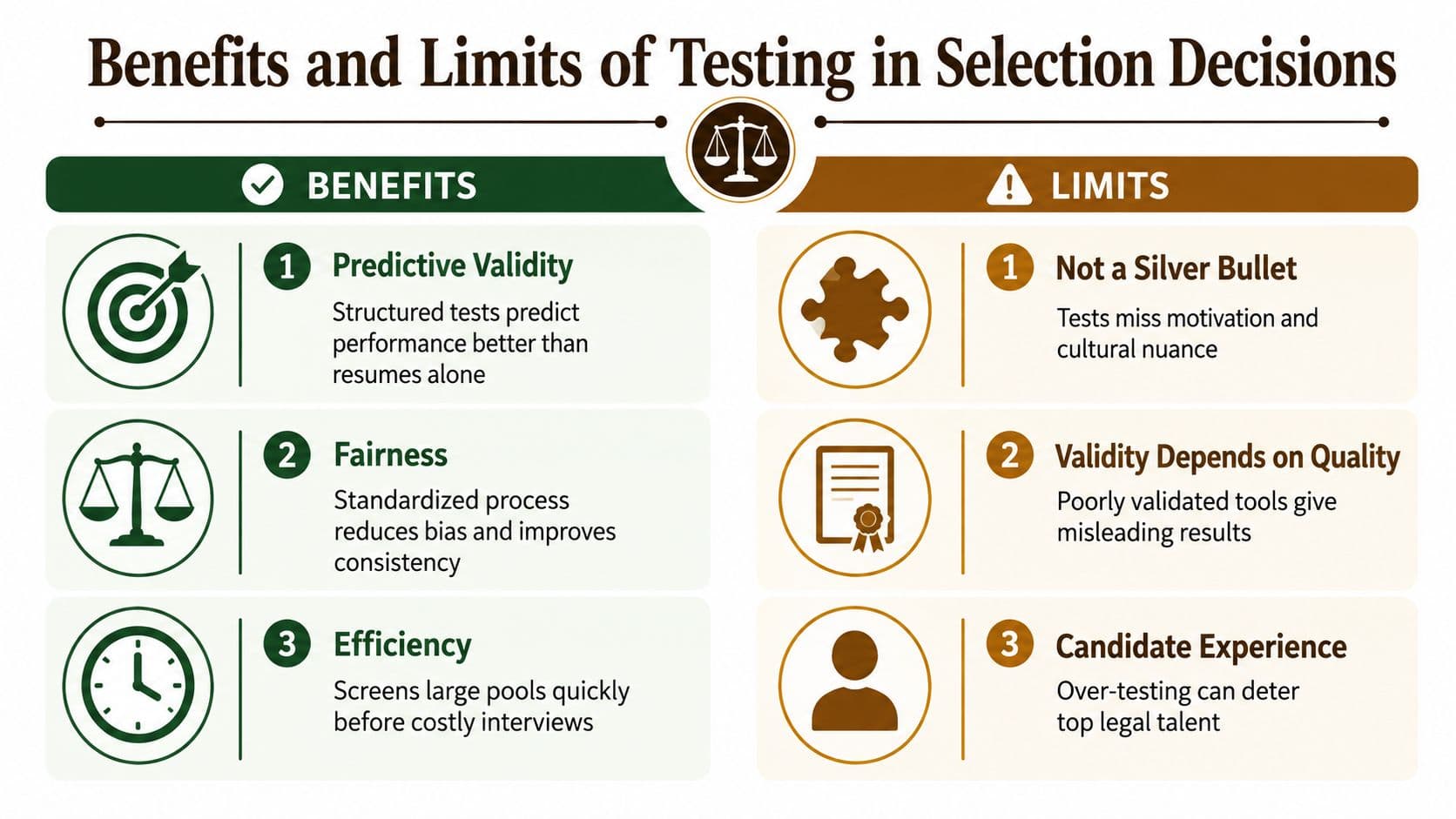
A contingency legal search can stall when a polished résumé and confident interview create more certainty than the evidence supports. A short, role-specific exercise gives the hiring team something concrete to examine. Each candidate receives the same assignment, and reviewers can compare observable work. A structured interview follows the same questions, sequence, and scoring rubric, reducing interviewer bias and improving prediction of job performance, as described in SHRM selection-method guidance.
That consistency changes the internal conversation. Rather than saying, “I liked this candidate,” a partner can discuss issue identification, organization, tone, or the treatment of an ambiguous fact. The team evaluates evidence instead of relying mainly on confidence, rapport, or interview fluency.
Where testing has the strongest value
Work samples and job tryouts show the strongest relationship with actual performance in the SHRM material. Assessment centers follow them, while unstructured interviews rank among the weakest methods. The practical rule for contingency legal hiring is simple: observe relevant work whenever the role allows it.
The assignment should match the risk of the vacancy. A litigation attorney might distinguish material from immaterial facts in a case summary. A paralegal might build a dependable deadline-tracking system. A legal operations candidate might turn a process problem into a workable implementation plan. The exercise does not need to reproduce the entire job. It should sample work that matters to success in that practice area.
Structured interviews add context, especially after a work sample. The interviewer can ask why the candidate prioritized one issue, selected a particular communication style, or responded to uncertainty in a specific way. That sequence links the result to judgment rather than treating the score as a verdict.
Why no score should decide alone
Assessment-center methods have measurable but moderate predictive power. SHRM's review cites an average validity coefficient of .37 across 107 validity coefficients from 50 assessment centers in its assessment-methods review. The figure cautions against overconfidence. A test can add useful evidence without predicting every aspect of future performance.
The U.S. Office of Personnel Management explains that predictive validity varies with assessor training, the assessment's purpose, and the mix of exercises. Its guidance also notes that assessment centers provide limited information about a candidate's relative strengths and weaknesses. They therefore work best as one part of a broader selection system.
A test should narrow uncertainty, not disguise it.
The operational limits
An assessment can introduce new risk when it measures the wrong thing. A generic test may reward familiarity with testing rather than legal capability. An overly long process may frustrate experienced candidates with demanding practices. A personality result may encourage a manager to label someone instead of examining the job behavior that affects client service, teamwork, or case execution.
Automation adds another question: will candidates understand how the screening process treats their work? Buyers should ask how the assessment explains scoring, handles accommodations, documents decisions, and permits meaningful human review. For a contingency recruiter, those safeguards also affect whether a strong candidate stays engaged through the process and whether the firm can explain its recommendation to the client.
Choose the test by matching it to the role's main risk, then combine the result with work evidence and structured discussion. That approach makes testing a decision aid, not a substitute for professional judgment.
How Candidate Testing Evolved Into Modern Digital Assessment
Candidate testing didn't begin with online recruiting software. Its foundations sit in large-scale aptitude screening and structured selection. During World War I, the U.S. Army developed the Army Alpha and Army Beta tests in 1917 and 1918 to measure recruits' abilities, as summarized in the history of assessment centers.
The modern assessment-center approach also traces to German officer selection during World War I. It expanded through World War II and later entered business recruiting. Industrial use is commonly associated with the early 1950s, including pioneering work by AT&T researchers Robert K. Greenleaf and Douglas W. Bray.
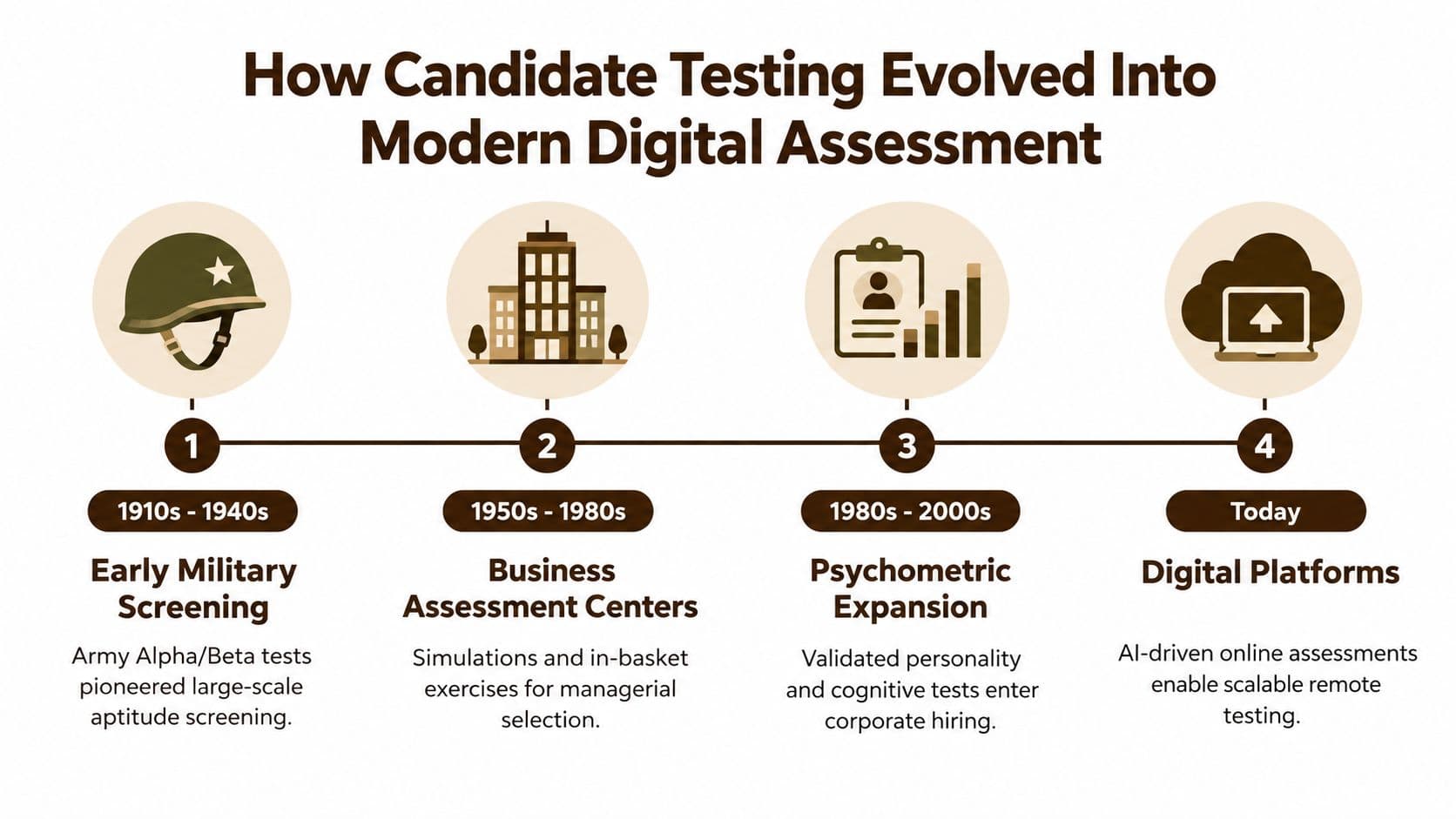
The next shift involved institutional scale. The Armed Services Vocational Aptitude Battery, or ASVAB, was introduced in 1968 and adopted by all U.S. military services by 1974 to 1976, according to the documented history of SkillCheck and standardized testing. These systems showed how standardized measures could support screening and assignment across large populations.
Digital delivery changed the practical experience again. SkillCheck was founded in 1991 and launched an online testing platform in 1999, described as one of the earliest of its kind in the same historical account. Paper administration and in-person scheduling gradually gave way to internet-delivered assessments, distributed candidate access, automated scoring, and electronic reporting.
For legal recruiting, that history explains why modern services emphasize standardization, accessibility, and workflow integration. A national legal department may need comparable evidence from candidates in different locations. A contingency recruiter may need to coordinate assessments without adding unnecessary scheduling friction. The technology is newer, but the underlying principle remains familiar: define the capability, observe it under consistent conditions, and interpret the result in context.
The history also explains why digital convenience shouldn't be confused with validity. A fast online test is still weak if it measures the wrong thing. Modern platforms make delivery easier, but hiring leaders remain responsible for choosing a method that reflects the role.
How to Integrate Testing Into Contingency Hiring and Screening
A contingency search can lose momentum when a client defines “qualified” only after resumes arrive. The recruiter and client should agree on decision criteria before candidates reach the shortlist. The model described in what contingency recruiting means depends on efficient sourcing, clear communication, and screening that respects the client's time while preserving candidate quality.
Start with the vacancy, then choose the assessment.
Define the risk before selecting a test
Write a short role profile in observable competencies. For a personal injury attorney, those may include client communication, case assessment, negotiation judgment, and deadline control. A corporate counsel may need contract analysis, business partnership, risk explanation, and prioritization. A litigation paralegal may need accuracy, procedural organization, document management, and responsiveness.
Classify the consequence of a poor match:
- Client-facing risk: Can the person explain difficult issues clearly and tactfully?
- Matter-quality risk: Can the person identify issues, apply legal knowledge, and produce accurate work?
- Workflow risk: Can the person manage deadlines, systems, handoffs, and volume?
- Leadership risk: Can the person delegate, develop relationships, and decide with incomplete information?
Then select an exercise that observes the highest-risk capability. A broad cognitive test cannot answer whether a candidate can explain a sensitive legal issue to a client. A short writing or role-play exercise may provide better evidence.
Place the assessment at the right point
A contingency process should not test every candidate immediately. First confirm baseline qualifications, practice experience, compensation alignment, location or remote expectations, and genuine interest. Use testing after that initial screen, when it can distinguish candidates who are otherwise plausible.
For a support role, a document-organization or email-writing exercise may belong early. For a partner search, a detailed test may be less appropriate than a structured discussion of client development, matter leadership, team management, and representative judgment. Senior candidates deserve a process that respects their experience while still producing evidence tied to the role.
Build a defensible review process
Ask the provider or recruiting partner:
- Job relevance: Which competency does each question or exercise measure?
- Scoring transparency: Can reviewers see the rubric and the candidate's underlying response?
- Assessor preparation: Who scores the work, and how is consistency maintained?
- Validation support: What evidence connects the method to job performance?
- Adverse-impact monitoring: How does the provider check whether the process disadvantages groups?
- Accessibility: What accommodations and alternative formats are available?
- Data governance: How are results stored, accessed, retained, and deleted?
- AI controls: Does automation assist review, recommend progression, or determine it?
- Audit trail: Can the team document instructions, scores, reviewer comments, and decision reasons?
These questions matter especially when an assessment uses automated scoring. Ask for bias audits, explainable scoring, human review, and records that show how a result affected progression. Candidates should also receive clear instructions about the exercise and a practical way to request an accommodation.
Interpret evidence as a panel, not a verdict
A recruiter can use the result to sharpen the client conversation. “The candidate scored well” says little. “The candidate identified the controlling issue, but the client-facing explanation was too technical” creates a focused interview question and supports a more candid placement discussion.
Keep the assessment version, instructions, rubric, reviewer, and final rationale on record. If the role or practice area changes, revisit the assessment instead of carrying it forward automatically. A test is a lens, not a verdict. It should influence the shortlist while the hiring decision reflects the full evidence set and the actual demands of the position.
Choosing the Right Testing Approach for Your Firm or Legal Department
The right candidate testing service is not the one with the largest library or the most impressive automation. It's the one that helps your team answer a defined legal hiring question with evidence that candidates can understand and hiring managers can defend.
A useful selection sequence is simple:
- Start with role risk. Identify the capability where a hiring mistake would create the greatest operational or client consequence.
- Match the method. Use work samples for observable execution, structured interviews for comparable judgment discussions, knowledge tests for defined technical foundations, and behavioral tools only when the measured traits connect to actual work.
- Pilot before expanding. Run the process on a limited group, review candidate reactions, compare assessment evidence with interview impressions, and adjust the rubric.
- Measure decision quality. Track whether the process improves shortlist relevance, hiring-manager confidence, retention, or time-to-fill. Don't treat completion volume as proof that the assessment works.
- Review governance. Require clear scoring, human oversight, accommodation options, and an explanation of how automated features affect decisions.
A skills-based approach can help legal employers look beyond titles and credentials, but it shouldn't turn every role into a generic test. The principles discussed in what skills-based hiring means work best when the selected skills come directly from the practice, matter to performance, and can be observed fairly.
Five Star Placements provides permanent legal placement for attorneys, legal support professionals, in-house counsel, partners, and legal operations leaders, with customized screening aligned to practice needs and organizational culture. For a firm or legal department without the capacity to design and administer every exercise internally, a recruiting partner can help connect role requirements, structured screening, interviews, and candidate communication into one process.
A candidate testing service should make hiring conversations more precise, not more mechanical. Choose the smallest set of assessments that produces meaningful evidence, explain the process to candidates, and keep experienced legal judgment at the center.
Five Star Placements helps law firms and corporate legal departments source and screen attorneys, support professionals, in-house counsel, and legal operations leaders using role-aligned hiring processes. Visit Five Star Placements to discuss a contingency search and determine whether structured testing or practical work samples fit your next legal hire.
Need help filling a legal role?
Five Star Placements partners with law firms and legal departments nationwide.
Schedule a Call