
Director of Legal Recruiting: Role, Pay, and Hiring Guide
September 9, 2026 · 14 min read · Five Star Placements

Table of contents
At 0.8% lawyer unemployment, a director of legal recruiting owns one of the firm's most consequential leadership functions: securing attorney talent when qualified lawyers have little reason to move. In 2025, 3,009 partners moved laterally across the AmLaw 200, making the role central to growth, succession, and competitive positioning.
This isn't a resume-screening job with a senior title. A capable director converts the firm's growth strategy into lateral partner pipelines, associate hiring plans, law school relationships, summer programs, offer decisions, and onboarding systems. The director also explains the results to managing partners and the executive committee.
The market makes weak recruiting leadership expensive. Law-firm demand growth averaged 2.5% in 2025 and reached as high as 4.4%, while lawyer compensation costs rose 8.2% and headcount increased 2.9%, according to Thomson Reuters' 2026 legal market signals as summarized by Achieve Professionals. Firms are competing for scarce talent while paying more to secure it. The director of legal recruiting is the person expected to make that competition manageable.
Table of Contents
- What a Director of Legal Recruiting Actually Owns
- Core Responsibilities Across the Attorney Hiring Funnel
- Skills and Experience Hiring Committees Look For
- Compensation Benchmarks and What Moves the Number
- Sample Job Description and KPIs You Can Use This Week
- Hiring Models Compared for Speed and Fit
- How a Legal Recruiting Firm Supports the Search
What a Director of Legal Recruiting Actually Owns
A director of legal recruiting owns hiring outcomes, not interview volume. The role is accountable for placing the attorneys each practice group needs, setting offers that can close, and ensuring lateral hires integrate after acceptance.
The director turns the firm's growth priorities into an attorney talent plan. For a private equity expansion, that means defining partner profiles, identifying supporting associate talent, selecting target markets, and setting compensation boundaries. For a stronger entry-level pipeline, the director connects school outreach, callbacks, offers, and summer associate experiences to the firm's hiring goals.
The three decisions that define the seat
A coordinator manages interview logistics. An HR business partner supports workforce processes. The director controls decisions that shape the firm's attorney supply:
- Set the annual hiring plan: Establish lateral, partner, associate, and entry-level priorities with practice group leaders and firm management.
- Own the offer strategy: Create negotiation guidelines, set escalation points, and align compensation decisions with market conditions and internal equity.
- Report hiring performance: Present pipeline strength, hiring volume, acceptance rates, and other recruiting KPIs to senior leadership.
The director also owns the operating details that determine whether recruiting produces lasting value. A director-level legal recruiting job description covers lateral hiring, summer associate programs, law school outreach, offer strategy, onboarding integration, staff supervision, and KPI monitoring.
Practical rule: If the director cannot connect a hiring decision to the firm's growth plan, the position has become administration.
The 2025 lateral market shows why this ownership now belongs at the leadership table. The 3,009 AmLaw 200 partner moves represented a five-year high and a 10% increase from the prior year, according to the 2026 legal recruitment trend analysis. A director who waits for applications will miss passive partners, complete teams, and opportunities that require fast decisions.
The role is strategic talent acquisition applied to a law firm's practice mix, geography, and partnership structure. Use legal talent acquisition strategies as a planning reference, then set priorities that match how the firm wins work and develops attorneys. A strong director can explain those choices in operational terms, defend them with hiring data, and hold practice leaders accountable for execution.
Core Responsibilities Across the Attorney Hiring Funnel
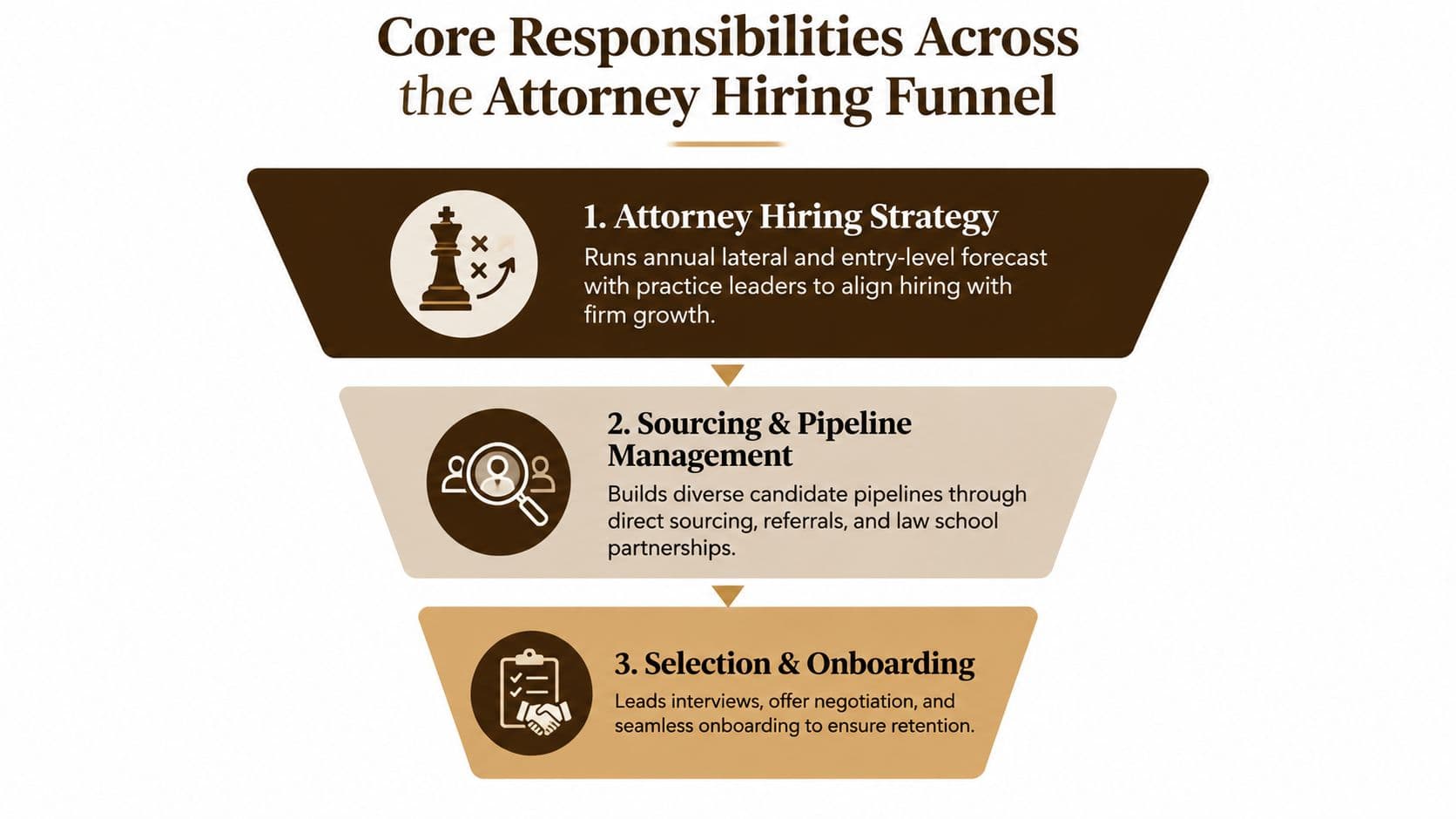
A director of legal recruiting owns three connected decisions: hiring strategy, candidate sourcing, and onboarding. Each requires a different audience, timeline, and success measure.
Attorney hiring strategy
The director begins with the firm's growth plan, not an open requisition. With practice group chairs, the director builds the lateral and entry-level forecast, selects priority markets, and decides which schools and candidate communities warrant attention.
Before a search opens, the director should confirm compensation bands with the COO or equivalent financial leader. That step prevents partners from pursuing a candidate the firm cannot approve an offer for. The forecast must separate urgent capacity needs from speculative growth, including partners who can generate work, senior associates who can fill immediate gaps, and entry-level hires who support long-term development.
Program leadership
The director owns the candidate experience from first contact through onboarding. Responsibilities include summer associate programs, law school outreach, callback design, interview training, offer presentation, and integration with the practice group.
For a 2L callback process, the director sets a consistent rubric covering legal judgment, communication, collaboration, and practice alignment. The director also controls the OCI slate and coordinates partners around one coherent message.
Offer negotiations demand diagnosis, not automatic concessions. A higher number will not resolve concerns about work allocation, partner access, location, or career progression. The director identifies the actual objection and helps partners give a credible answer.
Team and KPI ownership
Recruiters and coordinators need defined assignments, service standards, and escalation rules. The director reviews time-to-fill, offer acceptance, pipeline strength, hiring volume, and retention indicators, then brings meaningful patterns to the management committee.
Channel selection also affects vacancy time. Firms comparing job boards, internal recruiting, and attorney placement services should review how to hire lawyers faster before setting a sourcing plan. The director should match each channel to the role's urgency, market scarcity, and need for passive-candidate outreach.
The director does not automatically own firmwide learning and development, general employee relations, payroll, or every non-attorney hire. The job description must state whether the role covers attorney recruiting only or also staff recruiting, diversity programming, professional development, and employer branding. Clear boundaries keep accountability with the right leader.
Skills and Experience Hiring Committees Look For
Hiring committees often overvalue polished resumes and undervalue operating judgment. The strongest director of legal recruiting candidates can show how they influenced partners, solved stalled searches, managed compensation expectations, and protected the firm from poor-fit hires.
Experience matters first. A credible candidate usually brings substantial legal recruiting tenure, team leadership, and direct exposure to partner and senior associate placements. Titles vary across firms, so committees should examine scope instead of relying on whether the candidate previously held “director” in the job title.
What belongs in the experience screen
Look for evidence of:
- Legal-market fluency: The candidate understands practice groups, partnership economics, law school recruiting, lateral moves, and the difference between a strong resume and a commercially valuable attorney.
- Search ownership: They have managed searches from intake through acceptance and onboarding, rather than handing difficult negotiations to someone else.
- Partner credibility: Practice leaders trusted them with sensitive conversations and acted on their market guidance.
- Team management: They have set standards for recruiters, coordinators, and research support while maintaining accountability for results.
- Cross-functional judgment: They can work with finance, diversity and inclusion leaders, professional development, marketing, and firm administration without losing ownership of the hiring decision.
Credentials can support the profile, but they don't replace results. A bachelor's degree is common. An HR credential, legal education, or experience as a practicing attorney can help the candidate understand the firm's language and risk tolerance. Knowledge of NALSC compliance is important when the position handles fee-paid placements.
The difference between a director and a screener
A resume-screener forwards what looks familiar. A strong director challenges the intake. If a partner insists on an unrealistic profile, the director asks which business problem the hire must solve, tests the market, and recommends a workable alternative.
Compensation fluency is another separator. The director doesn't need to act as the finance department, but must understand how salary, bonus, guarantees, portability, class year, practice demand, and internal parity affect acceptance.
Political fluency is the trait committees often recognize too late. Law firms operate through relationships and shared authority. The director must know who influences a practice chair, which partner can close a candidate, where a decision will stall, and when to escalate without embarrassing the person who owns the relationship.
A useful screen is to ask for a specific example of a search the candidate stopped or reshaped. Their answer reveals whether they protect quality or process instructions. Candidates can also sharpen their understanding of the broader skills lawyers need to have, particularly the communication and judgment that influence recruiting outcomes.
Compensation Benchmarks and What Moves the Number
Compensation varies sharply by market, firm economics, and scope. A national title doesn't create a national salary.
A 2019 survey of legal recruiting professionals found that directors in New York City averaged $234,000, compared with $145,000 for directors in Philadelphia, according to Regents Recruiting and Executive Search's legal staffing data. The same survey found that nearly 30% of recruiters held a graduate degree or JD, 47% had more than eight years in legal recruiting, and 42% reported department growth during the preceding two years. Chicago directors' average pay rose 22.4% compared with the prior survey period.
Those figures are historical benchmarks, not a universal 2026 rate card. They show why candidates and firms should treat compensation as a market-specific negotiation.
The four levers that move pay
Firm tier is the first lever. A large, multi-office firm with aggressive lateral growth usually pays for broader judgment, more complex approvals, and greater exposure to senior partners.
Department scope matters just as much. A director handling only associate recruiting has a different mandate from one managing partner laterals, law school programs, summer associates, diversity initiatives, onboarding, and a recruiting team.
City and labor market create meaningful differences. The New York and Philadelphia comparison demonstrates that location alone can produce a substantial spread.
Documented performance moves the conversation from title to value. Candidates should bring evidence of hiring volume, acceptance rates, difficult searches closed, team productivity, and retention outcomes. Firms should ask how those metrics were defined before assigning credit.
| Firm Tier | Base Salary Range | Total Comp Range (est.) | Primary Pay Lever |
|---|---|---|---|
| Large national firm | Market-specific, based on scope | Market-specific, with bonus structure | Partner and team recruiting responsibility |
| Mid-market firm | Market-specific, based on local demand | Market-specific, tied to leadership scope | Combination of lateral and entry-level hiring |
| Boutique or regional firm | Market-specific, based on budget and mandate | Market-specific, often tied to narrower scope | Practice specialization and operating autonomy |
Don't sign an offer until both sides pressure-test the mandate. Candidates should ask which searches they own, how success is measured, who approves compensation, and whether bonus criteria are written. Firms should define reporting lines, decision rights, team resources, and the difference between a strategic director and a highly paid coordinator.
Sample Job Description and KPIs You Can Use This Week
A usable job description should tell candidates what they will decide, whom they will influence, and how the firm will judge performance. Generic language attracts people who can administer a process but haven't led attorney hiring.
Copy-ready job description
Objective: Lead full-cycle attorney recruiting so the firm meets hiring priorities, strengthens its talent position, and supports practice group growth.
Principal accountabilities:
- Own lateral partner, counsel, associate, and entry-level recruiting strategy.
- Build annual hiring forecasts with practice group leaders and firm management.
- Lead law school outreach, OCI, callback interviews, and the summer associate program.
- Establish interview rubrics and train partners on consistent evaluation.
- Manage offer strategy, compensation discussions, approvals, and closing.
- Supervise recruiters, coordinators, and recruiting operations.
- Coordinate onboarding and integration with practice leadership.
- Present recruiting KPIs and risks to the management committee.
- Partner with diversity, professional development, finance, and marketing leaders where their work affects attorney hiring.
Preferred qualifications: Legal recruiting experience, law-firm or legal search exposure, demonstrated ownership of senior searches, strong partner relationships, compensation judgment, and the ability to manage confidential information.
KPIs that expose real performance
Don't publish targets the firm can't support with systems or authority. Track measures that connect recruiting work to business outcomes:
- Time-to-fill: Segment by attorney level and practice group.
- Offer acceptance: Review accepted offers against extended offers and record decline reasons.
- Pipeline strength: Measure qualified candidates at each stage, not raw contact volume.
- Hiring quality: Gather structured feedback from practice leaders after onboarding.
- Retention: Review whether new attorneys remain and become productive members of the firm.
- Search cost: Track external fees, internal effort, travel, and partner time.
A scorecard should use the same categories for every finalist. Rate legal-market knowledge, partner influence, sourcing strategy, negotiation judgment, data discipline, team leadership, and political fluency. Add a short evidence field so interviewers record what the candidate demonstrated.
Ask questions that force judgment:
- Tell us about a partner search that stalled. What did you change?
- How did you handle a partner who rejected your market assessment?
- How do you forecast lateral demand when practice leaders give incomplete information?
- Describe an offer negotiation you prevented from becoming a compensation problem.
- How have you worked with diversity leaders while preserving a demanding practice-group standard?
Hiring Models Compared for Speed and Fit
The right hiring model depends on the risk of the search, not the firm's habit. Internal promotion, contingency recruiting, and retained search each solve a different problem.
| Hiring Model | Time to Shortlist | Candidate Pool Depth | Confidentiality | Typical Cost |
|---|---|---|---|---|
| Internal promotion | Often efficient when a ready successor exists | Limited to known employees and networks | Strong | Internal compensation and transition cost |
| Contingency legal recruiter | Fast for defined, active mandates | Broad access to active and passive legal talent | Strong if handled discreetly | Fee generally payable upon successful hire |
| Retained search firm | Structured and expansive for complex leadership searches | Deep, targeted outreach | Strong, with formal process | Retainer and search fee structure |
When internal promotion wins
An internal candidate already understands the firm's partners, systems, politics, and recruiting history. That person can ramp quickly and may have earned trust with practice leaders.
The limitation is reach. An internal promotion may know the firm's alumni network well but lack access to directors who are open to moving. It can also preserve an outdated process if the successor inherits the same assumptions.
When contingency recruiting fits
A contingency recruiter is practical when the mandate is clearly defined, the firm wants speed, and the search depends on reaching candidates outside the existing network. This model works particularly well for lateral-heavy recruiting leadership searches where the firm wants specialized legal-market access without committing to a retained process.
The firm should still insist on a written intake, calibrated profile, confidentiality rules, and a clear replacement policy. Lower upfront commitment doesn't eliminate the need for disciplined selection.
When retained search earns its place
Retained search makes sense when the firm is building the function for the first time, replacing a highly visible leader, or pursuing a confidential and unusually selective mandate. It also provides more structured market mapping when the firm needs a carefully designed slate rather than a quick response to an open role.
Use the matrix before approving the search. If the firm needs institutional knowledge, start internally. If it needs targeted reach for an active vacancy, consider contingency. If confidentiality, market mapping, and leadership assessment dominate, retained search is the safer route.
How a Legal Recruiting Firm Supports the Search
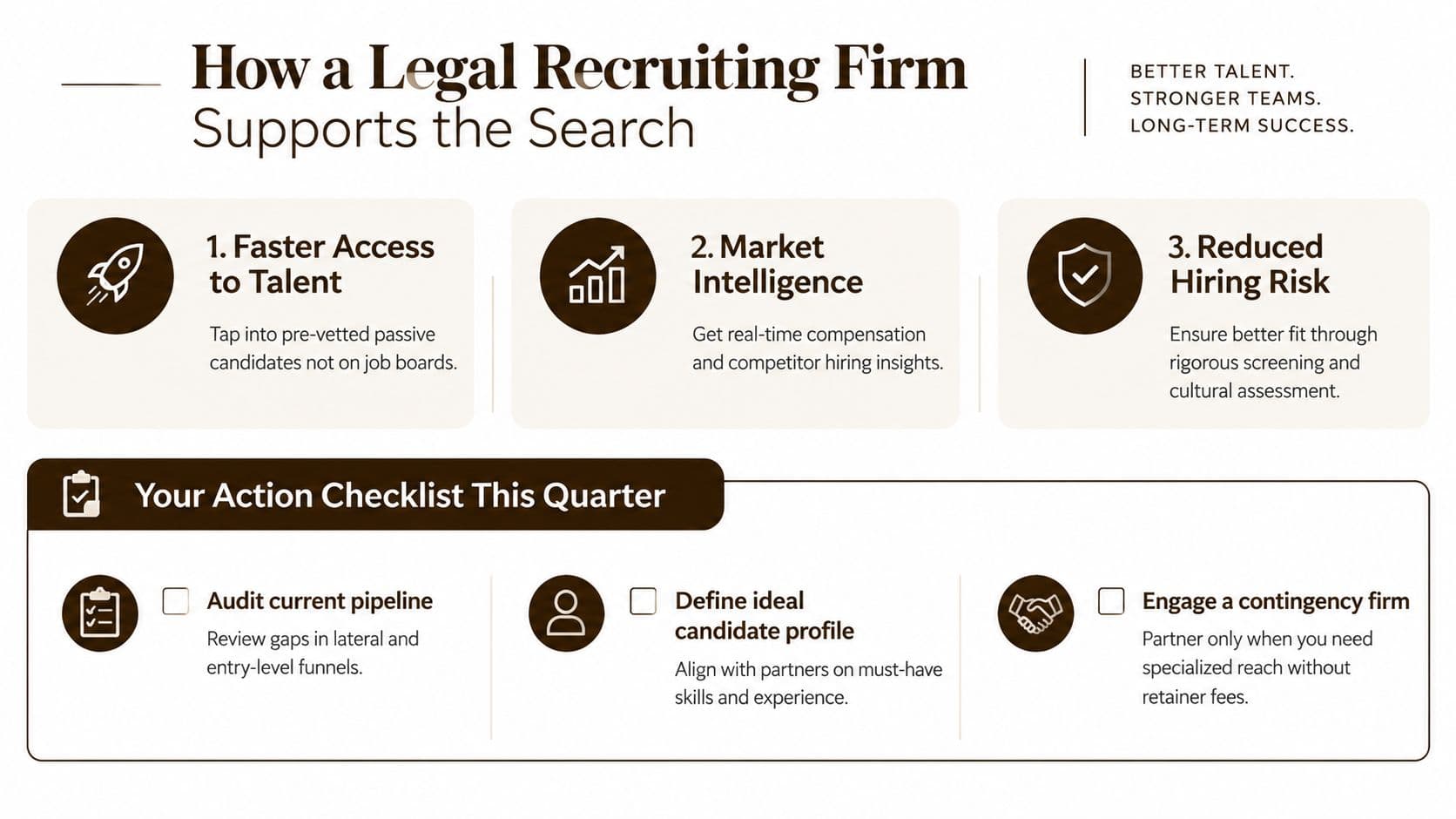
External support is most useful when the firm's internal team knows what it needs but can't reach the right director quickly or discreetly. A specialized legal recruiting firm can add value through a pre-vetted network, current compensation conversations, and targeted outreach to passive candidates.
The urgency is measurable. One industry benchmark places job-board sourcing at 8 to 12 weeks, internal recruiting at 4 to 8 weeks, and attorney placement services at 3 to 6 weeks, as reported in this analysis of recruiting attorneys in a competitive market. Those are benchmark ranges, not guarantees, but they show why channel selection affects vacancy time.
Where outside help pays off
Use a specialized firm when the search involves a difficult practice group, a confidential replacement, a competitive counteroffer, or discreet outreach to passive candidates. The recruiter should understand law-firm structures, partner incentives, attorney career moves, and the difference between a recruiting manager and a true director.
A sound external partner should provide:
- Calibrated intake: The recruiter tests the role with the hiring leaders before sourcing.
- Screened introductions: Candidates are evaluated for legal recruiting depth, management ability, compensation judgment, and cultural alignment.
- Market feedback: The firm learns how candidates view the mandate, reporting line, compensation, and decision process.
- Process control: Interviews, references, offer discussions, and communication follow a defined timeline.
- Outcome-based economics: The fee structure should make the recruiter accountable for a successful permanent hire.
Five Star Placements provides contingency-based permanent placement for law firms and corporate legal departments, including searches for legal recruiting and management leaders. Its process includes customized screening for experience, skills, and organizational fit, with payment tied to a successful hire rather than an upfront fee.
A quarterly action checklist
- Review the pipeline: Identify gaps in lateral, partner, associate, and entry-level funnels.
- Recalibrate compensation: Compare current approvals with recent candidate feedback and offer outcomes.
- Audit retention risk: Examine onboarding quality, partner integration, and early warning signs among new hires.
- Plan succession: Identify internal recruiting leaders who could step into broader ownership.
- Build search relationships: Establish working relationships with two specialized legal search partners before a confidential vacancy appears.
A director of legal recruiting should be treated as a leadership hire because the role directly controls access to attorney talent. Define the mandate, fund the tools, give the director decision rights, and measure outcomes that partners can understand.
Five Star Placements helps law firms and legal departments recruit directors of legal recruiting, attorneys, partners, support professionals, and legal operations leaders through customized permanent-placement searches. Visit Five Star Placements to discuss your recruiting leadership mandate and build a focused candidate pipeline.
Need help filling a legal role?
Five Star Placements partners with law firms and legal departments nationwide.
Schedule a Call