
How to Recruit Attorneys in a Competitive Market: A 2026
July 29, 2026 · 14 min read · Five Star Placements

Table of contents
If speed and quality are your top priorities, go with a specialized attorney placement service. Keep an internal recruiter only if you're consistently bringing on 10 or more attorneys per year. And reserve job boards for high-volume or junior roles where a slow fill won't hurt as badly. Blending these channels keeps opportunity costs in check while improving how quickly seats fill and start generating revenue.
Table of Contents
- What the 2026 Attorney Market Actually Looks Like
- Assess the Role Before You Post Anything
- Build Sourcing Channels That Actually Produce Candidates
- Screen and Interview With a Scorecard, Not a Gut Feel
- Compensation, Flexibility, and the Total Package
- Close Fast, Onboard With Intent, and Hold Onto the Hire
What the 2026 Attorney Market Actually Looks Like
The market right now is tight and lopsided depending on where you're looking. Hubs like New York, D.C., and California are seeing fierce competition and salaries that climb even after cost-of-living adjustments. For firms, that translates into longer searches, more counteroffers, and a genuine financial hit every time a seat stays empty.
Here's what actually moves the needle:
- Lost billable hours compound fast, so time pressure matters more than headline salary numbers.
- Geography shifts the equation: smaller hubs may pay less, but you're also competing with fewer candidates, which can work in your favor.
- Your hiring volume directly affects whether an internal recruiter makes financial sense or just adds fixed overhead.
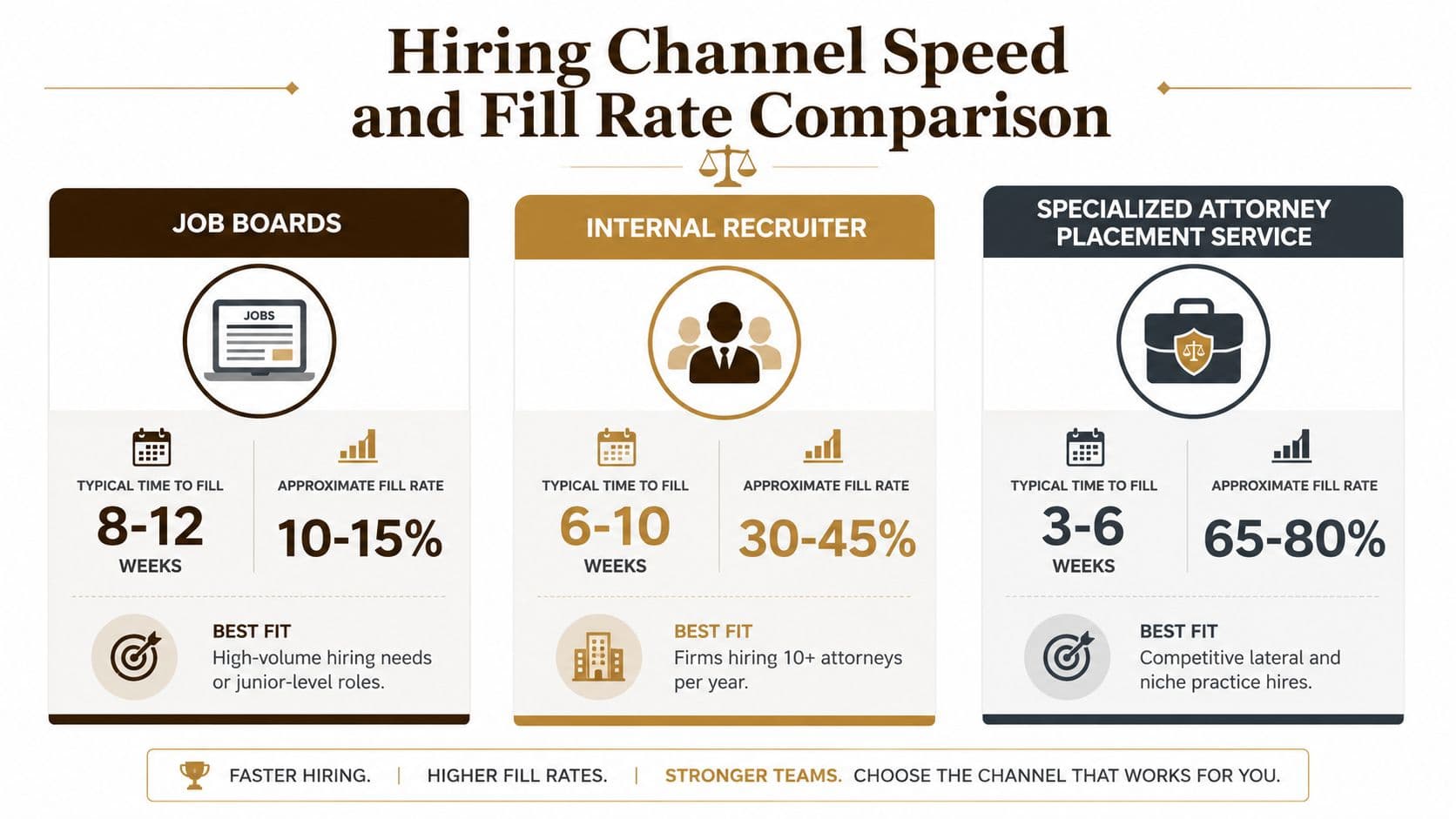
The chart above lays out typical time-to-fill and fill rates across three common channels so you can quickly gauge whether your current approach is keeping pace.
Here's the thing most firms overlook: when you're losing matter capacity, hire velocity almost always beats a small bump in comp. Faster fills tend to recover far more revenue than a one-time higher salary ever could.
Hiring Channel Speed and Fill Rate Comparison
Not all recruiting channels deliver the same results. The table below breaks down three popular options so you can match your approach to your firm's actual needs.
| Channel | Typical Time to Fill | Approximate Fill Rate | Best Fit |
|---|---|---|---|
| Job Boards | 8–12 weeks | 30–40% | High-volume, junior-level, or non-urgent roles |
| Internal Recruiter | 4–8 weeks | 50–65% | Firms with 10+ annual hires and consistent pipeline |
| Attorney Placement Services | 3–6 weeks | 70–85% | Urgent, specialized, or senior lateral hires |
The takeaway? If you're filling only a handful of roles a year and they matter, a placement service almost always pays for itself through speed alone. For firms with steady, high-volume hiring, bringing someone in-house starts to make economic sense.
Comparative Scenarios
- Small firm with 1–3 hires per year: Building a full internal recruiting team doesn't make sense here. A contingency partner gives you faster access to lateral talent without the fixed salary and tool costs hanging over you.
- Mid-size firm with 4–9 hires per year: A blended model tends to work well. Keep one in-house sourcer handling the pipeline and lean on contingency recruiters for specialized or urgent roles where speed is critical.
- High-volume firms with 10+ hires per year: Once your year-over-year hiring volume justifies a salary plus recruiting tools, an internal recruiter becomes cost-effective and gives you more control over the process.
Quick Cost-Decision Checklist
Before you commit to a channel, run through these three calculations:
- Figure out what each open seat costs you in monthly billable terms.
- Compare that against the expected speed difference between channels, say 3–6 weeks versus 8–12 weeks.
- Weigh contingency fees against the revenue you're losing to delayed time-to-productivity.
Practical next move: If you want a fast reality check on your channel mix and whether it's time to outsource, check out how Five Star Placements breaks down the timing model and billable recovery math. Learn more about Five Star Placements
Assess the Role Before You Post Anything
Start by forcing a hard conversation about what the team actually needs versus what feels familiar. Define no more than three must-have credentials and three nice-to-have skills; anything else will dilute the funnel and slow you down. This means prioritizing client-ready experience, courtroom or transactional exposure, and specific industry know-how.
Write a job description that survives real-market scrutiny. Replace platitudes with concrete deliverables, sample matters, expected billable range, and clear performance milestones for the first 12 months. This reduces mismatched applicants and speeds screening.
Set an internal compensation range before interviews begin. Use regional data and practice-area slices—for example, mid-market corporate counsel in New York will differ from litigation associates in midwestern hubs. A defensible range prevents last-minute panic and preserves negotiating leverage.
Treat the hire classification as a decision rubric, not a label.
Create a three-point rubric to decide whether the opening is lateral, stretch, or development:
- Lateral if the candidate must be fully billable day one with matching book-of-business expectations.
- Stretch if core skills exist but significant client development is required.
- Development if mentorship and a clear 24–36 month ramp plan are assumed.
Each classification changes where you source, how you pitch the role, and which candidates you target.
Practical example — small litigation firm: shifting a posted "senior associate" to a stretch role expanded qualified applicants by 40% while keeping base comp steady by promising structured origination credit and a six-month billable reduction.
Use short, testable statements instead of long paragraphs. After drafting, run a quick sanity check with a partner who will hire day-to-day; ask: would you hire this candidate tomorrow? If not, tighten requirements.
How To Avoid Copy-Paste Descriptions
- Compare last year's posting against current matters to spot drift.
- Strip irrelevant legacy tasks and add two real case examples.
- Add one metric a candidate can ask about in interviews (e.g., average matter size).
This upfront discipline leads to faster sourcing, cleaner shortlists, and offers that close.
Build Sourcing Channels That Actually Produce Candidates
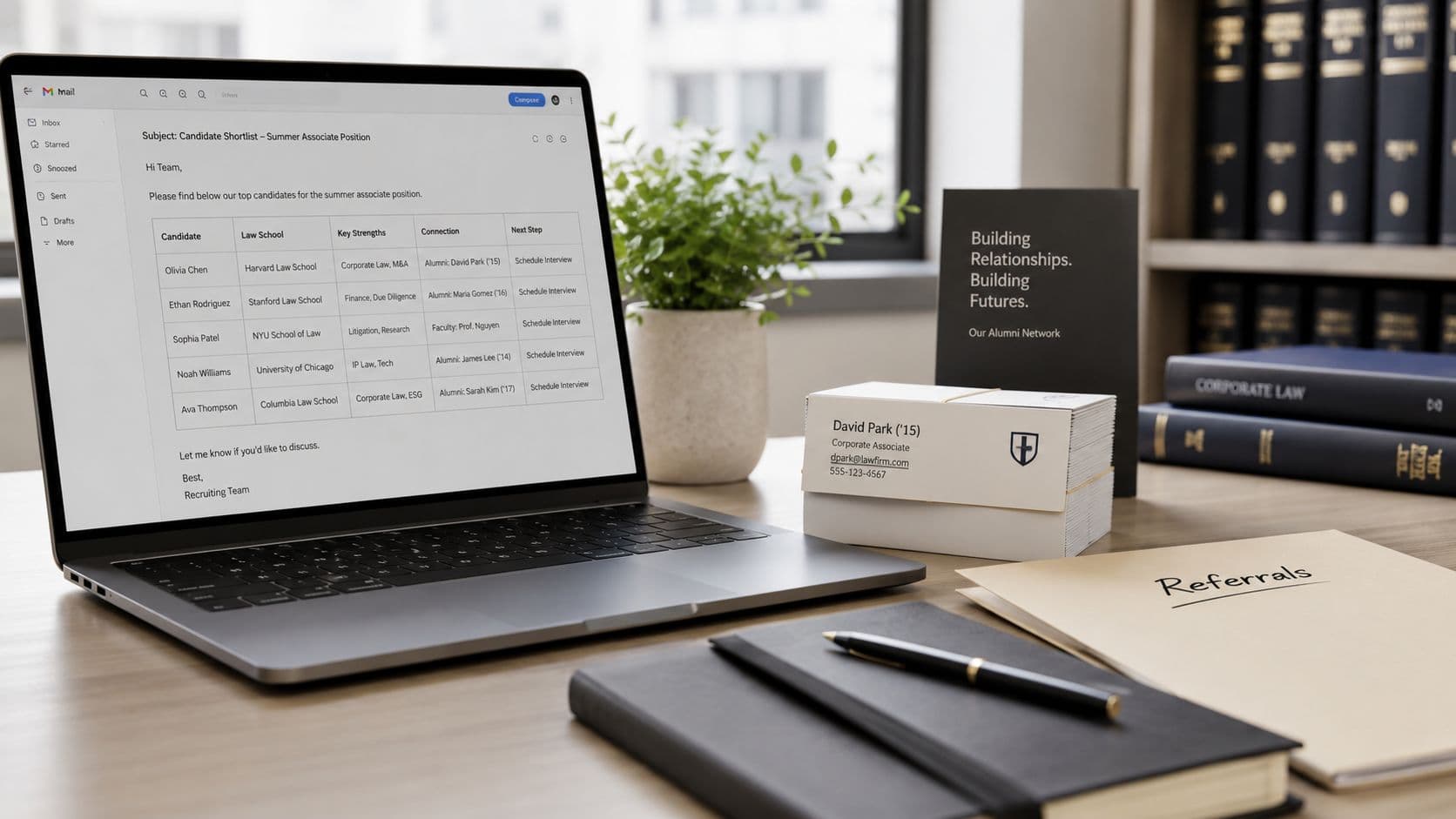
The best practice-ready attorneys rarely surface on job boards. They're tucked away in alumni networks, bar section rosters, and former clerk cohorts—places where your conversion rates dwarf anything you'll get from blind postings.
I watched a mid-market litigation partner fill a senior associate slot in three weeks by contacting two clerkship alumni and one former in-house counsel heading back to private practice. No job posting required.
Targeted associations matter more than most firms realize. Join practice-specific groups, sponsor CLE events, and use member directories to build a prioritized outreach list with notes on relevant matters attorneys have handled.
Alumni and law school networks are your goldmine. Tap career services and class agents at target schools. Offer to speak on real cases—it draws passive candidates far better than a generic recruitment pitch.
Candidates remember firms that stay visible between openings more than firms that show up only for a job ad.
A simple referral program goes a long way. Tie rewards to actual hires rather than just introductions. Paying referral bonuses on a 90-day retention milestone increases quality referrals and cuts down on early churn.
How to Work With Contingency Recruiters
Stop treating contingency recruiters as a fallback. Brief them like partners instead.
Start with a one-page role brief that covers three must-haves, two deal-breakers, and a profile of someone who succeeded in a similar seat at your firm. Then share honest feedback on their shortlists fast—this teaches them your benchmark and sharpens the search.
Run joint debriefs after first interviews. You'll refine search parameters together and avoid wasting weeks on mismatched candidates.
A sensible briefing cadence:
- Kick off with the role brief and an exemplar CV
- Expect the first shortlist within 7–10 days
- Set weekly syncs until the hire is done
Common pitfalls to avoid:
- Siloing external partners from your internal team
- Asking for exclusivity without committing to timely feedback
Both kill urgency and candidate momentum fast.
Subchannels worth testing:
- Former clerks looking to return to practice
- In-house counsel heading back to private practice
- Targeted LinkedIn outreach to attorneys who handled comparable matters in the past 24 months
Outreach messaging that actually gets responses:
- "I read your work on [specific matter]. Would you consider a role where you'd own similar cases?"
- "We're hiring a litigation associate—three partners will mentor for six months."
For deeper sourcing playbooks and outreach templates, check out the Five Star Placements blog.
Screen and Interview With a Scorecard, Not a Gut Feel

Hiring on gut feel alone is how firms end up with impressive interviewees who can't actually close a deal or manage a case load. A structured scorecard fixes that — it keeps panels aligned, reduces unconscious bias, and dramatically speeds up decision-making when the market moves fast.
Start by locking in five evaluation dimensions before you even post the role:
- Technical Depth
- Matter Judgment
- Client Readiness
- Communication
- Culture Alignment
Then weight them based on what the role actually demands. If you're hiring a practice-group partner who needs to bring book of business, Technical Depth and Client Readiness should carry more weight. For a midlevel associate slot, you might shift the balance toward Matter Judgment and Culture Alignment.
Here's the thing most firms get wrong — they either overload the panel or understaff it. Keep it lean but strategic. You want three voices: one partner who can sell the opportunity, one peer who understands the day-to-day grind, and one screener who checks logistics and motivation. That combination lets you test selling ability, feasibility, and cultural fit all at once instead of dragging candidates through four or five separate rounds.
Use a shared scorecard to make debriefs objective and fast.
Interview Prompts and Work Samples
The prompts matter as much as the scoring. You want questions that reveal how someone actually thinks, not how well they interview.
- Technical Depth — Have them walk through a recent matter they led, then ask which decision point they'd handle differently today. That second part separates real experience from rehearsed answers.
- Matter Judgment — Give them a 30-minute hypothetical that mirrors a typical case at your firm and ask for a short action plan. You're looking for structured thinking under time pressure.
- Client Readiness — Request two client communication samples or run a brief role-play around a billing dispute or scope change. This tells you more than any resume line about client management.
- Communication — Ask them to explain a legal concept in five minutes as if they're talking to a nonlawyer client. Clarity here predicts client satisfaction later.
- Culture Alignment — Dig into preferred supervision style, pace of work, and how they like to receive feedback. Misalignment here is the number one reason new hires don't stick.
Work-sample exercises should mirror real tasks but respect candidates' time. Redline a contract clause and draft a 200-word client summary. That's enough to assess skill without making people feel like they're working for free.
Weighted Scoring and Debrief
Use a 1–5 scale for each dimension, then multiply by the weight you assigned upfront. Tally the numbers before anyone walks into the debrief room. The discussion should focus on resolving scoring differences — not re-litigating first impressions.
A few practical tools that keep the process disciplined:
- Numbered checklist for required credentials (bar admission, practice area experience, book of business minimums)
- Shortlist color coding — green for strong advance, yellow for borderline, red for pass
- KPIs to track throughout: time-to-offer, shortlist-to-offer conversion, and 90-day retention
One mid-size firm I worked with cut their interview process from four rounds down to two by enforcing a scorecard at every stage. Their time-to-offer dropped from eight weeks to three weeks, and offer acceptance jumped by 18%. When you remove the ambiguity from hiring decisions, candidates notice — and they respond.
Compensation, Flexibility, and the Total Package
Money gets you in the room. It rarely closes the deal on its own when you're competing for attorneys. Candidates are weighing base pay, sure — but also trajectory, schedule, and the concrete signals that a firm will actually invest in their practice.
Start with credible benchmarking using regional and practice-area slices. Pull from at least two data sources and adjust for cost of living. BigLaw scales in a Midwest hub can look 20–30% different once you apply a cost-of-living index. That gives you a defensible internal range to hold to during negotiations.
Break compensation into clear buckets so flexibility doesn't eat away at base integrity.
- Base salary with a firm floor and a defined top of range tied to experience level.
- Target bonus structure with explicit achievement triggers — not vague "we'll see" language.
- Non-salary investments like CLE, tuition reimbursement, and conference budgets, framed as development dollars.
Offer development dollars as nonrecurring but bankable commitments — things candidates can actually count on during evaluation.
Get specific about remote work, flexible schedules, and reduced billable thresholds during the first 6–12 months. These tradeoffs close gaps that a larger base salary can't, and they don't create salary inflation down the line.
Here's a practical example. A regional litigation firm kept base flat but added a $10,000 annual professional development credit and a 20% temporary billable reduction for six months. Faster acceptances. Higher 12-month retention. The math worked.
Positioning Structural Signals
Be transparent about billable expectations, origination credit, and partnership path mechanics. Candidates almost always choose clarity over vague promises.
- Publish a short one-page partnership track summary.
- Explain origination credit math with a worked example.
- State billable target ranges and how they adjust for mentoring or rainmaking time.
Use benefits as evidence of investment rather than throwaway perks.
- Mentorship commitments with assigned partner sponsors.
- Technology stipends tied to actual productivity tools.
- Paid sponsorship for one key industry conference annually.
Numbered checklist for final offers
- Confirm base, bonus, and development dollar amounts in writing.
- Document schedule flexibility and billable adjustments with specifics.
- Attach the partnership track summary and origination policy to the offer letter.
When you pair defensible comp benchmarking with targeted flexibility and transparent career mechanics, your offer becomes competitive — without creating a runaway comp structure you'll regret later.
Close Fast, Onboard With Intent, and Hold Onto the Hire

Once you get a verbal yes, move fast—days, not weeks. Shoot over a concise offer summary via email the same day, then follow up with the formal letter. Make sure that letter spells out the base salary, bonus triggers, start date, remote or in-office expectations, and any probationary billable adjustments. Keeping everything transparent prevents miscommunication and shrinks the window for a counteroffer.
Make sure your offer letter covers these non-negotiables:
- Clear base salary and bonus formula with exact payout timing.
- Documented schedule flexibility and any temporary billable hour reductions.
- A one-page summary of the partnership track or clear promotion milestones.
Quick wins here boost acceptance rates and ease candidate anxiety.
If a counteroffer pops up, keep the conversation short and data-driven. Walk them through your benchmarking rationale, remind them of their career trajectory, and offer a retention-focused perk—like a dedicated development credit or a guaranteed mentor—rather than just throwing more money at the problem.
Onboard With a 30-60-90 Plan
Draft a 30-60-90 plan before their first day. Include measurable goals, primary matters they will own, and a named mentor. This approach cuts down time-to-productivity and shows you are genuinely invested in their success.
- First 30 days: Focus on learning systems, shadowing senior attorneys, and making at least one client introduction.
- Days 31–60: Hand over progressive billable responsibility and assign a small, client-facing task.
- Days 61–90: Aim for independent matter handling and schedule a formal feedback checkpoint.
Pair them with a mentor and set up biweekly check-ins. Early wins reinforce their decision to join, and regular catch-ups help you spot issues before they escalate.
Retention Mechanics That Work
Keep an eye on your KPIs: time-to-productivity, 90-day retention, and first-year billable attainment. Offer real development dollars, transparent origination credit rules, and flexible schedules. When figuring out how to recruit attorneys in a competitive market, these elements often outweigh a one-time salary bump.
Read also: Learn how Five Star Placements speeds hires and reduces risk with contingency searches on their Five Star Placements contact page
How Long Should a Realistic Attorney Search Take in 2026?
Timelines vary wildly depending on your sourcing method. If you bring in a contingency recruiter, expect a solid shortlist within 3–6 weeks. Relying on internal recruiting usually pushes that to 6–10 weeks, while posting on job boards can drag things out to 8–12 weeks. Every week you wait is billable capacity left on the table, so speed directly impacts your bottom line.
When Should You Use a Contingency Recruiter Versus Internal Sourcing?
It really comes down to volume and urgency. Contingency recruiters shine when you need a specialized skill set filled quickly or only have a handful of roles to hire. On the other hand, if you are bringing on 10 or more attorneys annually or trying to build out your firm's long-term employer brand, an internal recruiter makes more sense.
What Does a Mis-Hire Cost?
A bad hire hits your wallet hard. Once you factor in salary, overhead, lost billings, and the cost of restarting the search, a conservative estimate for a mis-hire runs between $150,000 and $300,000. That risk alone justifies investing heavily in your screening and interview process.
How Do You Judge Practice Readiness?
You need proof, not just promises. Ask candidates to walk you through three specific matter examples from their past. Request short work samples to verify their writing and analytical skills. Finally, score their client-readiness directly on your interview scorecard—this gives you a reliable baseline to predict how long their ramp-up time will actually be.
Need help filling a legal role?
Five Star Placements partners with law firms and legal departments nationwide.
Schedule a Call