
The Employment Screening Process for Legal Roles
August 30, 2026 · 14 min read · Five Star Placements
Table of contents
The offer went out after a polished résumé, confident interviews, and glowing references. A few weeks later, the firm learned that the attorney's claimed experience didn't match the matters they had handled, and an important credential required closer review. By then, the hire had access to confidential client information, internal systems, and active files. The cost wasn't limited to recruiting time. It reached client trust, supervision, workflow, and professional responsibility.
That's the problem a disciplined employment screening process is designed to prevent. Legal employers need more than a generic criminal search or a quick reference call. They need a repeatable method for confirming identity, credentials, practice experience, professional standing, and compliance requirements before a candidate becomes part of the organization.
Table of Contents
- Why Legal Hiring Demands a Rigorous Screening Process
- Mapping the Full Employment Screening Lifecycle
- How Legal Candidate Screening Differs from General Hiring
- Background Checks, Credential Verification, and Compliance Essentials
- Structured Interviews for Legal Roles
- Compliance Requirements Every Employer Must Follow
- Building an Employment Screening Process That Works
Why Legal Hiring Demands a Rigorous Screening Process
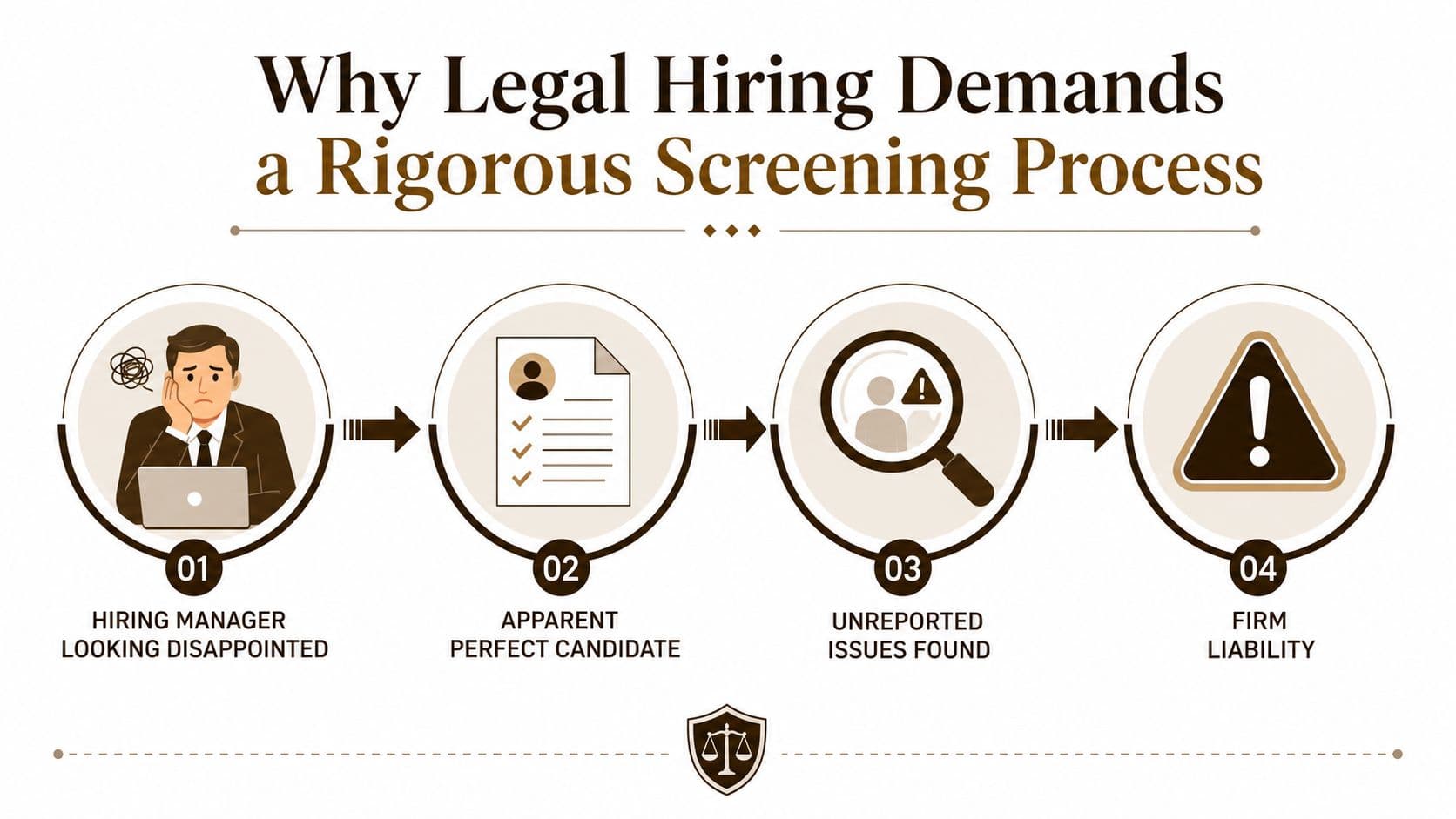
A bad legal hire can create risk in places a standard hiring checklist never reaches. An attorney may have an undisclosed disciplinary history, an inactive or inaccurately described bar admission, or a résumé that presents limited participation as lead responsibility. A paralegal or legal operations employee may gain access to privileged material, financial information, trust-account data, or sensitive client records before anyone notices a discrepancy.
The risk is not hypothetical in the broad sense. A PBSA-linked global survey reported that 93% of organizations worldwide conduct some type of background screening, and 76% have a documented screening policy. Screening was even more common among organizations with at least one U.S. location, at 95%, compared with 79% among organizations without a U.S. location. The most common global checks were criminal, identity, employment, and education verification.
Those figures matter because they show that screening has become a standard risk-control function, not an optional administrative task. The Consumer Financial Protection Bureau's market snapshot also described a major shift in U.S. employer practice, from about 72% of surveyed employers conducting background checks in 2016 to approximately 95% in a 2018 employer survey. For legal organizations, that shift has a practical consequence: candidates increasingly expect verification, and firms need a process that can withstand scrutiny.
The stakes extend beyond the résumé
Legal employers protect client confidences, manage conflicts, meet court and regulatory obligations, and supervise professional work. A credential problem can affect whether someone is permitted to perform a task. A poor judgment issue can affect client relationships. An identity problem can undermine every other verification step because the records may belong to someone else.
Practical rule: Treat every material credential on a legal résumé as something to verify, not something to accept because the candidate presents confidently.
A rigorous process also protects qualified candidates. Screening records can be incomplete or wrong, especially when employers rely on databases without checking the underlying source. The objective isn't to reject people automatically. It's to make decisions using accurate, role-related information and to give candidates a fair opportunity to correct errors.
Mapping the Full Employment Screening Lifecycle
A sound process follows a sequence. Each phase answers a different question, and skipping ahead usually creates confusion rather than speed.
Phase one starts with role definition and intake
Before reviewing applicants, define what the role requires. For an associate, specify the practice area, expected matter ownership, court or agency exposure, writing demands, client contact, and supervision model. For a paralegal, identify the case-management systems, filing responsibilities, discovery experience, and confidentiality expectations.
Then review the application against those requirements. Confirm basic employment history, education, licenses, work authorization questions, and any gaps that need clarification. A short recruiter screen can establish whether the candidate's stated experience aligns with the opening before partners invest interview time.
A structured approach to intake and search strategy can help hiring teams align role requirements, sourcing, and evaluation. Five Star Placements describes this broader approach in its guide to strategic recruitment solutions.
Phase two verifies the record
Deeper verification should examine the claims that matter to the position. Depending on the role, that can include identity, criminal history, employment, education, state bar admission, professional credentials, and disciplinary information. The sequence should follow the organization's written policy and applicable law, rather than an individual partner's preference.
For attorneys, verify the jurisdiction, admission status, admission date, and publicly available professional history through the relevant authority. For non-attorney roles, confirm certifications and specialized training when those qualifications affect the work assigned.
Phase three uses a structured interview
The interview should test capability, not just rapport. Ask consistent questions about matter management, writing, advocacy, negotiation, client communication, ethical judgment, and collaboration. Add a work sample when the role depends on drafting, analysis, research, or operational accuracy.
A candidate who communicates well in conversation may still struggle with a deadline-driven writing assignment. Conversely, a reserved candidate may demonstrate excellent judgment and precision through a work sample. Use multiple evidence points instead of allowing one charismatic conversation to decide the outcome.
Phase four closes the compliance loop
Before finalizing the hire, reconcile the screening file, document any discrepancy and its resolution, complete required notices and authorization steps, and confirm work-eligibility procedures. If a report may affect the decision, follow the applicable pre-adverse and adverse-action process rather than communicating an immediate rejection informally.
The final checkpoint should also confirm that the hiring team used the same standards applied to comparable candidates. That consistency protects the organization and gives decision-makers a clear record of why the hire was approved.
How Legal Candidate Screening Differs from General Hiring
General hiring often asks whether a candidate has held a similar title and can perform the broad duties of the position. Legal hiring must go further. The question isn't only whether someone worked in litigation, corporate law, family law, or legal operations. It's what they did, under whose supervision, on what type of matters, and with what level of responsibility.
A corporate résumé may list transactions without distinguishing whether the candidate led negotiations, drafted ancillary documents, managed diligence, or supported a senior lawyer. A litigation résumé may mention trial experience without clarifying whether the candidate argued dispositive motions, handled depositions, prepared witnesses, or observed the lead attorney. Those distinctions directly affect role fit.
Compare claims with work evidence
A conventional screen may verify title, dates, and education. A legal screen should connect those facts to actual work product and professional judgment.
| General hiring question | Legal hiring question |
|---|---|
| Did the candidate perform similar duties? | Which matters did the candidate own, and which did they support? |
| Does the résumé list the practice area? | Does the candidate's experience match the firm's clients, courts, statutes, and matter complexity? |
| Can the candidate communicate? | Can the candidate explain risk clearly to a client, partner, judge, opposing counsel, or business leader? |
| Is the reference positive? | Can a supervising attorney describe judgment, reliability, writing, ethics, and response to pressure? |
| Does the candidate meet the stated qualification? | Is the admission, credential, or certification active and appropriate for the work? |
For a family-law litigator, ask about hearings, negotiation strategy, client distress, and control of sensitive facts. For a labor and employment attorney, probe investigations, agency proceedings, counseling, and the ability to translate legal risk into business guidance. For an in-house counsel candidate, examine stakeholder management, prioritization, contracts, and escalation judgment.
References should come from people who saw the work
Generic HR references often confirm dates and titles. A peer, supervising partner, department leader, or client-facing manager can speak to the details that determine success. Ask how the candidate handled missed deadlines, changed facts, difficult clients, conflicting instructions, and feedback. Listen for concrete examples rather than broad praise.
Billable expectations also require context. A candidate's productivity should be evaluated alongside matter mix, staffing, business development expectations, training, and the organization's workflow. A raw production figure, without understanding the surrounding conditions, can produce a misleading comparison.
The strongest legal screen tests the distance between what a candidate says they handled and what another knowledgeable professional can substantiate.
Background Checks, Credential Verification, and Compliance Essentials
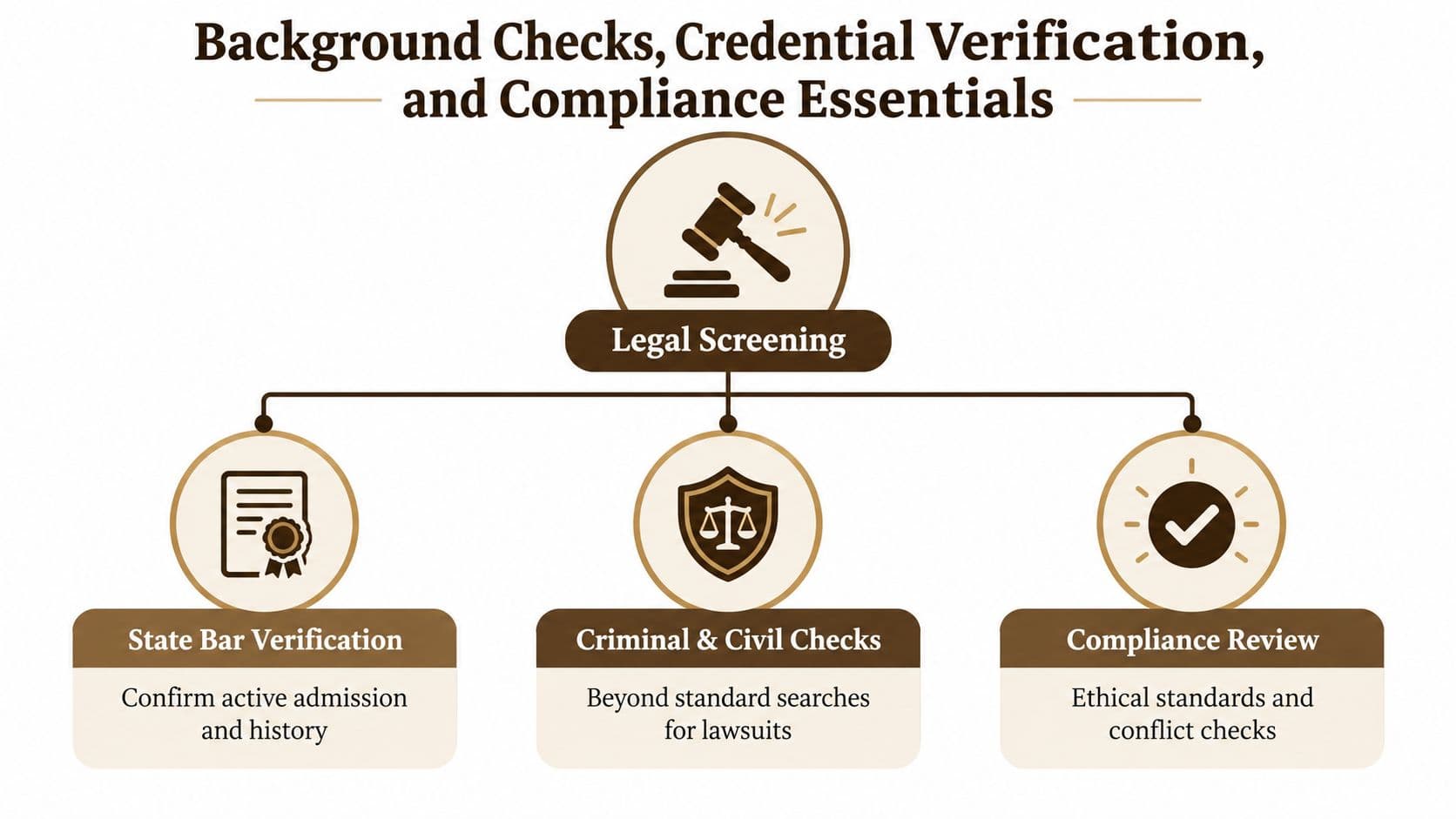
The verification stage should be customized to the role, but legal employers commonly need several distinct checks. A criminal search alone cannot confirm that the person is who they claim to be, that their license is active, or that their stated experience is accurate.
Verify identity before relying on other records
Identity verification anchors the rest of the file. Confirm the candidate's identifying information through a lawful, reputable process before interpreting records that may belong to people with similar names. This issue deserves more attention: a 2025 global benchmark report found that only three in five employers conduct identity checks, while one in six reported experiencing identity fraud and another three in ten were unsure. The same report said more than three-quarters of businesses found candidate discrepancies in the previous 12 months.
Those findings point to a practical weakness in many hiring programs. Teams often prioritize turnaround time, then discover that fast data isn't useful if it's attached to the wrong person or conflicts with the candidate's verified records.
Confirm professional standing and education
For an attorney, bar verification should establish active admission and relevant history through the applicable state authority. Review available disciplinary information and confirm that the candidate's stated jurisdictions match the work the organization expects them to perform. If the role involves regulated practice, specialized credentials, or court-specific authority, document those requirements separately.
Education checks should confirm the institution and degree claimed. Employment verification should test dates, titles, and, where permitted, the nature of the work. Don't ask a former employer to disclose confidential client information, and don't pressure a reference to reveal protected personnel details.
A focused resource on this attorney-specific work is Five Star Placements' guide to attorney background checks.
Understand the limits of criminal databases
Database results are leads for verification, not final judgments. A peer-reviewed study reported at least one false-positive error for 60% of participants on regulated private-sector checks and 50% on unregulated checks. It also found at least one false-negative error for 90% and 92% of participants, respectively, as described in the study on private-sector criminal background checks.
The operational response is clear. Use reputable providers, examine source records where legally allowed, compare multiple identifiers, and create a documented dispute process. A candidate must have a meaningful opportunity to explain or correct a record before the employer makes a final adverse decision.
| Verification type | Purpose | Legal relevance |
|---|---|---|
| Identity verification | Establish that records belong to the applicant | Prevents credential and record mismatches |
| Bar admission review | Confirm jurisdiction, status, and available professional history | Protects against inaccurate licensure claims |
| Education verification | Validate degrees and institutions | Confirms stated academic qualifications |
| Employment verification | Check dates, titles, and relevant work history | Tests whether claimed experience matches the role |
| Criminal and civil research | Identify potentially relevant records for lawful review | Supports role-related risk analysis without automatic exclusion |
| Reference interviews | Gather observed evidence of performance and judgment | Adds context unavailable from databases |
| Compliance review | Confirm process consistency and required notices | Creates a defensible hiring record |
A short explainer can help hiring teams distinguish the database portion of screening from the broader verification process:
Structured Interviews for Legal Roles
An interview should produce comparable evidence, not just a shared impression. Use the same core questions for every candidate applying for the same role, then allow limited follow-up questions to clarify answers. A written rubric keeps the evaluation tied to job requirements instead of personality or familiarity.
Build questions around observable work
Ask candidates to describe a matter they managed, a difficult client conversation, a negotiation that changed direction, or a time they identified a professional responsibility concern. Follow with specific prompts: What was your responsibility? What options did you consider? Who did you involve? What happened next? What would you change?
For a junior attorney, test research method, writing discipline, feedback response, and issue spotting. For a senior associate, examine delegation, client ownership, strategic judgment, and development of junior lawyers. For a legal assistant or paralegal, focus on calendaring accuracy, filing controls, confidentiality, prioritization, and communication under deadline pressure.
A separate communication skills assessment resource can support a more deliberate evaluation of how candidates explain complex information and manage professional interactions.
Use a scoring rubric that partners will actually follow
Keep the rubric short enough to use during the interview. Rate evidence against defined competencies, such as:
- Legal judgment: Identifies risks, distinguishes facts from assumptions, and escalates appropriately.
- Matter management: Tracks deadlines, anticipates dependencies, and communicates changes early.
- Client communication: Explains options plainly without overstating certainty.
- Technical capability: Demonstrates practice-specific knowledge through examples or work product.
- Professional responsibility: Recognizes confidentiality, conflicts, candor, and supervision concerns.
- Team behavior: Gives and receives feedback while preserving accountability.
A high score should require evidence, not enthusiasm. “I handled complex matters” is a claim. A useful answer explains the matter context, the candidate's precise role, the judgment exercised, and the result without disclosing protected information.
Red flags require follow-up, not automatic rejection
Watch for candidates who cannot distinguish their own work from the team's work, blame every former employer, avoid direct answers about mistakes, or describe ethical issues as someone else's problem. Vague answers don't prove misconduct, but they do justify a focused follow-up and reference verification.
Structured interviews also reduce the influence of unconscious bias because candidates face comparable opportunities to demonstrate relevant competencies. The hiring panel should record evidence independently before discussing overall impressions.
Compliance Requirements Every Employer Must Follow
Legal employers should involve qualified employment counsel when designing or revising a screening policy. The process must be effective, but it also must respect federal, state, and local requirements that can vary by jurisdiction and role.
Follow FCRA procedures when a consumer reporting agency is used
Under the Fair Credit Reporting Act, an employer using a consumer reporting agency generally needs a clear standalone disclosure, the candidate's written authorization, and a defined process for handling information that may affect the hiring decision. If the employer is considering adverse action based on the report, it must follow the required notice sequence, provide the relevant report and rights information, allow the candidate an opportunity to dispute inaccurate information, and issue the final notice when appropriate.
Do not bury the disclosure inside an employment application. Do not treat a vendor's report as automatically accurate. The error findings discussed earlier make review and candidate correction especially important.
Apply screening criteria consistently
EEOC guidance requires employers to apply background-check policies consistently and to ensure that exclusions based on criminal history are job-related and consistent with business necessity. A record should not trigger an automatic decision without considering the position, the nature of the conduct, the time involved, and other relevant individualized factors where applicable.
Write the policy before the opening attracts applicants. Train everyone involved, including partners who may want to make an exception for a favored candidate or impose an extra hurdle on an unfamiliar one.
Complete Form I-9 correctly
I-9 verification confirms employment eligibility for each hire. Assign responsibility, use the required form and acceptable documentation rules, complete the process within the applicable timing requirements, and store records securely and separately from ordinary personnel materials where appropriate.
Preserve a defensible record
Keep the job requirements, consent documentation, vendor communications, reports, dispute materials, decision rationale, and final outcome according to a documented retention policy. Limit access to people who need it. Confidentiality applies to screening information too, particularly in a legal environment where careless circulation can create another problem.
Building an Employment Screening Process That Works
A workable process is specific enough to control risk and flexible enough to reflect the role. Start with written requirements, verify identity and legal credentials, assess actual practice capability, use structured interviews, check relevant references, and complete compliance steps before finalizing the hire.
The shortcuts that fail are predictable: accepting résumé language without testing it, relying on a database hit without source review, skipping identity verification, treating a partner's intuition as a scoring system, and rushing adverse-action procedures. Speed matters when a practice group has an urgent vacancy, but speed without sequencing creates rework and exposure.
Make one person accountable for the file, give hiring managers a consistent rubric, and require documented resolution of discrepancies. That turns screening from a last-minute administrative hurdle into a repeatable legal hiring control.
Five Star Placements provides permanent placement for attorneys, legal support staff, partners, in-house counsel, and legal operations leaders, with screening aligned to practice needs, bar status, experience, and organizational fit. If your firm or legal department needs a carefully evaluated shortlist without adding another full recruiting workload, visit Five Star Placements to discuss the role.
Need help filling a legal role?
Five Star Placements partners with law firms and legal departments nationwide.
Schedule a Call