
Big Law Recruiters: Your 2026 Guide to Success
July 15, 2026 · 17 min read · Five Star Placements

Table of contents
A hiring partner needs a fifth-year finance associate now, not in six months. Deals are live, clients are calling, and the rest of the team is covering the gap at partner rates and senior-associate hours. On the other side, a strong senior associate is billing well, training juniors, and asking a harder question than compensation alone can answer: is this firm built for the next stage of my career?
That is the current Big Law market. Firms are paying for lawyers who can step into active matters, handle client pressure, and produce without a long runway. The old playbook centered on OCI, summer classes, and patient internal development still matters at the margins, but it no longer solves many of the hiring problems firms face today.
For candidates, that shift changes the economics of a move. A lateral transition can mean better origination credit treatment, a clearer partnership path, stronger platform support, or access to a practice group that is still growing instead of gradually stabilizing. For firms, the stakes are just as direct. A missed hire can slow revenue, strain key partners, and create avoidable client risk.
That is why big law recruiters play a larger role than they once did. The market has seen a clear increase in lateral movement across several practice areas, and firms are competing hard for lawyers who are already practice-ready. Good recruiters do more than circulate resumes. They qualify fit, test timing, flag compensation mismatches early, and keep both sides from wasting a month on a process that was never likely to close.
At Big Law recruiter Five Star Placements, the work starts with that practical question: can this lawyer help this firm make money and serve clients right away, and is the firm a real career upgrade rather than just a new logo? That is the standard the current market demands.
Table of Contents
- The New Reality of Big Law Talent Acquisition
- What Big Law Recruiters Really Do
- Comparing Types of Legal Recruiters
- Benefits and Risks for Firms and Candidates
- How to Effectively Engage a Recruiter
- The Five Star Placements Difference
- Frequently Asked Questions About Big Law Recruiting
The New Reality of Big Law Talent Acquisition
A finance partner lands a new matter on Monday, and by Wednesday the associate bench is already strained. The old answer was to rely on the incoming class and spread the work around. That answer breaks down when the client expects immediate execution, the matter requires subject-matter fluency, and the senior associates already billing at capacity cannot absorb another live file without service slipping.
That marks a significant change in Big Law hiring. The traditional pipeline of law students and junior associates still matters, but it no longer covers the firm's most expensive talent problems. Large firms are buying readiness. They want lawyers who can step into an active practice group, handle complex work quickly, and reduce pressure on partners and senior associates almost at once.
As noted earlier, recent market reporting showed a clear rise in lateral movement, with especially strong activity in practice areas where understaffing carries an immediate client-service cost. Bankruptcy and Real Estate stood out for exactly that reason. Firms were not hiring for abstract growth plans. They were filling revenue-producing gaps.
Why vacancies are more expensive than they look
An unfilled midlevel or senior seat creates operational drag long before anyone labels it a hiring problem. Partners spend time reviewing work that should have been handled a level down. Senior associates lose billable hours covering tasks outside their lane. Response times get longer, staffing gets thinner, and the team starts rationing attention across matters that all feel urgent.
That cost is easy to miss because it rarely appears in one line item.
It shows up in write-offs, slower turnaround, weaker mentoring, and client frustration when a team looks busy instead of sharp. In a high-rate practice, the financial hit from a delayed hire can exceed the recruiting fee by a wide margin. Hiring partners know this instinctively. The challenge is acting before the strain becomes visible to clients.
For candidates, the same market creates opportunity, but only when the move solves a real career problem. A smart lateral move can improve your firm fit, client access, matter quality, compensation trajectory, or path to partnership. A bad one can leave you with a better title and the same weak workflow, limited sponsorship, or narrow book-building prospects.
That is why serious firms and experienced associates tend to work with recruiters who understand the economics behind the opening, not just the job description. A legal recruiting firm such as Five Star Placements can help assess whether the need is urgent, whether the candidate can carry the work on day one, and whether the match holds up once the offer is signed.
The firms that adapt fastest to this shift are not waiting for old recruiting calendars to solve current business pressure. They are hiring for immediate contribution. In Big Law, that is often the difference between protecting a practice and overworking one.
What Big Law Recruiters Really Do
A strong big law recruiter works more like an investment banker for human capital than a job broker. The job is not to throw names into a process. The job is to identify where the market is, which candidates are movable, which firms are serious, and where a deal can hold together after the offer letter is signed.
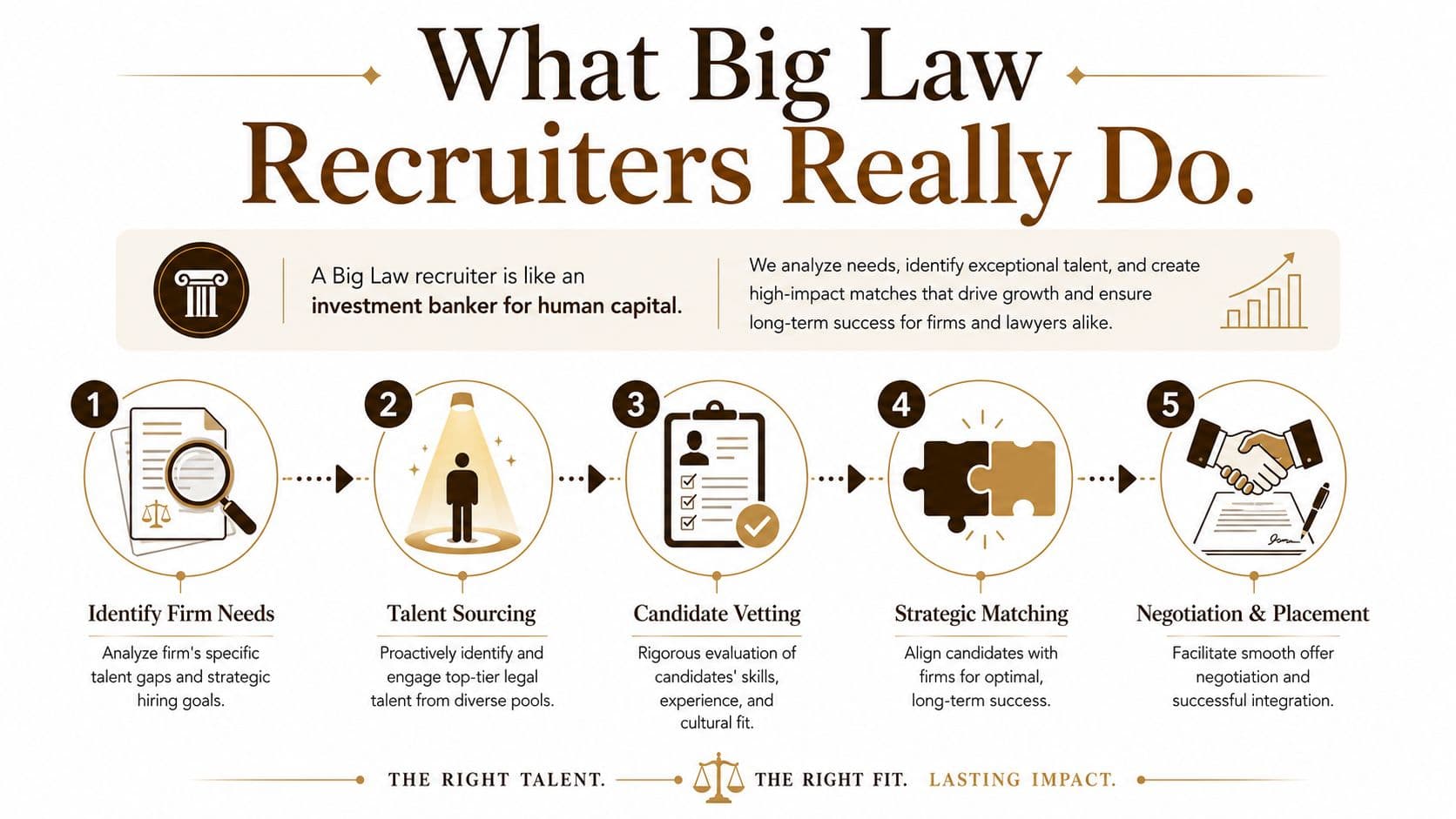
The scale alone explains why specialization matters. In 2025, law firms posted 45,300 lawyer jobs, and the U.S. law firm industry is projected to reach $422.4 billion in 2026, according to Robert Half's legal hiring research. That is not a casual hiring environment. It's a large commercial market where legal talent decisions affect revenue, client retention, and internal succession.
The work starts before any candidate sees a job description
The first useful question is not “Who's available?” It's “What does success in this seat require?”
That means the recruiter has to get precise about:
- Practice need: Is the firm trying to add capacity, replace a departure, enter a new sub-specialty, or stabilize a team under strain?
- Level and economics: Does the group need a senior associate who can run matters, or a junior partner who can supervise and help expand a book over time?
- Internal fit: Who will this person work with, how are matters staffed, and what management style succeeds inside that office?
A weak recruiter stops at title and compensation range. A good one builds the market map from the operating reality of the group.
Sourcing is mostly about access
The strongest candidates often aren't applying cold. They are busy, cautious, and selective about where they'll listen. Recruiters reach that market through relationships, pattern recognition, and credibility. They know which lawyers have hit a ceiling, which groups are vulnerable to exits, and which candidate profiles travel well between platforms.
That's why internal recruiting teams and outside recruiters aren't interchangeable. Internal teams know the firm intimately. Specialist recruiters know the external market intimately. The best results come when those strengths are combined.
The resume tells you what a lawyer has done. The interview process needs to tell you how that lawyer will function inside your specific group.
Vetting and negotiation decide whether the placement sticks
Screening in big law goes beyond school, class year, and firm name. It should test writing responsibility, client contact, supervision experience, deal or case ownership, pace tolerance, and reasons for moving. For partners, it should also test whether the portable work aligns with the receiving firm's platform and conflicts profile.
The recruiter then manages the quiet parts that often derail a search:
- Timing interviews so the candidate remains engaged without feeling rushed.
- Shaping the story so both sides understand why the move makes business sense.
- Handling compensation discussions without letting one awkward conversation kill a viable match.
- Reducing post-offer risk by surfacing concerns early instead of after acceptance.
That's the actual work. The introduction is the smallest part.
Comparing Types of Legal Recruiters
Not all recruiter models solve the same problem. A firm hiring one lateral partner in a niche practice should not default to the same search structure it would use for a national general counsel search. The same goes for candidates. Some recruiters are strong operators in one lane and weak outside it.
Contingency and retained searches
A contingency recruiter is paid only if a hire is made. That model fits many law firm searches because it lowers upfront risk and can work well when the role is clear, the market is active, and the firm wants speed. It also creates pressure on the recruiter to focus on winnable searches and responsive clients.
A retained recruiter is engaged with an upfront commitment. That model is often better when confidentiality is paramount, the role is unusually senior, the search requires heavy market mapping, or the hiring company wants a more controlled process.
Neither model is better. The issue is alignment.
| Model | Fee Structure | Best For | Key Characteristic |
|---|---|---|---|
| Contingency | Paid upon successful hire | Lateral associate, partner, and many law firm growth searches | Lower upfront risk and fast market activity |
| Retained | Paid through a committed search engagement | Highly sensitive or senior searches | Deeper exclusivity and process control |
Boutique and national recruiting firms
A boutique legal recruiter usually wins on specialization. The advantage is depth. The recruiter may know a particular city, practice, or partner market in a way a broader firm doesn't. That matters when the search depends on nuanced knowledge of who performs the work, not just who has the right title.
A national recruiting firm usually wins on breadth. It can be useful when a client is hiring across offices, building multiple teams, or needs access to a wider infrastructure. The trade-off is that the individual recruiter may be less immersed in your exact market niche.
Use a boutique when precision matters most. Use a larger platform when scale and geographic reach matter more.
How hiring partners should choose
Most firms don't need a theory lesson. They need a decision rule. Start with these questions:
- How specialized is the role? If the answer is highly specialized, niche expertise matters more than brand size.
- How sensitive is the search? If replacing a visible lawyer or building discreetly, tighter search control matters.
- How much internal recruiting capacity exists? If the internal team is thin, outside process management becomes more valuable.
- How quickly does the seat need to be filled? Urgent searches favor recruiters who already know the candidate pool.
For candidates, the test is similar. A recruiter who places entry-level associates may not be the right person for a lateral move involving counsel track, partnership path, or a strategic office change.
A recruiter's value is usually easiest to see in what they say no to. If they'll pitch you anywhere, they probably don't understand your market position.
Benefits and Risks for Firms and Candidates
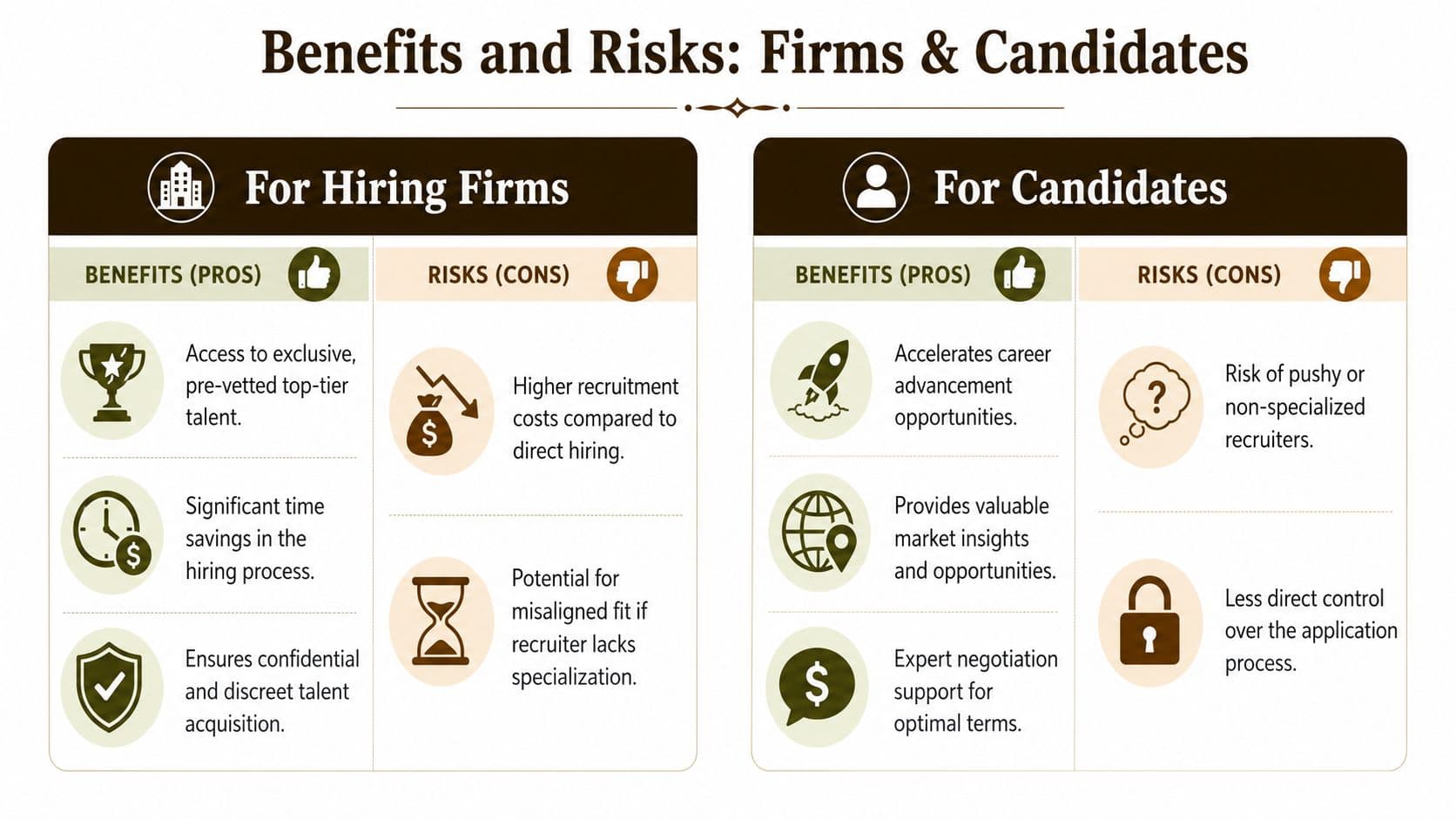
The benefits are real. The risks are real too. The mistake is assuming every recruiter relationship creates the same result.
For hiring firms
The biggest advantage is access. Many strong lateral candidates are not actively applying through job boards or formal portals. They will, however, take a serious call if the recruiter understands their practice, knows the firm's reputation in the market, and can explain why the role is materially better than staying put.
The second advantage is market intelligence. A specialist recruiter can pressure-test whether a firm's expectations are realistic. If the compensation is off, the title is too low, the office politics are visible in the market, or the role description doesn't match the actual work, a good recruiter will tell the client before the search wastes weeks.
Firms also gain confidentiality. When replacing a lawyer, exploring a new practice build, or adding talent before announcing a strategic push, discretion matters.
The risks usually come from mismatch in recruiter quality.
- Non-specialist sourcing: A recruiter without legal market depth may send lawyers who look right on paper but can't operate at the required level.
- Weak intake: If the recruiter doesn't understand the group, the shortlist will be noisy and time-consuming.
- Fee sensitivity: A direct application costs less on paper, so firms sometimes resist outside help even when the seat remains open too long.
- Overpromising: Some recruiters oversell candidate interest or understate concerns to keep momentum alive.
For candidates
Candidates use recruiters for reasons that go beyond job access. Confidentiality is one. A senior associate usually doesn't want exploratory outreach circulating through the market. Another is narrative control. A recruiter can help frame a move around platform, practice growth, training, business development support, or advancement path, rather than letting the move look purely reactive.
Negotiation support also matters. Candidates often mishandle comp talks by speaking too early, asking too vaguely, or focusing only on base pay while ignoring workflow, partnership track, integration, and office support.
The risks are different but just as important:
- Commission-driven pressure: A poor recruiter may push a move that closes fast instead of one that fits.
- Loss of process control: Once a recruiter represents you to a firm, the communication lane changes.
- Poor positioning: If your story is framed badly at the start, it can be hard to correct later.
- Market overexposure: Being submitted too broadly can damage bargaining power and credibility.
What works and what doesn't
What works is a selective partnership. The recruiter should understand your practice area, your market, and your actual reason for moving or hiring.
What doesn't work is volume. Ten weak submissions don't beat two credible ones. For candidates, talking to five recruiters who all send your materials in different directions usually creates confusion, duplication, and reduced bargaining power.
How to Effectively Engage a Recruiter
A litigation partner loses a fifth-year associate on a Wednesday. By Friday, two matters need immediate coverage, clients are asking who will take the lead, and the firm does not have six months to wait for a junior lawyer to grow into the role. That is the hiring environment now. According to FindLaw's review of the shift in Big Law recruiting, lateral hires made up a larger share of Big Law associate hiring in 2025 than new graduates. The evaluation should focus on whether a recruiter can move practice-ready lawyers in a high-stakes market, which requires a very different process from campus hiring.
What firms should ask
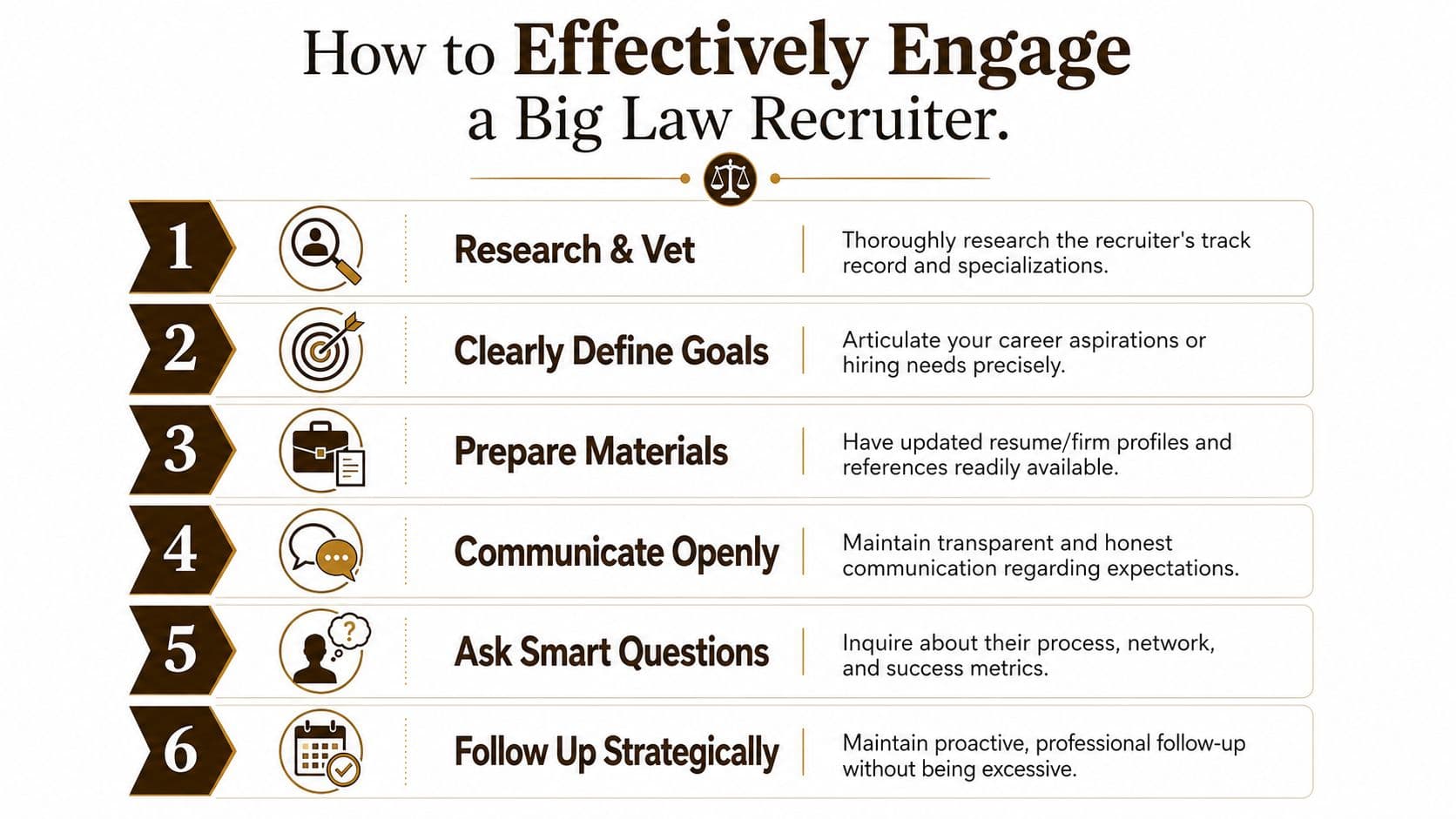
Firms get better results when they treat the first recruiter call like a search intake, not a vendor intro. Ask for specifics.
- Which mandates like this have you filled? Same practice, seniority, office, and compensation band.
- How do you test readiness? A strong answer should cover deal sheet or case experience, partner references, client exposure, writing, and pace tolerance.
- How do you run a targeted search without exposing the firm? Good recruiters can explain who they call first, how they protect names, and when they disclose the client.
- What usually stalls searches like this? Experienced recruiters know where firms create their own delays, especially around compensation approval, interview scheduling, and partner alignment.
- How do you keep candidates warm between interviews? In this market, good laterals have options and disappear quickly if the process drifts.
A useful reference point is the Five Star Placements blog on legal hiring and recruiting, which covers recurring issues in law firm and in-house searches.
Before the search starts, the firm also needs internal clarity on the business case for the hire. Is this a capacity hire, a succession hire, or a targeted growth hire tied to a client need? A recruiter can bring candidates, but cannot fix a partnership group that has not agreed on book expectations, workflow, reporting structure, or how much training the incoming lawyer will receive.
What candidates should disclose
Senior associates and counsel often make the same mistake. They give a polished résumé summary and hide the facts that determine whether a move will work.
Be direct about geography, current compensation, minimum acceptable economics, conflicts, visa issues, expected title, appetite for partnership pressure, and whether you want a bigger platform or just a different team. If your practice is portable, say how portable. If it is not, say that too. A recruiter can position a candidate around strong execution, institutional clients, or internal referrals, but only if the facts are clear from the start.
Candidate advice: “Open to the right opportunity” is too vague to help. A recruiter needs enough detail to judge whether an introduction is worth spending your political capital on.
This short video is useful if you're thinking through the relationship from the candidate side.
The engagement rules that save time
The best recruiter relationships run on clear rules and fast decisions.
- Confirm exclusivity and submission rights. Know whether the recruiter has authority to present you or the role, and to which firms or candidates.
- Require approval before any outreach. That protects confidentiality and prevents duplicate submissions that weaken credibility.
- Set response expectations early. In-demand laterals can be lost in days, not weeks.
- Give usable feedback. “Too light on stand-up experience” or “comp is below our band” lets the recruiter correct course quickly.
- Keep the story consistent. Your stated reasons for moving or hiring should hold up in every conversation, including the compensation discussion.
Disciplined engagement saves money for firms and saves time for candidates. In the current Big Law hiring market, that usually decides who gets the deal done first.
The Five Star Placements Difference
Top-tier legal hiring is selective by design. According to Momentum Search Partners' analysis of Big Law recruiting, top Am Law firms often hire less than 1% of applicants, which is why curated shortlists and deep cultural alignment matter so much. In practice, that changes how a recruiter has to operate. Volume is not the strategy. Precision is.

Why selectivity changes the process
A firm operating at that level doesn't need more resumes. It needs fewer, better ones. The screening has to go beyond a transcript of where the lawyer has worked. It has to test whether the person can function inside that client environment, with that workload, under that partner mix, and in that office culture.
That's where a contingency model can be attractive if it's paired with real screening discipline. The client avoids upfront spend, but still gets an external partner handling sourcing, calibration, and candidate management. That model fits firms that want flexibility without sacrificing specialization.
For firms or candidates looking into the team behind that approach, Five Star Placements' company background outlines its legal recruiting model, including contingency-based permanent placement and screening that goes beyond resume review.
One practical advantage of that structure is straightforward: prolonged vacancies create opportunity cost. A recruiter who understands legal practice economics can help reduce that gap by narrowing the field quickly and keeping both sides aligned through interviews and offer stage.
Frequently Asked Questions About Big Law Recruiting
Do candidates pay recruiter fees
Typically, no. In legal recruiting, the employer pays the fee when a placement is made. Candidates should still ask how representation works and where their materials may be submitted.
How is confidentiality handled
It should be handled deliberately, not casually. A recruiter should not circulate a candidate's resume without permission. For firms, confidentiality also matters when replacing a lawyer, opening a new practice pocket, or exploring a strategic hire before the market is supposed to know.
Can a recruiter help with diversity hiring without creating legal risk
Yes, but the approach has to be disciplined. Traditional diversity pipelines tied heavily to a narrow set of schools are proving insufficient. The ABA has urged firms to expand the talent pool and change evaluation criteria, and Berkeley Law's discussion of that gap in Big Law diversity efforts notes that firms often lack the mechanics to do it well. In practice, that means sourcing from broader networks and using skills-based assessment methods rather than relying too heavily on inherited screening habits.
Should firms use one recruiter or several
That depends on the role and the recruiter. A focused search with a recruiter who understands the assignment usually works better than a scattered process with multiple recruiters sending overlapping candidates.
What should the first conversation cover
For firms, the conversation should cover need, urgency, internal process, and decision-makers. For candidates, it should cover practice goals, deal-breakers, timeline, and target platforms.
If you're hiring for a hard-to-fill legal role or considering a strategic lateral move, Five Star Placements is one option to discuss the search confidentially and map the market with more precision.
Need help filling a legal role?
Five Star Placements partners with law firms and legal departments nationwide.
Schedule a Call