
Director of Compliance: Attract & Retain Top Talent 2026
July 21, 2026 · 17 min read · Five Star Placements
Table of contents
A hiring partner usually notices the need for a Director of Compliance too late. A client asks for proof that controls are documented. A regulator changes expectations. A board member wants to know whether the company can expand into a new market without creating avoidable legal exposure. Suddenly, policy binders that looked fine last quarter feel thin.
The deeper problem usually isn't a missing form. It's missing translation. Someone has to connect regulations, internal behavior, operational workflows, and business growth. When nobody owns that bridge, compliance gets treated like a brake pedal instead of a steering system.
That's why the Director of Compliance role matters now. In many organizations, this person isn't just policing conduct. The right hire turns abstract rules into operating habits, gives leadership a clearer view of risk, and helps the business move faster with fewer unpleasant surprises. If you want a grounded view of the legal recruiting market that often surrounds this kind of search, Five Star Placements' company background gives useful context on how specialized legal hiring firms position these mandates.
Table of Contents
- Introduction to the Director of Compliance Role
- Understanding Core Responsibilities and Reporting Structure
- Key Skills Experience and Performance Metrics
- Salary Benchmarks and When to Hire
- Crafting a Job Description and Interview Questions
- Sourcing and Screening Strategies for Top Candidates
- Onboarding Best Practices for a New Director of Compliance
- Conclusion and Next Steps
Introduction to the Director of Compliance Role
A midsize firm can look healthy on paper and still have a fundamental compliance weakness. The risk often hides in plain sight. Policies exist, but nobody updates them when the business adds a new practice line, enters a regulated client segment, or adopts a new technology workflow. Training happens, but it doesn't change behavior. Internal reviews happen, but nobody ties the findings to client retention, expansion plans, or board reporting.
That's where a Director of Compliance changes the equation. This person sits at the point where legal requirements meet actual operations. Think of the role like an air traffic controller for risk. Individual departments still move their own planes, but one leader watches the full pattern, spots conflicts early, and keeps the organization from drifting into avoidable danger.
In hiring conversations, managers often describe the need too narrowly. They say they want someone to “own policies” or “keep us current.” Those are pieces of the role, not the role itself. A strong Director of Compliance interprets new requirements, translates them into internal rules, builds monitoring routines, trains people in memorable ways, and tells leadership what needs to change before the issue becomes public, expensive, or both.
Compliance becomes strategic when the director can explain not only what the rule says, but what the business can safely do next.
That's also why the role is increasingly tied to revenue protection and market access. If your company can answer due diligence requests quickly, show a credible control environment, and demonstrate consistent internal accountability, commercial conversations get easier. When you can't, deals slow down and trust erodes.
Understanding Core Responsibilities and Reporting Structure
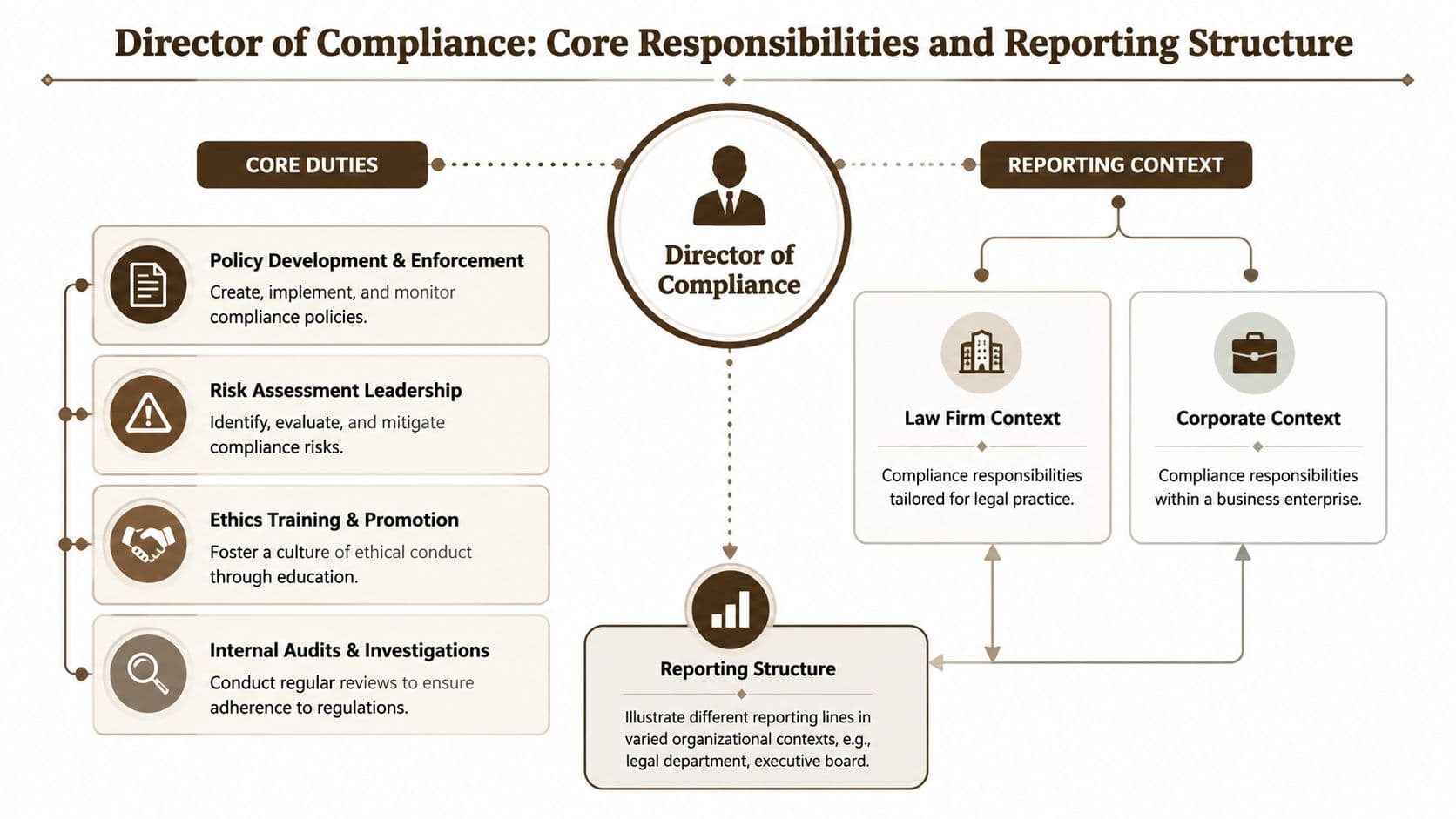
A Director of Compliance is often misunderstood because the title sounds broad. In practice, the work is concrete. This leader designs the internal system that helps the organization follow laws, regulations, contractual duties, and ethical standards on a repeatable basis.
What the role owns day to day
Start with policy work. The director doesn't just draft policies and file them away. They convert changing legal requirements into plain internal instructions, then make sure business units can follow them in real situations. In a law firm, that may involve conflicts procedures, client intake controls, billing integrity, records handling, and confidentiality practices. In a corporate legal department, it may include third-party diligence, anti-corruption protocols, data handling, and issue escalation procedures.
A second major responsibility is risk assessment. That means identifying where the organization is most likely to trip. The best directors don't review every issue with equal intensity. They prioritize the areas where a breakdown could disrupt operations, damage reputation, or block growth.
They also run or oversee:
- Internal audits: Targeted reviews to test whether policy matches practice.
- Training programs: Education that helps staff recognize issues before they become violations.
- Investigations: Fact-finding when a report, complaint, or anomaly suggests something went wrong.
- Board and executive reporting: Clear summaries that help leadership make decisions instead of just receiving legal jargon.
The reporting side matters more than many hiring managers expect. The broad compliance officer field is projected to grow 3 percent from 2024 to 2034, with about 33,300 openings projected annually according to the U.S. Bureau of Labor Statistics outlook for compliance officers. That same source also notes a hierarchy in which a compliance manager may report to a compliance director, while the director executes oversight responsibilities under a Chief Compliance Officer in some organizations. In other words, reporting structure isn't cosmetic. It signals decision-making authority.
How reporting lines change by organization
In a law firm, the director may report to the Managing Partner, General Counsel, COO, or Firm Administrator, depending on how centralized operations are. The key question isn't title prestige. It's whether the director can reach the people who control intake, finance, HR, information governance, and partner behavior.
In a corporation, the structure is often cleaner. The director commonly reports to the Chief Compliance Officer and works laterally with Legal, HR, Finance, Security, and Operations. If the director is buried too low in the chart, the role becomes reactive because every meaningful change requires too many approvals.
Practical rule: If the Director of Compliance can identify risk but can't influence budget, process design, or executive reporting, you've hired a monitor instead of a leader.
That strategic gap shows up in how boards perceive the function. Existing content often treats the role as a gatekeeping post, yet 72% of compliance directors report their programs are viewed as cost centers rather than value drivers, as discussed in Radical Compliance's coverage of board oversight and compliance value. Hiring managers should read that as a warning. If the role is structured too narrowly, the organization will struggle to see compliance as part of growth planning.
Key Skills Experience and Performance Metrics
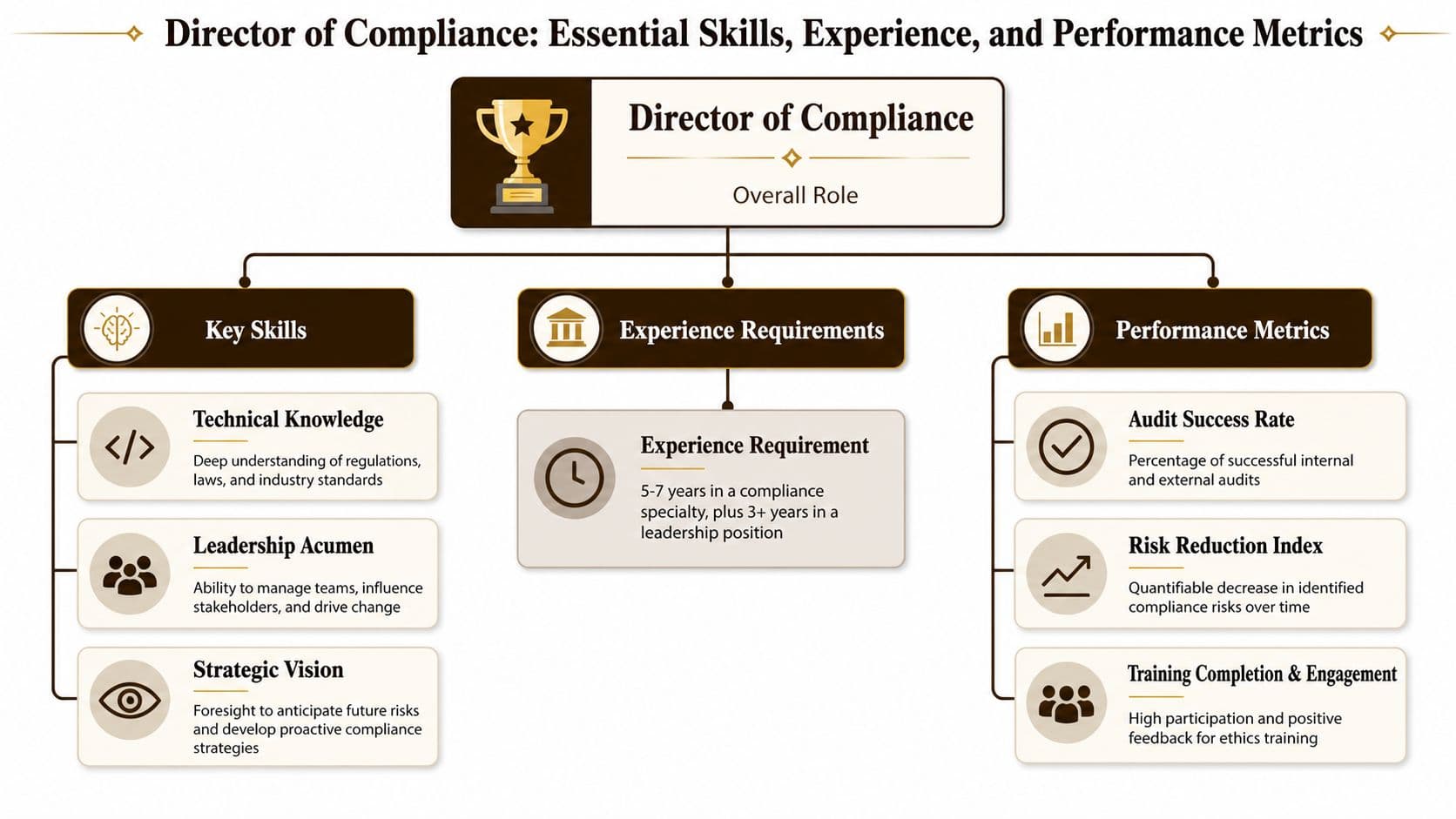
The strongest Director of Compliance candidates combine legal interpretation, operational judgment, and leadership presence. If one of those pieces is missing, the hire often stalls. A technically sharp candidate who can't influence department heads may write excellent memos that nobody follows. A polished executive without enough regulatory depth may win meetings and still miss critical risk.
What experience actually matters
For traditional corporate and healthcare settings, employers typically look for 5 to 7 years of specific compliance experience plus 3 years of managerial leadership, according to Indeed's compliance director career overview. That same source places average U.S. pay at $147,428 annually, with the top 10% earning up to $189,800. Those figures tell you something important about the market. Companies aren't paying for policy maintenance alone. They're paying for mature judgment.
In cloud and SaaS environments, the bar can be even higher. A Director of Compliance may need hands-on depth with NIST 800-53, FedRAMP, ATO, and POAM, plus certifications such as CISA, CISSP, CISM, or CRISC, as reflected in MongoDB's Director of Compliance job posting for cloud-focused work. In plain language, that kind of director must translate government framework language into engineering tasks developers can ship against. If they can't do that translation, the compliance program stays theoretical.
A quick way to think about qualifications:
| Area | What good looks like |
|---|---|
| Domain knowledge | Deep understanding of the regulations tied to your industry |
| Management background | Experience leading people, not just projects |
| Executive communication | Can brief a board without drowning it in jargon |
| Operational fluency | Understands workflows, systems, and handoffs |
| Technical literacy | Especially important in cybersecurity, SaaS, and regulated tech |
A useful primer before evaluating resumes is the broader hiring commentary in the Five Star Placements blog, especially if your team is calibrating senior-level legal and compliance searches.
Which metrics show the program is working
Many hiring teams still ask the wrong metric question. They ask whether a candidate improved audit pass rates, updated policy libraries, or increased training completion. Those items matter, but they're rearview measures. They tell you whether paperwork exists. They don't tell you whether the culture catches risk early.
This video gives a helpful visual frame for thinking about modern compliance leadership:
More current thinking puts weight on indicators that show whether people speak up and whether the company responds well when they do. Data from the 2024 Ethics & Compliance Benchmarking Report shows leading programs track rate of anonymous reporting and time-to-resolution for near-misses as primary KPIs, while 80% of standard interview guides still focus on administrative metrics, as summarized in Compliance & Ethics Alert's discussion of modern compliance KPIs.
That matters in interviews. A strong candidate should be able to explain:
- Why anonymous reporting volume can be healthy: It may show trust in the reporting channel.
- Why near-miss resolution matters: It shows whether the organization learns before a larger failure happens.
- Why culture metrics belong in board reporting: They reveal whether compliance is lived, not just documented.
Salary Benchmarks and When to Hire
Compensation discussions often go wrong because firms debate cost before they define the level of risk they're trying to manage. A true Director of Compliance is a senior leadership hire. If you budget for a manager and expect a director, your search will drag, your shortlist will weaken, and the eventual hire may lack the authority the role requires.
What the market pays
The average annual salary for a Director of Compliance in the United States is $128,297, with most professionals earning between $100,000 and $145,000, according to ZipRecruiter's July 2026 salary data for Directors of Compliance. That same source places top earners at about $178,000, with an overall range from $42,500 to $200,000 depending on experience, location, and employer scale.
The same salary reference also notes that the role typically requires substantial experience and leadership depth. In market terms, this isn't an entry-level compliance post with a fancier title. It's a position for someone expected to guide policy, people, and decision-making.
Here's a simple benchmark table you can use in early budgeting:
Director of Compliance Salary Benchmarks
| Percentile | Salary |
|---|---|
| Lower end of range | $42,500 |
| 25th percentile | $100,000 |
| Average | $128,297 |
| 75th percentile | $145,000 |
| 90th percentile | $178,000 |
| Upper end of range | $200,000 |
Signals that it is time to hire
You don't need a crisis to justify the role. You need a pattern. The best hiring trigger is usually a cluster of small warning signs that all point to the same gap: nobody owns compliance at the leadership level.
Common signals include:
- Expansion pressure: The company is entering a new market, client segment, or regulatory framework.
- Fragmented ownership: HR owns training, Legal owns policy, Operations owns workflows, and nobody ties them together.
- Board questions are getting sharper: Leadership wants evidence, not reassurance.
- Recurring audit themes: The same issue keeps reappearing because fixes aren't embedded operationally.
- Sales friction: Prospects or enterprise clients ask for control documentation and answers come back slowly or inconsistently.
A good rule of thumb is this. If compliance work is affecting revenue conversations, board confidence, or expansion timing, the issue has already become strategic.
Crafting a Job Description and Interview Questions
A weak job description attracts either generalists who are too junior or specialists who are too narrow. The fix isn't adding more buzzwords. The fix is defining what the role must own, who the person must influence, and how success will be judged.
A practical job description template
Use language that reflects real operating authority:
Job title
Director of Compliance
Reports to
Chief Compliance Officer, General Counsel, Chief Operating Officer, or other designated executive
Role summary
The Director of Compliance leads the design, implementation, monitoring, and continuous improvement of the organization's compliance program. This role interprets applicable laws, regulations, and internal standards, translates them into practical policies and controls, and partners with business leaders to reduce legal and operational risk while supporting growth objectives.
Core responsibilities
- Lead the compliance program: Build and maintain policies, procedures, and reporting routines.
- Interpret regulatory change: Turn new requirements into usable internal guidance.
- Oversee monitoring and audits: Test whether practices match written expectations.
- Direct investigations and issue management: Coordinate response to reports, complaints, and identified gaps.
- Train the organization: Deliver education that improves judgment, not just completion records.
- Advise leadership: Prepare clear updates for executives and, where needed, the board.
Required qualifications
- Relevant compliance background: Experience in the employer's regulatory environment
- Management experience: History of leading teams and influencing senior stakeholders
- Communication strength: Ability to explain technical rules in plain language
- Program-building ability: Can move from issue spotting to process design
For highly regulated technical environments, add framework-specific requirements such as FedRAMP, NIST 800-53, or related certifications only if they are essential. Otherwise, you'll shrink your candidate pool unnecessarily.
Interview questions that reveal strategic judgment
Most interview guides still lean too hard on administrative activity. That's a mistake. As noted earlier, top programs increasingly track anonymous reporting rates and time-to-resolution for near-misses, while many interview guides remain stuck on document maintenance and policy counts.
Use questions that test interpretation, prioritization, and influence:
-
Tell me about a time you converted a new regulation into an internal workflow.
Tests whether the candidate can move from legal text to practical execution. -
How do you decide which compliance risks deserve immediate executive attention?
Reveals triage judgment. -
What metrics would you show a board to demonstrate program effectiveness?
Strong candidates won't stop at audit outcomes. -
How have you handled resistance from a high-performing business leader who saw compliance as a blocker?
Tests influence under pressure. -
Describe a near-miss your team learned from. What changed afterward?
Shows whether the candidate builds learning loops. -
When do you escalate an issue versus coaching the business?
Explores judgment and proportionality. -
How do you structure investigations so they are fair, prompt, and actionable?
Looks at process discipline. -
What does a healthy reporting culture look like to you?
A sharp answer usually includes trust, consistency, and response quality. -
How do you work with HR, Finance, and Operations without blurring accountability?
Tests cross-functional maturity. -
What would you do in your first ninety days here?
Good answers sound specific, not generic. -
How do you measure whether training changed behavior?
Listen for examples beyond attendance. -
What commercial value can a compliance program create?
This question separates gatekeepers from strategic operators.
Sourcing and Screening Strategies for Top Candidates
Senior compliance talent rarely appears through passive posting alone. The people you want are often fully employed, selective, and careful about title inflation. Many have been approached for roles that promised authority but offered little access to decision-makers. Your search process has to show seriousness early.
Where strong candidates are found
A broad net helps, but a random one doesn't. Good sourcing starts with a market map. Identify the industries and organizational types where your ideal candidate is already solving a similar problem. A healthcare provider, a regulated software company, and a law firm may all employ someone with the same title, but their day-to-day exposure can be radically different.
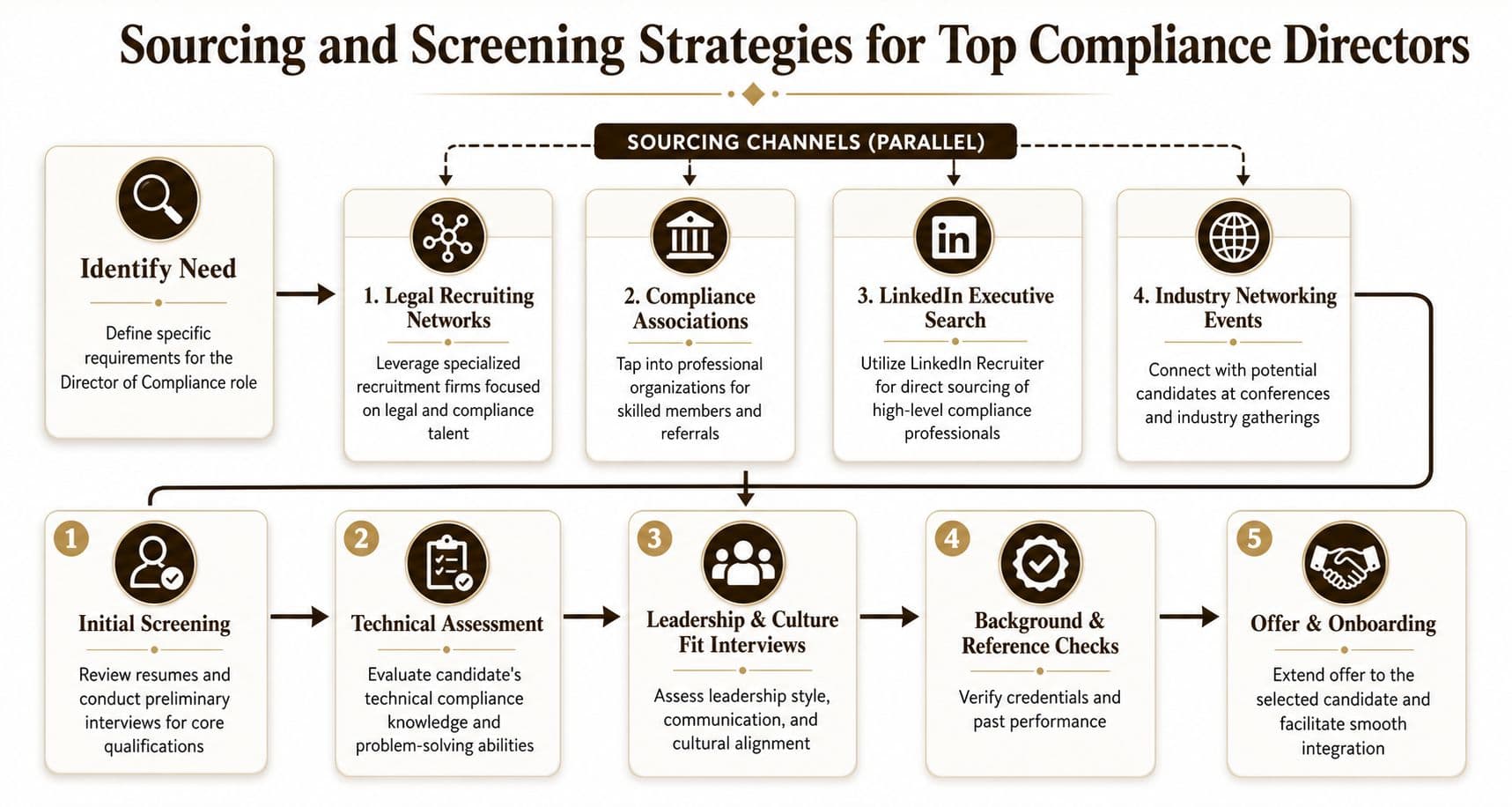
Useful channels include:
- Specialized legal and compliance recruiters: Helpful when confidentiality matters or internal recruiting bandwidth is thin.
- Professional associations: Good for finding candidates who stay current and visible in the field.
- LinkedIn executive search: Strong for identifying passive talent if outreach is personalized and credible.
- Industry referrals: Often the best path to candidates with a proven reputation for judgment.
If you want a starting point for the kind of firm ecosystem that serves these searches nationally, Five Star Placements reflects the broader legal recruiting model many hiring managers use when they need targeted sourcing.
How to screen without wasting executive time
Resume review should focus less on title history and more on evidence of translation. Did the candidate build programs, lead investigations, advise executives, or integrate compliance into operating processes? Titles can mislead. A “manager” in one company may have had more strategic authority than a “director” in another.
A tight screening sequence usually works best:
-
Initial qualification call
Confirm industry fit, reporting history, and real scope of ownership. -
Technical screen
Ask for examples of regulatory interpretation, program design, and issue response. -
Leadership interview
Test executive presence, judgment, and ability to handle pushback. -
Scenario exercise
Give a realistic problem such as a new client requirement, a whistleblower complaint, or a repeat audit finding. -
Reference checks
Ask specifically whether the candidate changed behavior, not just documentation.
The best reference question is often the simplest: “When this person raised a concern, did leaders act differently afterward?”
Screening should also verify fit with your reporting structure. A candidate who thrives under a Chief Compliance Officer may struggle in a flatter environment where they must influence partners or business heads directly. That isn't a flaw. It's a context issue.
Onboarding Best Practices for a New Director of Compliance
A Director of Compliance can't succeed on title alone. The first ninety days determine whether the hire becomes a trusted operator or an isolated policy owner. Most failures at this level trace back to poor integration, not weak credentials.
The first month
Start with access. The new director needs current policies, prior audit findings, open investigations, training materials, major client or regulatory obligations, and a map of who owns what today. Without that baseline, they'll spend too long reconstructing history.
Then prioritize listening. In the opening weeks, the director should meet leaders from Legal, HR, Finance, Operations, Security, and any frontline business units. The point isn't to impress people with expertise. It's to learn where friction lives, where exceptions get made, and where nobody is sure who owns the answer.
A practical first-month checklist:
- Collect the core documents: Policies, procedures, risk logs, investigation files, and reporting templates
- Map stakeholders: Identify decision-makers, blockers, and natural allies
- Clarify authority: Confirm escalation paths and board or executive access
- Spot early wins: Choose one visible issue that can be fixed without a long political battle
Days thirty one through ninety
The next phase is about credibility through action. The director should assess the program, identify the highest-risk gaps, and present a short prioritization plan. That plan needs to be realistic. Three well-executed changes beat a giant roadmap that nobody funds.
Good early initiatives often include:
- Refreshing a key policy area that no longer matches current operations
- Fixing an intake or escalation gap where issues get stuck between departments
- Reworking training so managers know what to do when risk appears
- Improving reporting to leadership so updates are brief, decision-oriented, and tied to business impact
A ninety-day roadmap should also include board or executive briefing preparation. Even if the director won't present formally right away, they should know what leadership wants to see and how risk appetite gets discussed internally.
A new Director of Compliance earns trust fastest when people see two things at once. The person understands the rules, and the person understands how work actually gets done.
One more onboarding mistake is common. Companies expect independence but provide no sponsorship. Assign an executive partner who can clear access barriers, validate priorities, and reinforce that compliance recommendations will be taken seriously. That support doesn't compromise independence. It gives the role enough air cover to function.
Conclusion and Next Steps
Hiring a Director of Compliance is rarely about filling a vacancy. It's about deciding whether compliance will remain scattered across departments or become a managed leadership function. The distinction matters. When one person owns the translation between regulations, internal behavior, and business priorities, the organization gets clearer decisions, stronger escalation paths, and more confidence in moments that carry real exposure.
The hiring process works best when managers stay concrete. Define the reporting line. Specify the regulatory environment. Decide whether you need a policy architect, a technical translator, a culture builder, or some combination of all three. Then interview for judgment, not just knowledge.
Retention follows the same logic. If you bring in a senior compliance leader but deny access, budget, or executive visibility, the role will collapse back into paperwork. If you give the person authority, sponsorship, and measurable goals tied to strategic outcomes, compliance can support growth instead of slowing it.
A practical next-step checklist looks like this:
- Clarify the business problem: What risk, expansion plan, or governance need is driving the hire
- Set the level correctly: Director means leadership scope, not just experience
- Build the right scorecard: Focus on culture, response quality, and operational follow-through
- Use realistic interviews: Test how candidates think, not just what they've memorized
- Plan onboarding before the offer closes: Early access and executive sponsorship matter
If you're hiring a Director of Compliance and want a search process built around legal market realities, Five Star Placements can help you define the role, reach qualified candidates, and screen for the mix of regulatory judgment, leadership, and culture fit that this position requires.
Need help filling a legal role?
Five Star Placements partners with law firms and legal departments nationwide.
Schedule a Call